



Abstract
Traditional Chinese medicine (TCM) compounds have recently garnered attention for the regulation of immune cell infiltration and the prevention and treatment of Alzheimer’s disease (AD). The Liuwei Dihuang Pill (LDP) has potential in this regard; however, its specific molecular mechanism currently remains unclear. Therefore, we adopted a bioinformatics approach to investigate the infiltration patterns of different types of immune cells in AD and explored the molecular mechanism of LDP intervention, with the aim of providing a new basis for improving the clinical immunotherapy of AD patients. We found that M1 macrophages showed significantly different degrees of infiltration between the hippocampal tissue samples of AD patients and healthy individuals. Four immune intersection targets of LDP in the treatment of AD were identified; they were enriched in 206 biological functions and 30 signaling pathways. Quercetin had the best docking effect with the core immune target PRKCB. Our findings suggest that infiltrated immune cells may influence the course of AD and that LDP can regulate immune cell infiltration through multi-component, multi-target, and multi-pathway approaches, providing a new research direction regarding AD immunotherapy.
Introduction
Alzheimer’s disease (AD) is a chronic progressive neurodegenerative disease caused by multiple factors. 1 It is more common in pre-senile and elderly people. The clinical manifestations of this disease include memory impairment, low self-care ability, abstract thinking disorder, and personality and behavioral changes. 2 The main pathological features of AD are senile plaques formed by the aggregation of extracellular β-amyloid (Aβ) and neurofibrillary tangles (NFTs) formed by the hyperphosphorylation of intracellular Tau protein.3-5 Several pathogenesis mechanisms exist for AD6-8; however, among all, the neuroinflammatory mechanism plays a key role in AD pathogenesis. 9 As an important part of neuroinflammation, immune cells are involved in the whole process of AD development. Furthermore, changes in their infiltration can even directly affect the therapeutic effects and clinical outcomes of AD.10,11 Therefore, the regulation of immune cell infiltration and the inhibition of neuroinflammation have become important targets for reversing the deterioration of the pathological state of AD and for improving survival prognosis. However, it is difficult for traditional, single-target western medicines to reduce neuroinflammation and delay cognitive impairment by regulating immune cell infiltration. In recent years, traditional Chinese medicine (TCM) compounds have garnered attention in the regulation of immune cell infiltration and the prevention and treatment of AD. This popularity stems from their multi-component, multi-target, and multi-pathway characteristics, with minimal side effects.
Liuwei Dihuang Pill (LDP) was first recorded in Qian Yi’s “Key to the Therapeutics of Children’s Diseases” in the Northern Song Dynasty. It consists of 6 herbs, namely, Rehmannia glutinosa (Shudihuang in Chinese, SDH), Cornus sericea (Shanyurou in Chinese, SYR), Rhizoma dioscoreae (Shanyao in Chinese, SY), Rhizoma alismatis (Zexie in Chinese, ZX), Cortex moutan (Mudanpi in Chinese, MDP), and Poria cocos (Fuling in Chinese, FL). 12 Studies have shown that LDP can promote the repair process of the reticuloendothelial system, enhance the phagocytic ability of macrophages, improve the killing activity of natural killer cells, and promote the proliferation and differentiation of T cells and lymphocytes.13-16 It can play a synergistic role in regulating immune cell infiltration, reducing neuroinflammation, degrading Aβ aggregation, and delaying cognitive impairment. 17 However, its specific molecular mechanism currently remains unclear.
The recent development of bioinformatics has provided a more comprehensive perspective for studying the molecular mechanism of LDP; it can also aid the selection of therapeutic targets for AD. Therefore, the bioinformatics approach was adopted in this study to explore the infiltration patterns of different types of immune cells in AD and investigate the molecular mechanism of LDP intervention. In this way, this study aimed to provide a new basis for improving the clinical immunotherapy of AD patients.
Materials and Methods
Downloading the Gene Expression Omnibus Data
The GEO database was searched to find relevant data, 18 with “Alzheimer’s disease” used as a keyword. The restricted search condition was “expression profiling by array,” the restricted species was “Homo sapiens,” and the obtained gene expression profile data number was GSE1297.
Screening the Differentially Expressed Genes of Alzheimer’s Disease
Based on the R (v.4.0.3) software,19,20 the differentially expressed genes (DEGs) in the hippocampus tissue samples of AD were screened according to a |log2 fold change (FC)| >.5 and p < .05, and visualized by a heat map and volcano plot.
Assessing Immune Cell Infiltration and Acquisition of Immune-Related Genes
The proportions of 22 kinds of immune cells in AD and normal hippocampal tissue samples were calculated using the “deconvolution method” (in Cibersort software and Perl language) to evaluate their infiltration. 21 R (v.4.0.3) and its related packages were used to plot a histogram, distribution heat map, violin diagram, and correlation matrix to show the difference of the results (P < .05 indicated statistically significant difference). The ImmPort database was used to obtain immune-related genes. 22
Prediction of Liuwei Dihuang Pill Target Genes
All active ingredients in LDP and their corresponding potential targets were manually acquired from the Traditional Chinese Medicine Systems Pharmacology (TCMSP) database. 23 The screening conditions were as follows: drug-likeness (DL) ≥ .18 and oral bioavailability (OB) ≥ 30%. 24 The UniProt database was used to standardize the names of drug targets to obtain the target genes of LDP. 25
Construction of Protein–Protein Interaction Network
The DEGs of AD, immune-related genes, and target genes of LDP were uploaded to the Venn online mapping software to get the intersection targets. 26 The intersection targets were imported into the Cytoscape (v.3.8.0) software, 27 and the Bisogenet and CytoNCA plug-ins were used to construct a protein–protein interaction network; the core immune targets were screened according to the degree value of >61.
Gene Ontology Enrichment and Kyoto Encyclopedia of Genes and Genome Enrichment Analyses
To clarify the possible biological functions and key pathways of LDP in the treatment of AD, R (v.4.0.3) was used to perform ID conversion on the names of the intersection targets,28,29 following which Gene Ontology (GO) and Kyoto Encyclopedia of Genes and Genome (KEGG) pathway analyses were carried out. 30 Moreover, the top ten items with the smallest P values for the BP, CC, MF, and KEGG signaling pathways were selected (all items with less than ten items were selected) to plot bubble charts. As p represents the significance of enrichment, the screening condition was limited to P < .05.
Construction of “Ingredient-Target-Pathway-Disease” Network
An Ingredient-Target-Pathway-Disease (I-T-P-D) network was constructed using the Cytoscape (v.3.8.0) software to intuitively reflect the key active ingredients in LDP’s prescription for the treatment of AD targets involved in KEGG signaling pathways.
Verification of Molecular Docking
The three-dimensional (3D) crystal structures of core immune targets were obtained from the Protein Data Bank (PDB) database, 31 while the molecules of key active ingredients were obtained from the PubChem database structure. After using Pymol (v.2.5) and AutoDockTools (v.1.5.6) software to remove the water molecules, separate the ligands, and conduct the hydro treatment,32,33 molecular docking was carried out using the Autodock vina (v.1.2.0) software. 34 Herein, the docking effect between key active ingredients and core immune targets was evaluated, with a binding energy of <-5 kcal·mol-1 as the reference standard. 35 A molecular docking diagram was then plotted.
Results
Screening Results for the Differentially Expressed Genes of Alzheimer’s Disease
According to the datasets GSE1297, a total of 31 hippocampal tissue samples were collected, including 22 AD patients and 9 normal individuals. After data preprocessing and gene differential expression analysis, 552 DEGs were screened in the hippocampal tissue samples of AD patients, including 249 up-regulated genes and 303 down-regulated genes (Figure 1A). The heat map showed the top 20 DEGs with most significant upregulation and downregulation (Figure 1B). DEGs of AD. (A) Heat map. (B) Volcano plot. Coral dots represent significantly up-regulated genes and cornflower blue dots represent significantly down-regulated genes.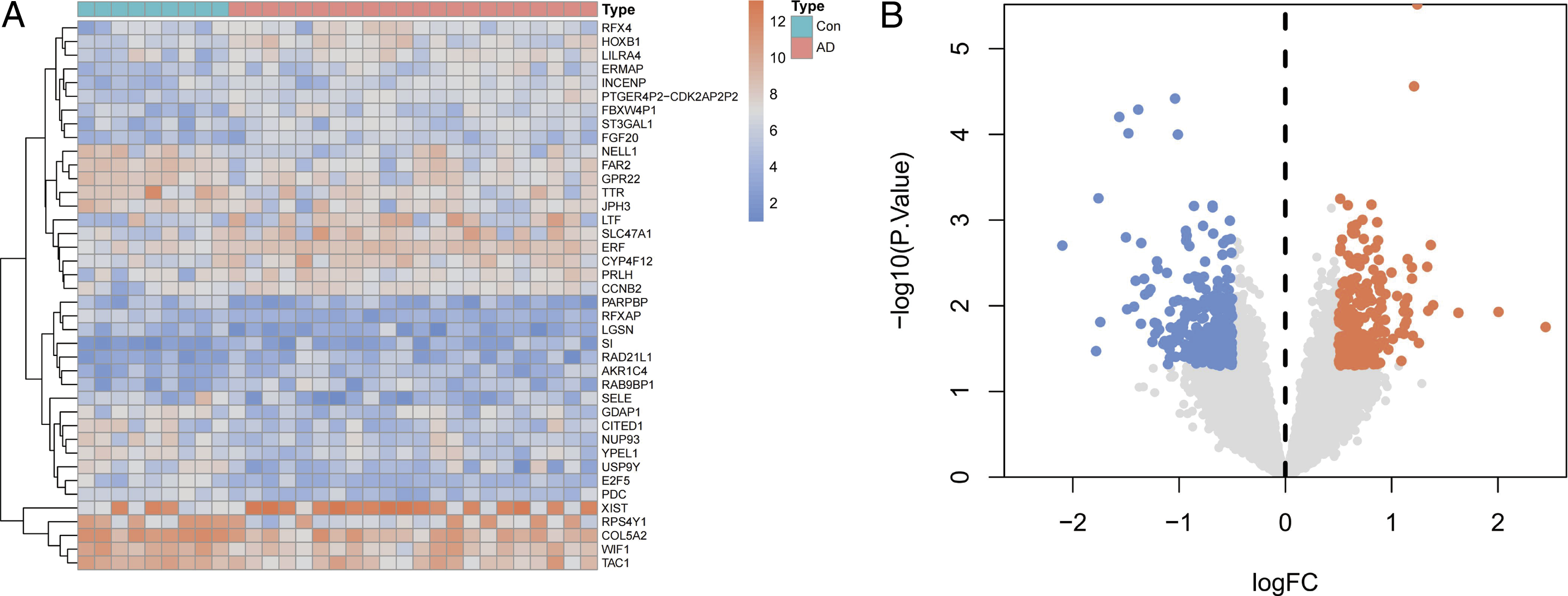
Analysis of Immune Cell Infiltration and Acquisition of Immune-Related Genes
A total of 15 eligible hippocampal tissue samples were obtained, including 11 AD patients and 4 normal individuals. As shown in Figure 2A-C, the proportions and degrees of infiltration of 22 kinds of immune cells were analyzed across all samples, and the proportions of each immune cell in the hippocampal tissue samples of AD patients and healthy individuals were compared. These results suggest that M2 macrophages and resting CD4+ memory T cells in the hippocampal tissue samples of AD patients had larger distribution ratios and higher degrees of infiltration than those of healthy individuals. Moreover, the degree of infiltration of M1 macrophages differed significantly between the hippocampal tissue samples of AD patients and healthy individuals (P <.05). As shown in Figure 2D, the correlation coefficients of the proportions of 22 kinds of immune cells were calculated for the hippocampal tissue samples of AD patients. The results show that the immune cells with higher positive correlation coefficients were activated dendritic cells and activated CD4+ memory T cells (r = .81), while the immune cells with larger negative correlation coefficients were naive B cells and memory B cells (r = -9.0). A total of 1793 immune-related genes was collected from the ImmPort database. Immune cell infiltration landscape. (A) Histogram of the proportions of immune cells in AD patients and healthy individuals; different immune cells are distinguished with different colors. (B) Distribution heat map of immune cells in AD patients and healthy individuals; the degrees of infiltration are indicated using coral and cornflower blue, respectively. (C) Violin diagram showing proportions of immune cells in AD patients and healthy individuals; red represents AD patients and blue represents healthy individuals. (D) Correlation diagram of proportions of immune cells in AD patients; red represents positive correlation, and blue represents negative correlation.
Prediction Results of Target Genes of Liuwei Dihuang Pill
A total of 42 active ingredients of LDP were screened from the TCMSP database corresponding to the 221 potential targets. After converting the drug targets to standard gene names using UniProt database, a total of 193 target genes of LDP were obtained.
Construction Results of Protein–Protein Interaction Network
A total of 4 immune gene intersection targets were obtained for the treatment of AD with LDP, namely, PRKCB, PPP3CA, NFKBIA, and NR1I2 (Figure 3A). PPI network among these intersection targets was constructed according to the degree value of >61, and found that NFKBIA and PRKCB (which had degree values of 178 and 114, respectively) may be the core immune targets of LDP in the treatment of AD (Figure 3B). Intersection targets. (A) Venn diagram of intersection targets. (B) PPI network diagram of intersection targets. Size and color of each node reflect the degree value of the target; edge thickness reflects correlations between nodes.
Results of Gene Ontology and Kyoto Encyclopedia of Genes and Genome Enrichment Analyses
A total of 206 GO biological function items were obtained (including 175 biological processes [BP], 3 cellular components [CC], and 28 molecular functions [MF]); thirty KEGG signaling pathways were identified. As shown in Figure 4Aand B, the intersection target BP mainly involved transcription factor activity, response to carbohydrate, and protein import; CC mainly involved presynaptic cytosol, the calyx of Held, and the cytosol region; MF mainly involved transcription factor binding, nuclear receptor binding, and hormone receptor binding, among the other functions. The main highly enriched KEGG signaling pathways were the B cell receptor signaling pathway, human immunodeficiency virus 1 (HIV-1) infection, and human cytomegalovirus (HCMV) infection. Enrichment analysis of immune intersection targets of LDP against AD. (A) GO biological function enrichment. (B) KEGG signaling pathway enrichment. Pathways with significant changes (P < .05) were identified. Dot size represents number of genes and color represents P value.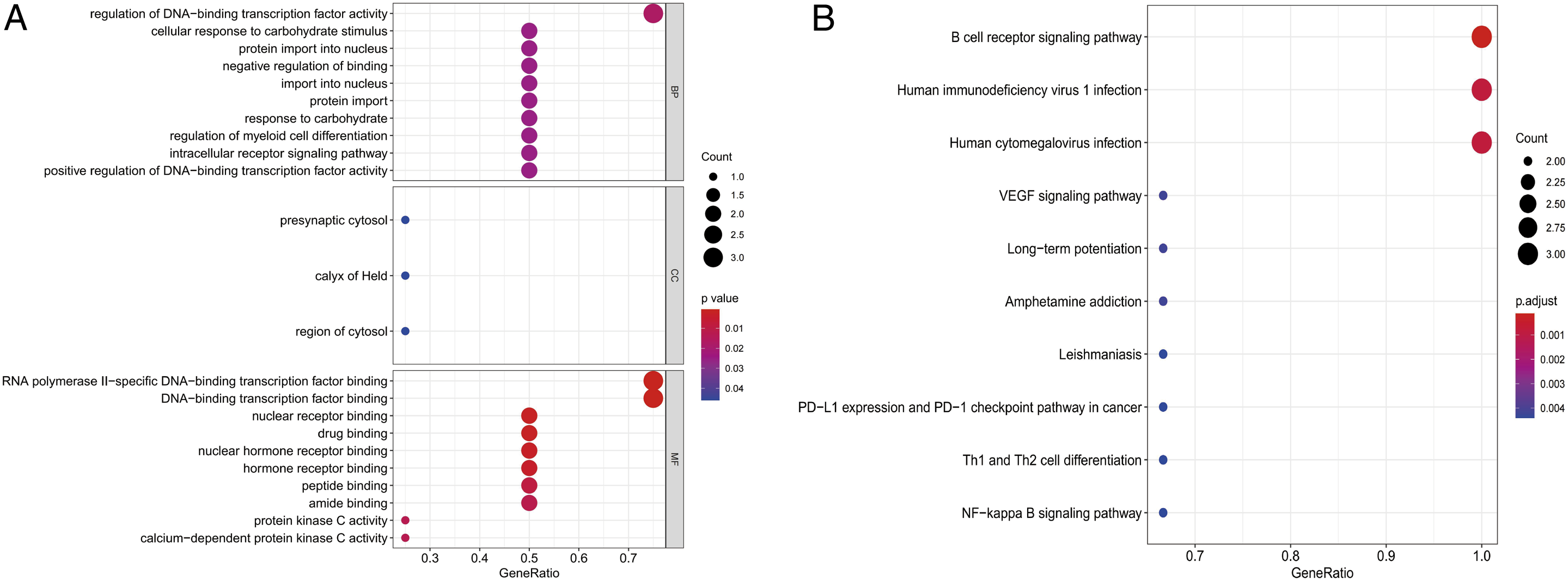
“Ingredient-Target-Pathway-Disease” Network Analysis
The constructed “I-T-P-D” network contained 27 nodes and 46 edges (Figure 5), suggesting that the targets of LDP in the treatment of AD were not only regulated by a variety of key active ingredients in LDP (quercetin and kaempferol) but also related to multiple KEGG signaling pathways. “I-T-P-D” network diagram of LDP against AD. Pink squares show ingredients, yellow diamonds show targets, coral “Vs” show pathways, and lavender triangles show diseases.
Molecular Docking Verification Results
As shown in Figure 6A-D, the key active ingredients (quercetin and kaempferol) were molecularly docked with the core immune targets (NFKBIA and PRKCB). The results showed that there were strong interactions between the key active ingredients and the core immune targets (Table 1). The binding effect between quercetin and PRKCB was the best; the binding energy was -9.0 kcal·mol-1. Molecular docking diagrams. (A) Quercetin and PRKCB. (B) Kaempferol and PRKCB. (C) Quercetin and NFKBIA. (D) Kaempferol and NFKBIA. Molecular Docking Results of Key Active Ingredients and Core Immune Targets.

Discussion
Although there is no relevant record or mention of AD in TCM, according to its clinical manifestations and functional characteristics, AD can generally be classified into the categories of diseases such as “forgetfulness” and “dementia.” In TCM, the emptiness of the sea of marrow, which is thought to be caused by the depletion of kidney essence, is considered to be an important cause of AD.36,37 LDP, as a typical formula for invigorating the kidney and filling essence, 38 has been confirmed by clinical and pharmacological studies to significantly improve the cognitive function of AD patients.39-41 Moreover, its mechanism of action may be related to the regulation of immune cell infiltration and the inhibition of neuroinflammation.
In this study, the M2 macrophages and resting CD4+ memory T cells showed relatively high degrees of infiltration in the hippocampal tissue samples of AD patients than in those of healthy individuals. Furthermore, M1 macrophages showed significantly different degrees of infiltration in the hippocampus tissue samples of AD patients and healthy individuals (P < .05). In AD, the activation of Aβ can increase the permeability of the blood–brain barrier, which in turn would promote the entry of peripheral macrophages and CD4+ memory T cells into the brain.42,43 Thus, immune infiltration can occur under the stimulation of environmental factors. This infiltration not only affords a certain degree of immune protection but also plays a certain role in promoting the formation of neuroinflammation and the pathological evolution of AD.44,45 Moreover, the disruption of this balance is an important factor regarding the occurrence and development of AD.
In addition, a large positive correlation coefficient was identified between activated dendritic cells and activated CD4+ memory T cells. This suggests that there may be mutual assistance between these 2 immune cells. Previous studies have shown that activated dendritic cells can not only effectively initiate the immune response of CD4+ T cells in the primary immune response but can also regulate them by interacting with memory cells in almost every stage of memory cell production.46-49 In this way, they play a key role in the reactivation and response of CD4+ memory T cells. A large negative correlation coefficient was identified between naive B and memory B cells, suggesting that there may have been mutual inhibition between these 2 types of immune cells. This correlation may be cause by a phenomenon whereby, after recognizing the antigen exposed by antigen-presenting cells, naive B cells can immediately activate, expand, and differentiate into memory B and plasma cells.50-52 Therefore, focusing on the interactions between immune cells and determining their potential correlations is expected to become a new strategy for AD immunotherapy.
The PPI network suggested that LDP may directly or indirectly exert its therapeutic effect on AD by regulating 2 core immune targets: NFKBIA and PRKCB. Studies have shown that NFKBIA can not only regulate immune inflammation and tissue damage but also be closely related to the development, differentiation, and migration of immune cells.53-55 In addition, as the most important inhibitor of the nuclear factor kappa B (NF-κB) pathway, NFKBIA usually exists in the mitochondria of the cytoplasm in a relatively static state. Once stimulated by Aβ, NFKBIA will be phosphorylated and degraded, causing NF-κB activation, and leading to AD neuronal degeneration and cognitive impairment.56,57 As a member of the PKC family, PRKCB also plays an important role in the regulation of immune cells. 58 Previous studies have shown that PRKCB is associated with immune cell infiltration and that its increased expression not only promotes increases in the numbers of naive B cells, M1 macrophages, and other immune cells but also predicts a better prognosis. 59 Meanwhile, negative PRKCB expression leads to severe immunodeficiency and memory impairment; in particular it affects B cell polarity and metabolic reprogramming. 60
Gene Ontology analysis revealed that the biological function of LDP in the treatment of AD was mainly related to transcription factors. Studies have shown that transcription factors can regulate gene expression and participate in a variety of life activities. 61 Moreover, they can play a key role in the activation or inhibition of AD-related signaling pathways.62-64 The KEGG results showed that the pathways of LDP in the treatment of AD were mainly enriched in the B cell receptor-signaling pathway and in HIV-1 and HCMV infections. Studies have shown that activated B cells can not only induce the differentiation of effector T cells and lead to neuroinflammation65-67 but also participate in the pathological process of AD by secreting cytokines and acting on other immune cells (such as macrophages).45,68 Further studies have found that B cell receptors play an essential role in maintaining the survival, proliferation, and differentiation of B cells.69,70 Therefore, inhibiting the activation of the B cell receptor-signaling pathway is of great significance in improving AD neuroinflammation and immune damage.71,72 In the brain, HIV-1 can not only cause neuroinflammation and neuronal death by infecting immune cells (such as macrophages) but also lead to the abnormal elevation of Aβ, thereby affecting cognitive function.73-75 The HCMV-congenital latent infection of old mouse models has been found to display typical AD-like pathological changes in the brain, such as Aβ, NFTs, and phosphorylated Tau (P-Tau).76,77 The low immune function caused by long-term HCMV latent infection may be an important mechanism in promoting the occurrence and development of AD.78,79
According to the “I-T-P-D” network developed in this study, quercetin and kaempferol were found to be the key active ingredients of LDP in the treatment of AD. As common flavonoids, 80 these ingredients can exhibit anti-AD activities by regulating the migration ability of macrophages, blocking the antigen presentation of macrophages, inhibiting the expression of downstream signal molecules, such as NF-kB, and preventing the excessive production of inflammatory factors.81,82 Further research has revealed that macrophages, as important immune cells, have key roles in inhibiting immune cell infiltration and improving neuroinflammation. 83
In this study, the bioinformatics method was used to evaluate the immune cell infiltration patterns of AD, explore the key active ingredients and core immune targets of LDP in the treatment of AD, construct PPI and “I-T-P-D” networks, preliminarily reveal LDP’s immune mechanism of intervention on AD, and conduct molecular docking verification. Thus, the study provides a new direction for experimental research in the use of LDP for the treatment of AD through immune pathways. Moreover, this study can provide more possibilities for the clinical application of ancient prescriptions used in TCM.
Footnotes
Acknowledgments
The authors would like to thank the GEO database, R (v.4.0.3) software, Cibersort software, Perl language, ImmPort database, TCMSP database, UniProt database, Venn online mapping software, Cytoscape (v.3.8.0) software, Bisogenet and CytoNCA plug-ins, Cytoscape (v.3.8.0) software, PDB database, PubChem database, Pymol (v.2.5) software, AutoDockTools (v.1.5.6) software, and AutoDock vina (v.1.2.0) software utilized in this research for data collection and/or analysis.
Author Contributions
Declaration of Conflicting Interests
The author(s) declared no potential conflicts of interest with respect to the research, authorship, and/or publication of this article.
Funding
The author(s) disclosed receipt of the following financial support for the research, authorship, and/or publication of this article: This project was supported by grants from the National Key R&D Program of China (2018YFC1704400 and 2018YFC1704404), Natural Science Research Project of Anhui Universities (kj2021a0547) and Graduate Scientific Research Project of Anhui Universities (yjs20210476).
