




Abstract
Adenosine plays an important role in the physiological and pathological conditions of the body by combining different types of adenosine receptors widely distributed in various tissues in the body. In present study, an acute model for paraquat-poisoning in Caenorhabditis elegans was established for quantitative assessment via a time-dose-mortality (TDM) modeling technique with various paraquat doses over 8 hours. Adenosine was first used to precondition at high, medium, and low concentrations and the survival rate of C. elegans was recorded to evaluate adenosine antistress protection against paraquat damage. The results revealed that the TDM model was good for the quantitative assessment of paraquat-poisoning on C. elegans based on the Hosmer-Lemeshow test for homogeneity of modeling (P = .38). The survival rates of adenosine-preconditioned C. elegans have a dose-dependent association with adenosine concentration. At 3000 μM (high concentration) and 300 μM (medium concentration), adenosine-preconditioned C. elegans still had survival rates of 5.38% ± 1.68% and 5.0% ± 1.19% in the subsequent 8 hours observation period. On the contrary, the survival rates of those receiving 30 μM (low concentration) and the 0 μM (unpreconditioned treatment) were zero. To conclude, adenosine preconditioning had protective effects on C. elegans intoxicated with paraquat by decreasing its mortality rate.
Introduction
Oxidative stress, also defined as the imbalance of oxidants and antioxidants, usually occurs under the pathological conditions of certain diseases or external factors, such as poisons. 1 Presently, oxidative stress had been confirmed to be closely associated with the occurrence and development of a number of different diseases, including tumors, type-2 diabetes, atherosclerosis, and Alzheimer’s disease. 2,3 Therefore, antioxidant stress may play a key role in the occurrence and development of related diseases, and this effect has been continuously confirmed.
Paraquat (PQ; also known as 1,1′-dimethyl-4,4′-bipyridinium dichloride) undergoes an in vivo, nicotinamide adenine dinucleotide phosphate-dependent reduction, yielding a stable paraquat radical that reacts with oxygen to generate a superoxide anion, a reactive oxygen species, enabling it to cause immediate damage by direct contact, ingestion, or inhalation. 4,5 Therefore, paraquat is a good chemical substance for generating an oxidative stress model in the laboratory, particularly when combined with the nematode Caenorhabditis elegans. Recently, C. elegans has been utilized in toxicological evaluations of different substances as an alternative in vivo animal model. 6,7 The advantages of this animal model include its short and prolific life cycle, small body size, ease of maintenance, invariant and fully described developmental program, and well-characterized genome. These features have led to an increase in utilizing C. elegans in toxicology, not only for mechanistic studies but also for toxicity screening approaches. However, C. elegans has normally been used to screen toxicity based on the dose-response of surviving worms, 8 yet, to the best of our knowledge, very few studies have been performed to estimate lethal time (LT50) and lethal dose (LD50) values simultaneously for further time-associated evaluation. Time-dose-mortality (TDM) models have been established as a good method for evaluating the time effect and dose effect in one model, and have been used to assess application potential in numerous biological control agents. 9,10
Adenosine (Ado, adenine nucleoside) plays an important role in the physiological and pathological conditions of the body by combining different types of adenosine receptors widely distributed in various tissues in the body. 11 A large amount of previous evidence has suggested that adenosine-associated drugs have effects for the treatment of pathological conditions, such as anxiety disorder, schizophrenia, epilepsy, drug addiction, and so on. 12 Besides, adenosine-preconditioning has ameliorated ischemia and reperfusion injuries in several experimental animal models and also in patients with acute myocardial infarctions after undergoing interventional or surgical therapy. 13 Normally, adenosine maintains a very low concentration (1-2 μM) in physiological conditions as it has an extremely short half-life (approximately a few seconds). However, the concentration of adenosine can quickly increase up to 1000 times in order to inhibit immunological reactions for protection while under stress conditions, such as ischemia, hypoxia, and inflammatory reactions. 14,15 No study has been reported which evaluates the effects of adenosine on survival rates of C. elegans treated with paraquat. Therefore, a TDM model was established for more reliable and practicable quantitative assessment of paraquat-poisoning on C. elegans, and new approaches for the protective effect of adenosine based on C. elegans model was described for the first time in the present study.
Material and Methods
Paraquat Solution Preparation
Paraquat was supplied by Sigma-Aldrich; Merck KGaA. A total of 0.2559 g paraquat was dissolved with 10 mL sterilized distilled water in tube with a theoretical final drug content of 0.1 M stock solution. The solution was then packaged into Eppendorf tubes and kept at −20 °C for the following paraquat-poisoning C. elegans assay. Dosing solutions were prepared by serially diluting the stock solution with M9 buffer (0.02 M KH2PO4, 0.04 M Na2HPO4, 0.08 M NaCl, and 0.001 M MgSO4). All other chemicals and solvents were of analytical or pharmaceutical grade.
Strain Preparation
The C. elegans used in the present study was wild-type Bristol (N2), originally obtained from the Caenorhabditis Genetic Center. They were maintained on nematode growth medium plates seeded with Escherichia coli (E. coli) OP50 at 20 °C as previously described. 16 A mixed population plate with gravid adults that have laid plenty of eggs was used to directly harvest eggs. Eggs then were transferred to fresh plates using a sterile pick for incubation at 20 °C. Age synchronous populations of L4-larval nematodes were obtained at 20 °C for ∼48 hours as previously described. 17
Establishment of TDM Model on Paraquat-Poisoning C. elegans
A TDM modeling technique, yielding the parameters for time and dose effects of the paraquat was performed as previously described. 14 Briefly, 30 synchronized L4-larval nematodes per well were picked out and raised in 96-well plates with different paraquat-treatment doses. The final concentrations of the tested paraquat were diluted from the original stock solution (0.1 M) as follows: 250 mM, 150 mM, 75 mM, 25 mM, and M9 buffer (same as described above) only, which was considered to be 0 mM. The total volume was 300 μL. All assay trials were performed at 20 °C and 12:12 (light: dark). The number of nematode survivors were recorded per hour and observation was continued for 8 hours. Morphology of nematodes treated with different doses of paraquat-poisoning was observed after exposing in paraquat for 1 hour using a Leica M205 light microscope. The condition of C. elegans in death or living was judged as described in Keith et al. 8 All experiments were repeated 3 times.
Adenosine Protection Solution Preparation
The 10 mM stock dosing solution were supplied by Penglai Nuokang Pharmaceutical Co, Ltd (National Drug Approval no. H20174052). The working solution was diluted with M9 buffer to obtain the different concentrations. The final concentrations were set as 3000 μM, high concentration; 300 μM, medium concentration; and 30 μM, low concentration. The total volume was 300 μL.
Protective Assessment of Adenosine Preconditioning
A 150 mM paraquat-treatment dose based on the results of the TDM model was selected to assess the protective effect of the adenosine-preconditioning for paraquat-poisoning C. elegans. An acute sensitivity trial, completed within 8 hours, was performed prior to paraquat-poisoning. The final concentration of adenosine diluted with M9 buffer, including the 3000 μM, 300 μM, and 30 μM solutions, were added into 96-well plates for preconditioning. A total of 15 synchronized L4-larval nematodes per well were pretreated with the aforementioned different adenosine concentrations for 24 hours before adding 150 mM paraquat. The individual concentrations of adenosine were repeated in 6 wells for evaluating the survival of paraquat-poisoning C. elegans. A total of 360 nematodes were counted per hour within 8 hours.
Statistical Analysis
A TDM modeling technique,
14
considering the assay that includes I dosages and J times of observation, was used to analyze the resulting TDM data of paraquat for C. elegans. Briefly, the cumulative mortality probability, pij
, caused by the dose di
(i = 1, 2,…, I) at the time tj
(j = 1, 2,…, J) was expressed as:
Result
Morphological Observation of Paraquat-Poisoning C. elegans
Morphology of C. elegans treated with different doses of paraquat are presented in Figure 1. All 90 nematodes were active throughout the 8-hour rearing period in the control group (0 mM paraquat; Figure 1A). Nematodes treated with other concentrations of paraquat (25 mM, 75 mM, 150 mM, 250 mM) are presented in Figure 1B-E, respectively. Their bodies became much more rigid and transparent with the increasing concentrations, the morphology of which exhibited a marked difference when compared with the controls.

Body morphology of Caenorhabditis elegans treated with different doses of paraquat. (A) 0 mM, (B) 25 mM, (C) 75 mM, (D) 150 mM, (E) 250 mM. Bar = 200 μm.
Time-Dose-Mortality Response to Paraquat
The cumulative mortality of C. elegans had a dose- and time-effect with paraquat concentrations, which are presented in Figure 2. In the 8th hour, the cumulative mortality of 0 mM, 25 mM, 75 mM, 150 mM, and 250 mM were 13.23% ± 3.34%, 32.54% ± 10.93%, 39.14% ± 6.49%, 93.48% ± 0.12%, and 95.89% ± 3.57%, respectively. The mortality curves of the 150 mM and 250 mM paraquat suggested that they have a clear high virulence on C. elegans.

The time-dose-mortality response of Caenorhabditis elegans to the different concentration of paraquat.
Time-Dose-Mortality Model Analysis
The data in the established acute paraquat-poisoning C. elegans model from Figure 2 fit the TDM model well, based on the Hosmer-Lemeshow test for homogeneity of modeling (Hosmer-Lemeshow C = 9.67; df = 9; P = .38). The parameter values of the cumulative death probability model and the variances Var (τj ) and covariance Cov (β, τj ) of the dose and time effects are presented in Table 1. The modeling generated the estimates of the parameters of β and τj . The parameter for dose effect, β, was estimated to be 3.05 (2.17-3.92). The cumulative time effect parameter, τj , was estimated to be −7.61, −7.42, −7.02, −6.76, −6.47, −6.06, and −5.94 at 2 to 8 hours, respectively. Based on the estimates of β and τj , the expected cumulative mortality probability of C. elegans as a function of the dosage of paraquat and the length of time after exposure was then established for the following comparison. The biological significance of the 2 fitted models, including conditional and cumulative mortality probabilities of C. elegans, were presented in Figure 3. The peak of highest conditional death probability was showed up at the 7th hour after treatment in the fitted nematode death (Figure 3A). The cumulative mortality probability under each dose treatment was the overall reflection of paraquat-poisoning effects (Figure 3B).
Parameters Estimated From the Modeling of Time-Dose-Mortality (TDM) Data in the Assay of Paraquat-Poisoning Caenorhabditis elegans.

Abbreviation: SE, standard error.
a Each digital subscript with γ and τ denotes the specific hour after treatment (the jth hour) or the number of hours.
b The Student t tests for all estimated parameters were significant (P < .001).

The plots for the conditional (A) and cumulative (B) mortality probabilities of paraquat-poisoning Caenorhabditis elegans.
Lethal Dosage and Time Effects
Using the parameter estimates of the cumulative mortality probability model in Table 1 and their variances and covariances, the lethal concentrations LC50 and LC90 of paraquat on C. elegans and the lethal times LT50 were calculated. The LC50 and 95% confidence intervals from 4 to 8 hours after paraquat treatment were 152.3 (120.5-192.5), 125.5 (100.1-157.4), 100.9 (80.4-126.8), 73.8 (57.9-94.1), and 67.5 (52.6-86.5) mM, and the corresponding LC90 and 95% confidence intervals were 377.2 (273.4-520.4), 311.0 (232.3-416.5), 250.1 (192.8-324.5), 182.9 (145.7-229.5), and 167.1 (134.0-208.5) mM. In addition, within the range of 75 to 250 mM, the LT50 decreased from 6.9 to 1.8 hours.
Protective Effect of Adenosine-Preconditioning
The survival rates of adenosine-preconditioned C. elegans have a dose-dependent association with adenosine concentration (Figure 4). Adenosine preconditioning could protect C. elegans from stress in a short time, thereby decreasing the mortality of C. elegans treated with paraquat. During all observation times, the survival rate of nematodes preconditioned with 3000 μM (high adenosine concentration) was significantly higher than that of the unpreconditioned treatment (P < .05). Furthermore, in the first 6 hours, the survival rate of 3000 μM adenosine-preconditioned nematodes was 1.4 to 6.8 fold higher than that of the unpreconditioned treatment. Particularly in 7th hour, though there was no nematode existing in unpreconditioned treatment, 3000 μM and 300 μM adenosine preconditioning still protected C. elegans, allowing them to maintain survival rates of 16.33% ± 0.82% and 6.02% ± 2.77%, respectively. Nevertheless, 30 μM adenosine preconditioning (low concentration) improved the nematode survival rate in the first 5 hours, but there was no statistically significant difference when compared with the control (P > .05). In addition, the survival rate of 30 μM and the control were both zero at 7th hour. On the contrary, 3000 μM and 300 μM adenosine-preconditioned nematodes still had 5.38% ± 1.68% and 5.01% ± 1.19% survival rates in the subsequent 8 hours observation. There was no significant difference on survival rates between the 3000 μM and 300 μM treatment groups (P > .05; n = 90) in 8th hour.
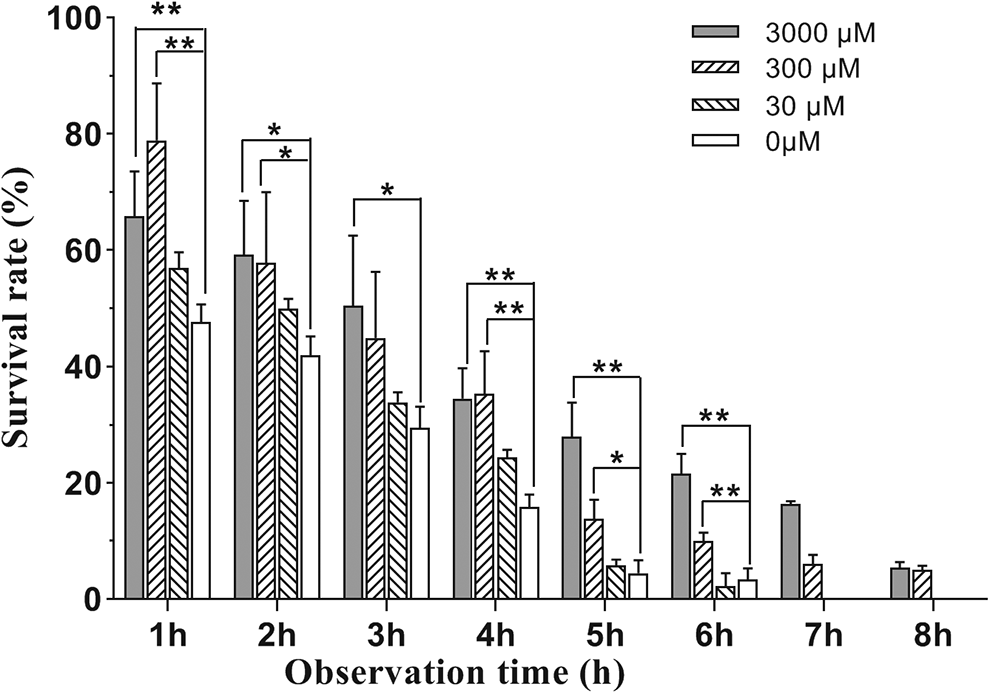
Survival rate of adenosine-preconditioned on paraquat-poisoning Caenorhabditis elegans.
In addition, an exponential dissipation model was presented to describe the association between the survival rate (Y) of nematodes preconditioned with different concentrations of adenosine with the observation time (T). The 0 μM adenosine pretreated nematode survival rate (%) curve: Y = 96.66 × EXP (−0.26 × T) (P = .0001, R
2 = 0.97). The 30 μM adenosine pretreated nematode survival rate (%) curve: Y = 104.31 × EXP (−0.32 × T) (P = .0001, R
2 = 0.98). The 300 μM adenosine pretreated nematode survival rate (%) curve: Y = 98.73
Discussion
Oxidative stress could cause oxidative damage to cellular stress and organismal aging. 1,19,20 The paraquat-poisoning C. elegans model had traditionally been used as agents of oxidative stress. 21 In the present study, the use of the TDM model to evaluate the potential toxicity of paraquat could gain much more information than simpler dose-mortality models for C. elegans (Table 1). The LC50 and its 95% confidence intervals with the observation time could be measured quantitatively as 152.3 (120.5-192.5), 125.5 (100.1-157.4), 100.9 (80.4-126.8), 73.8 (57.9-94.1), and 67.5 (52.6-86.5) mM, respectively. Furthermore, a generalized TDM association can be generated to give an expected mortality at the dosage and infection time concerned. 10 The TDM results demonstrated that LT50 decreased from 6.9 to 1.8 hours with the increasing dose of paraquat after acute exposure, indicating that the paraquat has a deleterious effect on C. elegans (Figure 1).
Due to the decreased concentration of paraquat increasing the LC50, the concentration should be manipulated to alter the length of the experiment. 8 According the TDM model, the LC50 and its 95% confidence intervals on the 4th hour after paraquat treatment were 152.3 (120.5-192.5) (Table 1). Therefore, the 150 mM paraquat was selected to study the following protective effect on the adenosine preconditioning C. elegans. In this context, the present study evaluated the effects of adenosine on survival rates during paraquat-poisoning in C. elegans. It was observed that preconditioning with adenosine significantly increased the survival rate in C. elegans exposed to paraquat compared with the paraquat group without pretreatment. The preconditioning with 3000 μM (high concentration) or 300 μM (medium concentration) were able to protect the nematodes, and there was a significant increase in survival rate when compared with the paraquat group. However, this protection was not observed when the nematodes were pretreated with 30 μM (low concentration). These data suggested that high concentration of adenosine were necessary when C. elegans met deleterious effects caused by paraquat.
The survival rate of C. elegans preconditioned with adenosine was presented as an exponential dissipation association alongside the observation time (Figure 4). The 3000 μM (high concentration) and 300 μM (medium concentration) adenosine-preconditioned nematodes still had 5.38% ± 1.68% and 5.01% ± 1.19% survival rates in the subsequent 8 hours observation. It suggested that paraquat-treated C. elegans would die quicker unless there was a continuous higher concentration of adenosine for protection. Furthermore, 300 μM adenosine-preconditioned seemed be the minimum concentration requirement to keep nematodes alive, but this requires further study.
Adenosine, a targeting molecule, regulates the immune response by binding to a specific family of G protein-coupled receptors on the cell membrane (ie, adenosine A1, A2A, A2B, and A3 receptors). 15 Exogenous adenosine does not function as an energy substrate, but primarily acts on adenosine receptors. For example, adenosine could decrease the superoxide anion produced by polymorphonuclear leukocytes (PMNs) through the adenosine A2 receptor. 22 Adenosine signaling based on adenosine receptor induced by Caffeine could partially extend the life span of C. elegans. 23 Similarly, Peralta et al 24 reported that the protective effect of adenosine could be a result of an increase in extracellular adenosine in ischemic preconditioning. In the present study, high concentration adenosine preconditioning for C. elegans also seemed to induce the activation of adenosine A2 receptors, which, by eliciting an increase in nitric oxide generation would protect against the injury associated with paraquat.
Conclusions
Altogether, an experimental study in which C. elegans were intoxicated with paraquat showed that the TDM model was reliable and practicable for quantitative assessment of paraquat-poisoning on C. elegans. Furthermore, adenosine preconditioning provided beneficial effects for C. elegans intoxicated with paraquat by decreasing nematodes mortality. However, adenosine that could protect from oxidative damage had to be used in high and continuous doses due to the short half-life and the variable bioavailability. The results obtained with this alternative model may be crucial to establish new approaches in adenosine-associated drugs and to predict their effects in complex animal models.
Footnotes
Authors’ Note
Xin Xie and Liangcheng Shang authors contributed equally to this study.
Acknowledgments
The authors would like to thank the Zhejiang Natural Science Foundation (Y18C140002, LGN18C200026), the Natural Science Foundation of China (31461143030), Outstanding talents training program of “HuanYu” (01107180032), and National key research and development plan (2018YFA0108403) for supporting this project.
Declaration of Conflicting Interests
The author(s) declared no potential conflicts of interest with respect to the research, authorship, and/or publication of this article.
Funding
The author(s) disclosed receipt of the following financial support for the research, authorship, and/or publication of this article: Received support from Zhejiang Natural Science Foundation (Y18C140002, LGN18C200026), the Natural Science Foundation of China (31461143030), Outstanding talents training program of “HuanYu” (01107180032), and National key research and development plan (2018YFA0108403).
