




Abstract
Background:
Cervical cancer is one of the leading causes of cancer mortality in women, which seriously threatens the health of women worldwide. Platelet (PLT)-related parameters, including PLT count, mean platelet volume (MPV), plateletcrit (PCT), and platelet distribution width (PDW), are correlated with tumor prognosis.
Methods:
In total, 110 patients with cervical carcinoma were recruited in this study. The patients were divided into 2 groups according to the receiver operating characteristic analysis cutoff values of PLT, MPV, PCT, or PDW. The post-/preradiotherapy ratios were defined as the rate of preradiotherapy PLT-related parameters counts and the corresponding ones obtained after radiotherapy.
Results:
Higher pretreatment PLT level was correlated with Higher Federation of Gynecology and Obstetrics (FIGO) stage (II). Higher pretreatment PLT level was correlated with worse progression-free survival (PFS) and overall survival (OS). Increased post-/preradiotherapy ratio of PLT was correlated with worse PFS and OS. Changes in PCT, MPV, or PDW levels had no effects on PFS or OS. Cox regression analysis model indicated that larger tumor size, higher pretreatment PLT level, and increased post-/preradiotherapy PLT ratio were independently associated with worse PFS; higher FIGO stage (II) and increased post-/preradiotherapy PLT ratio were independently associated with worse OS.
Conclusion:
Pretreatment PLT level and increased post-/preradiotherapy PLT ratio are correlated with outcomes of cervical cancer.
Introduction
Cervical cancer is the most common gynecological malignancy, which seriously threatens the health of women worldwide. 1 Cervical carcinoma is the third major cause of cancer death in women after breast and colorectal cancer, and more than 80% of cases occur in developing countries. 2,3 Although the incidence of cervical cancer has declined due to development in cervical cancer screening and vaccines, it remains a threaten for women with about 200 000 cases of mortality worldwide. 4 Cervical cancer is mainly squamous cervical carcinoma, accounting for about 90% to 95%, and adenocarcinoma accounts for only 5% to 10%. 5,6 At present, surgery and radiotherapy are the main treatments, and surgery is mainly used in patients with early cervical cancer. 7,8 Patients with cervical cancer with high-risk factors (pelvic lymph node positive, margin positive, and parametrial infiltration) are recommended to be treated with pelvic radiotherapy plus cisplatin concurrent chemotherapy after operation. 7
Recently, platelets (PLTs) have attracted clinical attention as a prognostic factor in malignant tumors. A present meta-analysis suggested that thrombocytosis was an important index for the pathological diagnosis and prognosis of various tumors, and PLT activation played an important role in tumor growth and metastasis. 9 In cervical cancer, the relationship between pretreatment PLTs counts and prognosis varies. For example, by assessing PLT counts in 219 patients with cervical cancer before surgery and conducting multivariate analysis, Rodriguez et al found that high PLT count(>300 000/µL) was an independent prognostic factor for poor survival in patients with early cervical cancer. 10 While Lopes et al reviewed the pretreatment PLT values of 643 patients with cervical cancer and did not find that increased PLT was an independent prognostic factor in cervical cancer. 11 Platelet-related indexes are related to PLT quantity, size, and activity, including PLT count, mean platelet volume (MPV), plateletcrit (PCT), and platelet distribution width (PDW). 12,13 Mean platelet volume indicates the average size of PLTs in the bloodstream, which is an early indicator of PLT activation. 14 Mean platelet volume is often used as an inflammatory marker to distinguish patients with cancer from healthy ones 15 and is associated with the prognosis of some solid tumors. 16,17 Plateletcrit equals to the product of PLT multiplied by MPV, which provides more comprehensive data about total PLT mass and is expected to be a tumor-related biomarker according to recent researches. 18,19 Elevated PCT is correlated with worse prognosis in pancreatic carcinoma. 20 Platelet distribution width is an indicator that reflects the average change in PLT volume. Increased PDW may be accompanied by abnormal thrombosis, but the relationship between PDW and solid malignant tumors is not clear. 21 Platelet-related indicators are correlated with the prognosis of multiple tumor types, including gastric cancer, 22 lung cancer, 23 rectal cancer, 24 and so on. And there are also some studies showing that thrombocytosis and elevated platelet to lymphocyte ratio were independent predictors in patients with advanced cervical cancer, 25,26 while few research focused on the prognostic value of other PLT-related indicators in resectable cervical cancer. In present study, we have investigated several PLT-related parameters and evaluated whether these parameters could be available prognostic indicators in patients with resectable cervical cancer.
Materials and Methods
Participants and Inclusion Criteria
This study was conducted as a retrospective investigation of resectable cervical cancer that had been referred to the Affiliated Suzhou Hospital of Nanjing Medical University (Jiangsu, China) between November 2012 and July 2014. Approval for the study was granted by the Medical Ethics Committees of the Affiliated Suzhou Hospital of Nanjing Medical University. All patients have signed informed consent. The inclusion criteria were as follows: (1) those with histologically or cytologically confirmed resectable cervical cancer; (2) age 18 to 70 years; (3) Karnofsky performance status score of ≥70; (4) those who met the following laboratory criteria: white blood cells (WBC) ≥4.0 × 10⁹/L; absolute neutrophil count ≥2.0 × 10⁹/L; and PLT ≥80 × 109/L; (5) histopathology confirmed as squamous cell carcinoma. The exclusion criteria were as follows: (1) the patient failed to complete radiotherapy after surgery and (2) histopathology confirmed as adenocarcinoma. All patients underwent modified radical hysterectomy plus pelvic lymphadenectomy and external irradiation (45-50 Gy dosage administered in 25 fractions over 5 weeks; 4-FELD box technique). Clinical and pathological records of all the patients participating in the study were reviewed periodically, the first follow-up was 3 months after radiotherapy and the last time was July 2014.
In total, 110 patients with resectable cervical cancer were recruited in this study. All cases were confirmed by surgery and pathology. Patient characteristics are detailed in Table 1. The median age of the 110 patients was 51.5 years (range, 25-70 years). The staging of cancer was made according to International Federation of Gynecology and Obstetrics (FIGO) recommendations. The prognostic analyses were performed regarding progression-free survival (PFS) and overall survival (OS).
Clinicopathologic Features.

Abbreviations: FIGO stage, Federation of Gynecology and Obstetrics stage; PLT, platelet.
a P < .05.
Blood Samples
Peripheral venous blood (5-7 mL) was collected into a sterile EDTA tube; patients were fasted 8 hours and samples were obtained from elbow venous between 6:30 and 7:30
Evaluation
Computed tomography scan was performed for the assessment of response every 3 months and evaluated according to the criteria of Response Evaluation Criteria in Solid Tumors 1.1.
Follow-Up
Survival time was measured from the date of diagnosed date until death or last clinical evaluation. The prognostic analyses were performed regarding PFS or OS. Patients were followed up regularly for 36 months.
Statistical Analysis
All statistical analyses were performed using SPSS version 19.0 software (Chicago, Illinois). The ROC analysis was performed to evaluate the predictive values of PLT-related indicators for resectable cervical cancers and determine the best cutoff values of PLT-related indicators. For analysis of survival data, Kaplan-Meier curves were constructed, and statistical analysis was carried out using the log-rank test. The associations between blood parameters status and clinicopathologic features were explored by the χ2 tests. Univariate and multivariate Cox regression analysis model was employed to identify the independent risk factors associated with cervical cancer. All values of P < .05 were considered statistically significant.
Results
Specificity and Sensitivity of Pretreatment PLT-Related Indicators Levels on OS of Predicting Resectable Cervical Cancers
The area under the curve of PLT was 0.643 (95% confidence interval [CI], 0.531-0.735; P = .012), the optimum cutoff point of PLT was 234.5 × 10⁹/L with sensitivity of 69.4% and specificity of 67.2%. The area under the curve of PCT was 0.492 (95% CI, 0.376-0.607; P = .882). The area under the curve of MPV was 0.466 (95% CI, 0. 351-0.580; P = .551). The area under the curve of PDW was 0.544 (95% CI, 0.430-0.658; P = .442; Figure 1A-D).

The ROC curve analysis of pretreatment PLT-related indicators levels on OS of resectable cervical cancers. A, Schematic of the ROC curve for prediction by PLT. B, Schematic of the ROC curve for prediction by PCT. C, Schematic of the ROC curve for prediction by MPV. D, Schematic of the ROC curve for prediction by PDW. MPV indicates mean platelet volume; OS, overall survival; PDW, platelet distribution width; PLT, platelet; ROC, receiver operating characteristic.
Specificity and Sensitivity of Pretreatment PLT-Related Indicators Levels on PFS of Predicting Resectable Cervical Cancers
The area under the curve of PLT was 0.643 (95% CI, 0.535-0.750; P = .010), the optimum cutoff point of PLT was 221.5 × 10⁹/L with sensitivity of 68.3% and specificity of 68.1%. The area under the curve of PCT was 0.562 (95% CI, 0.453-0.671; P = .263). The area under the curve of MPV was 0.493 (95% CI, 0.384-0.603; P = .907). The area under the curve of PDW was 0.487 (95% CI, 0.379-0.596; P = .822; Figure 2A-D).
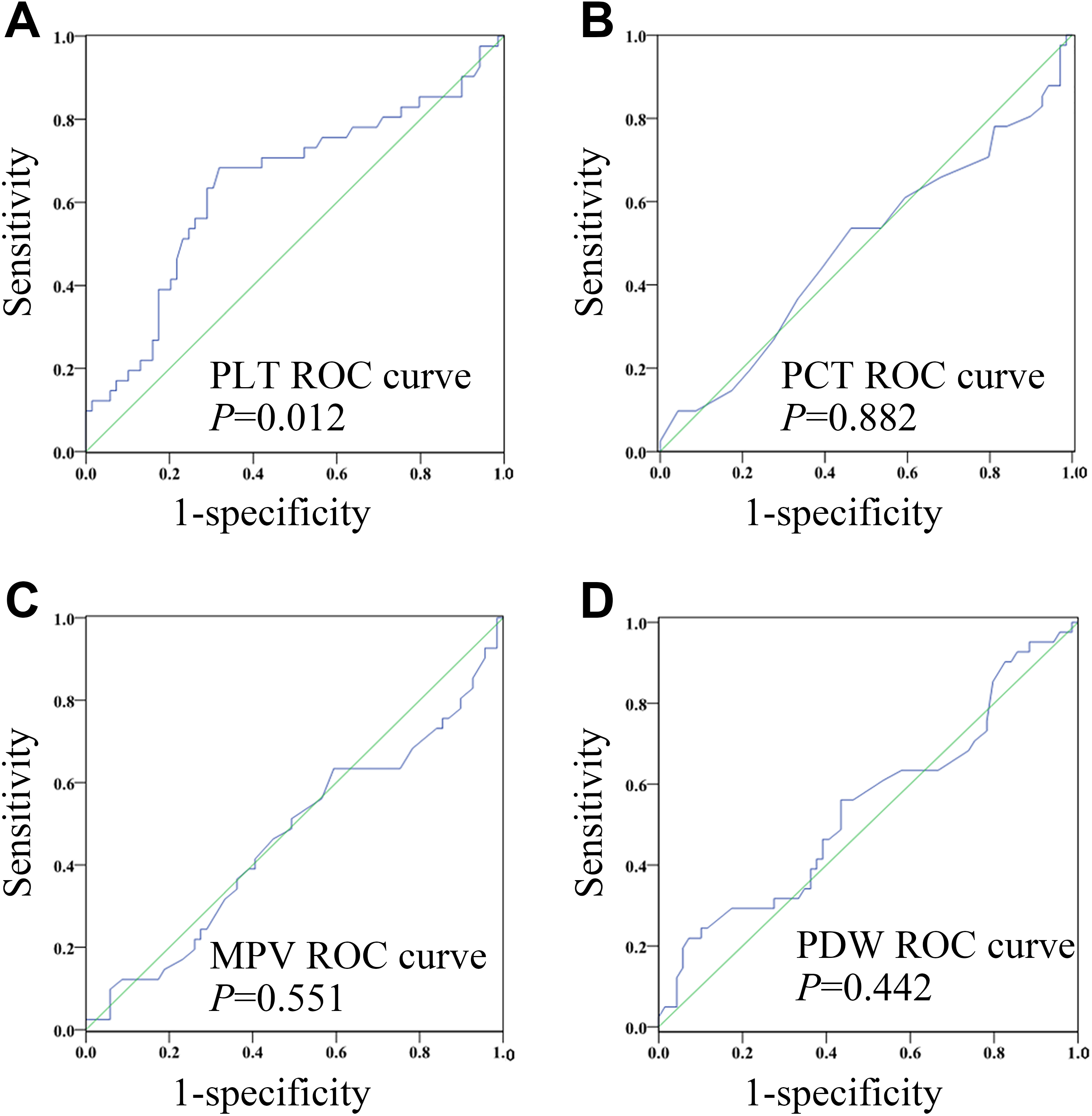
The ROC curve analysis of pretreatment PLT-related indicators levels on PFS of resectable cervical cancers. A, Schematic of the ROC curve for prediction by PLT. B, Schematic of the ROC curve for prediction by PCT. C, Schematic of the ROC curve for prediction by MPV. D, Schematic of the ROC curve for prediction by PDW. MPV indicates mean platelet volume; PDW, platelet distribution width; PFS, progression-free survival; PLT, platelet; ROC, receiver operating characteristic.
Pretreatment PLT Level Was Related to OS and PFS of Patients With Resectable Cervical Cancer
The Kaplan-Meier plots were used to determine the effect of PLT levels on OS and PFS (Figure 3A and B). The patients were divided into 2 groups according to the ROC analysis cutoff values. The median OS of the higher PLT group was 34 (95% CI, 23.211-44.789) months, while that of the lower PLT group was 44 (95% CI, 40.594-47.406) months (P = .044). The median PFS was 13 (95% CI, 10.074-15.926) months in the higher PLT group and 20 (95% CI, 15.999-24.001) months in the lower PLT group (P = .000). Thus, pretreatment lower level group of PLT level group had better prognosis.

The relationship between pretreatment PLT levels with OS and PFS of patients with resectable cervical cancer. A, The PFS according to PLT. B, The OS according to PLT. OS indicates overall survival; PFS, progression-free survival; PLT, platelet.
Changes in PLT Level After Radiotherapy Predicted OS of Patients With Resectable Cervical Cancer
The Kaplan-Meier plots were used to determine the effect on changes of PLT-related indicators status with OS (Figure 4A-D). The median OS of patients whose PLT level increased following radiotherapy was 32 (18.186-45.814) months, while that of the not-increased group was 44 (37.491-50.509) months (P = .022). The median OS of increased PCT group following radiotherapy was 38 (29.213-46.787) months, while that of the not-increased group was 39 (30.853-47.147) months (P = .577). The median OS of increased MPV group following radiotherapy was 34 (25.083-42.917) months, while that of the not-increased group was 42 (34.180-49.820) months (P = .395). The median OS of increased PDW group following radiotherapy was 41 (34.049-47.951) months, while that with not-increased PDW group was 35 (24.940-45.060) months (P = .263). Thus, the patients with not-increased PLT level after radiotherapy had better OS. However, changes in PCT, MPV, or PDW levels had no effects on OS.
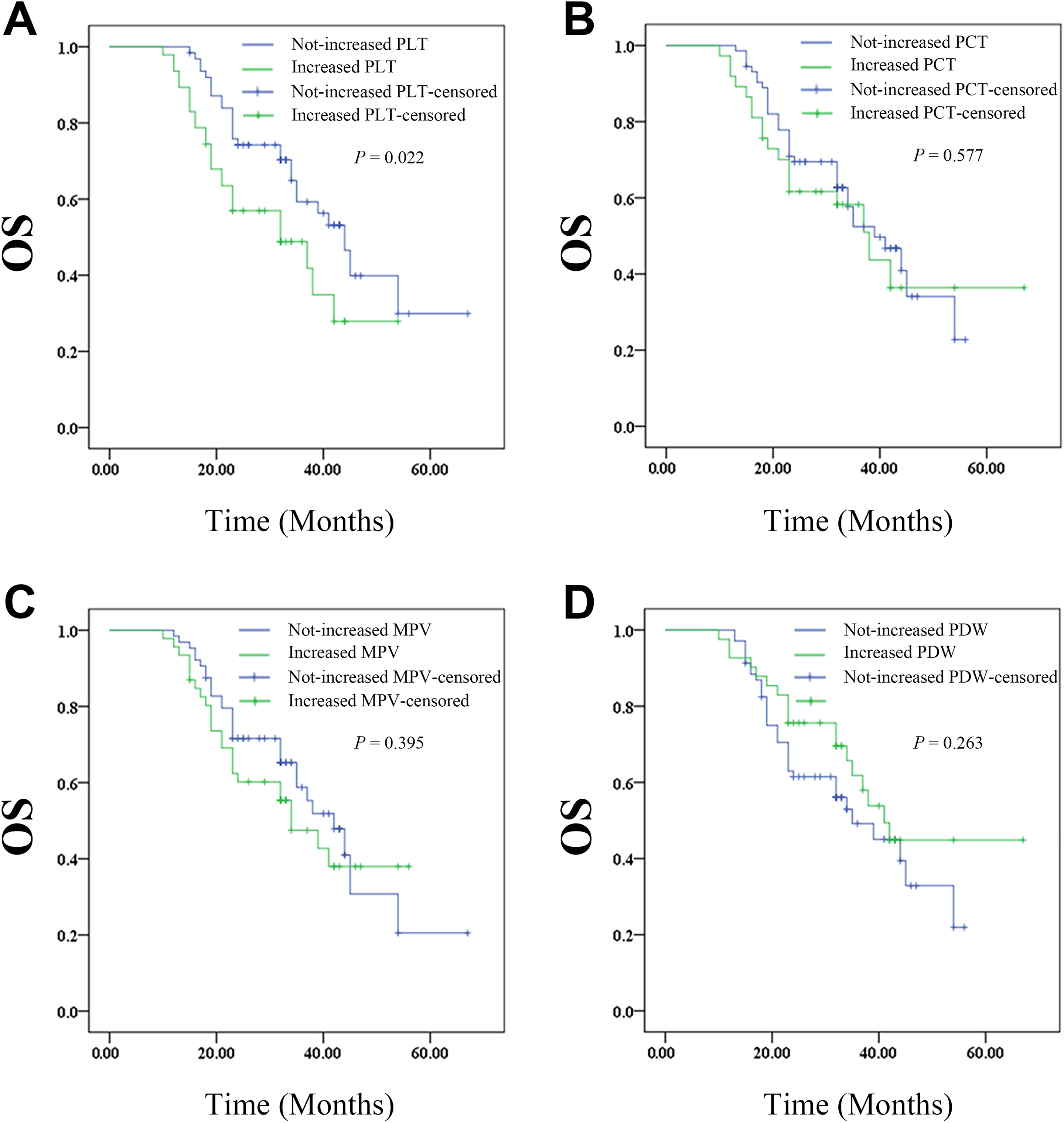
Relationship between changes in PLT-related indicators values with radiotherapy on OS. A, Radiotherapy increased the value of PLT. B, Radiotherapy had no influence on the value of PCT. C, Radiotherapy had no influence on the value of MPV. D, Radiotherapy increased the value of PDW. MPV indicates mean platelet volume; PDW, platelet distribution width; OS, overall survival; PLT, platelet.
Changes in PLT Levels After Radiotherapy Predicted PFS of Patients With Resectable Cervical Cancer
The Kaplan-Meier plots were used to determine the effect of changes of PLT-related indicators status on PFS (Figure 5A-D). The median PFS of patients whose PLT level increased following radiotherapy was 14 (11.765-16.235), while that of the not-increased group was 20 (15.139-24.861) months (P = .004). The median PFS of increased PCT group following radiotherapy was 15 (13.031-16.969) months, while that of the not-increased group was 16 (13.209-18.791) months (P = .221). The median PFS of increased MPV group following radiotherapy was 15 (13.338-16.662) months, while that of the not-increased group was 16 (13.761-18.239) months (P = .846). The median PFS of increased PDW group following radiotherapy was 16 (13.311-18.689) months, while that with not-increased PDW group was 16 (14.661-17.339) months (P = .593). Thus, the patients with not-increased PLT level after radiotherapy had better PFS. However, changes in PCT, MPV, or PDW levels had no effects on PFS.

Relationship between changes in PLT-related indicators values with radiotherapy on PFS. A, Radiotherapy increased the value of PLT. B, Radiotherapy had no influence on the value of PCT. C, Radiotherapy had no influence on the value of MPV. D, Radiotherapy increased the value of PDW. MPV indicates mean platelet volume; PDW, platelet distribution width; PFS, progression-free survival; PLT, platelet.
Prognostic Factors of OS for Patients With Resectable Cervical Cancer
Univariate analyses (Table 2) demonstrated that higher FIGO stage (II; hazard ratio [HR], 2.238; 95% CI, 1.293-3.872; P = .004) and increased post-/preradiotherapy PLT ratio (>1; HR, 1.854; 95% CI, 1.075-3.198; P = .027) were significant risk factors for a poor prognosis (Table 2). In multivariate analysis (Table 2), higher FIGO stage (II; HR, 2071; 95% CI, 1.183-3.625; P = .011) and increased post-/preradiotherapy PLT ratio (>1; HR, 2.101; 95% CI, 1.207-3.658; P = .009) were found to be independently associated with worse OS.
Univariate and Multivariate Cox Regression Analysis of Resectable Cervical Cancer Risk Factors.

Abbreviations: CI, confidence interval; FIGO stage, Federation of Gynecology and Obstetrics; MPV, mean platelet volume; OR, odds ratio; OS, overall survival; PCT, plateletcrit; PDW, platelet distribution width; PLT, platelet.
a P < .01.
b P < .05.
Prognostic Factors of PFS for Patients With Resectable Cervical Cancer
Univariate analyses (Table 3) demonstrated that larger tumor size (>5 cm; HR, 1.612; 95% CI, 1.075-2.426; P = .021), higher FIGO stage (II; HR, 1.562; 95% CI, 1.041-2.344; P = .031), moderately or poorly of differentiation (HR, 1.669; 95% CI, 1.108-2.513; P = .014), higher pretreatment PLT level (>0.145 × 10⁹/L; HR, 1.653; 95% CI, 1.104-2.474; P = .015), and increased post-/preradiotherapy PLT ratio (>1; HR, 1.739; 95% CI, 1.159-2.609; P = .008) were significant risk factors for a poor prognosis (Table 3). In multivariate analysis (Table 3), larger tumor size (>5 cm; HR, 2.023; 95% CI, 1.311-3.121; P = .001), higher pretreatment PLT level (HR, 1.800; 95% CI, 1.169-2.769; P = .008), and increased post-/preradiotherapy PLT ratio (>1; HR, 2.003; 95% CI, 1.292-3.107; P = .002) were found to be independently associated with worse PFS.
Univariate and Multivariate Cox Regression Analysis of Resectable Cervical Cancer Risk Factors.

Abbreviations: CI, confidence interval; FIGO stage, Federation of Gynecology and Obstetrics stage; MPV, mean platelet volume; OR, odds ratio; PCT, plateletcrit; PDW, platelet distribution width; PFS, progression-free survival; PLT, platelet.
The boldface values are statistically significance.
a P < .05.
b P < .01.
Discussion
Cervical cancer is the most common gynecological cancer type, which brings a heavy burden to women’s heath, especially in developing countries. 1 Squamous cell carcinoma antigen (SCCA), tissue polypeptide antigen, carcinoembryogenesis antigen, and carcinogen 125 are potential prognostic factors widely used in cervical cancer, but the prediction effect is limited due to tumor heterogeneity. 27 In recent years, the prognostic significance of PLTs in various solid tumors has also attracted clinical attention. Platelet activation plays an important role in tumor growth and metastasis, and elevated PLT counts are associated with poor outcomes in a multitude of solid malignant tumors, including breast cancer, 28 colon cancer, 29 non-small cell lung cancer (NSCLC), 30 and so on.
Platelets have multiple functions and are also involved in the development of malignancies. 31 Thrombin produced by tumor cells can effectively activate PLTs. And once activated, PLTs are capable to stimulate tumor generation and promote metastasis by releasing angiogenic factors such as platelet-derived growth factors and vascular endothelial growth factor. 12 Increased circulating PLTs or functional activation lead to the rapid expression of P-selectin, which mediates PLT–tumor interaction and facilitates thrombosis. 32 Activated PLTs play a key role in thrombotic events through coagulation cascade activation, and coagulation and fibrinolytic system activation are associated with tumor metastasis, invasion, and poor prognosis. 28,29 On the other hand, use of antiplatelet drugs such as heparin has been shown to improve the prognosis of solid tumor patients, which may be related to the interruption of this malignant cycle. 33 Besides, activated PLTs are able to protect tumor cells from cytolysis and directly interact with tumor cells, synergistically activating the nuclear factor-κB and tumor growth factor β/Smad pathways in cancer cells, inducing epithelial–mesenchymal transition 34,35 and advancing metastasis. 35 Additionally, activated PLTs can also promote the growth and invasion of tumor cells by secreting inflammatory cytokines, angiogenic regulatory proteins, growth factors, as well as proteolytic enzymes in the tumor microenvironment. 36 -38
A meta-analysis showed that more than 10 studies involved the prognostic significance of thrombocytosis in patients with cervical cancer, and more than half suggested that thrombocytosis was an independent prognostic factor for cervical cancer. 31 Rodriguez et al evaluated the PLT counts of 219 patients with stage IB cervical cancer before radical resection, showing that the 5-year survival rate of the high pretreatment PLT group (>300 000/µL) was lower than that of the low PLT group (≤300 000/µL). 10 Jonge et al studied 93 patients with cervical cancer who had undergone radical resection, suggesting that thrombocytosis (≥400 × 109/L) was significantly associated with worse PFS and OS. 39 Lopes et al reviewed the pretreatment PLT values of 643 patients with cervical cancer and did not find that increased PLT was an independent prognostic factor in cervical cancer. 11 Overall, most studies have confirmed that pretreatment thrombocytosis is associated with high tumor burden and poor outcome in cervical cancer. In our study, higher pretreatment PLT level and increased post-/preradiotherapy ratio of PLT were correlated with poor PFS and OS. Besides, Cox regression analysis model indicated that higher pretreatment PLT level and increased post-/preradiotherapy PLT ratio were independently associated with worse PFS, increased post-/preradiotherapy PLT ratio was also independently associated with worse OS. In view of these enumerated evidences, we believed that high serum PLT level indicated adverse outcomes in resectable cervical cancer. Platelet counts lie on the balance between PLT production and consumption. 31 However, normal PLT counts can conceal the presence of cancer phenotypes under an effective compensatory mechanism. 40 However, barely a few studies have revealed the predictive value of other PLT-related indicators, such as MPV and PDW, in patients with resectable cervical cancer. Both MPV and PDW are commonly used PLT activation indicators. While MPV reflects the average size of the PLTs, the PDW shows the size uniformity of PLTs. 41 -43
Mean platelet volume is an indicator of PLT activation, and reduced MPV is considered to be an increased consumption of large PLTs under inflammatory conditions. 44 Studies have confirmed that MPV changes in lung cancer, 45 colon cancer, 29 gastric cancer, 46 and ovarian cancer. 47 At present, the mechanism of the relationship between decreased MPV and poor prognosis of malignancies is unknown. It may lie in several points: First, larger PLTs are more sensitive to endogenous and exogenous stimuli and therefore consume more; and the relative proportion of small PLTs increases due to destruction of inflammation. 30 Therefore, increased consumption of large PLTs in the inflammatory state led to a decrease in MPV. 44 Platelets play an important role in promoting the hypercoagulable state of cancer, which may also affect the changes of MPV. 48 In addition, the regulation of DYS genes in megakaryocytes may affect MPV and PDW. Megakaryocyte maturation, PLT production, and PLT size are regulated by various cytokines, including interleukin 6 (IL-6). 49 Interleukin 6 is involved in the occurrence and metastasis of many solid tumors, 50 and MPV value has been found to be related to IL-6 level. 51 There are few reports about the prognostic significance of MPV in cervical cancer. Chandra et al found that MPV level in patients with cervical cancer is lower compared to the healthy control group and there was a significant correlation between MPV and FIGO stage. 52 In our study, neither pretreatment MPV level nor change of MPV had effect on PFS and OS in resectable cervical cancer.
As an index of MPV change, PDW is more advantageous in identifying the causes of thrombocytopenia than MPV. 53 The increase in PDW may be associated with abnormal thrombosis. 54 In normal individuals, there was a linear correlation between PDW and MPV, while in patients with cancer, there was no parallel relationship between them. 55 Previous studies showed that PDW is associated with poor prognosis in NSCLC, 56 gastric cancer, 57,58 and melanoma. 59 The statement on PDW is controversial in different cancer research, and the significance between PDW and malignancy has not been deeply explored. Compared with the normal control group, in patients with ovarian cancer, 60 pretreatment PDW significantly increased, while in patients with NSCLC 30 and breast cancer, 28,61 the PDW significantly decreased. It has been reported that combination of detections of SCCA, prealbumin, and PDW may accurately distinguish between cervical squamous cell carcinoma and the normal control. 62,63 In our study, pretreatment PDW level or post-/preradiotherapy ratio of PDW had no effect on PFS or OS.
Plateletcrit can be used to determine the need for PLT transfusion. 64 Usually, elevated PCT values are associated with increased risk of coronary artery disease and venous thrombosis, 65,66 and recent studies have recognized PCT as a tumor-related biomarker. 19,67 According to the stages, histological types, and metastatic status of different types of cancer, PCT has different results. Plateletcrit might correlate with the pathological type and stage of NSCLC, and chemotherapy would decrease PCT. 19 Plateletcrit measurements were found to be lower in patients with lung cancer than the healthy participants. 67 However, there was a significant increase in PCT in patients with papillary thyroid cancer when compared with normal ones. 68 In the present study, pretreatment PCT or change of PCT had no impact on PFS and OS. Previous studies on the prognostic significance of PLTs in cervical cancer have focused on PLT counts while ignoring other PLT-related indicators. In this study, we comprehensively analyzed the effects of PLT-related indicators on OS and PFS of resectable cervical cancer. As far as we know, this is the first study to specifically study the predictive value of various PLT-related indicators for resectable cervical cancer. In summary, our findings suggested that PLT could be used as a pretreatment prognostic marker and contributed to the risk stratification of prognosis, so as to provide appropriate individualized adjuvant therapy after surgery. Changes in PCT, MPV, or PDW levels had no effects on PFS or OS. Considering the prognostic model only requires routine and economical peripheral blood testing, we propose that these convenient and low-cost clinical parameters be included in routine practice of cervical cancer, which would have broad application prospects.
Nevertheless, this study still has some limitations: It is a retrospective single-center study involving a relatively small sample size, and all the samples focused on Chinese population. Given the abovementioned limitations, it is important to seek multiagency collaboration and validate the finding in future prospective studies.
Footnotes
Authors’ Note
Jing-mei Wang, Ying Wang, and Yue-qing Huang contributed equally to this work.
Declaration of Conflicting Interests
The author(s) declared no potential conflicts of interest with respect to the research, authorship, and/or publication of this article.
Funding
The author(s) disclosed receipt of the following financial support for the research, authorship, and/or publication of this article: This work was supported by the Science and Education for Health Foundation of Suzhou for Youth (grant numbers kjxw2018030 and kjxw2018032), the Science and Technology Project Foundation of Suzhou (grant number SS201651), and the Education Research Project Foundation of Nanjing Medical University (grant number FZS-ZD-201701).
