



Abstract
This article presents the results of a study attempting to provide examples that implement transparency and communicability elements of Ethical Rules Principle of Best Available Regulatory Science (BARS) and Metrics for Evaluation of Regulatory Science Claims (MERSC). It starts with an overview of regulatory science and briefly summarizes principles of BARS and key pillars of MERSC. Subsequently, the BARS/MERSC system is used to evaluate the linear nonthreshold (LNT) process used in cancer assessments and the similar process used for evaluating in particulate matter (PM) exposure. The study identifies 3 parts in dose–response curves, where the first part is reproducible science and the second part includes uncertainties and often requires the application of precautionary principle. The primary reason for disagreements on LNT and PM is a lack of recognition that the third part is based on desire of regulators to be protective, a policy decision process. Two PM epidemiological examples are included in this study to demonstrate the point. The regulatory process would benefit from recognizing the distinction between science and policy and excluding policy from regulatory science. Furthermore, the society would greatly benefit from increased transparency in the regulatory process and compliance with the Jeffersonian communication principle
Introduction
One of the primary problems facing the regulatory science community is the alleged lack of transparency in communicating scientific aspects of regulatory and other policy decisions to the affected community. In addition, there are allegations that certain regulatory agencies include societal objectives, ideology, or other nonscientific objectives in their scientific documents. The Administrative Procedures Act 1 and its subsequent amendments, the implemented regulations, and numerous other publications address transparency in the regulatory process. However, there appears to be a lack of transparency in the science associated with regulatory and other policy processes. This includes the communication of scientific issues in a manner that is understandable to the affected communities.
During the last several decades, the number of regulations in the United States has significantly increased. The regulatory agencies in the United States include Environmental Protection Agency (EPA), Food and Drug Administration (FDA), Occupational Safety and Health Administration, and Nuclear Regulatory Commissions. The EPA was established by President Richard Nixon in 1970 who appointed William Ruckelshaus as its first administrator. Since its founding, the number of regulations proposed and finalized by the EPA has increased significantly, and the current administration claims that has adversely impacted the economic development. As described by Moghissi et al,
2
although various scientific disciplines including engineering have been used for a long time, the establishment of regulatory science as a new discipline is also traceable to the formation of the EPA. However, only recently has the EPA recognized its significance
3
by defining it as follows: Regulatory science means scientific information including assessments, models, criteria documents, and regulatory impact analyses that provide the basis for EPA final significant regulatory decisions Regulatory Science is an interdisciplinary and multidisciplinary branch of science constituting the scientific foundation and tools of policy decisions including legislative, judicial, and particularly regulatory decisions.
Regulatory science consists of the applied version of various scientific disciplines used in the regulatory process.
Traditionally, the scientific part of regulations or other policy decisions begins with the evaluation of the existing scientific information, relevant data, and related materials. The result of these efforts is a document, often referred to as scientific assessment. Often, scientific assessments are multidisciplinary, and the authors are specialists in relevant disciplines. As stated by an observer: Scientific assessments are often written by specialist for specialists.
This article resulted from the studies performed by students participating in a regulatory science program at Georgetown University. It relies upon previous publications within the same program, including an article addressing regulating ionizing radiation by Moghissi et al. 3 The original version of this article identified several regulations that would benefit from transparency. However, in April 2018, the EPA 4 proposed a rule on transparency resulting in significant public discussion, emphasizing epidemiological studies on particulate matter (PM). Given the extensive literature on PM, it was decided to limit the coverage of this study to carcinogens and PM.
Effects of Exposure to Carcinogens
Probably, the most studied carcinogen is ionizing radiation. Consequently, in this article, we emphasize ionizing radiation with the objective of identifying key regulatory science areas that can be applied to other carcinogens. The human health consequences of exposure to ionizing radiation has been studied by numerous scholarly organizations. In United States, the National Academies, consisting of the National Academy of Sciences, the National Academy of Engineering, and the National Academy of Medicine, have provided several reports addressing this subject. In numerous articles, Calabrese 5 –8 has described the history of the linear no-threshold (LNT) process used in regulating radiation exposure. Based on the extensive availability of human data, the LNT process has been used in the regulatory process for other carcinogens. Although currently most regulatory and scholarly organizations rely upon LNT, there are exceptions. For example, as described previously, Health Physics Society, the primary professional society to radiation protection, claims 9 that “Linearity at low dose may be rejected for a number of specific cancers…” and “Underlying dose-response relationships at molecular levels appear mainly nonlinear…Considerable uncertainties remain for stochastic effects of radiation exposure between 100 mSv and 1000 mSv…” Similarly, Aurengo et al 10 of the Académie de sciences/Académie nationale de Médcine (Academy of Sciences/National Academy of Medicine) suggest a potential threshold of about 100 mSv. Sohrabi 11 suggests that an effort is in progress to reconcile the LNT and hormesis processes resulting in the agreement on occupational standards of 100 mSv/yr.
Particulate Matter Regulations
Particulate matter consists of mixtures of solid particles and liquid droplets found in the air. The 2 main types of PM that have been regulated are PM10 with diameters of 10 µm (sometimes called micron) and PM2.5 particles with diameters up to 2.5 µm. 12 Probably, the most well-known case of air pollution was the London smog 13 incident that occurred in 1952. The air pollution covered the entire city, causing several thousand people to be hospitalized.
The scientific foundation for regulations on PM started sometime in 1974 when Benjamin Ferris at Harvard University initiated an epidemiological study. Eventually, the program was taken over by Douglas Dockery 14 with the participation of several other investigators, including Arden Pope. Subsequently Pope et al 15 supported by the American Cancer Society (ACS) performed an epidemiological study emphasizing data predominantly from Western parts of the United States. Data from these 2 studies were evaluated by the Health Effect Institute (HEI), and the results were published by Daniel Krewski et al. 15 As expected, there were many publications addressing the findings of both Six Cities and ACS studies.
The publication of the EPA’s proposed rule on transparency has been supported and criticized by many groups and individuals, and the review of the subject is beyond the scope of this article. However, as claimed by Cornwall, 16 one of the primary criticism of the EPA’s proposed rule was the assertion that the EPA intends to disregard the Six Cities and ACS studies.
Recognizing the complexity of regulating PM, National Academies, as represented by the National Research Council (NRC), were contracted by the EPA to evaluate the areas of research for PM. The resulting 4-volume reports
17
–20
identify 10 key areas of the needed research including the following: Actual exposure of a population is different and may be significantly different than the measured values. Outside exposure is likely to be different than indoor exposure. Assessment of PM must consider the potential presence of several gaseous air pollutants.
As described earlier, there is extensive literature addressing inherent limitations in the application of the results of epidemiological studies. Typically, epidemiology attempts to compare 2 populations, one impacted by a specific event and another not unaffected population. One of the earliest studies that identified potential limitations of correlation was provided by Hill 21 who identified several criteria for acceptability of conclusions derived from epidemiological studies. Hill’s criteria as related to the PM would require relative risk ratio (RR) to be much greater than one. Consequently, in the case of the Six Cities and ACS studies, it is imperative to recognize that several elements such as exposure to several other air pollutants as well as other potential events may cause small changes in RR. Therefore, adverse effects require an RR that is somewhat larger than one.
Meanwhile, James Enstrom was provided with the data used in the ACS study as published by Pope et al, whereas the reevaluation of the 2 epidemiological studies by HEI and published by Krewski et al largely supported their conclusions; the revaluation of the ACS study by Engstrom 22 came to the opposite conclusion. In reevaluating the study published by Pope et al, Engstrom 23,24 concluded that the RR found between the group exposed to PM10 or PH2.5 was statistically insignificant. The disagreement between Enstrom and Pope et al led to extensive publications in this journal, demonstrating the problems discussed earlier. That claim caused a major disagreement not only between the 2 authors but also between several others as referenced in responses by Pope et al 25 and Enstrom 26 supporting their respective visions.
Assessment Process
Certain principles of Best Available Regulatory Science (BARS) and relevant pillars of Metrics for Evaluation of Regulatory Science Claims (MERSC) 27 address requirements for transparency and communicability of scientific assessments used in regulatory process. The application of BARS/MERSC to regulatory science, its history and advancements, and its application to the regulatory process have been described in several publications notably in a recent publication in this journal. 4 Briefly, the 5 principles of BARS consist of open-mindedness, skepticism, scientific rules, ethical rules, and reproducibility. These principles lead to the 3 pillars of MERSC consisting of reliability, classification of science, and areas outside the purview of science (OPS).
Key Sections of BARS/MERSC Applicable to Transparency
The Ethical Rules Principle of BARS is particularly relevant as are the Classification of Science and OPS of MERSC are particularly relevant to the assessment process and will be further addressed
Ethical Rules Principle: As described by Moghissi et al
28
constitutes the key elements of the ethical requirements of regulatory science and consists of the following:
Truthfulness implies that the scientific foundation of regulations may not include any claim that is not true.
Communicability is traceable to Thomas Jefferson the third president of the United States. The Communication Principle derived from Jeffersonian Communication Principle requires that science used in the regulatory process must be translated into a language that can be comprehended by knowledgeable nonspecialists of the affected community.
Transparency requires that any assumption, judgments, inclusion of default data, or any other issue that is not derived from reproducible science must be identified and must follow the Jeffersonian Communication Principle. Scientific Ethics is well known and is not further addressed in this article.
Classification of Science
As shown in figure 1, there are 3 categories of regulatory science. In addition, there is fallacious information that is often included in regulatory science claims. The proven science group is seldom used in the regulatory process and is disputed only by those who do not believe that “science never absolutely proves anything.” In contrast, evolving and borderline science are key scientific parts of the regulatory process.

Classification of regulatory science.
Four scientific classes are identified in evolving science ranging from reproducible to hypothesized regulatory science. In contrast to scientific laws, reproducible evolving science although reproducible, the reason for its reproducibility is not well understood. The level of reproducibility of 3 other classes reduces from partially reproducible to hypothesized regulatory science. Similarly, the 2 classes included in borderline science are no more than judgment or speculation of the regulators
Science Versus Policy
A key pillar of MERSC is the separation of science from areas that are outside the purview of science or OPS. The role of the scientific community is to provide the policy makers, including regulators with the level of maturity of science in regulatory process. William Ruckelshaus, who served not only as the first administrator of the EPA but also as administrator during the Reagan Administration stated: “…all scientists must make it clear when they are speaking as scientists—ex cathedra—and when they are recommending policy they believe should flow from scientific information…What we need to hear more of from scientists is science. “In effect, once the relevant science is accurately described, the participation of scientists in the decision process is the same as members of other professions.”
Transparency Requirements
The application of BARS/MERSC principles and pillars as well as the Jeffersonian Communication Principle provide a process to address the requirements for transparency and communication. Accordingly, the regulators must provide the affected community: any assumption; any judgment; any application of any default data; any inclusion of areas OPS; any other information that cannot be reproduced by an individual with sufficient relevant knowledge, and access to relevant equipment and facilities; any justification of their choices among various alternatives; and the impact of consequences of key alternatives in the regulatory decisions
Results and Discussion
Policy makers including regulators have traditionally faced with the need including legal mandates to regulate carcinogens and PM without having reproducible or reasonably acceptable science. What is the choice of regulator?
Traditionally, the regulators have sought the advice of recognizable scientific communities such as National Academies. They have also established advisory groups, peer-review panels, and similar groups to provide them with scientific advice. To avoid making difficult decisions, the regulators have accepted or even encouraged these scientific groups to include societal objectives in their assessments or recommendations. As stated in previous publications, to be conservative or protective is OPS and is the task of the regulators. The reason for regulators hiding behind scientific groups is simple; they claim “the scientists tell me.” The time has come to be truthful and separate science from societal objectives.
Based on the limitations of available epidemiological data, mathematical models are used to assess available epidemiological data to low-level exposures. The models that are typically used assume that inhalation of PM at any level is harmful. Currently, LNT is rejected as a model for PM. Instead, logarithmic models are used to calculate exposure at all levels.
Figure 2 shows the 3 phases of modeling used in cancer and PM assessments. The section identified as S describes exposures that cause reproducible adverse effects such as mortality. For obvious reasons, increasing exposure cannot change the impact on the exposed individual. The area designated as U is of significant interest to the regulatory science community. Often, there are observed effects in exposed individuals with different levels of exposure. This difference is often based on insufficient information or many other reasons. The task of the regulatory science community is to provide the regulators with scientific data as accurately as possible, identify uncertainties, and describe the information in compliance with the Jeffersonian Communication Principles. Subsequently, the regulators may carefully use the precautionary principle to ensure that the exposed population is protected. For obvious reasons, the cooperation of regulatory scientists and regulators would be desirable. The area designated as P is entirely the responsibility of policy makers including the regulators and is incorrectly included in the LNT and PM models.
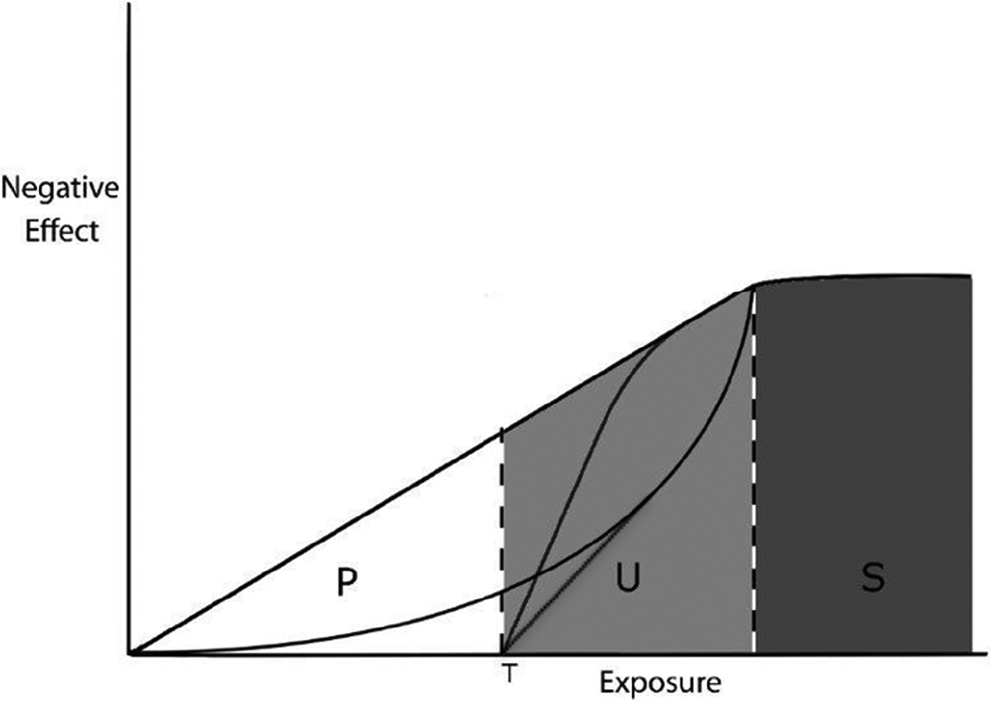
Categorization of cancer and particulate matter dose–response.
In this article, exposure to ionizing radiation is used to address the application of LNT to carcinogenic agents. As described in many publications, currently relevant regulations use LNT as the basis for their regulatory standards. Globally, there are many cities where the natural occurrence of ionizing radiation exceeds relevant regulatory standards. If LNT is valid, why cities such as Albuquerque in the United States, Ramsar in Iran, Kerala in India, Yangjiang in China, and Guarapari in Brazil are not evacuated as natural exposures in these cities exceed relevant standards? Similarly, why are there no limitations for flight attendants, pilots, and others who during the flight are exposed to higher level of ionizing radiation based on the higher level of exposure than earth surface exposure? The LNT proponents use the term as low as reasonably achievable (ALARA), implying that all individuals included in the abovementioned categories can reduce their risk using ALARA. However, how can a resident of the cities identified earlier use ALARA?
The disagreement between Enstrom and Pope et al in evaluating ACS studies demonstrates disagreements resulting from Association-Based Evolving Science, particularly when Hill criteria are violated. Because there is not a simple way of monitoring PM and measuring its effects on human health, the regulations on PM10 and PM2.5 exposure standards are consistently debated and changed. This disagreement demonstrates the need for transparency in the regulatory process, including the reproducibility of scientific claims
The EPA’s proposed rule-making would significantly impact the regulatory process by using only those studies that provide the data, methods, and processes used to drive conclusions. Subsequently, other investigators can reevaluate the data to ensure reproducibility of the study.
The 2 key epidemiological studies used by the EPA in the regulatory process are Six Cities study and ACS study. The authors of the Six Cities study claim that they cannot publicly release the data, as the rule of the privacy would be violated. The need for transparency demonstrated by the evaluation of both studies by HEI and published by Krewski et al who agreed with their conclusions and Enstrom who reevaluated the ACS study and came to the opposite conclusion. Who is right? The discussion of the process to make epidemiological data publicly available is too extensive and beyond the scope of this article. At a minimum, the original data should be provided to universities, research organizations, government institutions, and others who perform research that deal with humans including epidemiological studies. Typically, these groups use the institutional review board (IRB) as an organization that reviews all relevant studies and ensures compliance with privacy requirement, including ethical, legal, and any other relevant issue.
Conclusions
This study is not intended to endorse or reject current regulations. Instead, it attempts to separate science from social objectives including the ideology of members of the scientific community. The task of the scientific community notably researchers is to provide decision makers including the regulators with most accurate scientific information in compliance with the requirements of BARS/MRESC notably transparency and Jeffersonian Communication Principle. The authors of the Six Cities Study would serve the regulatory science community by providing the original data to organizations that have operating IRB.
Footnotes
Declaration of Conflicting Interests
The author(s) declared the following potential conflicts of interest with respect to the research, authorship, and/or publication of this article: For a period, Alan Moghissi was the project officer of the Six Cities study led by Benjamin Ferris at Harvard University. Moghissi supported an increase of funding for the study.
Funding
The author(s) received no financial support for the research, authorship, and/or publication of this article.