



Abstract
This study examines the dimensional, mechanical (bursting strength, ball traverse elongation, compressibility, and compressive resilience), and comfort-related properties (air permeability, water vapor resistance, volume electrical resistivity, and water retention) of double-weft knitted fabrics made from cotton and wool, using 1 × 1 rib and Milano rib structure, that develop during the washing process. The results reveal that yarn composition, knit structure, and washing conditions have a significant influence on the fabric’s performance after washing, particularly in terms of dimensional stability and structural integrity. Cotton fabrics exhibited greater dimensional changes after washing compared to wool fabrics. Isotropic shrinkage was observed in cotton Milano rib and wool 1 × 1 rib fabrics, while anisotropic dimensional changes occurred in cotton 1 × 1 rib and wool Milano rib fabrics. Wool fabrics had shorter initial stitch lengths and a higher mass per unit area, indicating coarser yarns and denser knit structures. Cotton fabrics, particularly those with a 1 × 1 rib structure, experienced notable reductions in bursting strength, compressibility, and air permeability. In contrast, wool fabrics, especially with a 1 × 1 rib structure, showed improved mechanical properties after washing. Across all samples, comfort-related properties declined after washing, with cotton fabrics experiencing more significant deterioration, likely due to increased sensitivity to conducted washing stresses. Overall performance rankings indicated that wool fabrics in the 1 × 1 rib structure maintained the greatest stability after washing, whereas cotton fabrics in the same knit structure exhibited the most substantial deterioration in performance. These findings provide valuable guidance for selecting yarn composition and knit structure type to enhance the dimensional stability, and functional performance of knitted products. The influence of yarn process and structure has not been taken into consideration.
Keywords
Introduction
Knitted fabrics are particularly susceptible to dimensional deformations due to mechanical stress, moisture, and heat. These factors can lead to stretching, bending, and changes in linear dimensions, which may occur during both the manufacturing process and the actual use of products. Such deformations can negatively affect the esthetic appearance, fit, and functionality of the final product, and in extreme cases, may render it unwearable. Among the various external influences, washing is known to have a significant impact on the dimensional properties of knitted fabrics, often amplifying these changes. Given the widespread use of cotton and wool in double weft knitted structures for clothing applications, it is essential to evaluate their dimensional stability after washing. Understanding how washing-induced dimensional changes affect the mechanical performance and comfort of knitted fabrics is critical for ensuring product quality and consumer satisfaction. 1 Various factors influence the dimensional stability of knitted fabrics, including fiber properties, yarn characteristics (such as yarn linear density, yarn twist, yarn type, etc.), the type of knit structure and its structural characteristics, washing method and the number of cycles, relaxation type and duration, drying method, etc.1 –6 Recognizing these factors during the design and production stages is essential for ensuring high-quality knitwear.
Cotton and wool are two of the most common natural fibers used in commercial knitwear production, each with unique inherent properties. Cotton is widely used in textile manufacturing and is the second most common fiber worldwide, after polyester. 7 Its versatility and broad availability make it a key material in many textile applications. Cotton is valued for its excellent comfort and favorable physical properties, 8 while wool offers superior elasticity, viscoelasticity, crease resistance, drape, handle, and thermal properties, making it a material with outstanding mechanical and comfort properties. 9 Wool, in addition to its functional advantages, is a natural, renewable, and biodegradable fiber valued for its ecological benefits and effective performance in textile products. These natural fibers are especially susceptible to shrinkage when exposed to moisture from washing or ironing, which can negatively impact the dimensional stability and usability of the knitted fabric. Studies indicate that knitted fabrics made from cotton fibers are particularly prone to shrinkage due to their high water absorption capacity, which causes swelling and significant dimensional changes. These fabrics exhibit the greatest dimensional alterations after their first wetting, with additional changes occurring during subsequent wettings.2,3 Addressing these challenges requires careful consideration of how the yarn composition (cotton and wool) influences the dimensional, mechanical, and comfort properties of knitted fabrics, to optimize the overall performance of knitted fabrics.
In addition to causing dimensional changes, washing also affects the structural characteristics of knitted fabrics. Research shows that washing knitted fabrics made from yarn with different composition (e.g. 100% cotton, 100% wool, 100% organic wool, and a blend of 95% cotton with 5% spandex) and different knit structures (single jersey and 1 × 1 rib) leads to increases in the number of courses and wales per centimeter, stitch density, weight, and thickness.10 –13 Furthermore, cotton and organic wool single jersey knitted fabrics exhibit a decrease in stitch length, while wool fabrics demonstrate an increase in stitch length after washing. 10
Knitted fabrics endure a variety of stresses from multiple directions during use, making it essential to assess their mechanical (strength and compression) properties. Furthermore, understanding how washing impacts these properties offers valuable insights for enhancing fabric performance. Research indicates that washing 100% cotton single jersey knitted fabrics increases ball traverse elongation 10 and decreases bursting strength.10,12 In contrast, Hassan et al. 14 found that for 100% spun polyester weft single jersey knitted fabric, simple washing resulted in a 1.2% increase in bursting strength. Similarly, Herath 13 demonstrated that 100% cotton knitted fabrics in single jersey and 1 × 1 rib structures, as well as cotton/spandex (93/7%) fabrics in a single jersey structure, showed increased bursting strength after washing. However, for cotton/spandex (93/7%) knitted fabrics in 1 × 1 rib structures, the bursting strength decreased after washing. Asanović et al., 10 in their study of compression properties, observed that washing single jersey knitted fabrics produced from 100% cotton, 100% wool, and 100% organic wool led to increased compressibility and thickness loss, while decreasing compressive resilience.
Surface and rubbing properties also undergo changes during washing. Quaynor et al., 15 using the KES-FB surface tester, investigated surface friction (MIU) and surface roughness (SMD) in both the course and wale directions for single jersey knitted fabrics made from mercerized cotton yarns, silk filament yarns, and polyester yarns. They observed a decrease in surface friction and surface roughness after washing for all samples, with the most pronounced changes in the course direction. Similarly, Solaiman et al. 11 examined the effects of different washing treatments (enzyme wash, silicone wash, and softener wash) on the dry and wet rubbing properties of various cotton knitted products, 100% cotton single jersey T-shirt, slub single jersey T-shirt, double Lacoste polo shirts (5% Lycra), single jersey T-shirts (CVC fabric), and single jersey T-shirts (PC fabric). They found that dry and wet rubbing properties were improved after all washing treatments, except for the 100% cotton T-shirt subjected to a silicone wash.
Sorption properties play an essential role in the functionality of knitted fabrics intended for daily use. Solaiman et al. 11 observed significant variations in fabric absorbency across different samples. Their investigation revealed that absorbency consistently decreased for single jersey 100% cotton and single jersey slub fabrics after all washing techniques (enzyme wash, silicone wash, and softener wash). In contrast, PC fabrics exhibited fluctuating absorbency changes across the three washing processes. Khalil et al. 12 found that acid washing reduced absorbency in various samples, including single jersey 100% cotton T-shirts, single jersey 95% cotton and 5% spandex T-shirts, and 1 × 1 rib 100% cotton T-shirts. This reduction was attributed to changes in the interfacial tension of fiber molecules caused by the treatment. Similarly, Hassan et al. 14 reported significant improvements in vertical wicking for 100% spun polyester weft-knitted jersey fabric in both wale-wise and course-wise directions after all finishes (simple wash, normal finish, silicon finish, and wicking finish), except for the silicon finish, which caused a notable reduction in the vertical wicking rate.
Numerous studies have demonstrated that washing significantly impacts the physical, mechanical, and comfort-related properties of knitted fabrics. Reported changes include dimensional changes,1,2,10,11 modifications in structural characteristics,10 –14,16 changes of strength and compression properties,10,12 –14 alterations in surface and frictional behavior,11,15 variations in sorption capacity.11,12,14 While these findings provide valuable insight into the isolated effects of washing, most investigations focus on individual parameters. As a result, there is a lack of comprehensive analysis of the combined impact of washing on the overall performance of knitted fabrics – an important factor for both manufacturers and end-users concerned with comfort. Washing is an important stage in the production process of knitwear made from natural fibers such as cotton and wool. This stage can greatly affect the dimensional and performance stability of the final knitwear. Despite its significance, washing is often replaced by ironing in many commercial production settings, typically due to efficiency or cost-saving reasons. However, ironing does not replicate the mechanical and moisture-related stresses induced by washing, which can result in an overestimation of dimensional stability and overall fabric performance. This substitution may cause discrepancies between production testing and actual performance during consumer use.
This research aims to close these gaps by systematically examining how washing affects the integrated performance of knitted fabrics made from 100% cotton and 100% wool, two of the most commonly used natural fibers in the knitwear industry. These materials were selected due to their favorable mechanical and comfort properties,8,9 as well as their increasing importance in sustainable textile production, driven by their biodegradability and renewability. 10 In line with current trends in the production of knitwear from natural yarns, this study explores the use of pure cotton and wool yarns to produce high-quality knitted products on an E12 gage flat-knitting machine. This type of machine supports fully fashioned or complete garment production methods, minimizing waste and ensuring a good fit. 17 The resulting products are suitable for year-round wear, including spring–summer and autumn–winter seasons, combining and sustainability to meet modern consumer demands and extend the product’s lifespan. To ensure meaningful comparisons, the study focuses on two widely used and structurally distinct knitted fabric types: 1 × 1 rib and Milano rib. The 1 × 1 rib structure features high elasticity and excellent recovery in the crosswise direction, making it ideal for stretch products. 18 In contrast, the Milano rib structure provides a compact, stable construction with low elasticity and a texture similar to woven fabrics, offering improved dimensional stability.19,20 In spite of the fact that two tested fabrics (1 × 1 rib and Milano rib) have totally different properties (high elasticity vs compact stable construction with low elasticity), these two types of knit structures are very often used together in the production of the same knitwear product. Milano rib structure can be used for the main section of the knitted products (e.g. front, back, and sleeves parts), while 1 × 1 rib stitches usually are used for the collar, cuffs, and hem of these details. Additionally, these knit stitch types are often used independently in various garments: 1 × 1 rib is commonly used for T-shirts, pullovers, and similar stretch-oriented products, whereas Milano rib is preferred for structured garments, such as long and short jackets, where dimensional stability and a stable structure are desired.
A series of controlled experiments was conducted to evaluate the effects of washing on selected fabric properties. These included dimensional stability, structural characteristics, and various fabric performance – specifically, mechanical performance (bursting strength, ball traverse elongation, compressibility, and compressive resilience), and comfort attributes (air permeability, water vapor resistance, volume electrical resistivity, and water retention). Measurements were taken both before washing (pre-wash) and after washing (post-wash) to facilitate a comparative analysis of how washing affects fabric integrity and performance. Ultimately, this study aims to determine which raw material composition of yarn (in further text: yarn composition) and knit structure exhibits the highest resistance to washing-induced degradation while maintaining superior overall performance. The findings aim to contribute to the production of durable and comfortable knitted fabrics, especially within the context of sustainable materials and optimized performance in commercial applications.
Material and methods
Materials
In this study, double weft knitted fabrics in 1 × 1 rib and Milano rib structures, made from 100% cotton yarn and 100% wool yarn, were used as experimental materials. The yarns used in the production of the investigated knitted fabrics are balanced commercial yarns. They yarns used are not entirely identical in terms of yarn count and twist of the two-plied yarn value, but due to the fact that the commercial yarns were used, information about the single yarn structure and twist was unknown. The experimental value of the yarn properties is presented in Table 1.
The experimental value of the yarn properties.
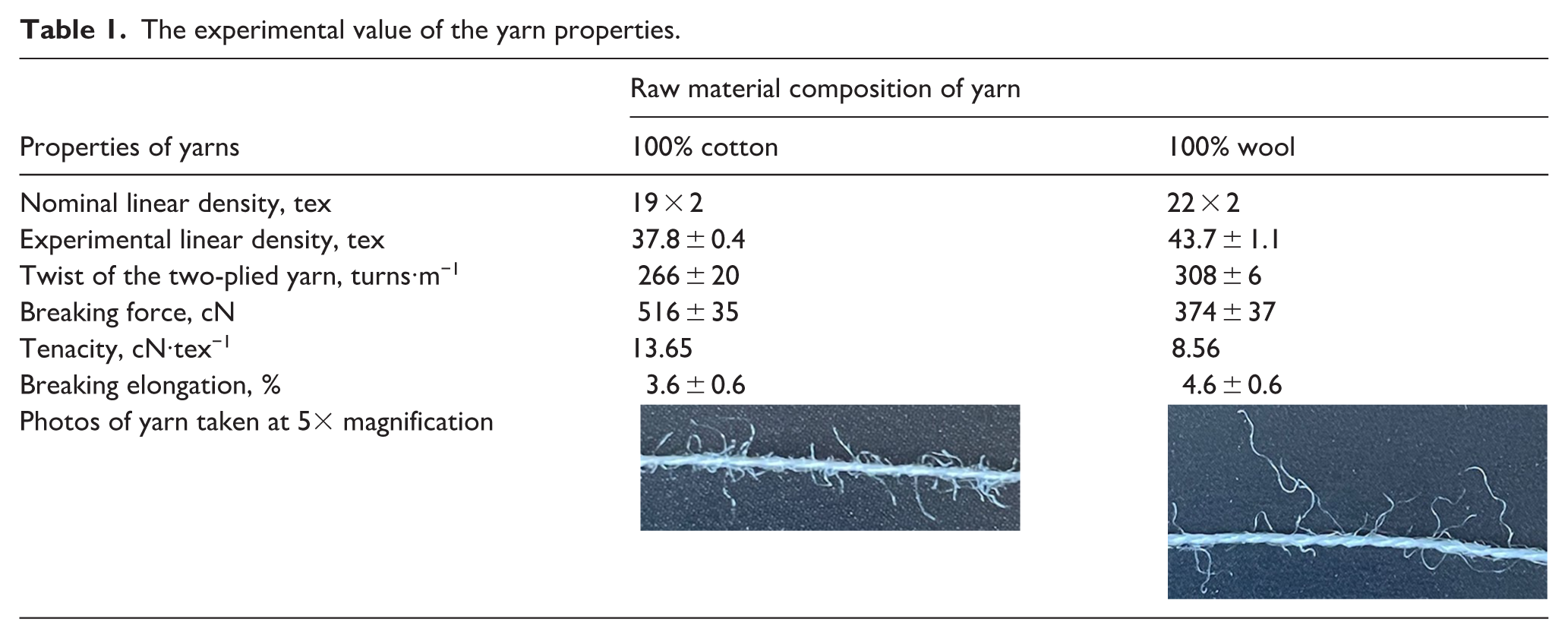
The experimental values of the yarn properties (Table 1) are influenced by the composition of the raw material. Wool yarn has approximately 15.8% higher twist level than cotton yarn, reflecting the need for greater fiber cohesion due to the crimped and less uniform nature of wool fibers. When the strength of yarn is in question, among the yarn parameters elaborated by El-Mogahyy, the two critical parameters are fiber strength and elongation. 21 In terms of tensile performance, cotton yarn exhibits a clear advantage, with a breaking force approximately 38% higher than that of wool yarn. Similarly, the tenacity of cotton yarn surpasses that of wool yarn by nearly 59.5%, reflecting the superior strength of cotton yarns, which might be attributed to cotton fiber’s high strength, that is, its higher crystallinity and structural uniformity. In contrast, wool yarn exhibits greater extensibility, with a breaking elongation that is around 28% higher than that of cotton yarn. This enhanced elongation is consistent with wool’s natural elasticity resulting from its helical and resilient fiber morphology. In summary, while cotton yarns provide significantly higher mechanical strength, wool yarns offer improved elasticity and flexibility, highlighting their respective advantages for different functional and esthetic applications in textile product development. Besides fiber type, other factors such as yarn count and thickness, yarn structure, single yarn twist, and twist multiplier can significantly influence yarn behavior and, consequently, fabric mechanical and comfort properties.21 –24 For instance, yarn strength increases with greater yarn thickness (under otherwise identical conditions), higher fiber parallel arrangement, longer fibers, and greater inter-fiber friction. 22 For the same material and yarn count, yarn flexibility varies depending on the spinning process and the degree of torsion. 23 Rotor yarns exhibit lower strength than ring-spun yarns. Twisting also enhances yarn strength, but only up to a critical twist level, beyond which excessive twist causes a decline in strength. 22 Additionally, lower twist multipliers and finer yarn counts tend to decrease air permeability, while coarser yarns enhance bursting strength. 24 Fabrics knitted from finer yarns are generally softer than those made from medium or coarse yarns. Yarn torsion also affects flexibility; less flexible yarns yield thicker knitted fabrics. 23 However, the effects of yarn structure and twist level on the studied properties were not considered in this research and could be addressed in future work.
The knitted fabrics were produced using a CMS 340.6L double-needle flat-bed knitting machine (Stoll, Germany) with an E12 gage, 863 needles per needle bed, and four knitting systems. During production, the machine stitch cam position, yarn input tension, and fabric take-down settings were kept constant. Figure 1 illustrates the graphical representation of the 1 × 1 rib and Milano rib structures, with “Rb” indicating the stitch repeat in the width direction.

The graphical representation of the rib structures: (a) 1 × 1 rib and (b) Milano rib.
As illustrated in Figure 1(b), the stitch repeats in the height direction of the Milano rib knit structure comprise three rows: a 1 × 1 rib knitted using the first yarn feeder, followed by two plain rows formed using the second and third yarn feeders. The second yarn feeder formed plain loops on the back needle bed, while the third yarn feeder formed plain loops on the front needle bed of the knitting machine. The Milano rib is a balanced (regular) knit structure, characterized by identical technical face and back surfaces composed of alternating rib and plain loops.
After the knitting, the fabrics were dry relaxed in such a way that they were laid on a flat surface (for several days) under standard atmospheric conditions, as defined with standard EN ISO 139:2005. 25
Following dry relaxation, the knitted fabrics were washed in a household washing machine following the ISO 6330:2021 standard. 26 After washing, they were laid flat to dry under minimal stress, allowing for wet relaxation. The surface appearance of the knitted fabrics before and after washing is shown in Figure 2.

The surface appearance of cotton and wool double weft knitted fabrics in 1 × 1 and Milano rib at 10× magnification: (a) before washing and (b) after washing.
Methods
Determination of the yarn properties
The cotton and wool yarn properties were analyzed through the yarn linear density, twist in yarns, strength (breaking force and tenacity), and breaking elongation. Yarn linear density was measured following the standard EN ISO 2060:1995, 27 while twist in yarns was determined following standard ISO 2061:2015 28 using a twist counter Branca Idealair, Italy. Determination of the strength (breaking force and tenacity) and breaking elongation was performed following the standard ISO 2062:2009 29 and standard ISO 6939:1988 30 using dynamometer AVK, type SZS-2, Hungary. The linear density, breaking force, and breaking elongation were considered as the average of 10 measurements, while the twist in yarns was considered as the average of 5 measurements per sample.
Determination of the structural characteristics of the knitted fabrics
The structural characteristics of the knitted fabrics before and after washing were analyzed through the wales per centimeter, course per centimeter, stitch length, mass per unit area, and thickness. Wales per centimeter (WPC, cm−1) and course per centimeter (CPC, cm−1) were determined following standard EN 14971:2006 (Method B). 31 The stitch length (La, mm) in the knitted fabric was measured following the standard EN 14970:2006. 32 For the Milano rib structure, the stitch length was measured for each individual stitch (rib in the first yarn feeder and plain in the second and third feeders) and then averaged based on the yarn length per stitch. The results are the average of 10 measurements for both rib stitch length (L1) and plain stitch length (L2), expressed in millimeters. Using these data, the average stitch length (La, mm) was calculated with the following formula:

Fabric mass per unit area (MPA, g⋅m−2) was determined following standard EN 12127:1997. 33 Fabric thickness (T, mm) was measured at a pressure of 9.96 kPa using a thickness tester AMES, type 414-10, USA. The wales per centimeter, course per centimeter, mass per unit area, and thickness were considered as the average of 5 measurements per sample, while the stitch length was considered as the average of 10 measurements per sample.
Determination of the dimensional changes caused by washing of the knitted fabrics
The dimensional change (DC) of the knitted fabrics caused by washing was analyzed through the percentage of change in length (DCl) and width (DCw). After being knitted, the fabrics were for several days laid out on a flat surface under a standard atmosphere to facilitate recovery from the stress imposed by knitting and were washed in a household fully automatic washing machine in accordance with the standard ISO 6330:2021 26 with a cotton program (at 30°C containing 3 g/l of an efficient wetting agent for cotton knitted fabrics) and with a wool program (at 20°C containing 3 g/l of an efficient wetting agent for wool knitted fabrics). After the washing cycle, the fabrics were laid out, with minimal stress, on a flat surface under standard atmospheric conditions for at least 24 h. 2 The mean percentage of dimensional change (shrinkage “-” or expansion “+”) in length (DCl) and width (DCw) is calculated according to the equation 2 :

where DC – the dimensional changes of the knitted fabrics in the length or width directions (%), x1 is the measurement after washing (mm), and x0 is the measurement before washing (mm). The results presented an average of 9 measurements per variant of knitted fabrics in both directions (in the length and width) after one wash cycle.
Determination of the mechanical properties of the knitted fabrics
Determining mechanical properties involves assessing bursting strength, ball traverse elongation, compressibility, and compressive resilience for knitted fabrics before and after washing.
Determination of bursting strength and ball traverse elongation of knitted fabrics was performed using a device mounted in clamps of a dynamometer AVK, SZ type KG-2, Hungary. Bursting strength (BS, N) represents the maximal bursting force registered when the metal ball (having a radius of 9.5 mm) passes through the circular specimen (having a radius of 12.5 mm). Ball traverse elongation (BTE, mm), that is, the elongation at maximum bursting force, was also determined on the same device during the determination of bursting strength. 34 The reported strength properties are the mean values of 5 measurements per sample.
A thickness tester (AMES, type 414-10, USA) was used for the investigation of knitted fabrics’ compressibility and compressive resilience. The knitted fabric thickness was measured starting with the initial pressure of 9.96 kPa, which was further progressively increased to 17.62, 43.66, 59.01, 74.34, and 103.99 kPa. After attaining the maximum pressure, the test was reversed in the same way till the complete recovery of the sample. The reported results are the mean values of 5 measurements per sample.
Knitted fabric compressibility (C, %) and compressive resilience (CR, %) were calculated according to the equations (3) and (4), respectively34,35:


where T0c and Tmax (mm) are the thicknesses of the knitted fabric determined under the initial pressure of 9.96 kPa and under the maximum pressure of 103.99 kPa, W’C and WC (Pa·m) are the compression work recovery and compression work of knitted fabric, Pr and Pc (Pa) are the magnitudes of pressure under recovery conditions (i.e. under decompression of the sample) and the magnitude of pressure which causes compression of the sample, dTr and dTc are the changes of sample thickness under the decompression and compression phase.
Determination of the comfort properties of the knitted fabrics
Determining comfort properties involves assessing air permeability, water vapor resistance, volume electrical resistivity, and water retention for samples before and after washing.
The knitted fabrics’ air permeability (AP, mms−1) was tested on the Air Permeability Tester (TexTesT Inc., Switzerland) at a constant pressure of 100 kPa (20 cm2 test area) following standard ISO 9237:1995. 36 Air permeability was determined at 10 different locations on each sample (5 measurements from back to face side and 5 measurements from face to back side of the knitted fabrics).
The water vapor resistance of knitted fabrics (Ret, m2PaW−1) was determined following standard ISO 11092:2014, 37 under steady-state conditions (sweating guarded-hotplate test). Knitted fabric water vapor resistance was calculated according to the equations 37 :

where pm (Pa) is the saturation water vapor partial pressure at the surface of the measuring unit at temperature Tm, pa (Pa) is the water vapor partial pressure of the air in the test enclosure at temperature Ta, A (m2) is the area of the measuring unit, H (W) is the heating power supplied to the measuring unit, ΔHe is the correction term for heating power for the measurement of water vapor resistance Ret, and Ret0 (m2PaW−1) is the apparatus constant for the measurement of water vapor resistance Ret. The results for water vapor resistance represent the average of 5 measurements.
The volume electrical resistance of the investigated knitted fabrics in the course direction (ρ, GΩcm), determined using the voltage method,38,39 was evaluated. The measurement was carried out as the relative air humidity in the chamber decreased in the measuring device from 55% to 35%. The paper presents the volume electrical resistivities of knitted fabrics determined at a relative air humidity of 45%. Throughout the entire process, 2 measurements were conducted for each sample, with two specimens of cotton and four specimens of wool knitted fabric connected to the electrodes during each measurement. Based on the determined knitted fabric volume electrical resistance (Rx, GΩ) the volume electrical resistivity of samples (in further text volume resistivity (ρ, GΩcm)) was calculated using equation 38,40,41:

where Rx (GΩ) is the volume electrical resistance, SF (cm2) is the surface of the sample’s cross-section calculated by multiplying sample thickness and width, and l (1 cm) is the sample length.
Water retention of knitted fabrics (WR, %) was determined following standard ASTM D 2402-01:2001. 42 The water retention method is based on the determination of the quantity of water that samples can absorb and retain under strictly controlled conditions. Water retention (WR, %) was determined using the following equation34,43:

where mc (g) is the mass of the knitted fabrics after immersing in distilled water at room temperature for 1 h and centrifuging at 2000g for 5 min, and md (g) is the mass of the absolutely dry knitted fabrics. Based on the data gathered, the average of 6 measurements is displayed.
Statistical analysis
The results underwent statistical analysis utilizing the t-test. The parameter t for independent samples was determined using equation (8), whereas for dependent samples, it was calculated through equation (9) 34,35:
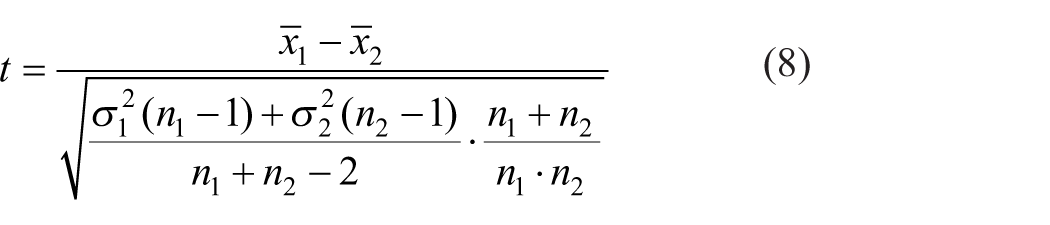

where
Analysis of performance changes in knitted fabrics due to washing
The performance of the investigated knitted fabrics, both before and after washing, was evaluated based on the results of their mechanical (bursting strength, ball traverse elongation, compressibility, and compressive resilience) and comfort properties (air permeability, water vapor resistance, volume resistivity, and water retention). To determine the overall performance with respect to the monitored properties, a ranking method was applied. The ranking method,40,43 consisted of providing each characteristic with the grading from “1” to “n,” where “n” represents the total number of knitted fabrics (in this manuscript “n” is “8”). Grade “1” indicates the best and grade “8” means the worst investigated properties of tested knitted fabrics from the aspect of monitored characteristics. In this experiment, grade “1” was assigned to the fabric that had the lowest values for water vapor resistance and volume resistivity and the highest values for remaining characteristics (bursting strength, ball traverse elongation, compressibility, compressive resilience, water retention, and air permeability). After assigning a grade to each knitted fabric sample (G1,. . ., G8), for each investigated property, the average grade values were calculated separately for mechanical (GM) and comfort properties (GC). To determine whether washing led to an improvement (“+”) or deterioration (“−”) of the tested properties, the percentage change in grade values due to washing for mechanical properties (PGVM, %) as well as the percentage change in grade values due to washing for comfort properties (PGVC, %) was calculated using equations (10) and (11), respectively:


where GM,bw is the average grade value for mechanical properties before washing, GM,aw is the average grade value for mechanical properties after washing, GC,bw is the average grade value for comfort properties before washing, GC,aw is the average grade value for comfort properties after washing.
Finally, based on the individual rankings for mechanical and comfort properties, an overall performance rank was assigned to each fabric, ranging from “I” to “IV.” Fabric ranked “I” exhibited the least change in investigated performance due to washing, while fabric ranked “IV” showed the most significant change.
Results and discussion
Dimensional changes of the knitted fabrics due to washing
Washing knitted fabrics in a household fully automatic washing machine results in their dimensional changes, as shown in Figure 3.

Dimensional change in knitted fabrics caused by washing.
The impact of yarn composition and knit structure on the dimensional changes of knitted fabrics after washing is clearly evident (Figure 3). Additionally, the washing temperature (30°C for cotton and 20°C for wool) has a significant influence on the dimensional behavior of the examined samples. The lower dimensional changes observed in wool fabrics, compared to those made from cotton yarns, can be attributed to both the yarn composition and the lower washing temperature. Cotton knitted fabrics in Milano rib and wool fabrics in 1 × 1 rib exhibit isotropic behavior, characterized by concurrent shrinkage in both length and width. Conversely, cotton fabrics in 1 × 1 rib and wool fabrics in Milano rib demonstrate anisotropic behavior. In these cases, cotton fabrics experience length shrinkage accompanied by width expansion, while wool fabrics show length expansion paired with width shrinkage. Minor width expansion (1.8%) for cotton fabrics and slight length expansion (0.1%) for wool fabrics were also recorded. However, these slight expansions did not lead to a reduction in wales or courses per centimeter after washing, as shown in Figure 4(a) and (b). The findings suggest that cotton knitted fabrics undergo greater dimensional changes compared to wool fabrics due to washing, primarily attributed to the significant swelling of cotton fibers. 2

Structural characteristics of knitted fabrics: (a) wales per centimeter, (b) courses per centimeter, (c) mass per unit area, and (d) thickness.
Structural characteristics of the knitted fabrics
The dimensional changes of knitted fabrics caused by washing are accompanied by changes in their structural characteristics (wales per centimeter, courses per centimeter, mass per unit area, and thickness), as shown in Figure 4.
The results in Figure 4(a) and (b) indicate that, regardless of the knit structure, wool samples exhibit higher wales per centimeter and courses per centimeter compared to cotton fabrics, both before and after washing, with the exception of wales per centimeter after washing and wales per centimeter before washing for the Milano rib sample, where identical values were observed. Additionally, 1 × 1 rib knitted fabrics show lower wales per centimeter and courses per centimeter than Milano rib fabrics, both before and after washing, irrespective of yarn composition, except for courses per centimeter in wool fabrics after washing. Statistical analysis using a t-test (Table 2) was conducted to assess the differences in the structural characteristics of the knitted fabrics. The results indicate a statistically significant difference in courses per centimeter, but not in wales per centimeter, between cotton and wool knitted fabrics in both 1 × 1 rib and Milano rib structures. Statistical analysis (Table 2) also reveals a statistically significant difference in wales per centimeter and courses per centimeter between 1 × 1 rib and Milano rib structures for both cotton and wool samples before and after washing (in most cases, with a significance level of 0.001). However, no statistically significant difference was found for courses per centimeter after washing between 1 × 1 rib and Milano rib for wool fabrics (t(1 × 1 rib)/(Milano rib) = 0.00, Table 2). Additionally, as shown in Figure 2, wales per centimeter exceeds courses per centimeter for all investigated knitted fabrics, both before and after washing, which can be attributed to the structural characteristics of double weft knitted fabrics. The conducted t-test also revealed a statistically significant difference between wales per centimeter and courses per centimeter for all samples, before and after washing (Table 3).
Statistical results of the structural characteristics of knitted fabrics determined by using the t-test.
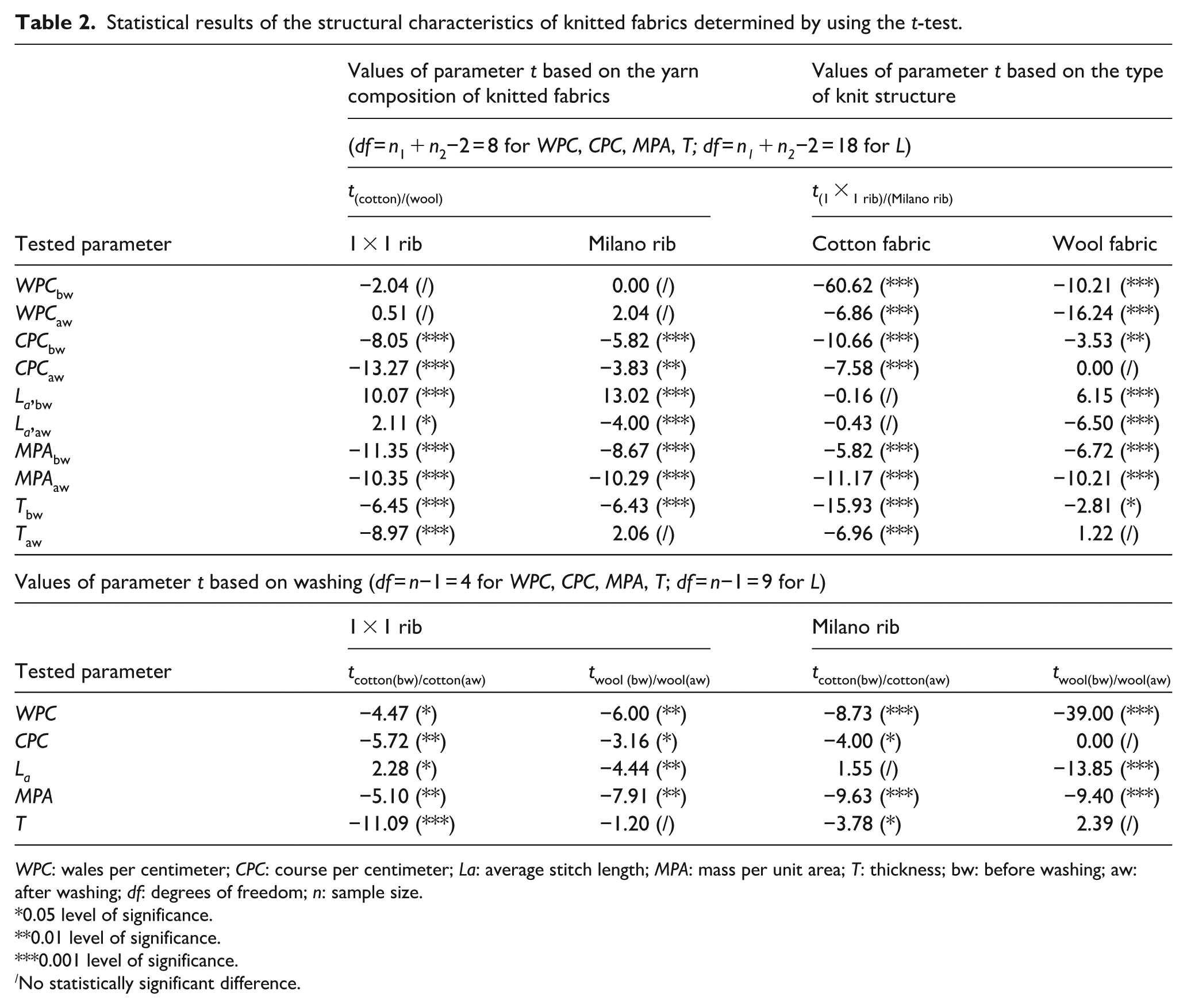
WPC: wales per centimeter; CPC: course per centimeter; La: average stitch length; MPA: mass per unit area; T: thickness; bw: before washing; aw: after washing; df: degrees of freedom; n: sample size.
0.05 level of significance.
0.01 level of significance.
0.001 level of significance.
No statistically significant difference.
Statistical results of knitted fabric wales and courses per centimeter determined by using the t–test.

WPC: wales per centimeter; CPC: courses per centimeter; df: degrees of freedom; n: sample size.
0.001 level of significance.
Washing results in an increase in both wales per centimeter and courses per centimeter for all knitted fabrics (Figure 4(a) and (b)), regardless of yarn composition or knit structure. The only exception is wool fabric in Milano rib, where washing does not cause any change in courses per centimeter. The most significant increase in stitch density due to washing was observed in wales per centimeter for Milano rib fabrics, with cotton and wool showing increases of 7.2% and 5.6%, respectively. Conversely, the smallest increase was noted in courses per centimeter for Milano rib fabrics, with cotton showing an increase of 1.52% and wool showing no change (0%). The t-test analysis (Table 2) confirms that washing led to a statistically significant increase in wales per centimeter and courses per centimeter for all samples, except for courses per centimeter in wool knitted fabric in Milano rib (twool(bw)/wool(aw) = 0.00). These findings align with data reported in the literature regarding the effects of washing on the stitch density of knitted fabric.10,12
The structural characteristics of the knitted fabrics, both before and after washing, reveal that both yarn composition and knit structure significantly influence their dimensional behavior. The results in Table 4 show that, regardless of the knit structure, cotton samples generally have a greater average stitch length than wool fabrics before and after washing, except for the Milano rib sample after washing. This difference before washing is likely due to the fact that wool fibers possess superior elasticity, 9 as well as the fact that wool yarns have higher breaking elongation than cotton yarns (Table 1), which allows wool yarns to bend more easily around the needles, resulting in a shorter stitch length. Statistical analysis using a t-test (Table 2) confirms a statistically significant difference in average stitch length between cotton and wool knitted fabrics in both 1 × 1 rib and Milano rib structures, as well as between 1 × 1 rib and Milano rib for wool samples, both before and after washing. However, no statistically significant difference in average stitch length was found between 1 × 1 rib and Milano rib structures for cotton fabrics, both before (t(1 × 1 rib)/(Milano rib) = −0.16) and after washing (t(1 × 1 rib)/(Milano rib) = −0.43), as shown in Table 2.
Values of the stitch length of the investigated double weft knitted fabrics before and after washing.

Additionally, as illustrated in Table 4, washing decreases average stitch length in cotton fabrics while increasing it in wool fabrics. In cotton fabrics, both knit structures exhibited minimal changes in stitch length after washing, with variations of approximately 1.0% (Table 4). Wool fabrics with a 1 × 1 rib structure exhibited a slight increase in rib stitch length, from 4.80 to 4.86 mm (1.3%). However, the Milano rib structure exhibited more pronounced changes: the rib stitch length increased substantially from 4.52 to 4.95 mm (9.5%), and the average stitch length increased from 4.73 to 4.97 mm (5.1%). In comparison, the plain stitch length in wool Milano rib changed only slightly, from 4.95 to 4.98 mm (0.6%). In general, the most significant change occurs in the Milano rib structure made from wool yarn, where the rib stitch length increases by 9.5% after washing, while the plain stitch length remains particularly unchanged, which is correlated with the almost unchanged stitch length in the wool plain weft knitted fabrics. 10 The obtained result suggests the stability of the plain stitch, with the absence of an effect of washing on its length. Although rib structures generally exhibit high elasticity and recovery, the combination of wool’s fiber properties and rib properties explains why wool Milano rib shows the most extensive post-wash stitch changes. Wool has higher elasticity and breaking elongation than cotton. During washing, residual tension is released, allowing the elastic rib to redistribute stitches more freely. In wool Milano rib, the stitch geometry combines a 1 × 1 rib with two plain ribs. Since the plain stitches show stability in that segment (plain stitch length remains nearly unchanged), in the segment 1 × 1 rib, their elasticity and recovery are overruled by higher elongation of wool yarn, preventing rib stitches from relaxing, and finally leading to a pronounced increase in rib stitch length. In contrast, cotton’s yarns lower elongation does not affect high elasticity and recovery in 1 × 1 rib segment, resulting in lower stitch length changes. The t-test results indicate that washing caused a statistically significant change in average stitch length for all fabrics, except for cotton fabric in a Milano rib structure (tcotton(bw)/cotton(aw) = 1.55).
The cotton and wool knitted fabrics in Milano rib exhibit higher mass per unit area compared to those in 1 × 1 rib, both before and after washing, as shown in Figure 4(c). This difference is attributed to the greater wales and courses per centimeter observed in Milano rib fabrics compared to 1 × 1 rib fabrics (Figure 4(a) and (b)). Furthermore, regardless of the knit structure, wool fabrics have a higher mass per unit area than cotton fabrics. The observed differences in mass per unit area are likely due to the yarn fineness used in fabric production. Specifically, finer yarn (19 × 2 tex) was used for cotton fabrics, while coarser yarn (22 × 2 tex) was used for wool fabrics, contributing to the higher mass per unit area in wool fabrics. Statistical analysis (Table 2) indicates a statistically significant difference in mass per unit area based on both yarn composition and knit structure, before and after washing. The increase in wales and courses per centimeter following washing was accompanied by a corresponding increase in the mass per unit area of the fabrics. Milano rib fabrics made from cotton and wool exhibited a greater increase in mass per unit area after washing compared to 1 × 1 rib fabrics. The highest increase in mass per unit area was observed in cotton fabric in Milano rib (15.6%), while the smallest increase was noted in wool fabric in 1 × 1 rib (6.7%). Statistical analysis (Table 2) confirms that washing resulted in a statistically significant increase in the mass per unit area for all tested knitted fabrics.
The thickness of knitted fabrics is affected by multiple factors, including yarn properties (fiber composition, fiber length, yarn structure, yarn torsion, yarn balance, and other characteristics),23,44 knit stitch type and structural parameters, fabric condition (dry-relaxed, washed, etc.), among others.10,20 The thickness of the investigated knitted fabrics, similar to mass per unit area, also varies before and after washing, as shown in Figure 4(d). Milano rib fabrics exhibit higher thickness values compared to fabrics of the same yarn composition in 1 × 1 rib, both before and after washing. However, an exception to this trend was observed in wool Milano rib fabric after washing. The greater thickness of Milano rib fabrics can be attributed to the presence of two rows of plain stitches combined with a 1 × 1 rib row in the stitch repeat, which results in their higher wales and courses per centimeter compared to 1 × 1 rib fabrics, as clearly illustrated in Figures 1 and 2. As wales and courses per centimeter increases, the compactness of the knitted fabric improves, reducing the spaces between loops. This makes the yarn loops less prone to flattening under applied pressure, leading to greater fabric thickness. 34 Furthermore, wool fabrics demonstrate higher thickness values compared to cotton fabrics, regardless of the knit structure, both before and after washing, except for Milano rib fabric after washing. The t-test analysis (Table 2) indicates a statistically significant difference in thickness based on yarn composition (except for Milano rib fabric after washing, t(cotton)/(wool) = 2.06) and knit structure type (except for wool fabric after washing, t(1 × 1 rib)/(Milano rib) = 1.22). The histograms in Figure 4(d) illustrate an increase in the thickness of knitted fabrics after washing, with the exception of wool fabric in Milano rib. The decrease in thickness of wool fabric with a Milano rib structure after washing is likely due to an increase in average stitch length (Table 4). A greater average stitch length enables easier compression of the knitted fabric under applied pressure, resulting in a lower thickness value. The highest thickness value after washing, along with the greatest increase in thickness (6.5%), is observed in cotton fabric with a Milano rib structure, while the smallest increase in thickness (approximately 3.1%) is recorded for wool fabric in 1 × 1 rib. Statistical analysis (Table 2) reveals that washing caused a statistically significant increase in thickness for cotton fabrics, but not for wool fabrics in either 1 × 1 rib or Milano rib structures (twool(bw)/wool(aw) is −1.20 and 2.39, respectively). These results highlight the combined influence of yarn composition and type of knit structure on the dimensional response of knitted fabrics to washing.
The results shown in Figure 4 and Table 4 for cotton fabrics indicate that increasing the number of wales and courses per centimeter, along with fabric thickness at a constant stitch length, leads to a higher mass per unit area. This is likely due to changes in the three-dimensional shape of the fabric loops resulting from structural compaction during knitting and relaxation processes. Such a loop shape is influenced by several factors, including yarn composition and physical properties (especially yarn bending rigidity), average stitch length, relaxation method (both before and after washing), inter-yarn friction force and wale-wise tensile stress applied during knitting, as noted in the literature. 44
For wool fabrics, notably in the Milano rib structure, we saw a significant increase in rib stitch length along with more wales and course per unit length and no change in the fabric thickness. While longer stitches usually mean lower fabric density, the observed inconsistency between increased stitch length and wales and course density stems from the non-uniform dimensional changes and complex structural behaviors of knitted fabrics during washing and relaxation. Wool’s high elasticity and inter-yarn friction force, 45 limit excessive relaxation, keeping dimensions stable despite internal changes. Although increased stitch length often indicates looser fabric, the reconfiguration, yarn recovery, and multi-axial deformation explain the observed results, offering a nuanced understanding of wool fabric behavior after washing.
Mechanical properties of the knitted fabrics
The results of the investigated mechanical properties (bursting strength, ball traverse elongation, compressibility, and compressive resilience), for cotton and wool double weft knitted fabrics in 1 × 1 rib and Milano rib, before and after washing, are shown in Figure 5.
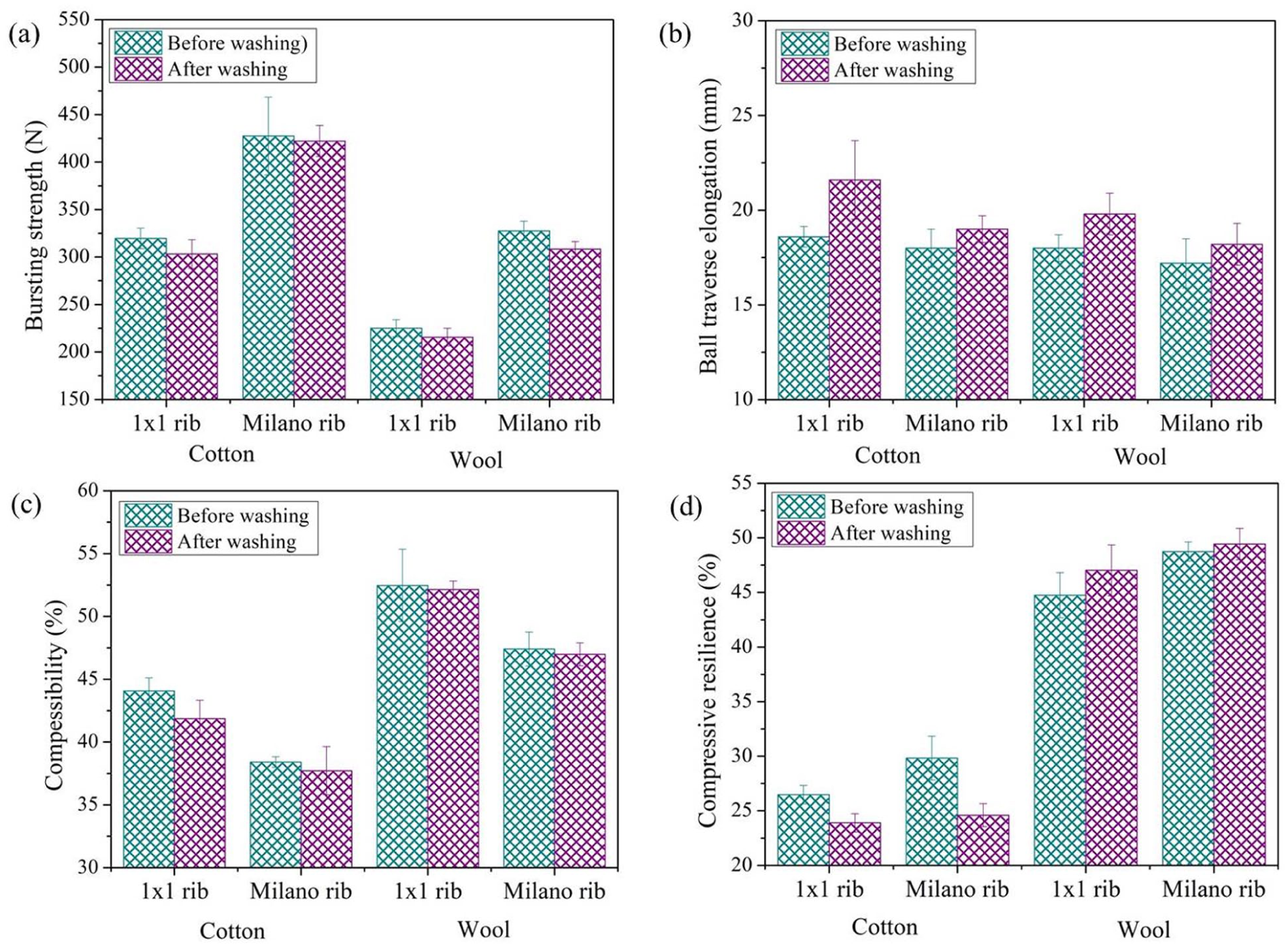
Mechanical properties of knitted fabrics: (a) bursting strength, (b) ball traverse elongation, (c) compressibility, and (d) compressive resilience.
The histogram results indicate that cotton and wool knitted fabrics in Milano rib exhibit higher bursting strength (Figure 5(a)) and lower ball traverse elongation (Figure 5(b)) compared to fabrics of the same yarn composition in 1 × 1 rib, both before and after washing. The greater bursting strength and reduced ball traverse elongation of Milano rib fabrics can be attributed to their higher wales per centimeter, courses per centimeter, mass per unit area, and thickness (Figure 4). Increased mentioned structural values enhance material compactness, intensifying the frictional forces between fibers within the yarn and between yarns in the knitted fabric, thereby impeding the ball’s passage through the sample. Regardless of fabric structure, cotton fabrics demonstrate higher bursting strength than wool fabrics, likely due to the inherently greater breaking strength of cotton fibers compared to wool fibers.10,46 Furthermore, the cotton yarn used for producing the cotton knitted fabrics had 59.5% higher tenacity compared to the wool yarn (Table 1). The statistical analysis using a Student’s t-test (Table 5) revealed a statistically significant difference in bursting strength based on yarn composition and type of knit structure, both before and after washing, with a significance level of 0.001 in all cases. However, a statistically significant difference in ball traverse elongation was observed only between cotton fabrics in 1 × 1 rib and Milano rib after washing (t(1 × 1 rib)/(Milano rib) = 2.66).
Statistical results of the determined knitted fabric mechanical properties using the t-test.

BS: bursting strength; BTE: ball traverse elongation; C: compressibility; CR: compressive resilience; bw: before washing; aw: after washing; df: degrees of freedom; n: sample size.
0.05 level of significance.
0.01 level of significance.
0.001 level of significance.
No statistically significant difference.
Regardless of yarn composition and knit structure, washing results in a decrease in bursting strength and an increase in ball traverse elongation of the knitted fabrics (Figure 5(a) and (b)). The reduction in bursting strength after washing aligns with the findings of Khalil et al. 12 and Asanović et al. 10 However, the decrease in bursting strength after washing was not expected, given that washing improved the wales per centimeter, courses per centimeter, mass per unit area, and thickness of the tested knitted fabrics (Figure 4). Hence, this reduction can be attributed to the chemical degradation of fibers, 47 which is reflected in a decrease in their degree of polymerization, 48 and surface damage caused by the mechanical action of the washing machine, 49 which facilitates easier penetration of the ball through the fabrics. Namely, due to the mechanical action of the washing machine, hairs protruded from the yarns (Table 1) are detaches, while new hairs from yarns are drawn to their surface. This process weakens the inter-fiber cohesion within the yarn, making it easier for the ball to penetrate the fabric. Statistical analysis (Table 5) reveals that washing caused a statistically significant decrease in bursting strength only for cotton knitted fabrics in 1 × 1 rib (tcotton(bw)/cotton(aw) = 4.41) and a statistically significant increase in ball traverse elongation for both cotton (tcotton(bw)/cotton(aw) = −2.86) and wool fabrics (twool(bw)/wool (aw) = −3.67) in 1 × 1 rib.
Wool knitted fabrics in both 1 × 1 rib and Milano rib exhibit higher compressibility (Figure 5(c)) compared to cotton knitted fabrics, both before and after washing. This increased compressibility in wool fabrics is attributed to the natural curliness of wool fibers, which hinders their dense packing within the yarn. This creates a greater number of micropores between the fibers, contributing to the higher compressibility of wool fabrics relative to cotton fabrics. Additionally, regardless of yarn composition, fabrics in 1 × 1 rib demonstrate higher compressibility than those of the same fiber type in Milano rib. A lower number of wales and courses per centimeter (Figure 4(a) and (b)) and a higher average stitch length (Table 4) result in a more open knit structure, allowing the yarns to flatten more easily under compressive loading, thereby reducing the fabric’s thickness. Conversely, fabrics with a higher number of wales and courses per centimeter, as well as lower average stitch length, exhibit a more compact knit structure, which restricts the yarns’ ability to flatten under compressive loading (loops move difficultly), 50 leading to greater fabric thickness.10,34 As a result, a greater difference in thickness measured under the highest and lowest pressures, indicating higher compressibility, was observed in cotton and wool knitted fabrics with a 1 × 1 rib structure compared to those in Milano rib. Washing reduces the compressibility of both cotton and wool knitted fabrics, regardless of whether they are in a 1 × 1 rib or Milano rib structure. The reduction in fabric compressibility after washing can be attributed to the increase in the number of wales and courses per centimeter. A t-test analysis (Table 5) revealed a statistically significant difference in compressibility based on yarn composition and type of knit structure, both before and after washing (in most cases, with a significance level of 0.001). However, a statistically significant difference due to washing was observed only for cotton fabric in a 1 × 1 rib structure (tcotton(bw)/cotton(aw) = 2.91).
The results shown in Figure 5(d) indicate that cotton knitted fabrics exhibit lower compressive resilience compared to wool fabrics, in both 1 × 1 rib and Milano rib structures, before and after washing. These findings are consistent with the results observed for cotton and wool single jersey knitted fabrics. 10 The greater compressive resilience of wool fabrics, as compared to cotton fabrics, suggests they recover more effectively after the compressive load is removed. This can be attributed to the yarn composition of the tested samples. Specifically, literature indicates that wool fibers exhibit superior elastic recovery compared to cotton fibers.10,22 In addition to the curly structure of the wool fiber acting like springs that enable an easier return of fabrics to their original position, the higher values of structural characteristics of wool fabrics, which increase the tension between the loops during compression, also facilitate a quicker and easier return of the loops to their relaxed state during decompression. 34 This contributes to the higher compressive resilience of wool knitted fabrics. Furthermore, regardless of yarn composition, fabrics in Milano rib exhibit higher compressive resilience than those in 1 × 1 rib of the same yarn composition, due to their greater structural characteristics. Washing results in a decrease in the compressive resilience of cotton fabrics, while it increases the compressive resilience of wool fabrics in both 1 × 1 rib and Milano rib. The greater increase in compressive resilience after washing for wool fabrics in 1 × 1 rib compared to Milano rib can be attributed to the higher overall increase in the number of wales and courses per centimeter in the 1 × 1 rib structure (Figure 4(a) and (b)). The reduction in compressive resilience of cotton fabrics after washing, despite their increased compactness, can be attributed to chemical degradation of the fiber during the washing process. Statistical analysis (Table 5) reveals a statistically significant difference in compressive resilience based on yarn composition and type of knit structure, both before and after washing, except for the type of knit structure after washing for both cotton and wool fabrics (t(1 × 1 rib)/(Milano rib) is − 1.17 and −1.96, respectively). Additionally, washing does not lead to statistically significant differences in compressive resilience for wool fabric in Milano rib (twool(bw)/wool(aw) = −1.19).
Comfort properties of the knitted fabrics
Air permeability, water vapor resistance, volume resistivity, and water retention of the knitted fabric were selected as key indicators of clothing comfort. The results of the comfort properties of cotton and wool double weft knitted fabrics in 1 × 1 rib and Milano rib, both before and after washing, are presented in Figure 6.

Comfort properties of knitted fabrics: (a) air permeability, (b) water vapor resistance, (c) volume resistivity, and (d) water retention.
Wool knitted fabrics, in both 1 × 1 rib and Milano rib, exhibit higher air permeability than cotton knitted fabrics, both before and after washing. This increased air permeability in wool fabrics is likely attributed to the curly structure of wool fibers, which prevents them from being tightly packed in the yarn. As a result, more micropores are formed between the fibers, enhancing the air permeability of wool fabrics compared to cotton fabrics. Before washing, only a minor difference in air permeability was observed between 1 × 1 rib and Milano rib structures for both cotton and wool fabrics. However, after washing, cotton and wool fabrics in 1 × 1 rib show higher air permeability than the same fabrics in Milano rib. Cotton and wool fabrics in 1 × 1 rib have a lower number of wales and courses per centimeter compared to the same fabrics in Milano rib, resulting in higher air permeability, which is in line with the literature. 51 Washing leads to a decrease in the air permeability of both cotton and wool fabrics in 1 × 1 rib and Milano rib, except for wool fabric in 1 × 1 rib, where a slight increase in air permeability was observed after washing. During washing, the number of wales and courses per centimeter, mass per unit area, and thickness of cotton and wool fabrics increase (Figure 4), improving the fabrics’ compactness, which is limits the amount of air flowing through their surface and thus reduces their air permeability. 34 Changes on the fabric surfaces due to washing, such as a slight increase in fluffiness (Figure 2), further contribute to the decrease in air permeability after washing, as the increased fluffiness can hinder air flow through the fabrics. The t-test (Table 6) reveals a statistically significant difference in air permeability based on yarn composition and type of knit structure, both before and after washing, except based on the type of knit structure before washing for both cotton and wool fabrics (t(1 × 1 rib)/(Milano rib) is 0.42 and −1.52, respectively). Additionally, no statistically significant difference in air permeability was found before and after washing only for wool fabric in 1 × 1 rib (twool(bw)/wool(aw) = −1.26).
Statistical results of the determined knitted fabric comfort properties using the t-test.
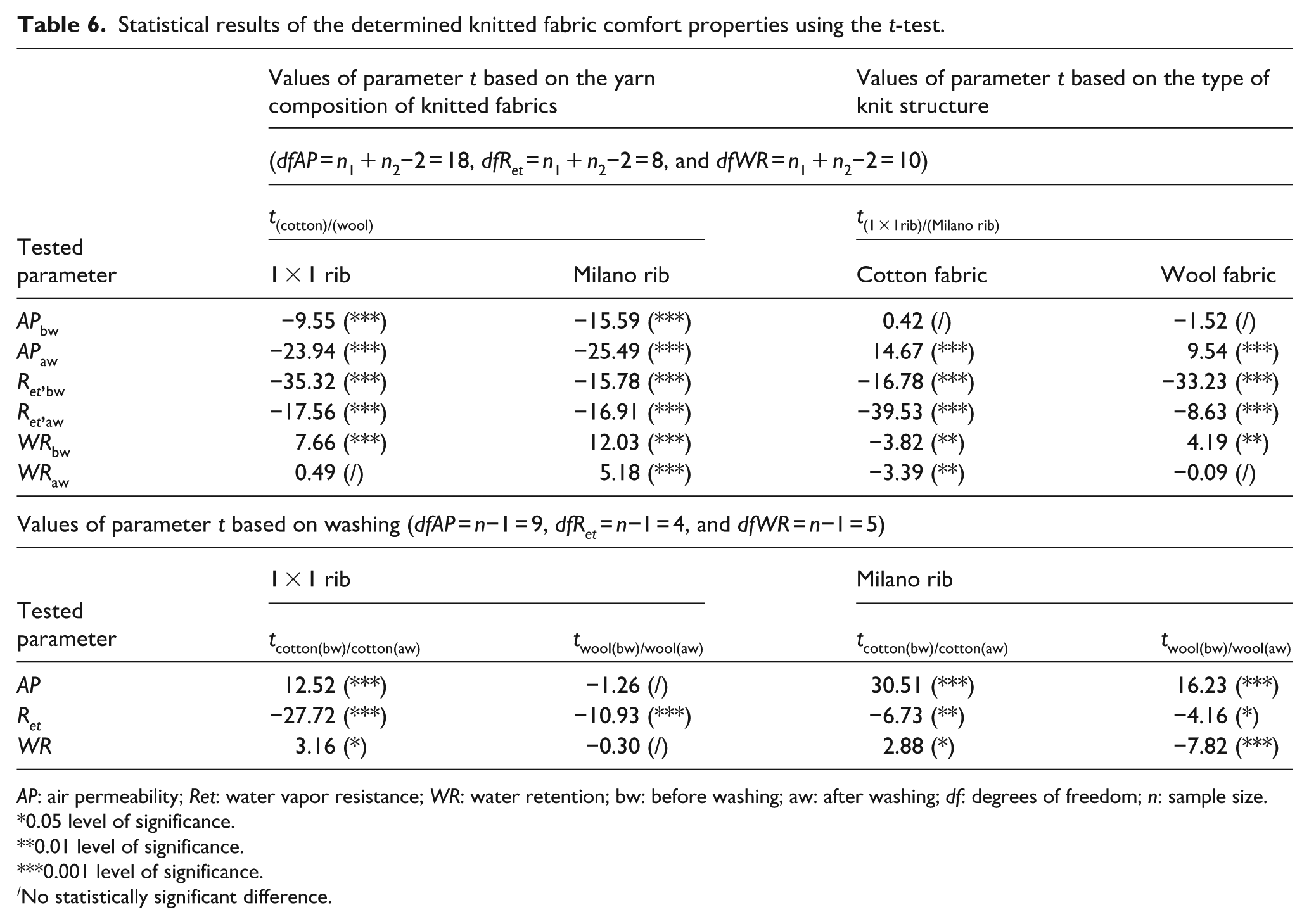
AP: air permeability; Ret: water vapor resistance; WR: water retention; bw: before washing; aw: after washing; df: degrees of freedom; n: sample size.
0.05 level of significance.
0.01 level of significance.
0.001 level of significance.
No statistically significant difference.
The results presented in Figure 6(b) demonstrate that wool knitted fabrics exhibit higher water vapor resistance than cotton fabrics in both 1 × 1 rib and Milano rib structures, before and after washing. This aligns with the known properties of natural cellulose fibers, which are characterized by excellent water vapor permeability, that is, low water vapor resistance due to their supramolecular and morphological structure. 52 Additionally, the hydrophilic surface of cellulose fibers enhances the diffusion rate of water vapor molecules adsorbed onto their surface. Moreover, the lower number of wales and courses per centimeter in cotton fabrics, compared to wool fabrics, further contributes to their lower water vapor resistance. Cotton and wool fabrics in 1 × 1 rib exhibit lower water vapor resistance compared to their counterparts in Milano rib, both before and after washing. The higher structural characteristic values of Milano rib fabrics, relative to 1 × 1 rib fabrics, are responsible for their increased water vapor resistance. Washing further increases the water vapor resistance of both cotton and wool fabrics in 1 × 1 rib and Milano rib structures. This increase can be attributed to the increase in structural characteristics during washing, which makes the diffusion of water vapor through the fabric more difficult, thereby resulting in higher water vapor resistance. 53 The statistical analysis (Table 6) reveals a statistically significant difference in water vapor resistance based on yarn composition and type of knit structure, both before and after the washing process, as well as based on the effect of washing.
The results shown in Figure 6(c) indicate that cotton knitted fabrics exhibit significantly lower volume resistivity than wool fabrics in both 1 × 1 rib and Milano rib structures, before and after washing, with differences in magnitude reaching up to 103 GΩcm. These findings align with existing literature.39,45 The notably lower volume resistivity of cotton fabrics is attributed to the hydrophilic nature of cotton fibers. Due to the abundance of hydroxy groups, cotton fibers tend to absorb and retain moisture through interactions between the hydroxy groups and water molecules in the air. This moisture retention enhances the conductivity of cotton fabrics, resulting in a reduced electrical resistivity. Additionally, cotton and wool fabrics in Milano rib exhibit lower volume resistivity compared to their counterparts in 1 × 1 rib, both before and after washing. The higher number of courses per centimeter, mass per unit area, and thickness (Figure 4), facilitates the directional movement of charge in Milano rib fabrics, leading to their lower volume resistivity. Washing results in an increase in the volume resistivity of both cotton and wool fabrics in 1 × 1 rib and Milano rib structures. The volume resistivity of both cotton knitted fabrics increased by approximately fivefold after washing, whereas the resistivity of the wool fabric in 1 × 1 rib increased by 3.9 times, and that of the Milano rib fabric increased by 2.3 times. This outcome is somewhat unexpected, as washing typically leads to an increase in the number of courses per centimeter, mass per unit area, and thickness, which would generally be associated with a decrease in the electrical resistivity of the knitted fabrics. However, as previously noted, washing can cause chemical degradation of fibers 47 and damage to the fabric surface due to the mechanical action of the washing process. 49 Such fiber damage disrupts the directional movement of charge through the fabrics, ultimately leading to an increase in their electrical resistivity. As shown in Table 1, wool yarns have fewer but longer surface hairs than cotton yarns. During washing, a greater number of short fibers detach from cotton fabrics, which more significantly disrupts fiber cohesion and interferes with the directional movement of electrical charge, ultimately resulting in a larger increase in volume resistivity.
The histograms in Figure 6(d) reveal that cotton knitted fabrics exhibit higher water retention compared to wool fabrics in both 1 × 1 rib and Milano rib structures, both before and after washing. This higher water retention in cotton fabrics is attributed to the hydrophilic nature of cotton fibers, which contain a greater number of hydroxy groups capable of absorbing significant amounts of water and swelling extensively upon contact with it. Additionally, water retention in fabrics is affected by the fabric’s structural characteristics.34,43 Cotton and wool fabrics in 1 × 1 rib generally show lower water retention than their counterparts in Milano rib, both before and after washing, with the exception of wool fabrics before washing, where the fabric in 1 × 1 rib exhibits higher water retention than the fabric in Milano rib. Cotton and wool fabrics in Milano rib exhibit higher structural characteristic values compared to the same fabrics in 1 × 1 rib (Figure 4), resulting in greater water retention for fabrics in Milano rib, except for wool fabrics in Milano rib before washing. Washing causes a decrease in water retention for cotton fabrics but leads to an increase in water retention for wool fabrics in both 1 × 1 rib and Milano rib. The increase in water retention of wool fabrics after washing is likely associated with the increase in their structural characteristic values, whereas the decrease in water retention of cotton fabrics is probably due to fiber damage caused by the washing process. The conducted t-test (Table 6) reveals a statistically significant difference in water retention based on fiber type and type of knit structure, both before and after washing, except based on the yarn composition of fabrics in 1 × 1 rib after washing (t(cotton)/(wool) = 0.49), and the type of knit structure after washing for wool fabric (t(1 × 1rib)/(Milano rib) = −0.09). Additionally, there is no statistically significant difference in water retention before and after washing only for wool fabric in the 1 × 1 rib (twool(bw)/wool(aw) = −0.30).
Impact of washing on the overall performance of knitted fabrics
The grades assigned to cotton and wool double weft knitted fabrics in 1 × 1 rib and Milano rib for all investigated properties, both before and after washing, are presented in Table 7. Furthermore, the overall performance ranking of the knitted fabrics, based on mechanical properties (bursting strength, ball traverse elongation, compressibility, and compressive resilience) and comfort properties (air permeability, water vapor resistance, volume resistivity, and water retention) affected by washing, is presented in Table 8.
Grade of knitted fabrics.

G1: grade of bursting strength; G2: grade of ball traverse elongation; G3: grade of compressibility; G4: grade of compressive resilience; GM: average grade values of mechanical properties; G5: grade of air permeability; G6: grade of water vapor resistance; G7: grade of volume resistivity; and G8: grade of water retention; GC: average grade values of comfort properties (Grade “1” indicates the best and grade “8” indicates the poorest analyzed properties).
The bold values be at the 0.1 significance level.
The effect of washing knitted fabrics on the rank of the overall performance.

Analysis of the changes in mechanical properties due to washing (Table 8) reveals that washing has opposite effects on cotton and wool knitted fabrics. Specifically, the 1 × 1 rib cotton fabrics show a deterioration (“−”) in mechanical properties, while the Milano rib cotton fabrics exhibit no significant change, as indicated by equal average grade values before and after washing (Table 7). In contrast, both wool fabrics demonstrate an improvement (“+”) in mechanical properties after washing, with the effect more pronounced in the 1 × 1 rib structure. Regarding comfort properties, washing resulted in deterioration across all tested fabrics, regardless of yarn composition or knit structure. This negative impact was more significant in the cotton compared to wool fabrics, highlighting the influence of fiber composition on the performance of the knitted materials. Based on the rank of overall performance, the wool fabric with a 1 × 1 rib structure exhibited the least change due to washing (Overall Rank – “I”). Conversely, the cotton fabric with a 1 × 1 rib structure showed the greatest change in overall performance (Overall Rank – “IV”).
Conclusion
This study systematically evaluates the impact of washing on dimensional changes and overall performance of knitted fabrics 1 × 1 rib and Milano rib structures from cotton and wool yarns, focusing on mechanical (bursting strength, ball traverse elongation, compressibility, and compressive resilience) and comfort properties (air permeability, water vapor resistance, volume resistivity, and water retention). The findings, relevant to manufacturers and end-users of natural yarn products, confirm that washing has a significant and multifaceted effect on the stability, and comfort of both cotton and wool knitted fabrics.
Cotton fabrics were more prone to dimensional changes and performance deterioration than wool fabrics. Isotropic shrinkage occurred in cotton Milano rib and wool 1 × 1 rib fabrics, while anisotropic changes appeared in cotton 1 × 1 rib and wool Milano rib fabrics. These dimensional shifts increased the wales, courses, mass per unit area, and thickness, except in the wool Milano rib fabric, where course density remained unchanged and thickness decreased. Wool’s elasticity and coarser wool yarns yielded higher fabric mass and shorter pre-wash average stitch lengths.
In terms of overall performance, washing had mixed effects: statistically significant decreases were observed in bursting strength and compressibility (cotton 1 × 1 rib), compressive resilience, air permeability, and water retention (cotton 1 × 1 rib and Milano rib), and air permeability (wool Milano rib). Conversely, washing led to statistically significant increases in ball traverse elongation (cotton and wool 1 × 1 rib), compressive resilience (wool 1 × 1 rib), water vapor resistance (all fabrics), water retention (wool Milano rib), and volume resistivity (all fabrics).
The comparative analysis revealed that cotton fabrics, especially 1 × 1 rib, deteriorated in mechanical stability, while wool fabrics, particularly 1 × 1 rib, showed improved resilience and retained stability after washing. Comfort-related properties generally deteriorated across all fabrics, more noticeably in cotton, likely due to its greater sensitivity to conducted washing stresses. Overall performance rankings positioned wool 1 × 1 rib fabric as the most stable (Overall Rank – “I”) and cotton 1 × 1 rib fabric as the least stable (Overall Rank – “IV”). This difference underscores the influence of both yarn composition and yarn type (structure due to spinning) and fabric structure on washing-induced changes in tested mechanical and comfort properties. In this study, what to precise the impact of yarn structure due to the spinning process (ring, rotor or else spinning) has not be considered, and the yarn counts and twist values are closed but not identical. Then, these differences could also have an influence.
The results of the study offer practical guidance to textile engineers and manufacturers on how to optimize design parameters to enhance comfort properties of cotton and wool knitted fabrics, ensuring that performance and environmental responsibility advance hand in hand. To expand existing knowledge, future research should explore how yarn structure affects the knitted fabric’s post-wash performance, as well as long-term effects, such as pilling, which influence product longevity and user satisfaction.
Footnotes

Funding
The authors disclosed receipt of the following financial support for the research, authorship, and/or publication of this article: This work was supported by the Ministry of Science, Technological Development and Innovation of the Republic of Serbia (Contract No. 451-03-136/2025-03/200135 and Contract No. 451-03-136/2025-03/200287). The authors gratefully acknowledge Ljiljana Parandilovic, CIS Institute from Belgrade, for determination of water vapor resistance.
Declaration of conflicting interests
The authors declared no potential conflicts of interest with respect to the research, authorship, and/or publication of this article.