




Abstract
Adopting magnetron sputtering continuous automatic production line equipment for industrial production, polyester fabrics as the substrates were coated with nano-Ag/TiO2 composite films prepared by direct current sputtering method and direct current/radio frequency reactive sputtering method, respectively. The microstructure of Ag/TiO2 composite films deposited on the surface of the fabrics was dense and uniform. Structural colors were generated on the surface of the fabrics coated with the composite films and the coloring mechanism was consistent with the single-layer film interference principle. The color fastness, mechanical properties, comfortable properties were not significantly changed and had better antistatic property, anti-ultraviolet property, and antibacterial property compared with the original polyester fabrics. Therefore, the multi-functional and structurally colored fabrics can be prepared by magnetron sputtering technology, and can achieve industrial production, and have wide application prospects in apparel, home textile, and so on.
Keywords
Introduction
With the improvement of living standards, people pay more attention to environmental protection, function, and health of textiles. Structurally colored textiles, using physical optics principles, can create structural colors on the surfaces through interference, diffraction, dispersion and scattering of light [1–6]. Therefore, they are high-quality textile products with green environmental protection and excellent functions. At present, the researches on structurally colored textiles mostly focus on the photonic crystal materials and magnetron sputtering technology. The fabrication of structurally colored textiles from photonic crystal materials needs complicated processes, high costs, and the textiles show poor mechanical properties, making it difficult to achieve industrialized production [7–12]. However, structurally colored textiles prepared by magnetron sputtering have simple processes, low costs, and the structural colors and functions of textiles can be controlled conveniently [13–20]. Moreover, there are industrial large-scale magnetron sputtering devices that can meet the mass production and high-efficiency industrial production now [21–24].
Through our previous experimental research, Ag/TiO2 composite films deposited on the surface of textiles using laboratory magnetron sputtering equipment can not only create beautiful and colorful structural colors but also has excellent optical and electrical properties [25–27]. At the same time, polyester fabrics were often used as substrates because of low cost and wide application. Therefore, adopting magnetron sputtering continuous automatic production line for industrial production, using polyester fabrics as the substrates, the metal Ag material and semiconductor TiO2 material were selected to deposit Ag/TiO2 composite films on the surface of polyester fabrics due to simple preparation process and excellent performance. The color fastness, mechanical properties, comfortable properties, antistatic property, anti-ultraviolet property, and antibacterial property of the deposited samples were analyzed in the paper. On the one hand, various properties of the samples were investigated. On the other hand, the possibility of industrial production using magnetron sputtering technology to develop structurally colored and multifunctional textiles was evaluated to meet the requirements of developing clothing, home, and industrial textiles.
Experimental
Materials
White plain weave polyester fabrics were purchased on the market, and the fabric specification was as follows: warp and weft yarn fineness of 160 D, warp density of 36.2 yards per centimeter and weft density of 32 yards per centimeter. Polyester fabrics were treated with conventional soaping of washing machines to remove impurities and size and then ironed and stored for later use.
Industrial production equipment of magnetron sputtering
The nano-Ag/TiO2 composite films were deposited by the magnetron sputtering continuous automatic production line manufactured by Suzhou Advanced Vacuum Electronics Equipment Co., Ltd. Figure 1 shows the magnetron sputtering continuous automatic production line.

Magnetron sputtering continuous automatic production line (a) Equipment physical drawing; (b) Equipment schematic.
The production line consisted of loading/unloading locking, entrance chamber, front transfer chamber, sputter deposition chamber, back transfer chamber, vacuum pumping and measurement system, magnetron sputtering system, automatic control system and more than 10 modules, and with more than 8 sets (including eight sets) self-developed rotary targets (ZL97109839.5). The utilization rate of these targets exceeded 75%. Multilayer metal films can be double-sided sputtered by the targets in the same vacuum cycle. The production line had excellent extensibility and can deposit a film of 8 μm resulting from adding the cooling chamber. There were many interfaces in the entrance chamber easily to increase UV cleaning, nitrogen cooling, and other functional modules and can be configured with non-metallic coating function.
Deposition of Ag/TiO2 composite films
A metal Ag target and a Ti target, as the sputtering targets, were cathode rotating cylindrical targets with a length of 1180 mm and a diameter of 80 mm. The vacuum degree was 6.0 × 10⁻³ Pa. The targets and the substrates were spaced 100 mm apart. Two methods, DC sputtering and DC/RF reactive sputtering were adopted to prepare nano-Ag/TiO2 composite films.
The preparation process of nano-Ag/TiO2 composite films deposited on polyester fabrics prepared by DC sputtering was as follows. Firstly, an Ag target was sputtered by DC sputtering with a current of 10 A and a working pressure of 0.48 Pa. The film thickness was calculated according to the sputtering number of the target. Normally, the Ag target was sputtered once, and the Ag film thickness was approximately 100 nm. Then, a Ti target was sputtered by DC sputtering with a current of 10 A and a working pressure of 0.48 Pa. The film thickness was also calculated by the sputtering number of the target, and the Ti target was sputtered once, and the Ti film thickness was about 60 nm. Finally, the Ag/TiO2 composite films were successfully prepared after placing them into the air for a while, and the TiO2 film thickness in the composite films was about 60 nm [27]. This sample was marked as No.1.
The preparation process of nano-Ag/TiO2 composite films prepared by DC/RF reactive sputtering was as follows. Firstly, an Ag target was sputtered by DC sputtering with a current of 5 A, and a working pressure of 0.48 Pa. Normally, the Ag target was sputtered once, and the Ag film thickness was approximately 50 nm. Then, a Ti target was sputtered by DC sputtering with a working pressure of 0.48 Pa and a current of 5 A. The Ti target was sputtered once, and the Ti film thickness was about 30 nm. Finally, a Ti target was sputtered by RF reactive sputtering with the Ar pressure of 0.6 Pa, the O2 pressure of 0.46 Pa, the mixing pressure of 0.5 Pa and a current of 10 A. Normally, the target was sputtered once, and the film thickness was about 4 nm. The Ti target was sputtered eight times here. Hence, the Ag/TiO2 composite films were also successfully deposited on the fabrics, and the TiO2 film thickness in the composite films was about 62 nm [27]. This sample was marked as No.2.
Microstructure and structural colors test
The microstructures of the nano-Ag/TiO2 composite films prepared by different magnetron sputtering methods were examined by scanning electron microscopy (SEM, JSM-5610LV, Japan).
Photographs of the deposited samples were taken with a digital camera (DCR-HC90E, Sony, Japan). The sample colors were evaluated using a GretagMacbeth Color-eye 7000A computer color measuring and matching instrument at standard illuminant D65. The reflectance curves and L*, a*, b* values were analyzed as the color characteristic.
The washing fastness of samples was tested using SW-12AII washing fastness tester according to GB/T 3921-2008. The rubbing fastness of samples was evaluated using Y571B type friction color fastness meter according to GB/T 3920-2008.
Properties testing
Mechanical properties
According to GB/T3923.1-2013, the tensile properties of polyester fabrics and the deposited polyester fabrics were tested by INSTRON 3365 universal testing machine with a clamping distance of 200 mm, the tension of 2 N and the stretching speed of 100 mm/min. The evaluation indexes were the breaking strength (N) and the breaking elongation (%). Samples along with the warp and the weft direction were tested five times and finally averaged.
According to GB/T 3917.1-2009, the tear properties of the polyester fabrics and the deposited polyester fabrics were tested by INSTRON 3365 universal testing machine. The tear strength (N), as the evaluation index, was tested five times and finally averaged.
Comfortable properties
According to GB/T5453-1997, the air permeability of the polyester fabrics and the deposited polyester fabrics was tested by fabric breathability tester (FX3300-IV, Textest, Switzerland) with a pressure drop of 100 Pa and a test area of 20 cm2. Each sample along with the different place was tested 10 times and finally averaged.
According to GB/T12704.1-2009, the moisture permeability of the polyester fabrics and the deposited polyester fabrics was tested by moisture permeability test chamber (DH-400, Japan). Three pieces of the same samples were taken for testing and finally averaged.
According to GB/T4669-2008, using AB223 electronic balance, the mass per unit area of the polyester fabrics and the deposited polyester fabrics was tested five times and averaged. According to GB/T18318.1-2009, using YG022D automatic fabric stiffness tester, the bending property of the original fabric and the deposited samples was investigated. The bending rigidity and the bending length, as the expression indexes, were tested four times and averaged.
Functional properties
Antistatic properties of the deposited samples were evaluated with static honestmeter (H0110/V1, Shishido electrostatic, LTD, Japan) according to GB/T12703.1-2008.
The anti-ultraviolet properties of the deposited samples were evaluated with an ultraviolet transmittance analyzer (UV-1000F, Lapsphere, America) according to GB/T18830-2009.
Antibacterial properties of the deposited samples were tested according to GB/T20944.3-2008. Gram-positive bacteria Staphylococcus aureus (S. aureus) ATCC 6538 and Gram-negative bacteria Escherichia coli (E. coli) ATCC29522 were the experimental strains, and the bacteriostatic rate was the antibacterial property evaluation index of the samples.
Results and discussion
SEM analysis
SEM images of the original polyester fabric and the nano-Ag/TiO2 composite films prepared by DC sputtering and DC/RF reactive sputtering are shown in Figure 2.

SEM images of (a) original polyester fabric; (b) Ag/TiO2 composite films deposited on polyester fabrics prepared by DC sputtering; (c) prepared by DC/RF reaction sputtering.
In Figure 2(a), SEM image of the original polyester fabric displayed a microstructure of polyester fiber, whose surface looked smooth. From Figure 2(b) and (c), we can see that the nano-Ag/TiO2 composite films on the surface of the fabrics were uniform and dense, and the bonding between the layers was also dense, indicating that the effect of the nano-Ag/TiO2 composite films deposited on the fabrics by magnetron sputtering was good.
Comparing Figure 2(b) and (c), the Ag/TiO2 composite films prepared by the two methods were slightly different, and the composite film prepared by DC/RF reactive sputtering was more smooth and dense than that by DC magnetron sputtering. This was mainly because reactive sputtering caused tighter bonding between layers [25,28–30]. By DC/RF reactive sputtering, Ti particles sputtered on the surface of the target chemically reacted in oxygen and were oxidized to TiO2, so that the prepared film was flat and uniform.
Structural colors and color fastness analysis
Photographs of the deposited samples prepared by DC sputtering and DC/RF reactive sputtering are shown in Figure 3.

Structural colors of fabrics coated with Ag/TiO2 composite films (a) prepared by DC sputtering; (b) prepared by DC/RF reaction sputtering.
In Figure 3, the surfaces of all deposited samples created structural colors, and the two samples’ colors were very close, one is golden yellow and the other is yellowish. According to the preparation process, the thicknesses of the TiO2 films in the Ag/TiO2 composite films prepared by the two methods were respectively 60 nm and 62 nm. According to the Yuan et al. [27], the corresponding to the reflection wavelength was yellow, concatenating with the colors of the samples in Figure 3.
The corresponding reflection spectra of the deposited samples prepared by different methods are displayed in Figure 4.
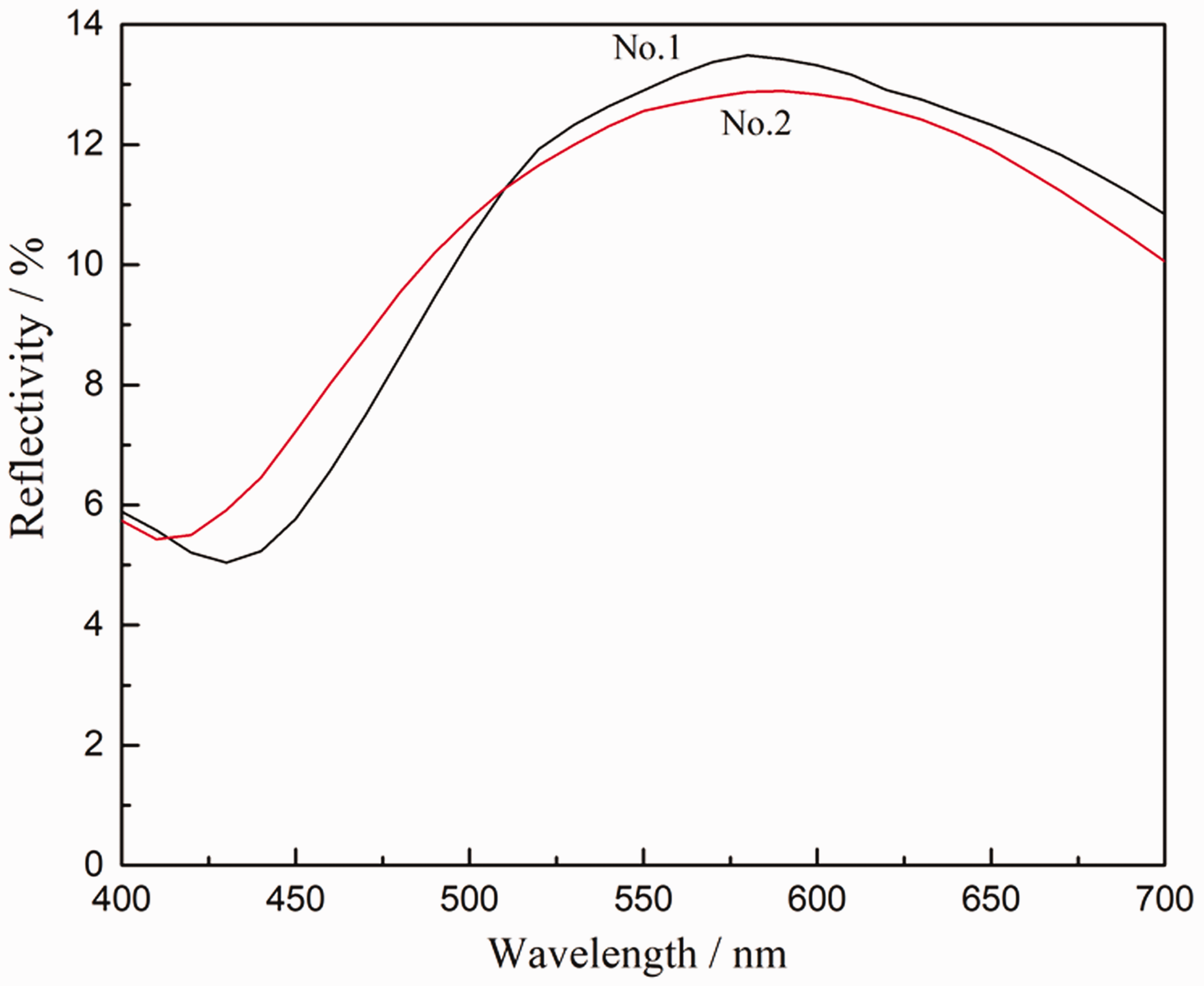
Reflection spectra of the samples coated with Ag/TiO2 composite films.
In Figure 4, the reflectance curves of the samples were very close in the visible range. The maximum reflection wavelengths on No.1 and No.2 sample reflectance curves were respectively 580 nm and 590 nm, which all corresponded to the yellow color, and all were consistent with their color photographs in Figure 3.
Table 1 shows the L*, a*, b* values of the deposited samples.
L* a* b* scale of the samples.
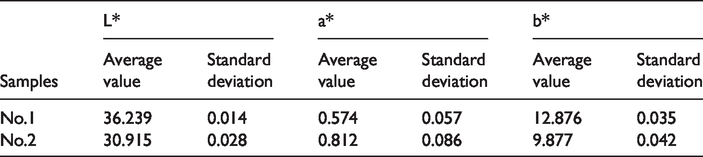
The a* and b* values and brightness values of the two samples were different in Table 1. The brightness value of the No.1 sample was larger than that of the No.2 sample, indicating that the No.1 sample was brighter in color. The a* and b* values of the No.1 and the No.2 sample were all positive, which indicated that the position of the sample colors was the same in the color space.
Figure 5 shows the spatial distribution of a* and b* values for the deposited samples.

Distribution of chromaticity indices, a* and b*, for the samples coated with Ag/TiO2 composite films.
From Figure 5, we can see that the a* and b* values of the samples were approximately in the range of yellow. Therefore, it can be concluded that these samples’ colors were yellow, and these results were also consistent with the colors of the samples in Figure 3.
Therefore, it can be demonstrated that the surface of the polyester fabrics coated with nano-Ag/TiO2 composite films prepared by magnetron sputtering industrial production equipment can obtain structural colors, and the coloring mechanism conformed to the single-layer film interference principle.
Color fastness results of the deposited samples are expressed in Table 2.
Color fastness results of the samples.

As seen in Table 2, the washing fastness of the deposited samples was very good, and the discoloration and staining were up to 5 in both warp and weft directions. It indicated that the composite films were strongly bonded to the fabrics and it was not easy to fall off under the soaping condition, and thus the color of the samples does not change substantially.
However, the color fastness to rubbing of the deposited samples was relatively poor, and the dry rubbing fastness was 2–3, while the wet rubbing fastness was only 2. It meant that the composite films and the fabrics had poor fastness and easily fell off under friction conditions, and thus the color of the samples changed.
In summary, using the magnetron sputtering continuous automatic production line, according to the laboratory preparation of nano-metal/semiconductor composite films, the structural color also can be generated on the surface of the deposited fabrics, and the rule of the structural coloration was consistent with the single-layer film interference principle. Polyester fabrics coated with Ag/TiO2 composite films have good soaping color fastness, but poor rubbing color fastness.
Mechanical properties analysis
The tensile property of the samples is displayed in Figure 6.

Tensile property of the samples coated with Ag/TiO2 composite films (a) Breaking strength; (b) breaking elongation.
In Figure 6, the tensile properties of the polyester fabrics and the deposited polyester fabrics were different. After depositing Ag/TiO2 composite films, the breaking strength and breaking elongation in the warp and weft directions all slightly decreased. The breaking strength and breaking elongation of the deposited polyester fabrics prepared by DC sputtering were reduced by about 0.8% and 2%, respectively, indicating that the tensile properties of the deposited samples prepared by DC sputtering have little change as compared with that of the original fabrics. Compared with the deposited samples prepared by DC sputtering, the breaking strength and breaking elongation of the deposited samples prepared by DC/RF reactive sputtering exhibited significant changes, which are about 8% and 6% in the warp and weft direction, respectively. It is mainly because the temperature of the fabrics substrates was increased during RF reactive sputtering compared with the DC magnetron sputtering, which has a certain influence on the strength of the fabrics, resulting in a certain decline of breaking strength and breaking elongation of the samples [31]. However, the overall drop was still relatively small and did not affect the wear performance of the fabrics later.
Figure 7 shows the tear property of the samples.

Tear property of the samples coated with Ag/TiO2 composite films.
As clearly seen from Figure 7, the tear strength of the deposited samples had slightly decline compared with that of the original fabrics, indicating that the tear property of the fabrics after depositing Ag/TiO2 composite films on the surface had a certain decline, but the decline was not significant. After the Ag/TiO2 composite films were deposited on the surface of the fabric, due to the firm bonding between the film layer and the yarns in the fabric, the force triangle area was no longer the collective force of multiple yarns, and thus the individual yarns were stressed separately during the tearing process, resulting in a drop in tear strength. Compared with the DC magnetron sputtering method, the tear strength of the deposited sample prepared by DC/RF reactive sputtering had a slight decrease. This was mainly because of the rise in fabric temperature during RF reactive sputtering [28,32,33].
Through the above analysis of the tensile property and tearing property of the deposited polyester fabrics, it was concluded that the mechanical properties of the fabrics after depositing Ag/TiO2 composite films on the surface had a certain degree of decline, but the decrease was small and did not affect the performance of the fabric later.
Comfortable properties analysis
Table 3 shows the breathability results of the samples.
Air permeability of the samples.

It can be seen from Table 3 that the air permeability of the fabrics after depositing Ag/TiO2 composite films on the surface had slightly decreased, indicating that the breathability of the samples had a certain decline. Because the composite films covered the surface of the fabrics, and the space between the yarns in the fabrics was obstructed by the nano-particles, resulting in a decrease in the porosity of the fabrics. The thicker the film layer, the smaller the porosity of the fabric surface and the poorer the air permeability. From Table 3, it can also be seen that compared with the DC magnetron sputtering method, the air permeability of the deposition sample prepared by DC/RF reactive sputtering declined significantly due to the different thickness of the composite films.
Table 4 shows the moisture permeability results of the samples.
Moisture permeability of the samples.

In Table 4, after depositing Ag/TiO2 composite films, the moisture permeability of the fabrics had slightly declined, and the reason was the same as the cause of the decrease in air permeability, except that the moisture permeability of the deposited fabrics was slightly better than the breathability.
The mass per unit area of the samples is shown in Table 5.
Mass per unit area of the samples.

Table 5 indicated that the mass per unit area of the fabrics after depositing Ag/TiO2 composite films on the surface had a certain increase, mainly due to the deposition of the composite films on the surface of the fabrics. With different film thicknesses, the mass per unit area of the deposited samples also varies.
The bending property of the samples is shown in Figure 8.
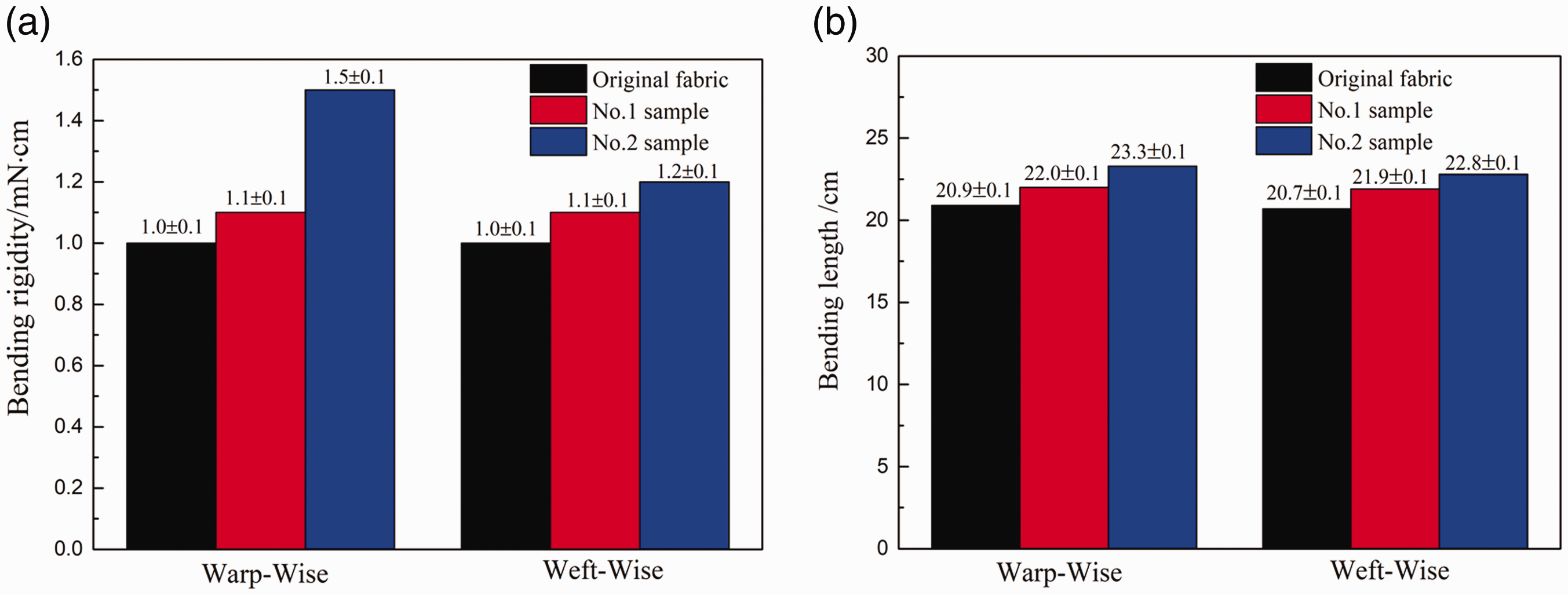
Bending property results of the samples coated with Ag/TiO2 composite films (a) Bending rigidity; (b) bending length.
Figure 8 illustrated that, after depositing Ag/TiO2 composite films, the bending rigidity and the bending length of the sample had a slight increase. It indicated that the bending property of the deposited polyester fabrics had a certain decline. Moreover, the difference of the bending property between its warp and weft was small, indicating Ag/TiO2 composite films deposited on the fabrics evenly. The reason for the decrease in bending property was that the Ag/TiO2 composite films deposited on the fabric, resulting in an increase in the mass per unit area of the fabrics and a harder hand.
Functional properties analysis
The antistatic property of the samples is demonstrated in Table 6.
Antistatic property of the samples.

It can be seen from Table 6 that the deposited samples all had better antistatic effect than that of the original fabrics due to the effect of the underlying Ag, and the antistatic properties of the deposited samples can meet the technical requirements of grade C. It indicated that the antistatic properties of the deposited fabrics were increased greatly compared with the polyester fabrics.
The anti-ultraviolet property of the samples is shown in Table 7.
Anti-ultraviolet property of the samples.

It was observed from Table 7 that the anti-ultraviolet properties of the deposited polyester fabrics were obviously better than that of polyester fabrics. The T(UVA) and T(UVB) values for No.1 and No.2 samples were less than 5%, and the UPF values were close to 30.
Table 8 shows the test results of the antibacterial properties of the samples.
Antibacterial property of the samples.

It can be seen from Table 8 that the deposited samples prepared by different methods have a bacteriostasis rate of 99.95% and have a very good antibacterial effect. According to GB/T20944.3 2008, as long as the inhibition rate reaches 70% or more, it is an antibacterial fabric. Therefore, it can be concluded that the deposited samples prepared by DC and DC/RF reactive sputtering all have excellent antibacterial properties.
In summary, polyester fabrics coated with Ag/TiO2 composite films prepared by DC sputtering and DC/RF reactive sputtering have excellent antistatic properties and antibacterial properties and belong to antistatic and antibacterial products. Although the anti-ultraviolet properties do not meet the standards, they are obviously better than polyester fabrics.
Conclusions
Adopting industrialized production of magnetron sputtering continuous automatic production line, the surface of polyester fabrics was coated with Ag/TiO2 composite films prepared by DC sputtering and DC/RF reactive sputtering methods. Structural colors are presented on the fabrics surface, and the rule of structural coloration was consistent with the single-layer film interference principle.
Polyester fabrics coated with the Ag/TiO2 composite films showed excellent soaping fastness and poor rubbing fastness. After depositing the composite films on the surface of fabrics, the tensile property and tearing property all had a certain decline, but the drop was small and did not affect the wear performance of the fabric later. Compared with the original polyester fabrics, the air permeability, moisture permeability and hand feeling of the deposited samples all slightly decreased, and also did not affect the comfortable properties of the fabrics in later use. The fabrics coated with the Ag/TiO2 composite films had excellent antistatic properties and antibacterial properties, and the anti-ultraviolet property was obviously better than that of polyester fabrics.
Footnotes
Declaration of conflicting interests
The author(s) declared no potential conflicts of interest with respect to the research, authorship, and/or publication of this article.
Funding
The author(s) disclosed receipt of the following financial support for the research, authorship, and/or publication of this article: The work is financially supported by the following funds: Fujian Natural Science Foundation Project (No.2018J01543), Fujian Science and Technology Plan Foreign Cooperation Project (No. 2019I0101), and National Natural Science Foundation of China(No.51706092).
Authors' Note
Qufu Wei is also affiliated with Fujian Key Laboratory of Novel Functional Textile Fibers and Materials, Faculty of Clothing and Design, Minjiang University, Fuzhou, China.
