



Abstract
This study systematically investigates breast motion dynamics during running, jumping rope, and high knee skips to inform sports bra design. Using motion capture, researchers analyzed three-dimensional breast movement. MATLAB analysis revealed distinct displacement patterns: running showed an irregular horizontal figure-eight trajectory, jumping rope had a vertically elongated path, and high knee skipping resembled a butterfly shape. Under braless condition, high knee skipping resulted in the greatest breast displacement, with notable superior-inferior (68.54–74.89 mm) and medial-lateral (47.02–65.99 mm) movements, while jumping rope showed notable superior-inferior (47.88–63.69 mm) but minimal medial-lateral (9.08–14.05 mm) displacement. Running had the least superior-inferior displacement (9.73–36.61 mm) but considerable medial-lateral movement (15.72–49.17 mm). Running’s medial-lateral displacement is 1.5 times superior-inferior; jumping rope’s superior-inferior is five times medial-lateral; high knee skipping is balanced at 0.8 times superior-inferior. Higher exercise intensities increased breast motion, most prominently in running. High knee skipping generated the highest breast accelerations up to (medial-lateral: 1.52g; superior-inferior: 4.18g), while jumping rope (medial-lateral: 0.48g; superior-inferior: 4.06g) and running (medial-lateral: 1.1g; superior-inferior: 2.65g) followed. Displacement and acceleration wearing low-support and high-support sports bras were also examined. Sports bras should offer activity-specific support: medial-lateral for running, superior-inferior for jumping rope, and multidirectional for high knee skipping, with adjustability.
Introduction
With the rising global involvement of women in sports and fitness activities, a comprehensive understanding of breast movement dynamics is becoming essential for the design of efficacious supportive clothing to prevent discomfort and injuries. Active women often experience varying levels of breast discomfort during different physical activities, which can hinder their full participation in sports. 1 By studying how breasts move during exercise, researchers can develop better sports bras that offer support, ensuring the well-being of the breasts.
When breast displacement and acceleration surpass the body’s stabilizing capacity, excessive breast movement can lead to discomfort, pain, and even tissue damage if not properly addressed. 2 Breast movement is a complex process affected by factors like individual differences in anatomy and the type and intensity of activities. During exercise, breasts can move in multiple directions—vertically, horizontally, and laterally—resulting in a three-dimensional displacement pattern. To track breast movement, displacement, and acceleration, researchers employ infrared cameras3–5 or 3D motion capture systems6–8 with reflective markers. Previous studies on breast motion have primarily focused on running, revealing intriguing findings such as the resemblance of breast motion trajectory to closed butterfly wings in braless conditions. 9 During unsupported treadmill running studies, research has shown that breast movement in relation to the torso ranges from 4.2 to 11 cm vertically, 1.8 to 6.2 cm mediolaterally, and 2.2 to 5.9 cm antero-posteriorly.2,6,10–14 In terms of acceleration, Scurr et al. measured vertical breast displacement during braless running, noting a vertical acceleration of 4.87g. 14 At a running speed of 10 km/h, the peak vertical acceleration of the breast was recorded at 2.8g. 10 Further research by Haake and Scurr indicated that at the same running speed, the vertical acceleration at the nipple reached 4.1g. 8 Displacement and acceleration are the primary kinematic parameters directly linked to breast motion and sports bras design.8,13,15
Recent scholarly endeavors have extended the examination to activities like jumping, agility tasks, 16 jumping jacks, 17 golf, 18 and yoga, 19 shedding light on breast motion variations across sports and underscoring the significance of sport-specific movements. Despite these efforts, there is a pressing need for comprehensive analyses comparing breast motion across diverse activities and intensities. Given the extensive discussion on the importance of wearing suitable breast support attire during physical activities in previous studies, 20 it is crucial to understand the dynamics of breast motion and displacement in various sports. This study can assist in identifying the unique support requirements for each activity, potentially leading to the need for specialized bra features tailored to individual sports rather than the traditional classification into low-, medium-, and high-support sports bras. Such insights could facilitate the development of sports-specific sports bras tailored to cater to the specific needs of athletes across a wide range of sporting disciplines.
This study aims to systematically compare breast motion patterns across various activities and intensities to inform the design of more effective sports bras. Leveraging advanced motion capture technology and intricate biomechanical analyses, the research aims to quantify breast trajectory, relative displacement, and acceleration during activities including running, jumping rope, and high knee skips under varying conditions of braless, low-support, and high-support bra utilization. Their diverse features and design elements affecting breast control effectiveness will also be explored. By gaining a better understanding of breast motion across various sports, the findings provide unique and valuable insights for sports bra design.
Experiment and methods
Experiment
In this study, six female participants aged 24–30 years, with a bra size of 80C (metric sizing system), were recruited. The participants’ heights ranged from 160 to 168 cm, body mass from 58 to 60 kg, and body mass indices (BMI) from 21.5 to 23.4. Prior to participation, all subjects provided written informed consent and the study received ethical approval from the Human Subjects Ethics Sub-committee of the university of the first author (Approval No. HSEARS20211012001).
The experiment was designed to compare breast motion across various activities, including running, jumping rope, and high knee skipping at different intensities, as detailed in Table 1. Running, integral to sports like track, soccer, and basketball, aids understanding of breast motion during forward locomotion. Jumping rope, used in boxing and gymnastics, highlights vertical breast motion. High knee skipping, used in warm-ups, reveals breast displacement under multidirectional forces. These activities were selected for their commonality in daily movements and their regular, comparable movement patterns in athletic and fitness activities. The selection of activities and their intensity levels was determined based on existing literature.21–26 Running was performed on a treadmill, while the frequencies of jumping rope and high knee skipping was regulated using a metronome. During the experiment, VICON Vero motion capture system (Nexus 2.15, UK), equipped with 12 digital cameras capable of capturing 120 frames per second, was utilized to collection breast motion data. Figure 1 shows the motion capture marker positions on a braless body according to established protocols.5,10,27,28 The three-dimensional displacement of the nipple markers was tracked in the global coordinate system (GCS) and subsequently transformed into the local coordinate system (LCS) of the torso. The LCS was established with the suprasternal notch (STN) as the origin. The M-L, A-P, and S-I axes represented medial-lateral, anterior-posterior, and superior-inferior directions, respectively. 5 Participants were instructed to maintain each activity for 30 s. To investigate the effectiveness of different sports bras, three conditions were conducted with the participants including braless, wearing a high-support sports bra, and a low-support sports bra. The two commercially available sports bra samples were selected based on their claimed impact levels. The high-support sports bra was designed for high-intensity activities, featuring encapsulation support, reinforced seams, and a fabric composed of 79% nylon and 21% spandex, ensuring durability and stretch. In contrast, the low-support sports bra is intended for activities of lesser intensity, characterized by a compression style and lighter materials, made from 90% Lyocell and 10% spandex, providing a soft, breathable feel. Bra samples are illustrated in Figure 2, and scanned images of subject wearing are shown in Figure 3. Flat measurements and design features of bra samples are shown in Table 2. Prior to the experiments, each participant was well-fitted with both bras, ensuring proper sizing and comfort to minimize the difference between markers and breasts. The subjects’ breasts were considered symmetrical. Only left breast kinematics were calculated referring to the previous research.15,29
Experimental scheme setup.


Motion capture marker positions on a braless body.
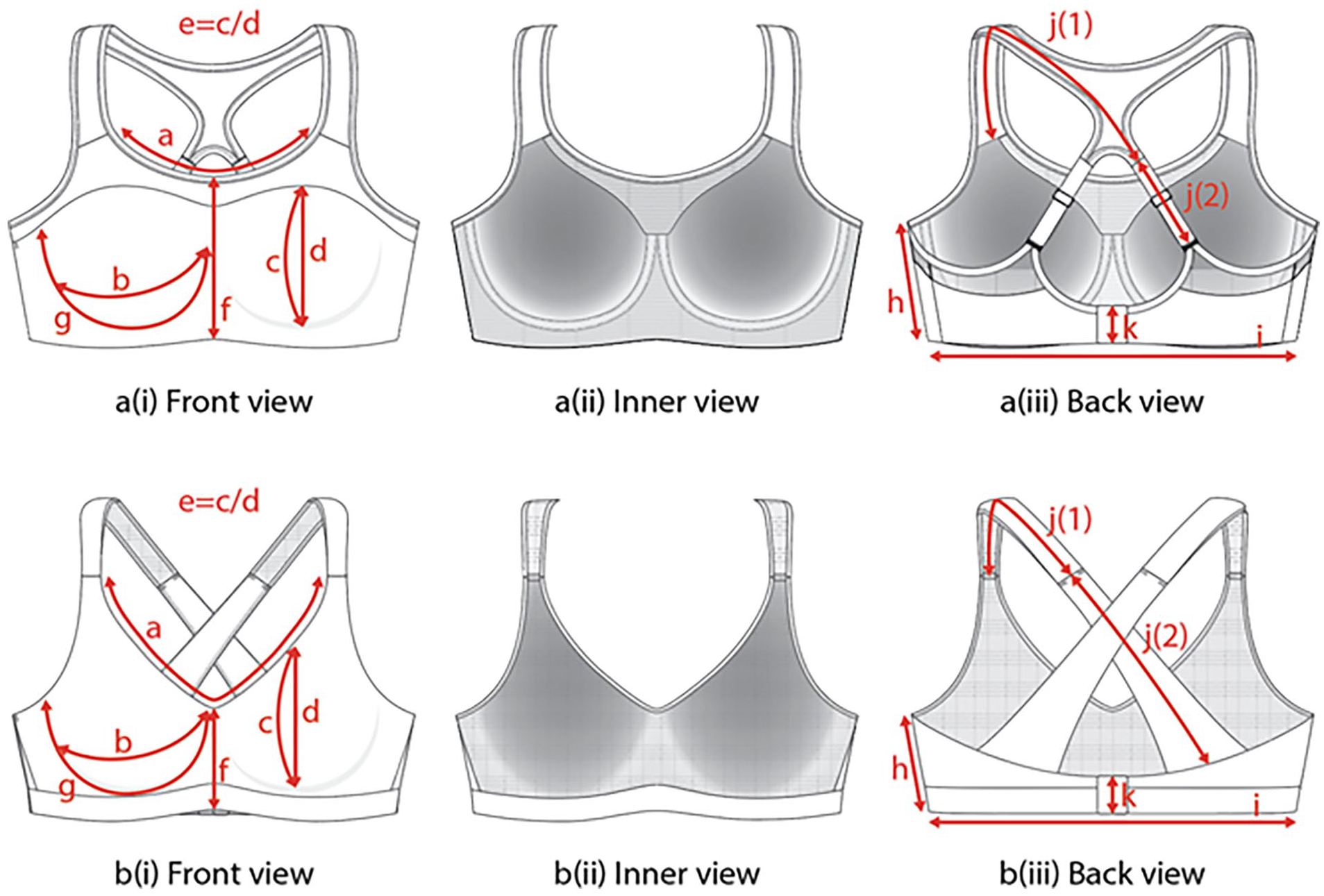
Illustration in front, inner, and back views for (a) high-support and (b) low-support sports bra samples.
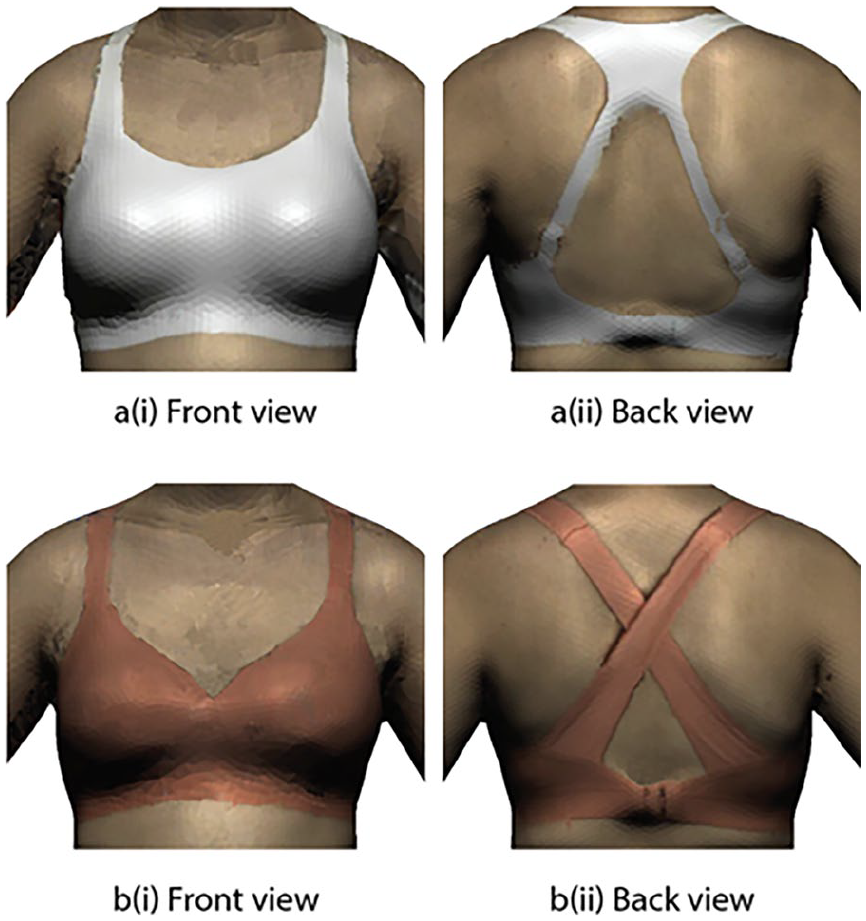
Scanned images of subject wearing (a) high-support (a(i) front view and a(ii) back view) and (b) low-support sports bra samples (b(i) front view and b(ii) back view).
Flat measurements and design features of two bra size samples.

Data processing
Motion data from markers were collected using a motion capture system and processed with MATLAB (2020, US). Previous studies4,13 and pilot data suggested that breast movements during these three activities mainly occur in the superior-inferior and medial-lateral directions. The anterior-posterior (A-P) motion is minimal and less variable, contributing less to overall displacement and acceleration. Hence, the analysis focused on the primary superior-inferior and medial-lateral directions for clarity and relevance. Initially, the data were denoised using a low-pass filter, specifically a zero-lag fourth order Butterworth filter with a cutoff frequency of 6 Hz.30,31 To define a local coordinate system, three non-collinear markers (STN, Rrib, Lrib) on the torso were utilized. A virtual midpoint was established between the anterior inferior ribs (Rrib, Lrib), extending to the suprasternal notch (STN), creating the superior-inferior (S-I) and medial-lateral (M-L) axes. Subsequently, an anterior-posterior (A-P) axis was formed by generating a normal vector perpendicular to the triangular plane with the suprasternal notch (STN) as the origin. 32 The relative displacement (r) of the breast nipple, defined as its displacement relative to the torso LCS, 16 was calculated by subtracting the suprasternal notch (STN) displacement from that of the nipple, see equation (1).

Where DNipple and DSTN represent the displacement of the breast nipple and suprasternal notch, respectively. As defined by equation (2),
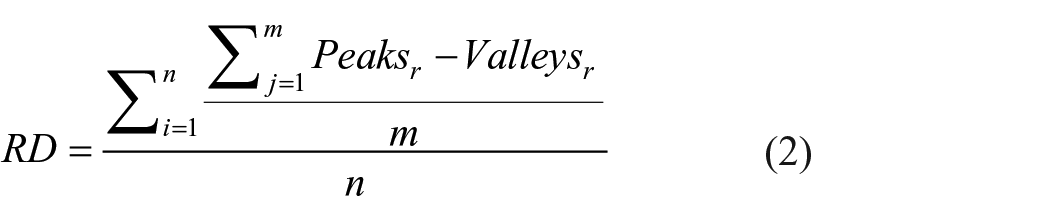
Where m denotes the number of motion cycles, and n is the number of subjects. The peaks and valleys were identified as the maximum and minimum displacements points within each motion cycle. Peaks r and valleys r in the relative displacement (r) were identified using the “findpeaks” function method. The average relative displacement of the nipple was determined by averaging the differences between these peaks and valleys. The overall average relative displacement (RD) was then calculated across all subjects. Subsequently, numerical differentiation methods were utilized to determine breast acceleration (a). As shown in equation (3), this process involves numerically differentiating the displacement (D) with respect to time (t), specifically by calculating the second derivative to obtain acceleration. The accuracy of these measurements was assessed using the mean absolute error (MAE). 33

To examine the functions of sports bras during breast motion, the motion constraint percentage (MCP) was defined as an index to describe their capacity to reduce or limit breast motion. In equation (4), the absolute difference in breast relative displacement (RD) with and without a sports bra was calculated. This difference is then divided by the displacement observed under braless condition to obtain the motion constraint percentage of relative displacement (MCPRD). 34 As presented in equation (5), the motion constraint percentage for acceleration (MCPa) was utilized to quantify the effectiveness of sports bras in limiting breast acceleration.


Results and discussion
Comparisons of trajectories of breast under different activities and intensities
The predominant breast motion during these three activities primarily occurs in the medial-lateral (M-L) and superior-inferior (S-I) directions. As illustrated in Figure 4, the motion trajectories of a subject’s breast nipple vary across different activities and intensities. During running, the trajectory resembles an irregular horizontal figure-eight, with displacement boundary ranging from 50 to 100 mm in the medial-lateral direction and from 40 to 110 mm in the superior-inferior direction. In contrast, the motion trajectory during jumping rope is circular, with minimal displacement in the medial-lateral direction (less than 20 mm) and notable displacement in the superior-inferior direction, ranging from 180 to 260 mm. This indicates that movement during jumping rope is predominantly concentrated in the superior-inferior direction, resulting in a vertically elongated and narrow trajectory. During high knees skipping, the motion trajectory resembles a butterfly or a four-petaled flower, with displacement ranging from 40 to 90 mm in the medial-lateral direction and from 230 to 260 mm in the superior-inferior direction. When observing the constraints of sports bras on breast displacement, it is evident that the movement trajectory when wearing a sports bra shows notable reductions in two directions.

Motion trajectories of breast nipple under different intensities of running (a–c), jumping (d–f), and high knee skipping (g–i).
Comparisons of relative displacement of breast under different activities and intensities
Figure 5 shows the average relative displacement (RD) of breast nipple under different activities and intensities. It also compares the relative breast displacement in the medial-lateral (M-L) and superior-inferior (S-I) directions under braless condition, low-support and high-support conditions.
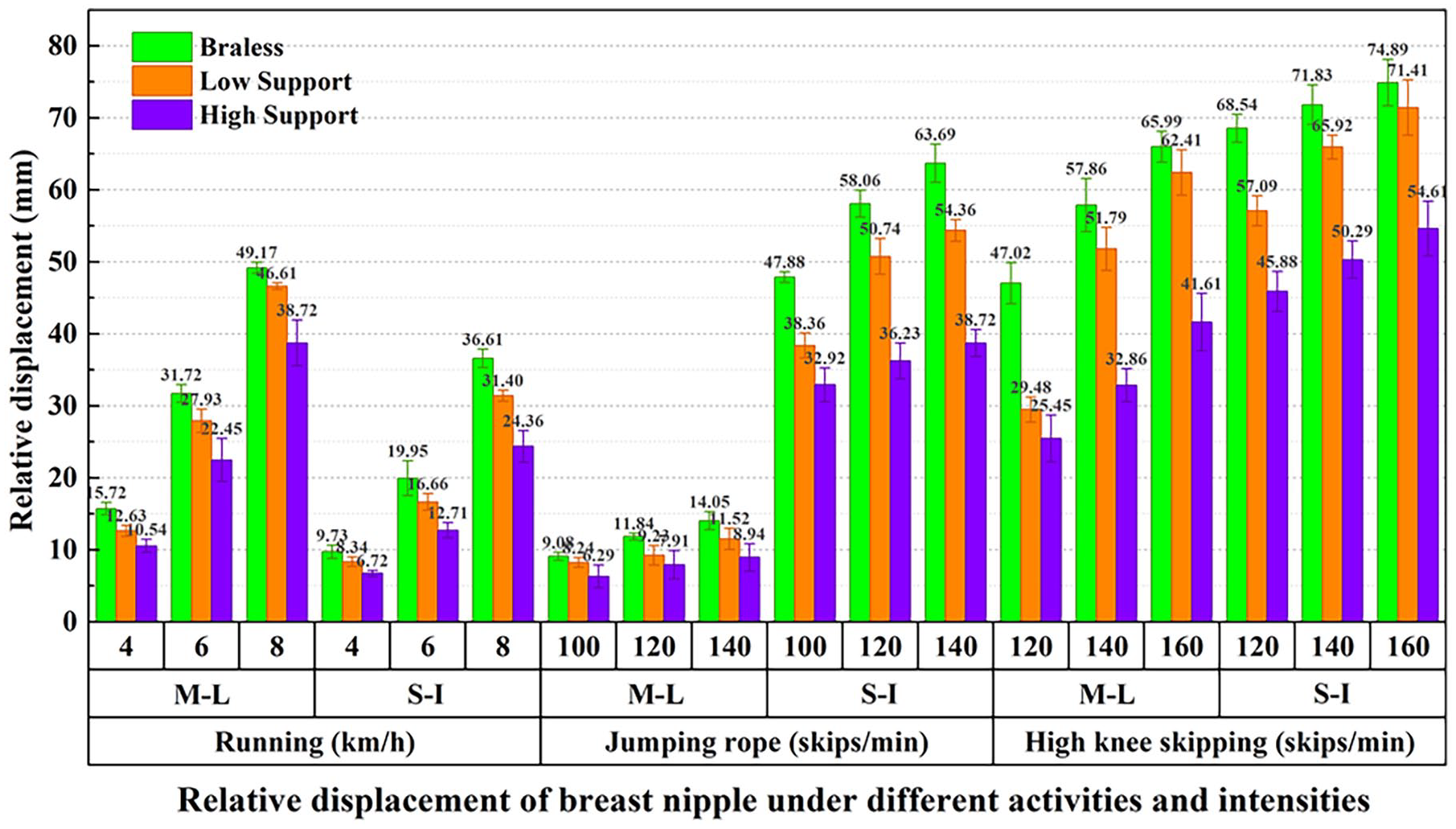
Average relative displacement of breast nipple under different activities and intensities.
Comparative analysis of relative displacement of breast under braless condition
Firstly, under braless condition, in the superior-inferior (S-I) direction, high knee skipping causes the greatest relative breast displacement (68.54–74.89 mm), followed by jumping rope (47.88–63.69 mm), while running results in the smallest displacement (9.73–36.61 mm). In study of Risius et al., 16 the vertical displacement during running was recorded at 50 mm, while jumping resulted in a displacement of 87 mm. Other studies report running displacements of 26–49 mm at 5–10 km/h, 29 35–46 mm at 4–7 km/h, 8 and 78 mm.2,14 In the medial-lateral direction, high knee skipping causes the greatest relative breast displacement (47.02–65.99 mm), followed by running (15.72–49.17 mm), while jumping rope results in the smallest displacement (9.08–14.05 mm). Previous study from Risius et al. 16 shows mediolateral displacements of 60 mm during running and 47 mm during jumping. Other studies have shown mediolateral displacements ranging from 18 to 62 mm2.6,11–14 Overall, in this study, high knee skipping result in the greatest relative breast displacement in both directions, indicating the most intense breast motion among the activities studied.
Secondly, the relationship between relative breast displacement (RD) in the medial-lateral (M-L) and superior-inferior (S-I) directions was analyzed for each activity. For running, the average of relative displacement from three intensities levels in the medial-lateral direction is approximately 1.5 times that in the superior-inferior direction. This indicates that during running, the mediolateral (side-to-side) displacement of the breast is greater than the S-I (up-and-down) displacement. Nonetheless, other published studies suggest that S-I displacement slightly exceeds M-L movement. Our results may be influenced by factors such as breast morphology and individual running styles, including the pronounced and excessive M-L swaying exhibited by some participants. In contrast, for jumping rope, the superior-inferior displacement is about five times greater than the medial-lateral displacement, with the medial-lateral direction displacement being only 0.2 times that of the superior-inferior direction. This suggests that S-I movement is the dominant motion during jumping rope. In high knee skipping, the medial-lateral displacement is approximately 0.8 times the superior-inferior displacement, indicating that while S-I movement is slightly more pronounced, the breast experiences relatively similar degrees of movement in both directions.
Thirdly, the influence of exercise intensity on relative breast displacement (RD) has been systematically examined. As running speed increases, there is a corresponding increase in relative breast displacement, demonstrating a direct proportional relationship between speed and displacement. In jumping rope, an observable trend shows that as the frequency increases, there is a corresponding rise in relative breast displacement, indicating that higher frequencies lead to greater displacement. Similarly, in high knee skipping, increased frequency leads to greater breast displacement. Overall, increased relative breast motion are associated with higher exercise intensities, with the most pronounced effects observed in running, followed by rope skipping, and the least impact noted in high knee skipping.
Comparative analysis of motion constraint in breast relative displacement between low-support and high-support sports bra conditions
Wearing low-support and high-support sports bras noticeably decreases relative breast displacement (RD). The motion constraint percentage of relative displacement (MCPRD) was used to describe the capability to effectively constrain movement and reduce deformation during exercise. The MCPRD for medial-lateral direction, superior-inferior direction and the averages in low-support and high-support sports bra conditions during the three activities is presented in Table 3. This data highlights the differences in motion control provided by the two types of bras across various physical activities.
MCP RD under low-support and high-support sports bra conditions.

When comparing the three activities, the constraint effect of the high-support sports bra is more pronounced than that of the low-support sports bra in both the medial-lateral and superior-inferior directions. On average, the high-support sports bra demonstrates the highest constraint effect during high-knee skipping, while the low-support sports bra shows the greatest effect during jump rope.
The performance differences of the two bras may be attributed to their distinct design features, despite being categorized by impact levels. In the medial-lateral direction, both low- and high-support bras provide the most constraint during high knee skipping (17.74% and 42.01% respectively), and the least constraint during running (12.26% and 27.29% respectively). In the superior-inferior direction, both bras achieve the highest constraint during jump rope (15.71% and 36.01% respectively) and the least during high knee skipping (9.86% and 30.04% respectively). Despite their support level categorization, they show similar breast control performance across the three tested activities. Their differences in design features and construction that contribute to the varying support levels are notable. The high-support bra features a higher round neckline (with a center front height of 15.8 cm), which provides additional support compared to the low-support bra, which has a lower V-neckline and a center front height of 11.4 cm. In terms of support structure, the high-support bra includes encapsulation support and reinforced seams, designed to minimize movement during vigorous activities. In contrast, the low-support bra employs a compression style with running stitch finishing, lacking the binding that offers additional support. Additionally, the high-support bra is designed with a Y-back that includes adjustable shoulder straps, allowing for a customized fit, while the low-support bra has a simple non-adjustable cross-back design. These construction differences collectively enhance the performance of the high-support bra in providing greater breast control during physical activities.
Regarding the exceptional constraint effect in the medial-lateral direction for the high-support bra (42.01%), it is believed that the relative nipple displacement in the braless condition is exceptionally high during high knee skipping, making the constraint effect more noticeable when wearing the bra. Conversely, the lowest constraint effect in the superior-inferior direction (9.86%) for the low-support bra can be explained by the fact that the relative nipple displacement during high-knee jumping is greater than during jump rope, which suggests that the bra is less capable of controlling the higher displacement, resulting in a less effective constraint during high knee skipping compared to jump rope where the displacement force is lower. This finding highlights the importance of investigating how specific bra features affect motion control in the medial-lateral and superior-inferior directions during different activities, as these effects may vary due to the distinct body motion patterns involved in each sport.
Comparisons of acceleration of breast under different activities and intensities
Figure 6 illustrates the maximum accelerations within the breast motion cycle across various activities of differing intensities. Typically, in the superior-inferior direction, the maximum acceleration occurs at the moment when generating huge impact force, with the negative acceleration (braking). 35 In the medial-lateral direction, due to the symmetry of motion and breasts, the acceleration direction has no effect. Without sports bras, during running, the acceleration ranges from 0.39 to 1.1g in the medial-lateral (M-L) direction and from 0.48 to 2.65g in the superior-inferior (S-I) direction. During jumping rope, these ranges are 0.31–0.48g in the medial-lateral direction and 2.38–4.06g in the superior-inferior direction. Consistent with previous research, Haake and Scurr 8 reported that vertical acceleration ranges from 0.4 to 2.2g at running speeds between 4 and 7 km/h. Other works shows that during running, acceleration reached 2.04g in the mediolateral direction and 4g in the vertical direction. During jumping, acceleration reached to 3.06g mediolaterally and 4.28g vertically. 16 For high knee skipping, as shown in Figure 6, the acceleration ranges are 1.0–1.52g in the medial-lateral direction and 2.73–4.18g in the superior-inferior direction. High knee skipping exercises produce the highest breast accelerations, followed by jumping rope, with running resulting in relatively lower breast accelerations. Additionally, acceleration increases with the intensity of the exercise.

Maximum acceleration of breast nipple under different activities and intensities. (a) Acceleration in medial-lateral (M-L) direction; (b) acceleration in superior-inferior (S-I) direction.
When wearing sports bras, there is a reduction in the acceleration of breast motion, which is defined as motion constraint percentage for acceleration (MCPa). Analyzing the average effects across three types of exercises shows that low-support sports bras reduce breast motion acceleration by 18.66%, while high-support sports bras achieve a reduction of 33.70%. This indicates that high-support bras are more effective in limiting breast motion acceleration compared to low-support bras.
Potential applications and limitations
This finding underscores the importance of exploring how specific bra features influence motion control directions across different activities, as these effects may vary due to the unique body motion patterns and breast movement dynamics associated with each sport. Running exhibits irregular figure-eight motion with notable medial-lateral displacement (15.72–49.17 mm) surpassing superior-inferior movement (9.73–36.61 mm). Lateral motion dominates, with notable superior-inferior accelerations (up to 2.65g) and medial-lateral accelerations (up to 1.1g). Sports bras designed for running should emphasize medial-lateral support and lateral stability. Key features such as side panels, shoulder strap width, back style, and adjustable elements effectively mitigate side-to-side motion. Reinforced side panels help restrict lateral movement, while wider shoulder straps and a higher back neck drop help distribute weight evenly, reducing pressure points and improving comfort while enhancing stability. Adjustable components allow wearers to customize support levels, accommodating varying degrees of lateral movement during acceleration. Jumping rope produces a circular trajectory, with dominant superior-inferior displacement (47.88–63.69 mm) and accelerations (up to 4.06g), while medial-lateral displacement (9.08–14.05 mm) and accelerations (up to 0.48g) are minimal. Sports bras designed for jumping rope should prioritize restricting superior-inferior motion. Encapsulation cups individually support each breast effectively reducing superior-inferior motion and minimizing bounce. A strong and snug underband is critical to anchor the bra and limit upward or downward movement that could lead to discomfort or distraction. Materials with viscoelastic properties could help dissipate forces from the high superior-inferior accelerations through cushioning effect. High knee skipping exhibits a butterfly-like trajectory with superior-inferior (68.54–74.89 mm) and medial-lateral (47.02–65.99 mm) displacement, producing high superior-inferior (up to 4.18g) and medial-lateral (up to 1.52g) accelerations. Bras for high knee skipping should emphasize multidirectional support, combining superior-inferior compression with reinforced lateral stabilization to manage forces. A hybrid design with compression for lateral motion and encapsulation for superior-inferior displacement is ideal. Adjustable shoulder straps can control displacement. Materials with dynamic stretch, like auxetic fabrics, adapt to the multidirectional breast motion inherent in high knee skipping. This flexibility ensures that the bra maintains its supportive structure without restricting movement. Furthermore, the study’s observation that increased exercise intensity correlates with greater breast displacement suggests that sports bras should be designed with adjustable support levels, allowing users to customize fit and support based on activity intensity. Overall, these insights can guide the development of sports bras that are not only activity-specific but also adaptable to varying intensity levels, enhancing both performance and comfort for users.
The limitations of this study include a small sample size of only six participants, which restricts the generalizability of the findings. The lack of diversity in terms of age and body type may appreciably influence breast motion patterns. The focus on only three activities further limits the scope of understanding breast motion across various sports and exercises. Moreover, only one sample of high-support and low-support sports bras was tested, which restricts the ability to fully investigate the effects of specific bra features on particular sports activities. Variations in bra design features, such as strap configuration, underband structure, and material composition, were not fully explored.
To address these limitations, future research should include a larger and more diverse cohort of participants to enhance the generalizability of the results and account for variations in breast motion due to different body types. Additionally, investigating a broader range of physical activities, including those with varying support levels, could provide a more comprehensive understanding of breast motion and the corresponding support needs. Future studies should also include a broader range of sports bras with varying designs to identify the features that optimize performance for specific activities.
Conclusion
This study investigated and compared breast motion across various activities and intensities, specifically focusing on running, jumping rope, and high knee skips at different intensity levels, using motion capture technology. The analysis of breast kinematics reveals distinct displacement patterns. Running creates an irregular horizontal figure-eight trajectory, while jumping rope results in a vertically elongated path, emphasizing superior-inferior motion. High knees skipping forms a butterfly or a four-petaled flower trajectory, indicating balanced displacement. The analysis of relative displacement illustrates that high knee skipping leads to the greatest breast displacement, with maximum superior-inferior and medial-lateral movements, respectively. Jumping rope follows with considerable superior-inferior displacement but minimal medial-lateral movement, while running exhibits the smallest superior-inferior displacement but a high medial-lateral displacement. The study finds that running’s medial-lateral displacement is about 1.5 times its superior-inferior, whereas jumping rope’s superior-inferior movement is five times its medial-lateral. High knee skipping shows a balanced displacement, with medial-lateral movement at 0.8 times the superior-inferior. Additionally, higher exercise intensities lead to increased breast motion, most notably in running, followed by rope skipping, and least in high knee skipping. High knee skipping generates the highest breast accelerations, followed by jumping rope. Running results in lower accelerations. Furthermore, breast acceleration increases with exercise intensity. The study also demonstrated that both low-support and high-support sports bras considerably reduce breast displacement and acceleration, with high-support bras consistently providing superior constraint and support across activities, particularly during high-intensity movements. This study’s findings can guide sports bra design by emphasizing tailored support for specific activities, benefiting researchers, designers, and healthcare professionals focused on improving women’s sportswear and well-being.
Footnotes

Author contributions
J.C., K.Y.C. and K.Y. conceived and drafted the manuscript. J.C. and K.Y.C. conducted the experiments and data analyses. K.Y., Y.S. and J.Y. oversaw the conceptualization, manuscript editing, and secured funding support. All authors reviewed the manuscript.
Funding
The author(s) disclosed receipt of the following financial support for the research, authorship, and/or publication of this article: This work received financial support from the Research Grant Council for funding this research project through project account PolyU 15606922; and partially supported by The Hong Kong Polytechnic University (project code: WZ21), Hong Kong.
Declaration of conflicting interests
The author(s) declared no potential conflicts of interest with respect to the research, authorship, and/or publication of this article.
Data availability statement
The datasets used and analyzed during the current study are available from the corresponding author upon reasonable request.