




Abstract
The interpretation of pressure between a sports bra and the skin is highly significant to females, marketers, and designers because it helps reduce discomfort. So far, many studies on sports bras pressure have focused mainly on static activities such as standing or sitting and dynamic activities such as jumping, walking and running, skipping, and jogging that cause vertical movement of the body. Therefore, this study focuses on upper body torsion rather than vertical or horizontal motion. The objective is to identify and compare factors that restrict females with large breasts from playing golf using two types of sports bras, an Encapsulation and Compression sports bras. The Novel Pliance-X® pressure system assessed the contact pressures from the shoulder straps, underbust, and backband. The results demonstrated that the underband of both sports bras generated less pressure than other features, while the backband of sports bras produced more pressure. It was concluded that the encapsulation sports bra with a racerback design has acceptable results for females with larger breasts when playing golf.
Introduction
Most females have noticed the importance of protecting their breasts during physical activities and pay more attention to their comfort. Yanmei et al. 1 suggested that the increase in the use of stretchy clothing has led to clothing pressure,2,3 which is the central aspect of comfort to consumers and designers. According to Zhu, 4 the pressure comfort of sports bras is the main influencing component of all-inclusive pressure. Due to the higher need for comfort, researchers need to emphasize comfort to identify and solve the problems that lead to sports bra discomfort. Putting on undergarments that suit one’s figure and size is essential.5,6 Although immoderate sports bra pressure can affect physical and mental health, such as blood flow, pressure on veins, and difficulty breathing of individuals, the right bra can mitigate these problems.7,8 To add to it, literature has highlighted the significant features of sports bras for females.9 –12 An appropriate sports bra can produce good breast support.
Sports bras are divided into three major varieties: (1) compression, (2) encapsulation sports, and (3) a combination of both bras. The design features for compression sports bras provide support by constantly compressing both breasts against the chest wall. 13 In contrast, an encapsulation sports bras have two separate bra cups that surround the breast and give support14,15 while the third type of sports bra consists of both the features of encapsulation and compression sports bras. These sports bras are designed to decrease discomfort and improve support to the breast while in motion. 16 Previous studies have shown that in comparing garment pressure in compression and encapsulation sports bras, the pressure in compression bras has extremely high movement purposes. Even so, Bowles et al. 17 claimed that compression sports bras with a shallow neckline limit the upper movement of the breast therefore, it provides comfort to wearers. Starr et al. 15 investigated vertical breast displacement in the two main types of sports bras. They found that compression sports bras have a higher level of vertical breast displacement than encapsulation sports bras. They identified that sports bras with encapsulation and compression design features reduce vertical displacement. Also, McGhee and Steele 18 noticed a remarkable drop in breast discomfort in women who put on compression and encapsulation sports bras but found no significant difference in the vertical displacement of the breast or its velocity when both bras were compared. 19 In comparing standard fashion bras or crop tops with encapsulation sports bras with molded cups, it has been found that encapsulation sports bras with molded cups generates more comfort and produces less breast pain. A survey done by Bowles et al. 20 shows that (267 women aged 20–35 years) uses encapsulation sports bras during physical activities. They concluded that consumers don’t have much interest in sports bras because they feel the design of the current sports bras isn’t comfortable enough therefore the design of sports bras should be improved. Education might be a good way to improve the usage of sports bras.
Nevertheless, White et al. 21 reported no notable difference between the two sports bras in comparing the vertical movement of the breast. However, it was noted that the combination of both sports bra features was a practical approach to reducing discomfort in breast support for women with larger breasts. 16 Furthermore, Verscheure et al.22 –24 claimed that compression sports bras are more comforting for females with smaller breasts while encapsulation sports bras are more effective for larger breasts (bra size C and above).
Sports bras have been invented as a structure of external aid to reduce unnecessary movement and serve as a guide to protect breast tissues. 20 Therefore females who play golf need comfortable and supportive sports bras to help them feel more confident when playing. In-depth knowledge of sports bra features gives marketers and designers an insight into the design specifications and materials properties for minimum pressure, higher comfort, and optimal support. Previous studies show that the waistband is in close contact with the skin; therefore, it maintains the locality of the bra.25,26 Imperfectly fitting sports bras with compressed shoulder straps and unsuitable waistband strains can cause breast pain and skin rash. Zhou et al. 27 assessed the depletion degree of breast displacement during physical activities. They noticed that effective sports bras had combined features: high neckline, cross back, bound neckline, no pad, and a wide adjustable strap.
Other works investigated bra straps and identified that women with bigger breast sizes usually have excessive pressure at the shoulder straps because the large breast is related to pain at the shoulder.28,29 Several researchers8,30 –33 also investigated the effect of sports bra pressure on the human body’s physical response. It has been concluded that the shoulder straps and waistbands contributed to sports bra pressure. Coltman et al. 34 also pointed out that intense pressure at the strap in cross-back orientation may be due to compressed straps.
According to Van, 35 the bra band bears more than 80% of the breast weight; therefore, 36 the waistband should be stretched entirely to withstand descending gravity force, particularly for women with larger breasts. Chen et al. 37 noticed that pressure from the underbust band hindered women during physical activities. Bowles et al. 20 suggested that a wider shoulder strap with enough cushion would increase the comfortability of sports bras. Also, wider shoulder straps escalate the contact surface, allowing even pressure distribution on the body. 38 Therefore, the fiber component (material) used in the strap and band should be entirely elastic, which will provide a substantial degree of elasticity so that the wearer can breathe normally. 34
Due to the limited studies on the back band in both encapsulation and compression sports bras, these studies investigated the pressure distribution of three major features of the encapsulation and compression bra types. Conversely, most researchers compared the two types of bras based on vertical movement. However, this study focused on the torso rotation of the upper body to identify the sports bra that produces more comfort for females with larger breasts (bra size C). It was hypothesized that the encapsulation sports bra with a racerback has a positive impact on females who plays golf and also focus on shoulder and trap workout over the compression sports bra with Y-back.
Materials and method
Study participants
Twenty females with no breast surgery, breastfeeding, or pregnancy history were recruited for this study. The participants had the following mean (±SD) characteristics: age 23.4 ± 3.9 years, body mass 60.4 ± 9.1 kg, and stature of 174.1 ± 8.1 cm. All participants were trained to be familiar with the chosen activity, as shown in Figure 1. Each activity lasted for about a minute per sports bra and was repeated three times. This activity is suitable for ladies who play golf and ladies who are into bodybuilding (arm, shoulder, and back).

Shoulder and strap workout that moves the upper body circularly.
All participants were briefed on the nature of the experiments, and therefore they voluntarily agreed to participate in the experiments. First, participants were interviewed to ascertain the number of times they play golf or shoulder and trap workouts. Confirmation of their bra sizes and whether they used the bra types for this study was done.
Bra sample
This study considered bra size C, the encapsulation sports bra with racerback, and the compression sports bra with Y-back. The structure, design details, and fabric components are shown in Figure 2. These sports bras were selected because previous studies were done on eight different types of sports bras and focused on three distinct movements (horizontal, vertical, and circular). Some participants with bra size C chose the encapsulating and compression bras to be the most comfortable. Hence this study focuses on the subjective test to confirm the previous research and identify the specific sports bra that generates less pressure.
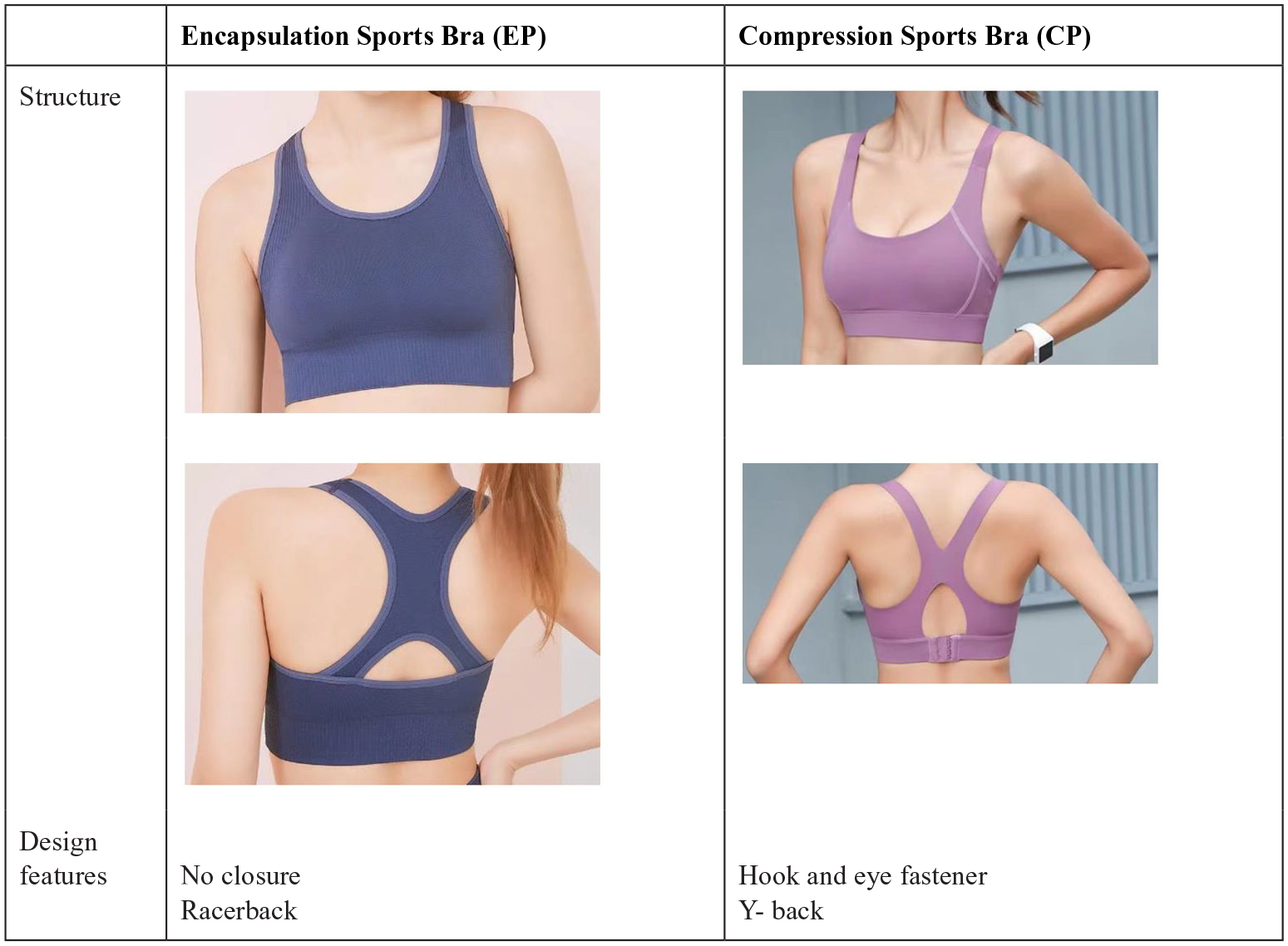
Sports bra type and its features: (a) encapsulation sports bra with racerback is represented as EP and (b) compression sports bra with Y-back is represented as CP.
Pressure analysis was done using the Novel Pliance® pressure machine because most researchers focus on analyzing the two main types of sports bras using different indexes to check the comfortability of the bra but no study has been done on female golfers using pressure index. Additionally, the Novel Pliance pressure machine is made up of a multi-channel analyzer, a calibration device, and a computer device that helps to give the accurate pressure of the human body. The length, strength, and elasticity of the sensors ensure consistency around the contoured area without wrinkling. 39 This device comes in different sensor sizes therefore it can measure different parts of the body. Three pressure sensors were attached on the right side of the participants, namely, shoulder straps, underbust, and backband. All 20 participants took the activity three times, this helped us to get accurate readings of the pressure text because we used standard deviation to confirm the reproducibility and repeatability of the study.
Descriptive statistics were used to measure the mean and standard deviation. The mean and standard deviations were calculated for pressure discomfort caused by the strap, underbust, and the backband. A questionnaire was distributed among female golfers and bodybuilders, 40 females responded to the questions. This study used a histogram to analyze subjective testing. Paired sample Test was further done to compare the sample mean of EP and CP and to check the difference between both sports bras. The paired sample test was then divided into three categories, the strap, underbust, and the backband. We decided to check the difference in groups because of the movement the activity produces. A box chart and line graph were constructed. All data were analyzed using IBM SPSS Statistics 20 software, with results found significant at an alpha level of p < 0.05, and Origin Lab was used to plot the chart and graphs.
Results and analysis
The results for the minimum and maximum values, the mean and standard deviation of the perceived discomfort of each bra component condition are displayed in Table 1. Participants identified the strap of the EP to be more comforting since it generates less pressure with a Mean ± SD of 2.5 ± 1.3 kPa. Meanwhile, participants reported the strap of CP to be discomforting as it produced a Mean ± SD of 3.2 ± 2.4 kPa.
Descriptive statistics of bra pressure when wearing EP and CP.
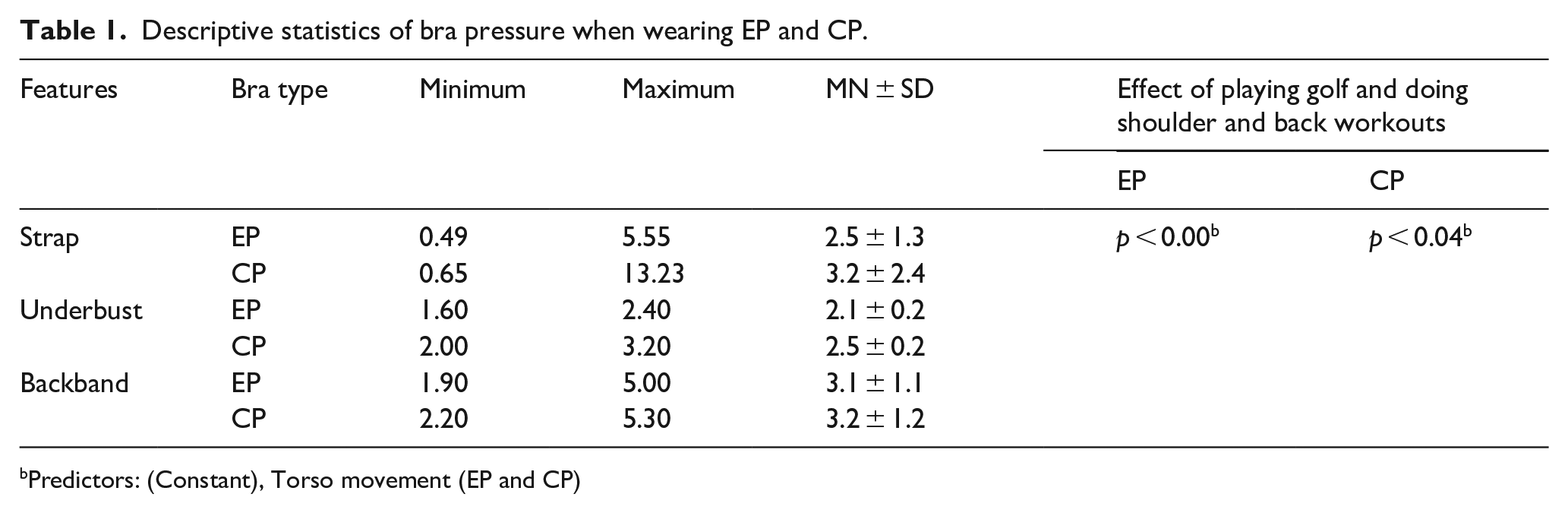
Predictors: (Constant), Torso movement (EP and CP)
In terms of underbust, the participants reported EP to be significantly comforting with a Mean ± SD of 2.1 ± 0.2 kPa while CP was significantly discomforting with a Mean ± SD of 2.5 ± 0.2 kPa.
With regards to the backband, EP still came out as the significantly comforting bra with a Mean ±SD of 3.1 ± 1.1 kPa while CP had more pressure with a Mean ± SD of 3.2 ± 1.2 kPa. Based on the descriptive analysis, the EP generates less pressure when females participate in activities that move the upper body circularly than the CP.
Figure 3 shows the subjective testing of the compression sports bra. Most females strongly agree to use the compression type with no closure (opening at the back) when they are playing golf or working on the shoulder because most of them feel they might get injured from the closure, and the closure has hurt others since most of them are made with steel. However, they also agree that the back design of a sports bra has an impact on comfortability. At the same time, most females strongly disagree that the backband of the compression type generates comfort. Lastly, when it comes to the comfort of the strap and underband, it was identified that most females disagree with the comfort these features provide.

Subjective analysis on the compression sports bra.
As shown in Figure 4, most females strongly agree that the back design of the encapsulation bra significantly impacts comfort. However, they agreed that the underband produces comfort. At the same time, they disagree that the shoulder strap does not slip off. There was a neutral interest in the comfort of the shoulder strap. Additionally, they strongly disagreed that the backband generates more pressure than other features.

Subjective analysis on the encapsulation sports bra.
The perceived comfort of the strap, underbust, and backband shows that there’s no significant difference between encapsulation and compression sports bras. The two sports bras show no difference between the back design, closure, and shoulder strap slipping off. The significant difference between EP and CP at the shoulder strap slipping off generated p = 0.67, while the back closure of the sports bras generated a significant difference of p = 0.77. Also, the back design of the sports bras produced a significant difference of p = 0.80. In as much that all the six variables show no significant difference between the two sports bras, the comfort of the shoulder strap generated a less significant difference with p = 0.24 while the back design generated a higher significant difference with p = 0.80 as shown in Table 2.
The difference in pressure distribution at the shoulder strap at three stages.

EP – CP (SC) — Strap comfort EP – CP (SS) — Strap slipping.
EP – CP (UBC) — Underband comfort EP – CP (C) — Closure.
EP – CP (BBC) —- Backband comfort EP – CP (BD) — Back design.
The box chart results shown in Figure 5 indicate that the EP had an upper quartile of 3.31% at 75% above the strap level, while CP exhibited an upper quartile of 3.57%. The EP showed a lower quartile of 1.53% at just 25% above the strap level, while the CP produced a higher quartile of 1.8%. Also, EP shows a positive skew while CP shows a normal distribution. It indicates that EP made less pressure, making it more comfortable when the shoulder strap is considered during the activity which moves the upper body circularly.
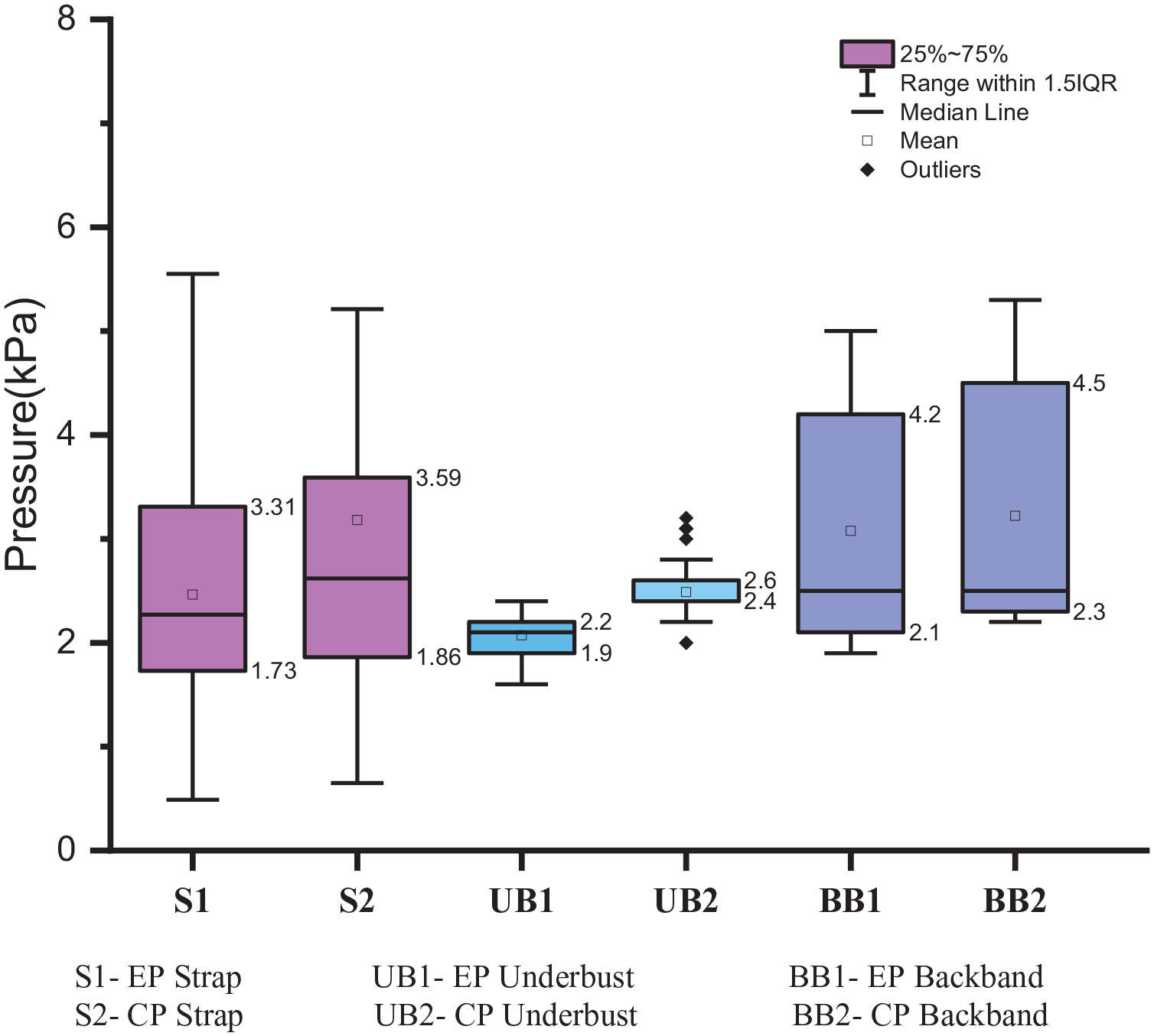
Pressure distribution on the shoulder strap, underbust, and backband.
In comparing the median of both sports bras, UB1 was 2.1 while UB2 was 2.4. It is shown in Figure 5 that the median line of the CP box plot lies outside the EP box plot, which means that there might be a difference between the two sports bras. Therefore further analysis is shown in Table 2. In comparing the interquartile ranges and the whiskers of the box, the results indicate that UB1 had an upper quartile of 2.2, a lower quartile of 1.9, an upper whisper of 2.4, and a lower whisper of 1.6. At the same time, UB2 generated an upper quartile of 2.6, a lower quartile of 2.4, an upper whisper of 2.8, and a lower whisper of 2.2. The analysis shows that the data has less dispersed because the length of the box is small. UB1 shows a left skewness, while UB2 shows a left-skewness. UB1 had a lower interquartile, and the whisker box was also lower than UB. Therefore, EP produces less pressure than CP when considering the underbust.
With the backband, both medians were identified at 2.5, and the median line for both boxes was not higher than the other. Therefore, there is a likelihood to be no difference between both sports bras. The upper quartile for BB1 was 4.2, the lower quartile was 2.1, the upper whisper was 5, and the lower whisper was 1.9, while BB2 had an upper quartile of 4.5, a lower quartile of 2.3, an upper whisper of 5.3, and a lower whisper of 2.2. This analysis shows that the length of the box is long; therefore, the data is more dispersed. Also, both box plots show a positive skewness. In conclusion, there is not much difference between the bras; at the same time, EP shows a better plot than CP because of the interquartile and the whisper of the box.
Table 3 shows the paired sample test for strap, underbust, and backband. The shoulder strap shows a significant mean difference between EP and CP pressure t (52) = 2.03, p < 0.05 because their significant value was 0.04, which is lesser than p = 0.05. The difference in the mean value between EP and CP pressure is 0.72. We can conclude that the mean EP pressure produced at the shoulder strap was lower than the mean CP Pressure. Therefore, we have evidence to show that the mean pressure between these two sports bras differs.
Paired sample test for EP and CP sports bra.

The average mean difference between the two sports bras was 0.42, showing that EP had a lower mean pressure than CP pressure (95% CI [0.52, 0.32]). Additionally, the mean difference between EP and CP is statistically significant at p = 0.005; t (52) – 8.4, p < 0.05. We can conclude that CP produced more pressure than CP, and also, there is a pressure difference between these two bras at the underbust area.
Lastly, the mean difference for the backband when considering EP and CP shows that EP pressure was 0.15 lower than CP pressure (95% C1 [0.63, 0.34]). There was no significant difference between EP and CP pressure because its significant value was p = 0.55, higher than t (52) = 0.6, p > 0.05. Based on this analysis, we can conclude then EP generated less pressure than CP, but there is no statistical difference between the two bras. It may be due to the paired mean produced because their gap was not much (0.15).
The line graph shown in Figure 6 represents the pressure distribution for the strap, underbust, and backband. Here, the x-axis represents the time interval in seconds, and the y- axis represents the mean pressure (kPa). Due to the change in slope, trend, and pattern of the shoulder strap, the line segment was divided into three stages, which might be a result of the movement. In Figure 6(a), the timeframe for the first stage was 0.4–2.1 s. At 0.4 s, EP started the graph with 0.49 kPa while CP generated 1.44 kPa. The pressure distributed within 1 s for EP developed 2.2 kPa while CP was 2.3 kPa. Also, during the endpoint of stage 1 and the starting point of stage 2, both bras developed 2.95 kPa at 2.1 s. The second stage started at 2.1 s and ended at 4 s. At 3 s, EP dropped from 2.95 to 1.75 kPa while CP dropped from 2.95 kPa to 2.82 kPa, and at the ending point of stage 2 and starting point of stage 3, both bras rose to 4.41 kPa. Lastly, stage 3 started from 4to 5.6 s, and CP had a giant peak at 4.1 s, which amounted to 13.23 kPa simultaneously; EP maintained its pressure at 4.41 kPa, also at 5 s, EP slope dropped to 0.57 kPa while CP dropped drastically to 2.95 kPa. The drastic change in slope and pattern was due to the change in motion.

Line graph showing the effect of circular motion on EP and CP sports bra: (a) (strap) S1‒ EP Strap, S2 ‒ CP Strap, (b) (underbust) UB1 ‒ EP Underbust, UB2 ‒ CP Underbust, and (c) (backband) BB1 ‒ EP Backband, BB2 ‒ CP Backband.
Moreover, EP had a total of 109.8, while CP came up with 131.9. Without any further analysis, it is concluded that the EP produced less pressure at the strap than the CP. Also, the line segment of EP and CP in Figure 6(a) shows that both EP and CP exhibited a decreasing pressure trend.
Figure 6(b) was also divided into three stages due to the slope, trend, and pattern change. The first stage started from 0.4 to 1.7 s; EP generated a pressure mean of 2.2 kPa while CP generated 2.3 kPa at 0.4 s and 1 s, but at 0.7 s EP rose to 2.3 kPa while CP also rose to 2.4 kPa at the ending point of stage 1 and starting point for stage 2, both sports bras mean pressure dropped to 2.3 kPa. Looking at the graph, both performed differently in stage 2. From the starting point of stage 2, EP pressure kept dropping while CP pressure kept rising until the ending point of 4.2 s. At 3 s, EP’s mean pressure fell to 1.9 kPa while CP rose to 2.4 kPa.
Similarly, EP produced 1.6 kPa while CP also produced 2.4 kPa at 3.6 s. At the end of stage 2 and the starting point of section 3, EP mean pressure rose to 2.4 kPa while CP dropped to 2.5 kPa at 4.2 s. Again, EP’s mean pressure fell to 1.8 kPa while CP rose to 3.2 kPa at 4.8 s, and at the end of stage 3, EP maintained its pressure at 1.8 kPa while CP drastically dropped to 2 kPa at 5.6 s. The change in slope and pattern is due to the motion used in the activity; as shown in Figure 2, the action entailed three movements. Based on the analysis done on underbust, it was decided that further research needs to be done to confirm the difference in both sports bras which is shown in Table 2. EP generated less pressure than CP during all three stages.
Figure 6(c) shows the backband of EP and CP, and it was divided into two stages based on the graph distribution. These two sports bras were compared on a timely basis. Stage 1 started from 0.4 s and ended at 3.5 s; at 0.4 s, EP had a pressure of 2.5 kPa while CP had 2 kPa. Furthermore, EP generated 3.6 kPa while CP produced 2.5 kPa within 1.5 s. During 2.5 s, EP generated 2.9 kPa while the CP also generated 4.8 kPa. At the time intervals, it was shown that EP decreased in pressure while CP increased in force. At the end of stage 1 and starting point of stage 3, the EP pressure level dropped to 2.3 kPa while CP also dropped to 2.2 kPa. EP’s pressure increased to 4.3 kPa while CP’s pressure increased to 5.3 kPa at 4.5 s. Lastly, at 5.5 s, both sports bras decreased in pressure, EP dropped to 2.2 kPa, and CP had 2.4 kPa. From the line graph in Figure 6(c), both sports bras had increasing, and decreasing trends, slopes, and patterns, but EP produced less pressure than CP, with a total pressure sum of 163 kPa for EP and 170 kPa for CP.
Based on the line graph in Figure 6(a), the paired sample test for the shoulder strap was divided into three stages shown in Table 2. The first stage produced a mean difference of 0.14, which indicates that EP pressure was 0.14 lower than CP pressure. Also, the mean difference between EP and CP pressure is not statistically significant because p = 0.48 is greater than p = 0.05. Regarding stage 2, EP pressure was 0.59 higher than CP pressure, with a substantial difference of p = 0.01. Lastly, the mean difference in stage 3 was EP pressure 2.9 lower than CP pressure. The mean difference was statistically significant between EP and CP pressure because they generated a substantial value of p = 0.00, lower than p = 0.05. In this case, we can conclude that stage 1 had no significant difference because its mean was significantly less, but there was a substantial difference between stages 2 and 3 because their significant value was lower; this may be a reason for the motion shown in Figure 3.
The underbust was also categorized into three stages based on the line graph in Figure 6(b). Looking at the sig. (two-tailed), there was a statistically significant difference between EP and CP pressure because it was significant at p = 0.02, which is lesser than p = 0.05. Also, the EP pressure was 0.06 lower than the CP pressure in stage 1. Stages 2 and 3 show a significant difference because their significant mean is p = 0.005, less than p = 0.05. Also, the stage 2 mean difference indicates that the EP pressure was 0.45 lower than the CP pressure, while the stage 3 EP mean difference was 0.65 shown in Table 4. The analysis concluded that the underbust generated different pressure because there was a significant difference between both bras during all stages; the underbust is more pressure-sensitive than the shoulder strap.
The difference in pressure distribution at the underbust at three stages.

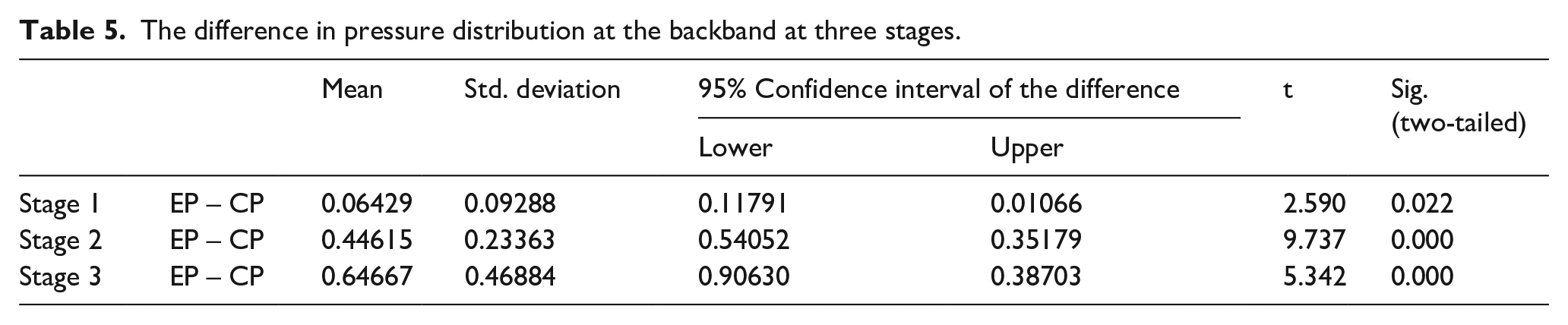
The backband was categorized into two stages based on Figure 6(c) distribution. Stage 1 shows no significant difference between EP and CP pressure because their significant value was p = 074, greater than p = 0.05. Also, the mean difference shows that EP pressure was 0.1 lower than CP pressure (95% CI [0.71, 0.41]) shown in Table 5. At stage 2, there was no statistically significant difference between EP and CP pressure because its significant difference was p = 0.62 which is greater than p = 0.05. Its mean difference shows that EP pressure was 0.20 lower than CP pressure (95% CI [1.03, 0.63]). In conclusion, the pressure distribution in the backband area shows that the two sports bras generated almost the same pressure in both stages; the difference between the mean pressures was 0.1, which means both bras produced the same pressure, but EP produced less pressure than CP because EP was 0.1 lesser that CP.
The difference in pressure distribution at the backband at three stages.
Discussion
The main features that affect sports bras are the shape of the breast, steadiness in movement, and comfort (not excluding fiber components and pressure comfort). Conversely, large breast size (bra size C and above) has been the focal point in most research lately since it has been anticipated that females with larger breasts feel more pressure at the shoulder strap due to the heavy weight of the breast as compared to smaller breast sizes. EP and CP have been assessed using numerous activities that move the body vertically, including jogging, running, walking, skipping, jumping, etc.
When using sports bras, the most common pressure issues found among large breast-sized females were strapped dig-in, tight waistband leading to difficulty breathing, and uncomfortable armhole. During the interview stage, it was noted that 80% of the participants used sports bras as their daily bras, following the comfort associated with sports bras as compared to everyday bras.
The shoulder width used in this study for EP was 3.5 cm, while CP was 2.7 cm. Due to the movement used in this study, both sports bras were divided into three stages to carefully check the difference between them. The pressure range for EP was 2.0–3.8 kPa while CP generated a range of 2.2–4.4 kPa. Also, from Table 6, the pressure means peak for EP was 2.5 kPa while CP generated 3.2 kPa. Therefore, EP generated less pressure at the shoulder straps than CP.
Perceived comfort for EP and CP.

In this study, a CP had a thicker band than an EP, and a CP had a bandwidth of 4 cm while an EP had a bandwidth of 6 cm. In the view of Figure 4, the underbust was divided into three stages among the three stages, stage one was indifferent because the same pressure level was produced while stages 2 and 3 generated different pressure levels among the bras. Additionally, the comfortable range of EP under-bust was 1.8–2.3 kPa while CP came up with a range of 2.2–3.2 kPa which shows that EP is more comfortable as compared to CP. Nevertheless, looking at the descriptive statistic in Table 6, it is shown that EP produced more pressure than CP which makes CP a discomforting bra. This agrees with the findings in.40 –48 Therefore, the EP produced less pressure at the under band than the CP.
The back structure contributes to the pressure level of both the back band and the shoulder strap. In analyzing EP and CP, the pressure difference was insignificant compared to the shoulder strap and underbust. The back band was divided into two stages because of the line graph distributed, in Table 4 we found no pressure difference between the two bras at both stages but the pressure mean shows that EP is more comfortable than CP. Also, EP had a medium pressure in the range of 1.9–4.7 kPa, while CP ranged from 2.2 to 5.3 kPa.
Conclusion
The work presented in this article compared the two main types of sports bras and focused on three features to evaluate the associated comfort levels. The study hypothesized that an EP would produce more comfort in all three designated areas: the shoulder strap, underbust, and backband than CP for females with larger breast sizes. Although the EP with racerback was identified as less pressured bras, all three designated areas did not produce the same pressure level. The results indicated that the underbust made less pressure, followed by shoulder straps, while high pressure was recorded at the back band. The results of the CP with Y-back indicate that both shoulder straps and backband generated the same high pressure while the underbust produced less pressure. In general, the encapsulation racerback sports bra with no closure, 88% polyester; 12% spandex, a bandwidth of 6 cm, strap width of 3.5 cm, and a neckline of 8 cm is more comfortable for female golfers compared to the compression Y-back with hook and eye fastener 80% polyester; 20% spandex, bandwidth of 4 cm, strap width of 2.7 cm, and the neckline of 10.2 cm. Comparing the subjective test and the experiment, it has been concluded that female golfers had a wrong perception about the two sports bras used in this. They thought there was no difference between the two bras at the strap, underbust, and backband but the pressure experiment shows that there’s a significant difference between the strap and the underbust. Therefore, this study will change the perception of most golfers.
This study will direct marketers and designers on how to produce and recommend sports bras for females who play golf and those who focus on shoulder and trap workouts. At the same time serve as a guide for researchers to investigate different forms of body movement aside from vertical motion. This study has shown that females with larger breasts who play golf can confidently purchase and use EP with a racerback structure.
The limitation of this study was identifying participants with the same breast size. We had over 34 participants, but we had to exclude 14 during the experiments because their breast size was an inch less or more than the targeted one. Further studies should investigate different kinds of EP and CP when females take part in various types of shoulder workouts because the high pressure identified at the back band could be a reason for the back structure.
Supplemental Material
sj-docx-1-jef-10.1177_15589250221127393 – Supplemental material for The impact of sports bra features on measured and perceived pressure for torso movement of the upper body
Supplemental material, sj-docx-1-jef-10.1177_15589250221127393 for The impact of sports bra features on measured and perceived pressure for torso movement of the upper body by Francisca Margarita Ocran, Xiaofen Ji and Lina Zhai in Journal of Engineered Fibers and Fabrics
Footnotes
Authors’ contribution
FMO contributed to the conception and design of the study and also drafted the manuscript. LZ supervised and helped in drafting the manuscript and, XJ supervised the experiments. All authors read and approved the final manuscript.
Data availability statement
Will be sent to editors on reasonable request.
Declaration of conflicting interests
The author(s) declared no potential conflicts of interest with respect to the research, authorship, and/or publication of this article.
Funding
The author(s) disclosed receipt of the following financial support for the research, authorship, and/or publication of this article: 2020 National Social Science Foundation of Art Project: “History of Chinese women’s underwear” (Grant/Award Number: 20BG134).

Supplemental material
Supplemental material for this article is available online.
References
Supplementary Material
Please find the following supplemental material available below.
For Open Access articles published under a Creative Commons License, all supplemental material carries the same license as the article it is associated with.
For non-Open Access articles published, all supplemental material carries a non-exclusive license, and permission requests for re-use of supplemental material or any part of supplemental material shall be sent directly to the copyright owner as specified in the copyright notice associated with the article.
