



Abstract
Female athletes and active women benefit greatly from wearing well-fitting sports bras to provide essential support and control during dynamic movements like running. Understanding how bra components like straps, neckline and underband affect breast motion is crucial for designing sports bras that reduce discomfort and maintain stability. However, evaluating sports bra performance with human participants faces challenges in recruitment and consistency. To address this, this study introduces a soft manikin system that accurately simulates and measures 3D breast movements during running. This system offers a novel method for objectively assessing sports bra effectiveness in controlling breast motion. By incorporating deformable breast forms into the manikin, researchers can consistently evaluate how bra features impact breast movement. The soft manikin’s breast displacement values align well with experimental results in the medial-lateral and vertical directions. This innovative approach provides valuable data for designing activewear bras, enabling informed adjustments to enhance breast motion control during physical activities.
Introduction
Activewear and athleisure wear have become major sectors of the global apparel industry due to the need to be physically active driven by the growing awareness of consumers of health and wellness. With the use of advanced materials and manufacturing techniques, there can be unlimited activewear designs that provide different levels of support, protection from injury and functionality for a wide range of activities.1,2 For example, sports bras have been developed to address different levels of physical activity intensity and end uses, such as running, yoga and other sports. The global sports bras market is predicted to grow exponentially from US$44.39 billion in 2021 to US$103.56 billion by 2029, or a compound annual growth rate of 11.4% during the projection period. 3 Based on previous studies, there is substantial evidence that confirms the effectiveness of sports bras in reducing excessive breast movement and discomfort during physical activities.4–6 However, the rapid growth of the sports bra market has brought about significant challenges, as few studies have investigated the impact of the fabrics, structure, components, and design features used on the functionality and wear comfort of sports bras.
Breast tissues do not have muscles or bones so there is no anatomical support, so breasts are susceptible to the effects of gravity. Without proper support, the breast tissues stretch and sag over time during physical activities, which cause them to become elongated and pendulous in appearance. 7 Therefore, bras are engineered to protect the structural integrity of the breasts and reduce their risk of sagging, while increasing confidence and improving sports performance.7–9 Sports bras are especially important for women when participating physical activities, but ill-fitting bras can cause exercise-induced breast discomfort and lead to frustration. 10 To improve the functional design of sports bras, the biomechanical parameters of breast motion and movement, as well as fit and movement are particularly important in the design and development processes.7,8 The bra features and materials greatly impact sports bra performance. Sports bras are commonly designed to compress (crop tops) smaller breasts or encapsulate (individually support each breast) larger breasts (cup size C or larger) to hold them in place and reduce their movement.7,8,11–13 Nevertheless, current research has not definitively confirmed the impact of different types of sports bras on controlling breast movement of women with different breast sizes during physical activities. Additionally, there is little documentation on how different sports bra designs affect functional capabilities during physical activity.
Bra designers and manufacturers often incorporate techniques that elevate or compress the breasts for support and control of breast displacement through different design features, thereby enhancing their sports performance and overall experience. 10 Design features such as the bra neckline, shoulder strap, underband, cup design and fabric properties affect bra displacement.6,14,15 The shoulder straps have a crucial role in providing the necessary support and stability of the breasts as they ensure that the breasts are held securely in position to minimise movement. According to a survey in Bowles et al., 16 267 female respondents indicated that they most dislike slipping or digging of the shoulder straps of their sports bras into their shoulders. The former can be prevented with a suitable bra back design. Back designs such as cross-over, racer-back and vertical centre are recommended to prevent the shoulder straps from slipping off the shoulders. Bras with wider padded shoulder straps are recommended for those with larger breasts,14,17,18 because they distribute the forces applied to the shoulders over a wider area. The interaction of the bra strap and movement of upper body has also been examined by Zhang et al. 19 with the use of simulation models. Their results indicated that elongation of the elastic woven tapes used for the shoulder straps has a significant influence on the displacement of the bra straps during movement. The underband contributes to overall stability and support, and bears more than 80% of the weight of the breasts. 20 Therefore, the underband needs to be fully stretched to withstand descending gravity force, especially for women with larger breasts. 21 Moreover, the material used for the shoulder straps and underband should be completely elastic so that they can be stretched enough to ensure normal breathing. 22 Sports bras designed with a high neckline can effectively limit the upper movement of the breasts. 14 The pattern of the bra pads is another key element that improves support given by the bra. 23 Full-cup bras are thought to reduce breast movement more effectively than half-cup bras through the increased coverage. 24 Additionally, Mason et al. 15 found that encapsulation sports bra with moulded bra cups are more comfortable compared to standard fashion bras or compression sports bras. Moreover, fabric with good extension and shape retention properties can minimise bra displacement during daily movement.22,25,26 To promote physical activity among women and protect their breast health, further developments of sports bra designs based on scientific evidence are warranted to ensure that the support is both practical and comfortable.
To provide a better understanding of the biomechanical parameters on bra support, previous studies have mostly relied on human wear trials and specific bra applications.7,8 Their experiments involve subjects who are performing various movements, like walking, running or jumping.27,28 However, the requirement for subjects to either wear a bra or go braless during the experiments involves the removal of their outer garments, which results in variations in bra fit and potential bra displacement. The personal embarrassment associated with these conditions also makes it challenging to recruit a sufficient number of subjects who could adequately represent a wide range of breast characteristics. Other limitations in subject recruitment include health conditions, breast geometry and mass, soft tissue composition and age differences among women with the same bra size. Ensuring consistent testing conditions to evaluate breast displacement pose further difficulties, ultimately impacting the reliability and reproducibility of the tests. Therefore, it is timely and necessary to develop a new approach and other innovative methods to evaluate breast motion.
The introduction of advanced manikins equipped with sensors to measure parameters such as pressure,29–31 temperature,32–34 and airflow 35 has revolutionised garment fitting and evaluation processes. These instrumented manikins provide crucial insights into comfort, thermal properties and garment performance, thereby enhancing the design and development of activewear, including sports bras. Furthermore, the adoption of dynamic manikin systems that incorporate movement and perspiration functions aims to create more realistic simulations of real-world clothing scenarios.36,37 Nevertheless, the development of manikins that accurately replicate dynamic body positions with soft breasts for simulating realistic female running movements remains limited to date.
Marker-based motion capture systems are traditionally used to capture breast displacement during walking and running. Well-fitting and supporting sports bras can reduce approximately 60% of the vertical breast displacement compared to the braless condition.27,38 Unfortunately, studies on breast biomechanics are limited by inconsistent research designs and methods so that discrepancies in breast displacement measurements have been commonly observed, which can range from 0.08 cm 7 to mean displacements of 5.1 cm 28 with a sports bra. These variations are attributed to factors such as breast size, running speed, sports bra fabric and different landmarks or reference points. These inconsistencies mean that there is still limited scientific understanding of the 3D dynamic positioning of the body, breast motion and multiplanar requirements for breast support during exercise, which would result in a bra design that cannot provide adequate support due to neglect of multiplanar breast displacement. Therefore, this study has developed a soft manikin system capable of measuring the complex 3D dynamic positioning of the body and breast motion during high impact running. This system can comprehensively evaluate breast control in advanced sports bra designs. By objectively quantifying the influence of different bra characteristics on controlling 3D breast movement, this novel manikin system will provide valuable biomechanical insights for designing sports bras that are not only comfortable to wear but also effectively eliminate excessive breast motion.
Methodology
Design of running manikin system
A novel manikin with soft breasts with an incorporated 3D dynamic body movement simulator (3dBMS) was designed to simulate the intricate 3D dynamic postures of the female body and mimic breast movement during running. The developed manikin features a silicone rubber skin that covers a hollow trunk with soft layers of tissues to resemble the breasts, designed for evaluating 3D breast movement and to replace human subjects in laboratory wear trials for bra fit and ensure consistent evaluation of sports bras performance for breast control. The dimensions and properties of the manikin were tailored to resemble the upper female body, with its size and breast shapes aligning with standard Asian bra sizes. The breast materials of the manikin were developed to replicate the realistic behaviours of dynamic 3D displacement and regional breast motion during running at a speed of 8 km/h.
Fabrication of manikin with soft breasts
To fabricate the manikin with soft and flexible breasts that can replicate breast displacement during running, a layer of soft artificial skin made with silicone material was used, which has been applied in previous clinical research studies and considered to have a similar texture as that of human skin.39,40 Artificial viscoelastic material was used as the implanted breast tissue41,42 and enclosed by using a layer of artificial skin to replicate the 3D breast movement. The entire fabrication process of the manikin is shown in Figure 1.

Fabrication process of manikin with soft breasts. (a) Bare manikin; (b) Base skin; (c) Waxy breast; (d) Breast skin solution; (e) Breast skin drying; (f) Wax remove; (g) Breast skin only; (h) Soft tissue filling.
The manikin was split into 2 parts (see Figure 1), with one part being bare manikin without the breast parts and used as the hollow skeleton (Figure 1(a)), and the 2 dependant breast parts split from the chest wall for soft breast simulant fabrication. A 3D image of a female with a bra size 36C/80C provided the shape details to 3D print the moulds of the bare manikin and breasts. It is challenging to create a silicone capsule for a breast-shaped container and wrap the artificial tissues around the capsule to form a solid silicone breast. Therefore, a novel and cost-effective method was used to fabricate a silicone breast with soft tissues. Figure 2 shows the fabrication of two separate wax breasts by using split breast moulds. The 2 wax breasts easily allow manual changes, and provide the supportive structure during casting of the artificial skin (layers of silicone) and facilitate extraction for soft tissue implantation due to the low melting point of the wax.

Wax breasts.
A silicone solution was poured directly onto the surface of the manikin for air drying, ensuring an even coverage through gravity. Then the wax breasts were placed onto the chest wall of the manikin and vertically extended from the second to the sixth ribs and horizontally from the lateral border of the sternum to the maxillary line, with a sternum width of approximately 1.6–2 cm. The silicone solution was then poured over the wax breasts to enclose them. To extract the wax in the breasts, the wax was heated for melting from a solid to liquid. A small hole was drilled on the nipple point for draining the wax. Then, artificial viscoelastic material was inserted into the silicone breasts to simulate the breast tissues. 43 Optimal compositions of the inserted material were finally confirmed after repeated comparisons of the torso movement and nipple displacement between the assembled soft manikin with the bare breasts of a female participant.
Development of the running motion simulator
A 3D running motion simulator was developed to mimic the dynamic body movement during running (8 km/h), where the manikin exhibits continual vertical movement along with trunk rotation and synchronised shoulder movement triggered by arm swings. 44 Determining the vertical motion and trunk rotation in a running cycle is influenced by the motion range of the clavicle and rotation angle of the shoulders,45,46 which is crucial for calculating the motor speed in designing the motion simulator.
The movement of the manikin was controlled by using a custom-designed mechanical device, focusing on vertical and medial-lateral torso motions while running. This device incorporates two motors: a linear actuator (servo motor) and a hollow rotary actuator (stepper motor). Its design aims to replicate the dynamic body motions seen in individuals running at a speed of 8 km/h. The linear actuator, powered by a servo motor, mimics the vertical torso movement during running by enabling continuous up-and-down motion of the manikin, resembling heel strike and toe-off phases in the gait cycle. This actuator controls the main shaft, facilitating the manikin’s vertical movements in line with human running patterns determined by clavicle marker trajectories. Clockwise rotation drives the manikin upward, while counterclockwise rotation lowers it. The linear actuator’s distance and speed can be adjusted using a motor-control device. Additionally, a stepper motor, serving as the hollow rotary actuator, replicates torso rotation during running. This motor controls the manikin’s rotation to mirror human torso movements. The angles for the rotary motor’s movement correspond to the average maximum shoulder angle, rotating the manikin in both clockwise and counterclockwise directions. Similar to the linear actuator, the rotary actuator’s angle and speed can be customised using a motor-control device, and guide rods installed alongside the main shaft ensured stable vertical movement without shifting or rotation (see Figure 3). Different views of the manikin are shown in Figure 4.

Details of the mechanical device.
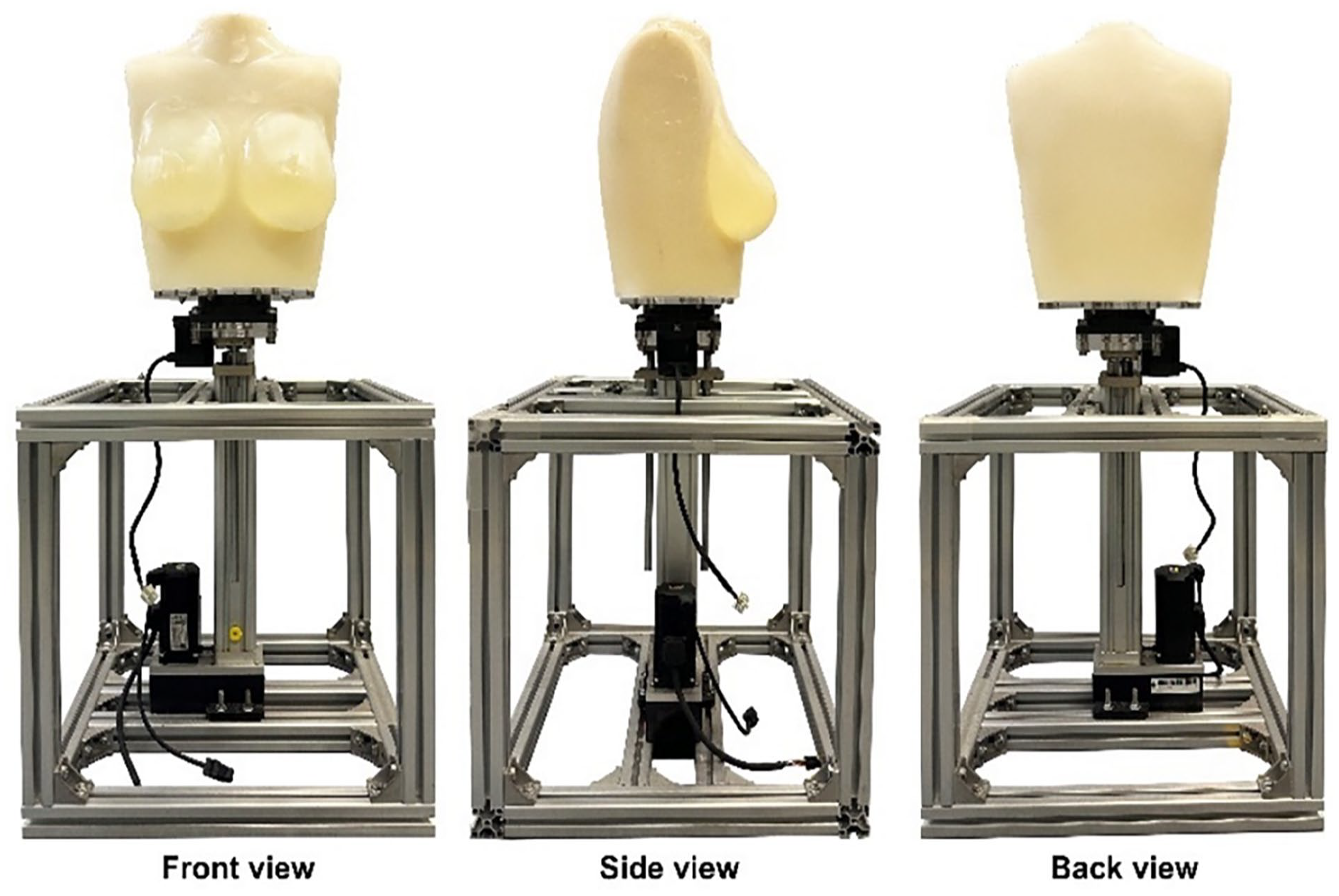
Different views of manikin.
To quantify the vertical motion and rotation of the 3dBMS for motor setting purposes, 5 female subjects, with mean age of 24.8 years old, participated in a motion capture experiment. None of them are pregnant, breastfeeding, or have a history of breast surgery. The mean circumference of their bust and underbust is 81.4 and 95.4 cm, respectively, which falls into the average bra size of Asians of 36C/80C. Additionally, the 5 subjects shared similar breast shape. A Reebok FR20 Floatride treadmill and a Vicon motion capture system, equipped with 8 Vantage cameras and 3 Vero cameras, were utilised to evaluate the breast displacement of the subjects.
Each participant completed two running trials at 8 km/h on the treadmill with a 0° incline. They were required to take rest 5 min intervals to prevent fatigue and ensure consistent performance. To better simulate the movement of the breasts in the braless condition, the participants performed the experiment by donning a soft bra to simulate the braless condition. All of the participants provided written informed consent after they were told about the experimental procedures and requirements. The experiment protocols were approved by the Human Subjects Ethics Sub-Committee of the university of the authors (reference number: HSEARS20210305003).
For the vertical movement, the clavicle motion exhibits two peaks and two valleys in a full running cycle (see Figure 5). The average vertical distance covered by the clavicle motion serves as a reference for the working distance range of the linear actuator. As shown in Figure 6, the mean displacement of the clavicle point of the 5 subjects is 90 mm. The servo motor, which acts as a linear actuator, controls the main shaft to enable the vertical motion of the manikin, thus mimicking the vertical movement of the human torso during running.

Vertical peaks and valleys of the clavicle marker in a running gait cycle.

Mean displacement of the clavicle marker.
For the trunk rotation, the clavicle motion exhibits one peak and one valley along the z-axis, with the shoulder marker rotating simultaneously during a full running gait cycle (see Figure 7). The shoulder angle is defined as the difference in the mean maximum angle between the shoulder vector and the x-axis within the motion captured area. As shown in Figure 8, the mean value of the shoulder angle of the 5 subjects is 20°. The stepper motor, which functions as a rotary motor, rotates the manikin to simulate the rotation of the human torso during running. The required angles for the motor rotation are set by the mean shoulder angle.
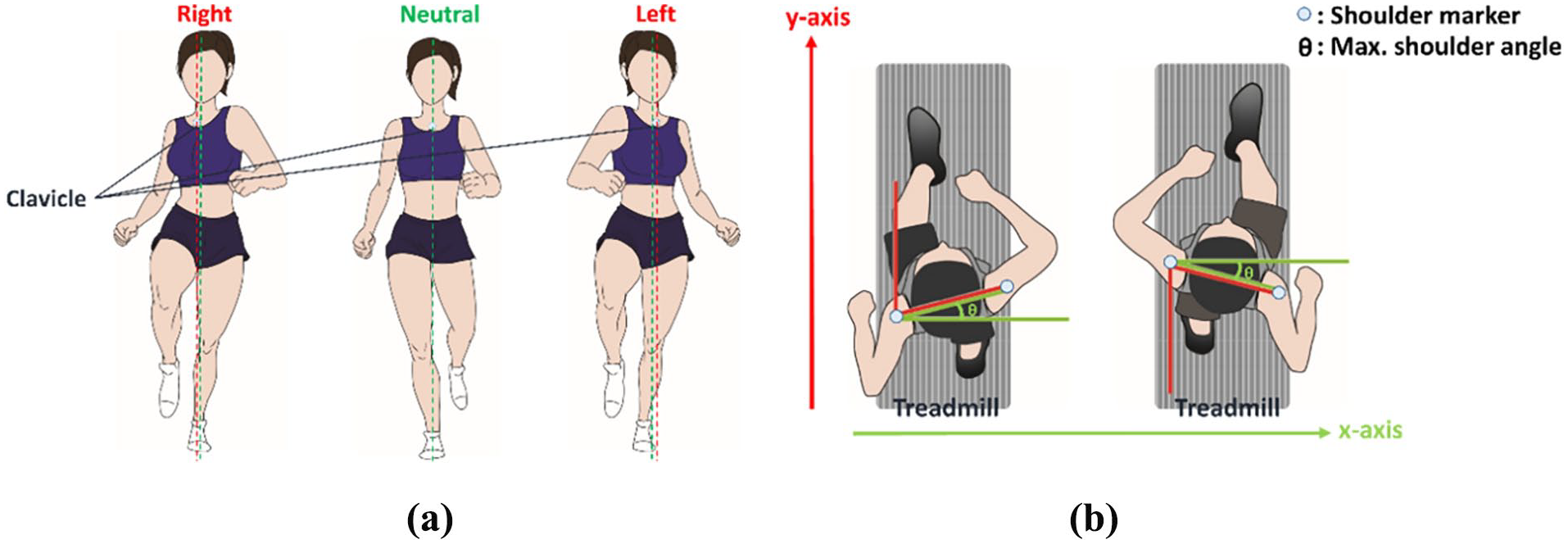
(a) Trunk rotation during a full gait cycle (rotational peak and valley of the clavicle marker, and (b) maximum shoulder angle.

Mean shoulder angles.
Validation of the soft manikin system
Repeatability and replicability are crucial factors that indicate the accuracy of the measurements with the use of the newly developed soft manikin system. Replicability or accuracy, as per ISO 5725-1:1994, reflects the degree of agreement between the measured results and a known reference value. 47 Repeatability indicates the degree of agreement among the measured results acquired under predefined conditions. Ensuring good repeatability minimises errors that originate from random system measurements. Therefore, an effective measurement system should exhibit both excellent repeatability and the capacity to deliver accurate measurements. 48 In this study, the repeatability of the soft manikin system is evaluated by conducting repeated motion capturing of the nipple and clavicle points. The evaluation of the accuracy involves comparing the nipple displacement values obtained from the system and participants.
Repeatability of the soft manikin system
To evaluate the repeatability of the developed system for breast motion measurement, the displacement of the nipple and clavicle points was measured 10 times, to determine the measurement consistency of the system. The device was switched off and then on between each capture.
Replicability of the soft manikin system
To validate the replicability of the soft manikin system, the amplitude and total breast displacement (in the vertical and rotational directions) values obtained from the manikin participants were compared. The coefficient of multiple determinations (CMD, R2) was used to represent the consistency of the displacement measured between the two groups. This value, which ranges from 0 to 1, is calculated with equation (1), in which a larger R2 points to a strong correlation between the two groups:


*where
Breast motion control performance of sports bras
Experiment
To evaluate the breast control performance of the sports bras, a systematic investigation was carried out to evaluate the extent that the samples can control breast movement. Breast displacement was measured both without a bra and with 10 different commercially available sports bras by using the developed soft manikin system. The design features of the 10 commercial sports bras are shown in Appendix 1. The dimensions in detail, including flat measurements (Figure 9) and mechanical properties of the material, are listed in Tables 1 and 2, respectively.

Illustration for flat measurement of bra samples.
Flat measurements of size 36C or equivalent bra size samples (unit: cm).

Material properties of size 36C or equivalent bra size samples.

Note. Test standards EN 14704-1 and ISO 3386/1 are adopted for Young’s modulus and compression stress.
Data analysis
Since nipple marker trajectories reflect both torso and extended breast movements in the coordinate system used in the laboratory, it is essential to remove the torso component by subtracting the nipple trajectories by using the clavicle trajectories to solely focus on the extended breast movement. By performing frame-by-frame subtraction of the clavicle marker coordinates, the resulting coordinates show the relative movement of the markers to the clavicle position, thus highlighting the extended breast movement. To improve the accuracy of identifying the torso movement, a new coordinate system established by Haake and Scurr 49 was used. First, a triangular plane was created by using three markers: the clavicle (CLAV), left side of the rib cage (LRIB), and right side of the rib cage (RRIB). This reference plane is used to define the local coordinate system (see Figure 10) with a new x-axis (u) that represents the LRIB-RRIB unit vector, a new y-axis (n) as the normal vector of the reference plane and a new z-axis (v) perpendicular to both the new x and y-axes. The equations of u, n and v are below:


The 3-point reference plane and new local coordinate system.
For transformation of nipple marker coordinates to a new local coordinate system, the new coordinate of the nipple marker was calculated relative to the local torso coordinate system. The new coordinates of nipple marker (x, y and z direction) in local coordinate system are:



Where:
The dot product was employed to project a vector onto a particular axis. When transforming the nipple coordinates relative to the novel local coordinate system defined by the unit vectors u, n and v, the process effectively determines the amount of the vector (from the clavicle to the nipple) aligned with each of these axes. The dot product achieves this by assessing the component of the vector in the direction of the axis.
In the local coordinate system, CLAV is defined as the origin. The trajectories of CLAV, LRIB and RRIB have been offset as the basic markers in this system. Therefore, the nipple marker trajectories that show extended breast movement can be obtained. To evaluate the performance of the 10 commercial sports bras, the percentage of breast control (%BC) was calculated by using:

where


where %BCx and %BCz indicate control of the extended breast movement along the medial-lateral and vertical axes respectively, thus providing insights into the support provided by the different sports bras from multiple perspectives. The %BC values were calculated and compared across the 10 commercial sports bra conditions on the soft manikin during running at 8 km/h.
Result and discussion
Repeatability of the soft manikin system
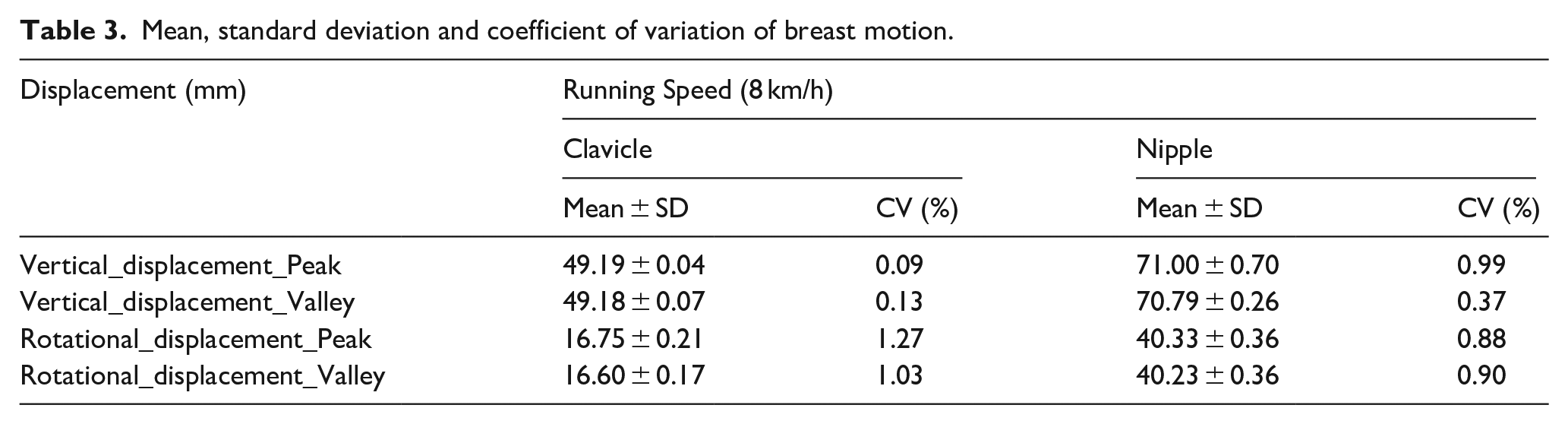
To evaluate the repeatability of the developed soft manikin system, the coefficient of variation (CV), which is defined as the ratio of the standard deviation (SD) to the mean value, was calculated. As shown in Table 3, the variation (CV%) of the clavicle and nipple displacements given by the soft manikin system ranges from 0.09% to 4.15%, which are all below the 5% threshold. The results indicate that the developed device demonstrates exceptional repeatability in breast displacement measurements, which shows a highly reliable and consistent performance.
Mean, standard deviation and coefficient of variation of breast motion.
Replicability of the soft manikin system
As shown in Figure 11, the plotted experimental and simulated amplitude and total breast displacement values – measured in the vertical and rotational directions, are in good agreement with the R² values that range from 0.9663 to 0.9961. This good agreement underscores the effectiveness of the soft manikin system in simulating the movement of the breasts, thus confirming its potential for reliable applications in sports bras testing.

Nipple displacement comparison in (a) vertical and (b) rotational directions: experimental versus simulation results.
Breast control performance of sports bras
The average %BC values across the 10 commercial bra conditions in the x- and z-axes during running at a speed of 8 km/h were calculated and are shown in Table 4.
Percentage of breast control (%BC) under the 10 sports bra conditions.

The breast control performance of the 10 different sports bras was evaluated by using the average %BC in both the x- (medial-lateral) and z- (vertical) directions. As shown in Table 4, the sports bras in this study show varying degrees of breast control effectiveness, which range from 5% to 24% in the x-direction and 56% to 88% in the z-direction. The higher level of breast control in the z-direction compared to the x-direction can be attributed to the fact that breasts move most in the vertical direction due to factors like breast inertia and force when the foot hits the ground. The medial-lateral movement is primarily due to inertia, thus resulting in lower displacement than that found in vertical motion. 9 Breast biomechanical studies have also indicated that when women run on a treadmill without external breast support, the breasts move substantially, at an average of 4.2–9.9 cm in the vertical direction and 1.8–6.2 cm in the medial-lateral direction.10–12 The forces generated from the breast motion are influenced by several variables, such as the structure and properties of the soft tissues of the breasts, size of the breasts, rate that the activity is carried out, type of activity, etc. The results obtained from the running manikin system also align with those of previous studies, which show that high-impact sports bras can limit vertical breast displacement by approximately 60% compared to the braless condition.6,11,50
Amongst the 10 different sports bras, Bras 1, 8 and 9 show a higher level of control along the x-axis (18%–24%), while Bras 2, 3, 5 and 7 show a higher level of control in the z-direction (80%–88%), which offer excellent support against vertical motion. Bras 4 and 6 provide moderate support in both directions, while Bra 10 does not control breast motion well along both axes (5% and 56% in the x and z directions, respectively), thus indicating potential areas for improvement in terms of breast control effectiveness. In this study, the ability to control breast motion along the x-axis (medial-lateral) of Bras 1 (24%), 8 (18%) and 9 (19%) is relatively higher than the other bras. With reference to the bra features and measurements in Tables 1 and 2 and Appendix 1, these three sports bras share similar design features: a higher side coverage and a similar hook-and-eye height, which enhance breast support and stability. The incorporation of long side seams with side wings, along with a large hook-and-eye closure, provide additional coverage and support, particularly in the lateral areas of the torso. This design element is essential for controlling breast displacement in the medial-lateral direction during high-impact activities like running.
Regarding the ability to control breast motion along the z-axis (vertical direction), Bras 2, 3, 5 and 7 show excellent control compared to the other bras. Therefore, bras with better cup coverage, including across cup, curved/vertical cup height, cup curvature, and cup bottom length, are the most effective sports bras that reduce vertical breast movement by up to 80% or more. The cup dimensions (height and curvature) are crucial in determining how well breasts are encased and controlled during physical activities. Hence, bras with supportive cups and proper measurements are recommended to offer more breast control. In view of the fabrication materials, rigid shoulder straps with a relatively high Young’s modulus, used in a racerback or cross-back design, contribute to controlling breast displacement in the vertical direction (i.e. Bras 3, 5 and 7). Highly stretchable shoulder straps that use rigid foam cups (Bra 2) can also reduce breast displacement during movement. However, studies in the literature have reported that rigid shoulder straps and cup pieces may induce excessive compression and pressure on the body, which lead to wear discomfort and stress, and negatively affect perceptions of sports bras.51,52
Designing a sports bra to reduce the repetitive motion of the breasts during sporting activities with minimal compression is highly challenging. The dilemma is that a high impact sports bra can reduce breast movement but have poor fit, cause discomfort, prevent flexibility of body movement or even result in health issues. Since no single sports bra will suit all women, good bra designs and structural features, along with the appropriate fabrication materials and elasticity, are closely linked to controlling breast movement, as well as ensuring a good fit and wear comfort.16,50 For instance, a high neckline with a higher centre front (i.e. Bras 2, 5 and 7) can effectively reduce breast movement in the upward and vertical directions, while adequate tension and elongation of shoulder straps made of elastic woven tapes can effectively hold a bra in place.22,53
Future studies could explore a wider range of design variables, including the shape of the cup, closure, type of strap, support elements used in areas such as the bra cup, underband and side wing, lining, etc.; dimensions of the side wing; and individual differences in breast shape, and use more sophisticated modelling techniques to gain a better understanding of ways to effectively control breast displacement during physical activity.
Conclusion
In this study, the development and utilisation of a novel soft manikin system have shown potential as a solution for dependable and accurate evaluations of bra performance. By simulating dynamic positions and breast movement in a controlled and repeatable manner, this system is a reliable platform to evaluate how different bra features interact with the body during movement. The analysis in this study provides a better understanding of how bra design elements impact breast motion, thus paving the way for the development of sports bras that can optimise both functionality and wear comfort. The study contributes to the literature with invaluable insights for the field of activewear design, which ultimately enhance user experience and effectiveness of sports bras in supporting active lifestyles. Nevertheless, there are still some limitations. Since the breast is a viscoelastic deformable object with complex movement in 3D space, only examining nipple movement cannot wholly describe movement of the entire breast. Moreover, the sample consists of only 5 female participants, which is a fairly small sample and limits the generalisability of the results. As such, we intend to conduct future studies with a larger number of participants and other elements of breast movement to enhance sports bra designs. Nevertheless, the developed soft manikin system is still a cost-effective tool for scientifically conducting biomechanical analyses that improve bras for optimal breast control and wear comfort during dynamic movement.
Footnotes
Appendix
Bra features of commercial sports bras.

| Bra styles | Cup construction | Shoulder straps | Back features | Closure |
|---|---|---|---|---|
| Bra 1 |
Cut and sewn knitted fabric, spacer fabric, inserted foam pad & mesh | Double layer mesh with different grain line (one course, one wale) | Crossed back with two sets of hook & eye (upper 1 × 2, lower 3 × 3) | |
| Bra 2 |
Double layer moulded knitted fabric & foam cup | Knitted fabric & mesh | 4 × 2 Hook & eye | |
| Bra 3 |
Moulded knitted fabric & foam cup | Crossed back with adjustable elastics | Knitted fabric & mesh laminated | 3 × 2 Hook & eye |
| Bra 4 |
Moulded knitted fabric & foam cup | Mesh & knitted fabric | 4 × 2 Hook & eye | |
| Bra 5 |
Moulded knitted fabric & foam cup | Double layer knitted fabric | 4 × 2 Hook & eye | |
| Bra 6 |
Double layer mesh & moulded foam cup | Double layer mesh | 4 × 2 Hook & eye | |
| Bra 7 |
Moulded knitted fabric & foam cup | One layer mesh | 4 × 2 Hook & eye | |
| Bra 8 |
Double layer knitted fabric, inserted foam pad & mesh | Mesh and knitted fabric racerback | Double layer knitted fabric | 3 × 3 Hook & eye |
| Bra 9 |
Knitted fabric & foam cup | Double layer knitted fabric | 3 × 2 Hook & eye | |
| Bra 10 |
Moulded knitted fabric & foam cup | Double layer mesh | 3 × 2 Hook & eye |

Author contributions/CRediT
Kwok-tung Hui: Developed the soft manikin system and performed the experiments. Analysed the kinematic data, data analysis, interpretation of results and wrote the initial draft of the manuscript; Li-ying Zhang: equally contributed to the study with the first author, conducted the literature review and assisted in the development of the research framework. Participated in data collection & analysis and wrote the initial draft of the manuscript; Kit-lun Yick: Conceptualised the study, designed the methodology, supervised the research process and assisted in the final editing of the manuscript; Sun-pui Ng: Conceptualised the study, designed the methodology and supervised the research process; Joanne Yip: Conceptualised the study, designed the methodology and supervised the research process.
Funding
The author(s) disclosed receipt of the following financial support for the research, authorship, and/or publication of this article: This research is funded by The Hong Kong Polytechnic University (project code: WZ21), Hong Kong.
Declaration of Conflicting Interests
The author(s) declared no potential conflicts of interest with respect to the research, authorship, and/or publication of this article.
Data availability
The data that support the findings of this study are available from the corresponding author upon reasonable request.