



Abstract
Cannabis sativa (Hemp) is renowned for its diverse applications across multiple industries. This versatile plant is utilized in food production, paper manufacturing, pharmaceutical development, cosmetic formulations, biofuel generation, and most notably, in the textile sector. The hemp fiber’s mechanical performance, low cost, and environmental sustainability make it a promising alternative to conventional fiber but the plant is highly susceptible to several agronomic and environmental factors, particularly herbicides. Our research investigates the impact of glyphosate and metribuzin herbicides on Cannabis sativa fiber quantity and quality. Cellulose and hemicellulose content, mechanical properties, and morphological features of fiber from treated plants were analyzed. Herbicide treatments significantly affected fiber composition and properties. Treatment with low-concentration glyphosate resulted in a reduction of both cellulose and hemicellulose content, whereas low-concentration metribuzin induced a slight increase in cellulose levels. Exposure to high concentrations of either herbicide led to a significant decrease in both cellulose and hemicellulose components. Mechanical tests and X-Ray Diffraction revealed that low-concentration glyphosate weakened fiber’s tensile strength, whereas low-concentration metribuzin enhanced it. However, high concentrations of both herbicides decreased tensile strength. Bast fiber content initially increased with low herbicide concentrations but declined at higher levels. Scanning electron microscopy revealed progressive structural damage to fiber with increasing herbicide concentrations. Glyphosate caused surface disruption, while metribuzin induced more severe degradation, including surface erosion and bubbling at high concentrations. These findings highlight the complex effects of glyphosate and metribuzin on Cannabis sativa fiber properties, emphasizing the need for careful consideration of herbicide use in hemp cultivation for textile production.
Introduction
The textile industry is known to be one of the most environmentally burdensome sectors worldwide. 1 To address its impact, one of the proposed solutions is to emphasize the integration of sustainable materials in garment production. 2 Cotton, which is the most used natural fiber poses challenges due to its excessive water and agrochemical usage. 3 Therefore, there is a pressing need to identify and incorporate an economically viable alternative fiber to meet the growing demands of the textile industry while paving a way to protect the environment and manage our limited resources wisely. 4
Hemp fiber, originating from the Cannabis plant has a long history of use in textiles. Due to misconceptions about its link to marijuana, hemp has been banned in many countries despite its benefits, which include aseptic properties, high absorbency, protection from UV radiation, and non-allergen properties. 5 Recently opinions are shifting, and many nations have reversed these prohibitions and reintegrated hemp back into their economic ecosystem. Hemp cell walls are made of cellulose, hemicellulose, pectin, and lignin, among other chemical constituents. These ingredients add to the fiber’s overall characteristics. Hemp’s essential component, cellulose nanofibers, acts mechanically like other engineering materials, which makes them useful for a variety of applications like gel formation and plastic reinforcement. 6 Hemp fiber is a recyclable and renewable resource. It can be recycled using techniques like combustion or anaerobic digestion, which convert hemp waste into energy. 7 It produces less residue and releases less carbon dioxide into the atmosphere when burned for disposal as compared to their absorbance during their growth period. 8 In addition, the fiber can exhibit specific properties on par with or exceeding those of glass fiber in polymer composites. 9 Furthermore, fiber obtained from Cannabis is relatively inexpensive at $0.5-$1.5 kg compared to E-glass ($1.65-$3.25 kg) 10 and carbon fiber ($8-$11 per kg). 11 The fiber possesses high tensile strength and elastic modulus compared to other natural fibers like jute, sisal, cotton, banana, and bamboo.12,13 Due to its superior tensile and elastic properties combined with cost competitiveness, hemp fiber shows tremendous potential to replace synthetic fibers as effective reinforcements in polymer composites across various applications. Thus, hemp fiber’s mechanical performance, low cost, and sustainability advantages make it a promising sustainable alternative to conventional composite reinforcements. 14
The global hemp market comprises over 25,000 products, with applications spanning from textiles, paper, construction, and insulation to composites, medicine, automotive, and production of biofuel. Hemp’s versatility and high productivity make it a promising and sustainable resource. 15 The global industrial hemp market was valued at USD 4.71 billion in 2019 and is projected to grow at a compound annual growth rate of 15.8% over the forecast period. This growth is driven by increasing demand for hemp-based products such as hemp seed oil, food and beverages, and hemp fiber used in textiles, automotive composites, construction materials, and other technical applications. The Asia Pacific region is expected to drive much of this growth due to emerging interest in industrial hemp. Europe is also seeing a resurgence in hemp cultivation and products, with a 70% increase in cultivation area from 2013 to 2018 and a 614% increase since 1993. However, the full potential of industrial hemp is yet to be fully realized in these markets. 16
Hemp is still a relatively undeveloped crop, irrespective of its popularity and little is known about the genetic makeup that underlies the high quality of its fiber. 17 Despite hemp’s ability to suppress weeds, researchers widely agree that weed control is still necessary for optimal fiber and grain yields, especially at low plant densities.18,19 As cannabis cultivation expands globally for medicinal and recreational markets, there is increasing use of agrochemicals by producers aiming to maximize crop yields. However, the impacts of these agrochemical inputs have been largely overlooked in cannabis. 20 Hemp is cultivated in some European regions without herbicides, but studies observe reduced productivity due to weed competition. 21 Environmental and agro-climactic factors like weed pressure can significantly influence hemp yields. However, best practices for hemp weed control remain understudied, prompting calls for further research to optimize management strategies. 22 Developing science-backed guidance on integrated weed management will facilitate sustainable, high-yielding hemp crops at commercial scales. 23 Thus, the objective of this research was to test the impact of selected herbicides on the quantity and quality of fiber obtained from herbicide-treated hemp plants.
Methods
All chemicals and reagents used were of analytical grade and purchased from Loba Chemie. Aqueous solutions were prepared using distilled water.
Field trial
Hemp plants were grown at Lovely Professional University, Punjab, India (234 m.a.s.l, 31.2560° N, 75.7051° E). The experiment layout was a completely randomized design (Figure 1). The plants were grown in pots for 6 weeks and then were treated with varying concentrations of glyphosate and metribuzin. Both glyphosate (active ingredients 40.6% w/w, Agri Venture) and metribuzin (active ingredients 88% w/w, TATA) herbicides used in the current experiment were of industrial grade. The experiment comprised of the following treatments: T0 (control), G1 (X/8), G2 (X), M1(X/8), and M2 (X) for glyphosate and metribuzin respectively, where X (1 l/acre for glyphosate and 300 g/acre for metribuzin) is the recommended herbicide dose. To prevent cross-contamination between treatments during herbicide application, each pot was individually removed from the experimental area and treated separately with the designated herbicide concentration before being returned to its original position. Each treatment was replicated three times. After maturation, plant stems were cut just above the soil for further analysis.

A schematic design of the planting scheme.
Fiber extraction
Stems of control and treated plants were cut into roughly equal-length pieces (15 cm). NaOH was used to extract fiber following the method given by Bredemann. 24 The stems were first treated by boiling them for 90 min in 0.35% NaOH solution. A second treatment was then carried out on the bark by boiling it in a 2% NaOH solution for 120 min. Later, the fiber was placed on a sieve and thoroughly rinsed with tap water. The obtained fiber was then dried at 105°C and weighed (Figure 2). Fiber extraction was performed from three replicates of each treatment.
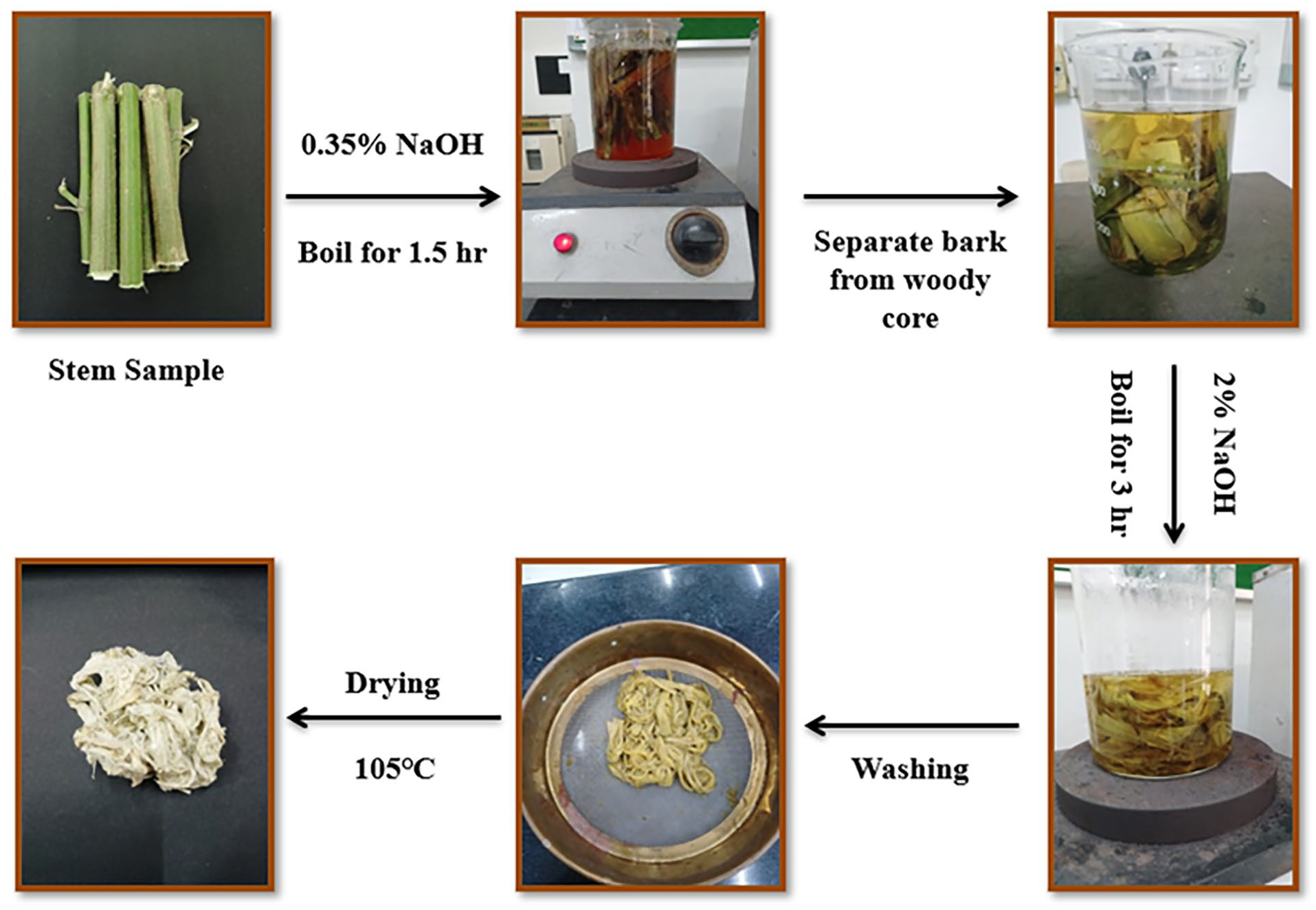
Stepwise methodology of fiber extraction.
Compositional analysis for fiber content
The Soxhlet extraction technique was employed using 150 ml of acetone to assess the extractive content in the cannabis stem. The weight of the extractive-free sample was recorded before and after the extraction process to calculate the constant weight of extractives.25,26 Each analysis was performed on three replicates.
Hemicellulose content
Hemicellulose quantification was then carried out following the protocol described by Ayeni et al. 26 Extractive-free dried biomass (2 g) was transferred to a 250 ml Erlenmeyer flask, to which 150 ml of 500 mol/m3 NaOH solution was added. This mixture was boiled for 3.5 h. After cooling, the mixture was vacuum-filtered and washed until a neutral pH was achieved. The residue was then dried to a constant weight at 105°C in a convection oven. The hemicellulose content (%w/w) of the dry biomass was calculated as the difference between the initial weight of the sample before treatment and the final weight after the treatment.
Cellulose content
The estimation of cellulose was performed according to the method given by Sun et al. 27 2 g of extractive-free dried sample was treated with an acid mixture containing 100 ml of 80% (v/v) acetic acid and 10 ml of 70% (v/v) nitric acid. This mixture was then incubated in boiling water bath for 20 min. Following incubation, the residue was alternately washed with distilled water and 95% (v/v) ethanol to remove reaction breakdown products and residual acid mixture until the pH was neutralized. After drying the residue overnight at 60°C, the cellulose content was calculated using the given equation: Cellulose content (%) = Final sample dry weight (g) / Initial sample dry weight (g) × 100
X-Ray diffraction
The cellulose crystallinity index (CrI) for all samples was analyzed using the Bruker D8 Advance XRD system at the CIF Lab of Lovely Professional University. X-pert pro diffractometer with scanning range 2θ was within 6–60° at 0.5°/minute using Cu-Kα radiation X-ray. The crystallinity index was then calculated from PXRD analysis using a formula earlier developed by Segal et al. 28

where CrI shows the crystallinity index, I002 shows the maximum intensity in the crystalline region of cellulose at the 002 planes, and Iam shows the minimum intensity in the amorphous region of cellulose between its lattice plane. 25
Mechanical properties
The mechanical properties of the fiber were tested at room temperature using a Zwick Roell universal testing machine (model: Static UTM Z010) with a 500N load cell. Tensile testing was conducted according to DIN EN ISO 1798 standards to determine the tensile behavior of the flexible cellular materials when stretched at a constant rate until failure. The gage length was set at 50 mm between the clamps and the crosshead speed was 1 mm/min to stretch the fiber to rupture. The analysis was performed in replicates of three.
Bast fiber content (%)
The bast fiber content was determined according to the method given by Sankari. 29 The weight of the plant stems after removing the leaves was noted. The fiber extracted from each stem was then washed, dried, and weighed. The bast fiber was calculated by using the following formula. Three replicates were analyzed for each treatment.

Surface morphology
FE-SEM (JEOL) was used to evaluate the surface morphology of the fiber, and pictures were captured at various magnifications at accelerated voltages of 5 and 10 kV. To stop the surface from being charged, a conductive coating of gold was applied to every fiber.
Statistical analysis
Data recorded were analyzed using one-way ANOVA. The Duncan’s test was conducted using IBM SPSS version 22 software. The graphs were plotted using OriginLab software.
Results
Fiber extraction
The boiling of stem pieces in 0.35% NaOH solution for 90 min facilitated the separation of the bark from the woody core. The bark still had some chlorophyll content present in it. The fiber was successfully extracted during the second treatment, and it was yellowish. The extracted fiber was then washed and oven-dried which gave the fiber its characteristic color and texture (Figure 3).

Extracted fiber after NaOH treatment: (a) raw fiber and (b) straightened fiber.
Compositional analysis
The analysis of cellulose and hemicellulose content in fiber after treatment with varying concentrations of glyphosate and metribuzin herbicides revealed significant differences (Figure 4). In the untreated control fiber, the cellulose content was 63.3%, while the hemicellulose content was 7.8%. When fiber was treated with a low concentration of glyphosate (G1), a decrease in both cellulose and hemicellulose content was observed, with values of 49.5% and 6.417%, respectively. This reduction becomes more pronounced with high concentration of glyphosate (G2), where the cellulose content dropped to 37.15%, and the hemicellulose content decreased to 5.21%.
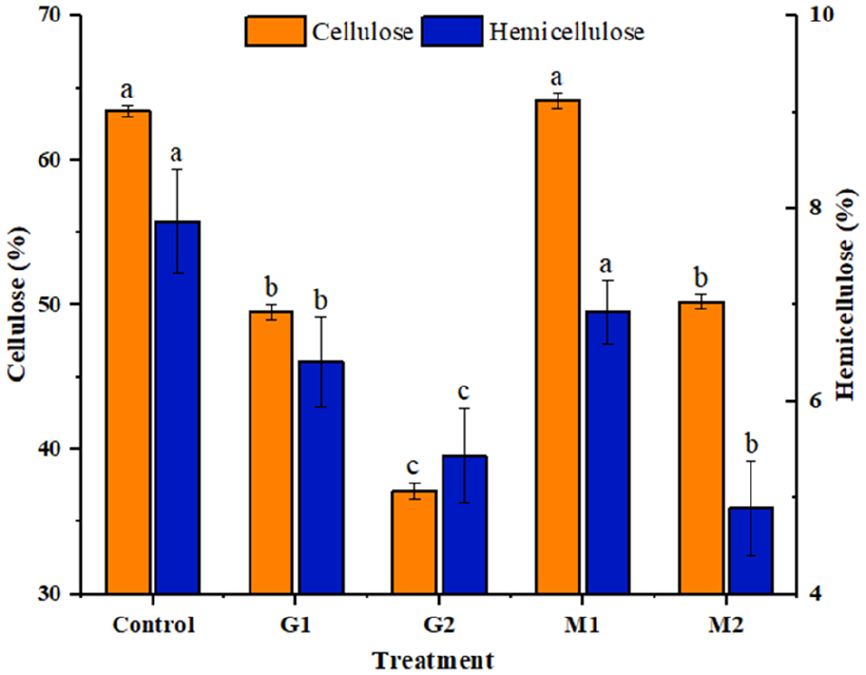
Change in cellulose and hemicellulose content with varying herbicide concentrations.
In contrast, treatment with a low concentration of metribuzin (M1) led to an increase in cellulose content to 64.1%, showing no significant difference with the control, although the hemicellulose content showed a minor reduction to 6.98%. However, fiber treated with a high concentration of metribuzin (M2) exhibited a cellulose content of 50.2%, lower than the control but higher than both glyphosate treatments. Notably, the hemicellulose content in this fiber was the lowest at 4.81%.
Cellulose crystallinity index analysis
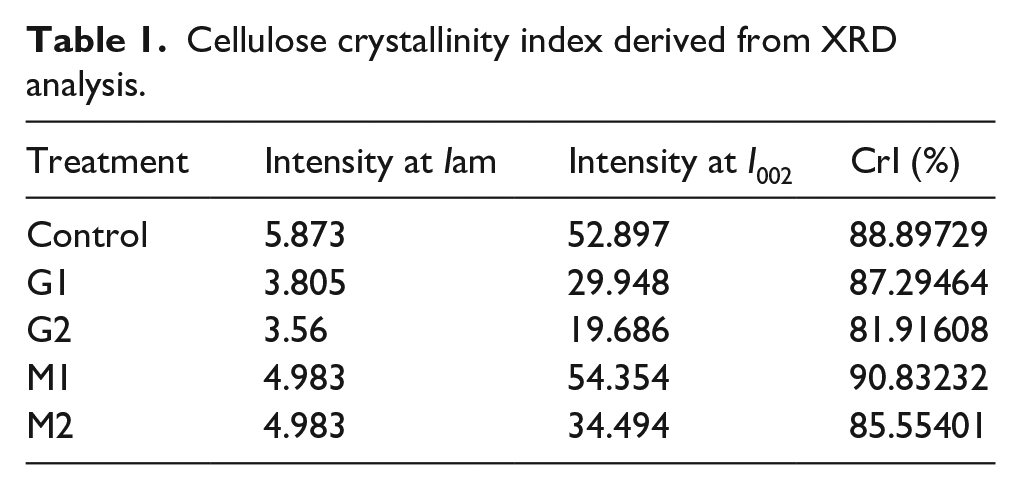
The X-ray diffraction (XRD) analysis revealed varying crystallinity indices (CrI) among hemp fiber samples subjected to different herbicide treatments (Table 1, Figure 5). The untreated control fiber exhibited an intensity at Iam of 5.873 and I002 of 52.897, resulting in a CrI of 88.90%. Glyphosate treatment caused a concentration-dependent decrease in CrI. Specifically, low-concentration glyphosate treatment (G1) reduced the intensity at Iam to 3.805 and at I002 to 29.948, resulting in a CrI of 87.29%. High-concentration glyphosate treatment (G2) showed the most substantial reduction, with Iam at 3.560 and I002 at 19.686, leading to a CrI of 81.92%.
Cellulose crystallinity index derived from XRD analysis.

X-ray diffraction pattern of fiber under varying herbicide stress.
In contrast, metribuzin treatment displayed divergent effects. Low concentration metribuzin treatment (M1) resulted in the highest CrI (90.83%), with Iam at 4.983 and I002 at 54.354, surpassing the control. However, high concentration metribuzin treatment (M2) led to a reduction in CrI to 85.55%, with Iam remaining at 4.983 but I002 decreasing to 34.494.
Strain at maximum load
The tensile strain of untreated hemp fiber showed a maximum strain of 1.81% before breaking. Fiber treated with low glyphosate concentration showed a decreased strain of 0.55%, while those treated with low metribuzin concentration had an increased strain of 4.17% as compared to control. However, the fiber treated with high concentrations of both herbicides showed reduced strain at maximum load that is, 0.78% for glyphosate and 1.17% for metribuzin (Figure 6).

Variation in strain at maximum load of fiber under herbicide stress.
Young’s modulus
Young’s modulus is a measure of the ability of a material to withstand changes in length when under lengthwise tension or compression. Fiber treated with the lowest glyphosate concentration exhibited the highest Young’s modulus value of 75695.87 MPa. In contrast, fiber treated with the lowest metribuzin concentration showed the lowest Young’s modulus of 7533.04 MPa. Untreated fiber had an intermediate Young’s modulus value of 15641.05 MPa. At the highest glyphosate and metribuzin concentrations, Young’s modulus was 48056.24 MPa and 37458.04 MPa respectively (Figure 7).

Variation in Youngs modulus under varying herbicide stress.
Maximum extension
The results showed that low metribuzin concentration (M1) resulted in the greatest fiber extension of 74.56 mm, indicating an increase in fiber extensibility. High glyphosate concentration (G2) gave the next highest extension of 74.066 mm, also increasing extension compared to the untreated fiber which extended up to 73.55 mm. In contrast, low glyphosate concentration gave the lowest extension of 72.26 mm, decreasing fiber extensibility. High metribuzin concentration resulted in a fiber extension of 74.03 mm, having little effect on extensibility compared to the control (Figure 8).
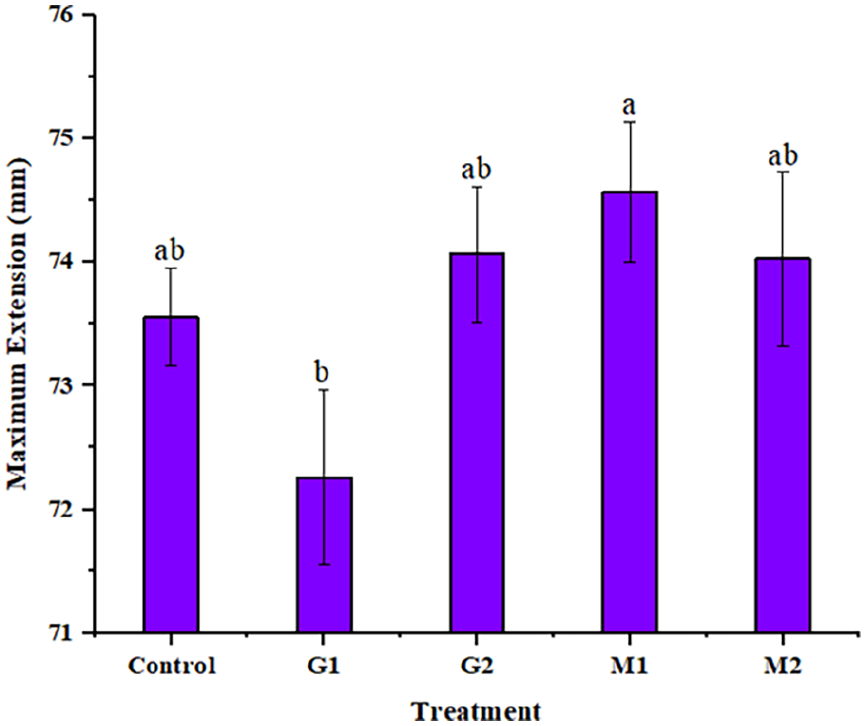
Maximum extension of fiber obtained from herbicide-stressed plants.
Elongation at break
Fiber extracted from the lowest metribuzin concentration treated plants showed the highest elongation of 6.52%. The highest glyphosate concentration resulted in the next highest elongation of 5.8%. Untreated fiber had 5.08% elongation. The lowest elongation of 3.22% occurred with the lowest glyphosate concentration, followed by 5.75% elongation with the second-highest metribuzin concentration (Figure 9).

Maximum elongation of fiber before breaking.
Stress-strain curve
The stress-strain curve was drawn for the fiber extracted from varying concentrations of glyphosate- and metribuzin-treated pants (Figure 10). The breaking strength of hemp fiber was estimated using a stress-strain curve after herbicide treatment (Figure 11). The untreated fiber exhibited a breaking strength of 260.141 MPa. Fiber treated with a low concentration of glyphosate (G1) showed a decreased breaking strength of 237.151 MPa compared to the control. This reduction in strength was more pronounced for fiber treated with a high concentration of glyphosate (G2), which had a breaking strength of 190.817 MPa, the lowest among all treatments. In contrast, fiber treated with a low concentration of metribuzin (M1) displayed a breaking strength of 264.089 MPa, higher than the control, indicating an increase in strength. However, fiber treated with a high concentration of metribuzin (M2) had a breaking strength of 239.942 MPa, lower than the control but higher than both glyphosate treatments.

Stress-strain curve of fiber under different herbicide stress.

Breaking strength of fiber obtained from stress-strain curve.
Bast fiber content (%)
Bast fiber may be defined as those obtained from the outer cell layers of the stems of various plants. 30 In the control plants with no herbicide treatment, the bast fiber content was 3.07%. At low concentrations, both herbicides increased bast fiber content compared to the control, with glyphosate treatment resulting in a maximum increase of 4.53% and metribuzin treatment resulting in 3.91% increase. This suggests low levels of these herbicides may have a positive effect on hemp fiber production. However, as the concentration of the herbicides was increased, the bast fiber content declined, indicating higher levels of herbicide stress decreases fiber content (Figure 12).

Bast fiber (%) content in fiber after herbicide treatment.
Surface morphology
The scanning electron microscope (SEM) micrographs show the untreated fiber’s natural state, characterized by a smooth and uniform surface topography (Figure 13(a)). Upon exposure to glyphosate herbicide at the lowest concentration (Figure 13(c)), the fiber exhibits initial signs of surface disruption and textural alterations compared to the control. At the highest concentration, surface irregularities and roughening escalations were observed, indicating structural damage (Figure 13(e)).
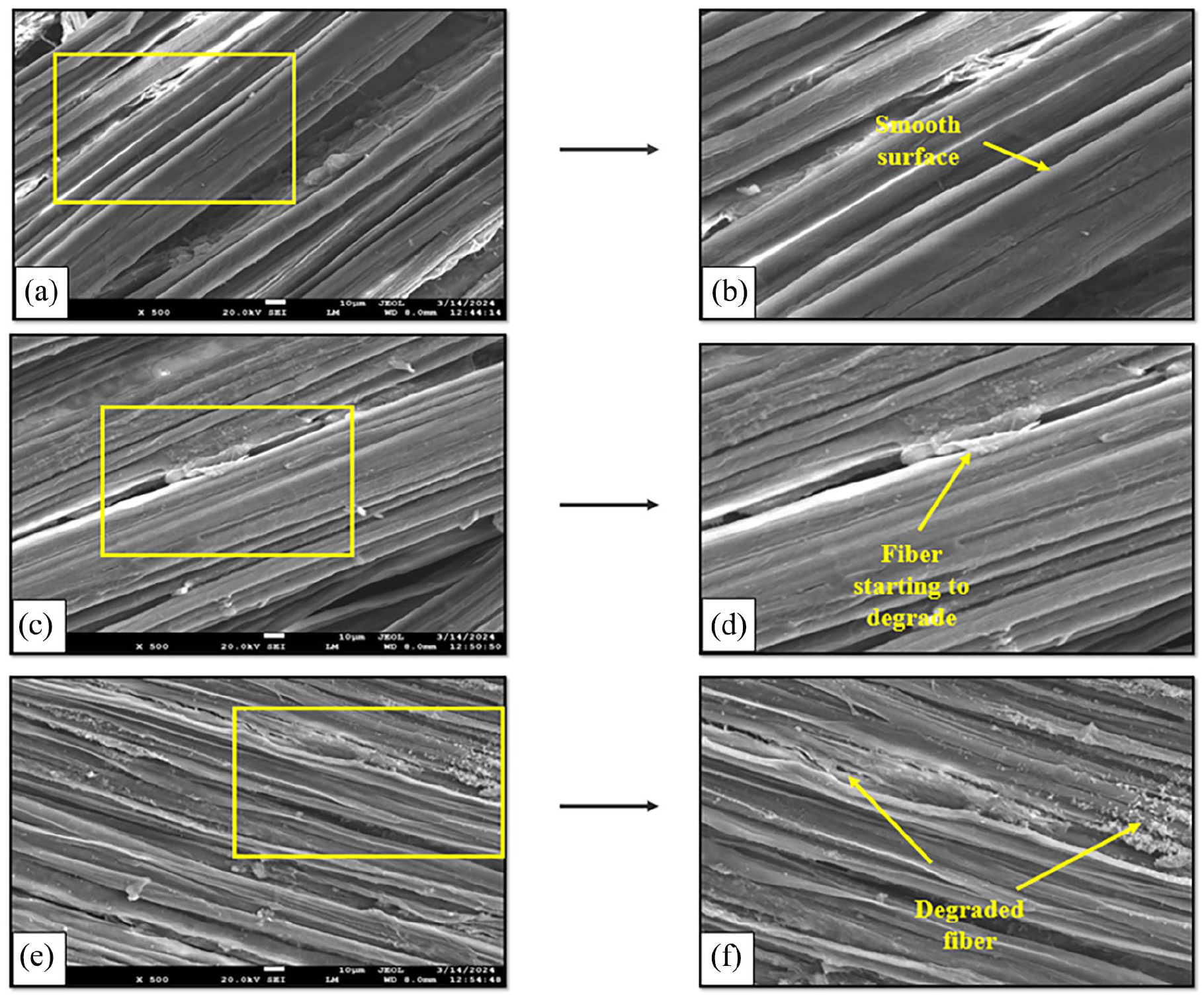
SEM image (×500) of fiber under varying glyphosate stress: (a) control, (b) zoomed in control, (c) G1, (d) zoomed in G1, (e) G2, (f) zoomed in G2; (b, d, f: Manually zoomed approximately two times at the degraded spot for enhanced visualization).
In metribuzin-treated samples, the SEM image reveals extensive surface erosion and significant degradation, characterized by substantial loss of the original smooth fiber morphology (Figure 14(c) and (e)). At the highest concentration, bubbling can also be seen indicating the highest form of degradation among all herbicide concentrations ultimately impacting the fiber quality.

SEM image (×500) of fiber under varying metribuzin stress: (a) control, (b) zoomed in control, (c) M1, (d) zoomed in M1, (e) M2, (f) zoomed in M2; (b, d, f: Manually zoomed approximately two times at the degraded spot for enhanced visualization).
Discussion
Natural fiber is a composite material made from renewable plant and animal sources, making them environmentally sustainable with well-understood structures. 10 The main component of plant fiber is the polymer cellulose. Lignocellulosic or plant fiber can be obtained from various parts of plants like bark, wood, leaves, seeds, fruits, vegetables, straw, bagasse, and roots. 10 Alongside cellulose, the plant fiber contains other constituents such as hemicellulose, lignin, pectin, and waxes. The exact composition of each component varies based on the plant source, its age, and any preprocessing steps applied. 31 Hemp fiber is a prominent type of bast natural fiber, commonly extracted from the hemp plant of the Cannabis genus. The inherent mechanical, thermal, and acoustic properties of hemp fiber, combined with the general characteristics of natural fiber, make it beneficial for a wide range of applications, including use as reinforcements in polymer composite materials. 32 In our study, we used sodium hydroxide for the fiber extraction process. A study tested effects of different levels of alkali concentrations on the hemp fibers’ mechanical properties (like length, strength, and weight) and physical properties (like diameter and surface texture). The treatment produced textile-grade hemp fibers that can be spun using a cotton spinning system. Also, the alkali treatment significantly improved the quality of the hemp fibers, making them suitable for textile applications. 33
Cellulose exhibits a structural configuration comprising long, linear polymeric chains of glucose monomers linked together by robust hydrogen bonds. 34 These hydrogen bonding interactions confer a highly stable and rigid geometry upon cellulose, endowing it with remarkable tensile strength properties. The length of the cellulosic fiber and its micronaire value (quantitative measure of fiber fineness and maturity), are significantly influenced by agronomic and climatic factors, as the growth and development of the fiber are susceptible to most factors that impact overall plant growth. Since cellulose constitutes the primary component of the plant fiber, any factor modulating the plant’s photosynthetic capacity and carbohydrate biosynthesis will exert a commensurate effect on fiber growth. 35 Cell expansion during the growth phase is strongly driven by turgor pressure, the hydrostatic pressure exerted by fluids within the plant cell, hence the plant’s water relations will likewise modulate fiber elongation. Sucrose, a non-reducing disaccharide and the primary product of photosynthesis in plants serves as the fundamental precursor compound in cellulose biosynthesis 36 ; consequently, any perturbation in sucrose concentration would directly impact cellulose synthesis. Our findings suggest that while low metribuzin concentration (M1) positively impacted cellulose content, glyphosate treatments negatively affected both cellulose and hemicellulose levels, with higher concentrations causing more severe reductions. Furthermore, high metribuzin concentration also decreased cellulose content compared to the control, but its effect on hemicellulose content was more substantial.
The cellulose filaments exhibit a parallel alignment along the longitudinal axis of the fiber, conferring maximal tensile and flexural strengths, imparting structural rigidity. The mechanical properties of the fiber is primarily governed by factors such as the cellulose content, the degree of polymerization (DP), and the fibrillar angle. Notably, a high cellulose content and a low fibrillar angle are desirable characteristics for fiber, intended for use as reinforcements in biological composite materials. 31 The parallel orientation of the cellulose filaments along the fiber length, facilitates the efficient translation of the cellulose polymer’s inherent strength and rigidity to the fiber’s overall mechanical performance. Furthermore, higher cellulose content and a smaller fibrillar angle, representing the acute angle between the cellulose microfibrils and the longitudinal fiber axis, are advantageous as they optimize the fiber’s stress transfer and load-bearing capabilities when incorporated as reinforcing elements within composite matrices. 37 A study on flax seeds concluded that applying glyphosate to flax stems initiates a predictable retting process, where fiber bundles start separating due to the drying and eventual microbial action. Mechanical tests showed that as the stems dry, the work needed to separate fibers initially increases and then decreases as microbial retting progresses. 38
The crystallinity index of fiber can change under stress. A study found that drought stress can significantly influence the crystallinity of hemp fiber. 39 The crystallinity index (CrI) and its contributing parameters, Iam and I002, offer insights into the structural changes in hemp fibers subjected to different herbicide treatments. Our results also showed a variation in crystallinity index under different herbicide stresses. The untreated control exhibited a high CrI (88.90%), characterized by significant I002 intensity (52.897) and a moderate Iam intensity (5.873), indicative of a well-ordered crystalline structure. The values of CI obtained through XRD were similar to values of other studies.39 –41 The crystallinity index significantly influences the mechanical properties of natural fibers, 42 as it’s the crystalline region that gives a fiber its strength. 43 Fibers with high crystallinity have tightly packed molecular chains, making them less accessible to water molecules. This restricts the fiber’s ability to swell, as fewer spaces are available for water to penetrate. Conversely, fibers with a lower CI have more amorphous regions, which allow for greater water absorption and swelling. 44 Our results of the crystallinity index of different fiber samples were found to be in a similar trend to the breaking strength results. Also, cellulose content showed a similar pattern. Our findings suggest that while low metribuzin concentration enhances the breaking strength of the fiber, glyphosate treatments, particularly at high concentrations, negatively impact fiber strength. Conversely, high metribuzin concentration also led to a reduction in breaking strength compared to the control, albeit to a lesser extent than the glyphosate treatments. In addition, other mechanical properties like fiber’s tensile strength were reduced at low glyphosate levels while low metribuzin levels increased it, but high concentrations of both herbicides negatively impacted fiber strength to withhold the load. Numerous factors, including chemical composition, flaws, the percentage of secondary fiber present, and fiber diameter, affect hemp fiber’s mechanical qualities. 45 Tensile strength declines with increasing fiber diameter, as shown by Fan. 46 This diameter dependency is only correlated with the number of single fibers present in the fiber bundle as well as the number of fiber defects.
Studies have demonstrated that the highest mechanical qualities, such as a greater Young’s modulus, are displayed by bio-composites made of natural fiber that have a high combined percentage of cellulose and hemicellulose. Cellulose, hemicellulose, and lignin make up the fiber. Hydrophilic crystalline cellulose influences the material’s elastic limit. The ductility of a material is significantly influenced by hydrophobic lignin, whereas hemicellulose and cellulose also have an impact. 47 In our study, low levels of glyphosate increased fiber stiffness as indicated by the high Young’s modulus, while low metribuzin levels decreased fiber stiffness. High concentrations of both herbicides led to intermediate Young’s modulus values compared to the low concentration and control groups. The Young’s modulus and tensile strength of natural fiber, particularly hemp fiber, are well-documented properties in the literature, with reported values ranging from 58 GPa to 70 GPa48,49 and 550 MPa to 1110 MPa,50 –52 respectively. These variations in mechanical properties and Young’s modulus are attributed to factors such as fiber diameter, fiber length, and test speed employed during characterization. Notably, the findings from the present study indicate that low metribuzin concentrations and high glyphosate concentrations resulted in increased fiber extensibility compared to the control sample, whereas low glyphosate concentrations led to a decrease in extensibility, and high metribuzin concentrations had a minimal impact on fiber extension. Additionally, it was observed that both tensile strength and elongation at break exhibited an inverse relationship with fiber length, diminishing as the fiber length increased. Conversely, Young’s modulus demonstrated a positive correlation with fiber length, increasing with an augmentation in fiber length. Furthermore, an escalation in the test speed during mechanical characterization was found to elicit a concomitant increase in the fiber’s Young’s modulus. 53
The elongation at break, a critical parameter characterizing the ductility of fiber, has been extensively studied, with literature values reported to be around 1.6%. 53 Although the modulation of fiber length under water deficit conditions would appear to be directly and simplistically linked to the processes of cell expansion, the effects of water availability on the duration and timing of flowering, as well as fiber elongation, result in intricate physiological interactions between water deficits and fiber properties. 54 The results obtained in the present study indicate that low concentrations of glyphosate herbicide compromised the fiber strength, manifesting as a reduction in strain at failure. Conversely, low levels of metribuzin herbicide fortified the fiber, enhancing their strain capacity. However, high concentrations of both herbicides elicited a decrease in the tensile strain of the fiber at the maximum load, compared to the untreated control samples. These findings underscore the intricate interplay between herbicide exposure and fiber mechanical properties, with the specific herbicide type and concentration playing a pivotal role in modulating the ductility and strain response of the fiber.
Concerning the changes in the morphological features of the fiber, the SEM results indicate that while both herbicides demonstrated the capacity to degrade the fiber structure, with higher concentrations yielding more severe effects, the data suggests that metribuzin, particularly at its highest concentration, exhibited the most detrimental impact on the fiber’s surface topography. The extensive erosion and degradation observed suggest a critical compromise in the fiber’s structural integrity, potentially rendering it unsuitable for applications that demand robust mechanical properties and surface uniformity. A study analyzed the effects of different thermal stresses, on the morphology of natural fibers like palm and coir and SEM micrographs showed significant structural degradation of the fibers after thermal treatments. Also, they concluded that heat treatments led to the breakdown of external cell walls and secondary layers of internal cells, indicating that these regions are more susceptible to thermal degradation. 55 SEM analysis by another study revealed that excessive or improperly controlled chemical and mechanical treatments can negatively impact natural fibers by causing surface cracks, roughness, and structural degradation. Alkali treatment often leads to over-fibrillation and void formation, while benzoylation and silane treatments can result in embrittlement and brittle surface layers. Peroxide, plasma, and ozone treatments introduce oxidative damage and micro-cracks, while acetylation can make fibers overly stiff and brittle. Additionally, thermal degradation during curing or drying causes shrinkage, cracking, and scorching. These effects highlight the need for optimized treatment conditions to preserve fiber integrity while enhancing their properties. 12
It is imperative to accentuate the inherent complexity of fiber quality, as it is contingent upon a myriad of parameters, thereby underscoring the necessity for a comprehensive study that can encompass, evaluate, and correlate as many of these factors as possible. While the issue of fiber quality has been extensively investigated by numerous researchers, the approaches employed have typically been fragmentary. 56
Conclusion
The study investigated the effects of herbicides (glyphosate and metribuzin) on hemp fiber properties. Low concentrations of metribuzin generally improved fiber characteristics such as cellulose content, breaking strength, crystallinity index and tensile strength. In contrast, glyphosate treatments negatively impacted these properties, especially at higher concentrations. The research highlighted the complex relationship between herbicide exposure and fiber mechanical properties. Factors like cellulose content, fiber diameter, and herbicide concentration played crucial roles in determining fiber strength, stiffness, and extensibility. Morphological analysis through SEM revealed that higher herbicide concentrations, particularly metribuzin, caused severe degradation of fiber structure. These findings underscore the importance of careful herbicide management in hemp cultivation to maintain optimal fiber quality. The study also emphasizes the need for comprehensive research approaches that consider multiple factors affecting fiber properties, as a complex interplay of various parameters influences fiber quality.
Footnotes
Acknowledgements
The authors are grateful to Lovely Professional University for providing the lab facilities. The authors also thank the Central Research Facility (CRF) at the Indian Institute of Technology Delhi for using their resources. The authors extend their appreciation to the Deanship of Scientific Research, King Saud University for funding through Vice Deanship of Scientific Research Chairs; Chair for DNA Research.
Author contributions
Conceptualization: Anand Mohan and Tabarak Malik; Writing - original draft preparation: Sabreen Bashir; Writing - review and editing: Anand Mohan, Anil Kumar, Madhuri Girdhar, Maqsood A. Siddiqui, Abdulaziz A. Al-Khedhairy; Supervision: Anand Mohan.
Data availability
All data generated or analyzed during this study are included in this published article.
Declaration of conflicting interests
The author(s) declared no potential conflicts of interest with respect to the research, authorship, and/or publication of this article.
Funding
The author(s) received no financial support for the research, authorship, and/or publication of this article.
Ethical approval
Not applicable.
Consent to participate
Not applicable.
Consent for publication
Not applicable.
