



Abstract
Fabric made from fancy yarn, especially neppy yarn has a great environmental impact because the fabric does not need any additional dyeing process. This study involved knitting neppy yarn of two distinct spinning processes, vortex and ring spinning, each having three different percentages of neps. The comfort properties of six different fabrics were evaluated by analyzing various parameters, including moisture management properties, water vapor transmission rate, air permeability, hand feel properties, and bursting strength. Microscopic views were also examined for analyzing the physical appearance of the fabric’s surface. The experimental results revealed that fabrics made from vortex-spun neppy yarn (VSNY) exhibit better moisture management, breathability, and hand feel properties than ring-spun neppy yarn (RSNY). Alternatively, bursting strength and water vapor evaporation rate showed a lower trend in fabrics made from vortex-spun neppy yarn. The research findings contribute valuable insights into the potential of vortex spinning techniques for sustainable and comfortable textile production.
Introduction
Clothing, an item that frequently envelops most of our bodies, holds significant sensitivity in our daily lives. 1 Its primary purpose is to deliver the utmost comfort to the wearer, encompassing a sensation of coolness. Comfort, an indispensable criterion, is a fundamental requirement when selecting a garment.2,3 The level of comfort a garment provides is closely tied to its proficiency in moisture management, characterized by the efficient removal of moisture from the body in vapor form, thus ensuring user comfort. Moisture management, alongside the air permeability and water vapor transmission rate, stands among the foremost influential factors shaping the overall comfort experienced by a garment.3 –5 There has been a lot of study and development in the area of moisture management of man-made fiber in recent years, which has resulted in consumer satisfaction with an increased comfort level.6 –8 Viscose rayon fiber is a popular choice for knitwear due to its comfort and visual appeal. Fabrics made from viscose rayon fiber have a comfortable feel and unique drape, making them preferred for inner and outer knitwear products.2,9
The feel of the textile materials to the touch is perhaps the most crucial aspect in deciding how comfortable clothing is to wear. A customer must assess the fabric quality and utility before purchasing.10,11 The tactile sensation of a fabric, known as a fabric handle, is also considered a critical factor in determining clothing comfort.10 –12 The physical and mechanical characteristics of a fabric that influence its handle are governed by its smoothness, softness, stiffness flexibility, compressibility, pliability, and surface friction.11,13 The main factor that influenced how comfortable the fabric of its surface texture, but not the kinds of fiber. 14 When it comes to evaluating the quality of the fabric, one of the initial measures taken by discerning purchasers is to engage their sense of touch. In this intricate dance of assessment, the human fingers assume a position of paramount importance that has more than 250 sensors per square centimeter, each finely attuned to perceive the nuances of texture, resilience, and subtleties that define the fabric’s excellence.15,16 There are several methods successfully introduced as a prediction method on textile touch feels from their physical properties, 12 such as the Kawabata Evaluation System for Fabric (KES-F),17,18 the Fabric Assurance by Simple Testing (FAST),11,12 and Fabric Touch Tester (FTT). 17
Salome et al. found that the spinning method can have an impact on the overall clothing comfort of a fabric. 9 The Murata vortex spinning (MVS) is a recent advancement in air-jet spinning technology, which allows for higher production speeds of up to 500 m/min, making the vortex spinning system one of the latest commercially viable spinning methods.3,19 Vortex spinning technology uses an air vortex to spin out the yarn, which creates fibers with a unique structure and a range of functionalities such as higher production rate, and lower cost. Additionally, vortex-spun yarns and fabrics have low hairiness, high pilling and abrasion resistance, quick-drying properties, and better durability.2,4,5
The objective of this study is to investigate the effect of the spinning process on comfort properties of single jersey knitted fabric made by both vortex and ring-spun neppy yarn. As far author’s knowledge, the fabric comfort properties of neppy yarn had not been previously explored in literature. This research work has the potential to bring significant benefits to the textile industry and contribute to the development of more comfortable, functional, and innovative textile products.
Materials and methods
26/1 Ne, vortex-spun neppy yarn (VSNY), and ring-spun neppy yarn (RSNY) with three different neps percentages (2%, 3%, and 4%) were produced in this study. The neppy yarns consisted of viscose rayon as a host fiber and polyester as a neppy fiber. The yarn properties are given in Table 1. Single jersey knit fabric with six different compositions of yarn was produced using Mayer & Cie single jersey knitting machine. The model of the machine is MV 4-3.2 II, (Germany), with a cylinder diameter of 610 mm, cylinder speed of 20 rpm, number of needles 1800 (Gauge 24), and number of feeders 78. After that, fabrics were treated with a normal wash using Sclavos Athena 1800 (Greece) dyeing machine at 1:8 materials to liquor ratio with 1 g/l Rucogen WBL, 1 g/l Oxinol LLS, 1.5 g/l Serafast CRD, and 1 g/l Texsoft HRDK. The treatment was conducted at 50°C for 20 min, followed by a 5-minutes minute-wash to ensure thorough cleaning. Finally, the fabric undergoes a finishing treatment at 1:3.5 materials to liquor ratio with 60 g/l Tubingal 9270 hydrophilic softening agent at 45°C for 20 min, while maintaining the pH at 5.5. All the washing and finishing chemicals were purchased from CHT Bangladesh Pvt. Ltd.
Properties of yarn used in this study.

Wales/cm and courses/cm (ASTM D-3887), stitch density, stitch length (TS EN 14970, 2006), and areal density (ASTM D 3776) were measured for both VSNY and RSNY fabric. Fabric thickness was measured on an SDL digital thickness gauge according to ISO 5084 standards. Details specifications of fabrics are presented in Table 2. The finished fabric was conditioned for 24 h in atmospheric conditions of 20°C ± 2°C temperature and 65 ± 2% relative humidity according to ASTM D 1776, 2004 before structural properties were measured.
Specification of the fabrics.

The tightness factor and porosity of the fabric were determined using equations (1) and (2),19,20 respectively. The density of the viscose rayon fiber, 1.52 g/cm3 21 and polyester fiber, 1.39 g/cm3 were utilized in the calculations.

Where l is the stitch length in cm.

Where the density of fabric (g/cm3) =
Before conducting all the tests, the samples were conditioned in a controlled environment at a temperature of 20°C ± 2°C and a relative humidity of 65 ± 2%, as specified in ASTM D 1776, 2004.
The fabric’s wicking properties were assessed using the strip test method adhered to the esteemed TM nine standard, utilizing samples size 20 × 2.5 cm, and the results were quantified in centimeters of wicking height. The fabric’s water vapor evaporation rate was conducted following the TM 10 standards. The fabric was initially conditioned at 20°C and 65% relative humidity (RH) for 16 h to achieve standardized moisture content. To initiate the test, a fabric sample measuring 100 cm2 was carefully cut and weighed (W1) then 1 ml of distilled water was added to the sample, and the sample was weighed again (W2) to determine the initial moisture content. The sample was then subjected to drying conditions at 20°C and 65% RH for 30 min. Following the drying process, the sample was weighed (W3) once more to determine the residual moisture content. By comparing the initial and final sample weights, the water vapor evaporation rate of the fabric was calculated using equation (3).

Water absorbency was measured as described by Mukhopadhyay et al. 22 The fabric samples were prepared by cutting them into circular shapes of 100 cm2 in area. The initial weight of each sample (W1) was measured and recorded. The samples were then immersed in distilled water to a depth of 10 cm using a wire sinker. After 6 h, the specimens were removed and placed on a sponge sheet in a closed room for 30 min to eliminate excess surface water. The final weight of the fabrics (W2) was measured and recorded. The water absorbency was calculated using equation (4).

Air permeability test was performed using FX 3300 LabAir IV (Switzerland) in accordance with ASTM D737 standard. The water vapor transmission rate (WVTR) (Cup Method
Results and discussions
Moisture management analysis
Moisture management involves the regulated transfer of water vapor and liquid water from the skin’s surface to the atmosphere through the fabric. The critical factors for assessing moisture management include vertical wicking, water absorbency, evaporation rate, and water vapor transmission (WVT) properties.23,24
Vertical wicking is the process by which a liquid is drawn and spreads through a fabric, facilitated by capillary action, surface tension, and the fabric’s structure. 24 The impact of different yarn compositions on wicking characteristics was examined in Figure 1(a). The results revealed that fabrics made from VSNY with 3% and 4% neps exhibited higher wicking heights, while fabrics with 2% neps showed a decline in wicking performance. The variation in fabric-wicking properties is attributed to the presence of neps in both VSNY and RSNY. Specifically, in VSNY, the neppy fibers are more closely intertwined with the mother yarn resulting in the fabric, which is depicted in Figures 7(a) and 8(a), allowing for less interrupted capillary action in comparison to RSNY. Furthermore, in vortex spinning, the arrangement of fibers within the yarn body is typically straight, 25 which facilitates the upward movement of liquids. Additionally, it is important to point out that, the presence of neps in both VSNY and RSNY as well as helically wrapped fibers 25 in the outer layer of VSNY and subsequently in the fabric during the production process does not follow a specific sequence, leading to inconsistencies in the test results.

Moisture management analysis of the different percentages of neppy yarn fabric: (a) vertical wicking, (b) water absorbency, and (c) evaporation rate.
A knitted fabric’s water absorbency refers to its ability to absorb and retain moisture upon contact with water. Evaporation rate refers to the speed at which water vapor present on a fabric surface evaporates into the surrounding environment. 19 As depicted in Figure 1(b) and (c), fabric samples composed of different percentages of neppy yarn were evaluated for their absorbency and evaporation rate. The results demonstrated that fabrics knitted from VSNY exhibited a higher rate of absorbency (Figure 1(b)) and a slower evaporation rate (Figure 1(c)) compared to those made from RSNY. This disparity arises from the contrasting structures of VSNY and RSNY. In the case of VSNY, a substantial proportion of the fibers align parallel to the yarn axis 25 and higher porosity is observed in VSNY fabric, as mentioned in Table 2. This alignment allows the VSNY fabric to gain a higher absorbency rate while retaining moisture for an extended duration, consequently resulting in a slower evaporation rate in VSNY fabric. This distinctive attribute contributes to the observed difference in absorbency and evaporation rates of fabrics produced from VSNY and RSNY. The error bars in the above figures indicate standard deviation.
Breathability analysis
Breathability analysis refers to assessing and evaluating the fabric’s ability to allow air and moisture to pass through it. 26
Air permeability and water vapor transmission rate (WVTR) a crucial comfort factors that significantly affect the wearer’s experience. 26 Figure 2 illustrates that fabrics made from VSNY exhibit better results in terms of both air permeability 2(a) and water vapor transmission rate 2(b) when compared to those made from RSNY. This distinction is attributed to the contrasting physical structures of the VSNY and RSNY. In the case of VSNY, which has a lower fiber packing density value than conventional RSNY, a fabric with low fiber packing density may have a fuller or more open structure, allowing more air and water vapor to pass through the fabric.27,28 Besides slightly higher porosity evident in the fabric made from VSNY, as mentioned in Table 2 is also responsible for the difference in the result. Furthermore, with an increase in the percentage of neps, both VSNY and RSNY fabrics demonstrate a decrease in air permeability and WVTR. This is attributed to the neps, which consist of entangled fibers that impede the transmission rate of air and water vapor. Thus, as the percentage of neps increases, the air permeability and WVTR values decrease accordingly. The error bars were calculated in Figure 4 from the standard deviation.

Breathability analysis of the different percentages of neppy yarn fabric: (a) air permeability values and (b) water vapor transmission rate (WVTR).
Hand feel analysis
The hand feel property of fabric refers to the tactile sensation or touch experienced when the fabric comes into contact. It encompasses various sensory perceptions, such as bending, compression, friction, and, tension. 29 The neppy yarn fabric’s compression average rigidity (CAR), bending average rigidity (BAR), and surface friction coefficient (SFC) were assessed using the Fabric Touch Tester DW262 (China), obtaining indices for softness (SF), stiffness (ST), and smoothness (SM), each graded on a scale of five.
Compression average rigidity (CAR) refers to the average resistance of a material or structure to compression forces, specifically, the forces needed to compress the material per millimeter. 30 It quantifies the softness of a material when subjected to compressive loads. In this study, Figure 3(a) demonstrated that the compression average rigidity was lower, and Figure 5 showed that the softness (SF) index was higher in case of VSNY fabrics compared to the fabric knitted from RSNY. This indicates that VSNY fabric is more compressible and has a softer hand feel than RSNY fabric. Additionally, the bending average rigidity (BAR) refers to the force required to bend a material or structure per radian. 31 It represents the stiffness or rigidity of a material when subjected to bending force. Figures 3(b) and 5 revealed that the bending average rigidity and stiffness (ST) index of VSNY fabrics were lower compared to the RSNY fabrics respectively. This indicates that the VSNY fabric has a more pliable nature and conforms better to the body compared to the traditional RSNY fabric. This is because, VSNY has a lower twist factor, meaning the fibers within the yarn are less tightly twisted together and a unique parallel alignment of fibers along the yarn axis. 32 Additionally Figure 4 also demonstrated that drape coefficient of VSNY fabric is slightly lower than RSNY fabric. Fabric with low drape coefficient is more flexible and soft hand feel. The combination of lower twist factor and parallel alignment of the fibers enhances the compressibility, flexibility, and bendability of VSNY fabric compared to RSNY fabrics.

Hand feels analysis of the different percentages of neppy yarn fabric: (a) compression average rigidity, (b) bending average rigidity, and (c) surface friction coefficient.

Drape coefficient of different percentages of neppy yarn fabric.
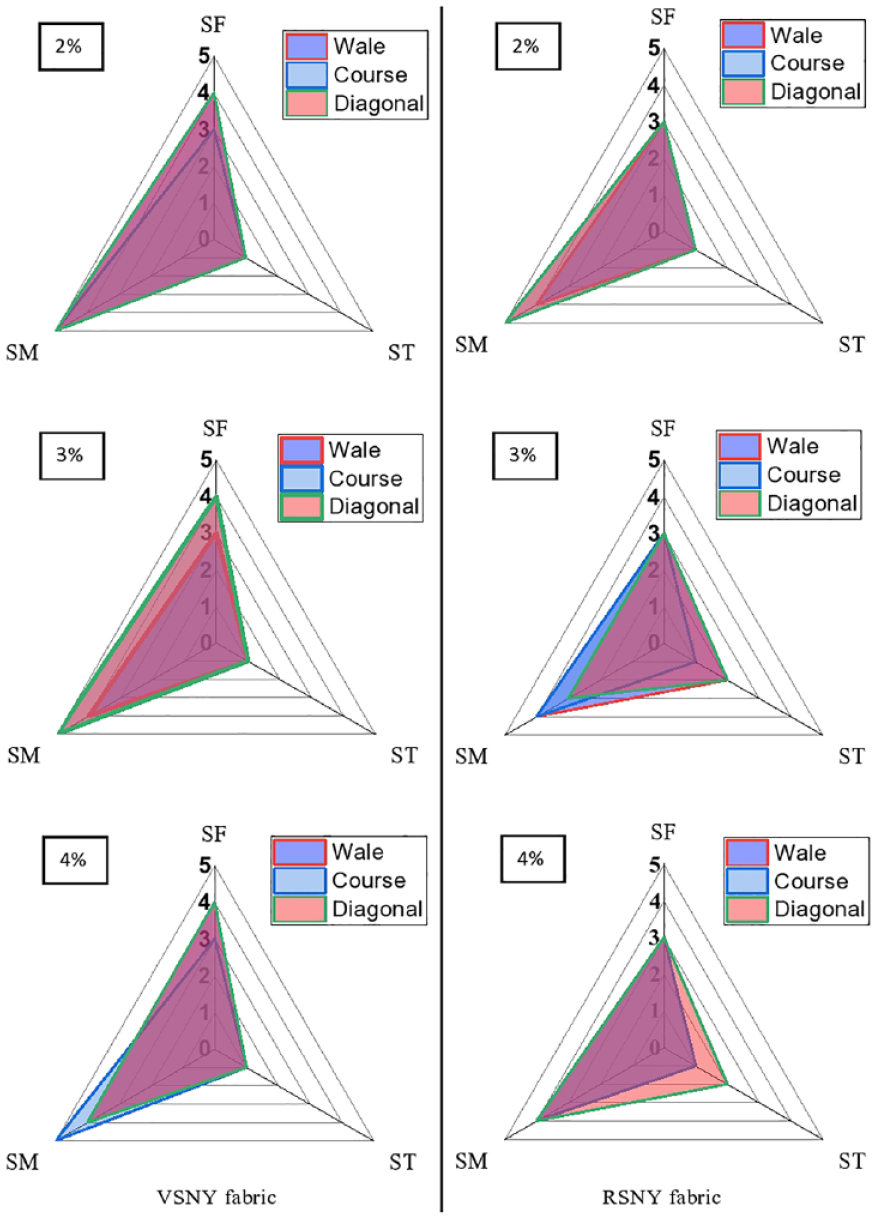
Softness (SF), Stiffness (ST), and, Smoothness (SM) analysis of the different percentages of neppy yarn fabric obtained from Fabric Touch Tester, DW262.
The surface friction coefficient (SFC) refers to the measurement of the frictional resistance between two surfaces in contact 33 and it is an indicator of the fabric smoothness index. In this study fabric made from VSNY exhibits a lower surface coefficient and higher smoothness (SM) index which is represented in Figures 3(c) and 5 than fabric produced from RSNY. This indicates that VSNY fabric has a smoother surface in comparison to fabric made from RSNY. This is attributed to the vortex spinning system possessing very low hairiness, lower coefficient of variation (CV%), and minimal thick and thin places, these characteristics contribute to a more regular yarn with an even surface, resulting in a smoother feel for the fabric. 34 The differences in the fabric’s surface friction coefficient in both VSNY and RSNY are caused by the variances of these two different spinning systems. Error bars were determined based on the standard deviation of the results. It’s important to highlight that the relatively high standard deviation is primarily attributed to the presence and size of neps within the neppy yarn fabric, which is unevenly distributed across the fabric surface. The presence and size of neps beneath the measuring head of the FTT tester were responsible for slight variations in the obtained results.
Bursting property analysis
Bursting strength is important for assessing the knitted fabric’s strength and durability. 35 Figure 6 illustrates that fabrics made from VSNY exhibit lower results when compared to those made from RSNY. This is because the vortex-spinning process aligns the core fibers in a parallel fashion with minimal fiber migration 36 which leads to poor twist distribution, resulting in lower yarn strength and subsequently affecting the fabric’s strength as well. On the other hand, in the ring-spinning process better twist distribution occurs due to high fiber migration.37,38 These variations in spinning systems account for dissimilarities in the bursting strength of the VSNY and RSNY fabrics. Error bars were determined based on the standard deviation of the above results.

Bursting strength of different percentages of neppy yarn fabric.
Microscopic analysis
It was observed that in VSNY fabric, the neps predominantly attach to the surface of the fabric, as depicted in Figures 7(a) and 8(a). In contrast, the neps in RSNY fabric are protruding or loosely attached to the fabric surface, as shown in Figures 7(b) and 8(b). In VSNY, a distinguishing feature is the larger proportion of neppy fibers remaining within the yarn core and wrapper fibers that securely bind the neppy fibers to the mother yarn body. As a result of this close association, the neppy fibers are firmly attached and positioned in close proximity to the yarn and subsequently in the fabric surface. On the other hand, in RSNY fabric, neps usually appear on the surface of the mother yarn body.

Optical microscopic views (1.5X) of fabric obtained from (a) VSNY and (b) RSNY.
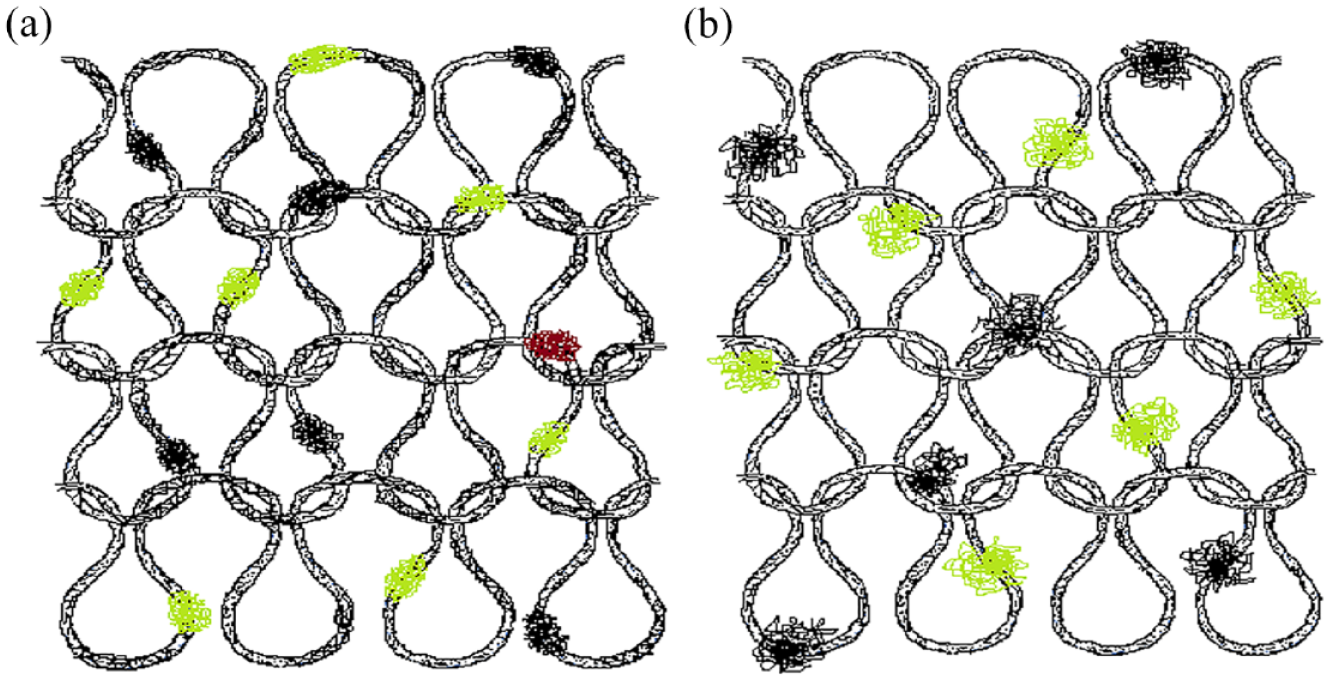
Schematic diagram of fabric obtained from (a) VSNY and (b) RSNY.
Conclusion
This work thoroughly investigated the comfort properties of fabrics made from vortex-spun neppy yarn (VSNY) and ring-spun neppy yarn (RSNY). The experimental findings were obtained about some improved characteristics of VSNY fabric, especially the moisture management, hand feel, and breathability properties as compared to the RSNY fabric. Measuring vertical wicking was challenging due to the presence of neps, which disrupted capillary action for both VSNY and RSNY fabric; however, absorbency levels were found satisfactory, while there was a slight decrease in the water vapor evaporation rate observed in the VSNY fabric. Fabrics produced from VSNY showed around 15% higher air permeability and approximately 7% higher water vapor transmission rates (WVTR) while bursting strength results decreased by roughly 12% as compared to RSNY fabrics. The microscopic analysis revealed the structural advantages of VSNY, contributing to the observed improvements in fabric properties. These findings highlight the significant benefits of incorporating vortex spinning techniques in manufacturing, emphasizing its potential for sustainable and comfortable textile production. By the inherent characteristics of vortex spinning, textile manufacturers and designers can create fabrics that excel in performance, meeting the demands of discerning consumers.
Footnotes
Acknowledgements
The authors extend their heartfelt appreciation to the authorities and personnel of Matin Spinning Mills PLC, Gazipur, Dhaka, Bangladesh, and Bangladesh University of Textiles for their invaluable support and cooperation throughout the research.
Declaration of conflicting interests
The author(s) declared no potential conflicts of interest with respect to the research, authorship, and/or publication of this article.
Funding
The author(s) received no financial support for the research, authorship, and/or publication of this article.
