



Abstract
Due to the low-cost fabrication, printing electronics on flexible substrates shows great potential in robotics, wearable healthcare, and persistent human-machine interfaces. Noninvasive dry-electrodes for electrocardiography (ECG) monitoring are an important technique for detecting early arrhythmias. This article describes a screen printing method for fabricating textile ECG electrodes. The biocompatible carbon ink served as the active electrochemical layer, while the silver paste acted as the conductive path, respectively. The measured results showed that the textile electrode had similar ECG signal monitoring performance compared to commercially available Ag/AgCl electrodes under conditions where the subjects were walking, stationary, and jogging. And the pre-made textile electrodes can be easily connected to the sports bra for monitoring daily exercise ECG. This study demonstrated the feasibility of utilizing textile electrodes for applications in the wearable healthcare industry.
Introduction
Noninvasive wearable devices enable long-term monitoring of biophysical and biochemical signals, including heart rate, lactate, or ions in sweat, as well as human activities.1 –9 Real-time and continuous monitoring of cardiac activities with the well-established medical test, electrocardiography (ECG) is very important for the early diagnosis and treatment of cardiovascular disease.10 –13 The potential signals in ECG equipment can detect arrhythmia, QRS-T morphology, and the R-R intervals. 14 Normally, the bio-electrodes are standard wet-type electrodes, which consist of three components: a sensing component (Ag/AgCl layer); a contacting component (conductive gel), and a connector component (metal button). However, the conductive gel could easily dry out and cause skin irritation and allergic reactions, which are not suitable for long-term recording. 15 Therefore, there are different types of dry electrodes, including metal electrodes, silicon-substrate electrodes, and fabric electrodes. For future wearable devices, three unaddressed challenges need to be considered: (1) the noise caused by the varying contact area during motion, (2) the compatibility between the sensors and the clothing, and (3) the level of wearing comfort.
Textronics covers an application-oriented interdisciplinary approach. 16 Its purpose is to manufacture high-performance flexible electronics integrated with textiles. Textronics can conform to people’s skin surface to continuously tract its wellness and physiological signal. 17 Numerous textronics have been studied and manufactured, including storage, energy harvesting, sensor devices and drug delivery system.18 –20 Compared to the traditional textiles with single function, integrated multifunctional textronics allow for tracking of physiological parameters, 21 interactive human machine interfaces 22 and on-chip therapeutic treatments 23 on one platform. A textile electrode for reliable ECG monitoring has been developed, which can adapt to a variety of human subjects and is convenient for manufacturing. By knitting or embroidering with conductive yarns, the ECG electrode can be integrated into various fabrics.24,25 Compared to the aforementioned methods, the screen printing process offers distinct advantages, including simplified processing steps, reduced materials wastage, and low fabrication costs. These advantages indicate a promising potential for the development of flexible ECG electrodes. The silver (Ag) and copper (Cu) based pastes and solutions are the commonly used materials due to their good physical and electrical performance.26,27 Yin et al. encapsulated an electroplated nickel (Ni) layer between sputtered platinum (Pt) and copper (Cu) layers on a PDMS substrate to obtain a dry electrode for ECG monitoring. 28 In addition, these electrodes have high production costs, which usually require the use of large equipment and clean room facilities. Considering the high cost of these materials, the carbon-based ink is also being explored as a substitute. For example, Chlaihawi et al. fabricated a flexible electrode using multi-walled carbon nanotubes (MWCNTs) on woven textiles for electrocardiogram (ECG) monitoring using the screen printing method. The obtained electrode shows significantly improved performance compared to passive electrodes made of textile materials and performs similarly to Ag/AgCl electrodes. 29 However, the toxic effects of carbon nanotubes are a major concern for their application. 30
In this work, we developed and evaluated a novel textile electrode specifically designed for monitoring ECG signals. The flexible textile electrode was rapidly fabricated using the screen-printing method. Highly conductive silver ink serves as the connecting component in the textile electrode, while the carbon ink acts as the layer for acquiring ECG signals. We conducted experiments on various factors, such as electrode shape and printing times. Our findings indicate that the sensor-shaped fabric electrode has a small surface area, low surface resistance, and low skin contact impedance. These characteristics make it highly suitable for future industrial production. The textile electrode can be easily integrated into a garment by using the screen printing method to secure it in place. A screen-printed textile electrode on a women’s sports bra demonstrated excellent performance in monitoring the cardiovascular activity of an athlete, both during periods of rest and exercise.
Experimental section
Materials
Cotton knitted fabrics with a weight of 100 g/m2 were used as the substrate. Conductive Ag(479SS) and carbon (423SS) ink, purchased from the Acheson Company, were used to print the fabric ECG electrode. The silver ink had a silver content of about 65%, making it suitable for general electronic printing and displaying highly stretchable properties. The Ag/AgCl snap buttons and disposable gel Ag/AgCl electrode for ECG measurements were obtained from a local medical instrument company (INTOC Medical Company). The exact dimension, specifications and photograph of the Ag/AgCl electrode was listed in the Supplemental Information S1. Saturated calomel electrode and KCl were purchased from Sigma Aldrich. Rolling Screen-printing Company offered a screen printing setup. The women’s sports bra was bought from the local store.
Design and fabrication of the electrode
Different-shaped textile electrodes were designed and printed on the plastic film roll. To evaluate the effect of electrode shape on sheet resistance, three groups of electrodes with different shapes were fabricated. The detailed parameters were shown in Table 1 and Figure 1. Screen printing was conducted using a screen printing setup with a nylon mesh count of 110, and the squeegee was held at a 45°angle using a custom-made holder. The printing speed was controlled at about 50 mm/s. The printed electrode was further transferred to vacuum oven to dry at 60°C for 1 h. The detailed information of manufacturing and structure of electrodes by using screen printing process is listed in Supporting Information S2.
The parameters of screen printing.
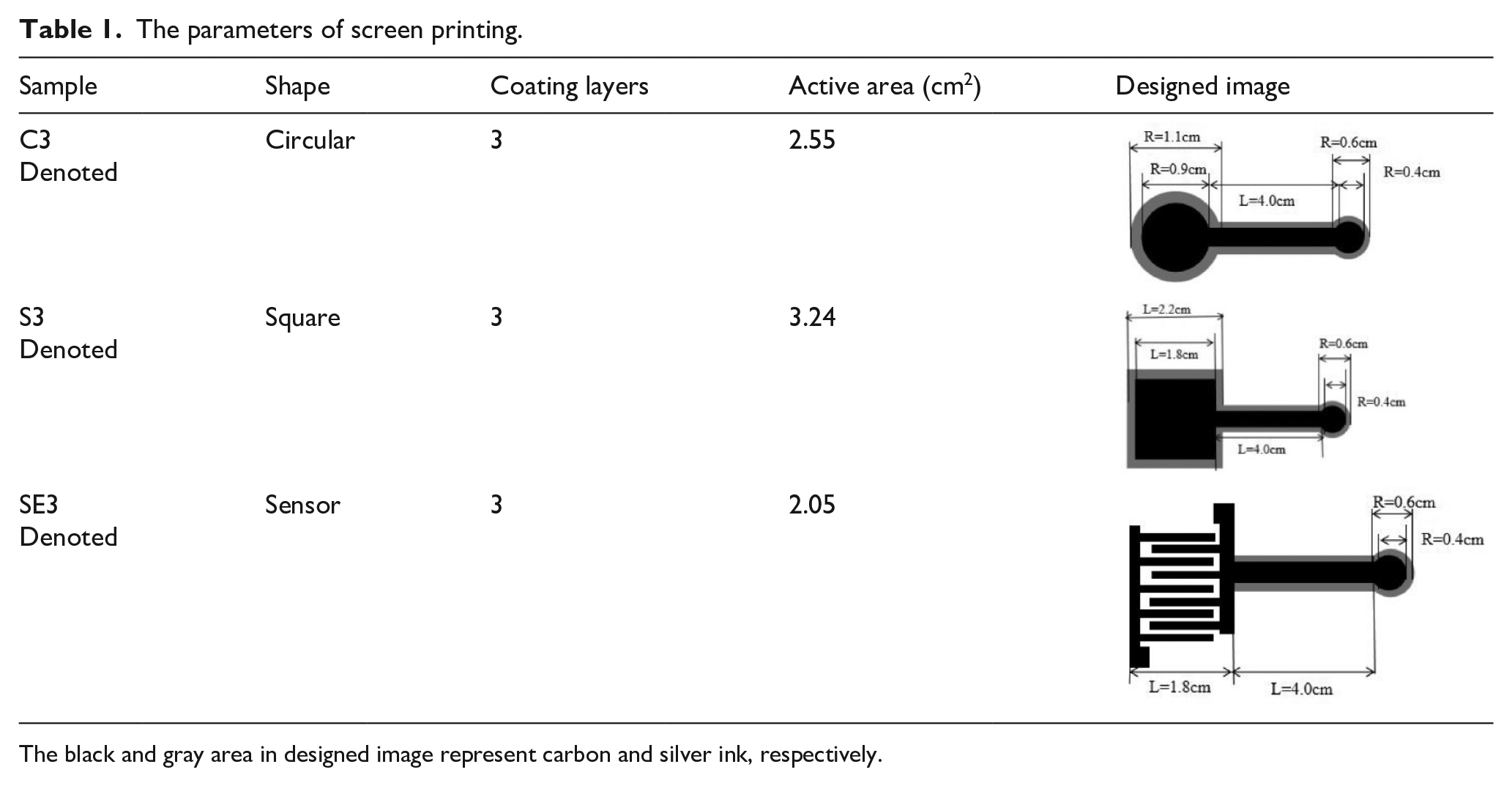
The black and gray area in designed image represent carbon and silver ink, respectively.

SEM images of the conductive layer surfaces at (a) high and (b) low magnification.
Skin contact impedance measurements
The sheet resistance (Rs) of the textile electrodes were measured using the four-point probe method with a digital multimeter and corrected with geometric factors. 31 The conductivity (σ) is calculated using the formula σ = 1/Rst, where t represents the average thickness. And the skin contact impedance of the textile electrode was tested and compared with the medical Ag/AgCl wet electrodes using a electrochemical workstation (CHI 660E, ChenHua). The two identical electrodes were placed on the skin of the subjects (4 cm gap). And the current was applied to test the skin contact impedance. The frequency ranged from 0.1 to 1000 Hz. To guarantee the electrodes was under the same pressure, we used a strip to fix the electrodes onto the forearm of the subjects.
ECG signals acquisition
All the ECG signals were obtained at room temperature without the use of conductive gel and skin preparation. Firstly, we used a typical “three-electrode” setup to obtain ECG signals. Three textile electrodes were placed on the subject’s body at three positions: left anterior (negative electrode), right anterior (positive electrode) and right lower quadrant (reference electrode). The electrodes were connected to the data acquisition circuit using connecting wires. The ECG signals circuit consisted of an instrumentation amplifier, a driven right leg and front-end circuit and an active filter. 32 The instrumentation amplifier (BDM 101 chip) detects and amplifies the ECG signals. An active filter is used to reduce baseline variation and power-line interference by band-pass filtering between 0.1 and 100 Hz. Then, we printed two electrodes on the women’s bra to create a wearable ECG monitor that operates using Bluetooth technology. Three healthy female subjects were recruited in this study. All the subjects were required to test the electrodes under different conditions, including walking, running, and resting.
Washability parameters
The washability of all the fabric electrodes was tested. The fabric electrodes were put in a laundry bag and agitated gently in 0.2-wt% soapy solution. The stirring rate was controlled at 200 rpm, and each washing cycle lasted for 15 min. Each sample was washed five cycles. And between each washing cycle, the sample was drip up at room temperature.
Electrochemical properties of the fabric electrodes
In order to assess the electrochemical stability of the conductive layer on the fabric electrodes, we conducted several tests using an electrochemical workstation (CHI 660E, ChenHua). These tests included cyclic voltammetry (CV) and electrochemical impedance spectroscopy (EIS). The fabric electrodes that were tested were cut into a size of 1.5 cm × 1.0 cm to be used as the working electrode. A platinum wire and Ag/AgCl were used as the counter electrode and reference electrode, respectively. A frequency sweep from 20 Hz to 1 MHz was carried out at a potential of 1V.33,34 1 M NaCl solution was used as electrolyte for both measurements.
Results and discussion
Figure 1 shows the top-view scanning electron microscopy (SEM; ZEISS G300) image of the coated conductive layer. From the SEM, we can find that the carbon particles with a diameter of about 50 nm are encapsulated in the polymer to create a three-dimensional porous structure. This type of porous structure is beneficial for improving the interface with the electrolyte in the electrode, resulting in higher catalytic activity compared to a flat surface.
To evaluate the performance and the characteristics of the fabric ECG electrodes, the skin impedance of the electrodes was tested. Figure 1(a) displays the sheet resistances of screen-printed fabric electrodes with different shapes and layers. The sheet resistance is proportional to the area of the fabric electrode. On the other hand, as the number of printing layers increased, the surface of the electrode became smoother, resulting in a decrease in sheet resistance. As shown in Figure 2(a), the three-layer sensor-shaped fabric electrode with an active area of 2.05 cm2 had the smallest sheet resistance of 10.023 Ω/sq. Besides, the fabric electrode coating with low resistivity showed resistance to washing, with ΔR/R0 not exceeding 6% after five cycles of washing/drying (Figure 2(b)). From a mechanical property point-of-view, the fabric ECG electrodes was flexible (Figure S3a). Besides, ΔR/R0 showed 83%, 57%, and 128% upon 50 repeated bending, twisting and friction, respectively (Figure S4, 1c and 1d). The increase in resistance of fabric electrode was related to higher rigidity as the paint penetrated the fabric fibers. 35 Compared to bending and twisting, repeated friction causes the coating on the surface of the fabric electrode to noticeably deteriorate, resulting in a sharp increase in resistance.

(a) Sheet resistance comparison of all electrodes, (b) durability of the three-layer sensor shaped fabric electrode upon subsequent cycles of washing and drying, (c) resistance change rate upon repeated twisting, and (d) resistance change rate upon repeated friction.
The impedance of the fabric electrodes and gel Ag/AgCl electrodes upon skin contact was also tested. As shown in Figure 3, the impedance of skin contact was found to be proportional to the surface area of the electrode. 36 The impedance amplitudes of the gel Ag/AgCl electrode were higher than those of the other fabric electrodes below 200 Hz. The SE3 fabric electrode had the lowest skin contact impedance. As for the C3 and S3 fabric electrodes, the amplitudes of skin contact impedance were higher than those of the gel Ag/AgCl electrode as the frequency increased. The impedance of the dry electrodes was monitored for a period of 1 week, and the change was less than 8%. Overall, there is no significant difference in the skin contact impedance values of C3, S3, and gel Ag/AgCl electrodes. Considering the dehydration of the gel in the Ag/AgCl electrode, the fabric electrode is more suitable for long-term ECG signal recording.37,38
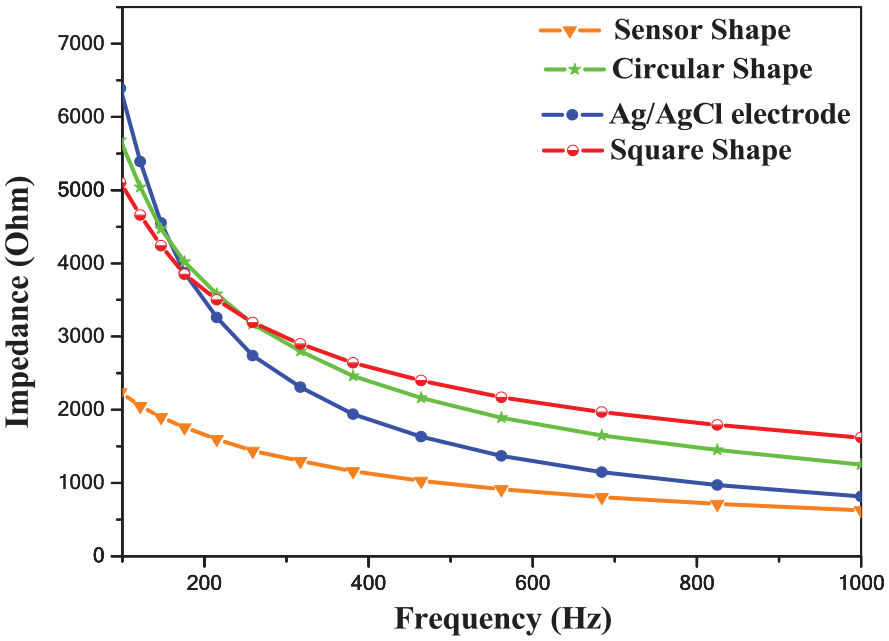
Average skin-contact impedance of obtained electrodes (C3, SE3, S3) and gel Ag/AgCl electrode.
The electrochemical properties of all the fabric electrodes were also analyzed using cyclic voltammetry (CV) and electrochemical impedance spectroscopy (EIS) in a standard three-electrode system. The CV measurements of three different fabric electrode shapes (C3, SE3, S3) in 1 M NaCl electrolyte at the same scan rate are shown in Figure 4(a). The magnitude of the peak current in the CV curve indicates the electrode’s ability to transfer charge, which is typically associated with the electrode’s conductivity. In Figure 4(a), the magnitude of the peak current and the area under the CV curve were found to be proportional to the electrode area. 39 The SE3 electrode exhibited the largest surface area, as evidenced by the largest area under the CV curve compared to the other two electrodes.

(a) CV curves of three fabric electrodes with a potential scan rate of 100 mV/s and (b) the measured Nyquist plots of all samples and equivalent circuit model for fitting (inset).
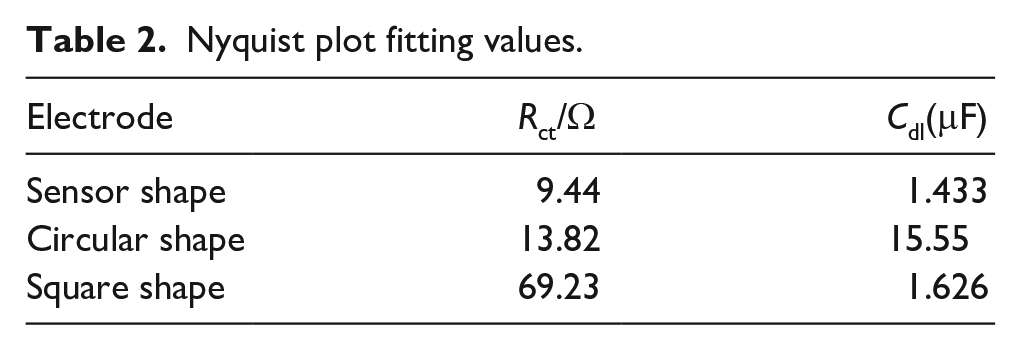
Electrochemical impedance spectroscopy (EIS) was conducted to evaluate the charge-transfer resistance (Rct) and double-layer capacitance (Cdl) of the electrode (Figure 4(b)). Normally, the Nyquist plot consists of two parts: the linear region in the low-frequency range and the semicircle region in the high-frequency range. 40 The linear part in the low-frequency range can be fitted as the Warburg impedance, which is caused by the charge transfer between the electrolyte and the electrode. Basically, the effect of the Warburg impedance can be ignored in the high-frequency region because the transmission distance of the diffusing reactants was very small. 41 The Nyquist plot can be fitted as a typical semicircle plot of Rct and Cdl in parallel connection (Figure 4(b) inset). The values of fitted Rct and Cdl are shown in Table 2. Based on the results mentioned above, the sensor with fabric electrode exhibited lower sheet resistance and skin contact impedance. The unique lead structure of the sensor-shaped electrode facilitates the transfer of ions, potentially reducing resistance even further.
Nyquist plot fitting values.
The ECG signals were measured on the skin of the subjects by placing three identical electrodes at three positions: the left anterior chest (negative electrode), the right anterior chest (positive electrode), and the left inferior abdomen (reference electrode). Figure 5 shows the ECG signals obtained using electrode C3 (Figure 5(a)), SE3 (Figure 5(b)), and S3 (Figure 5(c)), which are compared to the ECG signal acquired using the gel Ag/AgCl electrode. All of the ECG signals displayed the typical characteristics of an ECG, including the QRS- complex, P-wave and T-wave. And the QRS complex represents the depolarization of the heart. 42 It was shown that ECG signals obtained from the SE3 electrode exhibited no variations in amplitudes and less stable noise (Figure 5(b)). The R-R interval length (RRI) is commonly used to calculate the interval between two QRS complexes and determine the heart rate. 43 C3 and S3 electrodes showed varying degrees of R-peak amplitude fluctuation, which can affect the estimation of heart rate.

The ECG signals obtained from different electrodes: (a) ECG signals contrasted between Ag/AgCl and C3 electrodes, (b) SE3 and Ag/AgCl electrodes, and (c) S3 and Ag/AgCl electrodes.
We also evaluated the ECG signals obtained from different electrodes by calculating the Spearman’s rank correlation according to the equation (1)

Where wi and di corresponded to the ith data sample peak-to-peak amplitude acquired with the Ag/AgCl and test electrodes, respectively.1,44 The coherence between signals obtained by the reference and the test electrodes was calculated. Compared to the Ag/AgCl electrode, the SE3, S3, and C3 fabric electrodes showed average correlations of 0.92, 0.87, and 0.85, respectively. The peak-to-peak amplitude of 729.04 ± 33.2 mV, 565.57 ± 69.9 mV, and 384.66 ± 20.6 mV was acquired for the SE3, S3, and C3 electrodes, respectively. It can be concluded that the peak-to-peak amplitude of the ECG signal is related to the shape of the electrodes, with the SE3 electrode having the highest intensity. These results suggested that that SE3 fabric electrode had a stronger correlation and, therefore, better electrode performance. 45
Normally, commercial ECG electrodes consist of an Ag/AgCl electrode, conducting gel as an electrolyte, and an adhesive that helps the electrode make contact with the skin. However these electrodes are not suitable for daily use. Considering the commercial application of fabric electrodes and the wearing comfort of consumers, we have developed a type of women’s sports bra for monitoring ECG (Figure 6(a)). Screen-printed fabric electrodes on a sports bra present a promising method for monitoring the cardiovascular activity of ordinary people, not only during sedentary conditions but also during daily exercise.
As shown in Figure 6(b), the ECG signals obtained from the sports bra and the Ag/AgCl electrode did not display significant differences when the subject was in the relaxed sitting position. Both electrodes were capable of identifying the typical ECG characteristic peaks, including the QRS complex, the T-wave, and the P-wave. However, when the subject was engaged in light exercise, such as walking outdoors, the ECG signals got from the Ag/AgCl electrode and sports bra all exhibited slight variations in amplitudes. When the subject was running, the ECG signal obtained from the Ag/AgCl electrode exhibited significant fluctuations in amplitudes and was contaminated by noise and motion artifacts (Figure 6(d)). This type of ECG signal made it impossible to clearly identify the QRS-complex, T-wave, and P-wave. Although the ECG signal obtained from the sports bra also exhibited variations in amplitudes, it was still possible to distinguish the QRS complex from the baseline. The ECG signal was more contaminated by noise. The ECG signal distortion may be caused by the improper fit between the electrode and the body during intense physical activity.

(a) Screen-printed women bar. ECG signals obtained from women bra and Ag/AgCl electrodes when the subject was in different scenarios, (b) at stationary position, (c) walking outdoors, and (d) running.
Conclusion
In this study, we fabricated flexible dry ECG electrodes using a commercially available conductive carbon ink applied onto fabric materials. The moisture of skin could act as the electrolyte of the dry electrode. 45 We demonstrated the sensor-shaped fabric electrode with good resolution and stability during washing and daily use. A higher correlation of 0.92 and a minimal sheet resistance of 10.023 Ω/sq were achieved for the sensor-shaped fabric electrode. The fabric electrode could also provide a relatively low and stable contact impedance during recording. The flexible dry electrode was suitable for long-term and wearable biopotential recording. Based on the above technique, we further developed an integrated women’s sports bra for ECG monitoring. Compared to the Ag/AgCl electrode, the integrated women’s sports bra showed stable and wearable ECG recording ability.
Supplemental Material
sj-docx-1-jef-10.1177_15589250231220478 – Supplemental material for Screen-printed fabric electrode for electrocardiogram monitoring on commercial textiles
Supplemental material, sj-docx-1-jef-10.1177_15589250231220478 for Screen-printed fabric electrode for electrocardiogram monitoring on commercial textiles by Jiarui Jin, Wang Jia and Xuemei Yang in Journal of Engineered Fibers and Fabrics
Footnotes
Declaration of conflicting interests
The author(s) declared no potential conflicts of interest with respect to the research, authorship, and/or publication of this article.
Funding
The author(s) disclosed receipt of the following financial support for the research, authorship, and/or publication of this article: The author thank to the financial support from the Guangdong Basic and Applied Basci Research Foundation (No. 2022A1515110898) and Teaching Quality and Teaching Reform Project of Guangdong Province (2022. No. 19).

Supplemental material
Supplemental material for this article is available online.
References
Supplementary Material
Please find the following supplemental material available below.
For Open Access articles published under a Creative Commons License, all supplemental material carries the same license as the article it is associated with.
For non-Open Access articles published, all supplemental material carries a non-exclusive license, and permission requests for re-use of supplemental material or any part of supplemental material shall be sent directly to the copyright owner as specified in the copyright notice associated with the article.
