



Abstract
Brassiere straps are commonly perceived as one of the most irritating and uncomfortable components of a brassiere, especially for women with heavier breasts. This study aimed to design and developed auxetic structures to enhance the ergonomics of intimate apparel. The brassiere straps were developed by using textured polyester and nylon yarns with auxetic weave structures in two different widths. Tests were conducted to evaluate Poisson’s ratio, tensile strength, and pressure distribution properties and overall ergonomics of developed straps. Subjective analysis was also performed by conducting wear trials. The development of polyester straps yielded excellent results compared to nylon. In the subjective analysis, the selected polyester sample consistently performed better than others, significantly enhancing ergonomics comfort, fit, and psychological comfort according to respondents’ preferences. Based on the results, Auxetic structure can be a better alternative for brassiere straps in active wear to avoid related health problems and to improve women’s experience.
Graphical Abstract

Keywords
Introduction
In everyday life, brassieres are an essential part of clothing that provides a sense of support, safety, and comfort to women. Brassiere between the bodies and outwear to enhance the physique and body contour of the women. Breast tissues of women have not got enough anatomical support aside from skin and thin Cooper’s ligaments. 1 There has been a number of studies that concluded the need for well fitted and ergonomically comfortable brassiere to support breast tissues, to reduces excessive breast displacement during physical activities.2,3 Additionally, the excessive movement of breasts during running and physical activities can exert significant forces on the breast tissue, resulting in unnecessary strain on the shoulders and causing irreparable damage to its structure. It can also have an unpleasant impact on the esthetic appearance of the breasts. 4
The support and comfort provided by the brassiere secondary depends on the brassiere straps. 5 A brassiere with better ergonomics and an efficient strap can help to reduce breast movement during physical activity and everyday wear. A well fitted ad comfortable brassiere can also minimize the risk of breast pain, shoulder pain, and damage to soft ligaments and connective tissues of the breast. Contact pressure and comfort are two distinct aspects in which the performance of brassiere straps is evaluated. 6
Prior studies in which they analyzed brassiere strap pressure and discomfort, reported no significant pressure difference recorded between cross-back and vertical brassiere straps with or without cushion pads. Bowles and Steele 7 concluded that discomfort of the brassiere straps can’t be eliminated by varying orientation of straps, and that study also has many limitations. In another study Chan et al., 1 concluded the significant areas in brassiere that mostly cause discomfort in brassiere includes cups, shoulder straps and underwire. The overall support and comfort provided by brassiere depends on closely fit brassiere components, design and the selection of material, due to their constrictive forces and tension exerted to contact area. During the process of arm elevations, authors documented the difference between male and female shoulder kinematics. 8
A plethora of studies reported higher risk of women having neck/shoulder disorder than men. 9 The risk factor for shoulder disorder can be stress, gender disparities in shoulder kinematics, muscle difference 10 and overloading due to shoulder strap of the brassiere. 8 According to the findings, 11 relocating the weight of the breasts away from the shoulders is crucial for women’s health. Therefore, it is recommended to use a stronger, yet comfortable, band as the main source of support for the breasts.
Brassiere straps are regarded as least favorite part of the brassiere due to its digging into the skin and slippage from the shoulder of the wearer. 7 Moreover, prior studies have emphasized the significant health effects that can be due to excessive downward pressure due to ill-fitted or ill-designed brassiere straps. Brassiere straps exert extreme pressure on the shoulder of the women, and long duration of wearing brassiere can cause groove deformity, irritated skin, disturb blood flow 12 and damaged soft tissues under the contact area of the strap. Most women with hypertrophic breasts are reported to suffer from groove deformity. To minimize the brassiere strap discomfort, now brassieres are available in different strap orientation that most generally includes vertical, cross-back, T-bar, and racer- back. 7 In terms of design, brassiere straps now available in altered materials and width variations (approximately to 4.5 cm). For generally used brassiere, straps size can be as narrow as 0.8 cm, although in the sports brassiere, it can be about 2.5 cm and more. 13 When contact surface increased, the pressure can distribute evenly to boost comfort. 14
Auxetic structures are well known to have a negative Poisson’s ratio and for their magnified mechanical properties. 15 These materials show lateral expansion whereas conventional materials show inward shrinkage under the tensile strain which is shown in Figure 1. Auxetics possess properties such as indentation resistance, 16 shear strength, load bearing tendency, toughness, energy, and vibration absorption, 17 and mechanical stability. 18
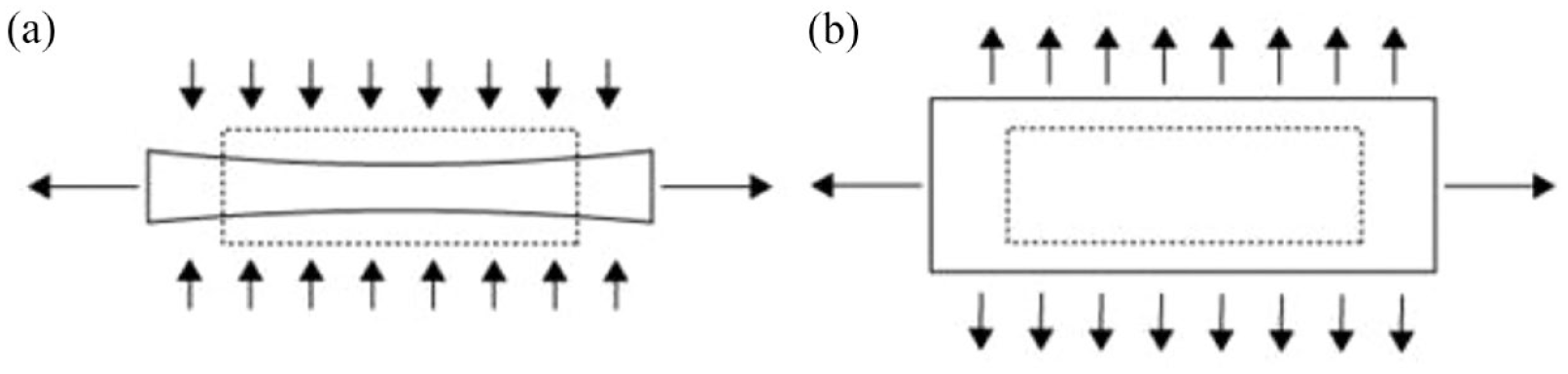
(a) Non-auxetic and (b) auxetic materials behavior under tensile strain.
Auxetic textile structures that have lateral expansion properties are used in sports garments, accessories (bags, shoes, and gloves) protective and functional clothing. 19 But the auxetic woven structure has not been used and analyzed as a brassiere strap yet. Due to their energy absorbing, tensile, load bearing and lateral expansion properties, they can prove a better alternative for conventional brassiere straps.
The objective of this study is to develop auxetic woven structures and to find their feasibility into brassiere straps, for the elimination of extreme pressure and related health issues, caused due to commercially available brassiere straps on the wearer’s body. Conclusively, this study is about developing auxetic woven structures, and finding their feasibility into brassiere straps, for the elimination of extreme pressure and related health issues, that can cause due to commercially available brassiere straps on the wearer’s body.
Materials and method
The methodology encompasses three main steps, namely design specification, prototype development, and testing and evaluation as shown in Figure 2. These steps were carefully designed to bridge the identified gap and offer a comprehensive and systematic approach to the research process. Polyester and Nylon samples were developed by using Auxetic Honeycomb (AHC) weave geometry. After testing their mechanical properties and competitive analysis of these samples, the best samples were further embedded in a brassiere to do wear trials. Then qualitative data from wear trials was analyzed to conclude this study.

Flowchart representation of methodological steps.
Design specifications
Design recommendations focus on factors such as comfort, fit, and elongation properties. They provide guiding principles to ensure that the developed auxetic weave design not only meets but exceeds the wearers’ needs. An adequate support for brassiere straps is essential, necessitating that the weave design allows for sufficient support to the wearer’s body. Comfort, evaluated through wear trials, is another crucial requirement, considering the physical contact between the strap and the body. The tensile properties of fabric samples are also assessed to gain insights into their mechanical characteristics, analyzing their stress-strain behavior.
Design features address esthetics and convenience. The visual appearance of the strap must be appealing while meeting all basic requirements. Convenience considerations include the availability of materials and reasonable prices. Overall, design specifications encompass various aspects, ensuring that the developed auxetic material strap meets comfort, fit, elongation, esthetics, and convenience requirements.
Prototype development
Material selection and fabrications of auxetic weave structures
To achieve the objective of the study, two different yarn types were used to develop samples. At first, polyester textured yarn was used to create weave structures, and then nylon textured yarn was used to develop samples with the same structures to do competitive analysis and assessment of their mechanical properties.
Auxetic Structures (AS) and Non-Auxetic Structures (NAS) both were developed with identical materials and parameters. The difference just lies between their weave designs and shrinkage properties, which cause auxeticity in them. For the comparative analysis between samples, NAS (1/3 and 2/2 twill) were developed with the same crimple percentage. In warp and weft textured Polyester and Nylon yarn of 330 deniers were used. Samples with 152 ends and 8 or 12 picks were developed on a conventional narrow needle weaving machine as coding of samples shown in Table 1. Identical machine specifications are maintained in developing all samples of polyester and Nylon yarns. After the development of all samples, each sample was de-sized in water at 100°C, and after complete air-drying samples was subjected to further testing.
Coding scheme for sample identification and differentiation in the study according to their structure and width variations.

Auxetic weave structures developed were by playing with float lengths and shrinkage of textured yarn. The void space between two consecutive interlacements of warp and weft is known as float length. The float length and density of warp and weft interlacement strongly impact the shrinkage behavior of the fabric. Three types of different weave designs were developed with different float lengths. AHC1, AHC2, and AHC3 structures are shown in Figure 3.
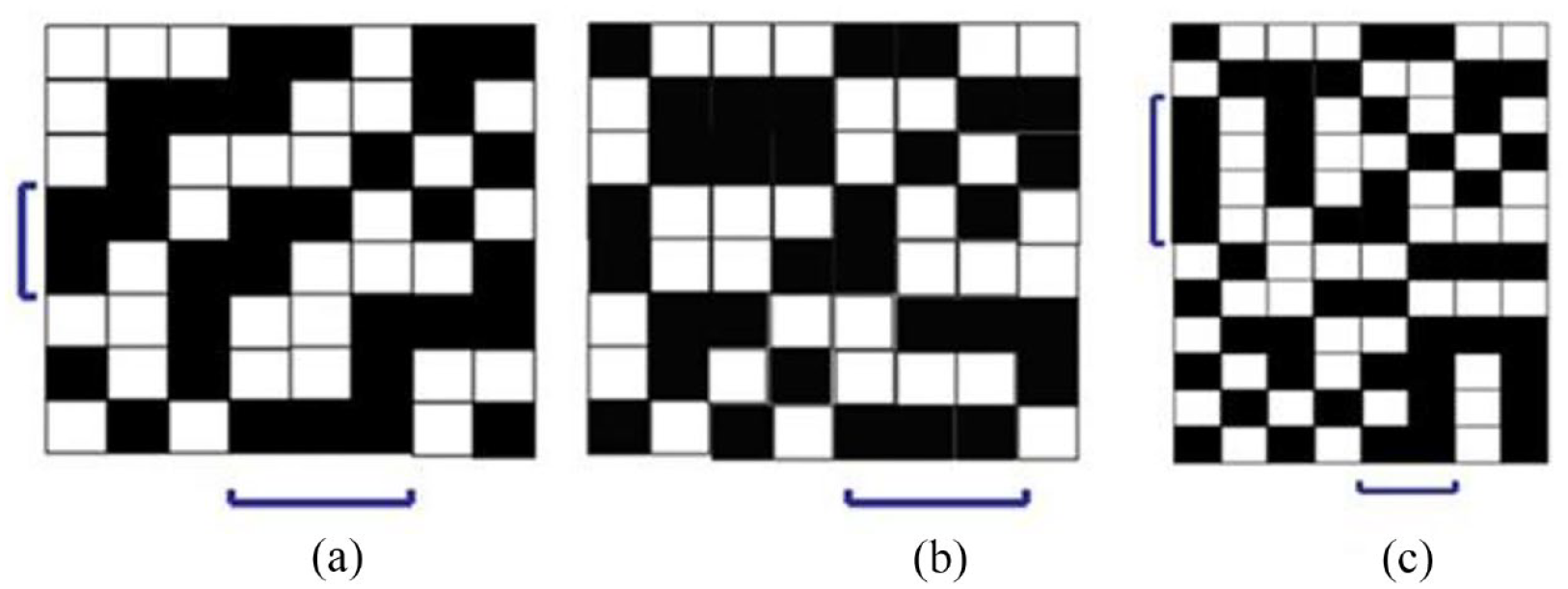
(a) AHC1 and (b) AHC2 (c) schematics show AHC3 blended weave designs.
The weave structures shown in Figure 3 developed with different drawings in draft along with control samples (2/2 and 1/3) twill. A total of five different weave designs developed by using textured polyester and then the same structures developed with textured nylon yarn. In case of comfort, contact area is an impactful factor. Wider shoulder straps can increase comfort for wearers. For better evaluation of comfort for wearer, each sample developed in two different widths (15 mm, 25 mm).
Design testing and evaluation methods
Poisson’s ratio test
After drying and relaxing of straps the structure of auxetic structures was analyzed through digital magnifying glass (BPM-1080W) used for brassiere strap Poisson’s ration testing. Sample with the dimensions 100 mm × 25 mm (L×W) was used to characterize NPR.
The negative Poisson’s ration of straps was measured by analyzing dimensional change in the marked box on the strap under applied tensile stress by using digital microscope. To determine Poisson’s ratio for each sample, the following equation was employed:

Poisson’s ratio testing of samples is done to choose one sample with the best auxetic properties that can help to eliminate problems regarding brassier straps. The testing was being done by measuring the Negative Poisson’s Ratio (NPR) of the auxetic samples by stretching both sides of a 100 mm sample to 110, 120, and 130 mm of the original specimen length.
Straps tensile properties testing
Tensile strain test is carried out by sing universal tensile machine according to ASTM D4964 − 96. Samples with both dimensions 200 mm × 15 mm (L × W) and 200 mm × 25 mm (L × W) placed in the jaws of the universal tensile machine and then stress was applied. The change in length against load was recorded to examine their suitability in required application.
Pressure sensor testing
To examine the pressure distribution characteristics of the straps, flexible pressure sensors were used as shown in Figure 4(a) and (b). Two specific sizes were utilized of pressure sensors based on the width of the straps. So that strap could place right above the sensor area to avoid any variation in the results. Pressure sensors with dimensions 50 mm × 25 mm was employed to evaluate straps with a width of 25 mm and 5 mm × 15 mm was used to assess samples with a width of 15 mm for efficient characterization of the straps. 20

(a) 3D schematics of pressure sensor and (b) visual description of pressure sensors.
Pressure sensors were employed on the shoulder region of a female mannequin as shown in Figure 5. The purpose was to collect suitable data for analysis while considering two different strap widths.

Pressure sensor evaluation of samples on mannequin.
The straps of both sizes (15 mm 25 mm) used for pressure resistance testing were 390 mm long, the same length as regular brassiere straps. The strap’s position was fixed from the back side and load was applied from front size. Following that, the pressure sensor also fixed the on shoulder, and strap placed above the sensor. Following the initial setup, weights ranging from 250 to 1000 g were systematically hanged to the straps, and the corresponding resistance values of the pressure sensors were recorded using a Digital multimeter. 21 In the piezoresistive sensors employed, the resistance exhibited an inverse relationship with the applied pressure. As the resistance values displayed by the multimeter decreased due to the added load on the straps, it indicates an increase in pressure exerted on the body.
Questionnaire development for wear trials
The questionnaire was developed with the help of the presented theoretical model to precisely evaluate each factor regarding the proposed brassiere strap for the wearers. For wear trial, auxetic brassiere straps were embedded in three brassiere sizes (32, 34, and 36) with the variation of two cup sizes (C and D). The following Table 2 shows the DOE of quantitative analysis of this study. Factors include brassiere band, cup, and strap width size of selected material.
Design of experiment of quantitative study.

Theoretical model
A theoretical model serves as a graphical representation aimed at enhancing the understanding of ideas, actions, essential factors, and their sub-factors. Developing a questionnaire to evaluate brassiere straps, the inclusion of a theoretical model becomes essential for providing clarity on the factors examined in this study. Through examination of the existing literature, relevant components and their sub-components were carefully selected to gather necessary information from the participants involved in the evaluation process. A theoretical model is showing in Figure 6.
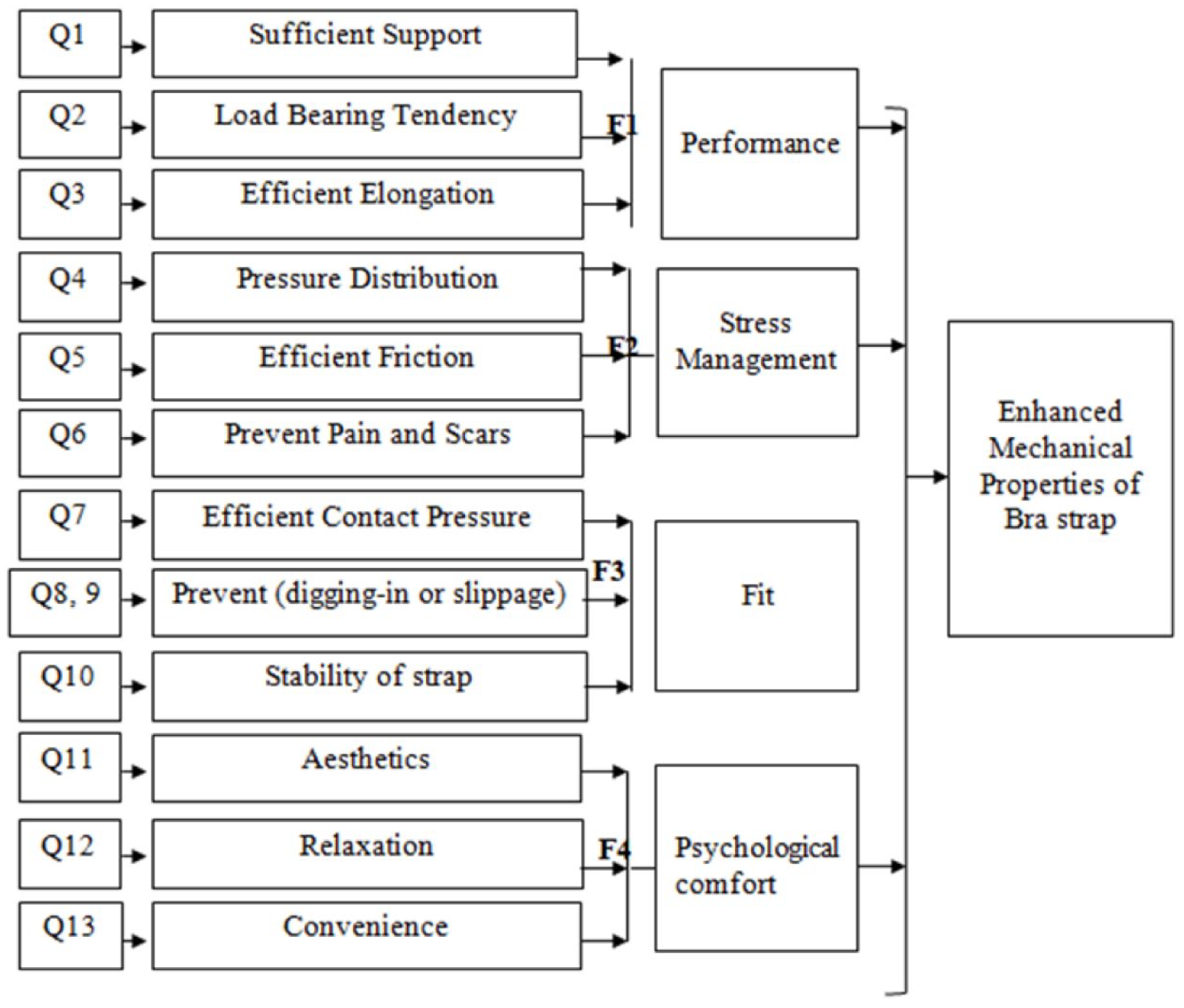
Theoretical model with factors representation.
The theoretical model consists of crucial factors and their sub-factors regarding brassiere straps. In the subjective evaluation of brassiere straps, four key factors were considered and each of them has three sub-factors. In the questionnaire, at least one question was asked about each sub factor. Performance was assessed based on the strap’s ability to provide support, elongation properties, and load-bearing tendencies, ensuring adequate tension for breast tissue support. Stress management was identified as crucial for wearer health, with better properties protecting against health issues and scars caused by the strap. Fit analysis focused on efficient contact pressure, stability, and the avoidance of excessive pressure on the shoulder, addressing concerns related to contact surface properties and wearer movement. Psychological comfort was evaluated through wearer feedback, exploring convenience, relaxation, and esthetic comfort to gauge mental satisfaction with the strap change. These comprehensive assessments aim to enhance the overall functionality and wearer experience of brassiere straps.
This study conducted qualitative and quantitative analyses of auxetic brassiere straps. Quantitative data analysis focused on studying their behavior under stress and assessing their mechanical properties. Subjective analysis was carried out to evaluate whether the developed auxetic structures delivered the desired comfort to the wearer. Total 24 women participated in this study, four women of each size.
Poisson’s ratio of straps
The auxetic straps were constructed using multifilament yarns, examined under a digital microscope. Firstly, the behaviors of polyester samples observed upon undergoing tensile stretch. These samples exhibited distinct variations in their structure, both along their length and width dimensions.
This allowed us to quantitatively assess the material’s response to deformation and further analyze its mechanical characteristics. The Poisson’s ratio of a material is determined by analyzing the recorded change in dimensions of a drawn box on the specimen 10 mm × 25 mm (L × W). Then polyester samples stretched from their original length of 100 to 110 mm, 120 mm and then 130 mm. The visual representation of the polyester auxetic straps stretched to a length of 120 mm is depicted in Figure 7. There was a clear increment in length and width of the auxetic weave straps. These images are shown in the figures below, illustrating the way deformation recorded of the material under the applied stress.

(a) Schematics to show auxetic structure before applying stress and (b) schematics to show auxetic structure after applying stress.
Twill (2/2 & 1/3) control samples were also tested under digital microscope. Control samples didn’t show any increment or decrement widthwise. As the maximum applied pressure was only 30%, non-auxetic samples didn’t show their positive Poisson’s ratio. 3BP structure shows elongation lengthwise and widthwise after applying stress. Maximum Poisson’s ration recorded by 3BP is −0.3535 NPR.
Firstly, the 3BP straps, then following sample 4BP and 5BP tested in digital microscope and its behavior recorded. All auxetic straps show elongation lengthwise and widthwise. At 30% stretched 4BP, NPR value was −1.2670.
Table 3 provides a comprehensive overview of the behavior of polyester samples after undergoing stretching, focusing on their lateral and linear strain measurements, as well as the Poisson’s ratios at each applied stress level. The table is organized into several columns, each providing specific data for the samples. The “Name” column lists the names or identifiers assigned to each polyester sample (1BP, 2BP, 3BP, 4BP, and 5BP). Moving to the subsequent columns that include information on the lateral strain exhibited by each sample at different percentages of stress, specifically at 10%, 20%, and 30% applied stress levels.
Lateral and linear strain and average Poisson’s ratio of polyester straps at applied stress levels.

Subsequently, after polyester sample’s testing, the same process applied on nylon auxetic samples. Firstly, 3BN then sample 4BN and 5BN, tested under digital microscope and its behavior recorded. It was observed that all samples show slight elongation lengthwise and but not widthwise. Although these straps didn’t show negative Poisson’s ratio, but not any of auxetic nylon straps show positive Poisson’s ratio but one of non-auxetic does, as the results shown in Table 4.
Lateral and linear strain in nylon after stretching and their Poisson’s ratio at each applied stress level.

By examining Table 4, valuable insights into the strain behavior and Poisson’s ratios of the nylon samples can be obtained. The lateral and linear strain measurements provide information on the material’s deformation properties under different stress levels. Additionally, the Poisson’s ratios offer insights into the material’s responsiveness to applied stress, aiding in the assessment of its mechanical characteristics. Nylon samples didn’t show negative Poisson’s ratio at all. Some of nylon non auxetic samples show positive Poisson’s at this low stress. Polyester used in this work is textured yarn, which has an extension similar to that of elastane yarn. Because of significantly high extension, polyester provides a higher room for auxetic nature to trigger. On the other hand, nylon yarn restricts the expansion of yarns, resulting in a limited auxetic nature.
Tensile strength
Brassiere strap stretching properties and their width affect the brassiere’s breast lifting and breast gathering properties. The tensile properties of the straps apprise about their tensile strength, elasticity and their stretchability and accommodation to different body shapes and sizes.
Stress-strain data of polyester samples 1AP to 5AP shown in Figure 8(a) and 1BP to 5BP shown in Figure 8(b). Firstly, Samples of polyester were tested in universal tensile machine and with raw data of test, stress-strain curve generated. In curve, 4AP and 4BP which is auxetic honeycomb 2 (8 picks) structure showed better elongation at the lowest stress shown in Figure 8(a) and in Figure 8(b).
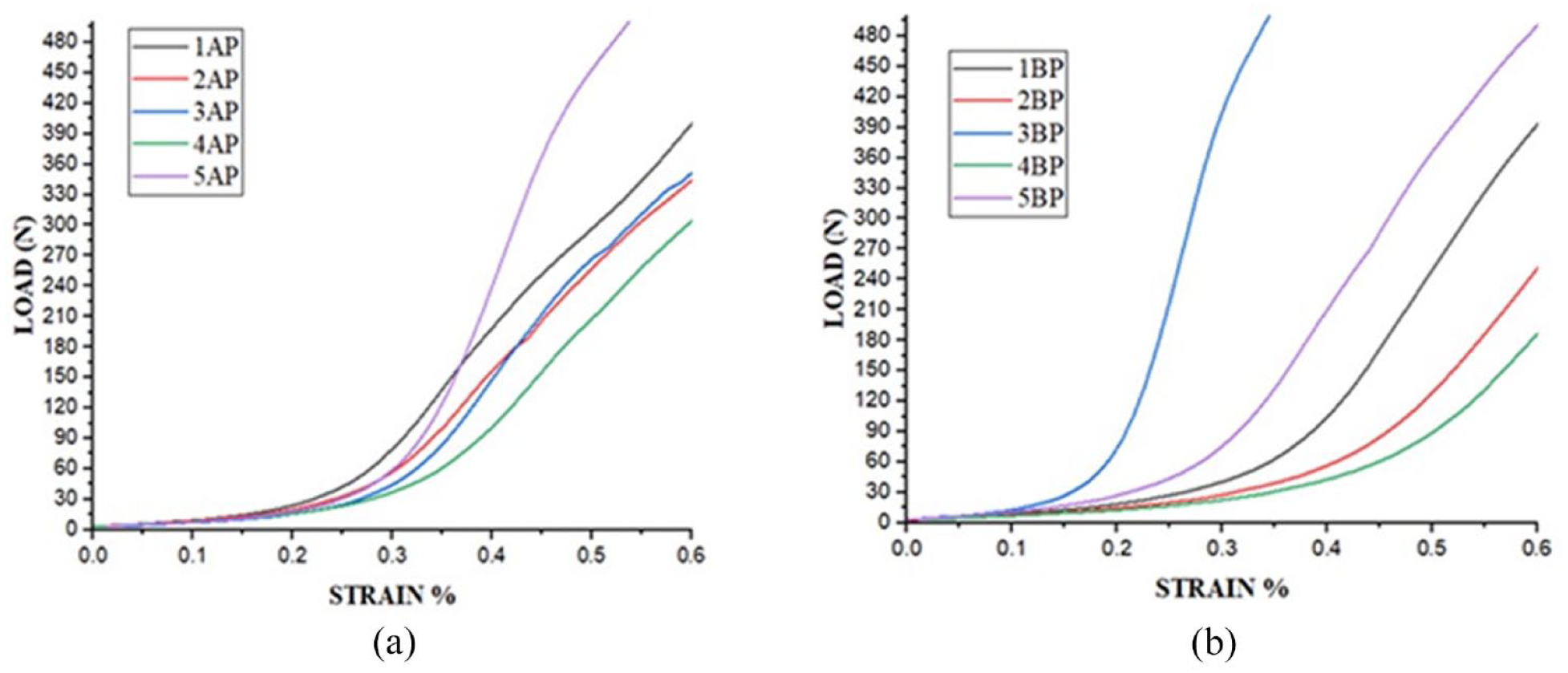
Stress and strain data of sample 1AP–5AP (a) & (b) 1BP–5BP.
Materials with better elongation at lower stress levels can absorb and dissipate energy more effectively. Whereas other auxetic honeycomb structures and twill samples showed cooperatively less elongation than AHC2. However, contrary to the tensile curve data, it was observed that not all auxetic polyester straps exhibited higher tensile strength as compared to the control samples of polyester straps.
During the comparison of elongation properties of nylon samples with widths of 15and 25 mm, it was evident that they exhibited elongation. However, the level of elongation was significantly lower compared to polyester samples subjected to the same stress level as shown in Figure 9(a) and (b).

Stress and strain data of nylon sample (a) 1AN–5AN and (b) 1BN–5BN.
In the case of nylon samples (1AN to 5BN), there were no substantial differences between the two widths and no specific distinctions were recorded in terms of auxetic and non-auxetic weave structures of the straps as stress-strain data. Nylon possesses less elongations properties as compared to polyester after de-sizing so that there was huge in difference noticed in tensile strength of both materials’ straps. The use of textured yarns in the study aimed to enhance the auxetic behavior of the weave structure. However, contrasting results were observed. The combination of textured yarn and auxetic weave structure in polyester straps successfully achieved the auxetic behavior, while in nylon straps; the effects seemed to minimize each other effect, leading to the absence of elongation behavior in nylon straps. These findings emphasize the importance of considering the complex interplay between material composition, yarn structure, material texture, and weave pattern in achieving desired properties in woven textiles.
Pressure resistance in developed samples
In the case of polyester auxetic straps, the pressure experienced was consistently lower compared to non-auxetic straps. As the load increased, the decrease in resistance was more pronounced in non-auxetic straps, indicating that the pressure exerted on the body also increased. It indicates reduced stability in non-auxetic straps. Average change in resistance of polyester samples width from 1AP to 5BP is shown in Figure 10. Series1 represents straps width (15 mm) and Series2 represents straps with width (25 mm) polyester straps in Figure 10.

Maximum change in resistance in polyester strap from 1AP to 5BP.
As shown in Figure 10 Series1, the percentage change in resistance values of auxetic weave straps ranges from 11%–12% under maximum applied load. By analyzing, it was found that the maximum change in resistance in auxetic polyester straps with a width of 25 mm ranges between (8% and 11%. These samples demonstrate comparatively lower variations in resistance when compared to 15 mm width straps. This indicates that less pressure is exerted on the body under maximum load conditions.
Although the nylon samples did not demonstrate negative Poisson’s ratio (NPR) values, the results of pressure sensor testing on the auxetic nylon strap yielded promising outcomes. Figure 11 visually represents the maximum deformation observed in the auxetic nylon structure. Series1 represents straps 1AN–5AN and Series2 represents straps from 1BN–5BN as shown in Figure 11.

Maximum change in resistance in nylon strap’s from 1AN to 5BN.
Maximum resistance change in auxetic 15 mm width samples ranges between 10% and 12% under maximum applied load according to above mention results. Whereas the results obtained from the auxetic nylon straps 1BN-5BN reveal same range of resistance change is between 10% and 12%, which is similar to the 25 mm width nylon auxetic samples. It is also observed that the auxetic nylon structures exhibit a less range of resistance change under 1000 g load, as compared to the non-auxetic nylon structures in both width straps. These observed results can be attributed to the altered structure and varying float length of the materials.
Subjective analysis of purposed material
By conducting a comprehensive analysis of the test results of Poisson’s ratio, tensile strength, and pressure sensor data, sample four of polyester material (4AP & 4BP), was selected. This sample was then integrated into three different sizes of brassiere bands (32, 34, and 36) and 2 cup sizes (C and D). For this study, 24 healthy women were selected as participants of the study. All women received a thorough explanation of the research’s purpose and procedures, and their consent was obtained through signed consent forms. The age range of the participants was between 18 and 40 years. Each subject participating in the study was provided with three brassieres, where in one had polyester auxetic structure straps with a width of 15 mm (Sample 1), another had polyester auxetic structure straps with a width of 25 mm (Sample 2), and the third one has a commercially available brassiere strap (Sample 3).
To gather subjective feedback and evaluate the wearers’ experiences, all subjects were instructed to wear brassiere for a week with a minimum duration of 8–10 h during their daily activities. Following the wear period, the participants were requested to complete a questionnaire that assessed their perceptions and feelings regarding each brassiere variant. This methodology aimed to capture the wearer’s subjective opinions and to evaluate the comfort, performance, and overall satisfaction associated with each brassiere configuration.
A detailed illustration of the responses obtained from subjects wearing brassiere band size 32 with cup sizes C and D as shown in Figure 12. The standard deviation values for all the graphs presented in Figures 12 to 14 fall within the range of 0.5–1.
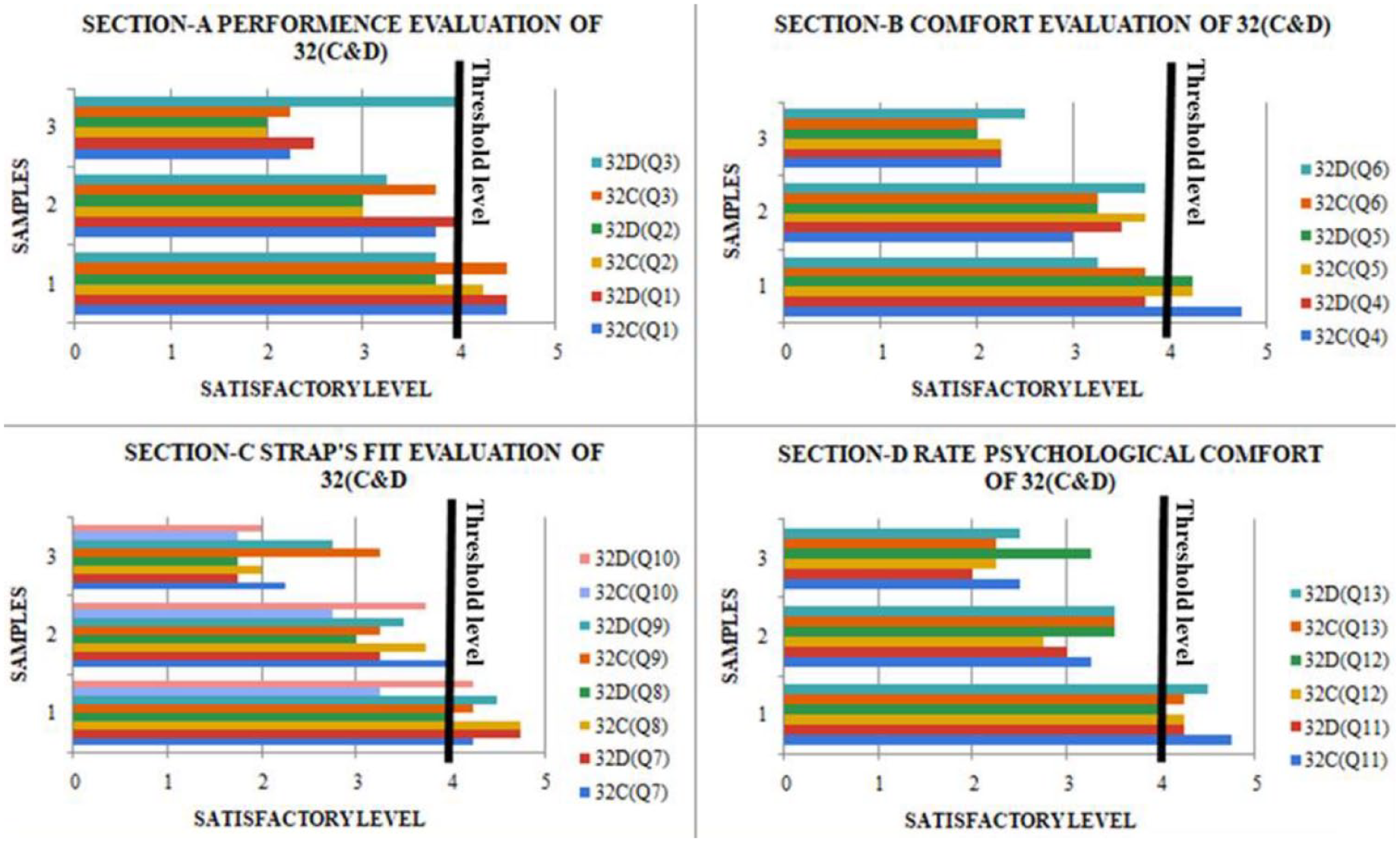
Graphical representation for responses of subjects with size 32 (C&D).
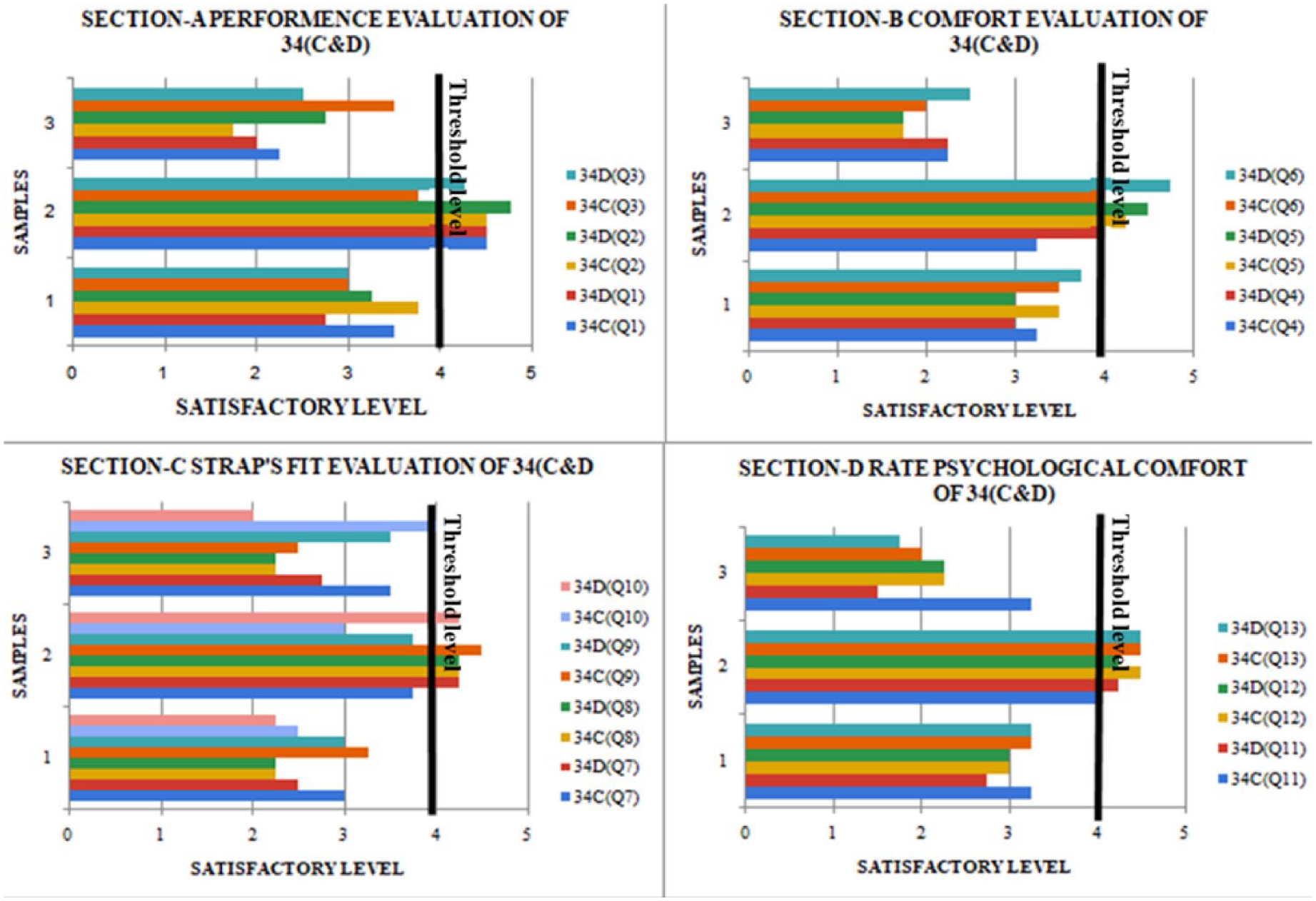
Graphical representation for responses of subjects with size 34 (C&D).

Graphical representation for responses of subjects with size 36 (C&D).
The threshold satisfaction level (set at 4) reveals that many of the respondents favor sample one (4AP) across various factors, including performance, comfort, fit, and psychological comfort of the wearer. Notably, both auxetic structure straps perform better than conventional straps in terms of satisfaction levels. 4AP is highly preferred by the subjects wearing brassiere band size 32 with cup sizes C and D, as evident from the satisfaction levels exceeding the threshold of 4. On the other hand, the satisfaction level associated with conventional straps falls below that of both auxetic structure straps, indicating a lower level of satisfaction among the respondents. As for the participants who wore brassiere band sizes 34 with cup sizes C and D, the questionnaire responses are shown in Figure 13.
By analyzing the graphs based on participants’ feedback with size 34 (C&D), it was found that sample 2 was highly favored by the participants, surpassing the threshold level by nearly 90%. This indicates that the brassieres with the 4BP strap were well-received and considered more comfortable or better fitting by the wearers as compared to other embedded straps. Notably, in the analysis of strap fit (section C), no considerable distinction was observed between the outcomes of sample 1 and sample 3. However, for the other three factors such as performance, comfort, and psychological comfort, respondents showed a preference for sample 4AP as compared to conventional straps. To illustrate the outcomes derived from the responses provided by subjects who wore brassiere size 36 (C and D) shown in Figure 14.
The participants who wore size 36 (C & D) also preferred sample 4BP. It exceeds threshold level 95%. As for the results, both 4AP and 4BP auxetic structure straps preferred as compared to conventional straps in all factors discussed in the questionnaire. For the better understanding of responses according to each specific factor, radar charts are shown in Figure 15.

Visual depiction of satisfaction percentage levels of four factors across six sizes investigated in the study.
In above mention radar charts each factor’s satisfaction level in percentage is shown according to six different sizes. Three straps that were used for subjective analysis were distinguished through different color lines and symbols. As shown in 1 chart, sample 1; satisfaction levels range from 56% to 90%, while sample 2 shows percentages between 50% and 86% according to the participants with brassiere size 32 (C&D). Sample 3 exhibits lower satisfaction levels, varying from 40% to 65%. Whereas for participants size 34 (C&D), sample 1’s satisfaction levels range from 48% to 81%, while sample 2 shows percentages between 58% and 93%. Sample 3 exhibits lower satisfaction levels, varying from 36% to 65% as shown in chart 3 and 4.
According to the respondents of size 36 (C&D), Sample 1’s satisfaction levels range from 43% to 81%, while Sample 2 shows satisfaction percentage between 55% and 91%. Sample 3 exhibits lower satisfaction levels, in this as well as shown in chart 5 and 6. The data provides an overview of the satisfaction levels of each sample concerning the specific factors evaluated in brassiere sizes 32, 34, and 36 (C&D). In size 32 (C&D) Sample 1’s appreciation levels in each factor is better than sample 2 and 3. For other sizes samples 1’s satisfactory level was in between 60% and 80%. The satisfactory level of polyester 8 picks sample with 25 mm width (Sample 2) is between 80% and 90% according to all mentioned factors in size 34 (C&D) and 36 (C&D).
The results obtained from the wear trials clearly indicate a strong preference among subjects for 4AP when wearing brassiere size 32 (C and D). This preference appears to be influenced by both the overall body mass index of the wearers and their individual preferences. Similarly, for subjects wearing brassiere band sizes 34 and 36 with cup sizes C and D, 4BP emerged as the more suitable option. The underlying reason for this preference could be attributed to the potential comfort experienced by women with notably heavy breasts when using wider strap sizes. Furthermore, the heightened preference for 4BP can be linked to its exceptional pressure resistance properties and more porous structure, providing enhanced support and comfort for the wearers. These attributes likely contribute to the overall satisfaction and preference for this strap design among the subjects during the wear trials.
Conclusion
The objective of this study was to develop brassiere straps with enhanced mechanical properties. Textured nylon and polyester yarns were used for this development. The addition of auxetic structures was another development in preparation of brassiere straps. However, it was concluded that the combination of textured yarn and auxetic weave structure in polyester straps strengthen each other effect to achieve enhanced auxetic properties. While in nylon straps; the effects seemed to minimize other effects, leading to the absence of elongation behavior. These findings emphasize the importance of considering the complex interplay between material composition, yarn structure, yarn textures and weave pattern in achieving desired properties in woven textiles. Among the developed straps, AHC2 (4BP) demonstrated exceptional performance, surpassing both auxetic and non-auxetic straps. Tensile testing revealed that not all auxetic structures outperformed non-auxetic ones. However, auxetic polyester and nylon structures exhibited remarkable pressure distribution capabilities, which can be attributed to their structural differences. In wear trials, auxetic structure polyester straps showed better performance than conventional straps. The preference for specific straps varied based on brassiere band size and cup sizes. Subjects favored 4AP in band size 32 with cup sizes C and D, while 4BP was preferred in band sizes 34 and 36 with cup sizes C and D. The choice of preferred straps in band sizes 34 and 36 might be influenced by the comfort provided by wider strap sizes and the superior pressure resistance properties of 4BP. Future work should explore auxetic structures, different material combinations and auxetic weave patterns for various brassiere components and active wear to enhance overall performance and comfort.
Footnotes
Declaration of conflicting interests
The author(s) declared no potential conflicts of interest with respect to the research, authorship, and/or publication of this article.
Funding
The author(s) received no financial support for the research, authorship, and/or publication of this article.
