



Abstract
This research aims to investigate the influence of single miss stitches on the structural characteristics, dimensional stability, and stretch properties of double weft cotton/flax knitted fabrics. The study encompasses nine fabric variants with different numbers of knit and miss stitches in the repeat, alongside with half Milano rib fabric. All knitted fabrics are produced using a 2-ply 25x2tex x 2 cotton/flax blend yarn (70% cotton, 30% flax) on a 10 -gage flat-bed knitting machine. The comprehensive analysis encompasses crucial structural properties after dry relaxation for 10 days and after four washing cycles. Also, both the dimensional properties and stretch properties were examined b lengthwise and widthwise. It was found that the lengthwise dimensional changes for all fabrics were significantly greater than widthwise. The interlooping repeat significantly affects the widthwise fabric shrinkage: an increase in the percentage of missed stitches in the repeat leads to a decrease in the widthwise shrinkage. The full lengthwise deformation of studied fabrics ranges between 15% and 25%, while the widthwise value reaches up to 63% and depends on miss stitches repeat. An Increasing the percentage of missed stitches in the repeat leads to a decrease in the widthwise stretching due to the floats’ positioning in this direction. Fabrics with the same percentage of miss stitches in the repeat show similar levels of structural characteristics, shrinkage and deformations. In brief, this research offers valuable insights into the properties of double knitted fabrics with different single miss stitches. Understanding how these stitches influence fabric characteristics can greatly optimize textile design and manufacturing for both fashion and technical textiles.
Keywords
Introduction
Textile materials, which include woven, knitted, and non-woven fabrics, exhibit an impressive capacity to undergo dimensional changes influenced by several factors. These factors encompass various aspects such as include repeated stretching, washing, soaking, exposure to moisture and heat, ironing, chemical cleaning, treatment with chemical agents, and prolonged storage, particularly in high-humidity conditions. Throughout their entire lifecycle – from the initial manufacturing process to their incorporation into clothing production and eventual use – these influences can lead to irreversible changes in both the textile material’s surface and the appearance of the resulting clothing. Therefore, conducting comprehensive investigations into the set of properties that govern the fabric’s shape stability, often referred to as dimensional stability, as well as its stretch properties, becomes paramount. Understanding the various factors that impact these essential characteristics is of utmost importance to ensure the quality and longevity of the textile products.
The knit structure of a fabric plays a pivotal role in determining its overall characteristics, including dimensional stability, stretch properties and other structural features.1,2 The way loops are formed and the connections between yarns are established significantly impact the fabric’s properties. Additionally, the orientation of yarnwithin loops, the fabric’s ability to deform, and the rate at which relaxation processes occur are all influenced by the knit structure. These factors together define the fabric’s performance and behavior. The specific arrangement and type of stitches used in different knit structures can greatly influence the final properties of the fabric. Stitches such as knit, miss, and tuck can lead to variations in fabric properties.3 –5 Each knit structure has its own distinct characteristics, and the choice of a particular structure depends on the desired properties and intended application of the fabric.6 –9 Choosing the appropriate knit structure for cotton knitted fabrics becomes crucial to effectively enhance properties like smoothness of the fabric surface, air permeability, heat transmittance, and hydrophilicity. 10 The geometric properties of the double miss knit fabric based on the 1 × 1 rib produced from blended cotton/flax (70/30) yarn depends on the width of the repeat of single- and double-knit structures.10 –13 Incorporating miss stitches into a knitted fabric leads to significant changes in its properties. Miss stitches affect the fabric’s thickness and area density. The miss stitch brings adjacent wales closer together, creating a more compact structure and increasing the course-wise density. This closer arrangement of stitches results in an overall increase in fabric thickness. 14 The effect of miss stitches on the geometrical properties of knitted fabrics made from regenerated cellulose (viscose, modal, Tencel, and bamboo), with the same stitch length and tightness factor, after dry and wet relaxation, showed that the geometrical properties depend more on wet relaxation rather than on the dry relaxation. The highest wale density change was observed in the cross miss stitch fabric after the dry and wet relaxations. 15 The analysis conducted on the influence of knit structure, particularly of knit and miss stitches, on various properties of knitted fabrics made from pure cotton yarn, demonstrated that the loop shape had a vital role in influencing these properties, even when other knitting parameters remained constant. Additionally, the incorporation of miss stitches within a specific structure had a significant impact on fabric characteristics such as drape ability, width-wise extensibility, lengthwise shrinkage, thickness, areal density, and low-stress mechanical properties. 16
Several factors are crucial to ensure dimensional stability in knitted fabrics, including the yarn type, knit structure, and relaxation process. The dimensional properties of the plain knitted fabrics made from silk, cotton, flax and acrylic yarns depend on the laundering procedure and their quantity.17 –21 Knit structures with miss loop stitches, such as half Milano rib and single pique, can indeed offer better dimensional stability compared to knitted fabrics with only knit loop stitches. 22 The width repeat of the miss stitches influences the dimensional changes of the single weft jacquard knitted fabrics. 23 Investigation of the influence of the type of relaxations such as knitting&dry relaxation, dye&dry relaxations, dye&wash relaxations for the single jersey, 1 × 1 rib and interlock knit structures on the dimensional properties of cotton knitted fabrics showed that the shape of the loop in the fabric and loop length of yarn are the main factors which are responsible for the dimensional properties. 24
Knitted garments experience various stresses and loads throughout their use, which can vary in magnitude, direction, and duration. The repetitive patterns of loading, unloading, and resting processes have an impact on the structure of the knitted fabric, potentially leading to changes in its linear dimensions or causing deformations in the garments themselves. Consequently, the initial appearance of the product may be compromised, and its functional properties can be adversely affected. One of the key factors that influence the stretch properties of knitted fabrics is the type of yarn used, 25 the type of knit structure,26,27 and their structural parameters. 28 The presence of missedknit stitches diminishes the elasticity of the fabric course-wise but enhances it wale-wise. The examination of elastic recovery demonstrated a decreasing discrepancy in recovery values among the knitted fabrics with knit loops and miss stitches as time progressed, suggesting a more uniform and consistent recovery performance. 27 Research on the impact of knit structure types on stress relaxation in weft-knitted fabrics, particularly rib knitted fabrics with varying miss stitches, has revealed significant findings. The study found that fabric structure has a notable influence on tensile stress relaxation. As the number of miss stitches increases, the fabric’s tensile stress relaxation also increases, both in the course and wale directions. Moreover, it was consistently observed that stress relaxation is higher in the wale direction compared to the course direction across all fabric structures. 29
In addition to the knit structure, the type of yarn plays a crucial role in determining the dimensional and stretch properties of knitted fabrics. The increasing demand for eco-friendly and sustainable textile materials presents significant opportunities for the use of natural fibers such as cotton and flax in the textile industry. Flax fiberin particular offers several advantages, such as absorbency, hygroscopicity, protection against ultraviolet radiation, specific handles, and favorable conditions for the skin. It also lacks allergenic effects, possesses good thermal properties, and exhibits suitable optimal electrostatic properties. These characteristics make flax fiber suitable for producing various textile materials.30,31 Overall, it is important to recognize the decline in cotton production and the potential for utilizing natural fibers like flax to meet the growing demand for sustainable textile materials. The low elasticity is one of the disadvantages of the flax fiber which can avoided by a suitable choice of the combination of different textile materials. 31 For this purpose, some investigations into flax have focused on the combination of flax with other fibers for the production of blended yarn with different blend ratios, which open new opportunities and a perspective market for using flax fibers in the textile industry, especially in knitting production.31 –34 Knitted clothes from blended flax yarn are suitable for hot weather because they feel fresh and comfortable in the warm period. The combination of cotton and flax fibers improves moisture wicking, air permeability, and durability of the textile materials. Sports clothes made from cotton can make the skin feel clammy during sports activities, as cotton does dry slowly. Clothes for sports activities from cotton/flax blends have better moisture-wicking and air permeability and allow the sports clothes to dry faster.35,36 The results of investigations into the influence of the blend ratio of cotton and flax fibers on the spinning process and physical yarn properties showed that the most suitable blend ratio is 80:20 or 70:30.37 –41 It is for this reason that we have chosen a blend of cotton and flax (70% cotton and 30% flax) for our yarn.
The above analysis shows that there is a number of works regarding flax/cotton yarn development and use in knitting, but almost all of them regard widely used weft structures such as a rib, piques, interlock, and a few others. On the other hand, the type of stitches (knit, miss or tuck) and their amount in the knitted structure impact its performance significantly. This study seeks to address this gap by conducting an extensive investigation into the influence of single miss stitches and their arrangement with loop stitches on the structural characteristics, dimensional stability, and stretch properties of cotton/flax knitted fabrics. The study will carefully assess the fabric’s dimensional stability within washing cycles and analyze structural parameters and stretch properties depending on the single miss stitches repeat and the relaxation type. By gaining a profound understanding of the dimensional stability and stretch properties of textile materials, manufacturers and designers can develop fabrics that retain their shape and size over time, ensuring the clothing’s longevity. This knowledge empowers both the industry and consumers to make better decisions regarding knitted fabric selection, usage, and care, ultimately contributing to a more sustainable and environmentally friendly approach to fashion and technical textiles. Embracing this knowledge will propel the textile industry toward a more responsible and eco-conscious future, where clothing and technical textiles are designed to withstand the test of time, reducing waste and promoting a circular economy.
Materials and methods
Materials
The half Milano rib and nine variants of double-knitted fabrics with missed stitches were produced using a 2-ply 25x2tex x 2 cotton/flax yarn (70% cotton, 30% flax) on a 10 -gage flat-bed knitting machine. Prior to knitting, the yarn underwent a waxing finishing treatment. The cotton/flax yarn was produced using the rotor spinning system in accordance with GOST 32086-2013 for blended yarn intended for knitwear production. 42
The main knitting parameters, including the position of the machine stitch cam, yarn input tension, and knitted fabric take-downs, were maintained at a constant level. The optimal levels of these main parameters have been determined based on previous research on the influence of the knitting machine on the structural characteristics of half Milano rib fabrics. In the first feeder (cam system), which knits a 1 × 1 rib, the position of the machine’s front stitch cam was aligned with the position of the machine’s back stitch cam. Similarly, the position of the machine’s front stitch cam in the second feeder (cam system), which knits single jersey, was set to the same position as the machine’s front stitch cams in the first feeder.
The repeat unit of the single miss stitches at the width Rb = m + n consists ofthe number of needles in action (m), which make knit stitches, and the number of needles out of action (n), which make miss stitches. The number of knit stitches (m) or miss stitches (n) in repeat varies from 1 to 3. The percentage of miss stitches in repeat was calculated as follows:

Graphical representations of the half Milano rib (variant 1) and the nine variants of double-knitted structures with miss stitches (variants 2–10) are presented in Table 1.
Graphical representation and knitting notation of the knitted fabrics.
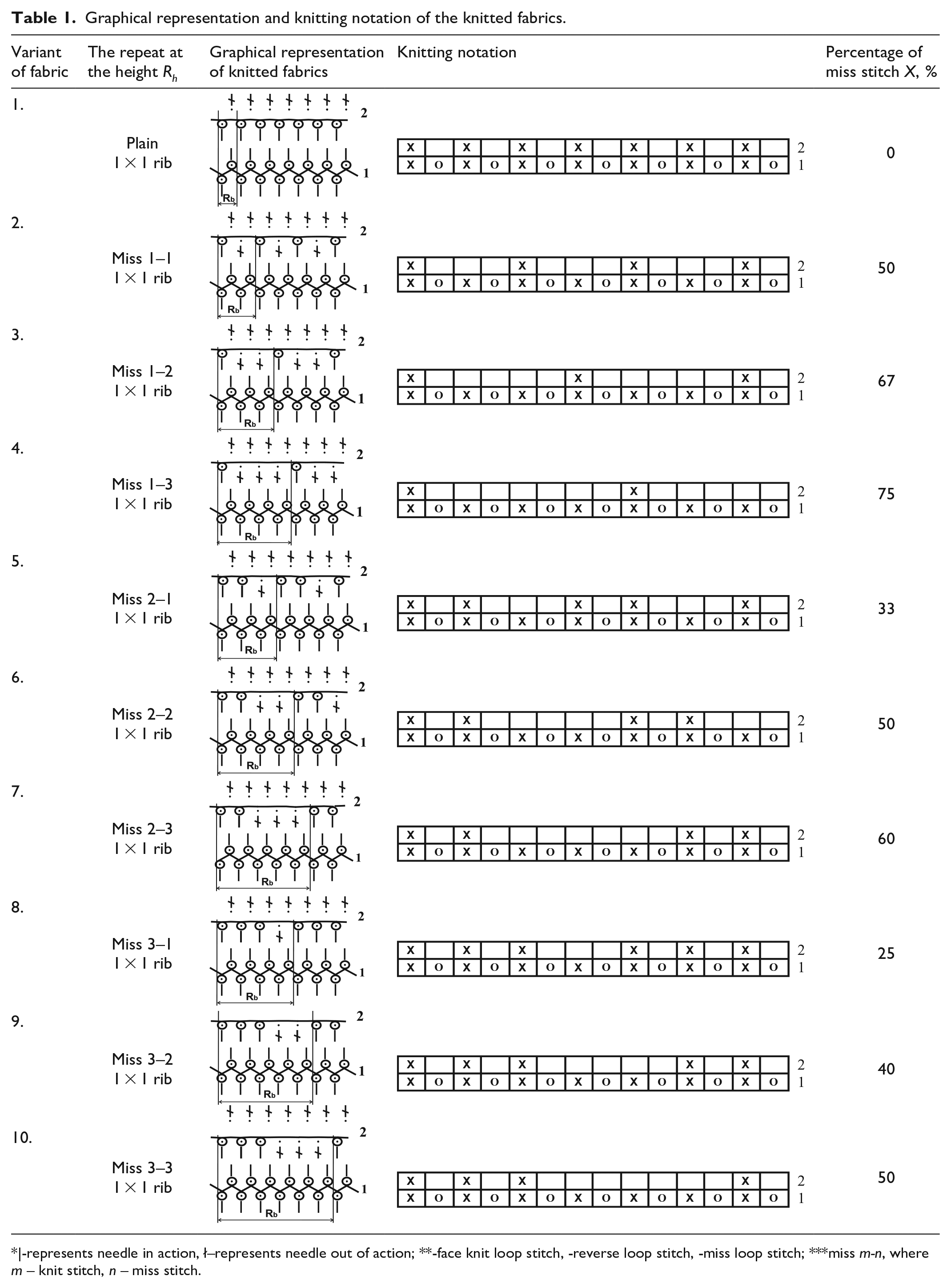

|-represents needle in action, ł–represents needle out of action; **-face knit loop stitch, -reverse loop stitch, -miss loop stitch; ***miss m-n, where m – knit stitch, n – miss stitch.
As it can be seen from Table 1 single miss stiches on the second feeder (variants 2–10) are produced by the needle of the machine front bed. The half Milano rib (variant 1) and double knitted fabrics with miss stitches (variants 2–10) have different technical face and back. The technical face of the knitted fabrics has a face loop of the 1 × 1 rib and plain (variant 1), face loop of the 1 × 1 rib and single miss stitches (variants 2–10). The technical back of the knitted fabrics has a face loop of the 1 × 1 rib.
Methods
Relaxation conditions
Dimensional stability is a crucial aspect of knitted fabrics, and the post-production relaxation process plays a pivotal role in it. Yarns subjected to tension and mechanical forces during knitting can retain residual stresses, which impact the fabric’s behavior and properties. Proper relaxation treatments, such as dry and wet processing, alleviate these stresses, allowing the fabric to regain its intended shape and size. Consequently, relaxation is a vital factor influencing the structural characteristics of knitted fabrics.
After knitting, all fabrics underwent a ten-day dry relaxation (DR10). During this period, the fabrics were placed on a flat surface following the conditioning and stress recovery guidelines outlined in ISO 139:2005. 43 After the dry relaxation, the knitted fabrics were washed using a household fully automatic washing machine with the cotton program. Four washing cycles (WR4) were performed in total. After each cycle, the knitted fabrics were carefully laid out on a flat surface understandard atmospheric conditions for a minimum of 24 h. These washing cycles followed the domestic washing and drying procedures outlined in ISO 6330:2021. 44
Determination of dimensional changes in knitted fabrics
ISO 5077:2007 45 was adhered to in order to assess the dimensional change of the knitted fabrics after each washing cycle.
The dimensional changes lengthwise (DCl) and widthwise (DCw) were calculated as follows:

where “original measurement” is the measurement before the first washing cycle.
Five parallel measurements were done for each variant of fabrics in both directions (lengthwise and widthwise). The mean value was used for future analysis.
Determination of structural characteristics of the knitted fabrics
The structural characteristics of the knitted fabrics were analyzed after undergoing dry relaxation for 10 days (DR10) and after four washing cycles (WR4).
The number of wales (WPC) and courses (CPC) per centimeter for the technical face (WPCf, CPCf) and back (WPCb, CPCb) of the knitted fabrics were determined in accordance with the standard EN 14971:2006. 46 For the measurements, a span of 10 cm was selected, and the values were extrapolated to represent the count per 1 cm. However, for knitted fabric variants 2–10, the number of wales was measured over a span exceeding 10 cm to include the full repeat at the width. The obtained results are a mean value of 10 different locations per sample, considering both the technical face and back of the fabrics.
The fabric stitch density for the technical back (Sb) in loops/cm2 was calculated as follows:

where WPCb – wales per centimeter for technical back in loops/cm, CPCb – courses per centimeter for technical back in loops/cm.
The fabric stitch density for the technical face (Sf) in loops/cm2 could not be accurately calculated due to the irregularity of the structure caused by the miss stitches.
The stitch length (length of yarn) of a knitted fabric is measured for each knit stitch and calculated as the average of all measurements, divided by the number of loops formed by the feeder in the specified area, following the standards set by EN 14970:2006 47 and GOST 8846-87. 48 The designated area consists of 50 wales (50 × 2 needles). The presented results are the mean values of 20 measurements for both the stitch length of the double stitch (l1) and the single stitch (l2).
The average stitch length (la) in mm has been calculated as follows:

where la – the average stitch length in mm, l1 – the stitch length of double stitch in mm, l2 – the stitch length of a single stitch in mm.
The weight (GSM) in grams per square meter was calculated from the measurement of the specimen with a standardized area of 200 cm2, following the guidelines of EN 12127:1997. 49 Five measurements were done for each fabric variant and the mean value of the GSM was used for analysis.
The fabric thickness (t) in mm was determined as a mean value of measurements at 10 different places for every fabric variant according to ISO 5084:1996. 50 A thickness Gage SM-124 device at a pressure of 2.5 N/cm2 (25 kPa) with a test surface area of 1 cm2 was used for the thickness tests.
Determination of stretch properties of the knitted fabrics
A comprehensive study on the stretch properties of knitted fabrics was conducted in accordance with the established standard GOST 8847-85. 51 A “rack” relaxometer (Figure 1) was used to carry out this research by implementing a well-defined “loading – unloading – rest” cycle. The testing process consisted of subjecting the fabric specimen to a 60-minute loading period, during which a constant load of 6 N was applied. Subsequently, the fabrics were allowed to rest for a duration of 120 min. This cycle (Figure 2) allowed us to precisely analyze and measure the stretch behavior of the knitted fabrics under controlled conditions. These findings provide invaluable insights into diverse applications across the textile industry, ranging from fashion to technical textiles. Moreover, they significantly enhance our overall comprehension of knitted fabric performance.

“Rack” relaxometer: 1 – stand, 2 – ruler, 3 – clamps, 4 – hanger, 5 – load, 6 – sample.

The example of specimen’s length changes in the width within the cycle of “loading-unloading-resting” for variant 5.
At the first stage (“loading”) (Figure 2), deformation occurs alongside disruptions in the external and internal connections of the knit structure elements. 52 During this stage, the full deformation (E) of the fabric is determined as follows:

where L0 – the specimen length between grips before testing, in mm, L1 – the specimen length between grips under loading for 60 min, in mm.
During the second stage (“unloading”) (Figure 2), after releasing the fabric from the applied load, the relaxation process starts. 52 At this stage, the elastic deformation (E1) is determined as follows:

where L2 – the specimen length between grips after unloading in mm.
At the third stage (“resting”) (Figure 2), the plastic and residual deformations are determined. The plastic deformation (E2) can be calculated as following:

where L3 – the specimen length between grips after 120 min resting in mm.
The residual deformation (E3) can be calculated as following:

After calculating deformation values the contribution of the components in full deformation (E1/E, E2/E, E3/E) was determined, which allows the evaluation of the fabric’s elasticity.
The presented results are the mean of five measurements, conducted for each fabric variant both lengthwise and widthwise.
Results and discussion
The dimensional change after washing of the knitted fabrics
As outlined in the “Materials” section, 2 ply 25x2texx2 cotton/flax yarn was utilized to produce half Milano rib and nine variants of the double knitted fabrics with different repeats of single miss stitches. The objective of this study part is to investigate the influence of interloping repeat on the dimensional changes observed within four washing cycles.
The results of the investigation of the dimensional change lengthwise (DCl) and widthwise (DCw) of the knitted fabrics after four washing cycles were presented in Table 2 and Figure 3(a) and (b). Additionally, the dimensional change after the first (WR1) and fourth (WR4) washing cycles depends on the percentage of missed stitches in repeat (X) as presented in Figure 3(c).
The dimensional change of the knitted fabrics after washing.


The dimensional change of the knitted fabrics after washing lengthwise DCl (a) and widthwise DCw (b), and the dependences of DCw on percentage X of miss stitches in repeat (c).
Changes in the linear dimensions of materials after wet treatments are primarily influenced by their fibrous composition. The process of shrinkage and contraction in knitwear during wet processing is primarily attributed to alterations in the loop structure, with changes in thread and fiber structures due to swelling being of secondary importance. Natural and hydrated cellulose fibers, such as cotton and flax, are particularly susceptible to shrinkage as they readily absorb moisture and swell significantly.53,54 The obtained results revealed that the majority of dimensional changes in cotton/flax knitted fabrics occurred after the first or first two washing cycles, which is expected for most knitted fabrics, especially from cotton and flax yarns.
The results obtained from analyzing the dimensional changes after four washing cycles are as follows:
The dimensional changes lengthwise (Figure 3(a)) in all fabrics are significantly greater than the changes widthwise (Figure 3(b)). This can be attributed to both the high shrinkage of the flax/cotton yarn and the arrangement of loop legs in this particular direction. Additionally, during knitting, the fabric is subjected to a draw-off load, which leads to the extension of needle loops. However, this extension reduces after relaxation. When planning for mass production, it is crucial to consider these factors while setting up the finishing processes. Understanding the behavior of the
fabric during knitting and post-production relaxation will ensure that appropriate measures are taken to achieve the desired dimensions and overall quality of the final product.
The dimensional change lengthwise was insignificantly influenced by the repeat of missed stitches (Figure 4(a)), especially after the first washing. This finding is consistent with previous research. 23
The dimensional change widthwise exhibited a noticeable correlation with the repeat of missed stitches (Figure 4(b)). This phenomenon can be attributed to the presence of yarn floating freely on the reverse side of the held loop. The widthwise shrinkage increases when the percentage of missed stitches in the repeat increases (Figure 3(c)). The dependencies for (other? These?) parameters after the first and fourth washing cycles had similar tendencies. The derived equations prove to be a valuable tool for predicting the shrinkage of future fabrics within the experimental parameters.
A comparative analysis of fabrics with an equal percentage of needles in action and needles out of action (variants 2, 6, and 10, X = 50%) revealed significant similarity of dimensional changes both lengthwise (DCl) and widthwise (DCw) within all washing cycles.
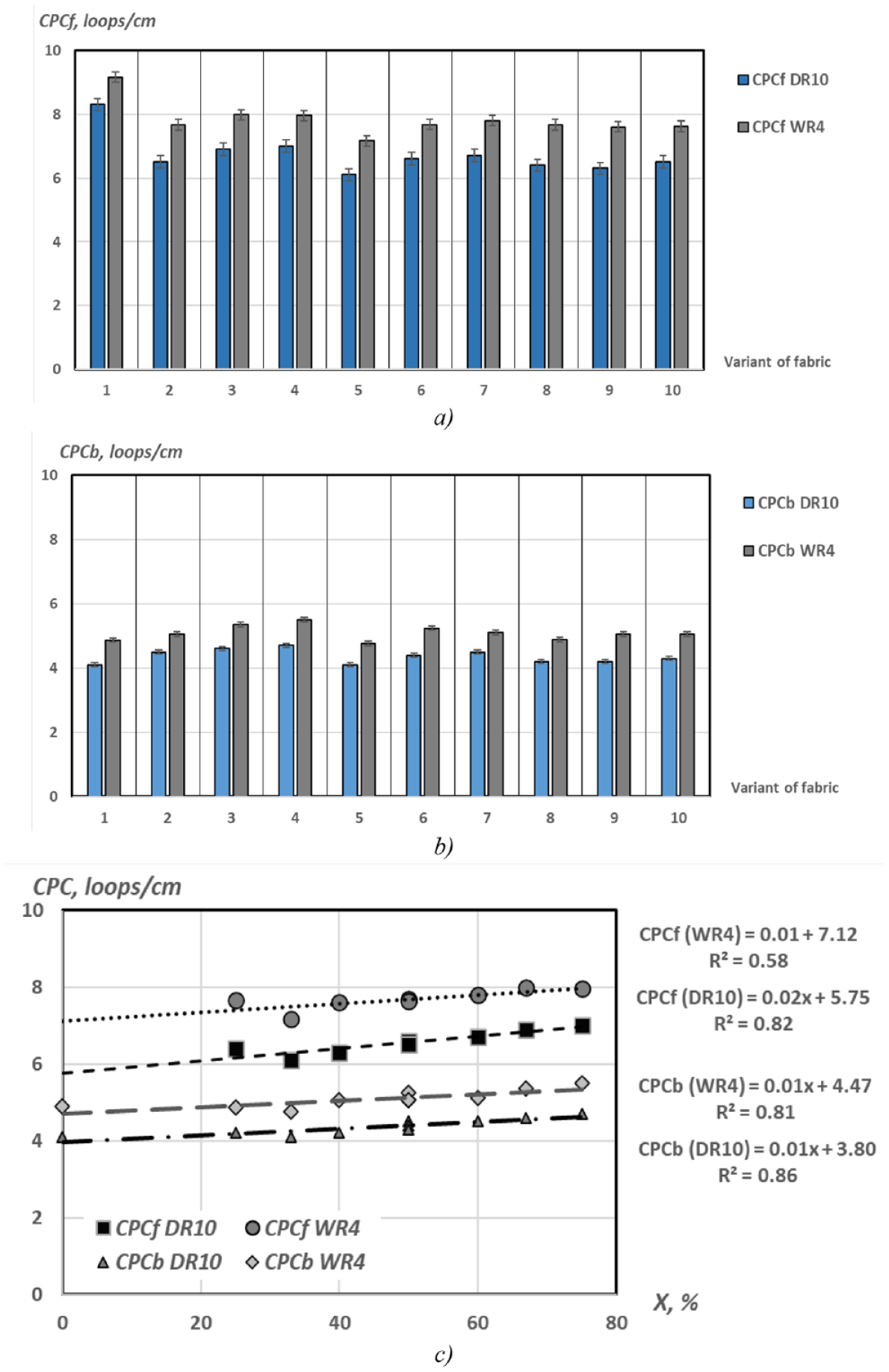
The number of courses for technical face CPCf (a) and back CPCb (b) of the knitted fabrics, and the dependences CPC on percentage X of miss stitches in repeat (c).
The structural characteristics of the knit fabrics
As explained in the “Materials” section, intentionally creating miss stitches on the front bed of the knitting machine resulted in differences in the technical face of the knitted fabrics. This section aims to examine the influence of miss stitches’ repeat on the fabric’s structural properties such as stitch density, stitch length, weight, and thickness. Through a comprehensive study of these variables, our goal is to gain a thorough understanding of how miss stitches contribute to the overall characteristics of the knitted fabrics. Hence, this study focuses on fabrics after undergoing 10 days of dry relaxation (DR10) and four washing cycles (WR4). By scrutinizing the effects of these processes, we aim to gain a comprehensive understanding of how the fabrics perform under real-life conditions, further enriching our knowledge of their suitability for various applications. Tables 3 and 4 present the experimental results for the structural characteristics of studied fabrics after dry relaxation (DR10) and four washing cycles (WR4) respectively.
The structural characteristics of the knitted fabrics after dry relaxation (DR10).

The structural characteristics of the knitted fabrics after four washing (WR4).

The number of wales per centimeter (WPC) of knitted fabrics
It is important to highlight that the number of wales for both face (WPCf) and back (WPCb) sides remains consistent and is denoted as WPC = WPCf = WPCb. It is clear (Tables 3 and 4) that the WPC values are nearly identical for all the fabrics and don’t depend on interloping repeat. This uniformity can be attributed to the fact that all the fabrics were produced using the 1 + 1 rib basic on the same knitting machine with identical technological settings. The observed differences do not exceed 5% and can be considered negligible. Furthermore, it should be noted that the WPC values show a slight increase after washing, which is linked to the fabric’s shrinkage. These results are similar to the trends highlighted in the previous study. 14 Therefore, the consistency in WPC values and their behavior post-washing further reinforces the reliability of the research findings.
The number of courses per centimeter for the technical face (CPCf) and back (CPCb) of knitted fabrics
As detailed in the “Materials” section, it should be noted that studied double-knitted fabrics display noticeable diversity between their sides. The knit loops of 1 × 1 rib along with plain stitches are on the technical face, whereas only extended loops of 1 × 1 rib are on the technical back of the fabric. Consequently, these distinctions contribute to the different stitch densities, namely course numbers observed on the respective technical face (Figure 4(a)) and technical back (Figure 4(b)) of the knitted fabrics. The number of courses for the technical face (CPCf) of Milano rib fabric (variants 1) is two times higher than for technical back (CPCb). The differences between CPCf and CPCb for fabrics with miss stitches (variants 2–10) are less.
The analysis of the experimental results revealed the following:
Washing affects the stitch density of all studied fabrics: the CPCf and CPCb after four washing cycles increase by 12-21% for both sides. This is related to the high shrinkage of double weft cotton/flax knitted fabrics lengthwise.
The number of courses per centimeter depends on the miss stitch repeat. With the increase of the percentage of miss stitches in repeat, the CPCb increases (Figure 4(c)). Thisis due to differences in the redistribution of yarn between 1 + 1 rib loops formed on different needle beds.
During the half-Milano rib knitting process, the 1 × 1 rib loops located on the needles of the back needle bed elongate on account of the 1 × 1 rib loops present on the needles of the front needle bed, in turn making the front needle bed 1 × 1 loops shorter. However, in the presence of single miss stitches, the 1 × 1 knit loops located on the inactive needles in the current cycle become the held loops, thus preventing the thread from being pulled through to the connected back needle bed loops. Consequently, these loops on the front and back needle beds will be of the same size. The increase in the number of miss stitches within the repeat leads to a significant decrease in the ability of the thread to be redistributed between 1 × 1 the needles of the front and back needle bed in the 1 × 1 rib.
The comparison of CPCf values (Tables 3 and 4) shows that the number of courses for the technical face of variants 2–10 is 15.7%–26.5% and 13.3%–22.1% less than the half Milano rib (variant 1) for knitted fabrics after dry relaxation and after washing cycles respectively. With the increase of the percentage of miss stitches in repeat, the CPCf increases as well (Figure 4(c)).
The comparison between the number of courses for the technical face (CPCf) and the back (CPCb) of fabric variants with the same percentage of needles in action (m) and needles out of action (n) (variants 2, 6, and 10, X = 50%) revealed that the number of wales and courses for both sides of the knitted fabric was notably similar.
The fabric stitch density for the technical back (Sb) of knitted fabrics
The fabric stitch density for the technical back (Sb) was calculated using equation (3) and thus it is closely related to the changes in the number of courses and wales per centimeter. It has been observed that after four washing cycles, the fabric stitch density for the technical back (Sb) increases (Tables 3 and 4) for all variants of the knitted fabrics because of the fabric’s shrinkage. The miss stitch’s repeat has a great impact on the fabric stitch density (Figure 5). Increasing the percentage of miss stitches in the repeat leads to the increase of the stitch density for the technical back (Sb). It is clear that these dependencies are similar to those for the number of courses for the technical back (Figure 4).

The dependence of stitch density for the technical back (Sb) on percentage of miss stitches in repeat X.
The stitch length
The study of the stitch length of 1 + x1 rib stitches (l1) after dry relaxation reveals consistent values across all fabrics, as shown in Table 3. The miss knit repeat does not impact this parameter significantly. However, after four washing cycles (Table 4), there is a slight (up to 4%) decrease in the stitch length l1. This reduction can be attributed to the natural shrinkage of the flax/cotton yarn used.
For Milano rib fabric, the stitch length of plain stitches (l2) is shorter compared to the stitch length of 1 + 1 rib stitches (l1). This difference arises from the way adjacent needle loops are connected. In the case of plain stitches, the adjacent loops are formed on the same needle bed, while for rib stitches the adjacent loops are knitted on different needle beds, resulting in longer junctures due to the distance between the two needle beds.
Figure 6 presents the length of yarn for a plain stitch (l2) and its relationship to the percentage of miss stitches in repeat (X). The data illustrates how the stitch length is affected by the presence of miss stitches, providing valuable insights into the behavior of the fabric.

The length of yarn of the single stitch l2 (a) and it’s dependence on percentage of miss stitches in repeat X (b).
The stitch length of the plain stitches (l2) for 2–10 variants knitted fabric is higher than for the Milano rib fabric (Figure 6(a)) in both cases (DR10 and WR4). Additionally, as the number of needles in action (m) remains constant (1, 2, or 3), increasing the number of needles out of action (n) from 1 to 3 leads to an increase in the stitch length of the miss stitches (l2). The observed increase in stitch length for miss stitches is a result of the used measurement method. As stated in the methods section, the stitch length was calculated by dividing the yarn length by the number of loops formed by the feeder. Since the miss stitches were not counted, the float length was inadvertently distributed to the stitch length, leading to the observed changes. This increase in stitch length is observed with a higher percentage of miss stitches in repeat, as shown in Figure 6(b). Furthermore, for fabric variants 2, 6, and 10, with 50% of needles in action (m) and 50% out of action (n), the stitch lengths (l2) are almost identical.
The thickness (t) of knitted fabrics
The thickness (t) of knitted fabrics is influenced by several factors, notably the type of stitches and the relaxation process. The research results of fabrics after a dry relaxation lasting10 days (Table 3) show that there is a slight increase in the thickness of fabrics with miss stitches compared to Milano rib fabric. This can be explained by the presence of the float yarn between loops formed on different needle beds. No dependencies between miss stitch repeat and thickness were found.
After four washing cycles, both the half Milano rib (variant 1) and knitted fabrics with miss stitches (variants 2–10) generally exhibit an increase in thickness. It is due to the changes in the loops’ shape and their disposition in the knitted structure after all relaxation processes.
The weight (GSM) of knitted fabrics
The weight (GSM) of knitted fabrics is subject to several influencing factors, including the interloping, the stitch density, and yarn lengths. The weight (GSM) of studied fabrics (Table 4) is in the range of 424–504 g/m2. The relationship between this parameter and the percentage of miss stitches in repeat wasn’t found.
Determination of stretch properties of the knitted fabrics
It is well known that the stretch properties of knitted fabrics play a crucial role in determining their dimensional stability under mechanical loads. When knitted fabrics are being stretched, the internal equilibrium of the loop system is disrupted, leading to a transition into a new equilibrium state. Typically, knitted materials are subject to deformation at a load much lower than their breaking point. Understanding the relaxation of the mechanical properties of knitted fabrics is of utmost importance. The results of this research hold promising implications for the design and production of clothing and technical textiles, as well as for the creation of novel materials boasting superior properties. By leveraging this knowledge, we can elevate clothing design and technical textile manufacturing, ensuring that they retain their shape and appearance even after prolonged use, thus significantly enhancing the overall user experience.
The stretch characteristics were studied for the knitted fabrics after four washing cycles (WR4), both lengthwise and widthwise. The calculated values of full deformation, as well as its components and their contributions to the full deformation, are presented in Table 5.
The stretch characteristics of the knitted fabrics after four washing WR4.

Figure 7 presents the correlation between the type of deformation widthwise and the percentage of miss stitches in repeat (X). Figure 8(a) and (b) show the distribution of deformations in knitted fabrics, highlighting the contributions of elastic (E1), plastic (E2), and residual (E3) deformations both lengthwise and widthwise. These visualizations offer valuable insights into how the distinct deformation components contribute to the overall deformation (E) of the knitted fabrics. By analyzing the elastic, plastic, and residual deformations separately, we gain a comprehensive understanding of the fabric’s mechanical behavior and its performance in different directions. This information plays a pivotal role in optimizing fabric properties and ensuring their suitability for a wide array of applications. Understanding how each type of deformation is influenced by the fabric’s structure allows the choice of a particular fabric that suits specific applications and meets the desired performance standards.

The relationship between the type of deformation widthwise and the percentage of miss stitches in repeat (X).

The contribution of elastic (E1), plastic (E2) and residual (E3) deformations in full (E) deformation lengthwise (a) and widthwise (b) of the knitted fabrics.
The results indicate that the studied fabrics exhibit significantly higher stretchability widthwise compared to lengthwise, with the former being approximately 2.5 times greater. This observation aligns with the typical behavior of most weft-knitted structures. Notably, the half Milano rib structure displayed the highest values of full deformation and its components in both directions. This trend can be attributed to the presence of single miss (float) stitches. The close arrangement of wales caused by these floats results in reduced width-wise elasticity.1,2 The incorporation of single miss stitches into the 1 × 1 rib structure did not alter this tendency. The findings from this study shed light on the stretch properties of various knitted fabrics, offering valuable insights for design and practical applications in the textile industry.
A full deformation lengthwise of the studied fabrics (Table 5) is ranging between 15% and 25% and demonstrate their excellent dimensional stability. During the experiment, no significant influence of fabric structure or the miss stitches repeat on the full deformation lengthwise or its components was observed. Notably, the elastic deformation lengthwise constitutes the largest part of the full deformation (Figure 8(a)). Its contribution exceeds 0.8 for almost all studied fabrics highlighting the fabric’s exceptional ability to retain its original shape and dimensions lengthwise.
The fabrics studied in Table 5 exhibit excellent dimensional stability, with a full deformation lengthwise ranging from 15% to 25%. Throughout the experiment, no significant impact on the full deformation lengthwise or its components was observed, regardless of fabric structure or missed stitches. Notably, the elastic deformation lengthwise accounts for the majority of the full deformation, as shown in Figure 8(a). For almost all fabrics studied, its contribution exceeds 0.8, indicating the fabric’s remarkable ability to maintain its original lengthwise shape and dimensions.
The widthwise deformation of the studied fabrics is influenced by the repeat of missed stitches (Figure 7). The fabric’s stretchability decreases with increasing the percentage of miss stitches in repeat because the floats are positioned in the stretching direction. This dependence is consistent across all components of full deformation. Understanding these relationships will aid in optimizing fabric designs for improved stretch and overall performance.
The fabric’s widthwise deformation is affected by the occurrence of miss stitches, as shown in Figure 7. As the percentage of miss stitches increases, the fabric’s stretchability decreases due to the positioning of floats in the direction of stretch. This relationship holds true for all components of full deformation. By comprehending these connections, it is possible to optimize fabric designs for better stretch and overall performance.
The contribution of elastic deformation widthwise with values ranging from 0.57 to 0.66 is significantly smaller compared to the lengthwise (Figure 8(b)). It is important to highlight the substantial level of residual deformation and its impact on the overall deformation. These factors must be carefully considered during the design and manufacturing of clothing. Due to these findings, the studied double weft cotton/flax knitted fabrics are not recommended to use in producing tight-fitting garments. They are better suited for garments that allow for more relaxed and oversized silhouettes, ensuring a better overall appearance and wearability.
The widthwise elastic deformation contribution, with values ranging from 0.57 to 0.66, is considerably smaller than the lengthwise contribution (as shown in Figure 8(b)). It is crucial to note the significant amount of residual deformation and how it affects the overall deformation. Designers and manufacturers need to take these factors into careful consideration while creating clothing. Based on these findings, it is not recommended to use the double weft cotton/flax knitted fabrics studied to produce tight-fitting garments. They are better suited for garments with more relaxed and oversized silhouettes, which will result in better overall appearance and wearability.
Conclusion
This study offers valuable insights into the structural, dimensional, and stretch properties of double weft cotton/flax knitted fabrics with single miss stitches. The interlooping repeat at the width (Rb) varies by the number of knit stitches and miss stitches, both ranging from 1 to 3. The study clarifies the performance of knitted fabrics with miss stitches, offering valuable knowledge for applications in various industries, from fashion to technical textiles. The utilization of cotton/flax yarn adds ecological significance to the findings, promoting sustainable fabric development and manufacturing.
The key findings after four washing cycles are that the lengthwise changes were notably higher than the widthwise, due to flax/cotton yarn shrinkage and loop leg arrangement during the knitting process. The repeat of missed stitches had a major impact on widthwise changes: the dimensional change increases with an increase in the percentage of miss stitches, due to the presence of yarn floating freely on the reverse side of the held loops. By utilizing these insights, fabric manufacturers can optimize finishing processes, anticipate shrinkage, and ensure better control over final fabric dimensions after washing.
The miss stitch repeat affects the stitch density of fabrics, especially the number of courses per centimeter (CPC). With the increase of the percentage of miss stitches in repeat, the CPCb for the technical back increases due to differences in redistribution of yarn between 1 + 1 rib loops formed on different needle beds. The stitch density of both WPC and CPC increases after washing cycles. Thus, double weft cotton/flax knitted fabrics became denser due to their shrinkage.
Washing affects the stitch length: the yarn length in the loop decreases by approximately 4% after four washing cycles. It was found that the stitch length of plain stitches is shorter compared to the stitch length of 1 × 1 rib stitches. This difference is due to the different lengths of junctures connected to adjacent needle loops: the adjacent loops of plain stitches are formed on the same needle bed, while the adjacent loops for rib stitches are knitted on different needle beds, resulting in longer junctures due to the distance between the two needle beds. The effect of the miss loop repeat on yarn length in plain stitches was established within this study: it increases with the increase of the percentage of miss stitches in repeat. This increase is due to the measurement method, where miss stitches were not counted, inadvertently causing the float length to be distributed to the stitch length. The double weft cotton/flax knitted fabrics became thicker (t = 1.7–1.8 mm) after washing but no dependence on the miss stitch repeat was found. The weight of studied fabrics is in the range from 424 to 504 g/m2 with no dependence on the miss stitch repeat as well.
The studied fabrics show good lengthwise elasticity. However, widthwise stretchability is greater and widthwise elasticity is smaller. The full deformation widthwise and its components are affected by the repeat of missed stitches. The presence of floats in the stretch direction reduces the fabric’s stretchability, observed consistently across all deformation components. The contribution of elastic deformation widthwise is much smaller compared to lengthwise. High residual deformation must be also taken into account.
This research offers a plethora of valuable insights with significant potential to benefit engineers in the knitting industry. By providing them with informed decision-making capabilities, this study enables the selection of optimal variables for producing knitted fabrics with precisely tailored properties. Whether in the domain of fashion or technical textiles, these findings promise to streamline and rationalize the fabric crafting process, elevating their quality and performance to meet diverse requirements. Empowering engineers with these findings will undoubtedly lead to advancements in the field, driving innovation and efficiency in the production of knitted fabrics. By gaining a comprehensive understanding of the properties of knitted fabrics with missed stitches, manufacturers can significantly improve their ability to provide enhanced care instructions for their products, thereby ensuring better quality and customer satisfaction.
Footnotes
Declaration of conflicting interests
The author(s) declared no potential conflicts of interest with respect to the research, authorship, and/or publication of this article.
Funding
The author(s) received no financial support for the research, authorship, and/or publication of this article.
