




Abstract
This study investigated the effect of the rib set-out repeat and single miss stitches on the structural properties and dimensional stability of double weft knitted fabrics compared with half Milano rib. Nine variations of double weft knitted fabrics were produced, each with a different number of inactive needles at the width repeat Rb. The fabrics were tested after 10 days of dry relaxation and five washings. The fabric’s structural repeat at the height Rh consisted of a combination of two courses, rib and plain (variant 1), and rib set-out and single with miss (float) stitch, with stitch repeats varying at the width Rb (for variants 2–10). The miss stitch was made on the technical back of the knitted fabrics, and the number of inactive needles during the production of the single and double stitches ranged from 1 to 3. The fabrics were manufactured using a 10-gauge flat bed-knitting machine from blended wool/PAN (60% wool, 40% PAN) 25×2tex×2 yarn. The results demonstrated that the width repeat of miss knit stitches Rb (different numbers of knit and miss loop stitches) plays a crucial role in determining the dimensional stability and structural properties of double knitted fabrics. The number of washing cycles did not significantly impact the structural properties (around ±5%). The research results demonstrated shrinkage in the length and width directions, specifically after the first two washing cycles. The rib set-out repeat and single miss stitches affect dimensional changes in both directions: an increase in the number of inactive needles increases shrinkage in the length and decreases shrinkage in the width direction. Overall, this study highlights the importance of the number and placement of miss stitches during the design process of double weft knitted fabrics, particularly when aiming to achieve specific structural and dimensional properties.
Introduction
The fashion industry has a high demand for unique and diverse clothing. Clothing manufacturers constantly seek new fabrics with different textures, structures, and appearances to meet this growing demand. They are experimenting with various knitting elements such as knit, miss, and tuck stiches to create a wide range of knitted fabric designs. Currently, most mass-produced clothing uses weft knitted structures like single jerseys, rib structures, interlock, and cardigans. Other stitches, such as jacquard, purl, and open stitches, are also frequently used for their vibrant colors and interesting textures. Double jersey structures like Milano and half Milano rib fabrics have many possibilities that could be explored to create unique designs. More research is needed to explore these unexplored possibilities in textile design fully. Several factors influence the production and use of knitted fabrics and clothing, which can change their appearance and how they feel. Even minor external influences can affect their appearance and shape over time. Therefore, it is crucial to study these factors closely to ensure that these fabrics retain their shape and appearance over time. This knowledge is essential for creating knitted products that endure harsh conditions while still looking great.
The wool industry has significantly transformed due to technological advancements in knitting and fabric construction. The growth potential lies in consumers who appreciate wool’s quality, authenticity, and transparency. 1 To increase wool production, the International Wool Textile Organization has implemented measures to boost wool prices. Population growth and urbanization are driving the expansion of the wool market, along with an increase in domestic consumption of luxury wool textiles. 2 Wool’s biodegradability and thermal insulation properties make it sustainable and attractive to consumers. Wool is highly sought-after due to its exceptional qualities, such as wrinkle-resistance, lightweight durability, moisture absorption and retention, graceful drape, long lifespan, and natural benefits. With new blends and finishing techniques, wool’s applications have extended, providing diverse practical and stylish clothing options. Wool blends with acrylic may be cheaper and easier to care for. 3
Various factors influence the structural characteristics and dimensional stability of knitted fabrics. The most important among them are the type of knit structure, the type of fiber used, the type and diameter of yarn, the knitting machine parameters, the loop length of yarn, the type and stages of relaxation, and other related factors.4,5 The structure of a knitted fabric is a critical parameter that influences its structural and mechanical properties. This is particularly important in women’s knitwear made from wool6,7 and other types of yarn. 8 The use of different knit structures, such as single jersey–single pique, single jersey–double pique, single jersey–single lacoste, single jersey–honeycomb, single pique–double pique, single pique–single lacoste, single pique–honeycomb, double pique–single lacoste, double pique–honeycomb, and honeycomb–single lacoste, has shown improvements in the appearance and mechanical properties of the fabrics compared with conventional single-structured fabrics. 9 The structural characteristics of single jersey knitted fabrics, including the number of wales and courses per unit length, are reduced after the fabric undergoes relaxation. 10 The state of relaxation of plain knitted fabrics influences their structural characteristics 11 and yarn properties. 12 The dimensional stability of single jersey knitted fabrics is influenced by the linear density, twist factor, machine gauge, and stitch length.13,14 However, the dimensional width change of the three different single jersey knitted fabrics with varying yarn types, fabric tightness, fiber blends, and double piqué knitted fabrics is not as significant. 15 The main structural characteristics of single-jersey knitted fabrics depend on the full wet-process cycle, which includes scouring–bleaching, enzyme processes, dyeing, wash-off, and the type of finishing softener. The number of wales and courses per centimeter, fabric stitch density, and weight of knitted fabrics increased after the full wet process, but the length of yarn decreased. 16
Combining single- and double-knit structures and their run-in ratio in the knit structure is an important parameter, which influences the structural characteristics of knitted fabrics. During the design process of the knit fabric structure, it is necessary to consider the number and layout of stitch courses in the height repeat, because of its great influence on the consumer characteristics of the knitted fabrics. 17 The run-in ratio between the plain and rib course of half Milano rib fabrics is an important parameter for obtaining a stress-free structure. 18 The main dimensional characteristics of the single-jersey weft jacquard structure depend on the stitch width repeat. This influence is attributed to the combination of a different number of elements of the jacquard stitch structure (knit loops and miss (float) loops). 19 The structural characteristics of the weft double knitted fabrics depend on the different stitch width repeats of plain and rib knit structures with miss stitches. 20 The miss (float) stitches in single jersey knitted structures reduce the thickness of the fabric and enhance its heat transfer ability. 21 Using miss (float) and tuck stitches in the knit structure can significantly reduce material consumption, and the presence of float stitches can improve the shape stability of the knitted fabric. The number of miss (float) stitches and tuck stitches has the strongest influence on the surface density of the fabric, followed by the volume density. 22 The stitch width repeat of the single and double miss stitches impacts the structural parameters of the knitted fabrics produced from blended cotton/flax (70/30) yarn 25×2tex×2, but does not impact their dimensional stability significantly during washing.23,24 The exact impact of the width repeat on the structural characteristics can be observed in single and double tuck stitches.25–27 The most significant characteristics of the basic weft double knitted fabrics made using blended flax yarn consist of the plain and incomplete courses depending on the width repeat of miss stitches. 28 Knit structures consisting of tuck loop stitches have more wales and courses per inch and higher fabric stitch density, weight, and shrinkage than miss stitches.29,30 In contrast, knit structures implementing miss stitches (such as half Milano rib and single piqué structures) have better dimensional stability than knitted fabrics with only knit loop stitches. 31 With the increase of the yarn loop length in half Milano and Milano rib knitted fabrics made using wool and acrylic yarns, a linear increase in the number of wales and courses per unit length can be observed. 32 Stitch structures with tuck (single/double piqué and single/double lacoste) and miss loop (single and double crossmiss) stitches have higher bursting strength in comparison to plain knitted fabrics. 33 Dimensional properties of plain, 1×1 rib, 2×2 rib, and half-cardigan structures made from wool yarn (such as the knit density constant and fabric thickness) were found to be independent of loop length and dependent only on the yarn diameter in the fully relaxed state. 34 The moisture responsiveness of knitted structures made from wool/nylon, wool, and spandex yarns under dry and wet conditions after 30 and 60 min of air-drying depends on the type of knit structure, including jersey, tuck, and miss stitch structures. According to the study, the miss and tuck/rib knitted structures displayed continued relaxation of fabric thickness in all conditions. 35 The structural characteristics of 1×1 rib, plain, and miss knit structures made from acrylic/wool yarn depend on the type of knit structure used. Unlike plain and 1×1 rib knits, miss knit stitches typically exhibit higher wale densities. 36 It was also found that different knit structures (such as 1×1 and 2×2 rib, Milano rib, Lacoste, and half cardigan) made using blended wool (80% lambswool and 20% wool) yarn significantly influenced the examined dimensional properties. 37 The influence of tightness on the main dimensional parameters was discussed using a geometrical model to predict the main properties of the 1×1 rib knitted fabrics made from wool yarn. It is indicated that a geometrical model can be applied to 1×1× rib knitted fabrics from different types of yarn. 38 However, some researchers propose that the geometrical model for prognostication of main properties is not universally applicable, since complete relaxation is difficult to achieve. 5
The dimensional stability of knitted fabrics is directly related to the type of yarn used, 39 yarn count, and loop length of the yarn in the stitch.40,41 The alteration in dimensions, in terms of length and width, as wool plain knitted fabrics transition from a dry-relaxed state to a fully relaxed state, is predominantly influenced by factors like loop length and yarn count. To a lesser extent, fiber quality, and yarn twist play a role, while the treatment level has no significant impact. It is important to note that these changes are consistently isotropic, meaning the dimensions uniformly decrease during the relaxation process. 40 The geometry and dimensional characteristics of relaxed plain knitted fabrics made from wool and cotton yarns are primarily influenced by the yarn length in the stitch. 41 The dimensional stability in the width of the single-jersey, single lacoste, and double lacoste knitted fabrics due to washing increases, while the dimensional stability in the length decreases. 42 The dimensional stability of single jersey, 1×1 rib, and interlock knitted fabrics is not impacted by changes in yarn length, as the loop configuration in each relaxation state was the most significant factor. 43 The structural characteristics of the piqué knitted fabrics influence the dimensional change in washing.39,44 The dimensional change in washing of the single miss stitches with a different stitch width repeat in length direction increases, while the dimensional change in width direction decreases. The dimensional stability in the length of knitted fabrics depends on the number of washing treatments. 45 The knit wool fabrics’ dimensional stability exhibited the highest shrinkage level during the first five drying cycles. However, the shrinkage rate increased relatively slowly as the number of drying cycles increased. In addition, it is important to note that fabric shrinkage primarily occurs in the length direction. 46
The current research focuses on the impact of the rib set-out repeat variants and single miss stitches on the fabric performance of fabrics made from blended wool yarn. It aims to fill the gaps in knowledge and enhance our understanding of fabric properties. The primary objective is to examine how various rib set-out repeat variants and single miss stitches affect the structural characteristics and dimensional stability of wool/PAN double weft-knitted fabrics. Wool is one of the main materials used in cloth production for the autumn–winter season and has many positive characteristics. Due to the higher cost of wool compared with chemical and synthetic fibers, the demand for wool cloth decreases. One of the solutions for this problem is using blended wool yarn and suitable types of knitting structures, which can decrease costs and increase the market value of knitting cloths with appropriate properties. Post-production relaxation has a significant impact on a knitted fabric’s future performance. Therefore, this research subjected the fabrics to two types of relaxation, dry and wash, to relieve stresses and allow the fabric to regain its intended shape and size. The findings will provide valuable insights with practical implications for designers and knitting technologists. With this essential knowledge, professionals can confidently choose the most appropriate variables to produce knitted fabrics with specific properties.
Materials and Method
Materials
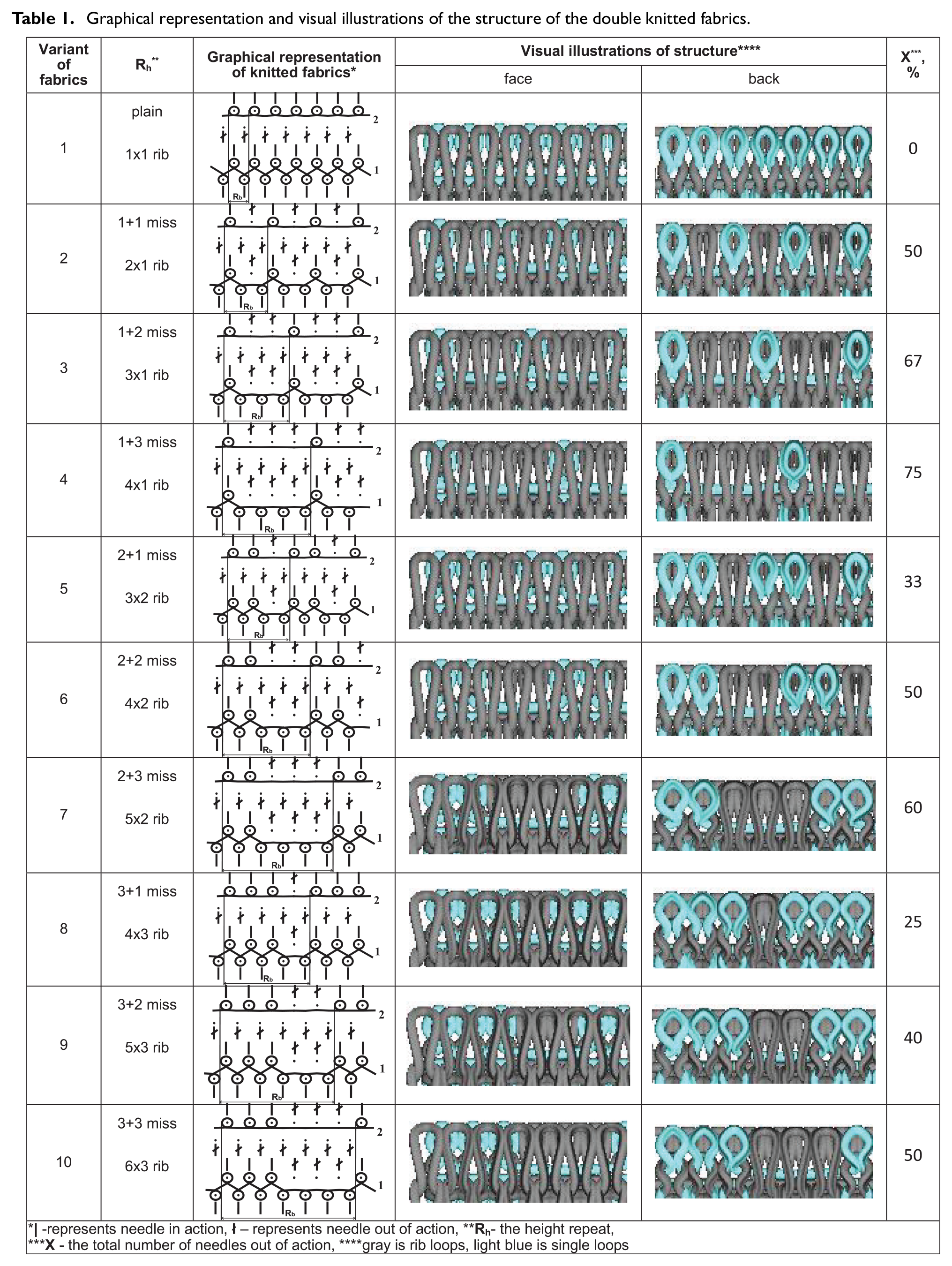
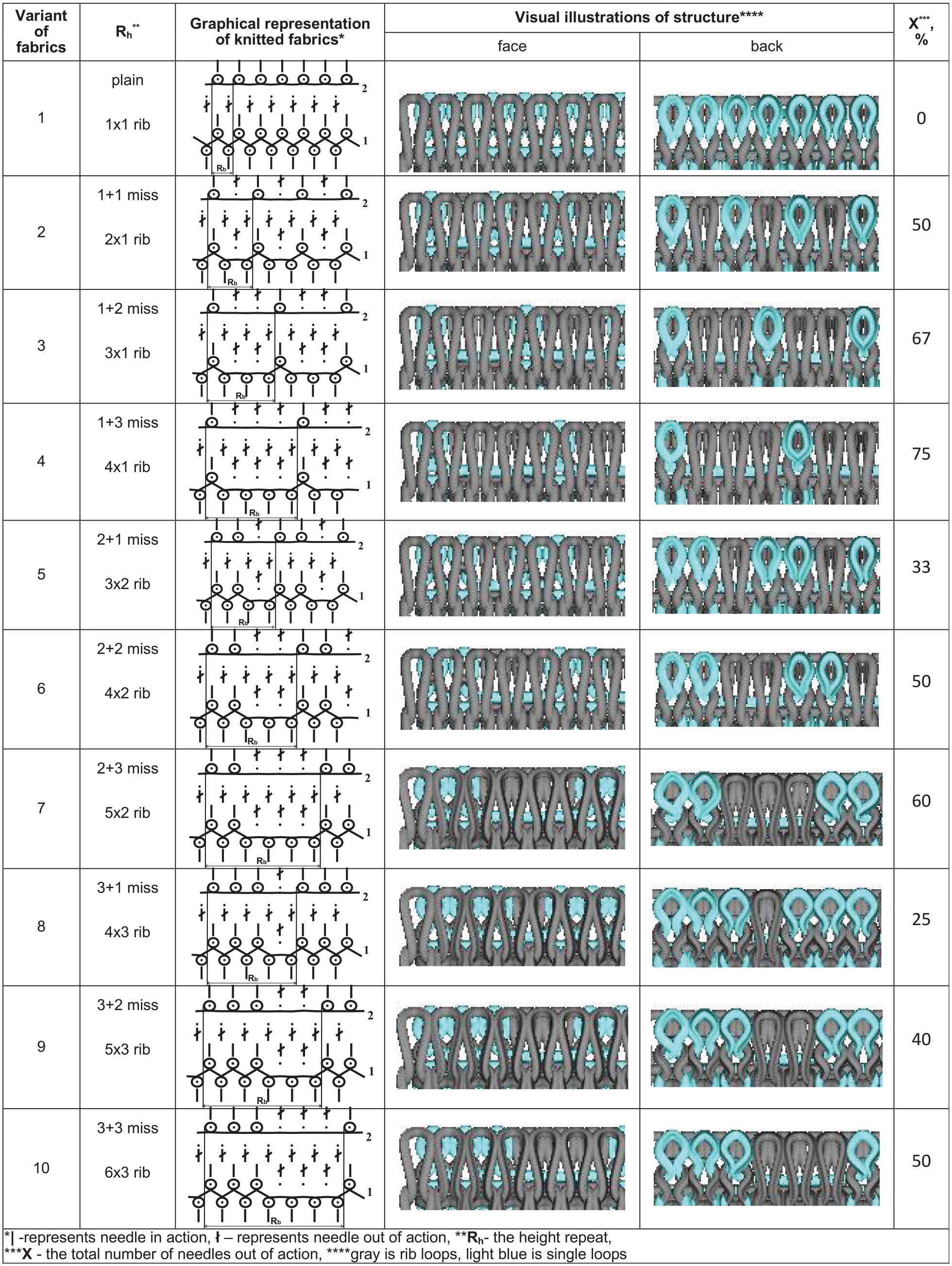
Graphical representation and visual illustrations of the structures of nine variants of double knitted fabric with rib set-out repeat variants and miss stitches (variants 2–10) and half Milano rib (variant 1) are presented in Table 1.
Graphical representation and visual illustrations of the structure of the double knitted fabrics.
Double weft knitted fabrics were produced on the 10-gauge flat bed-knitting machine using 25×2 tex×2 wool/PAN (60% wool, 40% PAN) yarn. The main knitting parameters (such as the machine stitch cam position, yarn input tension, and knitted fabric take-downs) remained unchanged during sample production. The stitch cams of both cam systems were set up at the same depth. The optimal levels were determined through the knitting process without any problems. The yarn before knitting was treated by waxing.
The structures repeat in the height direction Rh consists of a combination of two courses with different stitch width repeat Rb:
(1) variant 1—1×1 rib (double stitch) on the first feeder and plain (single stitch) on the needles of the back bed of the flat knitting machine on the 2nd feeder;
(2) variants 2–10—rib set-out repeat (double miss stitch) on the first feeder and single miss (float) stitch on the second feeder. The inactive needles make the miss loop stitches of the back bed of the flat knitting machine (the technical back of knitted fabrics).
The stitch width repeat Rb = m + n of the technical back of the knit stitch consists of the number of needles in action m, which creates the knit loop, and the number of needles out of action n, which creates the miss loop stitch. The number of knit loops m or miss loop stitches n on the technical back of knit stitches varies from 1 to 3 (m = const with n = 1 − 3 and n = const with m = 1 − 3). As such, the technical face and back sides of double knitted fabric are different. The technical face has a face knit loop of the 1×1 rib structure (variant 1) or a face knit loop of the rib set-out (variants 2–10). The technical back has a face knit loop of the 1×1 rib and plain (variant 1), a face knit loop of the rib set-out, and single miss (float) stitches (variants 2–10). The needle in action m or the needles out of action n in the back bed of the knitting machine are the same as in the first and second feeders.
The percentage of inactive needles X in rib set-out repeat and single miss stitches (X) on the back bed of the knitting machine was calculated as follows:

Method
Determination of the Structural Characteristics of the Knitted Fabrics
The presented structural characteristics of the knitted fabrics were measured by the following parameters:
The number of wales W and courses C per centimeter for the technical face (Wf, Cf) and back (Wb, Cb) which were determined according to the EN 14971:2006. 47 The presented results represent an average of 10 measurements of the dimensions (number of wales and courses) of a fabric sample per 10 cm on both the technical face and back sides. They are then calculated as a value per centimeter.
The length of yarn of the one loop in millimeters—determined as an average of 50 unrowed courses for each stitch in the knit structures repeat at height Rh (double stitch—l1 and singe stitch—l2) according to the EN 14970:2006. 48
The weight Ws in the g/m2 was determined as an average from the mass of five samples, each having an area of 200 cm2 according to EN 12127:1997. 49
The fabric thickness t in millimeters is determined as an average from the thickness at 10 different places on every sample according to the ISO 5084:1996. 50
After measurements of the dimensional values, the following parameters were calculated:
(1) The average length of yarn of one loop la in millimeters was determined using the formula (2):

where: la is the average length of yarn of one loop in millimeters;
l1 is the length of yarn of one loop of double stitch in millimeters;
l2 is the length of yarn of one loop of the single stitch in millimeters.
(2) The fabric stitch density for the technical face Sf in loops/cm2 was calculated according to equation (3):

where Sf is the stitch density for the technical face in loops/cm2;
Wf is the number of wales per centimeter for the technical face in loops/cm;
Cf is the number of courses per centimeter for the technical face in loops/cm.
The fabric stitch density for the technical back (Sb) in loops/cm2 could not be accurately calculated due to the irregularity of the structure caused by the miss stitches.
Determination of Dimensional Change in the Knitted Fabrics After the Dry and Washing Relaxations
The dimensional change in the knitted fabrics DC after dry DR and washing WR relaxations were analyzed through the percentage of change in length DCl and width DCw. After being knitted, the fabrics were for 10 days laid on a flat surface under a standard atmosphere to facilitate recovery from the stress imposed by knitting (dry relaxation DR) according to ISO 139:2005. 51 After that, the fabrics were washed in a household fully automatic washing machine using a wool program. The total number of washing cycles was five. After each washing cycle, the fabrics were laid, with minimum stress, on a flat surface under a standard atmosphere for at least 24 h. The samples were subjected to washing cycles according to ISO 6330:2021 52 and ISO 5077:2007. 53
The mean percentage dimensional change DC in both directions (in the length DCl and width DCw) is calculated as (4):
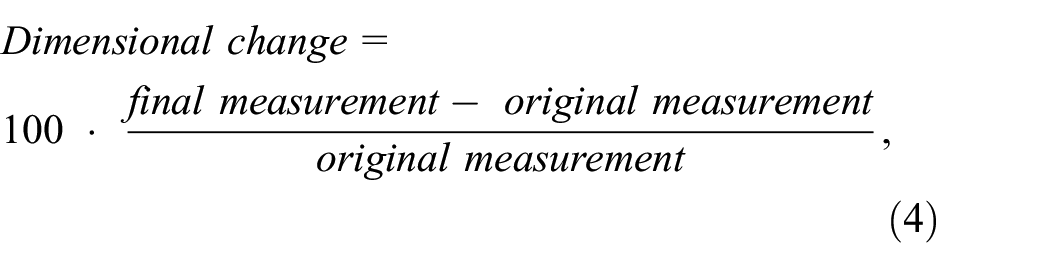
For each variant of fabrics, five measurements were recorded for both directions, and the mean value was expressed as dimensional change.
Statistical Analysis
Statistical analysis of the obtained results was performed using the Student’s t-test. The value of the t-parameter for the independent sample was determined by applying equation (5), and for the dependent sample it was calculated using equation (6):


where:
n 1 and n2 are their corresponding sample sizes (n1 = n2);
Results and Discussion
The Structural Characteristics of the Knitted Fabrics
As stated in the experimental section, all the knitted fabrics under investigation were knitted using a blended wool/PAN yarn of 25×2tex×2. The current section focuses on the impact of rib set-out repeat variants and different widths of single miss stitches (i.e. varying numbers of knit and miss loops stitches) on the structural parameters of the nine knitted fabric variants tested. In addition, a comparison with the structural parameters of half Milano rib fabric is also presented. The main structural characteristics of a fabric, including the number of wales W and courses C, stitch density S, average loop length of yarn la, weight Ws, and fabric thickness t, are crucial in determining the fabric’s behavior during wearing and washing. These properties play a significant role in defining the fabric’s dimensional properties; thus, their consideration is paramount.
The experimental studies show that the structural characteristics of double knitted fabrics depend more on the rib set-out repeat variants and width repeat of single miss stitches Rb and less on the number of washing cycles. The mean percentage change for all structural characteristics after each of the five washing cycles was about ±5%. This analysis used the experimental results after the dry DR and the fifth washing relaxation WR5. The number of wales and courses per centimeter and fabric stitch density for the technical face (Wf, Cf, Sf) and back (Wb, Cb, Sb) of the knitted fabric structure of the nine variants with rib set-out repeat variants and single miss stitches (variants 2–10) and half Milano rib (variant 1) after the dry DR and the fifth washing WR5 relaxations are presented in Figures 1–3.
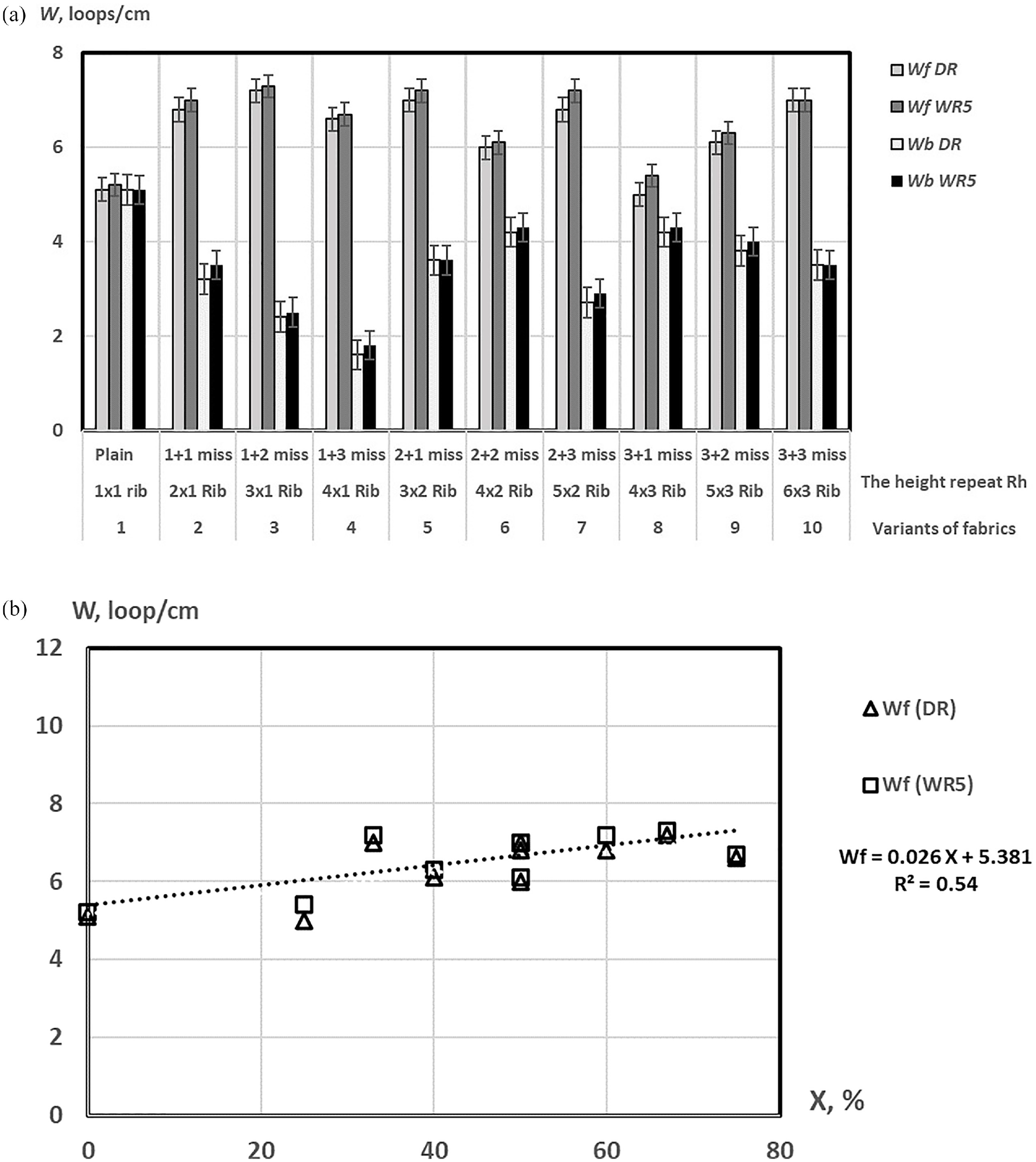
(a) The number of wales for the technical face (Wf) and back (Wb) of the knitted fabrics after the dry DR and the fifth washing relaxations WR5 and (b) the dependences Wf on percentage X of miss stitches in repeat.
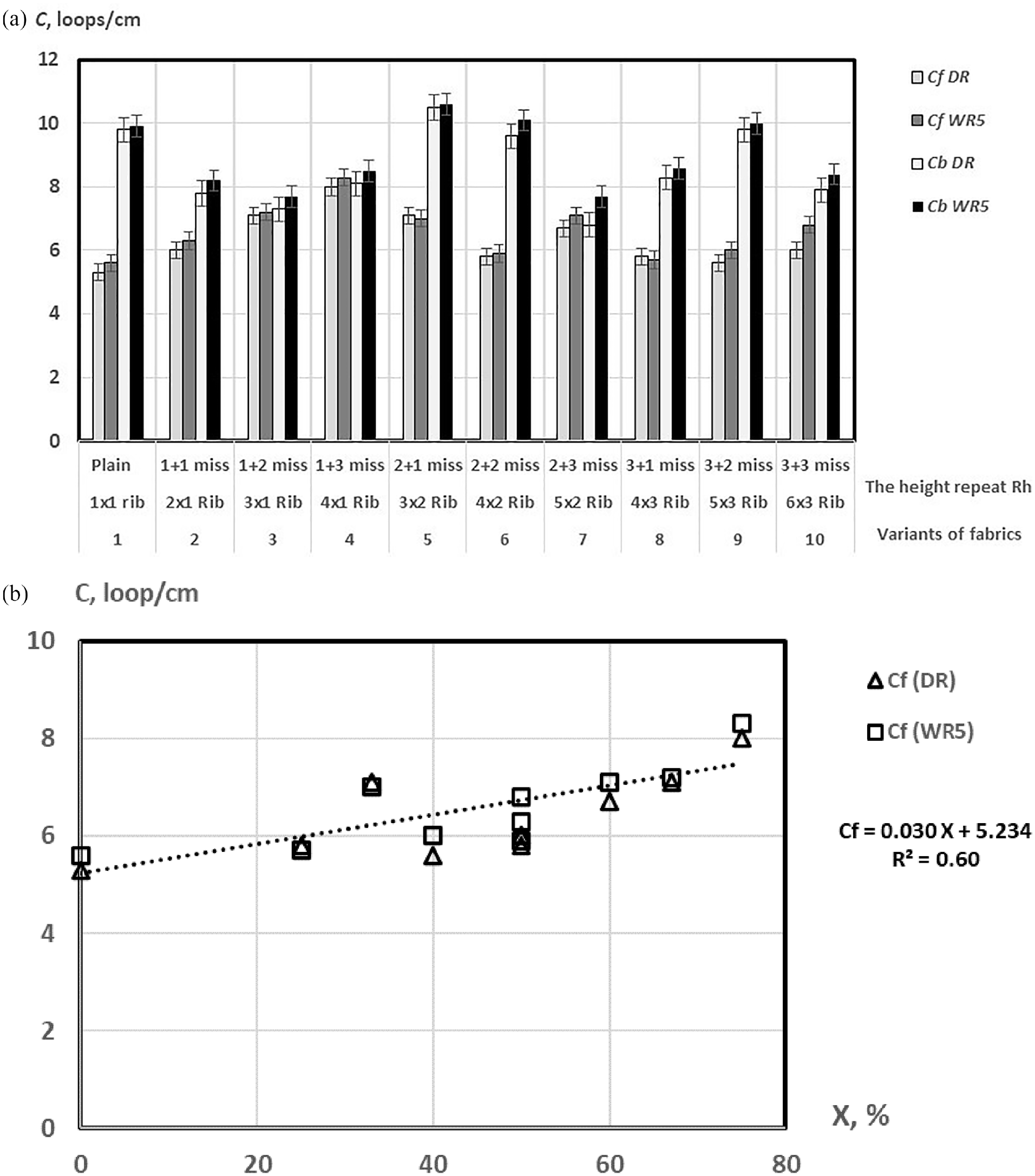
(a) The number of courses for the technical face (Cf) and back (Cb) of the knitted fabrics after the dry DR and the fifth washing relaxations WR5 and (b) the dependences Cf on percentage X of miss stitches in repeat.
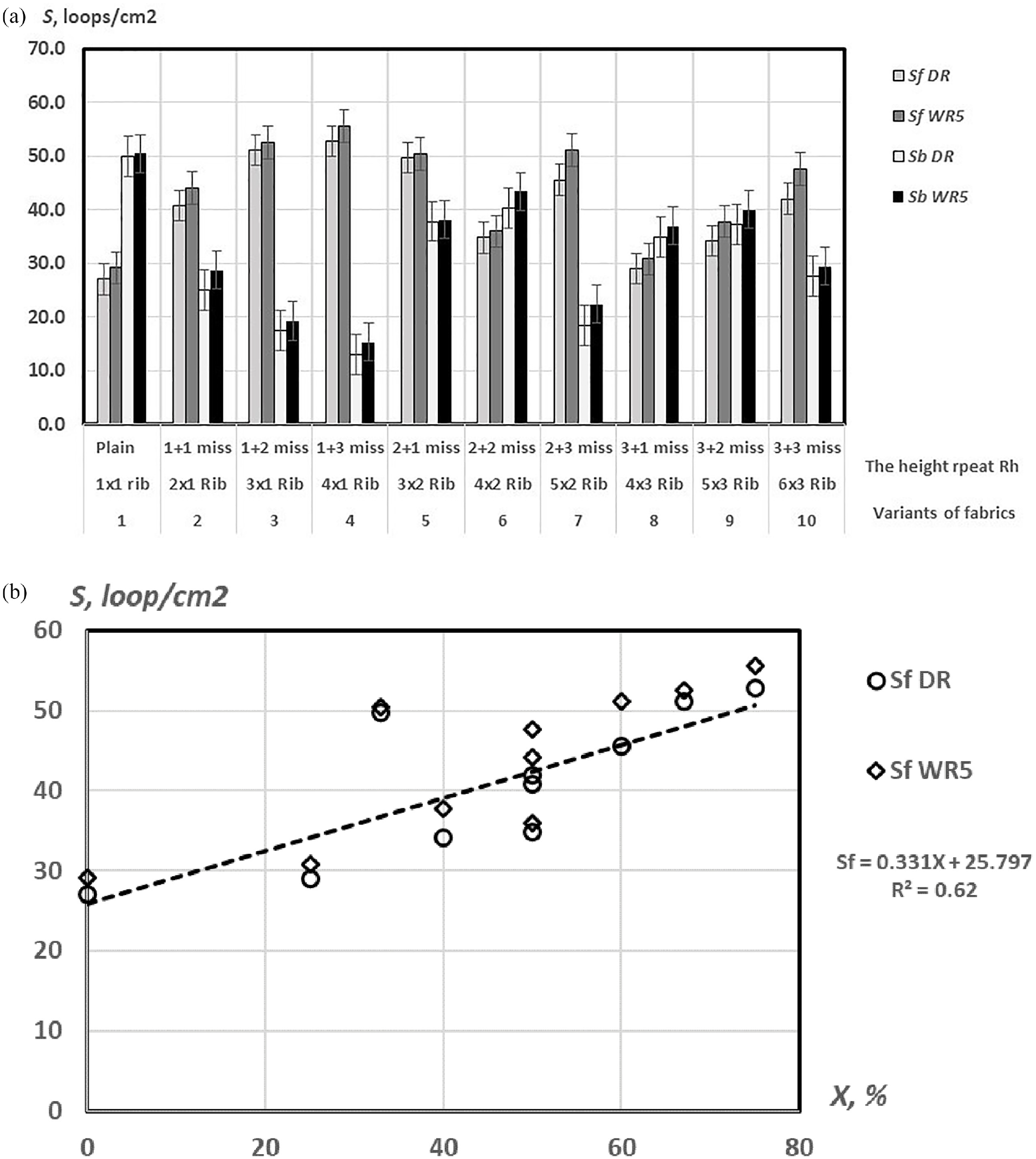
(a) The stitch density for the technical face (Sf) and back (Sb) of the knitted fabrics after the dry DR and the fifth washing relaxations WR5 and (b) the dependences Sf on percentage X of miss stitches in repeat.
It is apparent from Table 1 that knitted fabrics with rib set-out repeat variants and single miss stitches (variants 2–10) and half Milano rib (variant 1) have significantly different structures of the technical face and back sides. The technical face of the half Milano rib knitted fabric (variant 1) has a knit loop of the 1×1 rib. In the half Milano rib knitting process, the 1×1 rib loops on the front needle bed needles elongate due to 1×1 rib loops on the back needle bed needles. This elongation results in shorter 1×1 loops on the back needle bed (as shown in Table 1, visual illustration of structure variant 1). However, when rib set-out repeat variations and single miss stitches are introduced (variants 2–10), the rib knit loops on the inactive needles in the current cycle become held loops. This prevents the thread from passing through to the connected rib loops on the front needle bed. As a result, the rib loops on both the front and back needle beds are particularly the same size (as seen in Table 1, visual illustration of structure variants 2–10). The increase in the number of inactive needles within the repeat leads to a significant decrease in the thread’s ability to be redistributed between rib loops made by the needles of the front and back needles bed in the double stitches. The technical face of the knitted fabrics (variants 2–10) has a knit loop of the rib knit structure with a different width repeat. The differences between the fabrics’ structures are the highest at the technical back. The technical back of half Milano rib fabric (variant 1) has knit loop of the 1×1 rib and plain stitches. At the same time, the technical back of the knitted fabrics with rib set-out repeat variants and single miss stitches (variants 2–10) is different and consists of knit loops of the double (rib) and single stitches, miss (float) loops of the single stitches. This explains the differences between the densities on the technical face and back sides of the knitted fabrics.
The results of the investigation (Figures 1 and 2) showed that the number of wales and courses per centimeter for both sides (technical face and back) of the knitted fabrics, and as a result also the fabric stitch density of knitted fabrics, increased after the washing relaxation for all variants of fabric as in work. 16 This is related to the high shrinkage of double weft wool/PAN knitted fabrics. The analysis of the effect of the width repeat of the rib set-out repeat variants and single miss stitches Rb showed that the number of wales and courses per centimeter for both sides of the knitted fabrics (variants 2–10) depends on the width repeat Rb. The same influences were noted in the works.17,19,20,23,24,27
In Figure 1, it is evident that the number of wales per centimeter in all knitted fabric variations for the technical face side (Wf) is significantly influenced by both the fabric’s state and the percentage of inactive needles (X) within the repeat at the width (Rb). This relationship between wales per centimeter for the technical face (Wf) and the percentage of inactive needles (X) within the repeat at the width (Rb) is visually represented in Figure 1(b). The missed stitches in the structure create irregularities, preventing the depiction of the number of wales per centimeter for the technical back (Wb) dependence on X of missed stitches in repeat at the width (Rb).
The comparison of the structural characteristics of the knitted fabrics with rib set-out repeat variants and single miss stitches (variants 2–10) and half Milano rib (variant 1) knitted fabrics showed the number of wales for the technical face Wf of knitted fabric variants 2–10 after dry relaxation DR is 17.6–41.2% higher than half Milano rib (variant 1), except for variant 8. Variant 8 has 2.0% fewer wales, which can be attributed to the lowest number of inactive needles in the width repeat (16.7%). Previous research 36 supports this, as the presence of inactive needles can increase the number of wales in knitted fabrics. After undergoing five washing relaxation cycles WR5, the number of wales on the technical face Wf of knitted fabric variants 2–10 was found to be 3.8–40.4% higher than the number of wales on the technical face Wf of the half Milano rib knitted fabric (variant 1). This suggests that the knit structure and inactive needles during knitting the double knitted fabrics can influence dimensional changes during washing relaxations.
The number of wales for the technical back Wb of the knitted fabrics with miss stitches (variants 2–10) after the dry relaxation DR is less by 17.6–68.6% than that of the knitted fabric half Milano rib (variant 1). A similar reduction can be noticed in the number of wales for the technical back Wb after the fifth washing cycle WR5 (less 15.7–64.7%). This explains the influence of the variant of knit structure of the double knitted fabrics with different width repeat Rb on the dimensional change during the dry relaxation.
As the percentage of inactive needles (X) increases, there is a simultaneous 6.6% increase in the number of wales per centimeter on the technical face (Wf). This trend remains consistent regardless of the type of relaxation applied (dry or wash), as shown in Figure 1(b).
As previously mentioned, the knitted fabrics under study exhibit noticeable differences between their technical face and back sides, stemming from variations in the knitting processes for the front and back needle beds of the knitting machine. Consequently, this results in a different number of courses on the technical front (Cf) compared with the back (Cb) of the knitted fabric. The research findings, as illustrated in Figure 2(a), indicate that, after undergoing both dry relaxation (DR) and washing cycles (WR5), the number of courses per centimeter on the technical back (Cb) surpasses that on the technical face (Cb) for most fabrics. However, in the case of the half Milano rib (variant 1), Cb is 1.8 times greater than Cf. The variation between Cf and Cb for other fabrics (variants 2–10) varies because they possess different numbers of courses in distinct wales on the technical back. The number of courses for the technical face Cf of the knitted fabrics (variants 2–10) after the dry relaxation DR and the fifth washing relaxation WR5 is higher by 5.7–50.9% and 1.8–48.2% than that of the half Milano rib knitted fabric (variant 1). The number of courses for the technical back Cb of the knitted fabrics (variants 2–10) after the dry relaxation DR is less by 2.0–30.6 and 13.1–22.2% than that of the half Milano rib knitted fabric (variant 1), except for knitted fabric variants 5 and 9.
The number of courses per centimeter for the technical face (Cf) for all knitted fabric variants is notably affected by the percentage of inactive needles (X) within the repeat at the width (Rb) and independent of fabric condition. This correlation between the number of courses per centimeter for the technical face (Cf) and the percentage of inactive needles (X) within the repeat (Rb) is graphically presented in Figure 2(b). The increase in the percentage of inactive needles (X) leads to an increase in the number of courses per centimeter on the technical face (Cf) by 49.6%. This is due to differences in yarn redistribution between loops of both yarn feeds. In half Milano rib structure there is only redistribution between rib loops knitted on different needle beds. The loops on the front bed became longer, and the loops on the back bed became shorter when the plain course was knitted. In the case of the rib set-out repeat variants (variants 2–10), there is a redistribution between the double and single stitch loops. The double stitch loops on inactive needles became longer, and the loops on active needles became shorter. As the percentage of inactive needles (X) increases, the potential for yarn redistribution diminishes, causing the size of held loops on both sides to decrease. Consequently, this increases stitch density on the technical face (Sf), as demonstrated in Figure 3. The structure of the technical back contains missed stitches, resulting in irregularities that hinder the depiction of the technical back (Cb) dependence on X of missed stitches per repeat at the width (Rb).
In the knitted fabrics with miss stitches (variants 2–10), the fabric stitch density for the technical face Sf is higher by 7.4–95.6% compared with the half Milano rib knitted fabric (variant 1). Conversely, the fabric stitch density for the technical back Sb of the knit fabrics variants 2–10 is lower by 14.0–69.7% than that of the knitted fabric variant 1 (Figure 3(a)). These results indicate a significant influence of the number of miss stitches on the stitch density of the knitted fabrics, as previously reported by Sarybayeva et al. 22
Stitch density in knitted fabrics is primarily determined by the percentage of inactive needles and is relatively independent of the type of relaxation employed. An increase in the percentage of inactive needles (X) results in a 93.2% increase in the stitch density on the technical face (Sf) as presented in Figure 3(b).
The statistical results for the determination of the number of wales and courses of the knitted fabrics for the technical face (Wf and Cf, respectively) and back (Wb and Cb, respectively) were obtained for independent and dependent samples after dry DR and fifth washing WR5 relaxations using a t-test (refer to Tables 2 and 3, respectively).
The statistical results for the determination of the number of wales and courses of the knitted fabrics for the technical face (Wf and Cf, respectively) and back (Wb and Cb, respectively) for independent samples after dry DR and fifth washing WR5 relaxations using the t-test.
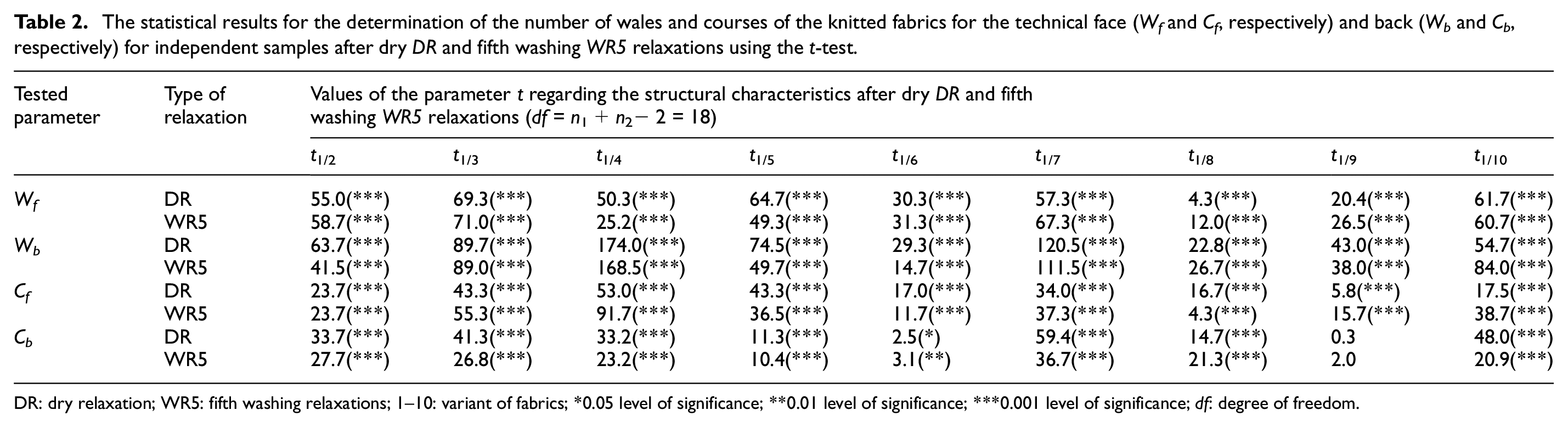
DR: dry relaxation; WR5: fifth washing relaxations; 1–10: variant of fabrics; *0.05 level of significance; **0.01 level of significance; ***0.001 level of significance; df: degree of freedom.
The statistical results for the determination of the face (Wf and Cf, respectively) and back (Wb and Cb, respectively) of the knitted fabrics for dependent samples after dry DR and fifth washing WR5 relaxations using t-test.

DR: dry relaxation; WR5: fifth washing relaxations; 1–10: variant of fabrics; *0.05 level of significance; **0.01 level of significance; ***0.001 level of significance; df: degree of freedom.
A statistical analysis using t-tests (Table 2) showed a significant difference in the number of wales for both sides (Wf, Wb) and the number of courses for the technical face Cf of the knitted fabrics between variant 1 and variants 2–10, with a significance level of 0.001. Moreover, there was a significant difference in the number of courses for the technical back Cb of all investigated knitted fabrics after dry DR and washing WR5 relaxations at a significance level of 0.001, except for knitted fabric variant 6. This variant showed a statistically significant difference at the significance level of 0.05 after dry relaxation DR and 0.01 after the fifth washing WR5 relaxation. In contrast, no statistically significant difference was observed for knitted fabric variant 9 after dry DR and washing WR5 relaxations. Based on the presented results, the width of the repeat Rb has a greater impact on the number of wales and courses of the investigated knitted fabrics compared with half Milano rib (variant 1).
The results of the statistical analysis, presented in Table 3, indicate a significant difference in the number of wales and courses for the technical face (Wf, Cf, respectively) of the knitted fabrics after both dry DR and washing WR5 relaxations, except for variants 4 and 5, with a significant level of 0.001, 0.05, or 0.01. On the contrary, for variant 1, the type of relaxation had a statistically insignificant influence on the number of wales and courses for the technical back (Wb, Cb, respectively). In contrast, for the other samples, a statistically significant difference in the number of courses for the technical back Cb was observed at a significant level of 0.001, 0.05, or 0.01. Based on these findings, it can be suggested that the width of the repeat Rb has a varying impact on the number of wales for the technical back Wb of all investigated knitted fabrics. The results of the measurements of the yarn length of one loop of double stitch l1, single stitch l2, the average length of yarn la, the weight Ws, and the fabric thickness t of the knitted fabrics after the dry DR and the fifth washing WR5 relaxation are presented in Figures 4 and 5.
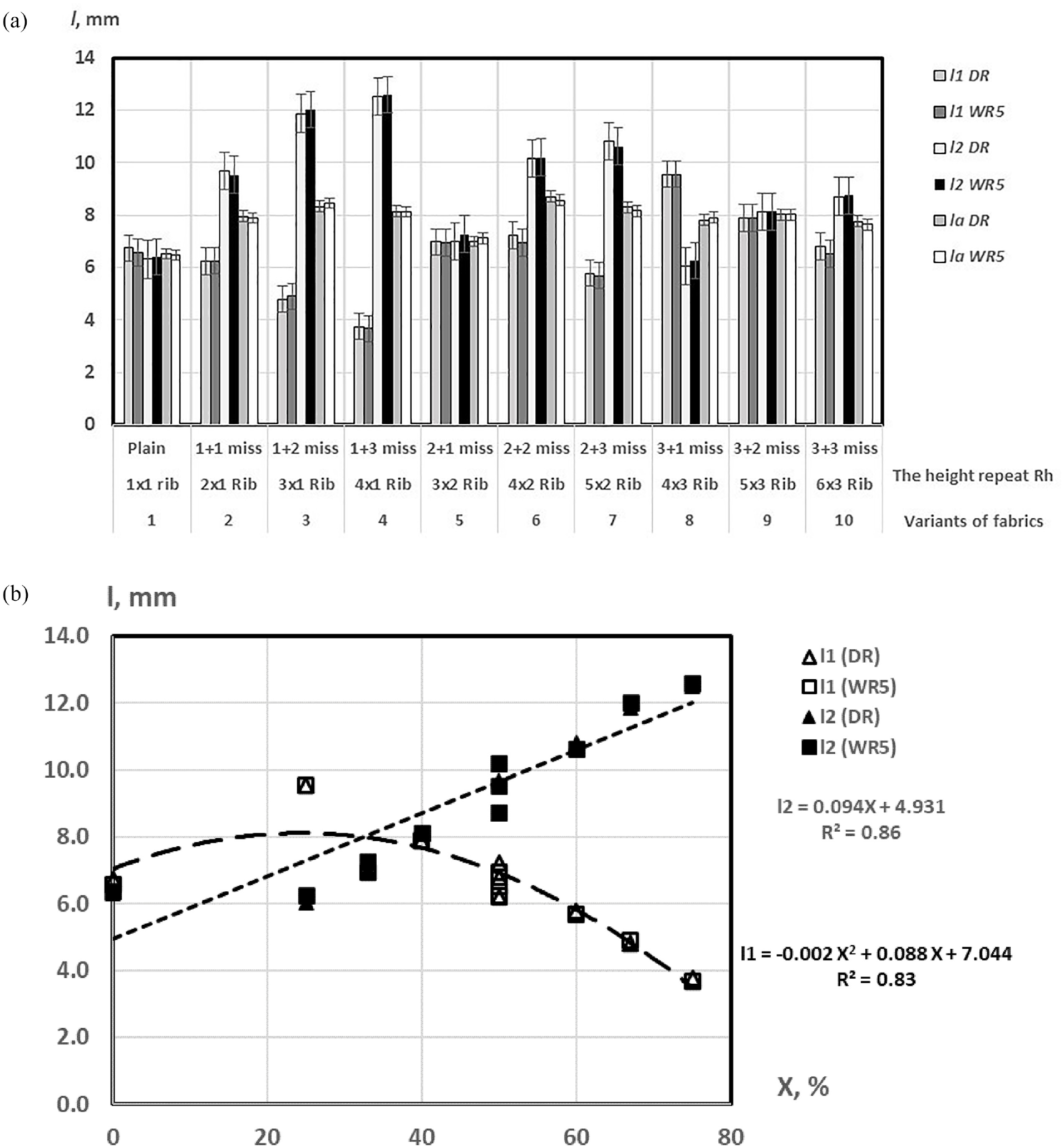
(a) The length of yarn of double stitch l1, single stitch l2, and average la and (b) the dependences l1 and l2 on percentage X of miss stitches in repeat of the knitted fabrics after the dry DR and the fifth washing WR5 relaxations.
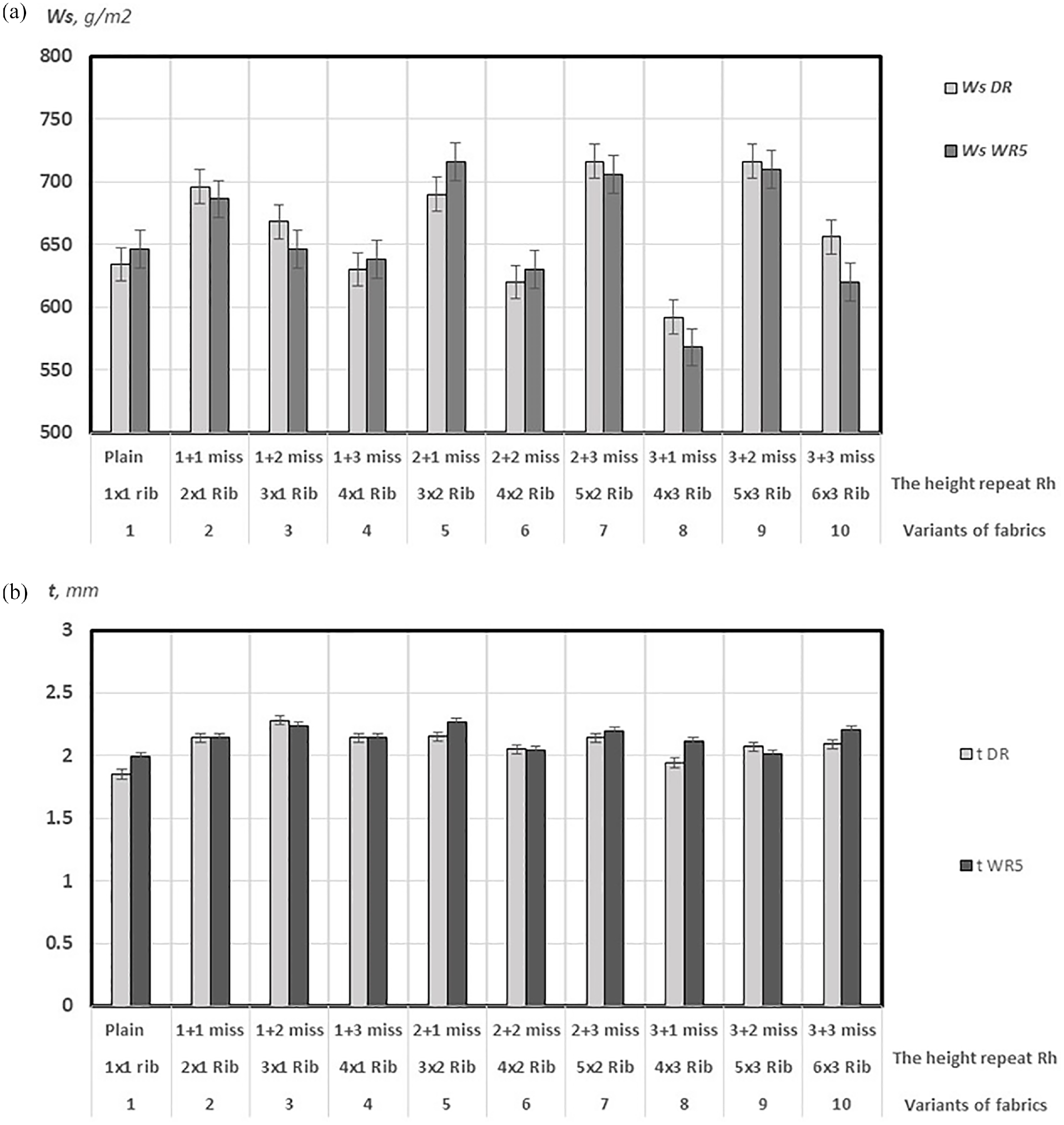
(a) The weight Ws and (b) the thickness t of the knitted fabrics after the dry DR and the fifth washing WR5 relaxations.
The obtained results revealed that the length of yarn in one loop of the rib set-out repeat variants and single miss knit stitches depends on the width repeat Rb, which could be ascribed to the different number of the knit and miss loop stitches, which has been previously mentioned.17,19,20,23,24,28
The stitch length of the single miss stitches (l2) in the knitted fabric variants 2–10 is greater than that in the Milano rib fabric, as depicted in Figure 4(a), under both conditions (DR and WR5). Furthermore, while keeping the number of active needles (m) constant (1, 2, or 3), increasing the number of inactive needles (n) from 1 to 3 results in an elongation of the stitch length for the single miss stitches (l2). The observed lengthening of the miss stitches results from the measurement approach. As explained in the “Method” section, the stitch length was determined by dividing the yarn length by the number of loops created by the feeder. Since the miss stitches were not counted, the float length inadvertently contributed to the stitch length, leading to the observed alterations. This increase in stitch length becomes more prominent with a higher percentage of miss stitches in the pattern, as shown in Figure 4(b).
The experimental results showed that with the increase in the number of inactive needles n from 1 to 3 in the width repeat of the knit structure Rb, when the number of active needles is m = const (1, 2 or 3), the length of yarn of the single miss (float) stitches l2 increases and decreases for double stitches l1 (Figure 4(a)). The comparison of the average length of yarn la of the knitted fabrics with miss stitches (variants 2–10) with half Milano rib (variant 1) showed that the average length of yarn la of the miss stitches is higher by 7.4–57.8% after the dry relaxation DR and by 12.6%–34.0% after the fifth washing relaxation WR5.
The length of yarn of the double stitch (l1) and single stitch (l2) are predominantly influenced by the percentage of inactive needles, regardless of the type of relaxation applied. An increase in the percentage of inactive needles (X) results in a 44.2% reduction in the length of yarn for the double stitch (l1) and a 97.5% increase in the length of yarn for the single stitch (l2), as depicted in Figure 4(b).
The weight of the knitted fabrics with miss stitches Ws (variants 2–10) does not depend on the type of relaxations and has a different tendency compared with the weight Ws of the half Milano rib (variant 1). It can be explained by the differences in density for the technical face and back sides of the knit fabrics and differences in the length of one loop of the double and single miss stitches (Figure 5(a)).
The thickness t of the knitted fabrics with miss stitches (variants 2–10) is affected by the type of relaxation used (Figure 5(b)). Washing relaxation resulted in changes in the thickness t of these stitches ranging from −2.9% to 8.8%, including the thickness t of the half Milano rib (variant 1). After dry relaxation, the thickness t of miss stitches (variants 2–10) was higher by 4.9–23.2%, and after the fifth washing relaxation, it was higher by 1.0–14.1%, compared with the thickness t of the half Milano rib (variant 1). These differences can be attributed to variations in density between the technical face and back sides of the knitted fabrics.
The statistical results for the determination of the yarn length of one loop of double stitch l1, single stitch l2, the weight Ws, and the fabric thickness t were obtained for independent and dependent samples after dry and washing relaxations using a t-test (refer to Table 4 and 5, respectively).
The statistical results for the determination of the of the yarn length of one loop of double stitch l1, single stitch l2, the weight Ws, and the fabric thickness t for independent samples after dry DR and washing WR5 relaxations using t-test.
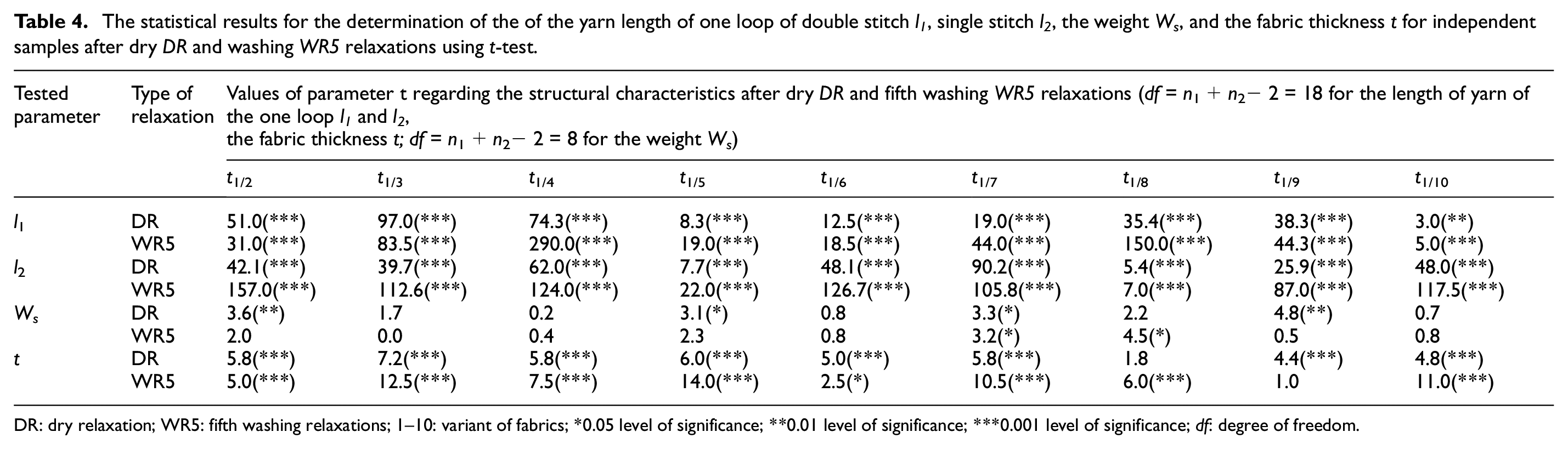
DR: dry relaxation; WR5: fifth washing relaxations; 1–10: variant of fabrics; *0.05 level of significance; **0.01 level of significance; ***0.001 level of significance; df: degree of freedom.
The statistical results for the determination of the of the yarn length of one loop of double stitch l1, single stitch l2, the weight Ws and the fabric thickness t for dependent samples after dry DR and washing WR5 relaxations using t-test.
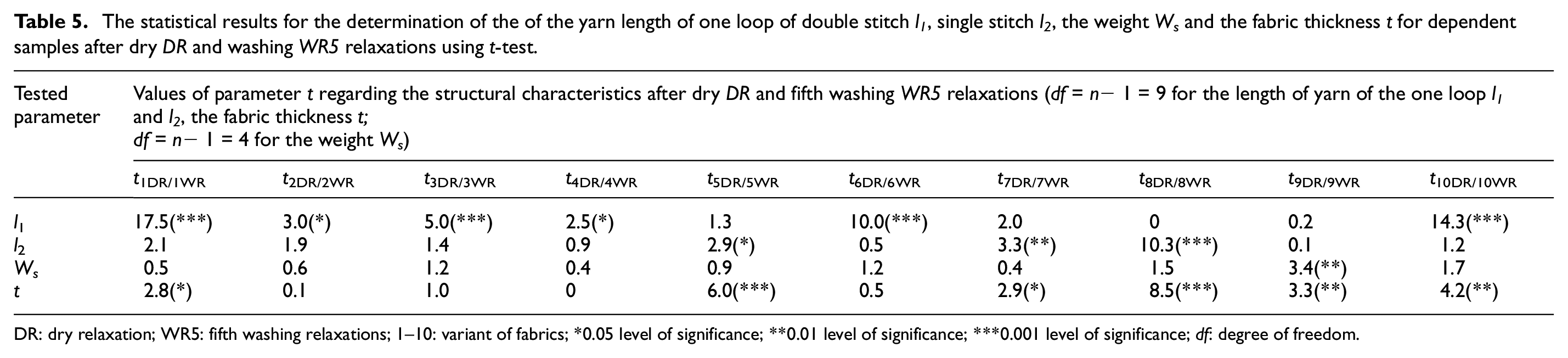
DR: dry relaxation; WR5: fifth washing relaxations; 1–10: variant of fabrics; *0.05 level of significance; **0.01 level of significance; ***0.001 level of significance; df: degree of freedom.
The t-test (Table 4) showed a statistically significant difference between the yarn length of one loop of double stitch l1, single stitch l2, and the fabric thickness t after both dry DR and washing WR5 relaxations for all investigated knitted fabrics, mostly at a significance level of 0.001, except for the thickness t of knitted fabric variant 9 after washing relaxation. However, the weight Ws of the knitted fabrics mostly showed a statistically insignificant difference, which can be explained by differences in the process relaxations for the knitted fabrics with miss stitches with different width repeat Rb.
Based on the statistical analysis of the dependent samples after both dry DR and washing WR5 relaxations (Table 5), it can be concluded that the width of the repeat of the miss stitches Rb has a varying impact on the yarn length of one loop of double stitch l1, single stitch l2, as well as the fabric thickness t of all the investigated knitted fabrics. The statistical results showed that the weight Ws of all investigated fabrics, except for variant 9, had statistically insignificant differences.
Dimensional Change in the Knitted Fabrics After Washing and Dry Relaxation
Modifications in the linear dimensions of textile materials after post-wet treatments are chiefly driven by the composition of their fibers. The shrinkage experienced by knitted fabrics during wet processing is primarily a result of changes in their loop structure. It is worth noting that natural fibers are especially prone to shrinkage due to their substantial moisture absorption capacity and the resultant significant swelling. The study’s outcomes emphasize that the most pronounced dimensional alterations in wool/PAN knitted fabrics happen following the initial two washing cycles. This trend is consistent with the general behavior observed in most knitted fabrics during wet processing.
The previously presented results demonstrated that the knitted fabrics that contain rib set-out and single miss stitches (variants 2–10), exhibit structural differences between the technical face and back. Moreover, they also show different tendencies in dimensional changes after undergoing dry relaxation DR and washing treatments WR. In this section, we focus on the influence of the number of active needles (knit loops) m and inactive needles (miss loops) n, which vary from 1 to 3 in the width repeat of the miss stitches Rb, on the dimensional changes. We compare these results to those obtained from the half Milano rib knitted fabric for dry DR and five washing relaxations WR1–WR5.
Experimental studies of dimensional change after the dry DR and the fifth washing WR5 relaxations show that knitted fabrics experience a shrinkage in length Shl and width Shw. The results of the investigation of the dimensional change DC of the knitted fabrics after the dry DR and the fifth washing WR5 relaxations are presented in Figure 6.
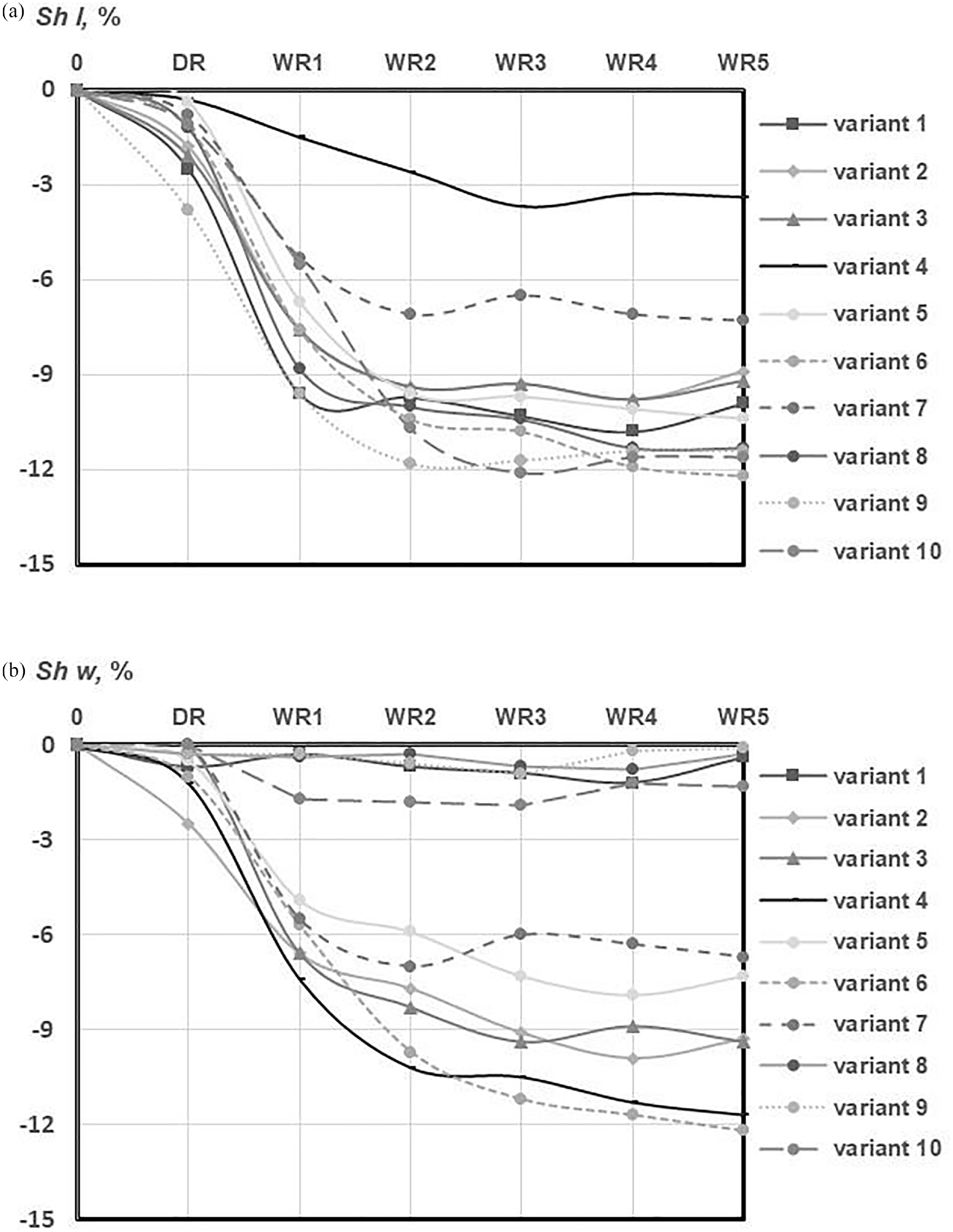
(a) The relations between of the shrinkage in the length Shl and (b) width Shw of the knitted fabrics and type of relaxations.
Figure 7 illustrates the shrinkage in length Shl of knitted fabrics, as well as the shrinkage in width Shw, with varying active needles (knit loops), counts (m = 1, 2 or 3), and a constant number of inactive needles (miss loops) (n = 1, 2, or 3). The fabrics were subjected to dry relaxation DR and five washing cycles WR1–WR5. The measurements were taken after each relaxation cycle.
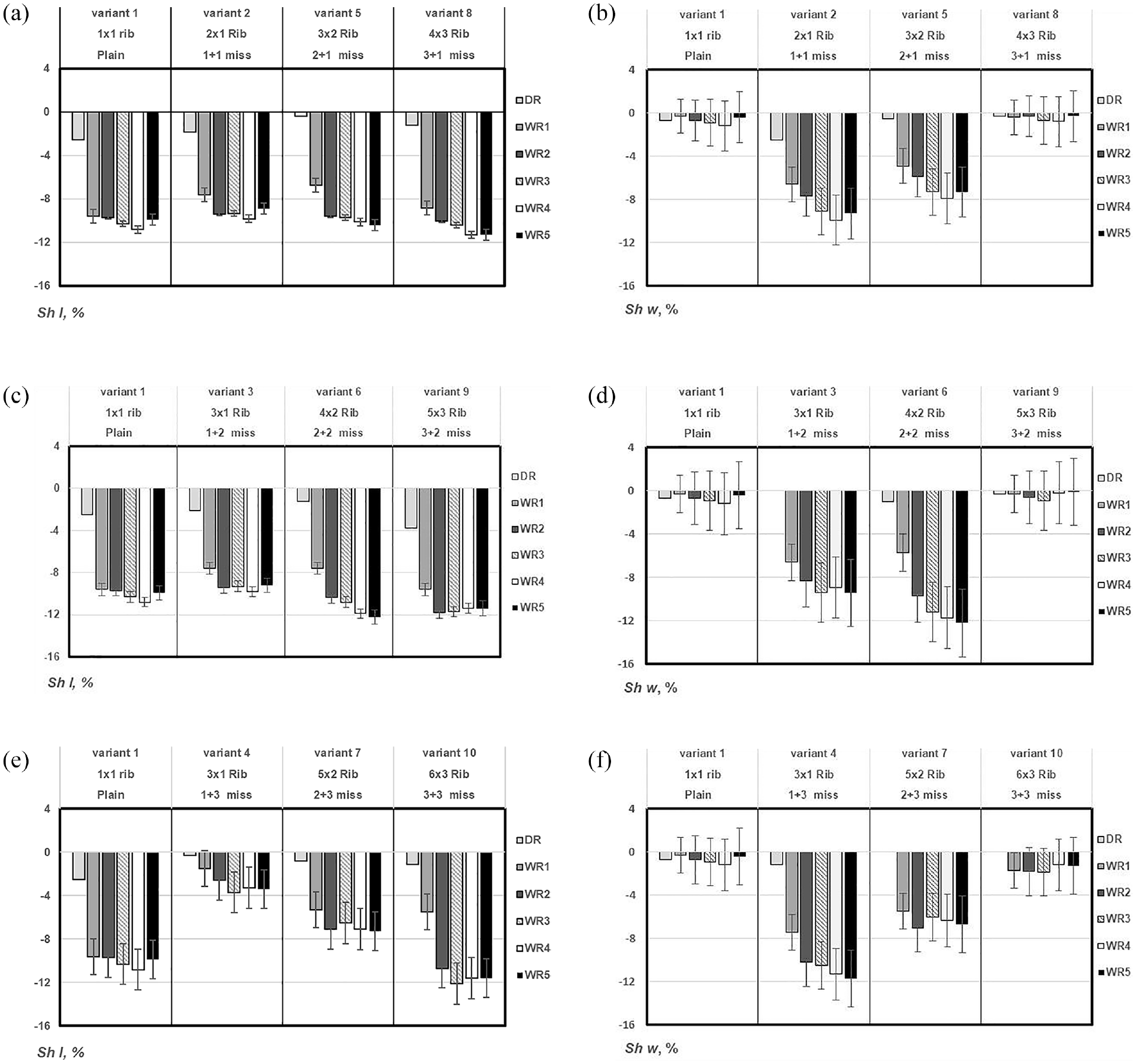
(a, c, e) The shrinkage in the length Shl and (b, d, f) width Shw of the knitted fabrics with varying knit loop counts (m = 1, 2, or 3) and a constant number of miss loops (n = 1, 2, or 3) after dry DR and five washing (WR1, WR2, WR3, WR4, WR5) relaxations.
The analysis of the results of the investigation of dimensional stability due to the dry DR and the five washing WR1–WR5 relaxations (Figures 6 and 7) showed that the dimensional change due to the dry relaxation DR and the fifth washing treatment WR5 in each direction decreases (shrinkage Sh). The shrinkage in the length Shl and width Shw directions of the knitted fabrics (variants 1–10) after the dry relaxation DR decreases. The experimental value of the shrinkage ranges from −0.3 to −3.8% % in length Shl and from −0.0 to −2.5% in width Shw, including the shrinkage of the half Milano rib knit fabrics (variant 1). The shrinkage in the length Shl and width Shw directions of the knitted fabrics (variants 1–10) after the fifth washing relaxations WR5 decreases. According to Figure 6, knitted fabrics tend to shrink significantly in length and width during the first two washing cycles. Although some minor changes in size may occur in subsequent washes, they are usually less noticeable than those observed during the first two washes. Nevertheless, as mentioned in reference, 46 the dimensional stability of knitted wool fabrics may worsen over time, causing a slight increase in shrinkage with each washing cycle. It is worth noting that the primary direction of shrinkage in knitted fabrics is the length direction. However, our investigations revealed different results. In particular, we examined the shrinkage of nine variants of knitted fabrics with miss stitches and half Milano rib fabrics after five washing treatments. We found that the shrinkage in the length direction ranged from 1.5 to 12.1%, while the shrinkage in the width direction ranged from 0.1 to 11.7%. These findings suggest that the shrinkage direction may not always be consistent in knitted fabrics.
Our finding demonstrated that the half Milano rib knitted fabric (variant 1) exhibits a higher shrinkage in the length Shl compared with the shrinkage in the width Shw. Especially, the shrinkage in the length Shl ranges from 9.6 to 10.8 %, while the shrinkage in the width Shw ranges from 0.3 to 1.2%.
According to the findings of the investigation, as mentioned in work, 44 the dimensional change after dry relaxation DR and washing treatments WR is influenced by the structural characteristics of the investigated knitted fabrics. The shrinkage in the length Shl of knitted fabrics with a constant number of inactive needles (miss loops) (n = 1, n = 2, or n = 3) and varying active needles (knit loops) counts m from 1 to 3, increases after each of the five washing treatments, as shown in Figure 7(a, c, e). The greatest increase in shrinkage occurs when the number of inactive needles is n = 3 (Figure 7(e)). When the number of inactive needles is n = 3 and active needles m is either 1 or 2 (variants 8–10), the shrinkage in the length Shl is particularly the same level as that of the half Milano rib knitted fabric (variant 1).
The shrinkage in the width Shw of knitted fabrics decreases with each of the five washing treatments, as shown in Figure 7(b and f). This occurs when the fabrics have a constant number of inactive needles (n = 1 or n = 3) and varying active needles counts m from 1 to 3. The lowest level of shrinkage in the width is observed when the active needle count m is 3, and there are varying inactive needle counts n from 1 to 3. This particular variant of knitted fabrics is similar in shrinkage level to the half Milano rib (variant 1).
The rib set-out repeat variants and the single miss stitches impact fabric shrinkage in both the width and length directions. Shrinkage in the length (Shl) increases as the number of inactive needles (X) rises after the first and fifth washing cycles, as shown in Figure 8(a). Conversely, shrinkage in the width (Shw) decreases as the number of inactive needles (X) increases after the first and fifth washing cycles, as illustrated in Figure 8(b). The fabric experiences a draw-off load throughout the knitting process, causing the knit loops to elongate. However, this elongation decreases during relaxation. When preparing for large-scale production, it is vital to consider these factors when configuring the finishing processes. A comprehensive understanding of the fabric’s behavior during both the knitting and post-production relaxation phases is essential to implement the necessary steps for attaining the intended dimensions and overall quality of the final product.
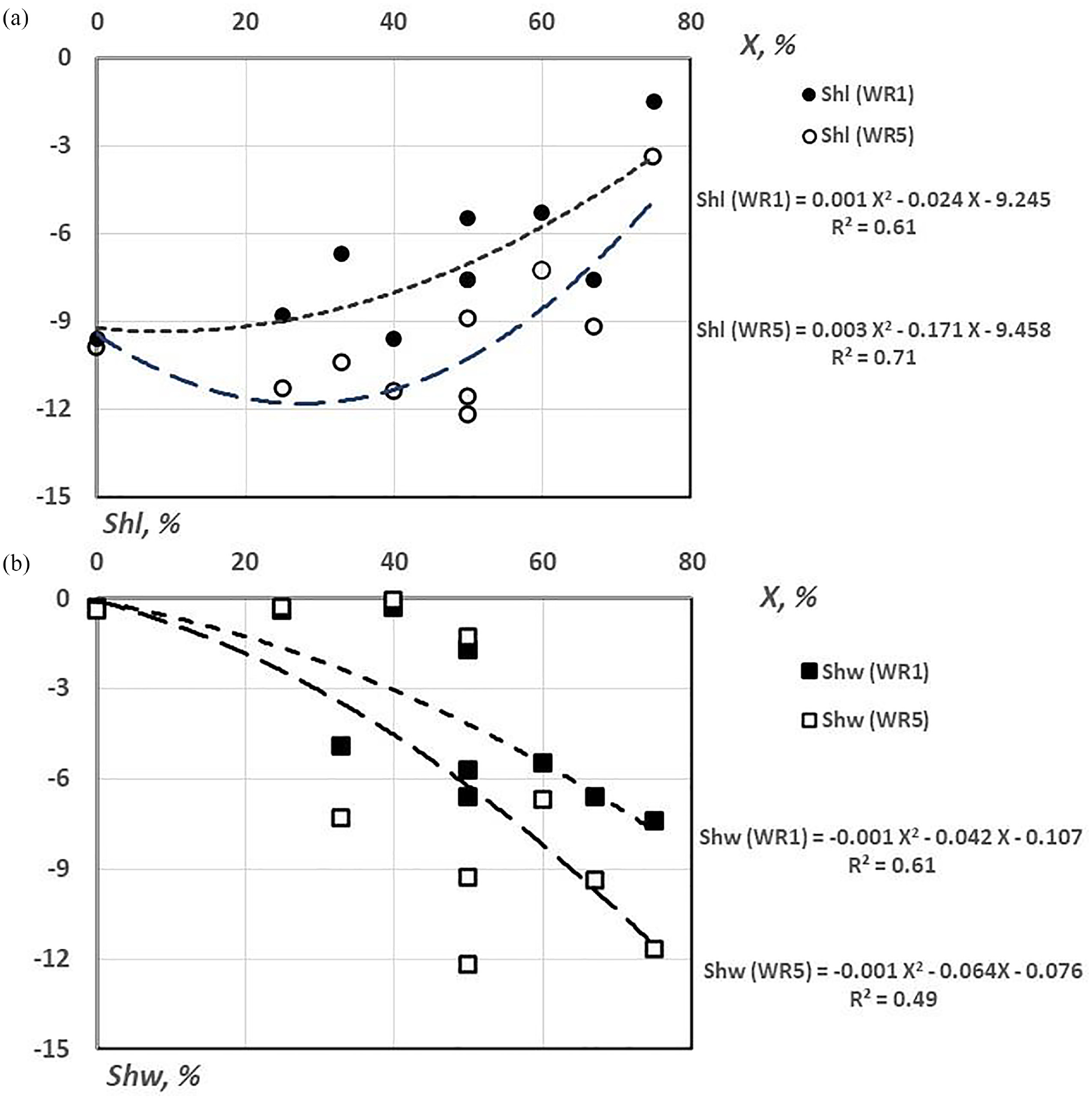
(a) The dependences shrinkage in the length Shl and (b) width Shw on percentage X of miss stitches in repeat of the knitted fabrics.
Conclusion
This study provides valuable contributions to our comprehension of the structural and dimensional properties of double weft-knitted fabrics produced from a 25×2tex×2 wool/PAN yarn, which is created by alternating two courses: rib set-out and single miss stitches. The research specifically delved into examining the impact of varying the rib set-out repeat and single miss stitches by adjusting the number of active (m) and inactive needles (n) on the back bed of a 10-gauge flat-bed knitting machine, ranging from 1 to 3. This investigation yielded significant insights into how the interlooping repeat, notably the percentage of inactive needles on the back bed of the knitting machine (X), influences the fabric’s dimensional stability during five washing cycles and its structural characteristics after undergoing both dry relaxation and washing.
The study aimed to produce nine variants of knitted fabrics with different width repeat of miss stitches Rb, using a 60% wool and 40% PAN blended yarn from the 25×2tex×2. Before knitting, the yarn was treated with waxing. A half Milano rib fabric was produced under the same knitting parameters using a 10-gauge flat bed-knitting machine. The structural characteristics and dimensional changes of the double knitted fabrics with rib set-out repeat variants and single miss stitches were compared with those of the half Milano rib knitted fabric after dry relaxation DR and five washing treatments WR1–WR5. Upon analyzing the research results, the following conclusions were drawn:
The structural characteristics and dimensional change after the dry DR and the fifth washing WR5 relaxations depend more on the stitch width repeat Rb, but less on the number of washing cycles (about ±5%).
The number of wales Wf and courses Cf per centimeter for the technical face of the miss knit structures (variants 2–10) is higher than that of the half Milano rib knitted fabric (variant 1). The number of wales for the technical back Wb of miss knitted fabrics (variants 2–10) is less than that of the half Milano rib knitted fabric (variant 1). The number of courses for the technical back Cb of miss knitted fabrics (variants 2–10) has a different tendency than that of the half Milano rib knitted fabric (variant 1). It can be explained by the differences between the structure of the technical face (which only has knit loops of the double rib structure) and the technical back (which has knit loops of the double and single structures).
The number of wales per centimeter and the number of courses on the technical face are significantly influenced by the percentage of inactive needles (X) within the width repeat (Rb) and remain consistent regardless of the fabric’s condition. As the percentage of inactive needles (X) increases, there is a 6.6% increase in the number of wales and a 49.6% increase in the number of courses per centimeter on the technical face (Wf and Cf). This trend holds true irrespective of the relaxation method used, be it dry or wash, and can be attributed to the fabric’s inherent structure and differences in yarn redistribution between loops of both yarn feeds.
The width repeat Rb of the miss stitches influences the length of yarn in one loop of the double l1 and single l2 stitches. The average length of the loop of miss knitted fabrics la is higher than that of half Milano rib knitted fabric (variant 1).
The weight of the miss knitted fabrics Ws (variants 2–10) depends on the fabric density for the technical face Sf and back Sb. The type of relaxations and the number of washing relaxations have a less significant impact on the weight of knitted fabrics Ws.
The fabric thickness t of the miss knitted fabrics (variants 2–10) particularly doesn’t depend on the type of relaxations. The thickness t of miss knitted fabrics (variants 2–10) is higher than that of the half Milano rib knitted fabric (variant 1).
The analysis of the experimental results after the dry relaxation DR and the fifth washing treatments WR5 showed that the dimensional change due to the relaxations in each direction (height and width) of all tested knitted fabrics obtained from the same blended wool yarn decreases.
The primary observations following five washing cycles reveal that all versions of the knitted fabrics experience both shrinkage in length and width. Notably, the rib set-out and single miss stitches significantly influence shrinkage in both directions (length and width). Shrinkage in the length direction grows in proportion to the rise in the percentage of inactive needles. In contrast, shrinkage in the width diminishes as the number of inactive needles in the width repeat increases. Fabric manufacturers can leverage these insights to enhance their finishing processes, anticipate shrinkage, and gain better control over the final fabric dimensions after washing.
This study presents numerous valuable insights that can prove highly advantageous for engineers and designers within the knitwear industry who work with knitted fabrics. By equipping them with informed decision-making tools, this research empowers them to choose the ideal parameters for crafting knitted fabrics with precisely tailored properties. Sharing these findings with engineers and designers is poised to drive advancements within the industry, fostering innovation and heightened efficiency in the production of knitted fabrics. Through a comprehensive grasp of the characteristics of dropped stitch knitted fabrics, manufacturers can substantially enhance their capacity to offer comprehensive care instructions for their products, thus ensuring superior quality and increased customer satisfaction.
Supplemental Material
sj-docx-1-aat-10.1177_24723444241237314 – Supplemental material for The Impact of Miss Stitch on the Dimensional Properties and Stability of Double Weft Knitted Fabrics after Dry and Washing Relaxations
Supplemental material, sj-docx-1-aat-10.1177_24723444241237314 for The Impact of Miss Stitch on the Dimensional Properties and Stability of Double Weft Knitted Fabrics after Dry and Washing Relaxations by Nadiia P. Bukhonka in AATCC Journal of Research
Footnotes
Declaration of conflicting interests
The author declared no potential conflicts of interest with respect to the research, authorship, and/or publication of this article.
Funding
The author received no financial support for the research, authorship, and/or publication of this article.

Supplemental material
Supplemental material for this article is available online.
References
Supplementary Material
Please find the following supplemental material available below.
For Open Access articles published under a Creative Commons License, all supplemental material carries the same license as the article it is associated with.
For non-Open Access articles published, all supplemental material carries a non-exclusive license, and permission requests for re-use of supplemental material or any part of supplemental material shall be sent directly to the copyright owner as specified in the copyright notice associated with the article.
