



Abstract
This paper investigated the washability and comfort properties of a kind of electromagnetic interference shielding material (Meftex10) with and without the parylene C coating. Parylene C can form a uniform protective film on the fabric and improve different properties of the fabric. In this paper, it will be used to improve the washability of electromagnetic interference shielding material. Through a large number of experiments, it can be determined that the parylene C coated samples have a significant improvement in washability compared to the uncoated samples. When the sample’s parylene C coating content arrives at 33.4 g/m², its electromagnetic shielding effectiveness still remains around 65% after 10 times washing cycles. Conversely, as the content of the parylene C coating increases, the air permeability of the samples as well as the water vapor permeability will decrease. The reason is that the parylene C coating closes some of the pores, which affects air and water vapor transport through the material. In addition to this, it can be concluded that the thermal conductivities of samples increase with increasing parylene C coating contents. The above phenomenon is caused by the following two aspects: The parylene C coating material will reduce the spaces between the fibers and yarns by partially filling the pores, leading to less still air inside and the fabric has a greater capacity for heat transfer; Parylene C has a higher thermal conductivity than the electromagnetic interference shielding material (Meftex10).
Keywords
Introduction
In recent years, with the continuous development of science and technology, electronic products have appeared in our life and work all the time. The radiation waves generated by these electronic products refer to electromagnetic radiation in the narrow sense, and the wavelengths of these radiation waves are usually in the part below infrared. 1 As researchers continue to explore in depth, they have found that while electromagnetic waves provide us convenience, they also pose a potential threat to our bodies. 2 Electromagnetic radiation pollution is the fourth major environmental pollution after air pollution, water pollution, and noise pollution. 3 The United Nations Conference on the Human Environment has included it as one of the major pollutants that must be controlled. 4
More and more research on shielding electromagnetic radiation has been carried out now. There are also many electromagnetic shielding products available on the market, which are widely used in home electronics, network hardware, medical instruments, aerospace, and defense fields. 5 However, electromagnetic shielding textile materials are mostly used for protective clothing for pregnant women or staff in specialized areas. Although these protective products cannot guarantee 100% elimination of electromagnetic radiation hazards, they can still provide the maximum degree of protection for people’s health in their daily lives and at work. 6 At present, there are a large number of specialists on how to improve the electromagnetic shielding effect of materials and expand the types of electromagnetic interference shielding materials to make the corresponding research, which is also to meet the new modern materials with low-cost, non-polluting, good performance characteristics.7–10 For electromagnetic shielding textile materials, there are also a number of specialists who have studied the comfort performance associated with them.11–14 However, few researchers have studied its washability and how to improve the washability of this material. 15 Therefore, the focus of this paper is to investigate a method to improve the washability of electromagnetic shielding textile materials and also to study its effect on the related comfort properties of materials.
An ultra-thin polyester nonwoven fabric with copper/nickel-coated was used in this paper and tested for related comfort properties, including air permeability, water vapor permeability, and thermal properties. These samples are then subjected to a parylene deposition process, where the fabric surface is coated with a thin protective layer as a washability treatment. Parylene is a protective polymer material that is the generic name for a unique family of poly-p-xylylene polymers. 16 It generally uses a vacuum vapor deposition process to form protective films that are uniform in thickness, transparent, stress-free, excellent electrical insulation, and have protective properties. 17 The next step will be to test the samples with the parylene coating for washability by conducting the machine wash test. After ensuring the validity of the parylene coating process, the coated samples will be tested again for related comfort properties. Finally, through the comparison of the above two groups of related comfort experimental results, the difference in the comfort performance of this electromagnetic shielding textile material before and after washability treatment can be obtained.
Materials and methods
Materials
Greige fabric
Meftex10 is an ultra-thin polyester nonwoven with copper and nickel plating from the Czech Republic company “Bochemie” as the greige fabric in this experiment. 18 This material provides the electromagnetic shielding function while maintaining the textile’s original properties of softness, breathability, antimicrobial, and corrosion resistance. It is mainly due to the patented technology for the chemical deposition of metals on the surface of textile materials and the additional surface finishing of fabrics. 19 Based on the material properties given above, it is suitable for application in apparel. In particular, it can be applied to sandwich materials as the middle layer used in winter clothing. 20 However, it has an obvious technical drawback that the electromagnetic shielding effectiveness of the material is significantly reduced after washing. Figure 1 shows the appearance of Meftex10 and the scanning electron microscope (SEM) picture of Meftex10, and the basic information of Meftex 10 refer to Table 1.

The appearance of Meftex10 (a) and SEM of Meftex10 (b).
Basic information of samples.

Greige fabric with parylene C coating
Parylene is a molecular-level coating material developed by Union Carbide Corporation in the mid-1960s. 21 It is the generic name for a unique family of poly-p-xylene polymers, which are also protective polymers. Parylene uses a vacuum vapor deposition process to form a uniform protective film with no micropores, no defects, excellent electrical insulation, and chemical inactivity. 22 Parylene materials can be divided into different types according to their molecular structure: N type, C type, D type, HT type, and so on. Each type of material has different characteristics due to its different structures, the most suitable type of parylene can be selected according to the specific needs. 23 C-type parylene was chosen in this paper, mainly because this type of material has a faster growth rate of deposition and is very environmentally friendly.24–27 In this paper, the “SCS Parylene Deposition System 2010” (CEITEC, Brno, Czech Republic) and the vacuum deposition technique was used for Meftex10. Samples were made into sizes of 13 cm × 13 cm, matching the sample holder’s dimensions in SCS Parylene Deposition System 2010. The sample was put on a homemade paper supporting frame for a complete and uniform coating after placing it for 24 h at room temperature ambient. Figure 2(a) displays the parylene deposition process on samples in the instrument. The solid powder is first vaporized and then pyrolyzed at high temperatures. And it will polymerize in the deposition chamber at room temperature to form a polymer that is deposited on the sample to be protected, thus forming a protective film.28,29 In addition, this paper also selected different parylene C contents for deposition, including 5 g (Meftex10-5), 10 g (Meftex10-10), and 15 g (Meftex10-15). Based on the working principle of this instrument, when 5 g of parylene C is added to it, it cannot be completely deposited on the sample. From Tables 1 and 2, detailed information on parylene C coating samples and parylene C coating content are observed. The SEM picture of Meftex10 with different parylene C coatings refers to Figure 2(b).
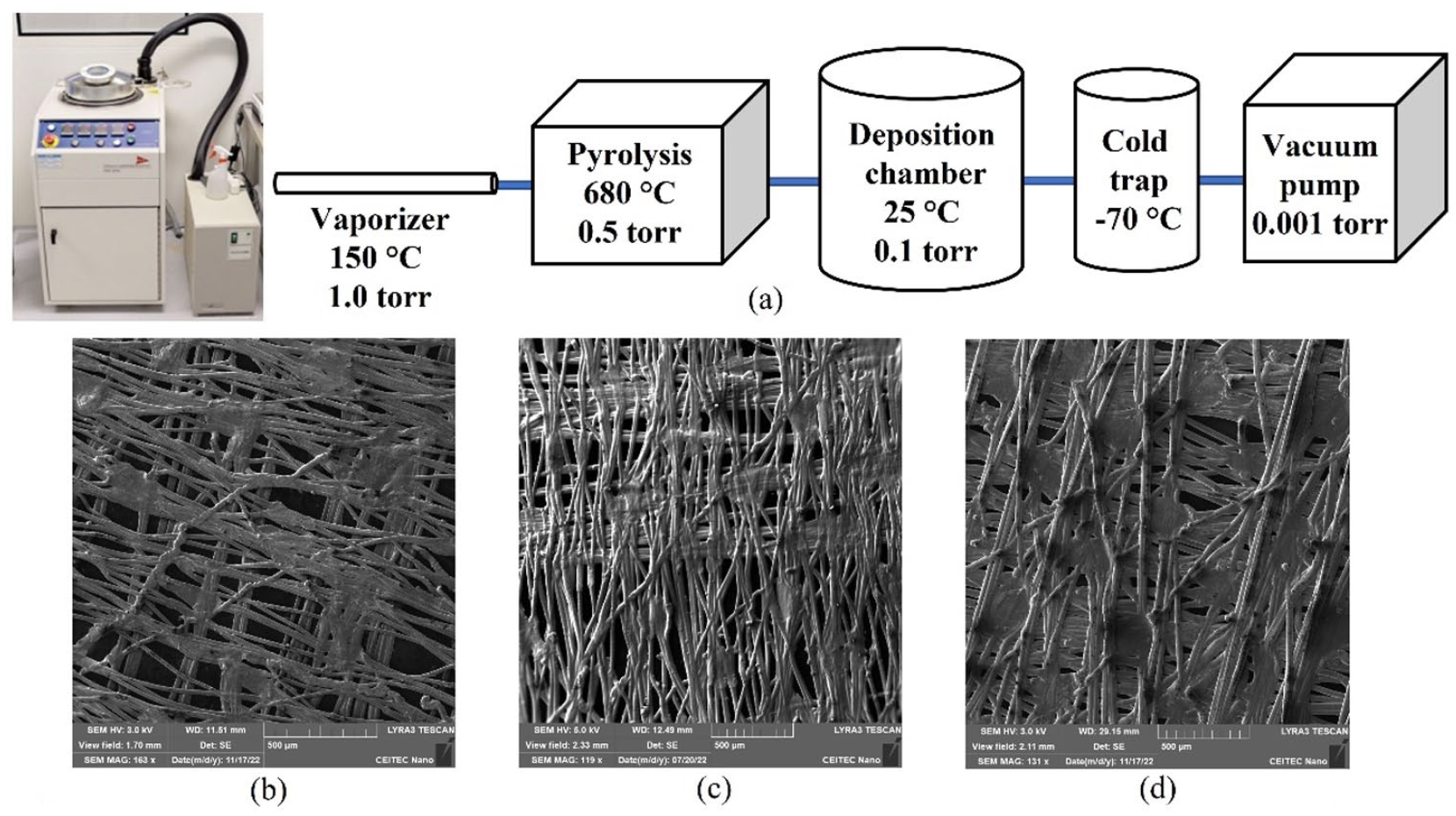
SCS parylene deposition system (a) and SEM of Meftex10-5 (b), Meftex10-10 (c), Meftex10-15 (d).
Basic information of parylene C coating.

Methods
Fabric physical properties
The thickness of the sample was tested by Schmidt thickness gage D-200 (Hans Schmidt & Co GmbH, Germany) and the standard for the test is EN ISO 5084 30 in this article. In the implementation of the measurement process, the measure of the distance between the upper and lower surfaces of the fabric measured at a pressure of 1.0 kPa is called the fabric thickness (mm). 31 The fabric sample was measured five times under the same conditions in different places, and the average value was calculated as the result of thickness. Areal weight is a vital specification parameter indicator of the fabric, usually expressed in mass per unit area of fabric. 32 The fabric areal weight calculation is mainly based on the ISO 3801 standard, 33 including the measurement of the length, width, and mass of the fabric sample. In this article, the sample size was 13 cm × 13 cm and the mass of the fabric sample was tested by the balance from Sartorius Lab Instruments GmbH & Co. KG (Göttingen, Germany).
Optical porosity
Porosity refers to the ratio of the pore volume to the total volume, it is a measure of the size of the pore volume index. The value of the porosity is affected by the fabric structure, which directly affects the fabric’s air permeability, water vapor permeability, and other transport properties. 34 In this paper, the optical porosity of fabric samples will be measured by Nikon Eclipse E200 optical microscopy and image analysis software NIS-elements 5.1. Images of samples were recorded by optical microscopy as RGB image matrices with sizes 1200 × 1600 pixel. Then the image analysis software processes and analyzes the image taken by the optical microscope, and gives the pore area of the observation part and the area of the observation part. Finally, a percentage value is obtained by calculating the ratio of them, which is the optical porosity of the sample.
Washing test
Samples were subjected to machine washing tests using a washing machine (Miele Professional Maintenance System, Germany) in accordance with the ISO-6330 standard, 35 using 20 ± g standard detergent for each cycle. The ISO-6330 requirement and the sample’s characteristics led to the selection of washing procedure No.3G (30 ± 3℃, 13 min). Samples were placed in a bag of protection. Washing (3 min), rinsing (8 min), spin-drying (2 min), and room-temperature drying (4 h) were all steps in one washing cycle. 36
Electromagnetic shielding effectiveness
The basic principle of electromagnetic shielding material is mainly based on wave reflection, wave absorption, and multiple reflections of electromagnetic waves in the material, resulting in the attenuation of electromagnetic wave energy. 37 At present, there are three test methods of electromagnetic shielding effectiveness: the far-field method, the near-field method, and the shielding room test method.38,39 The test method used in this paper belongs to the far-field method. According to the ASTM D4935-10 test standard, 40 fabric samples were tested from 30 MHz to 3 GHz by different waves. The test apparatus consisted of a network analyzer and sample holder from Rohde & Schwarz company (München, Germany), and the measurement standard was used to calculate the electromagnetic shielding effectiveness of the samples by the insertion loss method. 41 The same fabric sample was measured five times under the same conditions in different places, and the average value was calculated as the result of electromagnetic shielding effectiveness.
Air permeability
The air permeability of fabric refers to the volume of air flowing through the unit area of fabric per unit of time under a certain pressure difference. Air passes through the fabric mainly in two ways: through the pores between the yarns and through the pores between the fibers. Air through the pores between the yarns is the main way of the whole transmission system, its transmission process is very complex and plays an important role in the comfort of the fabric. 42 The air permeability of the fabric samples was characterized according to the ISO 9237 test standard, 43 and the FX3300 air permeability meter (TEXTEST AG, Switzerland) was used as the test instrument. The pressure difference of the testing instrument is 200 Pa, the size of the test sample is 13 cm × 13 cm, and the test duration for each sample is 10 s. The test specimen was clamped above an apparatus air inlet with a clamp. The pump was used to draw air through it, and then the flowmeter was used to gage the airflow. Five measurements are performed at different locations of the same sample, and the average value is calculated as the result of the sample’s air permeability.
Water vapor permeability
Water vapor permeability refers to the fabric’s ability to adsorb and diffuse water vapor and is one of the indicators of the body’s ability to maintain the thermal balance between heat production and heat dissipation when the body loses heat and sweat. 44 In this paper, the water vapor permeability of fabric samples was characterized according to the ISO 11092 test standard, 45 and the test apparatus was Permetest (Sensora Instruments & Consulting, Czech Republic). The test sample size was 13 cm × 13 cm, and the test conditions should be set at approximately 20°C and 35% relative humidity. During the measurements, the fabric samples were exposed to a parallel airflow of 1 m/s and placed on a heated porous plate with a water vapor permeable membrane. 46 After 2–4 min of machine operation, the relative water vapor permeability and water vapor resistance were shown on the digital indicator. Five measurements are taken at different points of the same sample, and the average value is taken as the result of the sample’s water vapor permeability. With a higher water vapor permeability or a lower water vapor resistance, the fabrics will perform better and feel more comfortably. Relative water vapor permeability is not according to the international standard, but it is a practical parameter. 47
Thermal conductivity and resistance
The heat transfer performance of the fabric is one of the most critical factors related to its comfort performance. 48 Alambeta device (Sensora Instruments & Consulting, Czech Republic) will be chosen as the measurement instrument in this paper. Thermal conductivity and thermal resistance will be chosen to characterize the heat transfer properties of the fabric sample. The principle of this device is the mathematical evaluation of the time process by which heat flows through the samples under test using the different temperatures between the bottom measurement plate and the top measurement plate. 49 The pressure between the two measuring plates is 200 Pa, the sample size should be larger than 12 cm × 12 cm, and the thickness of the samples should be between 0.5 and 10 mm. The ambient temperature is around 22°C, and the relative humidity is about 40% for measurement. During the measurement, the sample is placed on the bottom measuring plate (22°C). When the measurement starts, the top measuring plate (32°C) descends and touches the sample to be tested. The computer of the equipment will record the heat flow change of the sample and solve it with the transient temperature field of the thin plate under different boundary conditions. When the machine reached thermal equilibrium, the thermal conductivity and thermal resistance were displayed on the digital indicator. The fabric samples were measured five times under the same conditions at different points, and the average value was calculated as the result of thermal conductivity or thermal resistance. 50
Thermal insulation degree and emissivity
Thermal insulation degree is an index of heat performance properties. The test method is shown in Figure 3, and it is divided into thermal insulation by heat conduction and heat radiation. The room temperature (Ta) should be recorded at the beginning of the measurement, and the surface temperature of the thermostat (Tp) was fixed at around 40°C. The tested samples were 0 mm (for heat conduction) and 5 mm (for heat radiation) away from the thermostat, and the temperature of the sample (Tf) was measured by the FLIR camera when it was stable. In this experiment, the distance between the FLIR camera and the test sample was 1 m. And the testing process was carried out in the confined space under the same temperature and humidity. The thermal insulation (Ir) is calculated by equation (1):


Schematic diagram of thermal insulation test by heat conduction (a) and heat radiation (b).
The value of thermal insulation is between 0 and 1. When the value of thermal insulation is equal to 0, it means that the heat will be completely lost through the fabric sample. Conversely, if the heat totally cannot penetrate the fabric sample, the value of thermal insulation is equal to 1. 51
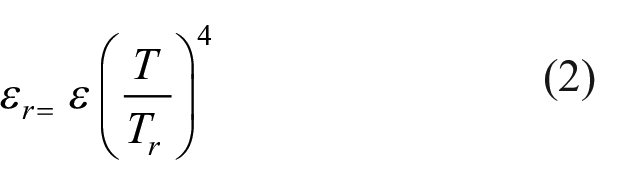
Since an infrared detector (FLIR camera) is used to measure the sample surface temperature, the emissivity of the sample surface must be measured. The emissivity of a material’s surface is its efficiency at emitting energy in the form of thermal radiation. The electromagnetic radiation produced by the thermal motion of particles in matter is called thermal radiation. All substances with a temperature higher than absolute zero emit thermal radiation. 52 As shown in Figure 4, the whole set of equipment for testing emissivity is mainly divided into four parts. The first part is a thermostat, which can be adjusted to the temperature required for a test. In this experiment, the temperature was set to 40° and the sample was placed on it. The second part is a temperature sensor, which is connected to the sample surface on one side and the computer on the other side. It can transfer the actual temperature of the sample surface (Tr) to the computer. The third part is an infrared detector, and its emissivity (ε) was set to 0.95 during measurement in this experiment. The distance between the infrared detector and the test sample was half a meter. It was connected to the computer also, and the measured temperature (T) was transmitted to the computer. The fourth part is the computer, where the software calculates according to the Stefan-Boltzmann law and gets the emissivity of the sample. And all testing process was carried out in the confined space under the same temperature and humidity. The sample’s real emissivity (εr) is calculated according to Stefan-Boltzmann’s law (2):

Schematic diagram of emissivity test.
Results and discussion
Fabric physical properties and optical porosity
From Tables 1 and 2, the basic information of the samples that with and without parylene C coating can be seen. In this article, Meftex10 will be coated with different weights of parylene C, including 5, 10, and 15 g. But these weights refer to the weight of the parylene C placement in the SCS Parylene Deposition System. The actual weights of the parylene C coating on Meftex10 can be found in Table 2 and are 0.192, 0.445, and 0.565 g, respectively. The original material “Meftex 10” has the lightest areal weight of 11.8 g/m2, the thinnest thickness of 0.0418 mm, and the largest optical porosity of 33.71% in all samples. As the content of parylene C coating increases, it can be seen that the areal weight and thickness of samples Meftex10-5, Meftex10-10, and Meftex10-15 show an increasing trend. Their areal densities are 23.1, 38.1, and 45.2 g/m2. And their thicknesses are 0.0708, 0.0916, and 0.1218 mm, respectively. On the contrary, as the content of the parylene C coating increases, the optical porosity of the samples shows a significant decreasing trend. Their optical porosities are 25.32%, 19.39%, and 16.26%, respectively. The main reason why the optical porosity tends to decrease may be that as the amount of parylene C coating on the fabric surface increases, more and more parylene molecules cover the surface pores.
Electromagnetic shielding effectiveness
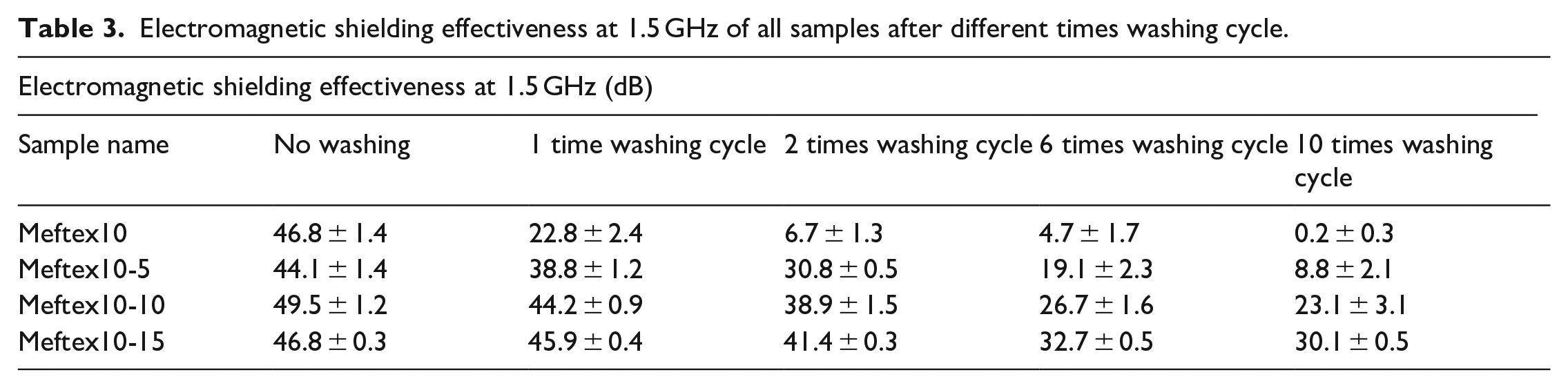
The average value at 1.5 GHz is compared in this paper to evaluate the electromagnetic interference shielding effectiveness of various samples. Because some researchers did extensive research on the frequency of electromagnetic radiation generated by various radio signals, the results indicate that 1.5 GHz is the most commonly exposed frequency in human life and work. 53 The data for all samples’ electromagnetic shielding effectiveness at 1.5 GHz after different times of washing cycles are presented in Table 3. For the sample Meftex10, its electromagnetic shielding effectiveness dropped directly from 46.8 to 0.2 dB after 10 times washing cycles. This set of data fully demonstrates the poor washability of this kind of electromagnetic interference shielding material. The electromagnetic shielding performance of the samples was not affected after parylene C coating, which can be confirmed by the no washing cycle data in Table 3. Their electromagnetic shielding effectiveness is still above 40 dB, but there is a big difference in the effect after washing cycles. The sample Meftex10-5 has the same situation as the sample Meftex10, and the electromagnetic shielding effectiveness is directly reduced to 8.8 dB after 10 times washing cycles, which shows that the parylene C coating given by 5 g is not enough to improve its washability. Relatively speaking, sample Meftex10-10 and sample Meftex10-15 showed better performance in washability. After 10 times washing cycles, the electromagnetic shielding effectiveness of sample Meftex10-10 decreased to 23.1 dB, while that of sample Meftex10-15 only decreased to 30.1 dB. From the above sets of data, it can be concluded that the washability is significantly improved after parylene C coating, and the sample Meftex10-15 shows the best effect. In addition, we can get the same conclusion from the information from Figures 5 to 8. By observing these figures, it can be found that the coating material on the fiber surface of sample Meftex10 is heavily shed and contains many cracks (refer to red rectangle parts) after 10 washing cycles. As the parylene C coating content increased, fewer cracks appeared on the fiber surface, and less coating material came off after the samples were washed. This phenomenon was particularly evident in sample Meftex10-15. This also confirms, from another point of view, that the washability of the samples is significantly improved by the addition of the parylene C coating.
Electromagnetic shielding effectiveness at 1.5 GHz of all samples after different times washing cycle.

SEM pictures of sample Meftex10 before and after washing.

SEM pictures of sample Meftex10-5 before and after washing.

SEM pictures of sample Meftex10-10 before and after washing.
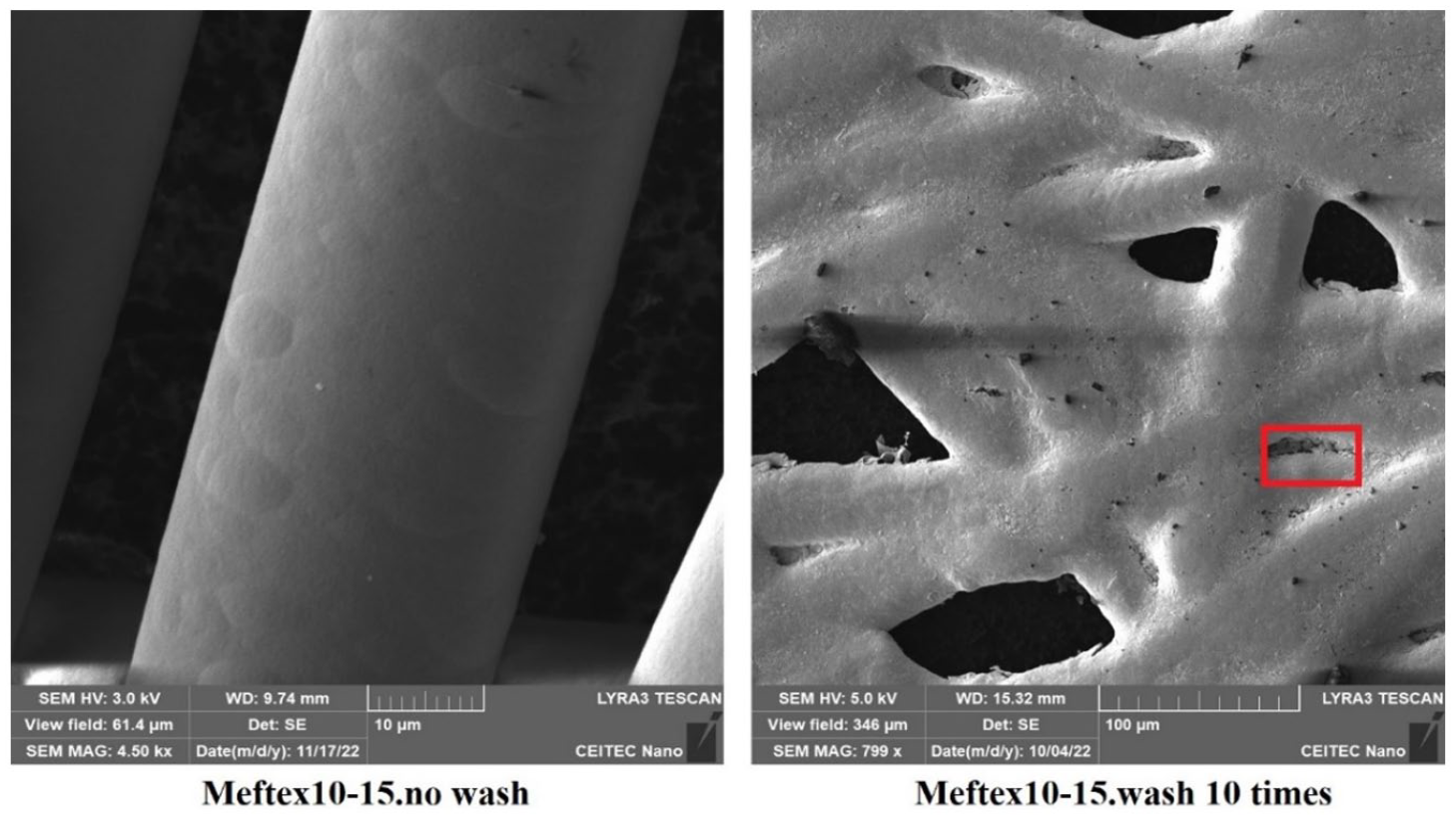
SEM pictures of sample Meftex10-15 before and after washing.
Air permeability
Meftex10 is a very breathable material, and it can be seen from Figure 9 that its air permeability value can reach more than 6036 L/m2/s. As the content of the parylene C coating increases, more and more of the parylene molecules are coated on the fabric. Therefore, the fibers may become slightly thicker, the areal weight increases, and the optical porosity decrease. Table 1 and Figure 10 can demonstrate this. So, the resistance of gas passing through the fabric increases, and the air permeability of the fabric decreases. The three samples all showed the phenomenon that the air permeability decreased with the increase of the parylene C coating content. Especially samples Meftex10-10 and Meftex10-15 showed a huge downward trend; they dropped from 6036 to 2068 L/m2/s and 1522 L/m2/s, respectively. Although air permeability has dropped a lot, it is still satisfactory for technical clothing applications.

Air permeability of samples.

Relationship between areal weight of parylene C coating (a), optical porosity (b) and air permeability.
Water vapor permeability
Water vapor permeability, that is, the transfer speed of water vapor in the fabric, depends on the sum of the water vapor transfer speed through the pores between fibers and yarns and the water vapor transfer speed inside the fibers. 54 It can be seen from Figure 11 that the changing trend of the water vapor permeability of the fabric after the parylene C coating is very close to the air permeability’s changing trend. Following the increase in the content of parylene C coating, the value of relative water vapor permeability decreases and the value of water vapor resistance increases (refer to Figure 12(a) and Figure 13(a)). However, it can be seen from the two sets of data that the magnitude of the change in water vapor permeability is relatively low. Meftex 10, which has the highest relative water vapor permeability and the lowest water vapor resistance, is 97.9% and 0.13 Pa/m2/W. However, sample Meftex10-15 has the lowest relative water vapor permeability and the highest water vapor resistance. The values are 75.6% and 3.53 Pa/m2/W, respectively. The main reason for this phenomenon is that the increase in the amount of parylene C coating reduces the optical porosity of the samples, resulting in a decrease in water vapor permeability (refer to Figure 12 and Figure 13).

Relative water vapor permeability (a) and water vapor resistance (b) of samples.

Relationship between areal weight of parylene C coating (a), optical porosity (b) and relative water vapor permeability.

Relationship between areal weight of parylene C coating (a) optical porosity (b) and water vapor resistance.
Thermal properties
Thermal comfort is an inherent sense of equilibrium generated by the interaction of the three elements of the human body, clothing, and the external environment. This feeling can not only maintain the stability and balance of human body temperature, but also ensure the free movement of the human body and promote the good operation of various physiological functions. 55 Therefore, the thermal performance of the taking material is an important indicator to evaluate its comfort performance. 56 In this paper, the thermal conductivity and thermal resistance of samples are shown in Table 4. The thermal conductivities of samples Meftex10, Meftex10-5, Meftex10-10, and Meftex10-15 are 0.035, 0.083, 0.104, and 0.125 W/m·K. From the above data, it can be seen that the thermal conductivities of the samples with parylene C coating are higher than that of the sample without parylene C coating. This result can also be confirmed by Figure 14, where the thermal conductivities increase with increasing parylene C coating contents. The following two factors are considered for the above phenomenon: One is that both fabrics and polymers are easy to conduct heat, and the only thing that hinders heat transfer is the air inside the fabric. After the surface coating, the surface of the material is covered with parylene molecules which partially fill the pores and reduce the gaps between fibers and between yarns. Thereby reducing the still air content inside the fabric, making the heat transfer capacity of the fabric rise. 57 Another one is that the thermal conductivity of the parylene C (0.082 W/m·K) 58 is much higher than Meftex10s (0.035 W/m·K), which causes the parylene C coated samples to perform higher thermal conductivity than the original ones. Besides, their thermal resistances are 0.0012, 0.00086, 0.00088, and 0.00098 K·m2/W, respectively. Since the thermal conductivity of the sample with parylene C coating is greatly improved compared with that of the sample Meftex10, their thermal resistances will be lower than those of the sample Meftex10. But for the samples with parylene C coating, the thickness of the sample increased with the content of parylene C coating. Based on the dual effects of thermal conductivity and thickness, the thermal resistance of parylene C coating samples increases with the increase in parylene C coating content.
Thermal conductivity, thermal resistance, and emissivity of samples.


Relationship between areal weight of parylene C coating and thermal conductivity.
Thermal insulation degrees by conduction and radiation are shown in Figure 15. In both cases, the thermal insulation degree of sample Meftex10 is the highest. This indicates that Meftex10 is the least capable of transferring heat but the most capable of blocking it. Except for sample Meftex10, with the increase in thermal conductivity and thickness, the other samples’ thermal insulation degree by heat conduction and heat radiation increases accordingly. This means that the ability of the samples to transfer heat is decreased, while the ability to block heat is increased. In addition to that, the thermal insulation degree of thermal radiation is generally higher than that of thermal conduction. It is due to the addition of an air layer of 5 mm in thermal radiation between the samples and the thermostat, which directly leads to an improvement in thermal insulation. In this case, the samples with parylene C coating are more suitable to be used as technical clothing during the summer season. If this material is used in winter, its thermal insulation is reduced compared to the original material.
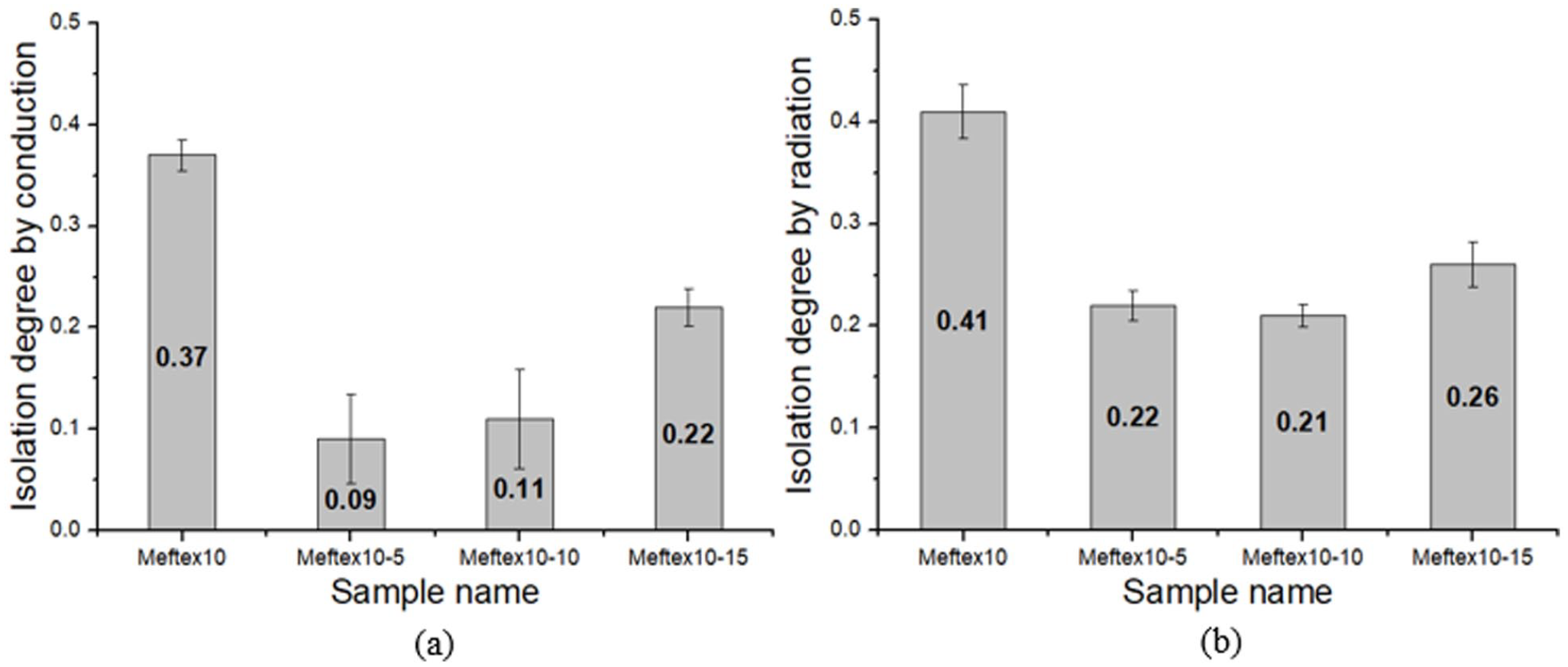
Thermal insulation degree by conduction (a) and radiation (b) of samples.
Conclusions
This paper evaluated and compared the washability and comfortable properties of a kind of electromagnetic interference shielding material (Meftex10) with and without parylene C coating. As the parylene C coating content increased, the washability of the parylene C coated samples also increased. Especially for the sample Meftex10-15, after 10 times of washing cycles and its electromagnetic shielding effectiveness still remains around 65%. This series of data fully demonstrates that the parylene C coating is significant for improving the washability of materials. For the air permeability and water vapor permeability, both of them decrease after parylene C coating. All samples show the phenomenon that the air permeability and water vapor permeability decreased with the increase of the parylene C coating content. The reason is that the coating layer closed part of the pores, which led to a decrease in optical porosity and also affected the transfer of air as well as water vapor. Meftex10 itself has excellent air permeability and water vapor permeability, even if the performance of these two aspects is reduced after parylene C coating and it still meets the comfort requirements of technical clothing.
In addition to this, it can be concluded that the thermal conductivities of samples increase with increasing parylene C coating contents. Firstly, the parylene C coating material will partially fill the pores and reduce the gaps between the fibers and yarns. This reduces the amount of static air inside the fabric and increases the heat transfer capacity of the fabric. Secondly, the thermal conductivity of parylene C is much higher than the thermal conductivity of Meftex10. The samples with parylene C coating are more suitable to be used as technical clothing during the summer season in this case. Taking into account the combined effect of thermal conductivity as well as thickness, the parylene C coated samples show an increased trend in thermal resistance as well as thermal insulation degree, following the parylene C coating content increases.
Footnotes
Declaration of Conflicting Interests
The author(s) declared no potential conflicts of interest with respect to the research, authorship, and/or publication of this article.
Funding
The author(s) disclosed receipt of the following financial support for the research, authorship, and/or publication of this article: This work was supported by the Ministry of Education, Youth and Sports of the Czech Republic and the European Union - European Structural and Investment Funds in the Frames of Operational Porgramme Research, Development and Education - project Hybrid Materials for Hierarchical Structures (HyHi, Reg. No. CZ.02.1.01/0.0/0.0/16_019/0000843).
