



Abstract
The PAN spinning solution was chosen as the spiral spinning research object. Laminar flow theory was used to straighten and align macromolecules, and spiral spinning needles were used to control the spiral twisting of straightened PAN macromolecules. The internal spiral arrangement of PAN nanofibers became more compact as the helix number of spinning needles increased. The TEM (transmission electron microscope) was used to photograph the motion trajectory of TiO2 (titanium dioxide) nanoparticles in nanofibers, which directly confirmed the feasibility of the spiral spinning principle. SEM (Scanning Electronic Microscopy) observations revealed that the appearance of the PAN nanofiber membranes changed to some extent under spiral physical technology. The analysis of the tensile and bursting properties of PAN nanofiber membranes demonstrated that the structure of the nanofibers changed significantly after spiral spinning. The pore structure, electrical resistance, and antibacterial properties of PAN nanofiber membrane all reached optimal values at the optimal helix number of spinning needle.
Introduction
Electrospinning was developed in the 1980s by Bayer AG Germany. Electrospinning is a specialty fiber manufacturing process which involves jet spinning polymer solution or melt in a strong electric field.1 –4 Under the influence of an electric field, the droplets at the needle will transform from spherical to conical (a “Taylor cone”) and extend from the cone's tip to form fiber filaments.5 –8 Because of its advantages such as simple manufacturing equipment, low spinning cost, various spinnable substances, and controllable process, electrospinning has become one of the most popular methods for effectively preparing nanofiber materials.7 –10 Electrospinning technology can currently prepare a wide range of nanofibers, including organic, organic/inorganic composite, and inorganic nanofibers.11 –14 Electrospinning, as a simple and effective new processing technology capable of producing nanofibers,15 –17 will play a significant role in biomedical materials, filtration and protection, catalysis, energy, optoelectronics, food engineering, cosmetics, and other fields as nanotechnology advances.9,14,18,19
Electrospinning technologies that are commonly used include single needle, non-needle, multi-needle, and solvent-free electrostatic spinning.20,21 Other types of electrospinning have distinct advantages for different manufacturing needs when compared to the most common single-needle electrospinning, but they also have drawbacks. The most basic requirement for large-scale production and widespread application of nanofiber membranes is high productivity. Needleless electrospinning and multi-needle electrospinning are both promising technologies. Clogging, however, remains a disadvantage of multi-needle electrospinning. When a nozzle becomes clogged, the electrospinning solution is redirected to other working nozzles, reducing the rotation optimization of that nozzle.22,23 Needle-free electrostatic spinning technology eliminates the needle and generates polymer jets with a variety of spinneret designs, including wire/coil, disc, plate, and sprocket. It eliminates the common blocking problem and ensures more stable production when compared to multi-needle electrostatic spinning. In comparison to needleless electrospinning, multi-needle electrospinning has less evaporation, resultsing in higher productivity.2 –4 Another requirement for large-scale production of nanofibers is environmental protection, and melt electrospinning is promising due to the lack of toxic solution in the electrospinning process.23,24 Melt electrospinning, like needleless electrospinning, is difficult to control without nozzles.
Tian and so on used the theory of spider-like spinning laminar flow to control the internal structure of nanofibers in recent years, that is, nanofibers were spun using long-needle electrospinning technology.25,26 Long-needle electrospinning was discovered to be an effective method for controlling the orientation arrangement of macromolecules in nanofibers, and the longer the spinning needle length (up to 150 mm), the more orderly the internal structure arrangement of nanofibers. Long-needle electrospinning was proven to be universal in electrospinning for low-viscosity spinning solution by a series of experimental studies (PVA\PAN) and performance characterization. In the process of spider spinning, the long tube is bent twice, which shows that the long tube in the spider is close to infinity, while Tian’s research only achieved a straight needle length of 150 mm. As a results, this research intends to increase the length of the spinning needle, which is infinitely close to spider spinning.27,28 We arrange the front part of the needle in a spiral due to the limitation of spinning space and the unstable voltage after the needle is too long. Simultaneously, to compensate for the spinning solution’s energy loss during the spiral movement, we apply DC power to both ends of the spiral to ensure that the spiral part produces a specific spiral direction. To control the spiral orientation arrangement of macromolecules in nanofibers, the laminar flow principle and spiral twisting principle are combined, and the structure and properties of PAN nanofibers (membranes) obtained by spiral orderly spinning were discussed.
Materials and methods
Raw materials and reagents
PAN (Polyacrylonitrile, molecular weight of 150,000, Analytial reagent) was purchased from Aladdin Biochemical Technology Co., Ltd., DMF (N-N dimethyl formyl, Analytial reagent) was provided by ShangHairun Jie Chemical Reagent Co., Ltd., and TiO2 (Analytial reagent, molecular weight of 80) was provided by Beijing Wan Yun Huarui Chemical Co., Ltd.
Spiral spinning technology
The self-assembled spiral spinning equipment includes a single-push injection pump, as shown in Figure 1. The pre-prepared spinning solution is pumped into the syringe during spiral spinning, the injection tube is attached to the single-push injection pump, and the injection speed is set. The stainless steel bending flexible needle’s pin is tightly connected to the syringe’s nipple, and the 150 mm (near the nipple) before the stainless steel bending flexible needle is straight. 150 mm (near the needle) after bending the stainless steel flexible needle is wound into different helix numbers, and the battery, the conductive wire, the adjustable resistor, and the spiral part of the stainless steel flexible needle form a closed loop circuit. When a small current is generated in the circuit and the polymer spinning solution passes through the spiral part of the stainless steel flexible needle, it generates spiral centripetal force on polymer macromolecular chains under the magnetic field, resulting in the twisting effect. At this point, the polymer spinning solution is finally sprayed out of the stainless steel bending flexible needle, and the needle is connected to the positive pole of the high-voltage electrostatic generator, while the negative pole is connected to the nanofiber collection end (flat aluminum foil paper). When the high-voltage electrostatic generator generates high-voltage electrostatic, the polymer spinning solution is drawn into nanofibers and uniformly collected on the aluminum foil paper by the high-voltage electrostatic action.

Schematic diagram of spiral spinning technology.
Performance characterization
SEM (JSM-IT100, Japan Electronics Co., Ltd.) was used to characterize the appearance and morphology of the nanofiber membrane, and the diameter of a single nanofiber was measured by ImagJ software (National Institute of Mental Health, USA), with 150 nanofibers chosen for measurement and the average value taken. The tensile and bursting properties of nanofiber membranes were evaluated by a universal testing machine (INSTRON-3365, USA). After testing each sample five times, the average value was calculated.14,19 The thickness of nanofiber membranes were measured with a micrometer in 10 different locations, and the average value was calculated. The distribution of TiO2 nanoparticles in nanofibers was tested and analyzed by the TEM (Talos L120C, Beijing opton optical technology co., ltd.).
The POROMETER 3G (Anton Paar (Shanghai) Trading Co., Ltd.) was used to test the porosity of the nanofiber membrane, and the porosity was determined using gravimetric analysis. FTIR-650 (Tianjin Gang Dong Sci. & Tech. Co., Ltd.) was used to indirectly characterize the crystallinity of nanofibers, and peakfit was used to separate two distinct regions (crystalline and amorphous regions) (peak fitting software). A resistance tester (FT-400AHXM, Ningbo Rui Keweiye Instrument Co., Ltd.) was used to measure the electrical resistance of the nanofiber membrane. The antibacterial properties of the composite nanofiber membrane were evaluated using the industry standard FZ/T73023-2006 “Antibacterial Knitwear” and Staphylococcus aureus as the fungus testing source.
Preparation of nanofibers membranes
Using polyacrylonitrile (PAN) as the solute and N-N dimethyl formyl (DMF) as the solvent, the mixture was first prepared to a mass fraction of 9% and placed in a sealed glass container before being placed in a heat-collecting constant temperature magnetic stirrer (DF-101s, Qingdao Juchuang Environmental Protection Group Co., Ltd.) for stirring and heating for 8 h until PAN was completely dissolved in DMF. Tian et al. demonstrated that the PAN/DMF spinning solution moved in laminar flow in the spinning needle, allowing the PAN macromolecular chain in front of the needle to reach full straightness and meet the spiral spinning requirements.27,28 The completely dissolved PAN/DMF spinning solution (average viscosity of 202.3 mpas) was injected into a 10 ml needle tube and attached to a micro-injection pump. Four different types of spinning needles with different helix number were chosen, namely 4, 7, 13, and 19, the needle diameter was 0.7 mm, and the injection speed of electrostatic spinning was set at 1.1 ml/h. The vertical distance between the needle and the receiving plate (covered with aluminum foil) is 18 cm; the front section of the spiral needle was connected to the anode of the high-voltage electrostatic generator; and the voltage was set to 18 kV. On the aluminum foil, a nanofiber film was formed after spinning.
The PAN solution containing titanium dioxide (TiO2) is prepared for spinning in order to verify that the helical magnetic field force is used to control the helical arrangement of macromolecules in nanofibers. Firstly, an N-N dimethyl formyl solution with a mass fraction of 9% of PAN is prepared, and TiO2 nanoparticles (with a diameter of 50–60 nm) were added to the above mixture according to a mass fraction of 1.5%. After that, the PAN-DMF solution added with TiO2 was quickly sealed, put on a high-speed disperser and stirred for 1.5 h, and vibrated with an ultrasonic cleaner for 1.5 h to ensure that TiO2 nanoparticles were evenly dispersed in the PAN-DMF solution. Following dispersion, the solution was placed in a syringe and attached to an injection pump; 150 mm long needle +0 helix number, 150 mm long needle +7 helix numbers, 150 mm long needle +13 helix numbers, and 150 mm long needle +19 helix numbers were the spinning needle combinations chosen.
Results and discussion
Morphology analysis of nanofiber membranes
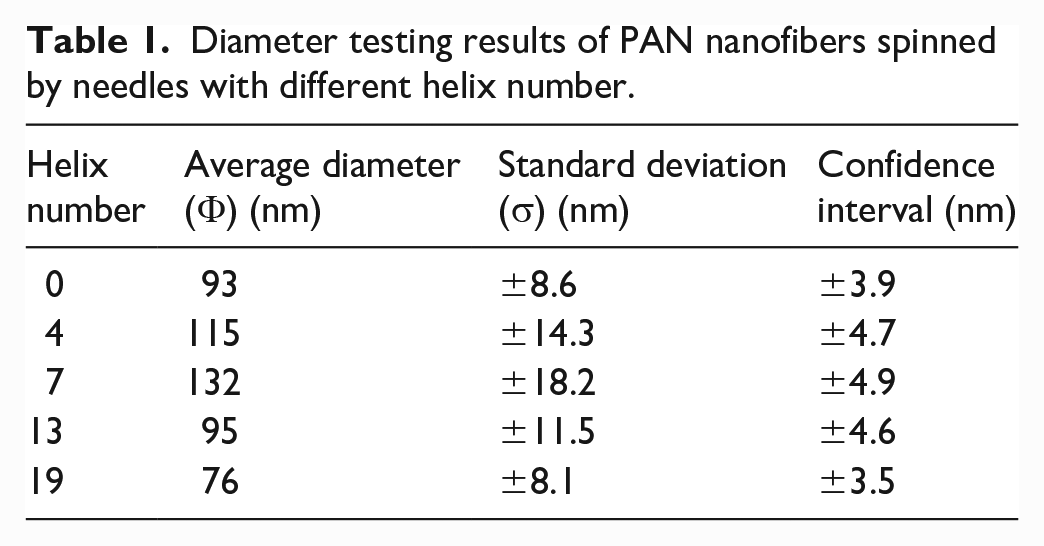
Figure 2 depicted a scanning electron micrograph and a frequency distribution diagram of PAN nanofibers spun with varying helix numbers of spinning needles. On the distribution frequency diagram, we also fit the diameter distribution gaussian curve (blue curve in the figure). The diameter testing results of PAN nanofibers spun with varying helix number of spinning needles were shown in Table 1. It was clear that when the helix number of spinning needle varied from 0 to 7, it increased the diameter of spun PAN nanofibers, and the average diameter increased from 93 to 132 nm. Comparing the gaussian curve fitted by the standard deviation in Table 1 and the average diameter frequency distribution of PAN nanofibers, it was not difficult to prove that the dispersion degree of the diameter of PAN nanofibers also increased. The diameter of the spun PAN nanofibers decreased significantly as the number of helix number increased from 7 to 19 but the average diameter decreased from 132 to 76 nm. When the standard deviation in Table 1 was compared to the gaussian curve fitted by the frequency distribution of the average diameter of PAN nanofibers, it was clear that the dispersion degree of PAN nanofiber diameter decreased gradually. However, no matter how many helix number of spinning needle we use, we always get smooth PAN nanofibers.

SEM images and frequency of diameter distribution about PAN nanofibers spinned by needles with different helix numbers (the measured SEM of the membrane spun with the helix number for 0, 4, 7, 13, 19 are recorded as a, b, c, d, e).
Diameter testing results of PAN nanofibers spinned by needles with different helix number.
Analysis of mechanical properties of nanofiber membranes
Figure 3(a) depicted the tensile stress-strain curve of PAN nanofiber membrane, while Figure 3(b) depicted the bursting stress-strain curve of PAN nanofiber membrane. Figure 3(a) and (b) showed that as the helix number of spinning needle increased, the tensile stress-strain curve and the bursting stress-strain curve of PAN nanofiber membrane had two-stage change trend, and both the tensile and bursting properties of PAN nanofiber membrane were at their best when the helix number of spinning needles was 13. As shown in Figure 3(a), when the helix number of spinning needle varied from 0 to 13, the tensile stress of PAN nanofiber membrane increased from 1.324 to 2.502 Mpa, so the tensile stress enchanced by 88.97%; the tensile strain increased from 0.2013 to 0.3337%, so the tensile strain increased by 65.77%. When the helix number of spinning needle was increased from 7 to 19, the tensile stress of PAN nanofiber membrane decreased from 2.502 to 1.753 Mpa, so the 29.94% decrease in tensile stress, the tensile strain decreased from 0.3337 to 0.2592%, so the 22.33% decrease in tensile strain. As shown in Figure 3(b), the bursting stress of PAN nanofiber membrane gradually increased from 2.3567 to 3.4896 Mpa (the maximum stress value) by 48.67%, the bursting displacement increased from 36.43 to 38.48 mm (the maximum displacement value) by 5% as the helix number of spinning needle increased from 0 to 13. When the helix number of spinning needle increased from 13 to 19, the bursting stress and bursting displacement of the PAN nanofiber membrane decreased noticeably. The bursting stress reduced from 3.4896 to 3.2265 Mpa, so the bursting stress reduced by 7.54%, while the bursting displacement reduced from 38.48 to 37.87 mm, so the bursting displacement reduced by 1.59%. The mechanical properties of PAN nanofiber membrane changed essentially, which demonstrated that the spiral spinning theory mentioned above was applicable to polymers. The spiral force can promote the twisting effect of stretched PAN macromolecules, and mechanical properties of PAN nanofibers below the critical twist can be improved. When the critical twist was exceeded, the mechanical properties of PAN nanofibers decreased to some extent, which directly lead to changes in the mechanical properties of PAN nanofiber membrane.29,30
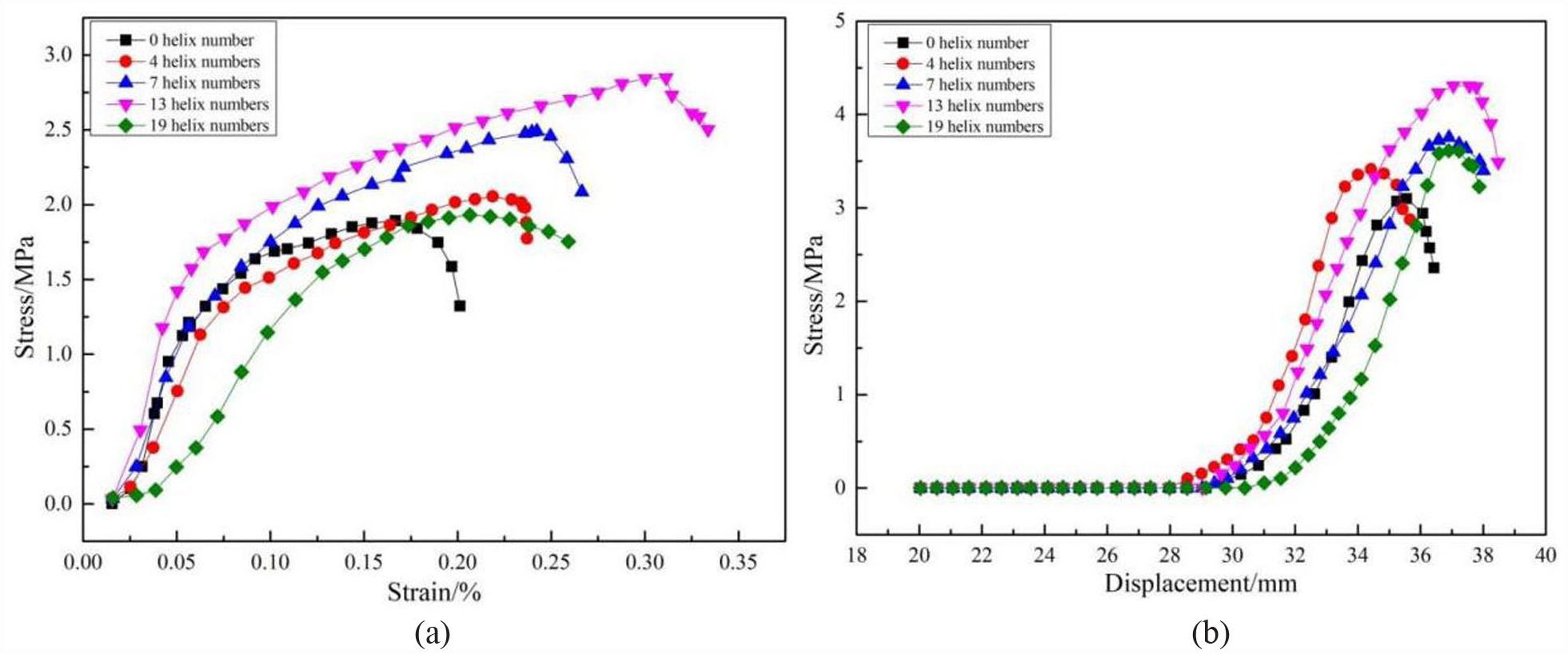
Mechanical property curve of PAN nanofiber membrane spun by needles with different helix number: (a) tensile stress-strain curve and (b) bursting stress-displacement curve.
Pore structure analysis of nanofiber membrane
Table 2 displayed the pore size testing results of the PAN nanofiber membrane. Figure 4 depicted the pore distribution of PAN nanofiber membranes prepared with various helix number. Table 2 showed that as the helix number of spinning needle increased, the average pore size of the PAN nanofiber membrane increased and then decreased. When the helix number of spinning needle was increased to 7, the average pore size reacheed 0.872 μm, while the change trend of pore size and porosity was exactly opposite that of the average pore size. When the helix number was 7, the pore size and porosity were both at their lowest, at 4.96108 and 65.12%, respectively. Figure 4 also showed that the pore size distribution of PAN nanofiber membrane was related to the average pore size. The smaller the average pore size, the narrower and more uniform the pore size distribution. These variations were caused by changes in the diameter of PAN nanofibers. When the diameter is reduced, the more nanofibers pile up in the same area, the more pores form, and the porosity naturally improves.31 –33
Pore size testing results of PAN nanofiber membrane spun by needles with different helix number.


The pore distribution of PAN nanofiber membrane spun by needles with different helix number.
Measurement and analysis of resistance performance of nanofiber membranes
Table 3 showed the results of the PAN nanofiber membrane resistance performance. Table 3 showed that as the helix number of spinning needle increased, the resistivity of the PAN nanofiber membrane changed correspondingly. When the helix number of spinning needle was 7, the resistivity of the PAN nanofiber membrane reached its maximum (3.61 × 10¹³ Ω·m), while the conductivity reached its minimum (2.92 s/m). When the helix number of spinning needle was 19, the resistivity of the PAN nanofiber membrane was the lowest (1.91 × 10¹³ Ω·m), while the conductivity was the highest (5.38 s/m). The reason for this was that the macromolecular structure of PAN nanofibers had shifted slightly. In general, the crystallinity of nanofibers in the nanofiber membrane was high, and thus the conductivity was high. We confirmed that the crystallinity of the spun nanofiber membrane varied with the helix number of spinning needle, proving that spiral spinning needles had also changed the arrangement structure of PAN nanofibers. That is, during the spiral spinning process, PAN polymerized macromolecules were twisted in an orderly manner and arranged more closely, resultsing in smoother electron flow inside the macromolecules, higher conductivity of PAN nanofiber membrane, and lower resistivity of PAN nanofiber membrane.
Testing results of electrical resistance properties of PAN nanofiber membranes spun by needles with different helix number.

Intuitive verification of spiral ordered control of internal structure
We ensure that the size (diameter) of titanium dioxide particles is relatively uniform. Through preliminary research, we conducted spiral spinning experiments with and without the electric field, and found significant differences in the experimental results. After applying the electric field, the particle path of nano titanium dioxide has a spiral effect. Figure 5 depicted the TEM diagram of PAN/TiO2. Figure 5(a) showed that when the helix number of spinning needle was 0 (the spinning needles are only 150 mm long needles), TiO2 nanoparticles were arranged in a straight line in the internal structure of PAN nanofibers, and the arrangement was relatively regular; When the number of spinning needles was 7, TiO2 nanoparticles were arranged obliquely in the internal structure of PAN nanofibers, but the inclination angle (with the axial direction of nanofibers) was small, as shown in Figure 5(b). The spiral force generated by the spiral needles under the spiral magnetic field was large enough when the helix number of spinning needle was 13, as shown in Figure 5(c), and TiO2 nanoparticles appear regular spiral inclined arrangement in the internal structure of PAN nanofibers, and the angle of spiral inclination of TiO2 nanoparticles (with the axis of nanofibers) was greatly increased. When the number of spinning needles was 19, as shown in Figure 5(d), the spiral force generated by the helix needles under the spiral magnetic field increases, resultsing in an increase in the inclined arrangement angle of TiO2 nanoparticles inside the PAN nanofibers. The aforementioned phenomenon also fully demonstrated that the distribution and arrangement of TiO2 nanoparticles in PAN nanofibers fully conform to the spiral spinning theory proposed in this study.

TEM images of PAN/TiO2 nanofiber spun by needles with different helix number (the measured TEM photos of the membrane spun with the number of helix for 0, 7, 13, 22 are recorded as a, b, c, d).
Antibacterial performance of spiral ordered control of internal structure
Table 4 showed the antibacterial testing results of PAN/TiO2 nanofiber membranes, and Figure 6 showed the number of colonies after the antibacterial testing of PAN/TiO2 nanofiber membranes prepared with different helix number. As shown in Table 4, when the helix number of spinning needle was increased from 0 to 19, the antibacterial property of the PAN/TiO2 composite nanofiber membrane changed noticeably. Its antibacterial rate and value first decreased and then gradually increased. The helix number of spinning needle increased from 0 to 7, the antibacterial rate of PAN/TiO2 composite nanofiber membrane decreased from 86.23 to 82.39%, and the antibacterial value decreased from 0.8025 to 0.6812. The helix number of spinning needle increased from 7 to 19, the PAN/TiO2 composite nanofiber membrane’s bacteriostatic rate increased from 82.39 to 97.58%, and the bacteriostatic value increased from 0.6812 to 1.6215. This trend was essentially consistent with the antibacterial change of PAN/TiO2 composite nanofiber membrane, and the main reason was that spiral spinning had changed the distribution state of TiO2 on PAN nanofibers, that is, TiO2 was more evenly distributed near the surface of PAN nanofibers, and TiO2 can fully exploited its bactericidal effect to ensure the excellent antibacterial performance of PAN/TiO2 composite nanofiber membrane.
Testing results of antibacterial properties of PAN/TiO2 nanofiber membranes spun by needles with different helix number.


The number of colonies about the antibacterial testing of PAN/TiO2 nanofiber membranes spinned by needles with different helix number (the measured colonies photos of the membrane spun with the number of helix for 0, 4, 7, 13, 19 are recorded as a, b, c, d, e).
Figure 6 showed that the number of colonies of PAN/TiO2 composite nanofiber membrane prepared with different helix numbers differed after antibacterial testing. As shown in Figure 6(b) and (c), when the helix number of spinning needle was 4 and 7, the number of colonies on the PVA/TiO2 composite nanofiber membrane was higher, indicating that the antibacterial property of the PAN/TiO2 composite nanofiber membrane did not reach its peak at this time, but when the helix number of spinning needle were 13 and 19, as shown in Figure 6(d) and (e), the number of colonies on PVA/TiO2 composite nanofiber membrane decreased obviously. This showed that the antibacterial properties of PVA/TiO2 composite nanofiber membrane samples were obviously improved. Moreover, the testing results of colony number of PVA/TiO2 composite nanofiber membrane samples were basically consistent with the antibacterial testing results of PVA/TiO2 composite nanofiber membrane.
Conclusion
We straighten macromolecules and arrange them in orientation under the condition of sufficient needle length, and then rely on the spiral spinning needle to control the spiral twisting of the straightened macromolecules, according to laminar flow theory. Spiral twisting will occur between macromolecules as a results of spiral centripetal force. When the number of spiral spinning is increased, sufficient spiral orderly twisting between the straightened macromolecules can be obtained. The feasibility of the spiral spinning principle was intuitively verified through theoretical analysis of the spinning solution mixed with TiO2 nanoparticles flowing in the spiral needle, and the movement track of nanoparticles in nanofibers was photographed by transmission electron microscope. The spiral arrangement of macromolecules in nanofibers was indirectly characterized by calculating the crystallinity of nanofibers. The more spiral spinning needles there are, the tighter the spiral arrangement in nanofibers. The appearance of nanofiber membranes has changed to some extent under spiral physical technology, as observed by scanning electron microscope; analysis of the tensile properties and bursting properties of nanofiber membranes has proven that the structure of nanofibers has obvious changes in properties after spiral spinning. The pore structure, electrical resistance, and antibacterial properties of the nanofiber membrane all reached optimal values at the optimal number of spinning needle spirals.
Footnotes
Declaration of conflicting interests
The author(s) declared no potential conflicts of interest with respect to the research, authorship, and/or publication of this article.
Funding
The author(s) disclosed receipt of the following financial support for the research, authorship, and/or publication of this article: Lei Zhao and Ting Zhu are co-first authors of this article. This research is funded by Jiangsu Higher Vocational College Teachers’ Professional Leaders’ High and Training (Team Visit) Project (2022TDFX008). The work is also funded by Qing Lan Project of Jiangsu Colleges and Universities for Young Academic Leaders (Jiangsu Teachers’ letter [2020] No. 10), the Integration Platform of Industry and Education of Jiangsu Higher Vocational Education (Grant number: Jiangsu Vocational Education 2019. No 26), Jiangsu Province Higher Vocational Education High-level Major Group Construction Project-Modern Textile Technology Major Group (Grant number: Jiangsu Vocational Education 2020. No 31). Brand Major Construction Project of International Talent Training in Colleges and Universities-Modern Textile Technology Major (Grant number: Jiangsu Foreign Cooperation Exchange Education 2022. No 8) also supports the research of this subject. Key technology innovation platform for flame retardant fiber and functional textiles in Jiangsu Province (2022JMRH-003) also supports this research.
