



Abstract
The aim of this study is to determine the performance properties of elastic warp-knitted fabrics used for medical purposes. The samples were knitted using different weft yarn material and changing the threading order of elastomer yarn. The detailed results of the dimensional and elasticity performance of elastic warp-knitted fabrics had been reported in Part I of this series. In this part, the effects of weft yarn material and the threading order of elastomer yarn on the thermal comfort characteristics were investigated. It has been seen that the type and linear density of the transverse weft yarns and the number of elastomer yarns in the fabric structure affected significantly the thermal comfort and permeability characteristics of the developed elastic warp-knitted fabrics. According to the results, using polyester yarns as weft and reducing the number of elastomer yarns led to an increase in air permeability. Additionally, the thermal conductivity characteristics of the fabrics increased as the number of elastomer yarns in the structure increased. It has been seen that from the results, the water vapour resistance coefficient of the samples is appropriate for the usage of these fabrics in medical products.
Introduction
The demand for medical textiles has been growing globally due to the prolonged life span. Medical textiles combine both technical disciplines, such as textile engineering and testing, and life sciences as medicine and comfort. 1 Nowadays elastic knitted fabrics are widely used in tight-fitting garments and medical products because of their high elastic recovery, shape retention and conformity with the shape of the body. 2
Elastic bandages, produced on crochet machines, are stretchable textile surfaces used to create localized pressure. They must have different levels of elasticity up to the usage area. The tension level of bandages depends on the used type of construction, yarn material and/or elastomer yarn amount in the fabric. 3 These products are expected to fulfil three criteria given below. They should have proper elongation and elasticity characteristics, 4 apply a suitable amount of pressure onto the body and provide comfort. The latter consists of both objective (permeability, hygroscopicity, thermal conductivity) and subjective (individual human approach) aspects. 5
Comfort can be described as ‘the absence of displeasure or discomfort’ or ‘a neutral state compared to the more active state of pleasure’. Clothing comfort comprises four main elements: thermophysiological, psychological, sensorial and body movement comfort. 6 Thermophysiological and body movement comfort are expressed as crucial for supportive medical products. Thermophysiological comfort is closely related to the thermal balance of the body, which depends on environmental and personal factors and clothing parameters.7,8 Air, heat and moisture transfer management are important factors in this comfort.9 –11 In the case of elastic warp-knitted medical garments, they are required to be stable and maintain the level of compression and assure the product’s comfort for the duration of use, as well. 12 The comfort properties of knitted fabrics are associated with their structural parameters. An increase in fabric density and elastomer yarn ratio results in higher elasticity, compressibility and better fit. 13 On the other hand, thermal and permeability characteristics are negatively affected. 14 Therefore, an optimum balance should be provided.
Various researches are conducted on thermophysiological comfort of weft knitted fabrics. These studies mainly focused on the effects of fibre type and yarn properties15 –19 and fabric properties20 –25 on thermophysiological comfort. On the other hand, investigations about the comfort properties of warp-knitted fabrics are quite rare and they are generally focused on spacer fabrics.26 –30 As elastic warp knitted fabrics used in medical textiles are in direct contact with human skin, comfort of these products should be discussed elaborately. Yu et al. 31 examined the moisture management and antibacterial properties of elastic warp-knitted fabrics. They determined that the water vapour transfer of elastic warp-knitted fabrics increased by using polyester yarns containing bamboo charcoal, and the drying time of the fabrics decreased by using crisscross-section polyester filament. As known, a knitted fabric should transfer moisture and water vapour effectively, whereas not cause significant changes in body temperature, any allergies or irritation. 32 Moreover, fabrics knitted from natural fibres are usually preferred in garments in contact with the skin due to their breathability, moisture absorbance, softness and non-allergic properties. 33
There are limited studies on the thermal comfort properties of elastic bandages produced on warp knitting machines. So, the aim of this work was to investigate the performance and comfort properties of elastic bandages produced with different laid-in yarn materials and threading of elastomer yarn. The structural and physical properties of elastic warp-knit fabrics were investigated in the first part (PART I) of this study. 34 Thermophysiological comfort properties including air permeability, thermal conductivity and water vapour resistance of the same fabrics are compared and analysed in this part (PART II).
Materials and methods
Materials
As mentioned in Part I, 34 totally 15 fabric samples were produced on a 15-gauge crochet knitting machine with four guide bars using 5 different threading orders for elastomer yarn and 4 different yarn materials for in-lay transverse weft yarns (Table 1).
Threading of elastomer yarn and type of weft yarn materials.

The closed pillar stitches (Figure 1(a)) were knitted using polyester threads (16.7 tex) fed from a fully threaded guide bar. Pillar stitches are used mainly as a ground for structures, connected by weft yarns. 35 The 0.8 mm diameter polyurethane thread was used as an elastomer yarn to provide the elasticity of fabrics. It was longitudinally fed (Figure 1(b)) with a preliminary elongation of 270%. The set of elastomer was calculated dividing the number of threaded guides by the total number of guides in third guide bar threaded with the elastomer. The other two guide bars (Figure 1(c) and (d)) were used to insert weft yarns in the transverse direction on both sides of the polyurethane threads.

Lapping diagram: (a) first guide bar (pillar stitch), (b) third guide bar (elastomer yarn) and (c and d) second and fourth guide bars (weft yarns).
The cross-sectional views of the fabrics knitted in different elastic yarn threading arrangements using 4-ply polyester weft yarn, taken on a LEICA10446316 digital microscope with magnification 0.32× are given in Table 2.
Cross-sectional view of elastic warp knitted fabrics.

Methods
The physical (mass per unit area, thickness, fabric density) and thermal comfort (air permeability, thermal conductivity and water vapour resistance) properties of elastic warp knitted fabrics were tested according to the related standards listed in Table 3.
Tested parameters and related test standards.

The bulk density is the weight per unit volume of the fabric that allow to determine how strong, dense and permeable the fabric is. Therefore, this parameter was used to evaluate thermal comfort properties of the samples using equatio(1):

where: ρ – bulk density, (kg/m3); ms – mass per unit area of the fabrics (g/m2); T – fabric thickness (mm).
Results and discussion
The mean and standard deviation values of measured characteristics are given in Table 4. The results of the elastic warp-knitted fabrics are evaluated according to the raw material of weft yarn and the threading arrangement of elastomer yarn. In order to determine the effect of the material type of weft yarn on the fabric properties, the PET2, PET4, COT and LIN samples were compared with each other, in which the elastomer yarn has a 2 in, 1 out (67%) threading pattern. The effect of the threading arrangement of elastomer on the fabric properties was determined by comparing the measured values for different elastomer sets for the samples which have PET2, PET4 and COT weft yarns.
Specifications of elastic warp knitted fabric.
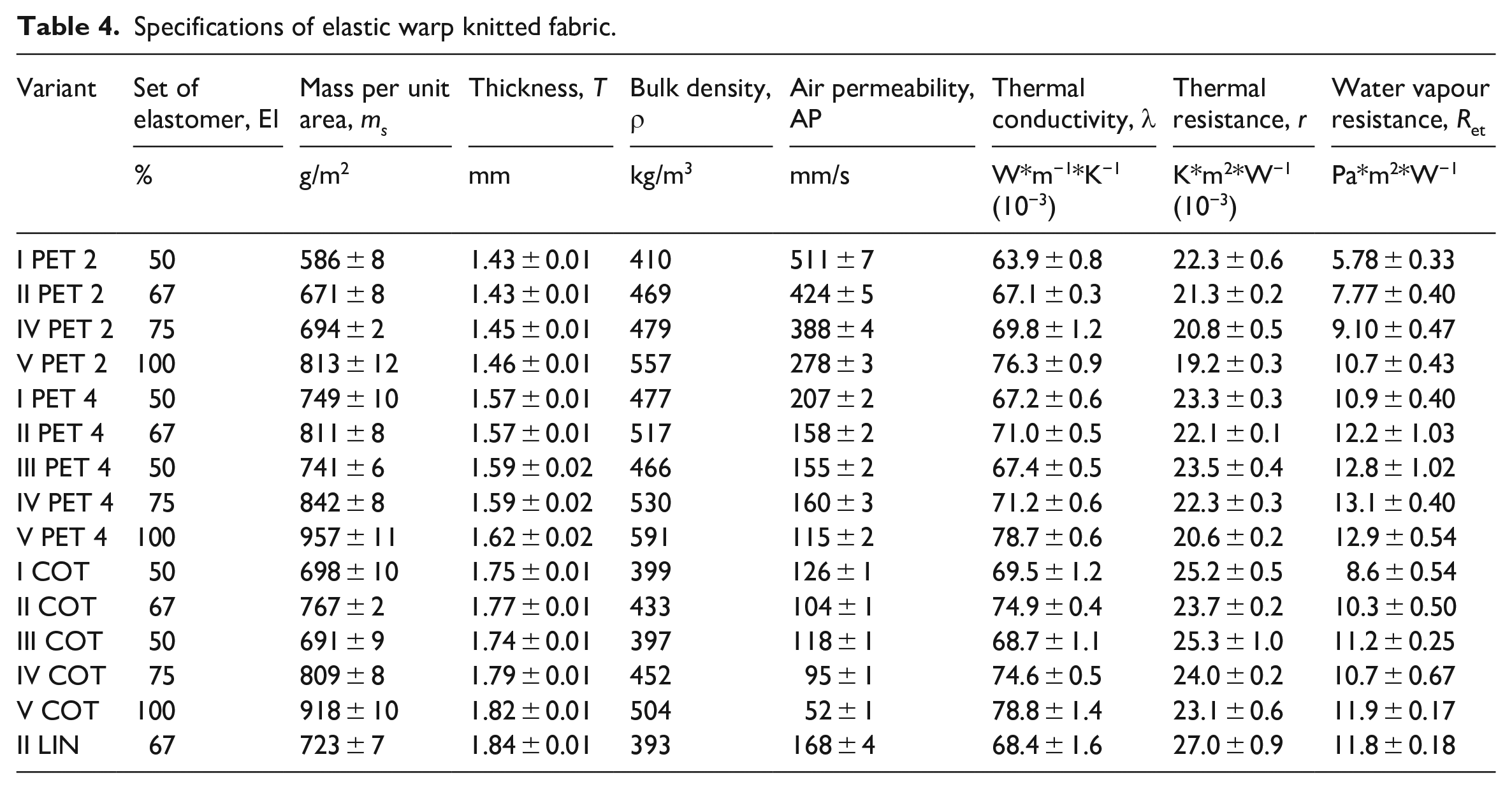
The results of investigation the weight and thickness of fabrics were analyzed at Part I. 34 It was found that the fabric’s thickness depends on the material type and linear density of the weft yarns. The mass per unit area of the fabric is significantly affected by both the material type of the weft yarn and the set of elastomer threads.
Bulk density
The bulk density of developed fabrics depends on both weft yarn type and elastomer threading. When the fabric density values of the samples that have 67% elastomer yarn are compared (Figure 2(a)), it is seen that the fabrics with polyester as weft yarn have higher values than the fabrics with natural yarns. As it was mentioned in Part I, four separate cotton or linen yarns are combined in the 4-ply yarn, and more gaps are found between each yarn compared to 2- or 4-ply polyester thread consisted of many filaments which fill even small gaps in the structure

Effect of weft yarn type (a) and set of elastomer (b) on bulk density of elastic warp knitted fabric.
In addition, as expected a significant decrease in the bulk density of knitted structure is observed with decreases in amount of elastomer yarn in the fabric structure (Figure 2(b)) due to increase the bulk areas without elastomer (Table 2). Mathematically processing of the experimental data the following equations were obtained between the elastomer threading arrangement (El) and bulk density of fabric (Table 5). These equations enables one to determine the bulk density of elastic warp knitted fabrics with high accuracy in case of changing the set of elastomer.
Equations between bulk density of fabric (ρ) and the set of elastomer (El).

Air permeability
Air permeability of a fabric is the measure of how well it allows the passage of air through it and is often used in evaluating the breathability characteristic. The amount and distribution of air influence some fabric characteristics such as warmness, protection against wind and rain, etc. and this leads to select the fabrics for different end uses. 36 Higher air permeability helps to evaporate water and air ventilation due to air movements within whole garment microclimate.
The results showed that the raw material of weft yarns and elastomer threading arrangement had a significant effect on the air permeability of elastic warp knitted fabrics. According to the results (Table 4), the fabric with 2-ply polyester yarn has the highest air permeability value and this value is approximately three times higher than the fabric with 4-ply polyester yarn. It is thought that these results are due to the lower thickness of the fabrics with 2-ply polyester yarn. On the other hand, the samples having natural weft yarn compared, it is seen that the fabric with linen weft yarn has a higher air permeability value than the fabric with cotton weft yarn. It is thought that these result is due to the lower bulk density of the fabric with linen yarn (Figure 2(a)). On the other hand, while the amount of elastomer yarn increases the bulk density also increases, and as expected air permeability decreases for all types of weft yarn materials (Figure 3(a)). There is a high correlation between air permeability and bulk density of studied fabrics (Figure 3(b)).

Effect of set of elastomer (a) and bulk density (b) on air permeability of elastic warp knitted fabric.
IPET4-IIIPET4 samples and ICOT-IIICOT samples that have the same set of elastomer (50%) but different threading arrangement (1 in, 1 out, and 2 in, 2 out) were compared. It was seen that samples with 2 in, 2 out arrangements have lower air permeability despite their similar bulk densities for both weft yarn materials. It is thought that these differences may be caused by the differences in the cross-section shapes of fabrics.
The mathematical relations between the air permeability (AP) and the set of elastomers (El) were given in Table 6. The obtained equations allow us to predict the air permeability of elastic warp-knitted fabrics for various elastomer threading arrangements.
Equations between the set of elastomer (El) and air permeability.

Thermal conductivity
Thermal conductivity coefficient λ presents the total heat transmitted through a fabric per unit time with unit temperature difference. Thermal conductivity properties of textiles depend on the fabric thickness and density, because still air trapped between the fibres has lower thermal conductivity value compared to all fibres (λair = 0.026). 36
Results given in Table 4 show that the differences between thermal conductivity values of the samples with same set of elastomer (e.g. 67%) did not exceed 5% so there isn’t a significant effect of weft yarn material type on the thermal conductivity of developed elastic warp knitted fabrics.
As can be seen in Figure 4, it has been determined that the threading arrangement of elastomer yarns influences the thermal conductivity of the elastic warp-knitted fabrics. For all weft yarn materials, while the amount of elastomer yarns increases in the structure, thermal conductivity values also increase. It is due to the great difference in thermal conductivity of textile yarns and air. As seen from the results (Table 4) and images of the fabrics’ cross-sections (Table 3), with the increase of the amount of elastic yarn, the amount of air gaps decreases. This leads to an increase in thermal conductivity.

Effect of set of elastomer on thermal conductivity of elastic warp knitted fabric.
When the samples that have the same set of elastomer (50%) but different threading arrangement (1 in, 1 out, and 2 in, 2 out) were compared, it was seen that the difference between thermal conductivity values is not significant.
The mathematical dependence of the thermal conductivity on the set of elastomer (El) is following (R2 = 0.984):

Thermal resistance
Thermal resistance is one of the main comfort characteristics of clothes in order to keep the body at an appropriate temperature, even when the surrounding temperature is rapidly changed. Thermal resistance is a function of the fabric’s thickness (T) and thermal conductivity (λ) and is defined as following37,38:

The research results demonstrate a high correlation between thermal resistance and fabric thickness. The elastic warp knitted fabrics with natural yarn as transverse weft has greater thermal resistance first of all because of greater thickness.
According to the results (Figure 5(a)), elastomer threading affects thermal resistance of fabric. Halving the number of elastomeric threads in the structure leads up to a 15% increase in the thermal resistance. It’s the result of decrease the bulk density (Figure 5(b)).
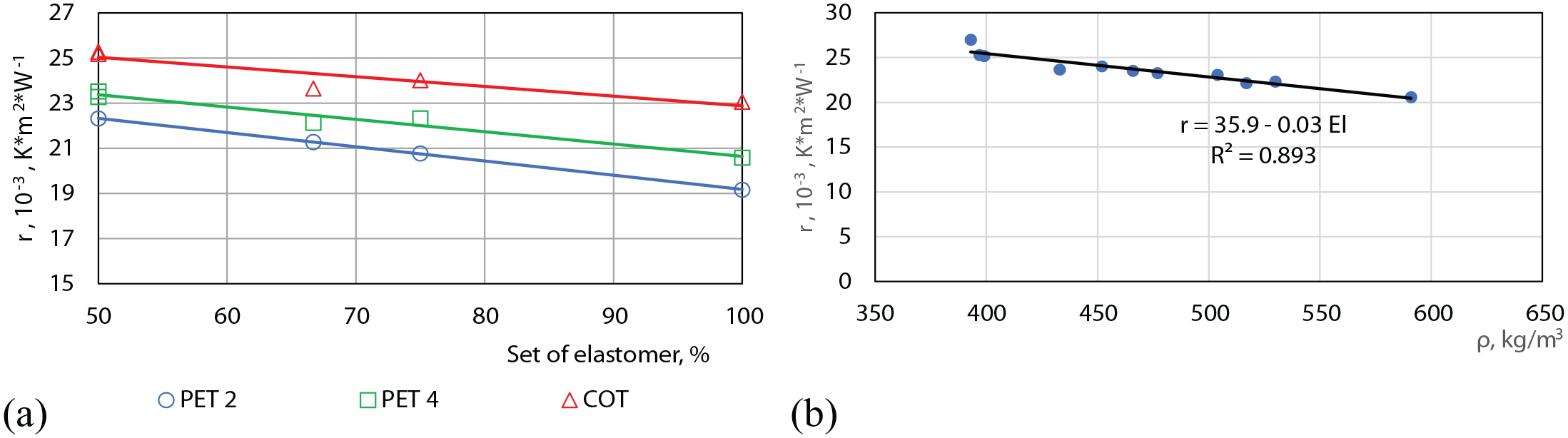
Effect of set of elastomer (a) and bulk density (b) on thermal resistance of elastic warp knitted fabric.
The mathematical dependence of the thermal resistance on the set of elastomer threading (El) can be seen in Table 7. The obtained equations allow us to predict the thermal resistivity of elastic warp-knitted fabrics for various elastomer threading arrangements.
Equations between the set of elastomer (El) and thermal resistance (r).

Water vapour resistance
By sweat production and evaporation, the body cools itself and the clothing should remove the vapour or the liquid phase from the skin in order to maintain comfort. It has a significant effect on human perception and the warm/cool feeling. 36 The water vapour resistance (Ret) of the fabric indicates the capacity of a fabric to stop water vapour from getting out. The lower this resistance is, the more comfortable the fabric. For determination of the rating levels of the water vapour resistance, the classification developed by the Hohenstein Institute (Table 8) is used. 39
Ret comfort-rating system. 39

Research results (Table 4) show that the water vapour resistance coefficient of developed elastic warp-knitted fabrics is between 6 and 13 Pa*m2*W−1. According to the Ret comfort-rating system by Hohenstein Institute, these values are evaluated as good levels. Therefore, the studied fabrics can be used in medical products because of their very breathable and comfortable properties at moderate activities. Especially the PET2 fabric structure is extremely breathable and comfortable at a higher level of activity. As a result of the conducted research, it was established that a decrease in the number of elastomers yarns in the knitted structure, leads to a decrease in the bulk density, and indicator’s value (Figure 6). Therefore, an improvement in the vapour permeability of the developed fabrics has been seen.

Effect of set of elastomer on water vapour resistance of elastic warp knitted fabric.
Water vapour resistance values of the samples that have the same set of elastomer (50%) but different threading arrangement (1 in, 1 out, and 2 in, 2 out) were compared also. According to the results, water vapour resistance values of the samples that have 2 in, 2 out arrangements are lower. It is similar to air permeability properties.
The mathematical relations between the water vapour resistance (Ret) and the amount of elastomer yarn (El) were given in Table 9.
Equations between the set of elastomer threading (El) and water vapour resistance.

Conclusion
The conducted research on permeability and thermophysical properties of elastic warp knitted materials, which are proposed for medical products for therapeutic and preventive purposes, show that the type and linear density of the transverse weft yarns and the number of elastomer yarns in the fabric structure affect the studied characteristics. The elastic warp knitted fabrics of four variants of transverse weft and five variants of elastomer threading are studied. On the analysis of the research results, the following is established:
Both the type of transverse weft yarn and the number of elastomer yarns in the structure affect its air permeability: the indicator increases when polyester yarns are used as weft and when the number of elastomer yarns is reduced. It is result of changes in bulk density of fabrics.
There is not significant effect of weft yarn type on thermal conductivity of developed elastic warp knitted fabric, but increasing the number of elastomer yarns in structure leads to increase of thermal conductivity.
The thermal resistance of elastic warp-knitted fabrics depends on both the type of transverse weft yarn and the number of elastomer yarns in the structure. The value decreases with increasing the bulk density
The water vapour resistance coefficient of studied elastic warp knitted fabrics is between 6 and 13 Pa*m2*W−1 that allows use of developed fabric in medical products for moderate efforts.
The research results of the study show that it is possible to decrease the amount of elastomer in structure to improve the comfort of medical compression clothes such as corsets and supports. By reducing the number of elastomer threads in repeat the fabric’s permeability increases and thermal characteristics are improved with a sufficiently high level of elasticity and elastic recovery. The replacement of polyester weft yarn with natural (cotton or linen) yarn leads to improvement in the comfort characteristics of medical compression clothes as well.
The obtained mathematical equations allow with high accuracy to determine the expected parameters’ values of elastic warp-knitted fabrics in case of changing the repeat of elastomer threading and the use of complex ratios.
Footnotes
Declaration of conflicting interests
The author(s) declared no potential conflicts of interest with respect to the research, authorship, and/or publication of this article.
Funding
The author(s) disclosed receipt of the following financial support for the research, authorship, and/or publication of this article: The authors would like to thank the Scientific and Technological Research Council of Turkey TUBITAK, Ministry of Education and Science of Ukraine and Philipp Schwartz Initiative for Ukrainian scientist from Humboldt Foundation for supporting this research.
