



Abstract
The demand for medical textile products is increasing with awareness regarding better healthcare services and efficient medical treatments. Compared to other textiles, elastic warp knitted materials, which have elastomer threads in each wale have been widely used in producing medical and preventive products. Thus, in order to decrease the weight and cost of these products without effect on fabric’s stretchability, in this study, various elastic warp knitted fabrics were produced using different raw materials and elastomer threading arrangements, and their properties were investigated. The fabrics were produced on a crochet knitting machine with five different arrangements of elastomer threading and four different laid-in yarn materials as polyester, cotton, and linen. Then the dimensional properties and elastic behaviors of the samples were determined and evaluated comparatively. Statistical analysis showed that all studied elastic warp knitted fabrics have high provide elasticity at a higher than 95% level. On the other hand, the mass per unit area of the fabric is reduced, with the use of linen yarn as weft yarn, or when the total linear density of the weft yarn and the amount of elastomer threads decrease. Finally, the obtained results revealed the possibility to reduce elastomer consumption to decrease weight for elastic medical products, which were developed, without effect on fabric’s stretchability and elasticity as well as replacing synthetic threads with natural yarns in order to improve product comfort.
Introduction
The global medical textiles market reached US$ 20.2 billion in 2021 and is expected to expand at a compound annual growth rate (CAGR) of 4.7% from 2022 to 2027. 1 The demand for medical-grade textile products is expected to grow with increasing awareness regarding better healthcare services and efficient medical treatments. The incidence of various diseases and the instances of accidents have both increased along with a continuously growing global population. 2 Therefore, the demand for the non-implantable goods segment of medical textiles, such as pressure garments, compression bandages, and corsets, has increased.
Textile products can be categorized as therapeutic and preventive if they can keep the human body's vital functions within normal limits. Medical products like a medical brace, belt, or corset can be used to support the trunk and the vertebral column and protect against traumatic or congenital spinal deformities. They are used externally, to compensate for lost functions due to changes in the spine and muscles, for fixation, support, unloading, correction, or even creation of the desired position.3,4 Matching the product's design to the wearer’s posture shape ensures the effectiveness of such preventive measures. The therapeutic and preventive effects occur indirectly by creating deformations of the skin and muscles after it is worn. The greatest changes occur in the abdomen and thigh areas by deforming muscle tissues and partially displacing them to the top. The body areas with the greatest curvature get the highest deformation since the greatest pressure occurs in these areas. Active forces must be precisely dosed to avoid damage to the skin, blood vessels, and peripheral nerve fibers. 5
The most important expectations from medical goods are 6 :
- the necessary therapeutic effect,
- dimension and shape stability after repeated use and launderings,
- good permeability and high moisture absorption,
- not to cause irritation and be nontoxic,
- the conformity of the product’s size and shape to the body surface,
- product convenience and ease of use as well as the normal course of the anatomical and physiological period.
Three different aspects must be combined in order to express a material's capacity to compress and push up soft body tissue:
The mechanical properties of materials, such as elongation and elasticity,
The pressure that can be applied on the soft tissues, and
Comfort for skin sensitivity. The latter is a complex parameter as it includes both objective (permeability, hygroscopicity, and thermal conductivity) and subjective (individual human approach) scores. 7
Orthopedic supports as medical corsets and belts are widely manufactured using elastic knitted fabrics. 8 No other technology can compete with knitting in respect of the possible combination of various technical parameters and raw material compositions that affect the performance of products. 9 Product specifications, including fabric structure, density, elasticity, strength, porosity, and permeability can be drastically altered. Knitted orthopedic supports are commonly divided into three categories: preventive supports, functional supports, and post-operative/rehabilitative supports. 10 The main differences between them are the compression size and consolidation strength. Unfortunately, the compression requirements for orthopedic support as well as elasticity and elastic recovery of used materials are not standardized to date. 11
Elastomeric threads have fundamentally changed the design and features of medical and preventive products with their extensibility, elasticity, and compression ability in a stretched state. 12 They are mostly produced with both weft and warp knitting technologies by placing elastomeric yarns within the structures. For the effective compression the run-in direction of an elastomeric yarn is used as stretch direction of supports. 13 For example, in weft knitting, elastomeric threads are inserted in course-wise direction, and the fabrics gain extensibility in this direction. 14 Conversely, elastomeric threads are vertically laid into the fabric in warp knitting, and the fabrics become more flexible in wale-wise direction. The fabric’s weight, density, elasticity, and permeability properties can be adjusted according to demand by making necessary changes in the placement of the elastomer threads. 15
Extensibility and elasticity are the most important characteristics of fabrics through which orthopedic supports are able to exert continuous pressure on the human body. Özdil 16 noted that as the elastane content increases, the stretching and the maximum stretching percentages of fabric increase owing to the high elasticity of elastane. It was found that increased amounts of elastane make fabrics stiffer. 17 Wang et al investigated the dynamic pressure attenuation of elastic knitted fabric 18 and found that it depends on the spandex feeding rate and fabric’s extension for both plain and rib structures. Senthilkumar et al. 19 studied elastic behavior of cotton/spandex knitted fabric and its dependence to spandex input tension and linear density. There are some later works,20 –22 but most of them related to the elastic weft knitted fabric from core spun yarn used in sports garment.
Medical corsets and bandages are made generally from warp knitted fabrics 23 with elastomeric threads in each wale produced by crochet machines. Closed pillar stitches are used as the ground for these fabrics and separate pillar wales are connected by weft threads.24,25 In order to improve the stretchability and flexibility of the fabric, bare elastomer threads are positioned between the overlaps and underlaps. 26 It was found that the linear density of the weft yarns and the pretension of both elastomer threads and the ground yarns are the main parameters that affect the stretch properties of the elastic warp knitted fabric. On the other hand, using 2 in 1 out threading repeat, the fabric weight was decreased by 20% while meeting the relevant extensibility. 27 Thus, it will be possible to produce lighter and therefore cheaper products. But still there is a lack in knowledge about how the reduction in number of elastomer threads in repeat affects the elasticity and elastic recovery of fabric.
Synthetic fibers with complicated fiber compositions, such as 72/28 polyester/spandex are generally used in the production of medical corsets and bandages. 28 From the other side, natural fibers are appropriate for hot climate and summer season as well as for high physical activities because of their hygienic properties.
In this context, this study aims to investigate the effect of weft yarn material and threading of elastomer on the structural and physical properties of the elastic warp knitted fabric to provide a high performance of orthopedic supports
Materials and methods
Materials and production data
The elastic warp knitted fabrics were produced on a 15-gauge T.C.H crochet knitting machine with four guide bars. Yarn feeding tension, fabric takedown load, and the number of used needles were kept constant for all samples.
The closed pillar stitches (Figure 1(a)) were knitted using 16.7 tex polyester threads which were fed from a fully threaded guide bar for the ground. The 0.8 mm diameter polyurethane thread was used as an elastomer to provide the functional properties of fabrics. It was longitudinally fed into the knitting zone (Figure 1(b)) with a preliminary elongation of 270%. To determine the influence of the guide bar threading arrangement on the fabric structure and parameters, five different polyurethane threading options were used as given in Table 1. The set of elastomer was calculated dividing the number of threaded guides by the total number of guides in third guide bar threaded with the elastomer.

Lapping diagram: (a) fist guide bar (pillar stitch), (b) third guide bar (elastomer thread), and (c) and (d) second and fourth guide bars (weft yarns).
Guide bar threading with polyurethane thread.

The other two guide bars (Figure 1(c) and (d)) were used to insert weft yarns in the transverse direction on both sides of the polyurethane threads. Thus, the elastomer thread is covered with weft yarn, and the elastomer stays inside the structure and cannot be seen on the fabric surface. Four different yarns were used as weft yarns to create elastic fabrics with various raw material compositions (Table 2, Figure 2).

Photo of weft yarn variants.
Weft yarn materials.

The samples are represented by a combination of the codes from Tables 1 and 2. For example, I PET 4 indicates that elastomer threads are laid in every second wale (1 in, 1 out) and 4 plies polyester threads are used as transverse wefts.
According to the experimental plan, 15 variants of elastic warp knitted fabrics which have different threading arrangements for elastomer threads and different raw materials for weft yarn were manufactured (Table 3).
The composition of raw materials in elastic warp-knitted fabric.

Testing methods and processing of results
The structural properties of the fabrics were investigated using the following tests and standards. Composition test (ISO/TR 11827: 2012) was repeated five times to ensure an error within 1%. Stitch density (EN14971:2006), Thickness (ISO 5084: 1996), and Mass per unit area (ASTM D3776) tests were made 10 times for each fabric type. The elastic behaviors of fabrics were tested walewise (in the direction of elastomer laying) by two different methods.
(a) In the first method (GOST 16218.9-89 standard), extensibility, elasticity, and residual elongation at a constant load were determined within a single cycle on the rack relaxometry. The tensile load was determined depending on the count and diameter of the elastomer in the specimen. For 0.8 mm diameter polyurethane thread, the load is 2 N per 1 thread. Three specimens (250 mm × 50 mm) were tested for each fabric variant. Three lengths were measured during the test:
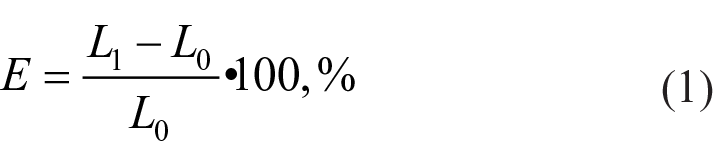
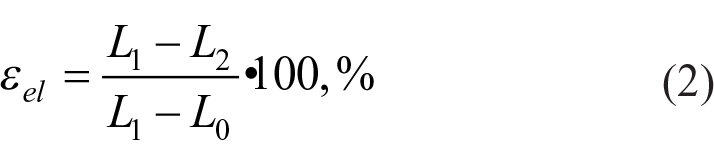
L0 is the specimen length between grips before testing, mm;
L1 is the specimen length between grips under loading for 3 min, mm;
L2 is the specimen length between grips after load removing and recovering for 1 min, mm.
The elastic behavior indicators were calculated using following equations:
extensibility
elasticity
residual elongation

(b) The second method (BS EN ISO 20932-1) was performed using Zwick Roell Z010 instrument. Three specimens (300 mm × 50 mm) were tested for each fabric variant. Used cycling limits were gauge length setting 100 mm; the number of cycles 5; cycling load 35 N (7 N/1 cm width); and recovery period 30 min. An example of obtained curves is presented in Figure 3.

Force to extension plots for fabric I PET 2.
Four lengths were measured during the test:
L is the initial length, mm;
E is the extension at maximum force on the fifth cycle, mm;
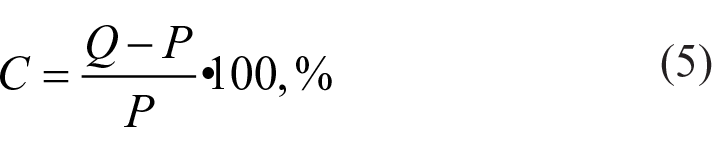
P is the initial distance between applied reference marks, mm;
Q is the distance between applied reference marks after a recovery period.
The following indicators were calculated from obtained data:
elongation

permanent deformation
recovered elongation

elastic recovery

Results and discussion
Raw materials composition
Study results of raw materials content in developed elastic warp knitted fabrics are presented in Table 3. Using partial threading for polyurethane threads, their contents in the fabric can be changed as seen in Figure 4. Additionally, the use of cotton or linen yarn as a weft yarn ensures at least 50% content of natural raw materials in the fabric structure.

The relation between set of elastomer and its content in fabric.
Fabric structure
The threading arrangement of elastomer significantly affects the structural properties and appearance of warp knitted fabric as seen in Table 4. The photos were taken on a LEICA 10446316 digital microscope with magnification 0.32×. Thus, with full threaded guide bar of polyurethane threads (variant V), the fabric’s surface is flat because of the location of the elastomer threads in each wale. Additionally, it is seen that the polyurethane threads are placed longitudinally in the fabric structure due to their elasticity. In each consecutive course, the closed loops of the pillar stitch bend alternately in different directions, and the width of the loops becomes bigger than its height.
Photos of 4-ply polyester fabrics with different threading plan of elastomer.

The surface appearances of the fabrics, which have different weft yarn materials, are given in Table 5. The use of different materials for weft yarn has an effect on the existing relief appearance. When the natural raw materials (cotton and linen) are used the surface relief is no longer apparent and can only be visible on the back side of the fabrics.
Photos of fabrics with 2 in, 1 out threading of elastomer.

Number of stitches per 100 mm
The results for structural parameters of the elastic warp knitted fabrics were given in Table 6. The expected stitch densities are of 60–62 wales per 100 mm, because of the knitting of all samples on the same machine. However, it was seen that the distance between the wales varied within 3 - 4% due to the relaxation of the weft threads fed into the knitting zone with a certain tension.
Structural characteristics of elastic warp knitted fabric.

From the results, fabrics produced by using 2-ply of polyester yarn as weft have the highest course density (Figure 5(a)). When the diameter of the transverse weft yarn decreases, the height of the loops also decreases and the fabric tightness increases in the relaxation state of the elastomer in the structure. It is obvious that the stitch density values for the fabrics knitted using 4-ply cotton and 4-ply polyester yarn are almost the same. On the other hand, using 4-ply linen yarn as the weft yarn leads to a 7% increase in course density compared to similar cotton yarn, because of different relaxation levels of the elastomer in structure after knitting.

Effect of weft yarn type (a) and set of elastomer (b) on courses number per 100 mm.
The results show that the threading arrangement of elastomer thread has a slight effect on the course density. For all variants of the weft yarns, while the raw material content in fabric structure increases, the course density also increases (Figure 5(b)). It should be noted that this increase is insignificant and does not exceed 6%. This is due to the tendency of the pre-stretched elastomer thread to return to its initial state after the knitting process.
Thickness
The thickness results show that the type of material used for the weft yarn influences the thickness of elastic fabrics (Figure 6(a)). The thickness value of the fabrics knitted with 2-ply polyester as weft yarn was lower than the fabric knitted with 4-ply polyester, as expected. On the other hand, the fabrics knitted with natural yarns had 10%–15% higher thickness values. Natural fibers are staple fibers produced by the ring spinning method. Therefore, four separate yarns are combined together in the 4-ply yarn, and more gaps are found between each yarn. Arising from the structure of natural yarns, these fabrics have higher fabric thickness. On the other hand, the 33.4 tex polyester thread is a continuous filament consisting of 96 filaments. So, 2- or 4-ply polyester thread, is like a coarser single yarn. Each filament of the plied thread is held securely in the yarn structure filling even small gaps. Therefore, when plied polyester threads are used as weft yarn, fabrics have lower thicknesses and internal porosity.

Effect of weft yarn type (a) and set of elastomer (b) on thickness.
The effect of set of elastomer threads on the thickness of the warp knitted fabric has not been revealed because of the relief structure of fabrics (Figure 6(b)). For all threading arrangements, the thickness of the areas without elastomer thread is lower and could not be measured. Because the width of thinner areas on the fabric surface was lower than 2 mm, while the diameter of the presser foot of the measuring device was 28.7 mm.
Mass per square meter
The stitch density and the mass per unit area of fabrics constitute the most important parameters that determine the weight and therefore cost of the product. In this study attempt was made to reduce material consumption and product weight while developing orthopedic supports with improved structural and functional properties. Thus, the product will become not only more economical, but also more comfortable. The results show that the weight of the fabric with 4-ply polyester as weft yarn has the highest value (Figure 7(a)). Reducing the number of yarn plies and thus the total linear density of the weft yarn by half resulted in a weight reduction of approximately 20%. When cotton and linen yarns are used instead of 4-ply polyester yarn, the weights of the fabrics reduce by 5%–8% and 10%–12%, respectively. It is noteworthy that the weight of the fabric with linen weft yarn is lower, although the fabric thickness and stitch density are higher. This fact confirms the above conclusion that elastic fabrics with natural yarns have a higher internal porosity because of air gaps between yarns.

Effect of weft yarn type (a) and set of elastomer (b) on gram per square meter.
It is noted that the effect of the threading arrangement of the elastomer on the weight of the fabric is very important. While the set of the elastomer thread in fabric structure increases, the weight of fabrics increases also (Figure 7(b)). According to the results, the weight of the fabric with half threading is lower by almost 25% than full threading arrangements. Mathematically, processing of the experimental data, the following equations were obtained between the elastomer threading arrangement (El) and fabric weight (Table 7). These equations enables one to determine the weight of elastic warp knitted fabrics with high accuracy in case of changing the set of elastomer.
Equations between fabric weight and the set of elastomer (El).

Elastic behavior
One of the most prominent features of orthopedic supports is the elastic behavior properties that enhance their configuration on the curvilinear human body. To achieve this, the elastic fabrics are knitted using elastic fibers and yarns that exhibit good extensibility and elastic recovery. 10 The results of the fabric’s elastic behavior indicators are given in Table 8. The measurements which were carried out according to GOST 16218.9-89 show that the material and linear density of the weft yarn significantly affect the extensibility of samples (Figure 8). The fabrics with 2-ply polyester as a weft yarn have the highest extensibility (over 100%) and with the usage of 4-ply polyester, extensibility value of the fabric decrease around 10%. When the natural yarns are used as weft yarn, fabric extensibility decreases as well (Figure 8(a)).

Effect of weft yarn type (a) and set of elastomer (b) on extensibility of elastic warp knitted fabric.
Elastic behavior indicators of elastic warp knitted fabric.

The results show the threading arrangement of elastomer did not an important effect on the extensibility of fabrics that have polyester weft yarns. But the threading arrangement is important for the extensibility of fabric with cotton weft yarn and the extensibility increases with the increase of elastomers in the structure (Figure 8(b)).
The results further showed that all samples of the elastic warp knitted fabrics exhibited elasticity at a higher than 95% level (Figure 9(a)). It should be noted that lower linear density (2-ply PET) of weft yarn leads to lower extensibility. For this fabric, the elasticity level is 96%–97%, and residual deformation is 4%. On the other hand, the use of weft yarns of twice linear density (4-ply PET) provides a 99% elasticity level and a residual deformation less than 2%. Elastic warp-knitted fabrics with natural fibers as weft yarn have an elasticity of 99% also with a residual deformation of less than 1%.
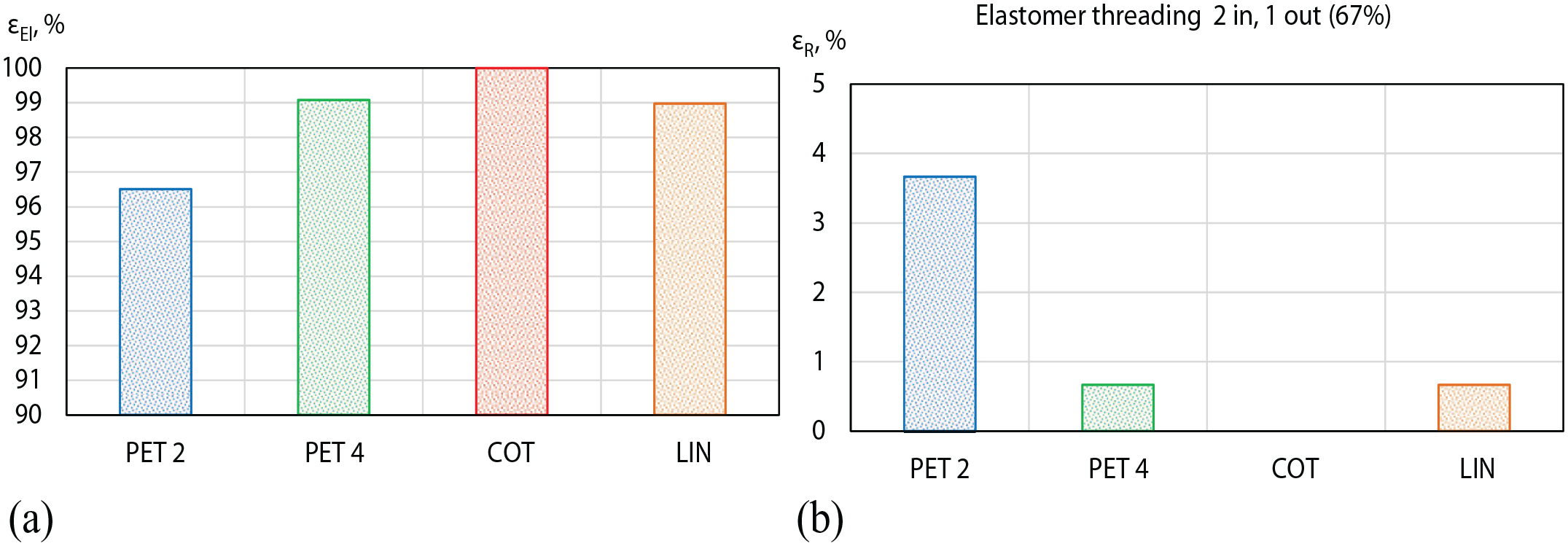
Effect of weft yarn type on elasticity (a) and residual elongation (b) of elastic warp knitted fabric with partly threading arrangement of elastomer: 2 in, 1 out.
According to ISO 20932-1: 2020, the elastic fabric with 2-ply polyester thread as weft yarn has the highest elongation (Figure 10). For partial threading arrangement of elastomer thread, doubling the linear density of the weft threads leads to 20%–40% reduction in elongation. With the usage of cotton yarn as a transverse weft, another 20% decrease happened in the indicator. According to the results (Figure 10(b)), the elongation of the fabric increases when the amount of elastomer threads in the structure decreases. When using half-threading elastomer, the elongation of the warp knitted fabric is higher than 40%–50% compared to fabric produced with fully threaded ones. This confirms the result that the total tensile resistance decreases with decreasing the number of elastomer threads.

Effect of weft yarn type (a) and set of elastomer (b) on elongation at 35 N on the fifth cycle.
The following equations of the elongation at 35 N on the set of elastomer (El) are established by processing the experimental data (Table 9).
Equations between the set of elastomer (El) and fabric elongation.

The results of the permanent deformation (Figure 11) show a correlation with the residual deformation obtained during the single-cycle study (Table 8). The knitted fabrics with lower linear density polyester weft yarns (PET 2 variants) have a higher permanent deformation value than the other samples. These fabrics have greater values of elongation. It leads to an extension of recovery time that is over the test time. An increase in the set of elastomer threads leads to a decrease in residual deformation. Attention should be paid to the absence of residual deformation in fabrics with an elastomer thread in each wale (variants V PET 4 and V COT).

Effect of weft yarn type (a) and set of elastomer (b) on permanent deformation after 30 min recovering.
The result of elastic recovery calculation based on the method of repeated stretching under a 35 N load (Figure 12(a)) completely corresponds to the elasticity obtained during the ingle-cycle study (Figure 9(a)). This implies that any of these methods could be used for future investigation of the elastic fabrics for rehabilitation and fixing goods. All studied elastic fabrics can be used in medical corsets without any limitations because they have above 97% elastic recovery. The effect of the threading arrangement of the elastomer thread on the indicator is insignificant (2%–3%; Figure 12(b)).

Effect of weft yarn type (a) and set of elastomer (b) on elastic recovery of elastic warp knitted fabric.
The results show that all developed elastic warp knitted fabrics have above 97% elastic recovery despite the influence of the threading arrangement of elastomer thread and the materials of weft yarns. A decrease in the set of elastomer threads and the linear density of the weft yarns leads to an increase in the elongation and the residual deformation of the knitted fabrics.
Conclusions
The elastic warp knitted materials have been widely used in the production of medical and preventive products due to their higher extensibility and elasticity. The most commonly used fabric is a polyester warp knitted fabric, which has elastomer threads in each wale. Thus, in order to decrease the weight and cost of these products, various elastic warp knitted fabrics were produced using different raw materials for weft yarn and the different elastomer threading arrangements, and their properties were investigated in this study. At the end of study, the following results were found:
- The surface relief is more pronounced with an increase in the number of adjacent wales without elastomer according to the threading arrangement. For example, the relief effect of the 2 in, 2 out threading arrangement is more palpable than 1 in, 1 out one.
- The type of raw material of weft yarn affects the relief effect and when polyester yarn is used instead of natural yarn, the surface relief decreases.
- The number of stitches per 100 mm in course direction is constant and is related only to the used knitting machine parameters. However, the number of stitches per 100 mm in wale direction depends on both the material and linear density of the weft yarn.
- The fabric’s thickness depends on the material type and linear density of the weft yarns. For example, the use of natural yarns like cotton or linen leads to a 10%–15% increase in thickness.
- The mass per unit area of the fabric is significantly affected by the material type of the weft yarn and the set of elastomer threads in the fabric structure. For example, a 50% reduction in the total linear density of the weft yarn could result in 20% decrease in the mass per unit area of the fabric.
- Additionally, the weight of fabric decreases by 10%–12% with the use of linen yarn as weft, and it reduces by 25% when half-set threading of elastomer instead of full elastomer threading.
- Elastic recovery of all developed elastic warp knitted fabrics is above 97% in the range of measurement despite the influence of the elastomer threading and the material type of weft yarns;
- Decrease in the set of elastomer threads and the linear density of the weft yarns leads to an increase in both the elongation of the knitted fabric and the residual (permanent) deformation.
Research results show the possibility to reduce elastomer consumption without adverse effect on fabric’s stretchability and elasticity as well as replacing synthetic threads with natural yarns in order to improve product’s performance. The linear functions have been identified between elongation or mass per unit area and the set of elastomer depending on the weft yarn type (4 ply cotton, 2 ply, and 4 ply polyester). The aforestated equations allow for high accuracy in determining the expected mass per unit area and elongation in elastic warp knitted fabrics in case of changing the threading arrangement of elastomer thread or the use of complex ratios. It will be useful to consider these results in the design and production of elastic warp knitted fabrics to be used in orthopedical supports.
Footnotes
Declaration of conflicting interests
The author(s) declared no potential conflicts of interest with respect to the research, authorship, and/or publication of this article.
Funding
The author(s) disclosed receipt of the following financial support for the research, authorship, and/or publication of this article: The authors would like to thank The Scientific and Technological Research Council of Turkey (TUBITAK), Ministry of Education and Science of Ukraine and Philipp Schwartz Initiative for Ukrainian scientist from Humboldt Foundation for supporting this research.
