




Abstract
Based on 3D body scanning, this study developed the corresponding measurement-based patternmaking (CMP) method for leggings that could systematically provide an excellent fit and control tightness for different body parts. The CMP method for leggings was qualitatively validated by comparing the fit suitability of the produced leggings prototypes through a wear test. The results suggest that the CMP method is an option to design leggings with outstanding suitability in terms of appearance satisfaction, size satisfaction, compression satisfaction, usefulness in movement, ease of movement, ease in donning and doffing for different body parts. In particular, the graduated application percentage (GAP) provided an advantage in usefulness in movement, while the fixed application percentage (FAP) showed an advantage in ease in donning and doffing. As such, this study suggests selecting the CMP method of the application percentage (AP) depending on the purpose of use. This study demonstrated that the proposed method ensured validity in directly implementing a leggings pattern with 3D body scanning and body measurement alone.
Introduction
Leggings refer to body contouring pants made of knitted fabric containing elastomer, which tightly fit the human body. Although leggings tightly fit the body, their materials extend and return to normal depending on the wearer’s movement, and therefore, they provide an attractive appearance and meet the needs of comfort fit during activities due to the material stretch characteristics).1,2 As such, leggings meet esthetic and functional utility,3,4 are widely used as functional and lifestyle wear, and are increasingly used as not just a base layer but also outerwear.5 –7 Leggings are tight-fit pants with uniqueness where most patternmaking components can be omitted and can be designed mainly with dimensions. Such uniqueness is observed in the leggings patternmaking method with no side seamline, which is quite common in such leggings products.8 –11 The elimination of the side seamline is achieved by combining the front and back to adjust the girth (see Figure 1). As waist dart amounts in the side seamline are removed, the curved front and back side seamline is straightened while the front center-back line is curved.8,11 The curvature of the moved front and back center line is drawn empirically in general. Therefore, a typical pattern shape of pants disappears in leggings with no side seamline, and only detailed girth and length dimensions remain. This patternmaking method makes possible by using stretchy materials that can stretch beyond the skin’s surface length increase by movement. This design makes possible by using stretchy materials that can stretch beyond the skin’s surface length increase by movement. Stretchy materials provide an advantage in meeting mobility and appearance suitability,2,12 which tend to conflict with each other in non-elastomeric clothes.13,14

Side seamline elimination in a leggings pattern: (a) Leggings pattern with side seamline, (b) Leggings pattern with no side seamline. Changing a pattern from (a, and b) is summarized by reducing waist dart amounts at the side seamline, straightening the front and back side seamline, and curving the front and back center line.
Among conventional leggings patternmaking methods, the method proposed by Armstrong 8 for leotards reduced 1 inch for waist girth and hip girth, 1/2 inches for knee girth and hemline girth, 3 inches for pants length, 5/4 inches of fixed amounts for body rise, and calculated hip girth/12 inches for front crotch width addition, and hip girth/12+3/4 inches for back crotch width addition. Kim and Lee 15 suggested a leggings patternmaking method to reduce fixed amounts from jean pants. Müller’s patternmaking method 16 proposed using 15 to 20% of the fixed reduction percentage for girth and body rise. Richardson 11 suggested using the fixed reduction percentage in the material stretch ratio grades table, but it did not reflect the actual stretch ratio measurements of materials used. In addition, Choi et al. 17 used body dimensions for leggings for underwear without reducing waistband girth, hip girth, and hemline girth and calculated body rise as the ratio to stature. As such, there are few cases where a patternmaking method is established for leggings, and there is some difference in setting ease allowances or calculating body dimensions between patternmaking methods.
Although leggings are increasingly popularized and mass-produced industrially,5,18 the method to reduce the pattern of a form-fitting garment in the apparel industry is not systematic as it relies on simply reducing the block pattern by fixed amounts or fixed reduction percentages, or empirically adjusting the clothes through a wear test with fitting models. As it is not possible to predict variability in a fit depending on the material stretch ratio with this method, it causes inefficiencies in manufacturing.1,15,19 Furthermore, the use of such rough and inaccurate pattern dimensions may affect blood flow functions in medical compression leggings20–22,24 and motor functions in sport leggings.23,24 Hence, there is a need to develop a scientific method that accurately incorporates body dimensions into a pattern for functional leggings.
Meanwhile, it is essential to reduce a pattern by considering amounts stretched by stretchy materials in form-fitting garment production.25,28 The available stretch ratio of materials indicates the maximum extent to which materials can be stretched in clothes. As the available stretch ratio (AS) is not 100% used in the actual wearing of clothes, 2 it is important to incorporate the application percentage of the available stretch ratio (AP), which denotes the used percentage of the available stretch ratio in practice, to reduce pattern dimensions for production. 26 AS refers to the ratio (%) of materials stretched under the tension of 350 N/m (2 lbf/inch),2,27 which is consistent with the tension value defined by ASTM D2594–04 28 for form-fitting semi-support apparel. AP refers to the used percentage (%) of AS to reduce block pattern dimensions, which are equivalent to body dimensions with ease allowances removed. 26
Based on this concept, Ziegert and Keil 26 proposed a pattern reduction equation for form-fitting garments, but there was a limitation that AP was suggested as the fixed value. Many studies19,29 –32 measured AS under a load of 500 g based on Ziegert and Keil’s 26 AS measurement method and proposed the AP to reduce a pattern in form-fitting garments. However, the tension used by Ziegert and Keil 26 was just 24.5 N/m (9.8 N/kg·0.5 kg/0.2 m), which is different from the material tensile strength range of 147–222 N/m in the actual wearing of compression leggings 27 and the load of 175 N/m (5 lbf/5 inch) for loose-fitting (comfort stretch) apparel fabrics and 350 N/m (10 lbf/5 inch) for form-fitting (semi-support) apparel fabrics as defined by ASTM D2594–04. 28 According to Laplace’s law, the interface pressure by garments in the same radius cylinder is proportional to material tension.33 –35 Hence, minor fabric tension conditions suggested by Ziegert and Keil 26 and the subsequently derived AP results need to be revised. Since different types of garments have different contact points with the skin, which are tie points, AP must be set differently for body parts. 2 If AP is different even in the same type of garment, tightness differs.27,30 Jeong and Hong 31 and Kim and Hong 32 had limitations as they suggested different APs between the horizontal and vertical directions and the same APs among body parts for the horizontal direction. Graduated compression refers to increasingly higher tightness in the distal than that in the proximal in compression garments and is a concept whose functional effect is recognized in clinical settings and studies.24,36 –38 The garment production method that adds tightness is about increasing the pattern reduction percentage, which is increasing AP. 29 Hence, it is necessary to suggest a systematic pattern reduction method that applies different AP for different body parts.
This study aims to develop a leggings patternmaking method that can systematically provide an excellent fit for the user’s body and control tightness for different body parts to support the functionality of leggings predictably for application in industry and research. First, this study attempted a new patternmaking method that could directly implement a leggings block pattern from a human body figure obtained based on 3D body scanning and systematically reduce a pattern for different body parts with fixed application percentage (FAP) and graduated application percentage (GAP). Second, two leggings prototypes in FAP and GAP were produced and compared through a wear test with women in their 20s, and the validity of the patternmaking method was confirmed in comparison with the control group. FAP and GAP were set because a garment’s tightness and fit differ depending on AP. 30 This study designed leggings only for women because it is necessary to distinguish between men and women, who have different body shape characteristics, for the scientific production of leggings to fit the body and support particular functionality. As there are additional physical conditions to consider in body rise for men compared to women, it was determined that it would be better to design men’s leggings after ensuring the method validity for women. This study focused on women in their 20s because they are a consumer group who often wear tight-fit pants and can sensitively evaluate leggings in a wear test.39,40
Development of the CMP method for leggings
The key focus of the process of the corresponding measurement-based patternmaking (CMP) method for leggings suggested herein is to directly enter measurements from body parts and generate a leggings pattern with the 3D body figure alone from one body scan, regardless of the type of body shape. The CMP method is proposed to build the design methodology of customized leggings as a baseline for wearables applicable to rehabilitating children or people with disabilities. This study explored customized design regardless of the type of body shape because typical body shapes from statistics cannot cover various anthropometric characteristics that depend on disabilities. 41 It will improve user convenience if it becomes possible to produce customized leggings with one body scan.
The process of the CMP method for leggings (Patent No. 10-2022-0014659) consists of the following steps: first, acquire a human body figure from 3D body scanning, second, draw a leggings block pattern from the 3D body figure, and third, reduce a pattern based on AP (Figure 2).
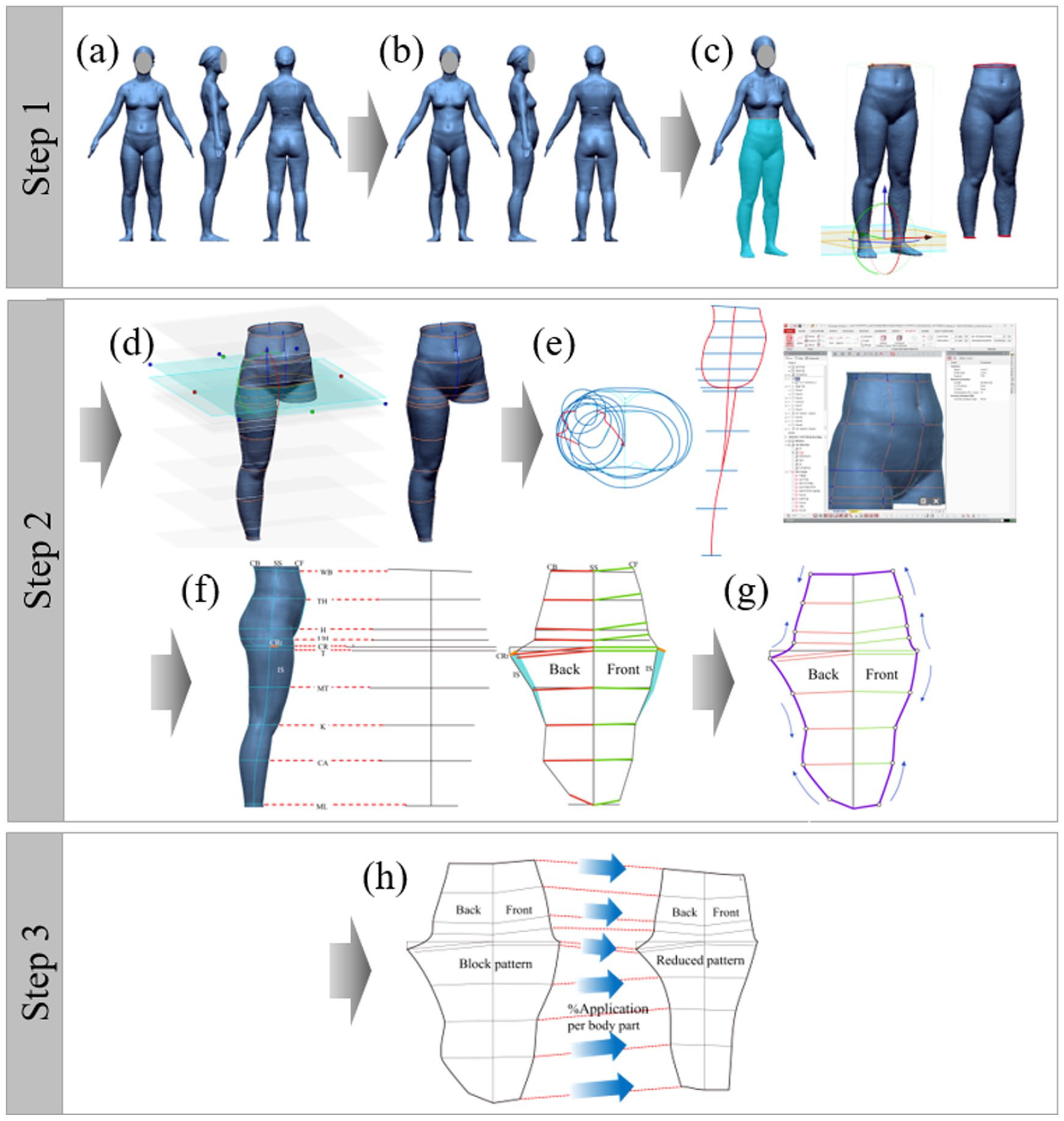
The process of the C-MTM patternmaking method for leggings: Step 1: (a) acquire a human body figure from three-dimensional body scanning; (b) align the mesh and edit the figure surface; (c) cut the waist and ankles through trimming and splitting, Step 2: (d) set horizontal and vertical baselines and create a 3D grid; (e) generate a convex hull curve and measure surface length The red line is the vertical baseline, and the blue line is the horizontal baseline; (f) rotate the horizontal line based on the vertical sideline to align the specific length in a 2D pattern with the surface length in the figure; (g) curve outer lines in a 2D pattern to draw a leggings block patter, Step 3: (h) reduce a leggings block pattern through AP and obtain the final leggings pattern.
Acquisition of the three-dimensional body figure
In designing leggings customized to individual participants, the first step is to conduct 3D body scanning. Nonetheless, as the study participants in a wear test were intended to wear prototypes equivalent to the average size, the average representative body figure identified from a vast database of previous scans was used instead of 3D body scanning to produce prototypes. The sixth Size Korea Survey 42 collected 3D automatic body measurement data from 208 women in their 20s. Excluding outliers, 43 the data of 196 women, whose skewness and kurtosis values have normality, were identified.42,44 The mean and standard deviation (SD) values of body measurements from these women are presented in Table 1. The following inclusion criteria were used to obtain the average representative body figure; first, ±z ⩽ 1 in the body dimensions of girths, heights, weight, and body mass index (BMI) in 196 women as close to the mean values in women in their 20s as possible, and if possible, ±z ⩽ 0.5, second, a symmetrical figure from the front, and third, a straight figure from the side. 45 The z-scores of body measurements from the selected women ranged from −0.450 to 0.797 (Supplemental Material Table S1).
Surface length measurements of the representative body figure.

Drafting a leggings block pattern by the corresponding measurement
The following sequence of drafting a leggings block pattern by the corresponding measurement was used. First, 10 horizontal and four vertical baselines were set for the body figure, and Geomagic Design X (3D Systems, Inc., USA) was used to generate the 3D grid based on horizontal and vertical baselines (Figure 3). Baselines were modified and set in reference to customized pants design as well as standards and studies about the clothing pressure measurement of compression leggings and stockings,10,46 –48 and the definition of baselines was based on landmark points, primary levels, and body dimensions in ISO 8559-1, 49 and the body measurement standard glossary, 50 Second, surface length to be split by 3D grid was measured (Table 1). A total of 21 arc items and 22 length items were set based on ISO 8559-1 49 and the body measurement standard glossary, 50 and Geomagic Design X (3D Systems, Inc., USA) was used for 3D body measurement. Third, the apparel pattern CAD software Super ALPHA Plus (Youth Hitech, Korea) was used to turn surface length measurements into a 2D pattern and draw a leggings block pattern (Figure 4). The principle behind turning surface length measurements into a 2D pattern is to rotate the horizontal line based on the vertical sideline to align the specific length in a 2D pattern with the surface length in the figure and curve the outer line.

Settings of horizontal and vertical baselines: (a) front view, (b) back view, (c) side view, (d) inside view, and (e) inside seamline. The item abbreviations are provided in Table 2.
AP, pattern reduction percentage, and pattern amount for FLs and GLs.

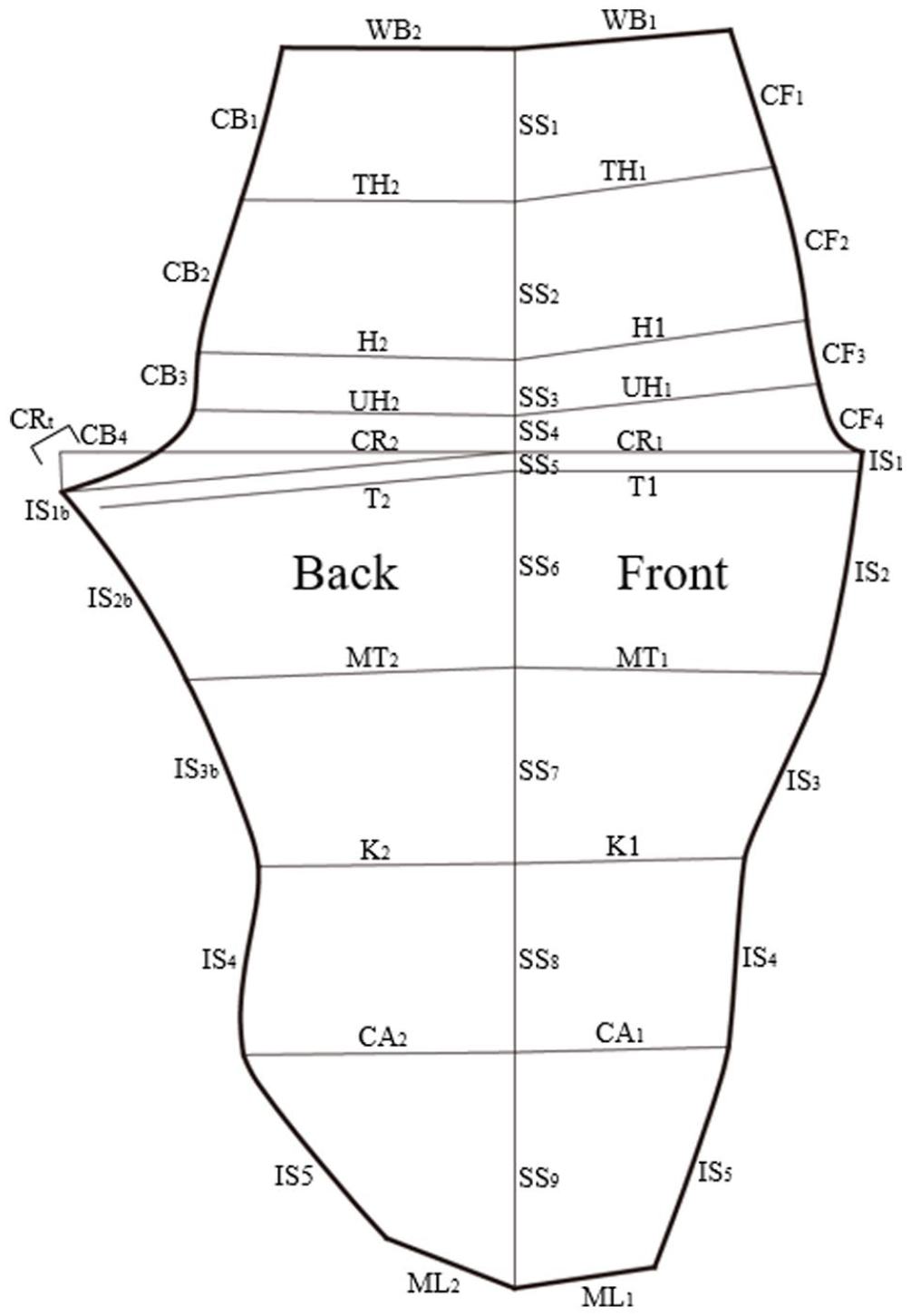
Leggings block pattern and item abbreviations.
Pattern reduction using AP
Considering the material construction, texture, thickness, stretch ratio, and touch based on a report by Seoul National University 51 about compression leggings products, raw materials commonly used to produce leggings prototypes included flat double-sided jersey (polyester/polyurethane = 74/26%) containing elastomer widely used for leggings (creora®, Hyosung TNC., Korea). Physical properties showed AS of this raw material was 168.35% in the course direction and 117.00% in the wale direction (Supplemental Material Table S2).
The reduction amount was obtained by multiplying the block pattern amount, the AS, and the AP as in the following equation 26 :
Pattern reduction amount (mm) = Block pattern amount (mm) × AS (%) × AP (%)
By reducing the block pattern using FAP and GAP, and two types of leggings prototypes were drafted: leggings reduced with fixed application percentage (FLs) and leggings reduced with the graduated application percentage (GLs) (Figure 5). The difference between FLs and GLs was the distribution of AP for arc items. For GLs, AP for arc items exhibited a gradually higher tendency toward the distal. AP for the waistband girth was set as 3%, considering the fit of the waistband not to go down. The top hip girth was set as 8%, hip girth as 10%, underhip girth as 10%, crotch level girth as 12%, thigh girth as 12%, midthigh girth as 17%, knee girth as 17%, and calf girth as 20%. The minimum leg girth which had no gradual tendency, was set as 6% to ensure the minimum girth to don and doff through the feet. The basis of the distribution of GAPs is wear tests of the leggings prototype made with the same stretchy material, which was reversely calculated from the pattern reduction rate used in the previous study. 51 For FLs, AP of arc items such as the top hip, hip, underhip, crotch level, thigh, midthigh, knee, and calf girth was fixed as 12%. Since it is not possible to don and doff if the waistband and minimum leg girth reach 12%, the waistband girth was set as 5%, the maximum girth to ensure to don and doff, while the minimum leg girth was set as 0% to remove tightness at the distal (Table 2). The reason AP differed between the course and wale directions was based on a previous study, which proposed different pattern reduction percentages and APs between the course and wale directions.1,52,53

Final reduced patterns and item abbreviations: (a) FLs pattern and (b) GLs pattern.
Validation of the CMP method for leggings
Participants
The inclusion criteria for participants in a wear test designed to validate the leggings patternmaking method included women in their 20s meeting physical conditions to wear a standardized size of leggings prototype: waist girth, hip girth, stature, and inside leg height, which are primary dimensions for the size of pants and leggings defined by ISO 8559-2, 54 equivalent to the mean values of women in their 20s in the sixth Size Korea Survey. 42 The minimum number of participants required for usability evaluation was five, as demonstrated in a previous study, 55 and 85% of usability issues were identifiable when there were five participants and 94% when there were 10 participants. 56 Based on the above, eight participants were recruited for a fit evaluation interview in this study. The participants’ age, waist girth, hip girth, stature, inside leg height, weight, and BMI mean and SD values are listed in Supplemental Material Table S3. The study proposal obtained approval from the Institutional Review Board of Seoul National University (IRB No. 2104/004-038), and all participants gave informed consent and voluntarily took part in the experiment.
Experiment garment wearing conditions
The experiment included three types of garments: two types of leggings prototypes and a control group (CON). FLs and GLs, which were leggings prototypes, were produced with a difference only in APs. CON was loose jersey shorts 24 and used as the control group under very comfortable conditions without limitations to movement or any tight-fitting element. The top was a crewneck short-sleeved t-shirt (polyester/polyurethane = 91/9%), and they selected the size they believed would fit well. To ensure routine walking patterns, the participants brought their jogging shoes and wore them during the experiment.
Fit evaluation interview through wear test
The fit evaluation questionnaire used to examine the fit suitability of leggings prototypes and validate the new leggings patternmaking method consisted of six questions about fit suitability (appearance satisfaction, dimension satisfaction, compression satisfaction, usefulness in movement, ease of movement, and ease in donning and doffing) selected from usability sub-criteria in the body part-user evaluation questionnaire (BUQUE) 27 for dynamic elastomeric fabric orthosis (DEFO) (Table 3). The evaluation consisted of the overall lower body for ease in donning and doffing and appearance satisfaction, six body parts (waist, hip, thigh, calf, waistband line position, and pants length) for dimension satisfaction and usefulness in movement, four body parts (waist, hip, thigh, and calf) for compression satisfaction, and two body parts (thigh and calf) for ease of movement. 27
Fit evaluation questionnaire.

A body part that was not rated in CON condition.
In the experiment, the participants wore each of the three experiment garments and walked on the treadmill for 35 min. A 1-week interval was set for garment wearing conditions37,57 was because 1 week was considered sufficient time for the effect of the previous experiment garment to disappear as it was reported that the effect of simulative training on the muscle and fascia lasted up to 72 h.58,59 After walking, a fit evaluation interview was conducted about the experiment garments. In the interview, participants were asked to respond on a Likert 5-point scale (1: Strongly disagree, 5: Strongly agree) about each question. In addition, narrative statements were collected as data to prevent misinterpretation and explain the evaluation ratings in detail through qualitative analysis. The researcher transcribed their answer.
Statistical analysis
Fit evaluation ratings were analyzed via descriptive statistics. For fit evaluation ratings, data normality was not recognized by the Shapiro-Wilk test across all criteria (Supplemental Material Table S4). To examine the difference between wearing conditions, the nonparametric Friedman two-way analysis of variance by ranks test was conducted for the three wearing conditions, and a pairwise comparison was added. The nonparametric Wilcoxon signed-rank test was conducted for the two wearing conditions. All statistical analyses were conducted with IBM SPSS Statistics Version 26.0 (IBM, USA), and the significance level of α was set as 0.05 for all the analyses.
Results and discussion
Fit suitability can be understood as part of usability. The concept of usability refers to the extent to which the user can use the product to achieve satisfaction, effectiveness, and efficiency in the context of use. 60 Criteria used in this study included perceived satisfaction, effectiveness, and efficiency for discussion.
Perceived satisfaction across wearing conditions
The analysis of fit evaluation ratings for different body parts showed ⩾4 points in appearance satisfaction across all of the three wearing conditions in terms of perceived satisfaction. There was no significant difference across the three wearing conditions (χ2 = 0.400, p = 0.819) (Table 4). The qualitative evaluation indicated the participants thought all of the experiment garments had a good appearance, and FLs and GLs had a natural appearance even if they are worn in everyday life settings (Table 5).
The mean values of fit suitability variation in the three wearing conditions (N = 8).

Analyzed using the Friedman two-way analysis of variance by ranks test (χ2) or Wilcoxon signed-rank test (z)a. Rated by 5-point Likert scale.
Result of qualitative evaluation with users’ narrative statement.

Dimension satisfaction was found to be outstanding with ⩾4 points across all the three wearing conditions and body parts except for waist dimension satisfaction (3.88) in FLs. While dimension satisfaction was higher in CON on average, no significant difference between the three wearing conditions was observed in any body part (Table 4). According to qualitative evaluation, the participants were satisfied with the size in CON as it was comfy. They felt FLs supported the waist and hip, and GLs supported the thigh and calf. The participants could fully identify how the clothing fit in terms of size for the designated body parts. Some gave the same evaluation rating even though the wearing conditions felt a bit different. In other words, more explanation from the user was considered helpful as the evaluation rating alone may have some limitations. While some stated that they preferred the current waistband line position and pants length, some participants wanted to adjust them. For example, a participant, who enjoyed wearing leggings, wanted to have a higher waistline position. The waistband line of FLs and GLs was set 1 cm lower than the human waistline during patternmaking, and it could be raised higher if it were required to support the waist (Table 5).
Although CON had no compression, it showed more than 4 points in compression satisfaction. Compression satisfaction in FLs and GLs was as outstanding for the hip and thigh as that in CON and great for the calf, while FLs and GLs had a moderate level of compression satisfaction for the waist. The only significant difference in compression satisfaction between the three wearing conditions was observed in the waist (χ2 = 6.462, p = 0.040) (Table 4). According to qualitative evaluation, most participants stated they were satisfied with compression in CON because it was comfy with no irritative element. However, some preferred the garment with compression over that with no compression. There were opinions that FLs were uncomfortable as it was small for the waist and hip, and the evaluation ratings revealed that dimension satisfaction and compression satisfaction for the waist in FLs were slightly lower than that in GLs and moderate. Therefore, it is recommended to increase waist pattern dimensions for FLs as close as GLs. The participants stated they were satisfied with tightness in GLs because it supported the thigh and calf muscle during walking and was helpful for exercise (Table 5).
Hence, the two leggings prototypes ensured satisfaction in appearance, size, and compression in comparison with comfortable and loose shorts.
Perceived effectiveness across wearing conditions
In terms of perceived effectiveness, usefulness in movement in CON was ⩽2 points, and it had almost no advantage during walking. Usefulness in movement in FLs was moderate with less than 4.00, while usefulness in movement in GLs was moderate with 3.50 and 3.63 for the waist and hip and outstanding with 4.38 and 4.25 for the thigh and calf. Usefulness in movement was high in the order of GLs, FLs, and CON (waist, hip, calf: p < 0.01; thigh: p = 0.000) (Table 4). The pairwise comparison revealed the difference between CON and FLs in the hip and thigh (p < 0.05) and between CON and GLs across all body parts (p < 0.01), and usefulness in movement in GLs was up to 0.50 higher than that in FLs, but there was no significant difference (p = 1.000) (Table 6). The qualitative evaluation indicated that CON was comfy but did not support any functionality. The waist in FLs was tighter than in GLs, and some said FLs supported the waist more during walking, while some said it was similar in FLs and GLs. In most opinions, GLs supported lower extremities, stabilized walking, and showed less fatigue as they walked more, and some participants said FLs were functionally better. This was probably why there was no significant difference in the evaluation ratings between FLs and GLs. Additionally, some participants said GLs were very appropriate for exercise because of their soft material texture (Table 5). Such responses showed that raw materials and the sewing technique were appropriate, along with the size.
The mean values of fit suitability variation in the two wearing conditions (N = 8).

Analyzed using the Friedman two-way analysis of variance by ranks test. Rated on a 5-point Likert scale. ** and * in bold = p < 0.01 and p < 0.05, respectively.
As such, the two leggings prototypes were found to ensure better usefulness in movement during walking compared to shorts. Therefore, the new patternmaking method is believed to be more valuable in developing functional leggings.
Perceived efficiency across wearing conditions
In terms of perceived efficiency, ease of movement in the thigh and calf showed 5.00 points in CON and ⩾4 points in FLs and GLs. The significant difference observed in ease of movement between the three wearing conditions was for the thigh (χ2 = 6.615, p = 0.037) (Table 4). The qualitative evaluation revealed that the participants said CON was loose and comfy, and therefore, ease of movement was almost ideal with CON, while it was easy to move with FLs just like pants they were usually wearing and it was easy to move with GLs although it held them tightly. While there were some differences among the participants, all of the three wearing conditions ensured ease of movement. The soft material touch felt in GLs, which other participants mentioned for usefulness in movement, was also mentioned for ease of movement (Table 5).
Ease in donning and doffing was high in the order of CON, FLs, and GLs. CON showed 5 points in ease in donning and doffing, like ease of movement, and it was evaluated as comfortable to wear and easy to use. FLs showed 4.25 points in ease in donning and doffing, and GLs were moderate with 3.25 points. In ease in donning and doffing, there was a significant difference between the three wearing conditions (χ2 = 13.231, p = 0.001) (Table 4). It was notable that the pairwise comparison showed a significant difference between CON and FLs (z = 3.250, p = 0.003) and no significant difference between CON and FLs (z = 1.250, p = 0.634) (Table 6). According to the participants, it was very easy and ideal to don and doff CON compared to typical pants, and it was worth noting that FLs had as outstanding ease in donning and doffing as CON. As the waist in FLs was evaluated as the minimum girth for donning and doffing, it would be possible to suggest increasing waist girth in FLs like the results for dimension and compression satisfaction (Table 5). It seems that GLs had a lower rating of ease in donning and doffing due to their narrow calf.
As such, the two types of leggings prototypes ensured outstanding ease of movement compared to loose shorts, and it was confirmed that FLs had a similar level of ease in donning and doffing to shorts. By contrast, GLs had a moderate level of ease in donning and doffing, which was lower than shorts. These results suggest that usefulness in movement and ease in donning and doffing could potentially conflict. Similarly, Kim and Lee 10 evaluated the fit of compression leggings on the 7-point Likert scale and determined the optimal compression satisfaction in the prototype was 4.5 points for the ankle, 5.5 for the calf, and 5.1 for the thigh, with 4.9 for ease of movement and 6.1 for usefulness in movement. These results demonstrate that it is not easy to satisfy compression satisfaction, ease of movement, and usefulness in movement altogether. Accordingly, it would be desirable to select the distribution of APs depending on the functional purpose of the leggings. In other words, if a high level of compression function is required, leggings design based on GAP would be more appropriate for usefulness in movement even though it would be more challenging to put it on and take it off, while design based on FAP would be more suitable for subjects such as patients or children for whom ease in donning and doffing has a considerable effect on compliance.
In summary, the leggings prototypes based on the CMP method for leggings had outstanding fit suitability. FLs designed based on FAP with as high compression satisfaction as loose shorts had outstanding ease in donning and doffing and moderate usefulness in movement, while GLs based on GAP had outstanding usefulness in movement and moderate ease in donning and doffing. User-oriented fit evaluation consisting of appearance satisfaction, size satisfaction, compression satisfaction, usefulness in movement, ease of movement, ease in donning and doffing validated the new patternmaking method that directly implements a leggings pattern with 3D body scanning and body measurement alone. Such validation resulted from the product made of the representative body figure extracted from a user group and confirmed that this method is fully applicable to the mass-production system.
Conclusions
It is almost impossible for experts to conduct visual observation on leggings. Only waistband line position, pants length, and wrinkles in leggings are observable by the third party. Since whether leggings are appropriately tight can be determined tactilely rather than visually, fit evaluation is essential, directly determined by the wearer. However, studies on fit evaluation in clothing construction tend to be conducted by experts and use an excessively specific evaluation too.61,62 For instance, a body part is divided into the front, side, and back to determine detailed fit conditions. Such an evaluation tool may lose the comprehensive aspect of fit suitability and is too professional and complex for the ordinary user to evaluate. Hence, this study established a fit evaluation questionnaire with an appropriate specificity for the user to fully determine and asked the user to provide a supplementary explanation. The qualitative evaluation with an explanation from the user could provide the reason for the scale-based evaluation ratings, support, and enrich the evaluation results despite the small number of participants. Hence, the user-oriented fit evaluation method was found to determine the advantages and disadvantages of the use of the developed product comprehensively yet specifically. It would be necessary to develop such a user-oriented evaluation tool for other clothing items.
This study presented the CMP method that could implement a leggings pattern with 3D body scanning and body measurement alone for application in industry and research. Through fit evaluation, this method was confirmed as an option to design leggings with outstanding fit suitability in terms of appearance satisfaction, dimension satisfaction, compression satisfaction, usefulness in movement, ease of movement, and ease in donning and doffing for different body parts. This study holds significance as it provides a reference for the principles of the scientific leggings patternmaking method applicable to industry and academia. As FAP was found to have an advantage in ease in donning and doffing, and GAP was found to have an advantage in usefulness in movement, it is possible to select and design the distribution of APs depending on the functional purpose of the leggings. Leggings produced by the proposed method can be used as a baseline smart wearable or functional garment for particular purposes. Baseline leggings that fit the user’s body, support functionally, and adjust tightness for different body parts would ultimately provide utility to the user.
This study has a limitation in that it involved only women. Due to the anthropometric characteristics of the crotch, it would be better to adopt the method for men in a follow-up study after completing it for women. Additionally, there is a need to conduct a study validating the method across different age groups and body shapes. The method holds significance as it applies to not just customized production but also mass-production with the representative body figure extracted for size designation. However, this study provided the results of investigating participants with body dimensions suitable for the one size by the leggings prototypes produced in one size designation assuming mass-production. Therefore, a follow-up study needs to examine the validity of this method for customization.
Supplemental Material
sj-docx-1-jef-10.1177_15589250231163773 – Supplemental material for Corresponding measurement-based patternmaking method for leggings using three-dimensional body scanning technology
Supplemental material, sj-docx-1-jef-10.1177_15589250231163773 for Corresponding measurement-based patternmaking method for leggings using three-dimensional body scanning technology by Hye Suk Kim and Hee Eun Choi in Journal of Engineered Fibers and Fabrics
Footnotes
Correction (July 2023):
Affiliation of the author Hee Eun Choi is corrected after original publication of the paper.
Declaration of conflicting interests
The author(s) declared the following potential conflicts of interest with respect to the research, authorship, and/or publication of this article: HSK is the inventor of the patent (KR Patent No. 10-2022-0014659), which was applied to the Korean Intellectual Property Office by SNU R&DB Foundation.
Funding
The author(s) disclosed receipt of the following financial support for the research, authorship, and/or publication of this article: This work was supported by the New Faculty Startup Fund grant funded from Seoul National University (No. 350-20220075), and by the National Research Foundation of Korea (NRF) grant funded by the Korean Government (MSIT) (No. RS-2023-00213398).
Ethics approval
This study was approved by Seoul National University Institutional Review Board (Ethics Code: 2104/004-038) on April 26, 2022. All participants provided written informed consent prior to enrollment in the study. This research was conducted ethically in accordance with the World Medical Association Declaration of Helsinki.

Supplemental material
Supplemental material for this article is available online.
References
Supplementary Material
Please find the following supplemental material available below.
For Open Access articles published under a Creative Commons License, all supplemental material carries the same license as the article it is associated with.
For non-Open Access articles published, all supplemental material carries a non-exclusive license, and permission requests for re-use of supplemental material or any part of supplemental material shall be sent directly to the copyright owner as specified in the copyright notice associated with the article.
