




Abstract
The main purpose of this experimental study is to determine the thermal properties and the moisture conduction function of a single jersey with a three-dimensional channel structure. As the channel structure of single jersey is gradually applied in the functional sportswear sector, the channel structure has been knitted by single jacquard technology for research purposes. Firstly, the formation principle and the structural unit of knitted fabric with the channel structure were explained. Then, the effects of channel structure with different sizes on thermal insulation, quick-drying, wicking height, and moisture management performance of the fabrics were investigated. Finally, the performance characteristics of the channel structure fabric were analyzed through the channel structure model. The analysis obtains that the channel structure of the sample holds more stagnant air and a large evaporation area. Moreover, as the courses or wales of structural units increase, the thermal insulation rate and the evaporation rate of the fabric improve accordingly. Also, it has a superior effect on the improvement of the wicking effect and the unidirectional transmission of the fabrics. However, when the structural unit exceeds a particular value, the fabric structure begins to deform, which makes its wicking height and unidirectional transmission properties decline. It provides a reference for the design and development of the 3D channel structure of the functional knitted fabric.
Keywords
Introduction
The development trend of knitted products with functional diversification, functional combination, and functional customization has been gradually presented.1,2 Therefore, the functional knitted fabric has become the focus of the research and development of scientific research teams. And, numerous scholars have largely studied the unique, changeable, and rich knitted fabric structure to realize the function of the fabric, and have made significant progress.3,4
Recently, some researches show that unique structure designs bring an excellent function to the fabric, such as channel structure, 5 groove structure, and mesh structure.6,7 Zhou 8 designed a tree-shaped bionic knitted fabric with the moisture conduction channel structure by referring to the “branch structure” of plants, which improved the thermal and moisture comfort performance of the fabric. Zhu 9 constructed many tree-shaped network channels in the vertical direction of the fabric, which formed a continuous water transmission channel structure between the bottom layer and the top layer of the fabric, thus improving the moisture conductivity of the fabric. Luning et al. 10 used the single-sided jacquard process to conduct local stretching and pressing on the fabric to form the folded channel structure. It optimized the arrangement of each temperature control unit, and finally knitted the three-dimensional knitted fabric with excellent dynamic humidity and temperature control performance. Li et al. 11 proposed a design method for fouling-proof cooling (FP-Cool) fabrics with an interactive functional structure for efficient personal thermal regulation by constructing spatially distributed superoleophobic Janus channels on the optimized heat-conducting superhydrophobic fabrics.
It can be seen that the channel structure of fabric presents unique advantages in the thermal properties and the moisture conduction function, as well as the novelty fabric.12,13 At the same time, combined with the excellent softness, comfort, air permeability, and heat dissipation properties of weft-knitted single jersey, 14 the performance characteristics of fabric are greatly improved, making it superior to fabrics such as double-layer fabric.15,16 However, the current research on the channel structure of the fabric is focused on design and development. Meanwhile, because the thermal property of fabric guarantees the body’s constant temperature, 17 and the moisture conduction function of fabric conducts sweat and improves the comfort of clothing, the thermal and moisture comfort of fabric has always been a difficult issue and research direction in fabric design. Thus, there is no complete and detailed experimental scheme to explore the influence of different channel structure fabrics on the thermal and moisture transfer performance of fabrics, failing to get a more optimized design scheme of the channel structure fabric.
This study focuses on the design of the three-dimensional channel structure of the fabric to better realize the thermal and wet comfort function of the fabric. In the first step, we establish the structural unit and structure design principle of the three-dimensional channel structure, and then demonstrate the thermal properties and the moisture conduction function of different channel structure fabrics, including the thermal insulation, quick-drying, wicking height, and moisture management performance of the fabric. Besides, the functional characteristics of the fabric channel structure are simulated and analyzed. In this study, we obtained various trends in the properties of the fabric with channel structure, and we firmly believe that this research would provide some guidance for the design of channel structure fabrics with thermal-moisture function and make it more likely for them to be applied in sports clothing, functional clothing, and summer clothing fields, etc.
Experiment
Design principle of fabric
Through the collocation of different structures, more and more functional knitting fabric structures, such as channels, concave, and convex grooves, have been developed. However, weft knitted single jerseys are very soft and loose, which leads to fewer methods to construct the three-dimensional structure of the fabric, and the float stitch has become the primary way to realize it. For example, the mock rib fabric with the horizontal arrangement of float stitch presents the appearance effect of longitudinal strips in the fabric18,19; And the structure with the longitudinal arrangement of float stitch, the fabric has the appearance of pleats.20,21
The design principle of fabric with a channel structure formed by floating knitting is built in 3D Studio Max. As shown in Figure 1, A1, A2, A3, and A4 are a lower loop structure of the fabric, different tension exerted on the long loop structure, a floating structure, and an upper loop structure of the fabric, respectively. One or more long loops in A1, pass through A3 to connect with A4, forming the channel structural units. The long loops are subject to the elasticity of the yarn, the yarn feeding tension, and the pull force on the yarn during knitting, which begins to shorten the length of the long loop structure, causing local wrinkle and concave in A3. Therefore, the local changes in structural units will lead to surrounding folds. When multiple structural units are arranged tightly, the adjacent folded areas are connected to form a three-dimensional channel structure of the fabric. As shown in Figure 1, A5 is the folded region, and A6 is the three-dimensional channel region.

Channel structural unit and design principle.
The establishment of the structural unit
The fabric structural unit is designed as shown in Figure 2. The courses and wales of the float stitch in the diagram are set as C and W. In the knitting process, the yarn is knitted five longitudinal lines as the A4, and the sixth to C + 5th longitudinal floating lines of the structural unit belong to the A3 zone. Then, the C + 6th to the end of the cycle form the A1. On the other hand, the yarn first knits four wales loops in the longitudinal direction of the structural unit, and then knits W wale floating structure without looping at the fifth horizontal line. Finally, four wales loops are knitted to end the cycle, forming the minimum number of cycles of the structural unit.

Design of structural unit.
The channel structure fabric presents a semi-elliptical tubular shape after the finishing process. However, the actual channel structure of the fabric will be deformed, which is different from the theoretical elliptic structural unit and has an S-shaped surface, but the circumference of the channel structure is the same. According to the above study, the sunken semi-ellipse is composed of the A3 and A5 zone, so the perimeter of the semi-ellipse equals the spacing of C courses. It can be seen that as the C and W of the structural unit change, the channel structure of the fabric presents different sizes. To facilitate the study and analysis, L1 and L2 of the channel structure are established in the X-axis and Y-axis directions. The circumference of the semi-ellipse is calculated as
L周 = π × L1 + 2 × (L2 - L1)
L周 = C × L3
Where: L周 is the circumference of the semi-ellipse. L3 is the spacing of each course.
Therefore, from the theoretical formula and analysis, the width and height of the channel structure are positively correlated with the C value of the structural unit. But the W value of the structural unit also actually has an impact on the width and height of the fabric channel structure due to yarn elasticity, fabric shrinkage, and other factors.
Materials
To reduce the influence of other variables on fabric performance, this study only discusses the influence of fabric channel structure on fabric properties, and we choose the most common yarn in the market as the raw material. Thus, 50D/32F polyester and 20D/50D nylon/spandex-covered yarn are selected to knit experimental samples on the SM8 TOP2 single seamless machine with gauge 28 (Santoni S.P.A, Italy). When the C and W values in the floating area exceed a certain range, the machine knitting needle will be damaged, and the fabric cannot form a three-dimensional channel structure when C is small. Therefore, in this experiment, the channel structure unit with the C value of 12, 20, and 28, and the W value of 1, 2, and 3 are selected to be knitted. The basic parameters of the fabrics are shown in Table 1 and the channel structure fabric effects are shown in Figure 3.
Basic parameters of the fabrics.


Appearance effect of fabric.
From Table 1, it is found that the order of weight and thickness of 10 samples is F10 > F7 > F4 > F9 > F6 > F3 > F8 > F5 > F2 > F1, and the same law is obtained from Figure 3. In addition, the weight and thickness of the fabric gradually increased with the increase of the C or W. And the more C of the structural unit is, the higher the height of the sample channel structure and the larger the width are, which is consistent with the formula results. Due to the increase of W, the number of long loops increases, causing the fabric channel structure to tighten more seriously, so the height of the structure does not change, but the width is weaker. When the size of the structure reaches a certain extent, the channel structure appears in unstable states such as deformation and distortion, which results in different degrees of numerical fluctuation in the height and width of F3, F4, F6, F7, and F10. Furthermore, the more W is, the more stable the structure is, and the smaller the value fluctuation is, while C is the opposite.
Methods
This work was focused on testing the effect of three-dimensional channel structure on the thermal properties and the moisture conduction function of fabrics, including thermal insulation performance, evaporation rate, wicking height, and moisture management properties.
The plate type temperature protector was used to test the thermal insulation performance of experimental samples by GB11048-1989 standard requirements (YG606D, Ningbo Textile Instrument Factory, China). At the beginning of the experiment, a 45-min blank test is carried out first (the time of the blank test varied under different conditions). Then, when the temperature reaches the set value (36.0 ± 0.5°C), the blank test is finished, and the sample test begins. Moreover, the sample was placed on the plate face down, and the average value of the five groups of experiments was taken for each sample.
The excellent moisture evaporation rate of the fabric can quickly adjust the thermal and moisture balance of clothing, which directly affects the wearing performance of clothing. 22 It was used here to characterize the evaporative heat dissipation effect of channel structure fabric. According to the standard of GB/T21655.1-2008, the sample is placed on a plane, and 0.2 ml of water is dropped on the fabric side close to the human skin. It is then weighed and hung naturally in a standard atmosphere. Also, the weight is weighed every 5 min, and the variation law of sample quality with time is drawn.
The effect of the three-dimensional channel structure on fabric capillarity was characterized by testing the wicking height of the fabric. In this experiment, the sample is equilibrated in the experimental environment of temperature (20 ± 2)°C, and relative humidity (65 ± 3)% according to the test standard of FZ/T01071-2008. At the beginning of the experiment, the sample is suspended vertically, and one end of the sample is immersed in laboratory level III water. The liquid height rising along the sample is measured within the specified time.
The liquid moisture management tester can better reflect the moisture conduction and transmission performance of sweat in fabric, and absorption and diffusion indexes in all directions23,24 (Q290, Standard International Group (HK) Limited, China). According to the standard of GB/T21655.2-2009, the 0.9% sodium chloride solution is prepared in the tank, which is drained until the upper sensor can continuously drip out the solution. Then, the reverse side of the sample (the side that fits tightly into the human skin) is placed on the lower sensor, and “Start” is clicked to begin the experimental test. The experimental data of wetting time, moisture absorption rate, diffusion rate of upper and lower layers, one-way accumulation transfer index, and overall liquid water dynamic transfer index (OMMC) are recorded.
Results and discussion
Thermal insulation properties
The data results of each sample are shown in Figure 4. The heat preservation rate of F1 was the lowest. With the change of C and W of the structural unit, the shape of the channel structure changes so the sample has different thermal insulation and heat dissipation effects. The experimental results show that the thermal insulation rate of F2−F10 of the channel structure is greater than that of F1, indicating that the channel structure improves the thermal insulation effect of the fabric, as shown in Figure 4(a).

Thermal insulation performance. (a) The heat preservation rate of the sample, (b) comparison of thermal insulation performance under the same course of samples, and (c) Comparison of thermal insulation performance under the same wale of samples.
In Figure 4(b), the longitudinal variation of the C value from 12 courses to 20 courses greatly improved the thermal insulation effect of the samples, increasing the heat preservation rate by about 22.7%, while the heat preservation rate of the structural samples from 20 courses to 28 courses increased by about 3.5%. The thermal insulation of the sample increases with the structural unit’s C value but gradually levels off. This trend is related to the dimensional stability of the fabric channel structure. Meanwhile, the heat preservation rate from one wale to two wales and from two wales to three wales in Figure 4(c) increased by 6.3% and 17.4%, respectively, which is due to the more W value of structural units, the fabric thickness increased, thus making the heat preservation rate of samples higher. Therefore, course and wale changes of structural units can be used to design functional fabrics with different thermal insulation and temperature control effects, which ensure the body temperature stability of the human body at rest, and protect against diseases such as cold and fever caused by excessive cooling.
Quick-drying of fabrics
Figure 5 shows the change results of the evaporation of 10 experimental samples. F10, F9, F7, and F6 were the first to achieve complete evaporation of liquid within 10–15 min, followed by F4, F5, and F8 within 15–20 min, while F3 and F2 reached evaporation within 20–25 min and 25–30 min, respectively. The evaporation of F1 was the lowest, and the evaporation effect was not completed within 30 min.

Evaporation rate.
It can be seen that the evaporation rate increased with the increase of C and W of structural units because the C value increased and the channel structure became deeper, which in turn increased the surface evaporation area of the fabric. In contrast, the W value increased, which guaranteed the stability of the fabric channel structure and thus indirectly raised the evaporation rate of the fabric. The three-dimensional channel structure design of the sample helps the fabric to evaporate and dissipate heat quickly, realizing the cooling function during human movement, and enhancing the thermal comfort performance of the clothing.
Wicking height of fabrics
Figure 6 shows the wicking height of the sample. It is found that the sweat absorption effects of nine groups of the fabric with channel structure are not all satisfactory. The wicking height of F2, F3, F4, F5, and F8 at 10 min was higher than that of F1, and the wicking effect of F2 was the best. On the contrary, the perspiration height of F6, F7, F9, and F10 samples was lower than that of F1. The same course or wale is then plotted. It can be seen that when the structural units of the sample are in the same course, the core absorption effect of the fabric decreases with the increase of the C value. This is because the channel structure of the sample becomes deeper and wider, or even deformed, resulting in the fabric being unable to provide a suitable channel for water transfer. Meanwhile, when the C value of the structural unit is the same, with the increase in W value and fabric thickness, the difficulty of climbing the liquid inside the fabric increases. Therefore, a suitable channel structure should be applied to the design of moisture transfer fabric to improve the function of moisture and humidity control of clothing.

Wicking height.
Moisture management performance
The grade evaluation of wetting time, moisture absorption rate, and diffusion rate of the upper and lower layers are shown in Figure 7. Figure 7(a) and (b) show the fabric’s moisture management performance with the same C and W, respectively. The 10 samples have almost the same moisture absorption rates of the upper and lower layers because of selecting the same yarns to knit. Besides, the fabric’s wetting time and diffusion rate show a consistent relationship: red line > blue line > green line, which shows that with the increase of C and W of structural units, the wetting and diffusion properties of the fabric gradually decrease.

Moisture management performance. (a) Radar chart of moisture management performance index of the sample under the same wale, (b) Radar chart of moisture management performance index of the sample under the same course.
In addition, the experimental results show that the channel structure has a poor influence on the wetting diffusion of the fabric, and its wetting diffusion property is not as good as that of the plain stitch fabric. Then, by analyzing the transfer mode of water on the fabric with the channel structure, it is found that the wetting diffusion of liquid needs to pass through the sinking part of the channel structure, which increases the difficulty of water diffusion, making the diffusion rate and wetting time of the upper layer less than that of the lower layer. With the increase of C or W, the sinking part becomes larger and longer, which slows down the diffusion rate and wetting time of the fabric, leading to a decrease in the overall moisture transfer ability of the fabric.
Figure 8 represents the comprehensive ability of liquid water dynamic transfer of the fabric. 20 The order of the dynamic transfer index of overall liquid water was F1 > F2 > F5 > F8 > F3 > F6 > F9 > F4 > F7 > F10. With the increase of C or W of structural units, the dynamic moisture transfer capacity of the sample decreases, and the alteration of C leads to a greater change in the overall moisture transfer capacity of the fabric.

Overall liquid water dynamic transfer index.
The one-way accumulation transfer index reflects the ability of liquid water to transfer from the fabric impregnated surface (inner surface) to the permeable surface (outer surface).25,26 The greater one-way accumulation transfer index, the greater the moisture transfer of sweat. 27 As shown in Figure 9, the index of F2 and F5 is larger than that of F1, and F2 has the largest transfer index. The channel structure has a little promoting effect on the one-way transmission performance of the fabric. However, with the increase of C or W, the one-way transmission index of the channel structure sample gradually decreases. Meanwhile, the more C, the more the unidirectional transfer index of the channel structure sample decreases.

One-way accumulation transfer index.
This illustrates that the C value variation of channel structure has the greatest effect on the structural size and stability performance of the fabric. The larger the C value, the longer the structure, and the greater the structural fluctuation, which affects the performance of the channel structure fabric. Therefore, the overall moisture uptake capacity and the unidirectional cumulative transmission index of liquid water on fabric are significantly reduced.
The main reason why the moisture management of channel structure fabric is not as good as that of plain knitted fabric is that the liquid water management tester is not suitable for testing the performance of the three-dimensional channel structure. Besides, subject to the extrusion of the instrument up and down the test disks, the channel structure fabric cannot maintain the structure stable. Nevertheless, this experiment can still show that the fabric’s wetting time, diffusion rate, overall liquid water dynamic transfer index, and one-way accumulation transfer index decrease to different degrees with the increase of C and W of channel structural units. And, for the development of moisture conduction products, the channel structure of samples should avoid designing too many courses and wales of structural units, which will affect the moisture conduction performance of clothing.
Analysis of channel structure and function
The three-dimensional channel structure of the fabric was established in 3DMax software for some summative analysis about the functional principle of the channel structure. When the channel structure of the fabric contacts the human skin, the semi-elliptical tubular shape begins to change into the S-shaped curve tubular shape under the influence of clothing pressure, as shown in Figure 10(a). The curved tubular channel structure supports the entire fabric and creates an air passage structure between the fabric and the skin.
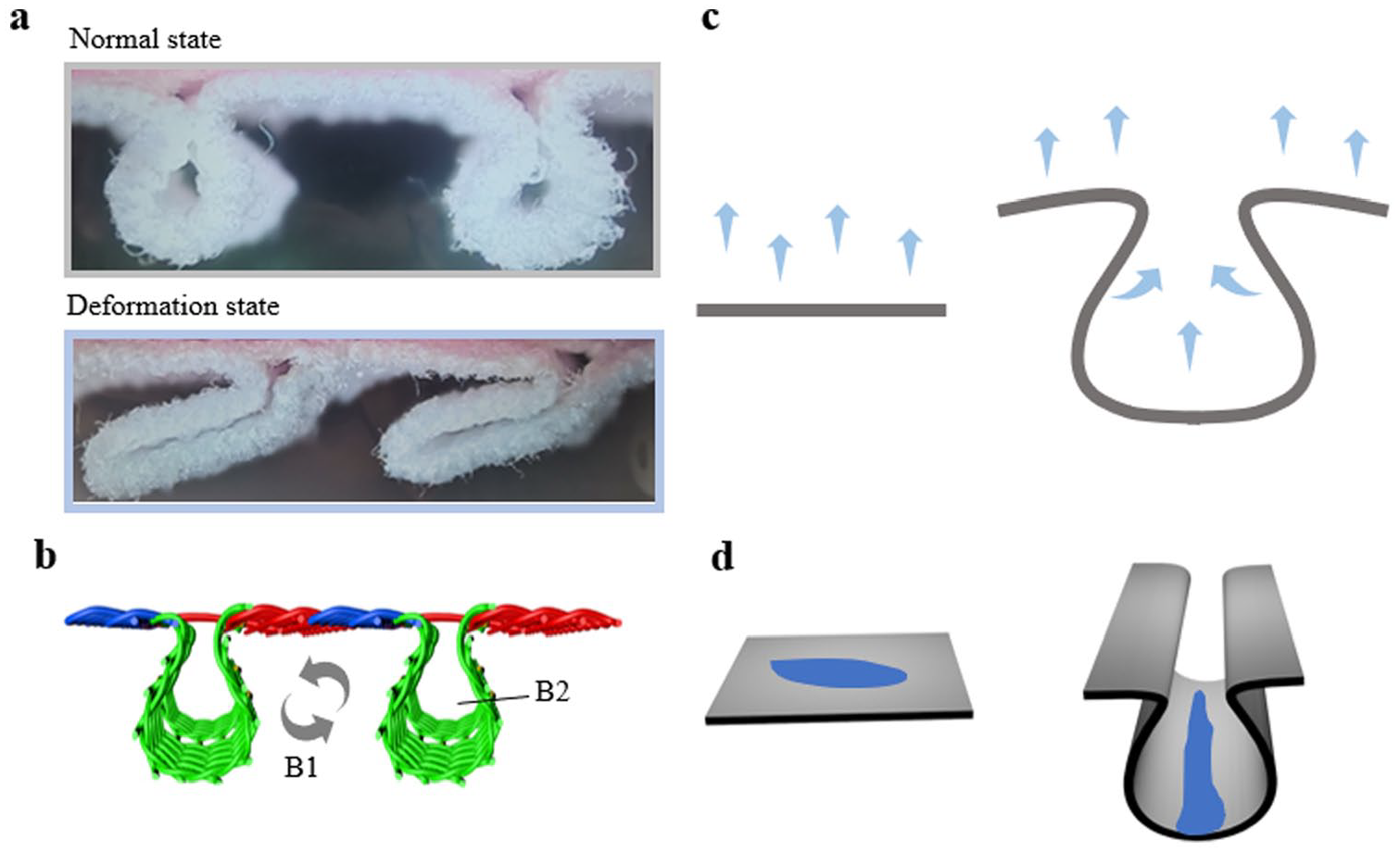
Channel structure. (a) Trend of appearance change of channel fabric, (b) Schematic diagram of insulation performance of channel structure fabric, (c) Schematic diagram of evaporation effect of channel structure fabric, (d) Schematic diagram of water diffusion in channel structure fabric.
Figure 10(b) shows that B1 is the air passage and B2 is the channel. The air inside the passage is isolated from the outside to form a stagnant environment. And affected by the skin temperature, B1 can store more temperature and energy, forming a good temperature control zone, and improving the warmth and protection of the human body.28,29 So, the channel structure has a better effect on the insulation effect of the fabric. Due to the increase of C, the channel structure becomes deeper, and the yarn strength cannot control the stability of the structure. It makes the tubular shape of the S-shaped curve of the channel structure begin to deform, as shown in Figure 10(a), and the scale shape appeared in the fabric finally. Even if the channel structure is ultimately scaly, it also makes the fabric also have a higher insulation rate because the scales overlap each other, increasing the thickness of the fabric. For another, in the case of the increase of W, the structure is tighter and the width of the structure decreases, resulting in the transformation of B2 into a B1 with stagnant air, which significantly increases the heat preservation function of the fabric.
Compared with the plain knitted fabric, with the increase of structural units C and W, the channel structure of the fabric becomes larger, so that the area of the fabric surface in contact with the outside air increases and the evaporation area increases. As shown in Figure 10(c), evaporation occurs from the upper surface of the fabric to the concave surface of the fabric, significantly increasing its evaporation rate. Therefore, the channel structure of the fabric, its derivation and deformation significantly enhance the fabric’s evaporation and heat dissipation function.
The channel structure of the fabric provides a channel wall that facilitates liquid wicking. As shown in Figure 10(d), the structural fabric changes the diffusion direction of liquid on the plain knitting fabric, and the liquid can gradually flow up the channel wall of the fabric. The smaller the channel wall, the more obvious the wicking effect, 30 so with the increase of the C value of the structural unit, the channel structure becomes deeper, and the wicking effect decreases. Moreover, with the increase of W of the structural unit, the channel structure of the fabric gradually thickens, and the liquid is difficult to transfer inside, affecting the capillary wicking effect of the fabric.
Conclusion
In this paper, the three-dimensional channel structure fabric was designed by using the weft knitted jacquard knitting method, and nine structural units were established by using different courses and wales of floating areas. In addition, the thermal properties and the moisture conduction function of samples were tested, and the functional principles of the channel structure were analyzed. The conclusions were as follows:
The channel structure of the sample supports the whole fabric, forming the air passage structure between the fabric and the skin. The air inside is isolated from the outside, holding more stagnant hot air and providing better thermal insulation. The different shape of the channel structure makes the fabric’s surface have a larger evaporation area, accelerate the fabric evaporation rate and enhance the heat dissipation function of the clothing. In addition, by increasing the course and wale of structural units, the fabric with better thermal insulation and evaporation effect can be designed to meet the thermal properties of the clothing. Moreover, the channel structure provides the tube walls for moisture transfer on the fabric, which improves the wicking effect and unidirectional transfer of samples to a certain extent. Conversely, the channel structure of the fabric hinders the wetting and diffusion of liquid on the fabric when the channel structure of the fabric is too large and begins to deform.
By studying the functions of the three-dimensional channel structure fabric, different effects and trends of the channel structure changes on the fabric performance were found. Therefore, for the development of channel structure fabric, the course and wale of structural units should be designed reasonably, so that they can meet better thermal-moisture comfort performance requirements of the product, providing ideas and helping for the development of channel structure functional knitted fabric.
Footnotes
Declaration of Conflicting Interests
The author(s) declared no potential conflicts of interest with respect to the research, authorship, and/or publication of this article.
Funding
The author(s) disclosed receipt of the following financial support for the research, authorship, and/or publication of this article: The author(s) received the National Natural Science Foundation of China (61902150,61772238) and Taishan Industry Leading Talents (tscy20180224) for the research, authorship, and/or publication of this article.
