




Abstract
In this paper a mathematical model of looped warp knitted jacquard fabric is proposed. The technology parameters cover chain notation, threading, jacquard pattern grid and so on are defined based on the matrix. A basic pattern matrix is derived from chain notation and threading using the block matrix. Then combined with the displacement data of jacquard girds, the jacquard pattern matrix is calculated. Finally, the stitch type and stitch position are obtained analyzing the pattern information in the previous matrix. Special stress is laid on the difference between two different displacement data of jacquard girds, RT = 0 and RT = 1, which results in inconsistent lapping for the same jacquard bitmap. The pattern models are implemented and the jacquard lapping bitmap and three-dimensional simulation are generated by a calculating program via Visualstudio2015 using C# and JavaScript. The results show that this model can distinguish two types displacement jacquard information. The parameter input process is simplified and the run time for calculation is also shortened. In addition, with the help of CAD system via the web, priorities including resource sharing, design-time saving, and efficiency improving are achieved.
Introduction
A looped warp knitted jacquard fabric, produced on a warp-knitted single-bar jacquard raschel machine, is the most popular and exquisite fabric for interior decoration, underwear, swimsuit, scarf, and so on. Due to the large pattern scale, complicated structures and repeated basic lapping notation, the design is time-wasted and costly on the repeat of input parameters. The pattern of warp knitted jacquard fabric is formed by the combined effects of the needle selection technology and displacement of jacquard guide needles. With an advancement of piezo jacquard technology, guide needles on jacquard bars are controlled independently according to the pattern information. The recent computer-aided design software has successfully offered simulation methods for warp knitted fabrics. But for the warp knitted fabric with a large pattern, especially the warp knitted jacquard fabric, simple methods for the structure design still deserves a further research.
Up to now, quite a lot of scholars have studied the warp knitted jacquard fabric from different perspectives. There have already many matured models in the aspect of geometric modeling for the warp knitted fabric. Based on the early geometric loop models1,1–3 it has been developed by many scholars and new models were established.4,5 Among them, the stitch model established by Goktepe and Harlock 5 was based on the measured size of the actual stitch and the inclination of the stitch was considered. It was the earlier stitch model whose shape was close to the real stitch shape. Different types of warp knitted loops were analyzed in detail and the geometric models were built using 3DS-MAX with curves,6–8 whose segments were given different angles so that the final stitch models were generated with various shapes. Finite element method was also used in the parametric modeling of warp knitted fabrics. 9 Combined with the warp-knitting process, finite element was used in order to calculate the properties of preforms. 10 The geometric structures of the spacer fabric with constant or non-constant thickness and tubular fabrics were studied and an effective mathematical model for coordinate transformation was proposed, 11 which was convenient to the angle calculation for the whole fabric. Those researches and the models can simulate the stitch shape and the fabric structure very well, but there was no detailed research and description for a great design model of the warp knitted fabrics especially for those with the jacquard technology.
Moreover, especially for jacquard warp knitted fabrics, a simple matrix transformation method for jacquard pattern bitmap was mentioned by Renkens and Kyosev 12 . In this study, the jacquard displacements were represented by several corresponding color grids as a jacquard bitmap, which was converted to a mathematical matrix model containing the underlap and overlap movement for one unit cell. However, only the jacquard displacement of the jacquard bar was presented without the consideration of transformation from the basic chain notation to the jacquard chain notation. Besides, the information of normal guide bars was ignored to be analyzed and modeled. However, the focus was put on the jacquard bars motion and it also represented a direction in the future from sketch to machine data in automated design process. Zhang et al. 13 proposed a deformation simulation method of double jacquard fabric based on the mass-spring model. Similarly, Li et al. 14 used the mass-spring model to realize the deformation of warp knitted jacquard lace fabrics. Appearance simulation of warp knitted jacquard lace fabrics was also discussed with image processing techniques 15 . The key of the visual simulation for warp knitted jacquard fabric was building the position model and the stitch geometry model. The models for the basic parameters were not mentioned in those papers. In addition, another focus is the pattern design for different uses mainly including warp knitted fabric for shoe materials,16–18 warp knitted jacquard terry fabrics,19,20 warp knitted seamless garment21–23 and so on, which involves pattern arrangement and design for the warp knitted jacquard structure. The major contents of the above research were the distribution and arrangement for the jacquard pattern results from the aesthetics and air permeability. And the technology characteristics of warp knitted jacquard fabric were introduced in detail. Moreover, there were also some special type covering warp knitted jacquard spacer fabric 24 and warp knitted dodge lap jacquard fabric 25 and so on. Certainly, there are several computer aided design software mainly produced by professional and commercial groups such as the SAPO Lace Drafting System by CADT 26 in Spain and the ProCad Developer System developed by TEXION 27 in Germany for the warp knitted jacquard fabric.
Although many studies have been conducted on the warp knitted jacquard fabric, modeling the complex structure in a more efficient method is often neglected. Thus, based on the basic chain notation of warp knitted jacquard fabric and the displacement information corresponding to jacquard grids, a simplified model via the matrix is proposed in this paper. Technology parameters covering chain notation, basic patterns, a jacquard pattern bitmap and threading are transferred into machine data to control the design of the warp knitted jacquard fabric in the CAD software. The technology parameters are described and calculated by several matrices, which convert the parameters into a mathematical form that can be recognized by computer programming. Distinguished from the previous studies, the parameterization method for the technical parameters in the design process not only considers the analyzation and calculation of the jacquard information, such as the jacquard bitmap, the jacquard displacement, chain notation and so on, but also describe the information of the ground bars. Therefore, there is no need to re-build the mathematical models for the ground bars separately. Moreover, there is a special feature in jacquard fabric that the stitch displacement is not necessarily the same in one fabric, so that the traditional ergodic method may not be appropriate. Using mathematical matrix models, the displacement elements of the whole fabric can be calculated at the same time which is friendly to the computation load. Another advantage is that this approach is integrated the web technology, the pattern information and the technology parameters are stored because of the application of the interface technique and database in CAD system. Parameters of the selected fabric can be obtained from the databased on the web page so that the repeated input for the same jacquard fabric can be avoided. The requirement of resource sharing is achieved without the limitation of space and application installation.
Structure of warp knitted jacquard fabrics
The looped warp knitted jacquard fabric is knitted with 3~6 ground bars and one jacquard bar for more diverse patterns. Jacquard bar, located in front of ground guide bars, are two half-gauge jacquard bars in split execution controlled by the Jacquard command system. Jacquard bars in half-gauge using separate lapping technology, which can guide lapping not only in the same direction but also in the opposite direction. Figure 1 shows an example of guide-bar arrangement on a warp knitted jacquard machine with the type of RSJ4/1.

Guide bar arrangement of RSJ4/1.
Looped jacquard technology in warp knitting can be divided into technology of 2-needle displacement, 3-needle displacement and 4-needle displacement, which can form the traditional thick stitches, thin stitches and meshes of various sizes. Among them, the pattern knitted by 3-needle and 4-needle displacement technology are more stereoscopic than that knitted by 2-needle displacement technology. However, the selection of knitting technology is not only related to the pattern stereoscopic sense but also to yarn consumption and the cost. 3-needle displacement technology is the most yarn saving one in reaching the same requirement of jacquard patterns. Moreover, it is the only option if the mesh effect is required in the jacquard pattern. Hence, the jacquard design model with 3-needle technique is introduced in this paper. In this kind of technology, ground bars, similar to the normal lapping, are used to form the basic ground structures such as tricot jersey, warp velvet, mesh, ground pillar and so on. Jacquard bars are driven by chain notation of 1-0/1-2// as the basic lapping data.
Jacquard pattern bitmap is the most commonly used representation for the jacquard pattern. Only one jacquard pattern bitmap is used to describe the displacement information of jacquard bars because there is only one jacquard in total on a single-bar warp knitted jacquard machine. In the jacquard bitmap, each gird contains the information of one wale and two courses. While lapping with driven data 1-0 in odd courses and 1-2 in even courses, jacquard needles knitting each course is controlled by the signal H to stay at the original position or controlled by signal T to displace left. As shown in Table 1, chain diagram of thin stitches, thick stitches, mesh and both-course displacement thin stitches are represented by green, red, white and blue grids in the jacquard pattern bitmap. But the lapping effect does not consistent with the design jacquard pattern bitmap design if the displacement data of jacquard grids are directly used for lapping. Because the effects of jacquard needles always lag one wale while knitting even courses. Thus, as shown in Figure 2, in order to knit the fabric matching with the jacquard bitmap, the displacement data in each even course should move horizontally to the right for one wale, which is defined as RT = 1 and the original one is called RT = 0.
Jacquard grid principle in different colors.


Jacquard displacement data: (a) jacquard bitmap and lapping with RT = 0, (b) jacquard bitmap and lapping with RT = 1, (c) jacquard signals with RT = 0, and (d) jacquard signals with RT = 1.
Although only the displacement data in even courses change, both of stitches in odd courses and even courses may change accordingly. Figure 3 shows the different colored combination of jacquard grids in the case of RT = 0 and RT = 1 respectively. Group (a) represents jacquard pattern bitmap of white-green grids, by which the yarn lapping remains unchanged either in RT = 0 or RT = 1. Nevertheless, colored grids matching in other groups result in the transform of displacement data in jacquard grids. The stitch type and position are also changed correspondingly. Take the group (b) for example. When red grids adjacent to white ones, the edges of color grids are covered by lapping yarns of adjacent wales. Pillars in the third wale in Figure 3(b1) corresponding to white grids are covered by the lapping yarn of red grids, which results in the unobvious mesh effect. On the contrary, after displacement data of even courses moving to the right, the second wale transits from red (T/H) to blue (T/T) and the fifth wale transits from red (T/H) to green (H/H). Pillars are not overlapped by lapping yarns on both sides and the mesh effect is formed. The important thing to note here is that, there are only three colors corresponding to three basic structures in RT = 0 initially. However, after the displacement under RT = 1, a new structure is generated that both of the odd and the even courses shift relative to the initial structure, which is represented by the blue grid. Similarly, as shown in Figure 3(c2), in order to match the jacquard effect in Figure 3(c1) where the second and the third wales were supposed to be thick stitches, the third wale transits to green (H/H) and the fifth yarn lapping moves as the red grid defines, so that the third wale and the forth wale are covered with two yarns in each grid matching thick stitches. Therefore, it can be revealed that the displacement data with RT = 1 will lead to the obvious pattern effect and smooth and clear pattern contour matching the actual jacquard pattern bitmap.

The different colored combination of jacquard grids: (a) white–green grids with RT = 0 and RT = 1, (b) red–white grids with RT = 0 and RT = 1, and (c) green–red grids with RT = 0 and RT = 1.
Mathematical matrix modeling
Matrix for basic pattern
The jacquard pattern is affected by lapping of both ground bars and jacquard bars, mainly depending on the quantity of ground bars and jacquard bars, chain notation, threading and so on. Generally speaking, the warp knitted jacquard fabric is knitted more than one bar, so a set of three-dimensional matrices is used to represent the technology parameters. Actually, each three-dimensional matrix can be regarded as the superposition of several two-dimensional matrices, in which each two-dimensional matrix contains information of one ground or one half-gauge bar. The first two pages represent two half-gauge bar jacquard bars respectively and other two-dimensional matrices represent ground bars, so the number of pages of three-dimensional matrix is one more than that of guide bars. In order to ensure the number of matrix pages and guide bars are the same, the page of the three-dimensional matrix is numbered from 0. Page 0 and page 1 show the information of two half-gauge jacquard bars. Supposing that a warp knitted jacquard fabric is knitted by N guide bars, the chain notation is 1-0/1-2/1-0/1-2// with jacquard bars and 1-0/1-2/2-3/2-1// with ground bars. Two half-gauge jacquard bars are threaded every two needles (one threading, one empty/one empty and one threading) separately and the ground bars are threaded fully. Figure 4 shows the matrix model for a basic pattern.

The matrix model for a warp knitted jacquard fabric.
The three-dimensional matrix model shown in Figure 4 is composed of two matrices about chain notation (as shown in Figure 5) and threading (as shown in Figure 6). In the threading matrix, 1 represents the yarn threading and 0 represents empty. In general, the pattern scale of jacquard is very large in one repeat with a complex pattern. Therefore, it is a time-saving and less-working method to describe technology parameters using fewer elements matrix models. The pattern matrix

Combining with the matrix for chain notation, it is observed that every two adjacent columns (an odd column and an even column) in the pattern matrix contain the chain notation information of one yarn. The pattern matrix



Where,

The matrix model for chain notation.

The matrix model for threading.
There is a certain linear relationship among the submatrix

On the basis of equation (2), the basic pattern matrix (1) can be calculated as follow:

Matrix for jacquard pattern
Matrix for jacquard pattern is also composed of matrices for chain notation and threading. Slightly differing from the previous matrix, displacement data from jacquard grids is considered based on the basic pattern matrix


Process of jacquard pattern matrix: Step 1: the jacquard pattern bitmap; Step 2: the mathematical code for jacquard pattern grids; Step 3: displacement data for jacquard pattern grids; Step 4: mathematical code transformed from displacement data, where 0 concerning to H, means staying at the original position while 1 concerning to T means displace left.
It can be obtained from Table 1 that displacement data in the red jacquard grid controls the even course to move to the left by one wale and keep the odd course at the same status. On the contrary, the odd course is controlled to move in the white grid. When the pattern grid is green, both courses stays still while the blue grid controls both courses to move to the left. Hence, the displacement data with RT = 0 of the jacquard pattern bitmap in Figure 7 can be expressed as a matrix C4,8, as equation (8) shows. equation (9) shows that if RT = 1, all even courses move one wale to the right for the sake of the correct jacquard displacement.


As equation (10) shows, a pattern matrix representing all jacquard bars is derived based on the basic pattern matrix

Where, i∈{0,1}, j∈{1,2,3. . .,H}, k∈{1,2,3. . .,W}.

Where,
Matrix for stitch type
The structure of looped warp knitted jacquard fabric is mainly composed of open stitches, closed stitches and pillars. The stitch type can be decided from the chain notation blocked in the pattern matrix. Take the jacquard pattern matrix for example, the lapping path of each yarn is different from others on account of separate control on jacquard needles with the displacement data. So each submatrix
The lapping movement of the guide needle is divided into overlap and underlap. Overlap, defined as OL, can be analyzed by chain notation of the current course. And underlap called UL is calculated by the chain notation at the end position of the current course and at the start position of the next course. When
Stitch type for the looped warp knitted jacquard fabric.

Each stitch type in warp knitted structure is given a number. A three-dimensional matrix L(N+1), H,W (i,j,k) (shown as equation (12)) is established in this paper to store the code of stitch type. li,j,k is the stitch type of the j-th course with the k-th wale on the i-th guide bar.

Matrix for stitch position
The course position of a stitch is fixed in a regular knitting order while the wale position will change with technology parameters including chain notation, threading, especially the displacement data in the jacquard pattern. The numbering rule of lapping is from 0 while for the stitch position is from 1. So the larger one between the two chain notation in one course can be regarded as the stitch position.
Stitch position for warp knitted jacquard fabric can be expressed by a three-dimensional matrix

Where,
Results and discussion
In order to implement the simulation, a simulator named IWKDS is designed in a warp knitted computer-aided design (CAD) system based on the web. The B/S architecture, browser and server, as shown in Figure 8 is applied in this system, which realizes the interaction and data transmission between browser and server. This system is generated by Visual Studio 2015 in window10.

B/S architecture for the warp knitted computer-aided design system.
Clients of this CAD system, which provide users with friendly interface, can be run in different operating systems under network connection on computers, mobile phones and other electronic equipment with web browsers. HTML5 (Hyper Text Markup Language) is used to beautify the Web pages. Product data are input by the client and besides, the rendering results are displayed on it.
Server, including a database server and a web server, is responsible for the web publishing of this CAD system and the storage and transmission for the fabric data, pictures and so on. SQL Server 2008 is used in the database server, which not only authorizes a user table to store user information with different permissions but also store the inputting product information such as the jacquard bitmap, the basic chain notation, yarn specifications et al. The background program is written by C#, a programming language, which is used to retrieve product information, calculate the coordinate and realize other functions.
The interaction between client and server is realized by JavaScript, which is also a programming scripting language and can assist HTML5 to realize the client function. In addition, it can also help to obtain the data from the background program to achieve the data transfer and conversion between them. In particular, the fabric information stored in the server can only be get by those who have access judged by the user table. Computers are not the only option to operate the data inputting and fabric simulation, other mobile equipment such as mobile phones, ipads, and so on are also good carriers to support the design processes. Users use different equipment are shown in Figure 9. As show in Figure 10, the parameter-processing and bitmap-generating are realized by these procedures.

The warp knitted CAD system running in different equipment: (a) simulation on a computer, and (b) fabric information inputting on a mobile phone.

Flowchart for parameter matrixing.
As a general rule, thick stitches, thin stitches and meshes of various sizes can be represented adequately by green, red and white grids in the ordinary small pattern warp knitted jacquard fabric. Therefore, a jacquard fabric with these displacement data is selected as an example (shown in Figure 11(a)). The pattern repeat was 60 courses and 20 wales knitted on an E32 single-bar jacquard raschel warp knitted machine RSJ4/1. The finished density was 41.7 courses and 63 wales in one square centimeter. Before yarn lapping generation, the jacquard fabric was designed in a web-based CAD system IWKDS. Basic parameters include density, basic chain notation, threading, materials, jacquard pattern bitmap and so on. A part of parameters covered chain notation, threading and materials are shown in Table 3. Figure 11(b) is jacquard bitmap with yarn lapping RT = 1 generated by IWKDS system.

Lapping form with jacquard pattern bitmap: (a) a part of real fabric, and (b) a part of jacquard pattern bitmap corresponding to the real fabric.
Technology parameter of a warp knitted jacquard fabric.

means that there is no yarn threaded in this needle.
Figure 12 shows jacquard details of the same part with RT = 0 (a) and RT = 1(b). It can be seen from Part A1 that a red grid is covered by two yarns forming the thick pattern while the green one has only one yarn representing the thin pattern under the displacement data of RT = 1. Part B and Part C in both bitmaps are symmetrical patterns with red-white grids. B0 and C0 show the incorrect lapping compared with B1 and C1. The red grids should be covered with two yarns as that in Part A1 and the white grids contains pillars only. Obviously B1 and C1 follow this rule. Part D0 and D1 keep the structure unchanged with white-green grids. It can be revealed that yarn lapping there is an accurate correspondence between yarn lapping and jacquard pattern bitmap with RT = 1 when the color in the adjacent wale is different, by which the pattern effect of thin, thick and mesh are more precise and the pattern edge is clearer.

Differences between simulation bitmaps with RT = 0 and RT = 1: (a) RT = 0, and (b) RT = 1.
Run time of jacquard patterns with one or several repeats in different proportion of colored jacquard grids were tested. The results were taken from the average value of 60 tests of each pattern. It is concluded from Table 4, that larger pattern consumes more time based on the matrix operation but run time of different patterns with the same scale are similar. In the cases of RT = 0 and RT = 1, run time shown in Table 4 is within 100 ms, which indicates it is a highly efficient method to process parameters of looped warp knitted jacquard by the matrix model.
Run time based on the matrix model of warp knitted jacquard fabrics.

Figure 13 shows three-dimensional simulation of a jacquard fabric with only white grids and red grids. The basic chain notation of either jacquard bars or ground bars are 1-0/1-2//. The warp knitted loop model based on experiences data proposed by Dr Goktepe is used so that the coordinates of a single stitch are obtained. 5 And then smooth tubes are generated along a specific path using Three.js technology. Figure 13(c) and (d) show the three-dimensional simulation with the displacement data of RT = 0 and RT = 1 respectively. It can be revealed that the pattern has a much clear edge when RT = 1 comparing with that of RT = 0. For example, the outline of the back of the head of this skier in the real fabric is a straight line and it can be seen at Figure 13(d), the simulated bitmap with RT = 1. But in Figure 13(c), there are some extra underlaps which affect the clarity under the inaccurate displacement. Another instance is shown at the abdomen and the leg on the left in this picture. Both in the real fabric (Figure 13(a)) and the simulation with RT = 1 (Figure 13(d)), there are significant angles at the connection between the abdomen and the leg, which is not well-represented in simulation with RT = 1 (Figure 13(c)). And combined with the comparison between simulation and the real fabric, the result is that the jacquard pattern bitmap corresponds to the simulation with RT = 1 correctly.
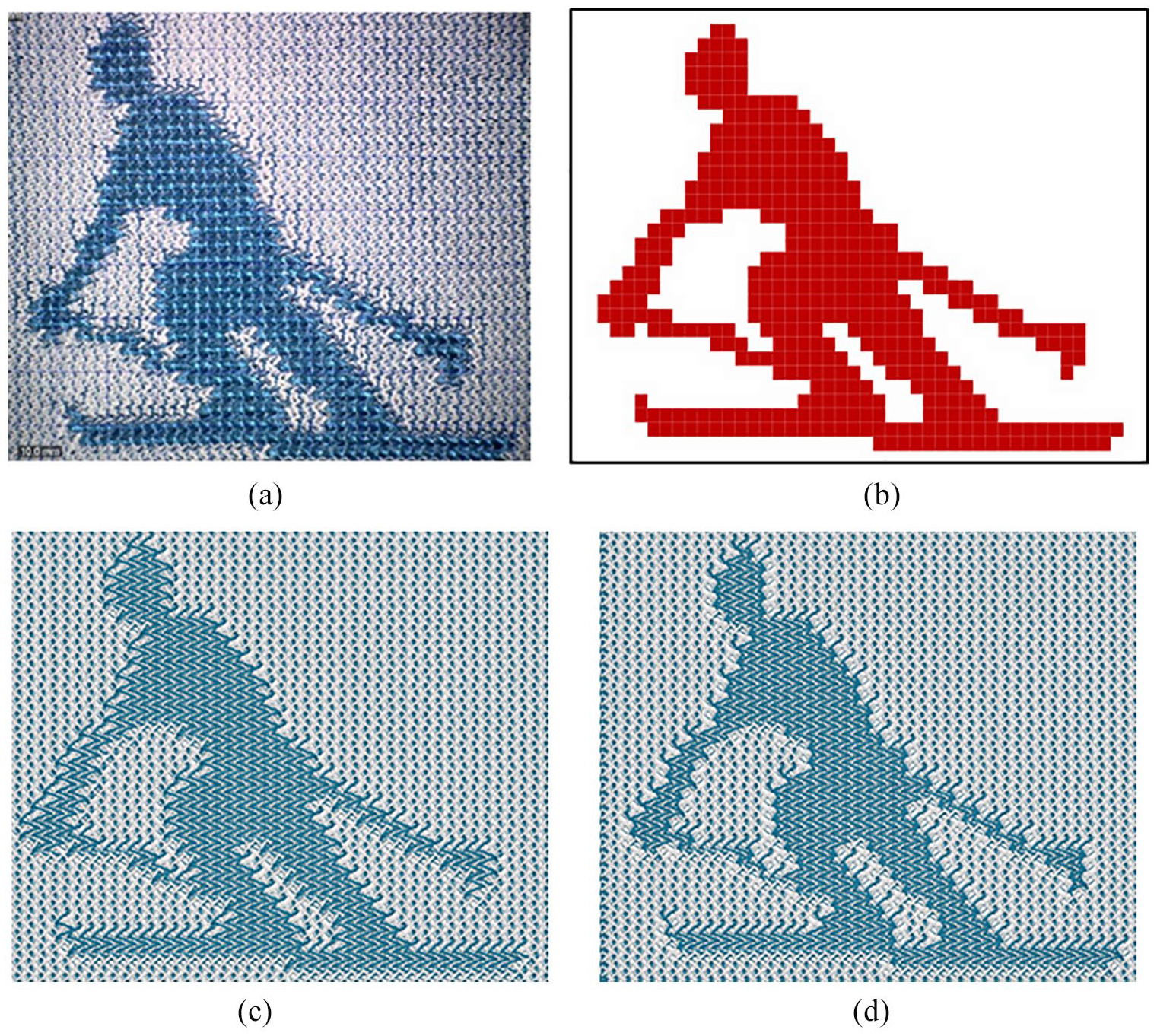
Comparison of three-dimensional simulation using the jacquard model proposed in this paper: (a) a real fabric, (b) a jacquard pattern bitmap, (c) 3D simulation with RT = 0, and (d) 3D simulation with RT = 1.
Conclusion
Via the jacquard pattern bitmap, a matrix for jacquard displacement data corresponding to a complete pattern repeat is established. On this foundation, together with basic pattern matrix, the jacquard pattern matrices for two half-gauge jacquard bars is derived. Then the matrix for stitch type and stitch position is obtained based on the principle of overlapping and underlapping. At last the parameters is transformed on a programming via web technology on Visualstudio 2015 and the final bitmap is generated using HTML5 technology. Also, a comparison between three-dimensional simulation and the real fabric is implemented. The results show that the mathematical method based on the matrix is a highly efficient and time-saving way for warp knitted jacquard fabric designing. Meanwhile, with the web and database technology, fabric resources can be shared without the limitation of space so that the design efficiency is improved.
Footnotes
Declaration of conflicting interests
The author(s) declared no potential conflicts of interest with respect to the research, authorship, and/or publication of this article.
Funding
The authors disclosed receipt of the following financial support for the research, authorship, and/or publication of this article: The authors acknowledge the financial support from Postgraduate Research & Practice Innovation Program of Jiangsu Province[KYCX20_1789], Taishan Industry Leading Talents[tscy20180224] and the Fundamental Research Funds for the Central Universities[JUSRP52013B].
