




Abstract
Many researchers have reported that inter-yarn friction has an important effect on the response of the plain-weave fabric to an impact. However, the effects of inter-yarn friction on impact responses of woven fabrics with other weaves have not been studied in detail. In the present work, numerical analysis was utilized to study the effects of inter-yarn friction on responses of woven fabrics with different weaves (the plain weave, 2/2 twill, 2/2 basket, and 3/1 twill) to a low-velocity impact. Both inter-yarn friction and the weaves of the woven fabrics greatly influenced the responses of the fabrics to a low-velocity impact. The higher the inter-yarn friction, the higher the levels of the tensile stresses concentrated near the centers of impact of the woven fabrics, and the earlier the failures of the fabrics. In addition, the greater the inter-yarn friction, the higher the velocities of the transverse stress waves in the woven fabrics, and the more effective the distributions of impact energy from the primary yarns of the fabrics to the secondary yarns of the fabrics. Although it had the lowest velocity of the transverse stress wave, due to its firmly interlaced yarns, the plain-weave fabric had the highest total energy absorption capacity among the woven fabrics with the different weaves. On the other hand, due to its loosely interlaced yarns, the 3/1 twill fabric had the lowest total energy absorption capacity among the woven fabrics.
Introduction
Woven fabrics made from high-performance fibers with excellent strength-to-weight ratios are materials frequently used for producing ballistic resistant materials. The woven fabrics include aramid fabrics such as Kevlar® (by DuPont) and Twaron® (by Teijin), ultra-high-molecular-weight polyethylene (UHMWPE) fabrics such as Dyneema® (by DSM) and Spectra® (by Honeywell), and poly(p-phenylene-2,6-benzobisoxazole) (PBO) fabrics such as Zylon® (by Toyobo). Being strong, flexible, and light, the woven fabrics are widely used for producing soft body armor.
Impact resistance properties of high-performance fabrics have been studied extensively Since the 1990s.1–3 In recent years, researchers have investigated the impact performance of high-performance fabrics from various perspectives, for example, by studying the ballistic performance of fabrics through experimental methods,4–6 numerical methods,7–9 coating effect,10–12 and low-velocity study.13–15 Since the development of new high-performance fabrics with excellent ballistic-impact properties is time-consuming, researchers have been optimizing the physical properties of existing high-performance fabrics. The structure of a ballistic fabric is complex: the fabric consists of stacked layers of high-performance fabrics, and each of the layers is interwoven by thousands of yarns. Each yarn is composed of hundreds to thousands of high-performance fibers. Therefore, diverse factors affect the ballistic-impact resistance of ballistic fabrics. These factors include not only the factors related to the fabrics (e.g. the weaves of the fabrics, GSM, coating, and thickness), but also the factors related to the yarns (e.g. the crimp, moduli, strength, linear densities, and fracture strain of the yarns).
Inter-yarn friction is a vital factor influencing the physical and ballistic-impact properties of woven fabrics. Through an experiment, Briscoe and Motamedi, 16 who measured inter-yarn friction in fabrics under quasi-static conditions and high-velocity-ballistic-impact conditions, showed that the interfacial friction that dissipates at fiber-fiber and yarn-yarn junctions determines the stiffness of the fabrics. Bazhenov 17 studied the influence of water on the ballistic-impact properties of a rectangular laminate consisted of 20 layers of “Armor” fabric. A projectile with a spherical tip was used to impact the laminate, which was attached to a Plasticine base. When the wet laminate was pierced, the dry laminate stopped the projectile. The author hypothesized that water acts as a lubricant that reduces the friction between the projectile and the laminate.
Experimental studies have improved the understanding of ballistic-impact properties of fabrics. However, due to the difficulty in obtaining detailed information on deformation and failure of fabrics through experiments, it is difficult to study the influence of physical properties of fabrics on the impact resistance of the fabrics through experiments alone. 18 In recent years, numerical methods have been commonly used to study responses of high-performance fabrics to an impact. Duan et al. 19 used LS-DYNA, a commercial finite element program, to model the ballistic impact of a spherical projectile on a square single-ply woven fabric on which three types of boundary conditions were applied. On the basis of the results of numerical analysis, the authors indicated that friction increases the number of yarns absorbing the impact energy and therefore increases the amount of energy absorbed by the fabric. On the basis of their numerical studies, in the works,20–22 the authors reported that excessively high inter-yarn friction reduces the energy absorption capacity of the plain-weave fabric. However, on the basis of their numerical investigations, authors in the works23–27 concluded that increasing inter-yarn friction by a certain degree improves ballistic-impact performance of fabrics. The higher the inter-fiber friction and inter-yarn friction, the more optimum the arrangement of fibers and yarns, and the more effective the distribution of stress throughout the fibers and yarns. 28
Although researchers have studied the effects of inter-yarn friction on the impact performance of the plain-weave fabric, the effects of inter-yarn friction on impact performance of woven fabrics with other weaves have never been understood. Even though Zhou et al. 20 and Sun et al. 21 have studied the effects of inter-yarn friction on impact performance of woven textiles with different weaves, however, the weaves were based on changes to the plain weave. Whether other types of weaves will show the same tendency to respond to the changing of inter-yarn friction as plain fabrics is an interesting area well worth exploring.
Furthermore, because almost all existing reports focused on the effects of impact responses of fabrics to medium-velocity and high-velocity impacts (30–1000 m/s) only, there is little known about the effects of impact responses of fabrics to low-velocity impacts (below 30 m/s). Most of the existing studies on low-velocity impact related to fabrics just focused on fabric-reinforced composites, resulting in low-velocity impact research to pure fabric almost blank. In addition, simulating responses of fabrics to low-velocity impacts is challenging and costly because low-velocity impacts require more time to penetrate fabrics than do high-velocity impacts. the CPU calculation time of low-velocity impact maybe times and even a dozen times longer than high-velocity impact because time step in explicit schema is always much lower to ensure the calculation precision.
Therefore, it is still crucial for current engineering to further understand the impact response to fabrics with different weave under condition of different mechanical and physical parameters. The present work endeavors to comprehensively investigate the effects of friction on responses of different weaving type (the plain weave, twill, and basket) of high-performance fabrics to low-velocity impacts. Large amount of computing time cost in this study for trying to make a great breakthrough in the research area of low-velocity impacts on soft body armor.
Numerical simulation
Construction of a numerical simulation model of impact responses of fabrics
A numerical simulation model of responses of fabrics to low-velocity impacts was constructed according to our previous study. 12 Thus, a brief description of this impact model and parameters are summarized below. The impact model then validated on the basis of experimental results.
Ansys®, commercial finite element software, was utilized to simulate an impact test that uses a low-velocity impact, the projectile was assumed to be a rigid body. A hemispherical head with a diameter of 12.7 mm and a mass of 7.07 kg were used to simulate the projectile used in practical impact tests. The high-performance plain-woven fabric Twaron® CT 612, provided by TENJIN™ (Japan) was employed in this study. Twaron® yarn was modeled to have a lenticular cross-section, 29 the path of the yarn was simulated using an elliptic curve, and the yarn was considered a continuous solid with the same properties as the fiber. After determining that a simple circle-packing geometry generated the highest volume ratio (0.91) of the yarn, of which the fiber was assumed to have a circular cross-section, the density of the yarn (ρyarn) and density of the fiber were designated to be 1310 and 1440 kg/m3, respectively. According to measurements of the real fabric using a digital microscope, the width and height of the cross-section of the yarn were designated to be 0.902 and 0.100 mm, respectively, and the wavelength of the yarn was designated to be 1.818 mm. The woven fabric was simulated at the yarn level. The thread densities and linear densities of the warp and weft yarns were designated to be 11 threads/cm and 550 dtex, respectively, and the thickness of the fabric was designated to be 0.2 mm according to real fabric.
The numerical simulation model was created according to the experimental setup, fixed circumference of the fabric is set as boundary condition. The coefficient of friction between yarns (0.3) was adopted from Huang et al. 30 The coefficient of friction between the projectile and the fabric was set at 0.2. 9 After being analyzed, the dynamic mechanical parameters of Twaron® yarn were applied to the numerical simulation model to study the effects of the velocity of an impact on the mechanical properties of the yarn by using a three-element viscoelastic model.
Experiment and model validation
INSTRON™ Pneumatic Dynatup System 9250HV drop-weight impact tester was used to conduct the impact experiment, as shown in Figure 1(a). The test system is suitable for a wide variety of applications. The target holder sandwiches the specimen between two rectangular steel plates that have circular central holes. A standard diameter of 12.7 mm hemispherical-head projectile made from 4340 steel was used. Once the impact begins, the impactor drops from a predetermined height and the steel hemispherical impactor hits the center of the test sample between the round-clamped plates. The impactor is guided by two smooth columns and can rebound automatically after its initial impact to avoid restrikes. The minimum impact weight of 7.07 kg was used in tests. According to Nayak et al.,31,32 standard test method for body armor used in protection plays a vital role in experimental results, and the present tests followed to the ASTM D7316 standard. 33

(a) A 9250 HV drop weight impact tester and (b) specimen after impact at 8 m/s.
In this work, a size of 10 cm × 10 cm of the Twaron® fabric specimens were prepared and then sandwiched and bonded between two treated plywood plates using superglue. The 5 mm-thick plywood plate was first cut to the same size of the specimen, after that a 7 cm-diameter hole was cut into the middle of the plate, because 7 cm is the size of the pneumatic clamp hole. Impact tests of Twaron® fabric with single layer were conducted between impact velocities ranged from 4 to 20 m/s with an interval of 4 m/s based on the abovementioned experimental setup, detailed experimental and specimen setup are available in our previous work. 12 To ensure repeatability, at least five specimens were tested repeatedly for each designated velocity. Figure 1(b) demonstrates the specimen after impact at 8 m/s. In order to validate the model, the results of the energy absorption in the experimental tests and FE simulations were compared. Figure 2 shows the correlation between the FE predictions and the average experimental results in terms of energy absorption. The gradients of the regression lines for energy absorption were 0.9989, which indicates the validity of the model.

Comparison of energy absorption between experimental and FE simulation results.
Simulations of responses of woven fabrics with different weaves to a low-velocity impact
On the basis of the numerical simulation model, numerical simulation models for replicating responses of woven fabrics with different weaves (the plain weave, 2/2 basket, 2/2 twill, and 3/1 twill) to a low-velocity impact were constructed. The geometric parameters of various fabrics were kept consistent as much as possible to allow a comparison of only the effects of the weave factor. The yarns in all types of weaves had the same cross-section size and yarn spacing, the woven fabrics were identical in thickness, length, and width. Due to the interlacing pattern of the yarns in the plain-weave fabric, the fabric had a higher crimp rate than did the other woven fabrics. The geometric parameters of the woven fabrics with the different weaves are shown in Table 1, and the impact models of the fabrics are shown in Figure 3.
Geometric parameters of woven fabrics with different weaves.


Impact models of woven fabrics with different weaves.
A uniform 8 m/s initial velocity was applied to the projectile, and different levels of inter-yarn friction (0.1, 0.3, 0.5, 0.7, and 0.9) were designated to each impact model. On average, simulating the impact response of a one-layer woven fabric (the plain-weave, 2/2 twill, 2/2 basket, or 3/1 twill fabric) required 60 h. The simulation was accomplished using a central processing unit (CPU) with Intel Xeon 12 Core and 64 GB RAM.
Results and discussion
Effects of inter-yarn friction on the distribution of stress in different weaves
Responses of primary yarns to a low-velocity impact
Primary yarns are yarns that contact the projectile directly. When a projectile impacts on a fabric, the yarns in the fabric experience stress due to the impact and deform. When the stress increases above the maximum stress the yarns can withstand, the yarns break. Primary yarns are critical for resisting an impact. The central primary yarn was selected as the representative primary yarn and the stresses the yarn experienced were measured on the central plane on the back surface (i.e. opposite to the impact surface) of the central primary yarn. The stresses were measured along the distance from the impact center to the fixed boundary of the fabric.
Tensile stress
Tensile stress is the stress component acting along the axes of yarns. To clarify the influence of inter-yarn friction on the distributions of stress along the central primary yarns of the woven fabrics with different weaves, at the selected moments of impact (0.3, 0.5, and 0.7 ms), the levels of the tensile stresses produced along the primary yarns of the fabrics were plotted against distances from the impact centers of the fabrics (Figures 4–7). In the woven fabric with a particular weave, regardless of the level of inter-yarn friction, tensile stress propagated at almost similar speed. However, the distribution and magnitude of the tensile stress were affected by the level of inter-yarn friction.

Effects of different levels of inter-yarn friction on the distribution of tensile stress along the central primary yarn of the plain-weave fabric: (a) at 0.3 ms, (b) at 0.5 ms, and (c) at 0.7 ms.

Effects of different levels of inter-yarn friction on the distribution of tensile stress along the central primary yarn of the 2/2 twill fabric: (a) at 0.3 ms, (b) at 0.5 ms, and (c) at 0.7 ms.

Effects of different levels of inter-yarn friction on the distribution of tensile stress along the central primary yarn of the 2/2 basket fabric: (a) at 0.3 ms, (b) at 0.5 ms, and (c) at 0.7 ms.
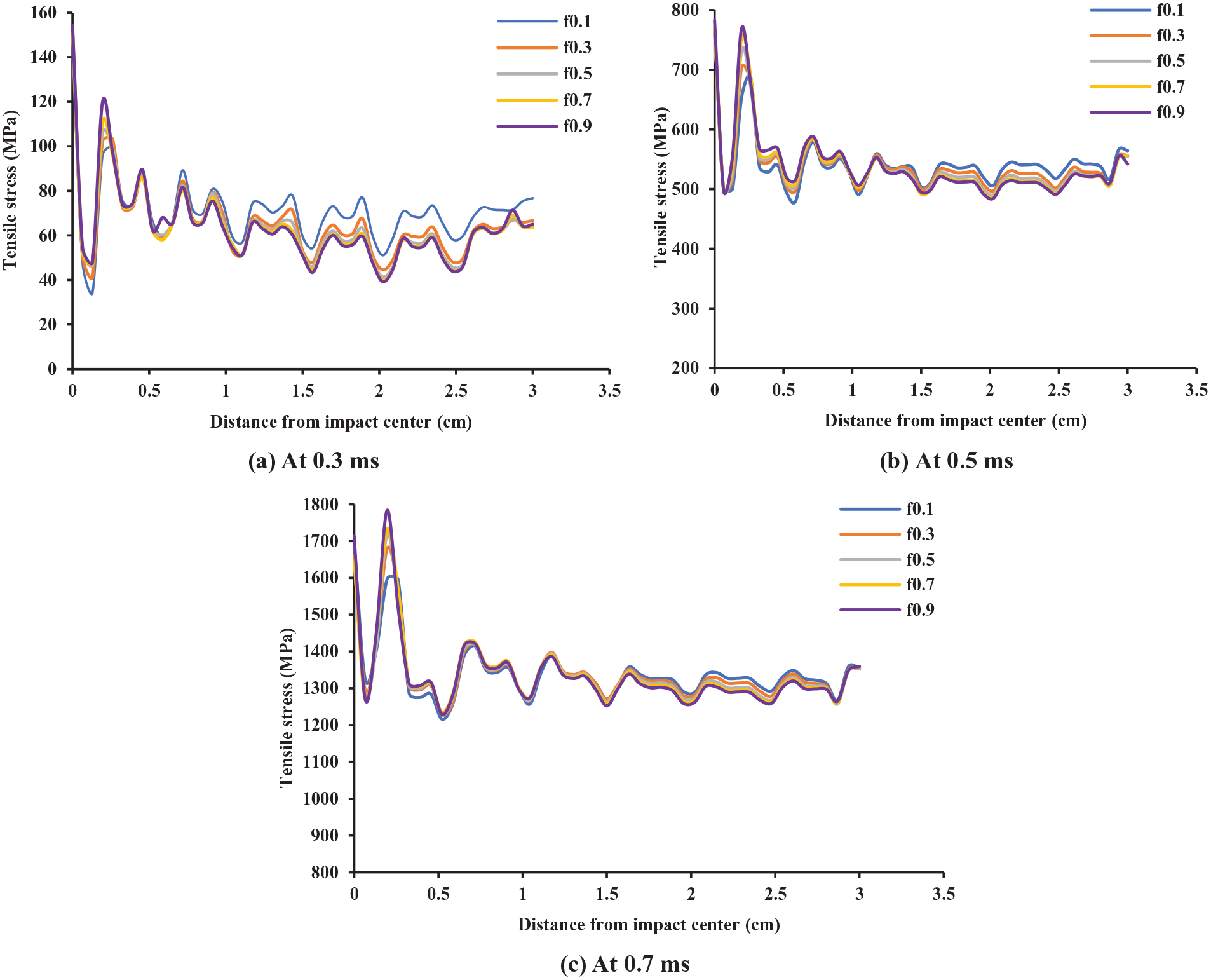
Effects of different levels of inter-yarn friction on the distribution of tensile stress along the central primary yarn of the 3/1 twill fabric: (a) at 0.3 ms, (b) at 0.5 ms, and (c) at 0.7 ms.
Figure 4 demonstrates the effects of different levels of inter-yarn friction on the distribution of tensile stress along the central primary yarn of the plain-weave fabric. At the early stage (0.3 ms) of the impact process, the higher the inter-yarn friction, the higher the level of the tensile stress distributed throughout the central primary yarn. On the other hand, at the middle and late stages (0.5 and 0.7 ms) of the impact process, under high inter-yarn friction, near the impact center, the yarn is more stressed under higher inter-yarn friction, and conversely, near the fix boundary, the yarn is less stressed. As shown in Figure 5, at every stage of the impact process, the higher the inter-yarn friction, the higher the level of the tensile stress distributed throughout the central primary yarn of the 2/2 twill fabric. As shown in Figure 6, under different levels of inter-yarn friction, at the early and middle stages of the impact process, the distribution of tensile stress along the central primary yarn of the 2/2 basket fabric is similar to that along the central primary yarn of the 2/2 twill fabric: the higher the inter-yarn friction, the higher the level of the tensile stress distributed throughout the central primary yarn of the 2/2 basket fabric. However, at the late stage of the impact process, the effect of the level of inter-yarn friction on the distribution of tensile stress throughout the central primary yarn of the fabric is less evident. As shown in Figure 7, under higher inter-yarn friction, at every stage of the impact process of the 3/1 twill fabric, it’s noticeable that near the impact center, the yarn is more stressed, and conversely, near the fix boundary, the yarn is less stressed.
In all of the woven fabrics with the different weaves, in general, under higher inter-yarn friction, at the part of yarn close to the center of impact, the higher levels of the tensile stresses distributed. This stress distribution trend indicates that stress concentrates more severely around the impact center under higher levels of inter-yarn friction in all kinds of weaves. The concentration of tensile stress is undesirable because it leads to the premature failures of the woven fabrics. Therefore, the higher the inter-yarn friction, the earlier the failures of the woven fabrics due to the low-velocity impact.
As shown in Figures 4–7, in each of the woven fabrics with the different weaves, the maximum tensile stress does not occur at the geometric center of the fabric. Rather, it occurs at a relatively small distance from the center. Compared to the plain-weave and 3/1 twill fabrics, the 2/2 twill and 2/2 basket fabrics are more likely to fracture at locations close to their geometric centers.
The level of the tensile stress distributed on the central primary yarn of the 3/1 twill fabric was the highest, followed by 2/2 basket and then plain-weave, while the 2/2 twill fabric was the lowest. Figure 7(c) shows that at the moment of impact of 0.7 ms and inter-yarn friction of 0.9, the tensile stress distributed near the impact center of the 3/1 twill fabric reaches 1712.9 MPa, the highest among all weaves. In comparison, Figure 5(c) shows that at the moment of impact of 0.7 ms and inter-yarn friction of 0.9, the tensile stress distributed near the impact center of the 2/2 twill fabric reaches the lowest of 1251.1 MPa among all weaves. As mentioned above, the concentration of tensile stress around the impact centers of the woven fabrics will result in the premature failures of the fabrics. Therefore, the higher the tensile stresses concentrated around the impact centers of the woven fabrics, the shorter the impact-resistance time of the fabrics, and the lower the energy absorption capacities of the fabrics. Accordingly, the 2/2 twill fabric, which experienced the lowest level of tensile stress, is the woven fabric with the desired weave as it had the longest impact-resistance time among the woven fabrics with the different weaves, followed by plain-weave and then 2/2 basket, while 3/1 twill reached the shortest impact-resistance time, which can be seen in Table 2.
Effects of different levels of inter-yarn friction on impact-resistance time of woven fabrics with different weaves.

Shear stress
When a fabric is subjected to an impact, the yarns in the fabric are subjected to tensile stress and shear stress. Shear stress is the stress component acting on the cross-section of yarn. At different moments of impact, effects of different levels of inter-yarn friction on the distributions of shear stress along the central primary yarns of the woven fabrics with the different weaves are shown in Figures 8–11. The figures show that the levels of the shear stresses distributed along the central primary yarns of the woven fabrics are lower than the levels of the tensile stresses distributed along the central primary yarns of the fabrics. Therefore, on contact with a low-velocity impact, the fabrics are more likely to fail due to tensile failure than they are due to shear failure. Throughout the impact process, regardless of the weaves of the woven fabrics, the higher the inter-yarn friction, the higher the levels of the shear stresses distributed on the central primary yarns around the impact centers of the fabric. According to Briscoe and Motamedi, 16 the higher the inter-yarn friction, the higher the modulus of a fabric in the transverse direction, and the stiffer the fabric. Therefore, the higher the levels of the shear stresses distributed on the central primary yarns of the fabrics near the impact center.
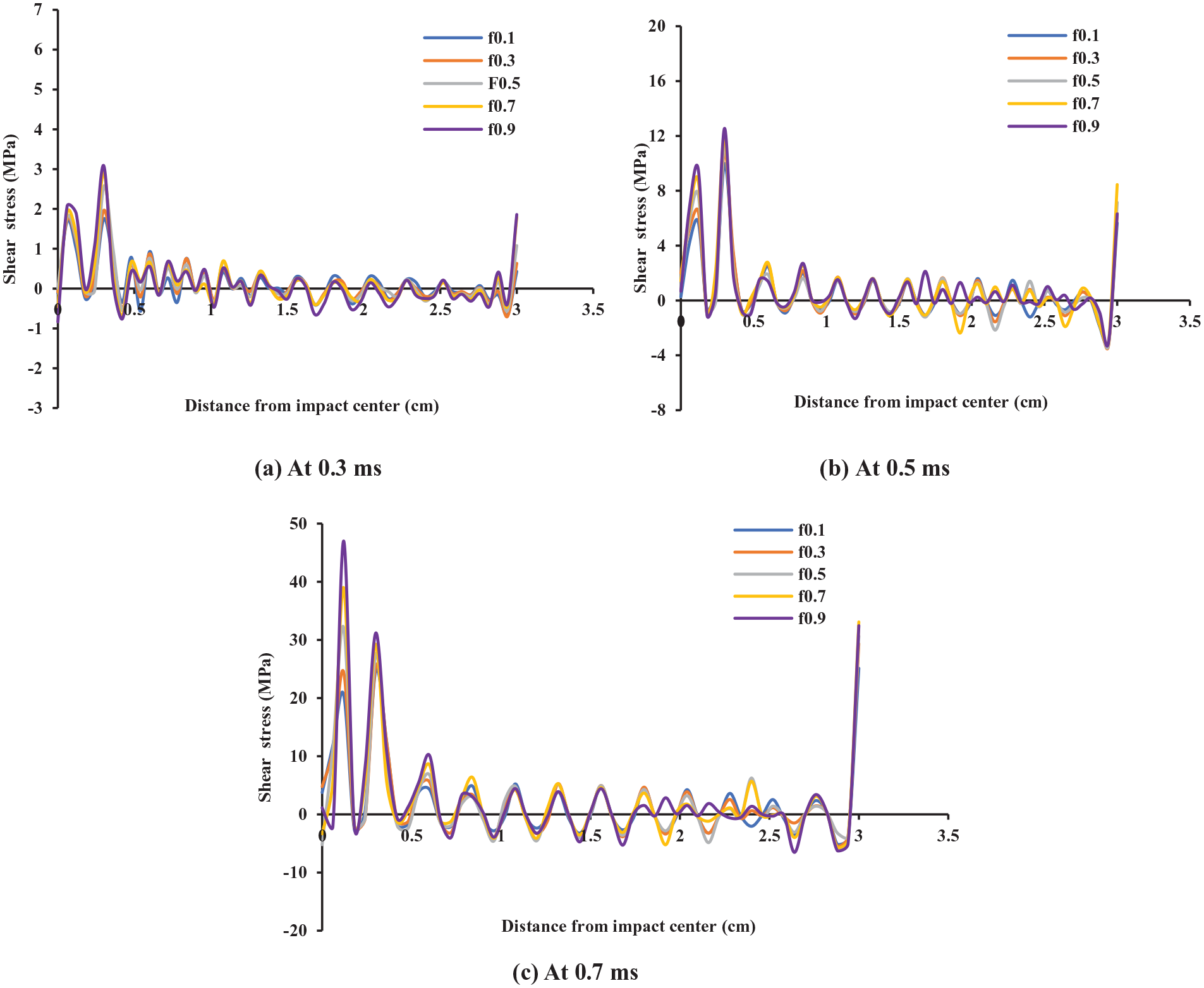
Effects of different levels of inter-yarn friction on the distribution of shear stress along the central primary yarn of the plain-weave fabric: (a) at 0.3 ms, (b) at 0.5 ms, and (c) at 0.7 ms.

Effects of different levels of inter-yarn friction on the distribution of shear stress along the central primary yarn of the 2/2 twill fabric: (a) at 0.3 ms, (b) at 0.5 ms, and (c) at 0.7 ms.

Effects of different levels of inter-yarn friction on the distribution of shear stress along the central primary yarn of the 2/2 basket fabric: (a) at 0.3 ms, (b) at 0.5 ms, and (c) at 0.7 ms.

Effects of different levels of inter-yarn friction on the distribution of shear stress along the central primary yarn of the 3/1 twill fabric: (a) at 0.3 ms, (b) at 0.5 ms, and (c) at 0.7 ms.
Figure 8 demonstrates the distribution of shear stress along the central primary yarn of the plain-weave fabric. Shear stress is concentrated around the impact center and fixed boundary of the fabric. In the late stage of the impact process, the stress near the impact center increases fast, the increase rate of the shear stress distributed near the impact center of the plain-weave fabric is the highest among the increase rates of shear stresses distributed near the impact centers of the woven fabrics with the other weaves. Figure 9 demonstrates that the distribution of shear stress along the central primary yarn of the 2/2 twill fabric is similar to that along the central primary yarn of the plain-weave fabric. At the early and middle stages of the impact process, the levels of the shear stresses distributed along the central primary yarn of the 2/2 basket fabric are the highest among the levels of the shear stresses distributed along the central primary yarns of the woven fabrics with the different weaves. Figure 10 shows that the distribution of shear stress on the central primary yarn of the 2/2 basket fabric is unique: shear stress is concentrated not only around the impact center and fixed boundary of the fabric but also the center of the yarn. Figure 11 shows the distribution of shear stress along the central primary yarn of the 3/1 twill fabric. The levels of the shear stress distributed along the central primary yarn of the 3/1 fabric are the most dispersed and the lowest among the levels of the shear stresses distributed along the central primary yarns of the woven fabrics with different weaves. Generally, regardless of the weaves, the higher the inter-yarn friction, the higher the levels of the shear stresses distributed on the central primary yarns around the impact centers of the fabric throughout the impact process. The results also indicate that the weaves greatly influence the distributions of shear stress on the central primary yarns of the woven fabrics. The overall shear stress achieved in 2/2 twill fabric is the largest among all weaves, followed by plain-weave and then 2/2 basket, while 3/1 twill achieved smallest.
Responses of secondary yarns to a low-velocity impact
Secondary yarns are yarns that do not contact the projectile directly during the impact process. During an impact process, stress is transmitted from primary yarns to secondary yarns. The velocity of the stress transmission and magnitude of the stress determine the ability of a fabric to absorb impact energy. The above-mentioned stress is known as the von Mises stress, which is a combination of three primary stresses at three orthogonal directions and three shear stresses at three orthogonal planes. The levels of the von Mises stress to which secondary yarns are subjected were studied to investigate the capacities of primary yarns to distribute impact energy and the corresponding tensile and shear stresses.
In each of the woven fabrics with the different weaves, a representative secondary yarn was selected for analysis. The representative secondary yarn of the plain-weave fabric is shown in Figure 12. The positions of the representative secondary yarns of the 2/2 basket, 3/1 twill, and 2/2 twill fabrics were the same as that of the representative secondary yarn of the plain-weave fabric. The effects of different levels of inter-yarn friction on the distributions of the von Mises stress along the representative secondary yarns of the woven fabrics with the different weaves are shown in Figures 13–16. In all of the woven fabrics, the higher the inter-yarn friction, the higher the levels of the von Mises stresses distributed throughout the representative secondary yarns of the fabrics. This indicates that the higher the inter-yarn friction, the more effective the distributions of the stresses applied to the primary yarns of the woven fabrics to the secondary yarns of the fabrics, which may be because the higher the inter-yarn friction, the stronger the adhesion of the interweaving points of the warp and weft yarns of the fabrics. The increase in the adhesive force improves the transmission of impact energy from the impact centers of the woven fabrics to the fixed boundaries of the fabrics, which improves the distributions of the von Mises stress from the primary yarns of the fabrics to secondary yarns of the fabrics.

The central primary yarn and representative secondary yarn of the plain-weave fabric.

Effects of different levels of inter-yarn friction on the distribution of the von Mises stress along the representative secondary yarn of the plain-weave fabric: (a) at 0.3 ms, (b) at 0.5 ms, and (c) at 0.7 ms.

Effects of different levels of inter-yarn friction on the distribution of the von Mises stress along the representative secondary yarn of the 2/2 twill fabric: (a) at 0.3 ms, (b) at 0.5 ms, and at (c) 0.7 ms.

Effects of different levels of inter-yarn friction on the distribution of the von Mises stress along the representative secondary yarn of the 2/2 basket fabric: (a) at 0.3 ms, (b) at 0.5 ms, and (c) at 0.7 ms.

Effects of different levels of inter-yarn friction on the distribution of the von Mises stress along the representative secondary yarn of the 3/1 twill fabric: (a) at 0.3 ms, (b) at 0.5 ms, and (c) at 0.7 ms.
Figure 13 demonstrates the distribution of the von Mises stress along the representative secondary yarn of the plain-weave fabric. At the early stage of the impact process (0.3 ms), the von Mises stress is concentrated around the impact center of the fabric. As the impact process progresses, the stress is concentrated around the impact center and fixed boundary of the fabric. Figures 14 and 15 show that the distribution of the von Mises stress along the representative secondary yarn of the 2/2 twill fabric and that along the representative secondary yarn of the 2/2 basket fabric are similar. At the early stages of the impact processes, the levels of the von Mises stresses distributed along the representative secondary yarns of the fabrics fluctuate. On the other hand, at the middle and late stages of the impact processes, the von Mises stresses are concentrated around the impact centers and fixed boundaries of the fabrics. In comparison, as shown in Figure 16, the levels of the von Mises stress distributed along the representative secondary yarn of the 3/1 twill fabric fluctuate uniformly. On the whole, regardless of tensile stress and shear stress, the magnitude of 2/2 basket performed relatively high level in four weaves, resulted in von Mises stresses in 2/2 basket reached the highest level among four weaves, followed by 3/1 twill and them 2/2 twill, while plain-weave reached lowest.
Effects of inter-yarn friction on transverse deflections and velocities of transverse stress waves in different weaves
Effects of inter-yarn friction on transverse deflections of in different weaves
When a projectile impacts on a fabric, the generated tensile stress stretches the yarns in the fabric and generates transverse deflection in the primary yarns. The transverse deflection intensifies, and the fabric fails when its maximum transverse deflection is reached. From an energy-absorption perspective, the higher the transverse deflection of a fabric, the longer the impact-resistance time of the fabric. Therefore, a large transverse deflection is beneficial to the energy absorption capacity of a fabric. However, from a body-protection perspective, a low transverse deflection is desirable: on contact with an impact, a fabric that has a low transverse deflection is less likely to deform transversely. Therefore, the application of a fabric determines the suitable magnitude of the transverse deflection of the fabric.
In the present study, the effects of different levels of inter-yarn friction on the levels of the transverse deflections distributed along the central primary yarns of the woven fabrics with the different weaves were analyzed at the moments of failure of the woven fabrics. Figure 17 shows that the higher the inter-yarn friction, the lower the levels of the maximum transverse deflections of the woven fabrics. High inter-yarn friction on the interlacing points of the woven fabrics with the different weaves may restrain the yarns in the woven fabrics from bending and stretching and therefore may reduce the transverse deformation of the fabrics. When the coefficient of inter-yarn friction is 0.1, among the woven fabrics with the different weaves, the plain-weave fabric shows the highest maximum transverse deflection of 6.75 mm, followed by 6.57 mm in 2/2 twill and then 6.36 mm in 2/2 basket, while the 3/1 twill fabric shows the lowest maximum transverse deflection of 6.22 mm. In addition, immediately before their failures, the central primary yarns of the plain-weave and 2/2 twill fabrics are more stretched than those of the 2/2 basket and 3/1 twill fabrics. The stretching states of the central primary yarns of the woven fabrics with the different weaves before the failures of the woven fabrics affected the energy absorption capacities of the fabrics.

Effects of different levels of inter-yarn friction on the distributions of transverse deflection along the central primary yarns in different weaves: (a) the plain-weave fabric, (b) the 2/2 twill fabric, (c) the 2/2 basket fabric, and (d) the 3/1 twill fabric.
Effects of inter-yarn friction on velocities of transverse stress waves in different weaves
After being impacted by a low-velocity impactor, a fabric develops a longitudinal stress wave and a transverse stress wave. The longitudinal stress wave, which is influenced by the longitudinal Young’s modulus and volume density of the yarn in the fabric, propagates at the speed of sound of the material along the axis of the yarn. On the other hand, the transverse stress wave, which is influenced by the characteristics of the fabric and velocity of the projectile, travels synchronously with transverse deflection. Due to the extremely high velocity of the longitudinal stress wave, studying the stress wave has no practical significance for investigating the response of a fabric to a low-velocity impact. In contrast, the transverse stress wave is important to analyze the resistance of a fabric to a low-velocity impact. The higher the velocity of the transverse stress wave in a fabric, the higher the number of yarns that can participate in the absorption of impact energy by the fabric, and the higher the energy absorption efficiency of the fabric.
Figure 18 shows the effects of different levels of inter-yarn friction on the distances traveled by the transverse stress waves in the woven fabrics with the different weaves. The vertical blue lines indicate the positions reached by the transverse stress waves when the moments of impact of the woven fabrics were 0.3 ms. The greater the inter-yarn friction, the higher the velocities of the transverse stress wave in the woven fabrics with the different weaves. This trend is consistent with the trend in the distributions of the von Mises stress on the representative secondary yarns of the woven fabrics. A high level of inter-yarn friction improves the distributions of stresses from the primary yarns of the fabrics to the secondary yarns of the fabrics.

Effects of different levels of inter-yarn friction on the distances traveled by the transverse stress waves in different weaves.
As shown in Figure 19, at the same inter-yarn friction, among the woven fabrics with the different weaves, the 3/1 twill fabric has the highest velocity of the transverse stress wave, and the plain-weave fabric has the lowest velocity of the transverse stress wave. The velocities of the transverse stress waves in the woven fabrics with the different weaves were calculated on the basis of the time required by the stress waves to travel from the impact centers of the woven fabrics to the locations where the levels of the transverse deflections of the fabrics became zero. 7

Effects of different levels of inter-yarn friction on the velocities of the transverse stress waves in different weaves.
Effects of inter-yarn friction on energy absorption capacities in different weaves
Total energy absorption capacities of woven fabrics in different weaves
The energy absorption capacity is the most important factor of the impact resistance of body armor. The total amount of impact energy absorbed by a fabric, that is, the total energy absorption capacity of the fabric, can be calculated using equation (1):

where ET, m, vi, and vr represent the total energy absorption capacity of the fabric, mass of the projectile, initial velocity of the impact, and residual velocity of the impact, respectively.
Figure 20 shows that the total energy absorption capacities of the woven fabrics with the different weaves decrease and then increase as inter-yarn friction increases. Therefore, it is important to optimize the level of inter-yarn friction to maximize the resistance of the woven fabrics to a low-velocity impact. On the one hand, high inter-yarn friction increased the levels of the tensile stresses and shear stresses distributed on the woven fabrics, which reduced the impact-resistance time and time-to-failure of the fabrics. Thus, high inter-yarn friction is disadvantageous to the absorption of impact energy. On the other hand, because high inter-yarn friction increased the velocities of the transverse stress waves in the woven fabrics, it is advantageous to the absorption of impact energy.

Effects of different levels of inter-yarn friction on the total energy absorption capacities of the woven fabrics in different weaves.
Therefore, increasing inter-yarn friction does not necessarily increase the total energy absorption capacities of the woven fabrics with the different weaves. The two contradicting effects of increasing inter-yarn friction act on the woven fabrics simultaneously and reach equilibrium at a certain level of inter-yarn friction, which is known as the equilibrium friction coefficient (EFC). The EFC of the Twaron® fabric used in this study was 0.5. The EFC of the fabric may be greatly influenced by the physical properties of the fabric. The results of this study suggested that the modulus of the yarn in the Twaron® fabric significantly influenced the EFC of the fabric. Therefore, the effects of the modulus of the yarn in the Twaron® fabric on the EFC of the fabric were investigated. Figures 21 and 22 show the effects of different levels of inter-yarn friction on the total energy absorption capacities of the woven fabrics with the different weaves, of which the moduli of the yarns in the fabrics were 1.5 and 2.0 times as high as the original moduli of the yarns. The results shown in the figures indicate that the higher the moduli of the yarns, the lower the EFCs of the woven fabrics.

Effects of different levels of inter-yarn friction on the total energy absorption capacities in different weaves. The moduli of the yarns in the woven fabrics were increased by 1.5 times compared to the original moduli of the yarns.

Effects of different levels of inter-yarn friction on the total energy absorption capacities in different weaves. The moduli of the yarns in the fabrics were increased by two times compared to the original moduli of the yarns.
Although the plain-weave fabric has the lowest velocity of the transverse stress wave, it has the highest total energy absorption capacity among the woven fabrics with the different weaves. In contrast, although the 3/1 twill fabric has the highest velocity of the transverse stress wave, it has the lowest total energy absorption capacity among the woven fabrics. The excellent total energy absorption capacity of the plain-weave fabric can be attributed to the firmly interlaced yarns of the fabric, which improves the stretching ability of the fabric before the failure of the fabric (Figure 17). On the other hand, due to its loosely interlaced yarns (Figure 17), the 3/1 twill fabric may not stretch sufficiently before its failure. Accordingly, the 3/1 twill fabric had the shortest impact-resistance time and the lowest total energy absorption capacity among the woven fabrics with the different weaves. The impact responses of the 2/2 twill and 2/2 basket fabrics were very similar, except that the 2/2 twill fabric had a longer impact-resistance time and a higher total energy absorption capacity than did the 2/2 basket fabric.
Energy absorption ratios of primary yarns in different weaves
The energy absorption ratio of the primary yarn refers to the ratio of the energy absorption capacity of the primary yarn to the total energy absorption capacities of the primary and secondary yarns. The effects of different levels of inter-yarn friction on the energy absorption ratios of the primary yarns of the woven fabrics with the different weaves are depicted in Figure 23. The higher the inter-yarn friction, the lower the energy absorption ratios of the primary yarns of the woven fabrics. High inter-yarn friction increased the velocities of the transverse stress waves in the woven fabrics and the number of the secondary yarns that contributed to the impact resistance of the fabrics. Therefore, high inter-yarn friction reduced the energy absorption ratios of the primary yarns of the woven fabrics. Furthermore, the higher the total energy absorption capacities of the woven fabrics, the lower the energy absorption ratios of the primary yarns of the fabrics. The results clearly showed that the energy absorption capacities of the woven fabrics with the different weaves depend largely on the ability of the weaves of the fabrics to maximize the number of yarns that participate in the impact resistance of the fabrics.

Effects of different levels of inter-yarn friction on the energy absorption ratios of the primary yarns of the woven fabrics with different weaves.
Conclusion
In the present work, numerical analysis was utilized to study the effects of inter-yarn friction on responses of woven fabrics with different weaves (the plain weave, 2/2 twill, 2/2 basket, and 3/1 twill) to a low-velocity impact. The following findings were obtained from the present work:
Under high levels of inter-yarn friction, tensile stress was concentrated around the centers of impact of the woven fabrics. This reduced the impact-resistance time and total energy absorption capacities of the woven fabrics. The 2/2 twill fabric achieved the longest impact-resistance time while 3/1 twill fabric achieved the shortest.
Under high levels of inter-yarn friction, shear stress concentrated near the centers of impact of the woven fabrics with the different weaves. The overall shear stress achieved in 2/2 twill fabric is the largest among all weaves while 3/1 twill achieved smallest.
Under high levels of inter-yarn friction, the tensile stresses and shear stresses applied to the primary yarns of the fabrics were more effectively distributed to the secondary yarns of the fabrics. The Von Mises stresses in 2/2 basket reached the highest level among four weaves while plain-weave reached lowest.
The higher the inter-yarn friction, the lower the maximum transverse deflections of the woven fabrics. Under the same inter-yarn friction, the plain-weave fabric had the highest maximum transverse deflection, while the 3/1 twill fabric had the lowest.
Under the same inter-yarn friction, among the woven fabrics with the different weaves, the 3/1 twill fabric had the highest velocity of the transverse stress wave while plain-weave fabric had the lowest.
The moduli of the yarns in the woven fabrics significantly influenced the equilibrium friction coefficients of the fabrics. Although it had the lowest velocity of the transverse stress wave, due to its firmly interlaced yarns, the plain-weave fabric had the highest total energy absorption capacity among the woven fabrics with the different weaves. On the other hand, due to its loosely interlaced yarns, the 3/1 twill fabric had the lowest total energy absorption capacity among the woven fabrics.
The higher the total energy absorption capacities of the woven fabrics, the lower the energy absorption ratios of the primary yarns of the fabrics. Energy absorption ratios of the primary yarns of the fabrics rank in this order, plain weave, 2/2 twill, 2/2 basket, and 3/1 twill.
Footnotes
Declaration of conflicting interests
The author(s) declared no potential conflicts of interest with respect to the research, authorship, and/or publication of this article.
Funding
The author(s) disclosed receipt of the following financial support for the research, authorship, and/or publication of this article: The authors gratefully acknowledge the financial support from Fujian Provincial Department of science and technology for the project of Natural Science Foundation of Fujian Province (No. 2022J011111). This paper is also supported by Quanzhou "harbor plan" high level talent team plan (Project No: 2017zt002). And we also gratefully acknowledge the financial support from Quanzhou Dongnuo Technology Co., Ltd for the project 2021K20.
