



Abstract
Knitted sports socks remain in continuous scuff with wearers’ feet and shoes during activities. Such continuous physical contact governs severe pills on socks surface, which is unpleasant for both the wearer and the working life of socks. Hence it becomes necessary to take measures for controlling fabric deterioration, that is, anti-pilling treatments. Though pilling performance is enhanced; however, thermal comfort characteristics are compromised through the treatments. Simultaneous acquirement of both pilling and thermal characteristics is an area of interest. Fiber denier and yarn doubling techniques are among the influential factors in the solution to the problem. Specimens have been developed using four different fiber deniers, two yarn doubling conditions, and two specialty wet treatments under a full factorial experimental design. Results showed a significant variation in pilling behaviors and thermal characteristics before and after treatments in the statistical analysis, predicting the possible stages, that is, a combination of experimental factors for desired characteristics attainment.
Introduction
Knitting has acquired a considerable market interest owing to its capabilities of satisfying swiftly changing customer demands.1,2 Socks are the clothes put on feet to attain needed comfort and performance attributes.3 –6 Knitting technology is the most preferred technique for socks engineering. Knitting has surpassed weaving as the most widely regarded textile manufacturing process due to its simplicity and comfort characteristics.7 –9 Comfort is the foremost desired property in knitwear; however, today’s customers are also aware of performance parameters.10 –12 Usually attaining comfort parameters successfully is termed as the performance achievement. However, mechanical performance that is, surface deterioration is the general attribute being noticed by each end user. 13 Comfort is defined as the state of satisfaction. Comfort in textiles has been categorized into thermos-physiological, tactile, and psychological comfort.7,14 Socks are evaluated in terms of thermo-physiological comfort characteristics while wearing. 15 Thermos-physiological comfort elaborates the air, heat, and moisture transportation from socks.16,17 Pilling is the phenomenon of tangled fiber bundles on surface of textile fabrics. Socks are in continuous abrasion with feet; hence the pilling phenomenon is common. 18 Different antipilling treatments are available to overcome the issue, the treatments bind protruding fibers from the fabric surface resulting in better pilling performance.19,20 Though, the comfort characteristics are compromised. Hence it is vital to analyze the comfort characteristics while pilling performance improvements.
Muhammet Akaydin and Can investigated different knitting and material related factors influencing pilling performance of weft knitted fabrics, interlock fabrics were found to be better as compared to plain jersey fabrics in terms of pilling performance. However, the dyed, and compact spun yarns also show better performance. 21 Uyanik and Topalbekiroglu 22 found that weft knitted fabrics having more amount of tuck stitches possess better pilling performance due to increased porosity. El-Dessouki 23 suggested coarser yarn, elastane, and synthetic yarns that is, polyester and polyamides addition as a positive contribution toward pilling performance of knitted socks. Arafa Badr 24 found antimicrobial treated socks having plain rib structure and bamboo fibers show superior pilling performance over the plain jersey and cotton knitted socks. Gun et al. 18 found the reclaimed fibers knitted socks showing higher pilling tendencies as compared to virgin materials knitted socks. However, reclaimed fibers knitted socks show better thermal resistance over virgin cotton knitted socks, and elastance addition also improves thermal characteristics. 25 Kaplan and Karaman 26 found 48:52 cotton/modal blended yarn socks have enhanced pilling performance than simple cotton, modal, and bamboo knitted socks. Rafael Beltran et al. predicted that yarn surface architectures are vital in pilling performance that is, yarns have least pilling performance. 27 Millington 28 removed fragile protruding fibers from wool and cotton weft knitted fabric surface using Siroflash treatment; an antipilling treatment comprising UV exposure. Sarioğlu et al. 29 worked for the pilling performance improvement of cellulose knitted socks using silicone softeners. Though, the literature consists of some work on pilling performance improvement of socks through material and knitted structures variation. Treatments also have been performed for performance enhancement. However, the literature still finds a gap in describing influence of different fiber deniers, yarn doubling, pilling, and antistatic finishing processes on the comfort and pilling performance characteristics of knitted crew sports socks. Hence the study focuses on development of polyester knitted crew sports socks with variable fiber deniers, comfort and pilling performance have been assessed at each step predicting the optimum fiber denier and treatment stage to obtain both comfort and performance characteristics.
Materials and methods
Socks are engineered with two different classifications that is, sock length and fabric structures. Length wise classifications are based on sock ending length position w.r.t heel. However, in fabric structures socks are classified as plain, plaited, and terry socks. Plaited jersey crew socks were architected in the research, crew socks have length higher than ankle portion but lower than the knee area. Figure 1 shows the yarn configurations in plaited jersey fabrics. 100% polyester yarns having four different fiber denier values and two different counts (yarn doublings) were employed as main knitting yarns. Nylon covered lycra was used as plaiting yarn. Nylon and elastance blend ratio were of 93:7 in the plaiting yarn. Table 1 shows the specifications of used material. Polyester is a synthetic fiber having ester linkage, it offers low moisture regain however the moisture transportation characteristics are significant. 30 Nylon is also a petroleum origin fiber with amide linkage polymer chains and offers better tactile and abrasion characteristics. 31 Elastane yarn comprises of polyurethane chains with hard and soft segments and is well known for its stretch and recovery characteristics. 32 Tables 2 and 3 describe experimental factors and design of experiment respectively.
Physical characteristics of yarns.

Experimental factors and levels.

Design of experiment.


Yarn configurations in plaited jersey fabrics.
Crew socks having length above ankles were fabricated using the plaited jersey structure on LONATI single cylinder socks knitting machine. The machine comprised of 3.75 inches diameter and 14 gauge. Total number of needles on machine were 144. However, the knitting cylinder consisted of six feeds among which two were main feeders and four were pattern feeds. Main knitting yarns were supplied through feed number one, and plaiting yarn was fed using feed two. There wasn’t any pattern yarn, hence the remaining feed points were kept off. Samples were dry relaxed for 24 h after knitting. Antipilling treatment was applied using finish having trade name Nearfinish HPU, reverse osmosis water having pH value of 5.5 was utilized as solvent. Finish concentration was of 5%, samples were treated in sample finishing machine for 20 min at 40°C and were then dried in TRIVENTA drying machine for 5 min. Antistatic treatment was performed with a finish of trade name Naisatat 1350, finish concentration was kept 1% while other time and temperature parameters were same. 3% softener was used for both antipilling and antistatic treatments. Figure 2 shows a pictorial representation of experimental work of knitting and wet processing. Diagrammatic notation of plaited jersey fabric has been shown in Figure 3(a); however, Figure 3(b) highlights the animated fabric view using APEX-III software. Knitting actions of needles for simultaneous feeding of two yarns in hook has been exhibited in Figure 3(c) and (d).

Specimens knitting and wet treatments machines.

(a) Diagrammatic notation, (b) animated view of fabric, and (c and d) feeders and needles movement.
Characterization
Socks being continuous in contact with wear’s feet require acceptable thermo-physiological comfort characteristics; hence, the included comfort parameters were air permeability, thermal resistance, and overall moisture management capability index. Though crucial testing was of pilling resistance evaluation. Each characterization was carried out at griege, antipilling, and antistatic treatments. Table 4 shows the international standards followed for testing conditions and procedures w.r.t their output units.
Standard testing methods for responses.

Results and discussion
Physical parameters of socks
Physical parameters of knitted fabrics are precursors in defining the trends of characterizations. Usually described physical parameters of knitted fabrics include stitch length, wales and courses density, and GSM. Stitch length elaborates the amount of yarn consumption for a single loop construction. Wale and course density describes the number of wales and courses in a specific area. However, GSM abbreviating the grams of fabric in a meter square area provides an idea about fabric weight. Table 5 shows that yarns with fine fiber denier exhibited lower stitch length values than the yarns with coarser fiber denier. Although the stitch length difference remained up to 0.01 cm among samples, the trend could be experienced. Similarly, socks with lower stitch length values possessed a greater number of wales and courses per centimeter, governing a tighter structure. An average number of wales and courses were obtained as 6.25 and 9.225 respectively. More number of wales and courses directly increased the stitch density and GSM value. Stitch length and GSM were found to be inversely proportional; increasing stitch length caused GSM to decrease.33 –35 Figure 4(a) highlights the trend line pictorially. Similarly, Figure 4(b) shows the increasing number of wales and courses simultaneously.
Physical parameters of socks.

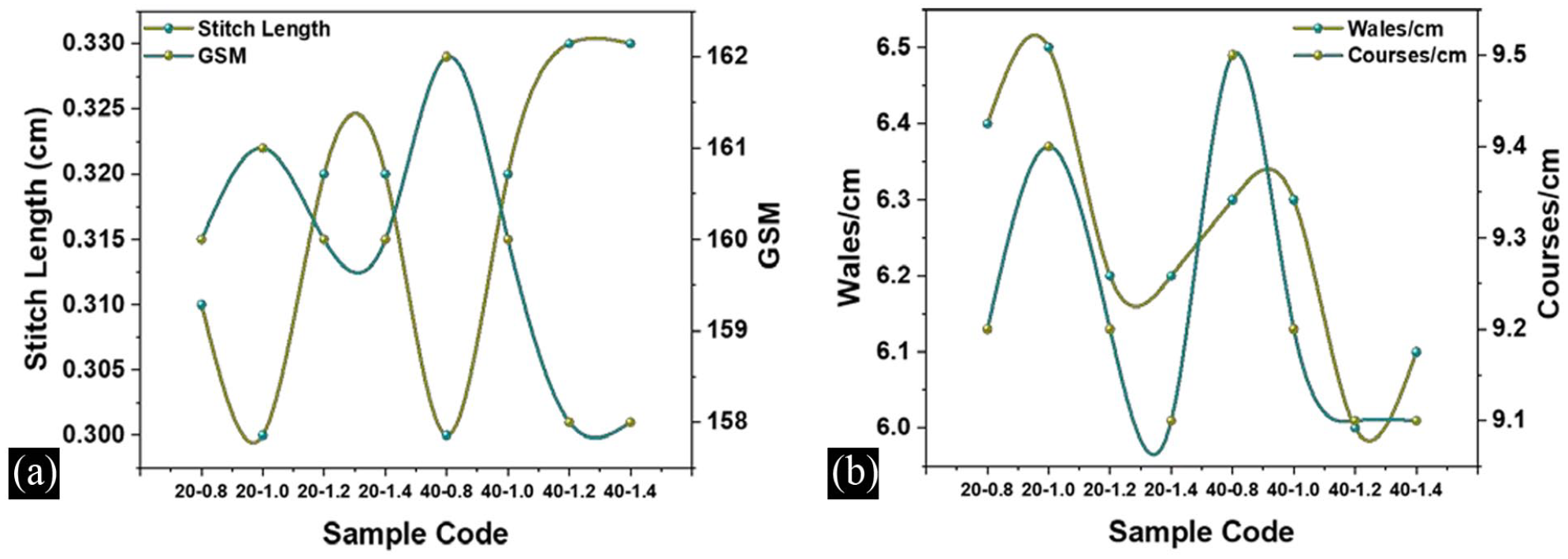
Physical parameters: (a) stitch length and GSM and (b) wales and courses density.
Air permeability
Air permeability of textile materials justifies their efficacy for air transportation through the bulk. Air permeability is vital in defining and maintaining the wearer’s physiological comfort, hence is a primarily considered element in clothing comfort.36 –38 Air permeability measurements of knitted socks at greige stage and after antipilling and antistatic treatments have been shown in Figure 5. For greige, antipilling, and antistatic treated socks the air permeability values of 20/1 polyester specimens were higher than 40/2 polyester specimens. The fiber denier variation was constant for both yarn counts, and decreased air permeability relates to the fabric bulk created due to double yarn in 40/2 polyester. 39 As the trend remained the same before and after wet treatments; hence antipilling and antistatic treatments do not affect materials’ inherent air permeability behaviors. A slight decrease in air permeability was seen for both 20/1 and 40/2 polyester knitted specimens after the antipilling treatment. The finish absorption caused fibers to swell, increasing fabric GSM and compromising the free spaces for breathability. 40 20/1 polyester knitted socks had a 4.01%, 2.78%, 1.23%, and 2.50% decrease in air permeability for 0.8, 1.0, 1.2, and 1.4 fiber deniers, respectively. The highest decrease of 4.01% was experienced for 0.8 denier specimens. 40/2 polyester knitted specimens showed 1%, 3.06%, 2.80%, and 2.01% breathability decrease respectively for 0.8, 1.0, 1.2, and 1.4 fiber deniers. However, air permeability showed an increasing trend after antistatic treatment. Static charge elimination caused fibers to come closer within a yarn, creating more porosity for air transportation. 41 There were increments of 5.81%, 2.45%, 0.35%, and 0.34% in breathability for 0.8, 1.0, 1.2, and 1.4 denier’s 20/1 polyester knitted socks after antistatic treatment. Similarly, 40/2 polyester socks increased air permeability by 9.5%, 3.15%, and 0.91% for 0.8, 1.0, and 1.2 fiber denier. However, air permeability remained the same for 1.4 deniers 40/2 knitted socks.

Air permeability plots.
Overall moisture management characteristics (OMMC)
The overall moisture management characteristics value (OMMC) describes the capability of textile materials to handle moisture. It includes absorption rates, wetting times, moisture transportation factors etc.42 –44 OMMC of the polyester knitted crew socks at the greige stage, and after antipilling and antistatic treatments, has been shown in Figure 6. OMMC value of 20/1 polyester socks were found to be lower than 40/2 polyester specimens. More capillaries in double yarn governed the phenomenon. However, OMMC values showed a decreasing trend as the fiber denier moved toward the coarser side. Antipilling treated specimens exhibited higher OMMC values than the greige socks. The fact was related to the hydrophilic nature of the applied finish. The 20/1 polyester knitted specimens showed an increase of 42.85%, 37.03%, 33.33%, and 15.38% in OMMC value for 0.8, 1.0, 1.2, and 1.4 fiber deniers after hydrophilic antipilling treatment. Hence, the wet treatment enhances moisture-related thermos-physiological comfort. Similarly, for 40/2 polyester knitted socks, the OMMC values showed increments of 51.72%, 48.27%, 62.50%, and 80.95%, respectively, for 0.8, 1.0, 1.2, and 1.4 fiber deniers. However, after antistatic finishing, there was a drastic decrease in OMMC values of specimens, and the trend was intermittent. Hydrophobic nature of the antistatic finish governed the change predicting the antistatic treatment contributes negatively to moisture-related thermos-physiological comfort parameters. After antistatic finishing the 20/1 polyester socks exhibited 70%, 70.27%, 66.67%, and 70% decrease in OMMC value respectively for 0.8, 1.0, 1.2, and 1.4 fiber deniers. And the 40/2 polyester socks had 75%, 74.42%, 79.48%, and 78.94% declines in OMMC values of 0.8, 1.0, 1.2, and 1.4 fiber deniers, respectively. The overall decrease in OMMC was around 70% for all specimens, and such a major decrease can alter the wearer’s comfort significantly.

Air permeability plots.
Thermal resistance
Thermal resistance of textile materials is the potential to impede heat flow through the bulk.45,46 Thermal resistance values of knitted socks have been plotted in Figure 7 at greige stage, after antipilling and antistatic treatments. The 40/2 polyester knitted socks showed slightly higher thermal resistance values than 20/1 polyester socks at each characterization stage. Air being a good insulator adds to the thermal resistance of textile materials. 47 40/2 polyester yarn was prepared by doubling two 40/1 yarns; hence there were more air packets in 40/2 compared to 20/1 polyester, which contributed to thermal resistance enhancement. Unlike other comfort characteristics, that is, air permeability and moisture management characteristics, the thermal resistance does not show noticeable change when compared before and after wet treatments; however, there were still slight differences. 20/1 polyester knitted specimen with 0.8 fiber denier exhibited a 0.16% increase in thermal resistance, while 1.0, 1.2, and 1.4 fiber denier socks showed 0.16%, 0.36%, and 1.07% decrease in thermal resistance values after antipilling treatment. For 40/2 polyester knitted socks, there was a 0.44%, 0.29%, 1.19%, and 1.17% decrease in thermal resistance for 0.8, 1.0, 1.2, and 1.4 fiber deniers after antipilling treatment. Similarly, the antistatic treatment also induced slight variations in thermal resistance values of specimens. The 20/1 polyester socks exhibited a 3.38%, 1.00%,and 1.90% decrease in thermal resistance for 0.8, 1.0, and 1.4 fiber deniers; however, thermal resistance remained unchanged for 1.2 denier polyester after antistatic treatment. And in 40/2 polyester socks, there was a 1.04%, 0.44%, 0.34%, and 10% decrease in thermal resistance for 0.8, 1.0, 1.2, and 1.4 fiber deniers, respectively, after antistatic treatment. There was an overall decrease in thermal resistance values after wet treatments; the phenomenon relates to the absence of meso-level air spaces with yarns after finishing, which contribute to thermal resistance.

Thermal resistance plots.
Pilling resistance
Pilling is the phenomenon of protruding fibers fuzz and ball generation on the fabric’s surface through physical abrasions. 48 Pilling performance of textiles is quantified in terms of pilling grades from 1 to 5, where grade 1depicts severe pilling and vice versa for grade 5. 49 Pilling performance of 20/1 and 40/2 polyester knitted socks at greige, antipilling treated, and antistatic treated levels have been plotted in bar charts in Figure 8. There was no noticeable difference between higher or lower pilling grade trends for 20/1 and 40/2 knitted specimens during characterizations. However, the pilling performance of fine fiber denier polyester was higher for both 20/1 and 40/2 yarns, even at the greige stage. The fine protruding fibers are easily detached from the fabric surface after abrasion instead of ball formation on the fabric surface like long and coarser fibers. As antipilling treatments are carried out for pilling performance enhancement, a similar trend was observed in the experimentation. Pilling grades showed an improvement after antipilling treatment; antipilling finishes bound fibers tightly within yarns decreasing the chances of fibers protrusion. The 20/1 polyester specimens showed a 33.33% increase in pilling grades of 1.0, 1.2, and 1.4 fiber deniers; however, the pilling performance of the 0.8 denier specimen remained unchanged before and after antipilling treatment. 40/2 polyester knitted socks increased pilling performance by 33.33% for 1.4 denier polyester after antipilling treatment. However, pilling grades of 0.8, 1.0, and 1.2 deniers remained unchanged; the existing pilling grades were 3.0 and in an acceptable range. Antistatic treatment was applied to overcome the static charges accumulation issues; hence technically, it does not contribute to pilling performance. Since the pilling grades remained constant for all other specimens after antistatic finishing, the pilling grade of 1.0 fiber denier, 40/2 polyester knitted socks improved by 16.67%.

Pilling performance plots.
Statistical data analysis
Principal component analysis (PCA)
Principal component analysis is an advanced statistical tool applied to interpret relationships and extract useful information from confusing data sets. The main attributes of PCA comprise data pattern interpretation and correlation identification 50 PCA is also used to identify the samples with the best characteristics among a data set; however, in the study, PCA was employed to interpret trends and correlations 51 The analysis was performed using MINITAB 18 statistical software, and data sets were placed in sheet after developing a full factorial design of experiment. The primary method of PCA was followed. 52 Table 6 shows the data utilized datasheet, only output variables, including air permeability, OMMC, thermal resistance, and pilling grade, were used in PCA.
Principal component analysis data.

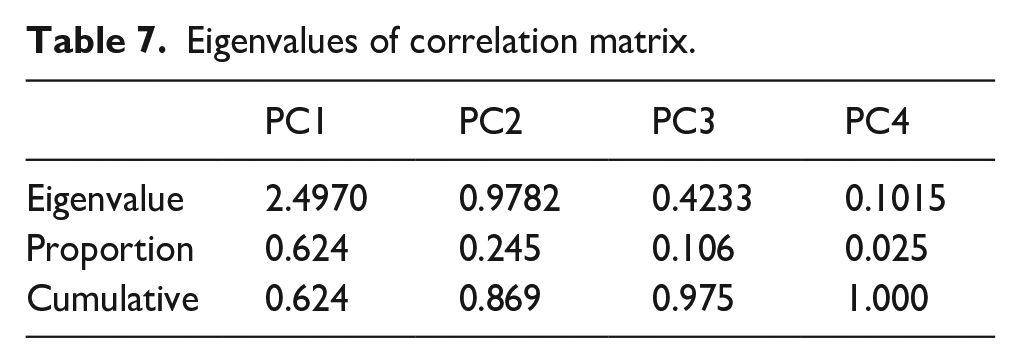
Eigenvalues were obtained to interpret the latent root variance of obtained principal components. Principal components are linear permutations of original dataset variables responsible for variance inside the data. Following the Kaiser criteria, principal components with eigenvalues greater than 1 were considered. The scree plot in Figure 9 allows to visually construct eigenvalues and the number of principal components with an eigenvalue greater than one. Moreover, the eigenvalues are shown in Table 7. In the given data set, the first eigenvalue was 2.49 and the second was 0.99, which approximately approached 1; hence second principal component was considered. The proportion row in Table 7 highlights the variability in data governed by each principal component. While cumulative value adds up the proportion of each principal component, the cumulative value of the last principal component is 100%. Similarly, the outlier plot visualizes the distance of each data set value from the Mahalanobis distance line. Mahalanobis distance is the path length between each point of data and the multivariate space’s centroid. The Mahalanobis distance reference line in the given data set was at 3.403. Points lying outside the reference line are considered outliers. Figure 10 shows the outliers plot, and it can be observed that no value in the data set was an outlier.
Eigenvalues of correlation matrix.
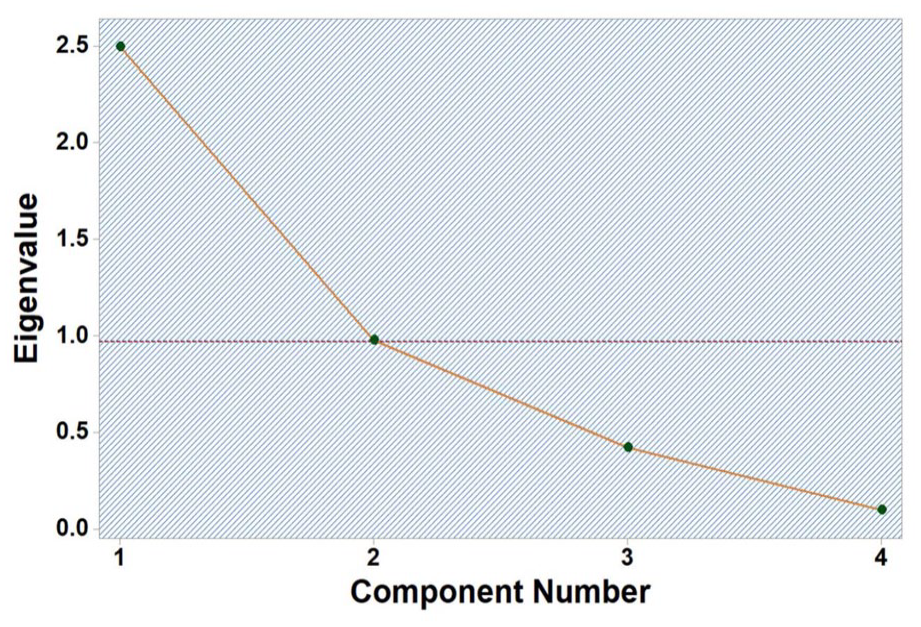
Screen plot.
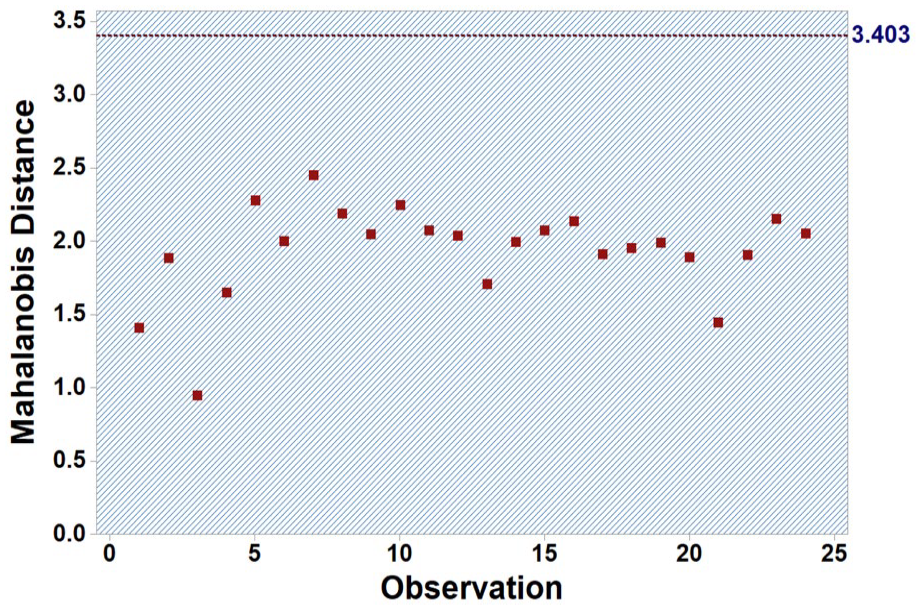
Outliers plot.
Eigen analysis correlation matrix’s provided proportion values (Table 7) are helpful to determine the original data set variables corresponding to obtained principal components from the eigenvectors table (Table 8). As discussed previously, two principal components were selected for further analysis. The first proportion value was 0.624; from the eigenvector table, pilling grade and thermal resistance PC1 values are closer to 0.624. Most data variation is due to the PC1; it can be said that treatments, fiber denier, and yarn doubling have affected the thermal and pilling resistance most. Similarly, the PC2 proportion value was 0.245, and from the studied variables, OMMC’s eigenvector principal component value is closer to 0.245. The wet treatment, fiber denier, and yarn doubling may have the second most significant effect on OMMC of socks. The score plot describing linear combinations of variables with each principal component in Figure 11 shows the data clusters and variations of the data grouped w.r.t treatments. The sum of PC1 and PC2 induced 86.9% variations in data, where PC1 caused 62.4% and PC2 governed 24.5% data variation. Correlations of the variables with principal components can be identified through the loading plot presented in Figure 12. Variables with negative side projection correlate negatively with the principal components and vice versa. Air permeability showed a strong negative correlation with PC1 while it was correlated slight negatively with PC2. Similarly, the thermal resistance, OMMC, and pilling grades were positively associated with PC1; however, pilling was negatively correlated with PC2.
Eigenvectors.


Score plots: (a) fiber deniers and (b) yarn counts.

Loading plot.
Conclusion
Knitted sports socks offering influential performance and comfort characteristics and have gained an essential market value. However, correlation of comfort and physical performance characteristics always remained an area of interest. The study presents the simultaneous relationships of specialty wet treatments with pilling and thermal characteristics of socks. Increased fiber denier shifted air permeability toward higher values, and yarn doubling caused decrease in air permeability. Antipilling treatment reduced air permeability, while a slight increase was experienced after antistatic treatment. Hydrophilic and hydrophobic natures of antipilling and antistatic treatments enhanced and reduced the moisture management capabilities of socks respectively. Thermal resistance of socks seemed to be reduced after wet treatment due to absence of air pockets between fibers. Piling performance increased after antipilling treatment; however, there was not any significant difference in pilling resistance before and after antistatic treatment. Hence the socks having both specialty treatments are suitable to wear during sports activities requiring less thermal resistance than standardly utilized untreated socks. The statistical data analysis showed 86.9% outputs data variation due to first two principal components. Pilling grade, thermal resistance, and moisture management showed eigenvector values equivalent to first two principal components depicting them as most effected characteristics.
Footnotes
Declaration of conflicting interests
The author(s) declared no potential conflicts of interest with respect to the research, authorship, and/or publication of this article.
Funding
The author(s) received no financial support for the research, authorship, and/or publication of this article.
