




Abstract
A novel spacer fabric with a weft-knitted structure of silicone tube and foam inlays is proposed for use in insoles to alleviate in-shoe pressure, reduce moisture and enhance thermal comfort. The material variables, including the diameter of the spacer yarn, type of inlaid material and net wrap and spacer pattern have been systematically investigated. Their force reduction and thermal characteristics in terms of air and water vapour permeabilities, thermal conductivity and impact force reduction are determined and compared to those of traditional insole materials. The results show that the inlays can effectively enhance the impact force reduction of the 3D spacer fabrics. In comparison to traditional insole materials, the proposed spacer fabric with an inlaid structure can enhance air and moisture permeabilities and heat dissipation to provide greater wear comfort for prolonged use. The air permeability, thermal conductivity and impact force reduction of the inlaid spacer structure can be modified with changes to the diameter of the spacer yarn, type of inlay and net material used and spacer pattern, whilst its water vapour permeability can also be varied by using different types of inlays. Spacer fabric with a higher number of spacer yarn courses and spacer yarn with a large diameter not only exhibits good impact force reduction with uniform thickness, but also offers good thermal conductivity. The findings of this study will contribute toward an insole design with the use of alternative insole materials for optimal foot protection.
Introduction
Insoles are an important interface between the foot and footwear, which have been widely used in the treatment of foot problems and deformities for relieving pain, altering foot function, modifying the kinematics and kinetics of locomotion, 1 and enhancing stability during walking. 2 For example, arthritis of the ankle causes plantar fasciitis or hallux valgus, so that excessive or inappropriate plantar pressure may be distributed under the foot, thus resulting in gait pain during daily activities. For patients with diabetic mellitus, high levels of plantar pressure and shear forces in the foot have also shown to be the major contributing factors in the formation of ulcerations due to increased load and strain on the skin and soft tissues of the plantar side of the foot.3,4 Custom-fabricated insoles made of suitable cushioning materials are therefore prescribed to reduce the magnitude of the pressure, relieve foot pain 5 and redistribute the plantar pressure which act on the metatarsal heads and other bony prominences thus exerting excess stress and causing ulcerations. 6
The types of insole materials traditionally used include leather, foam rubbers, cellular polymers, etc., which are available in a wide range of hardness, thickness and structural and mechanical properties. Rigid materials are applied to improve postural stability and reduce the risk of falls in older adults. 2 Soft materials such as low density ethylene vinyl acetate (EVA) (e.g. nora® Lunairmed) and polyurethane (PU) foam (e.g. PORON®) with excellent cushioning and shock absorption properties are mainly used to temporarily relieve pressure and painful symptoms. 4 Cham et al. developed a vibro-medical insole made of EVA for diabetic patients with mild-to-moderate neuropathy to improve their balance control. 7 Niu et al. used PORON® to develop an insole with layers of small cushions embedded below the metatarsal, arch and the heel to reduce excessive pressure on the weight-bearing areas of the plantar surface of the foot. 3 The influence of the insole materials on foot ulceration and foot balance has also been investigated. Premkumar et al. found that a soft insole combined with a midsole and hard outsole can reduce the risk of foot ulceration. 8 The thickness and stiffness of the insole material have little impact on reducing the maximum plantar pressure and energy absorption during loading, whilst the stiffness and thickness of the plantar soft tissues greatly affect the insole material properties of an optimum insole. 9 Martinez-Santos et al. found that the plantar pressure is reduced when different types of soft insole materials are used as the offloading materials under the metatarsal heads. 6 Nevertheless, offloading insoles with arch support might cause poor balance in diabetic patients. 10
Although traditional foam materials provide cushioning to alleviate foot problems, they have poor air and moisture transport properties which cause the foot to perspire as heat builds up inside the shoe. Insole materials that offer better porosity and breathability to reduce moisture and heat generation or increase heat dissipation, improve wear comfort and reduce the risk of foot ulcers. With advances in textile materials for a variety of functional applications, the use of three-dimensional (3D) spacer fabrics may possibly overcome the above limitations of traditional insole materials. Spacer fabrics are 3D knitted fabrics known for their superior properties, such as good air and moisture permeabilities, cushioning performance, shock resistance, and pressure distribution, and ability to prevent ulcerations in clinical applications.11–13 Their unique properties mean that spacer fabrics can be used for a wide range of products, for example, thermal insulated clothing, 14 mattresses,15,16 protective clothing, 17 insoles18,19 and wound dressings. 20 Nevertheless, there are also some limitations of spacer fabrics and concerns around their use in insole applications. Due to a high compression stress during walking, spacer-fabric insoles gradually deform and their compression and resilience properties deteriorate with repeated loadings and even collapse with use, thus nullifying their pressure-relieving performance. Modifications and analyses of their material parameters are therefore paramount to improve the compression and recovery characteristics of these 3D spacer fabrics for optimal foot protection.
In weft knitted spacer fabric, there are two outer layers that are connected by a middle layer of spacer yarns. The middle layer is constructed when spacer filaments are used to form tuck stitches with both the front and back needle beds to fabricate and support the 3D structure of the resultant fabric. 21 This sandwich structure provides spacer fabric with excellent pressure relief properties. When spacer fabric is compressed, the connecting yarns buckle and bend. The deformation of spacer fabric during load is similar that of foam, in which the load is gradually distributed into a larger area. 12 To further enhance the energy absorption capability and cushioning effect, some researchers have examined the changes in spacer yarn materials and their knitted structure. For instance, Hamedi et al. developed weft knitted spacer fabric with a shape memory alloy, nickel-titanium, as the spacer monofilaments. 19 However, the use of metal wire as the spacer yarn requires special equipment and is time consuming. To resolve this problem, Yu et al. proposed a novel approach of reinforcement by inlay knitting silicone tubes and spandex as the inlaid material into the spacer structure.21,22 Inlay knitting is conducted by inserting yarn to a knitted structure. The inlay process requires two yarns; one type of yarn is used for knitting, while the second type of yarn is used for weaving (weft; held in front or behind the stitches). 23 This method has been used to manufacture compression garments and buoyant swimwear .24–29 In fact, Li et al. showed that inlaid fabric has better recoverability with an increase in the diameter of the inlaid material. 30 Yu et al. showed that inlaid silicone tubes increase the compression resistance and impact force absorption of spacer fabrics. 21 Although the inlaying of elastic materials such as silicone foam or silicon rods effectively reinforces the spacer fabric, the compression energy and stiffness of the spacer inlaid fabrics can be affected by the inlaid materials with various Young’s moduli and tensile behaviours. 31 However, to date, the influence of the inlaid reinforcement in the 3D spacer fabric structure on the thermal comfort properties is still largely unexplored.
As the traditional EVA insole material has poor breathability and heat dissipation, it increases the plantar temperature and humidity from sweating after prolonged use. Unlike conventional EVA insoles, the textile materials chosen for insoles would need to alleviate in-shoe pressure, as well as enhance heat dissipation and thermal comfort to reduce the potential of foot ulcers. Therefore, in considering the repeated loadings onto an insole, silicone tubes or foam rods are proposed as the inlaid material of the connecting or middle layer of the spacer fabric as a means of reinforcement to provide additional support upon weight bearing and walking. The loading of body weight during daily activities has been associated as a significant factor in foot pain and injuries. Insoles with good cushioning properties must be act as shock absorbers to minimise shock transmission to the foot. Although the cushioning performance and walking comfort of inlaid spacer fabrics has been largely neglected, this study aims to provide a better understanding of the effect of inlaid spacer structure on the force reduction and thermal comfort properties as compared to the traditional insole material. It is anticipated that the spacer yarns, air space in the 3D spacer structure along with the inlays will result in higher impact force reduction, increased thermal conductivity, and higher air and water vapour permeabilities of the resultant knitted fabrics. The findings of this study will greatly contribute toward insole prescription with increases in the range of insole materials available and widened scope of the applications of spacer fabric for different end-uses.
Materials and methods
As friction is created during knitting between the inlaid material and knitting machine, the inlaid materials sourced in the market were wrapped with a knitted net before knitting proceeded. To better understand the performance of the spacer fabric, the properties of three traditional insole materials, including PORON®, EVA and nora® Lunairmed, were also taken into consideration (Figure 1). In this study, a systematic investigation of the effects of the fabric parameters including the diameter of the spacer yarn, type of inlaid and net materials, and spacer pattern on increasing the force reduction and thermal comfort properties is conducted. Material parameters of the weft-knitted spacer fabrics are listed (Table 1). Microscopic View of (a) PORON®, (b) EVA and (c) nora® Lunairmed Material parameters of weft-knitted spacer fabrics.

Preparation of Inlaid Material
Silicone tubes with outer diameter of 2.07 mm and inner diameter of 1.01 mm and foam rods with outer diameter of 2.25 mm were used as the inlaid material as they are flexible and soft enough to be inserted during the knitting process. Their cross-sections are illustrated in (Figure 2. Prior to knitting, the inlaid materials were wrapped by using different types of knitted nets to reduce the surface friction during insertion. The nets were knitted by using a multifunction fancy twister (SFM32-04, Kunshan Shun Feng Textile Co., LTD., China) with four needles. The yarn used was 4/135NM 100% Peruvian Pima Gassed Cotton yarn or DRYARN® 140D (equals to 1/64NM) 100% polypropylene yarn. The inlaid material was then manually inserted into the knitted net. Details of knitted nets that were used to wrap the inlaid material are provided in Table 2. Microscopic View of (a) Silicone tube and (b) Silicone foam rod. Specifications of knitted net for wrapping inlaid materials.

Fabrication of inlaid spacer fabric
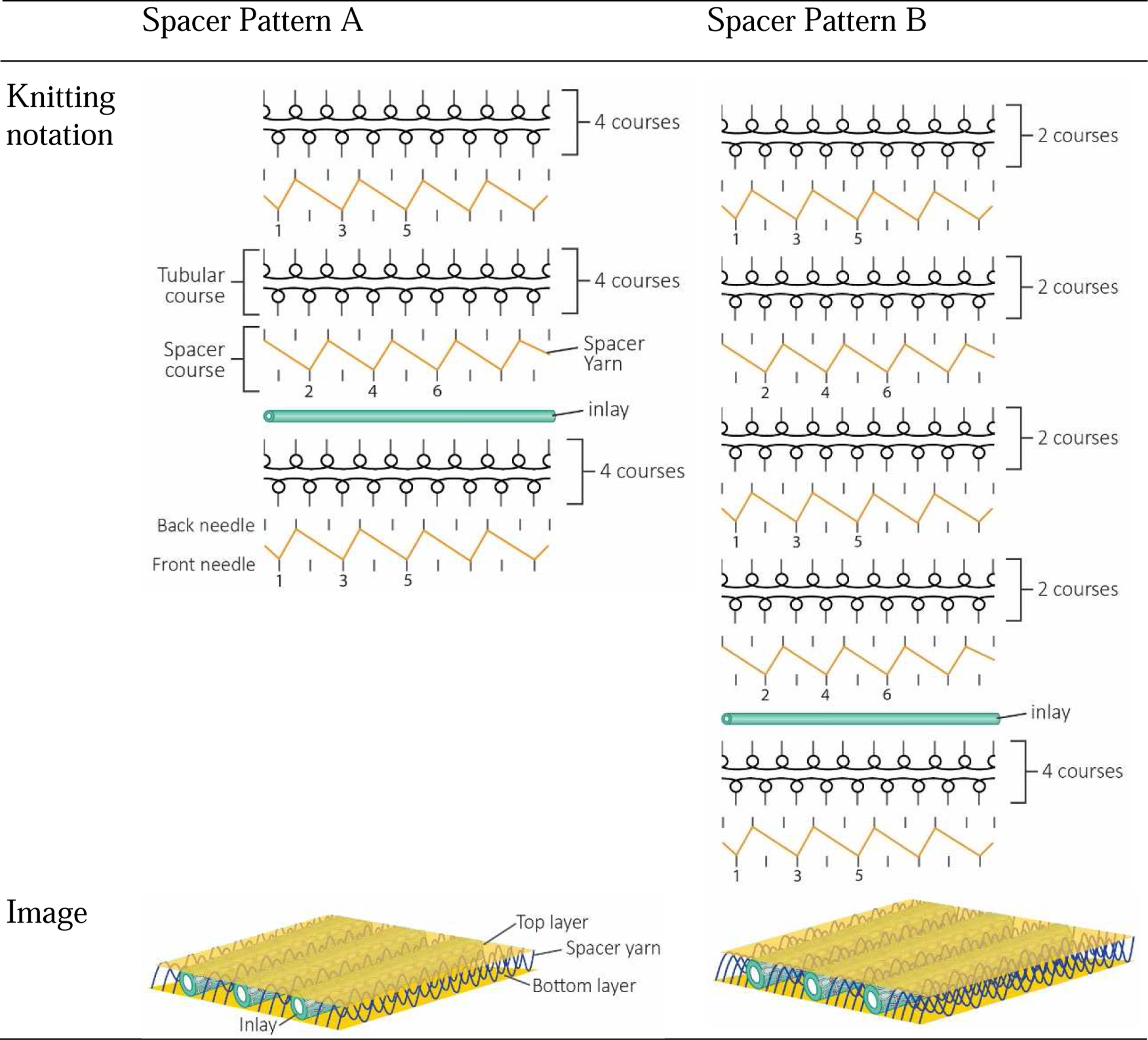
Knitting notations and images of fabrics with different spacer patterns.

Sample specifications of inlaid spacer fabrics.

Notes: ‘AR’ denotes foam rod wrapped with Net A, ‘BR’ denotes foam rod wrapped with Net B, ‘FR’ means foam rod wrapped with Net C, ‘TR’ means silicone tube wrapped with Net C and C is control fabric without inlay.
Fabric objective evaluation
The fabric thickness was measured by using a dial thickness gauge (Model H, Peacock OZAKI MFG. CO. LTD, Japan) under a pressure of 4 gf/cm2 with an accuracy of 0.01 mm in accordance with ASTM D1777 Standard Test Method for Thickness of Textile Materials. The hardness of the samples was evaluated on a durometer (GS-744G, Type: FO, TECLOCK Co., Ltd., Japan) in accordance with ASTM D2240-05: 2010 Standard Test Method for Rubber Property—Durometer Hardness. A 3D-optical microscope (VR-3000, KEYENCE, Japan) was used to examine the variations in surface thickness of the samples and the surface roughness profile obtained along the wale direction was evaluated, as shown in (Figure 6). The fabric thickness is represented by different colours, in which red constitutes as the peaks while blue constitutes as the valleys in the roughness profile. All of the samples were allowed to relax at least 24 h before testing was carried out on them. Two samples were knitted with each type of fabric, and each sample was tested three times at different locations. The mean value of each fabric or insole material obtained from the six measurements was also recorded.
Air and water vapour permeabilities
The air permeability of the samples was determined by using an air permeability tester (SDL M021S, SDL International Textile Testing Solutions, USA) in accordance with ASTM-D737 Standard Test Method for Air Permeability of Textile Fabrics. Each sample was placed onto the circular testing head with the area of 5.08 cm2 and the test was carried out under a water pressure difference of 125 Pa. The water vapour permeability test was conducted with the cup method in accordance with ASTM E96 Standard Test Methods for Water Vapor Transmission of Materials. The sample covered the mouth of the cup which has an inner diameter of 83 mm and the cup contained 46 mL of distilled water. Then, the sample was placed onto a turntable at a rotation speed of 2 revolutions per minute to prevent the formation of still air above the cup. The test was conducted at a temperature of 20°C and relative humidity of 65%. The testing was carried out for 24 h and the weight of each cup was then recorded. A higher water vapour transmission rate means that the fabric has higher water vapour permeability. The water vapour transmission rate (WVTF) was calculated by using the following equation
Thermal conductivity
The thermal conductivity was determined by using a KES-F7 Thermo Labo (Kato Tech Co., Ltd., Japan) in accordance with JIS L 1927 Standard Test for Textiles-Measurement method of cool touch feeling property. A sample with dimensions of 10 cm × 10 cm was placed between two heat plates with a constant temperature; one was 30°C and the other was 20°C. The amount of heat transmitted through the sample due to the temperature difference was measured. Each fabric sample was tested in 60 s. The thermal conductivity is calculated by using equation (2)
Impact force reduction
Two specimens of each sample were stacked before the testing was carried out. When the stopper was pulled out, a ball bearing was released and dropped onto the sample through a straight tube at a height of 400 mm (Figure 3). The highest impact force was measured by using a load cell placed at the bottom of the instrument. The impact force reduction capacity of the sample is defined as a percentage of the maximum impact force with the sample and the ground surface
32
Instrumentation for measuring impact force reduction.

Statistical analysis
The data from the experiment were analysed by using SPSS 23 (IBM Corp., Armonk, New York). A multivariate analysis of variance (MANOVA) was used to examine the mean differences among the four different independent variables: (1) diameter of the spacer yarn, (2) type of inlaid material, (3) type of net and (4) spacer pattern on four dependent variables (air and water vapour permeabilities, thermal conductivity and impact force reduction). Prior to the analysis, the data were evaluated to ensure that the assumptions for the multivariate tests were validated. Measures of skewness and kurtosis, histograms and normal Q-Q plots were used for the dependent and independent variables. Observation of these measures and plots shows a normal distribution at the different levels of these variables. The significance level of the statistical analysis was set at 0.05.
Results and discussion
Physical properties of the fabrics and common insole materials.

MANOVA summary table of fabric parameters and their performance.

Wilks’ lambda = 0.003, F(6,5) =313.83, p<0.001, η2= 0.997
bWilks’ lambda = 0.003, F(6,5) =255.361, p<0.001, η2= 0.997
Wilks’ lambda = 0.001, F(12,10) =32.24, p<0.001, η2= 0.975
dWilks’ lambda = 0.005, F(6,5) =152.50, p<0.001, η2= 0.995

Air permeability of inlaid spacer fabrics and common insole materials.

Microscopic view of inlaid spacer fabrics (a) TR1 and (b) TR2 along the wale direction.

Surface thickness variations of the inlaid spacer fabrics (a) FR1; (b) FR1-2; and (c) FR2.

Water vapour transmission rate (WVTR) of the inlaid spacer fabrics and common insole materials.
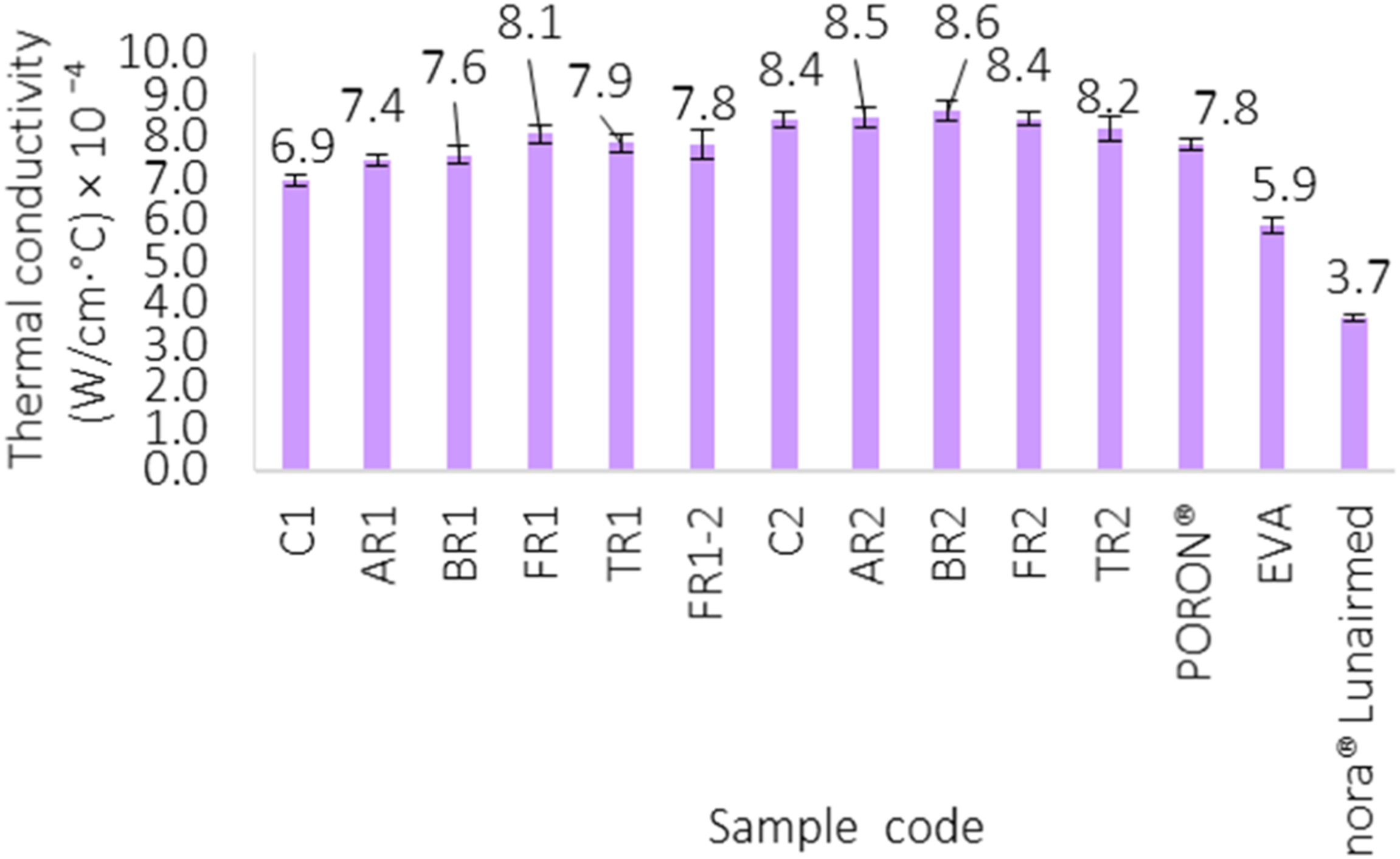
Thermal conductivity of the inlaid spacer fabrics and common insole materials.

Impact force reduction of the inlaid spacer fabrics and common insole materials.

Force-time curves of the inlaid spacer fabrics and common types of insole materials.
Stage 1: Comparison of fabric and common insole materials from market
As the feet tend to perspire more, the rate of the evaporation of perspiration should remain high so that the in-shoe climate remains dry. 33 Moreover, increases in foot temperature have been associated with subsequent foot ulceration.34,35 Therefore, materials with good water vapour permeability enable more rapid heat dissipation and reduce the foot temperature, which can enhance the overall comfort of the in-shoe climate with the orthotic insoles.. 32 As shown in Figures 4, 7 and 8, the inlaid spacer fabrics have significantly higher levels of air permeability, water vapour transmission rate, and thermal conductivity as opposed to PORON®, EVA and nora® Lunairmed. It may due to the porosity of the surface layer and the space created in the connective layer. It provides more channel for air, water vapour and heat to pass through when compared to the foam structure of three traditional insole materials as shown in Figure 1. However, PORON®, EVA and nora® Lunairmed have a slightly higher impact force reduction than the spacer fabrics, except for BR2 and FR2, which has a higher impact force reduction than nora® Lunairmed.
The inlaid spacer fabrics are much more air permeable than the common insole materials (Figure 4). TR2 has the highest air permeability which is 1093 times higher than that of the three common insole materials. As a higher air permeability is desirable for insoles, inlaid spacer fabrics are more suitable as the insole material than PORON®, Eva and nora® Lunairmed when considering the breathability of the insole. In terms of the water vapour transmission rate, TR1 (Spacer Pattern A fabric inlaid with silicone tubes and PP net) has the highest water vapour transmission rate among the inlaid spacer fabrics which is 1.7 times higher than that of PORON® (Figure 7). This implies that the inlaid spacer fabrics allow wicking of sweat away from the skin to the environment at a faster rate than PORON® which further reduces the in-shoe humidity. For the thermal conductivity, the inlaid spacer fabrics also show a better performance in general; see Figure 8. BR2 has the highest thermal conductivity, which is higher than even PORON®. This shows that heat can be easily conducted away from the skin when using BR2 as the insole material and subsequently reduces the risk of foot ulceration.
Since a higher force reduction is preferred with insole materials, the spacer fabrics are not a good option for insoles. Generally, the spacer fabrics have a 25% lower impact force reduction than the three common insole materials (Figure 9). Among the spacer fabric samples, FR2 has the best performance in reducing the impact forces up to 74.94% during gait which is higher than nora® Lunairmed (but lower than both EVA and PORON®).
In general, the result in this study shows that the inlaid spacer fabrics allow air, water vapour and heat to transmit more easily than the three common insole materials. They provide a cool and breathable micro-environment for the foot when used as insoles which enhances the thermal comfort of the wearer and prevents ulceration. However, they do not perform as well as the three common insole materials in reducing the impact force.
Stage 2: Effect of the fabric parameters
Air permeability
The factorial MANOVA results showed that the air permeability of the inlaid spacer fabric is highly correlated with the diameter of the spacer yarn, type of inlaid material and net material, and spacer pattern (Table 6). The diameter of the spacer yarn (η2 = 0.955), type of inlaid material (η2 = 0.970) and spacer pattern (η2 = 0.950) account for over 94% of the variance in air permeability while the net accounts for 86% of the variance (η2 = 0.861).
As shown in Figure 4, AR2, BR2 and TR2, all of which are knitted with 0.15 mm spacer yarn and used Spacer Pattern B have higher air permeability than AR1, BR1 and TR1 which are knitted with 0.12 mm spacer yarn and used Spacer Pattern A. It shows that inlaid spacer fabrics are more air permeable when higher number of courses of tuck stitches and thicker spacer yarn are adopted. However, Spacer Pattern B with a higher number of spacer yarn courses (FR1-2) has a lower air permeability than Spacer Pattern A (FR1). The number of spacer course and the diameter of spacer yarn must be strategically manipulated in order to preserve the air permeability of the inlaid spacer structure.
For the net, fabric with the net knitted with two ends of cotton yarn (BR1 and BR2) have higher air permeability than that which is knitted with one end of cotton yarn (AR1 and AR2) (Figure 4). Fabric that has inlay wrapped with a thinner net shows lower air permeability which may be due to the tightness of the net on the inlaid material. The net knitted with one end of cotton yarn has low elasticity and was loosely wrapped on the surface of the inlays which obstructed the flow of air through the fabric. When comparing the fabric with a net of a similar mass per unit length (AR and FR), they have different air permeabilities which implies that the air permeability is not affected by the mass of the net. Unlike the results of Yu et al., 21 the inlaid spacer fabric in this study generally shows a higher air permeability than the spacer fabric without inlay (C1 and C2) (Figure 4). This may be due to the different ratio of spacer and inlaid courses used in the knitted structure.
Water vapour permeability
The result of the post hoc between-subjects factorial MANOVA indicates that only the inlaid material is significantly different in terms of the WVTR (F=4.99, p < 0.05, η2 = 0.333) with less than 35% of the variance accounted for by the inlaid material (Table 6). However, no significant difference in the WVTR is found from the diameter of the spacer yarn, type of net and spacer pattern (p > 0.05). This result is also in agreement with the findings in Arumugam et al. 36 who found that the water vapour permeability is not correlated to the air permeability. The inlaid spacer fabrics have a lower WVTR than the fabrics without inlay (C1 and C2) (Figure 7). Unlike air, the passage of water vapour is blocked by the inlay due to the large water particle size. The fabric with silicone tubes as the inlay (TR) has a higher WVTR than the foam rods (AR, BR and FR) with the same spacer pattern. The reason could be attributed to the silicone tubes which provide more channels for the water vapour to easily pass through.
Thermal conductivity
Similar to the air permeability result, the thermal conductivity of the fabric significantly differs with the diameter of the spacer yarn, type of inlaid and net materials, and spacer pattern. Around 60% of the variance in thermal conductivity is accounted for by the diameter of the spacer yarn (η2 = 0.697), net (η2 = 0.697) and spacer pattern (η2=0.631) while the inlaid material only accounts for 42% of the variance (η2 = 0.418).
According to Figure 8, Spacer Pattern B samples that use thicker spacer yarn (C2, AR2, BR2, FR2 and TR2) have higher thermal conductivity than fabric constructed with finer spacer yarn and fewer courses of knitted spacer yarn (C1, AR1, BR1, FR1 and TR1). When comparing the thermal conductivity of FR1-2, FR1 and FR2, an increase in the diameter of the spacer yarn from 0.12 mm (FR1-2) to 0.15 mm (FR2) increases the thermal conductivity. However, the Spacer Pattern B sample with five courses of spacer yarn (FR1-2) was found to have similar thermal conductivity to Spacer Pattern A with three courses of spacer yarn (FR1). The reason is that heat conductivity is largely related to the contact area. A smoother surface increases the area of contact and the heat flow from the skin to the fabric, therefore, creating a cooler feeling.37,38 The surface thickness variations with peaks (in red colour) and troughs (in blue colour) of the inlaid spacer fabrics are shown in Figure 6. Despite of the different spacer patterns, samples FR1 and FR1-2 did not show major differences in surface thickness profile. The increase of spacer yarn diameter, however, resulted in major changes in fabric surface thickness variation in sample FR2. It is confirmed by the results of MANOVA that around 70% of the variance in thermal conductivity is contributed by the diameter of the spacer yarn while it has only 63% for spacer pattern. The uneven thickness of FR1 is more severe than that of FR2 due to the thinner connective layer in the area without inlay. Less support from the finer spacer yarn and fewer courses of spacer yarn creates peaks and valleys on the fabric surface, which reduce the contact area and the flow of heat.
For the net, fabric inlaid with foam rods in Net B (BR1 and BR2) has a higher thermal conductivity than that of Net A (AR1 and AR2). This is because the net knitted with two ends of cotton yarn (Net B) have a larger surface area for heat conduction than using only one end of the cotton yarn (Net A). The fabric with a thicker net to wrap the inlays has higher thermal conductivity which can reduce the risk of foot ulceration when used as the insole. When comparing the fabric with different inlaid materials, the fabric inserted with foam rods (FR1 and 2) has a slightly higher thermal conductivity than that of the fabric inserted with silicone tubes (TR1 and 2).
Impact force reduction
The impact force reduction properties of the inlaid spacer fabrics significantly differ with the spacer pattern (F = 34.09, p < 0.001, η2 = 0.773), inlaid material (F = 28.30, p < 0.001, η2 = 0.739), type of net (F = 9.40, p < 0.05, η2 = 0.653) and diameter of the spacer yarn (F = 9.22, p < 0.05, η2 = 0.480). The spacer pattern, inlaid material and type of net account for over 60% of the variance in the force reduction while the diameter of the space yarn only accounts for 48% of the variance. As shown in Figure 9, the spacer fabrics without inlay (C1 and 2) provide a smaller reduction of impact force than the fabric samples with inlay and constructed with both Spacer Patterns A and B (AR, BR, FR and TR). As compared to the control spacer fabric (without inlay), the inlaid spacer samples result in lower peak force values and prolonged time intervals, showing a gradual force absorption and energy buffer against impact forces (Figure 10). This result is in agreement with Yu et al. 21 in which the inlaid material effectively absorbs and reduces the impact force by prolonging the reaction time for the impact to have effect.
In terms of the spacer pattern and diameter of the spacer yarn, the force-time curves of fabric that uses 0.15 mm spacer yarn and Spacer Pattern B (C2, AR2, BR2, FR2 and TR2) show relatively low and blunt peak forces within a longer duration of time than those of fabric that uses 0.12 mm spacer yarn and Spacer Pattern A (C1, AR1, BR1, FR1 and TR1). Amongst samples FR1, FR1-2 and FR2, FR1 resulted in highest peak impact force with the shortest reacting time, followed by FR1-2 and FR2 (Figure 10). Considering the performance of force reduction, as compared to FR1, while the impact force was reduced by 6.2% with increased number of spacer course in FR1-2, the increased diameter of spacer yarn in FR2 was found to have a further reduction of 7.2% in impact force (Figure 9). This confirms that the fabric can reduce the force more when using a thicker spacer yarn and inserting more spacer yarn courses in the fabric. When increasing the diameter of the spacer yarn and the number of tucked courses of spacer yarn, the top and bottom layers obtain more support through the connective layer and also increase the thickness of the connective layer (Figure 5). This result is in agreement with the results in Zhao et al. 39 in which the energy absorption performance of spacer fabric could be improved by the use of coarse spacer yarns and increasing the number of spacer courses.
When comparing the spacer fabric with the different types of inlaid material, the fabric inserted with foam (FR1 and 2) has a higher force reduction than that of the spacer fabric inserted with silicone tubes (TR1 and 2). This may be due to the numerous small bubbles in the silicone foam rod (Figure 2) which provide a better cushioning effect than the silicone tubes with a large hollow lumen. Therefore, the silicone foam rods can absorb and reduce higher impact forces than silicone tubes. As for the net that is wrapped around the inlaid material, the fabric with Net C (FR1& FR2) can absorb force more easily than Nets A and B (AR1 and AR2, BR1 and BR2). As the PP yarn in Net C has elasticity, the foam rods are firmly wrapped by the PP net which further strengthen them and enhance the impact force reduction properties of the fabric. However, this is not the case with Nets A and B which are made of cotton (Table 2).
In consideration of the air and water vapour permeabilities, thermal conductivity and impact force reduction, BR2 has the best performance which is knitted with a 0.15 mm diameter spacer yarn, inlaid with silicone foam rods wrapped with Net B (cotton) and uses Spacer Pattern B. The extra courses of spacer yarn and thicker spacer yarn provide more support to the spacer structure which enhances its ability to absorb the impact force, air permeability and thermal conductivity. Therefore, BR2 is the optimum sample in this study for insole applications. With reference to the objectives of insoles for reducing shear and friction loads between the plantar surface of the foot and the insole, the effect of the inlaid spacer structure and inlay pattern in relation to the surface and contact properties is suggested to be explored in future. A wear-trial of different types of insoles including the spacer fabric with inlays is also suggested in order to study the effect of the insoles on the in-shoe environment and the impact on human physiological and psychological responses.
Conclusion
In this study, a novel knitted spacer structure is developed with different types of inlays for cushioning insoles. In consideration of the key properties and functional requirements of footwear insoles, the behaviour of the inlaid spacer fabrics is compared with that of three types of traditional insole materials in terms of the air and water vapour permeabilities, thermal conductivity and impact force reduction. The inlaid spacer fabrics are very air permeable, water vapour permeable and have thermal conductivity. Insoles made with the proposed inlaid spacer structure not only reduce the magnitude of the plantar pressure but also preserve a breathable in-shoe environment to facilitate heat dissipation, reduce plantar temperature, humidity from sweating and even ulcers. The influence of the knitting parameters on the performance of the samples in terms of shock absorption, cushioning and breathability are investigated. The results show that the air permeability, thermal conductivity and impact force reduction of the fabric can be significantly modified with different diameters of spacer yarn, types of inlays and net material, and spacer pattern. The water vapour permeability of the fabric can also be changed with the type of inlaid material. Increased spacer yarn size and densities of the tuck stitches in the spacer pattern can also change the air permeability, thermal conductivity and impact force reduction properties of the fabric. The findings from this study provide useful guidelines that can broaden the applications of inlaid spacer fabric for cushioning apparel and footwear in clinical and/or sports applications.
Footnotes
Acknowledgements
The authors would like to thank fashion brand “TSE” for sponsoring the 4/135NM 100% Peruvian Pima Gassed Cotton yarn.
Declaration of Conflicting Interests
The author(s) declared no potential conflicts of interest with respect to the research, authorship, and/or publication of this article
Funding
The author(s) disclosed receipt of the following financial support for the research, authorship, and/or publication of this article: This work was supported by the Laboratory for Artificial Intelligence in Design under the InnoHK Research Clusters, Hong Kong Special Administrative Region Governemnt (Project code: RP1-2).
