



Abstract
Society’s growing concern for the environment has led to an increased emphasis on greener products and processes. While societies are becoming more accepting of this change, there are still significant challenges regarding the esthetic aspect of environmentally friendly products. Textiles, which are essential for providing cover and esthetics, contribute to environmental pollution through waste production. Currently, the production of hard waste yarn, a textile intermediate product, utilizes the OE (open-end) spinning method to make use of textile waste. However, this approach has limitations in terms of quality, as it results in yarn with low abrasion resistance, higher pilling, and poor physical appearance of garments. Consequently, consumers are less satisfied with these sustainable yarns, hindering their widespread use. This study focused on preparing ring-spun yarn from recovered fibers of leno waste and subsequently producing knitted fabrics from these yarns. The properties of these fabrics were analyzed and compared with fabrics made from 100% virgin ring spun yarn. The results revealed that the fiber reclaimed from leno waste had a higher content of short fibers. The yarn produced from these fibers exhibited higher imperfections, unevenness, and reduced strength as the percentage of reclaimed fibers increased. Socks made with an increasing percentage of leno waste showed higher thermal resistance. However, as the yarn became finer, the thermal resistance of the socks decreased. On the other hand, the air permeability of the socks increased with a finer yarn count. Overall, the moisture management of all samples was good, with coarser yarns exhibiting better moisture management in socks. An ANOVA approach was used to statistically evaluate the properties of the yarn and fabric. The conclusion drawn from the study was that these recycled yarns can be effectively utilized in the socks and denim industry without compromising quality.
Introduction
The urgency for environmental sustainability cannot be overstated, especially in the face of the significant challenge posed by global warming. Pollution and resource depletion are key factors contributing to this issue. The textile industry plays a major role in global pollution, with a staggering three out of four garments ending up in landfills. Furthermore, the production of new garments necessitates the consumption of additional natural resources. The combination of increased purchasing power, the prevalence of short-term fashion trends, and the importance placed on individual self-esteem has fostered a culture of disposability. 1 With the world’s population continuing to grow, the demand for textile materials has also increased significantly, leading to a doubling in textile fiber consumption over the past two decades. Consequently, a substantial amount of material that could potentially be recycled is instead discarded as waste. 2
Textile waste can be classified into three categories: pre-consumer, post-consumer, and industrial waste. Among these, only a fraction of the first two categories is recycled for reuse. The majority of textile waste is simply discarded in landfills, and we must reconsider this approach and prioritize recycling. By doing so, we can have a positive impact on the environment by conserving resources for new applications and creating a more effective waste management system. 3 Recycling fibers from textile waste presents one solution to address the growing demand for textiles. This approach significantly reduces the reliance on virgin materials, relieving pressure on the environment and conserving energy and natural resources. 4
Furthermore, it helps stabilize material prices, even with the availability and advancements in synthetic and regenerated fibers, as cotton continues to dominate as the primary raw material in the textile industry. 5 In the textile industry, waste is generated at each stage of production. One notable waste product in the weaving process is leno waste, which refers to the edges of woven fabric separated from the main fabric and deemed futile. Unfortunately, these discarded fabric parts typically end up in landfills or are incinerated. However, if we can recover and utilize these materials, we can reduce raw material costs and contribute to a more sustainable environment. Although fiber recovered from leno waste may be shorter lengths, it is still in excellent condition and can be transformed into remarkable new garments. 6
Textile waste has gained significant attention among researchers, with several studies exploring the production and properties of recycled cotton yarn. One common approach in the literature is the utilization of open-end spinning technology to facilitate the spinning process with shorter fibers. Awgichew et al. 7 analyzed the effect of recycled fibers on yarn and handloom fabrics and found that yarns and fabrics blended with waste fibers are suitable for home furnishing purposes. In another study, Duru and Babaarslan 8 investigated the impact of opening roller speed on different percentages of waste fibers and polyester fibers in the open-end spinning process. Their findings suggested that higher roller speeds led to improved fabric results. Mohamed Taher et al. 9 developed a statistical model for rotor-spun yarn, examining the influence of waste percentage and rotor machine parameters. They concluded that up to 25% waste fiber could be used without negatively affecting rotor yarn quality.
Yilmaz et al. 10 explored the effects of soft waste on rotor-spun and ring-spun yarn, assessing various quality characteristics of the yarns. Additionally, Vadicherla and Saravanan 11 reported on the thermal properties of single jersey knitted fabric produced from recycled polyester and cotton. Their research demonstrated that as the waste percentage increased, the thermal resistance of the fabric decreased, while thermal conductivity and air permeability increased. Vasanth Kumar and Raja 12 studied the comfort properties of the fabrics developed by blending recycled polyester and virgin cotton fibers. They found that blending recycled polyester fiber improved the comfort properties of the socks. Gun et al. 13 developed socks using virgin polyester fibers, elastane, and reclaimed cotton fibers and compared their thermal properties with socks made from virgin cotton fibers. They have found that elastane enhanced the socks’ thermal characteristics but reduced their water vapor permeability. In another study, Gun et al. 14 developed socks from a blend of polyester fibers and reclaimed fibers, evaluating their physical and dimensional properties in comparison to socks composed of virgin cotton fibers. Their findings indicated that incorporating reclaimed fibers enhanced certain physical properties such as thickness, stitch density, and resistance to pilling, although it led to a reduction in air permeability compared to socks made from virgin cotton.
Previous research was mostly conducted on incorporating reclaimed or recycled fibers in sock production, comparing them to virgin socks. However, there’s a gap in the literature regarding the utilization of leno waste in cotton yarn for sock development. This study aims to create high-quality yarn from recovered hard leno waste fibers and subsequently manufacture knitted socks, analyzing various properties associated with socks produced from this unique yarn.
Materials and methods
Materials
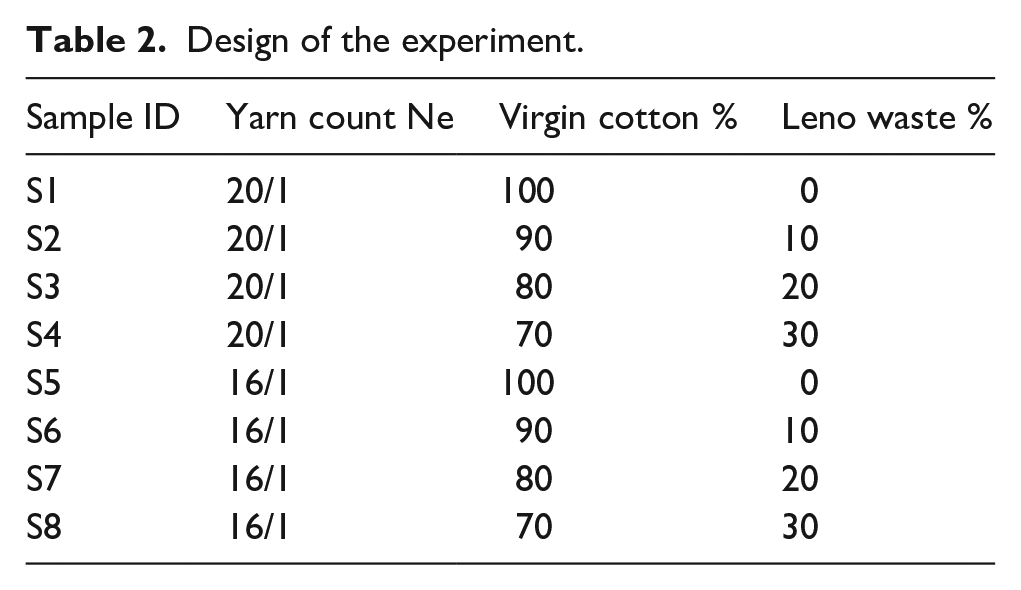
Virgin cotton fibers and leno waste fibers were used to fabricate the knitted socks using two different yarn counts: 20/1Ne and 16/1Ne. The leno waste used in the study was collected from various weaving units. The yarns were composed of a combination of recovered fibers from leno waste and virgin cotton fibers, blended in three different ratios: 30:70, 20:80, and 10:90. The properties of the virgin cotton and leno waste fibers were investigated using Fibrograph 530 (Spin Lab USA) and High-volume instrument (HVI 1000, Uster Switzerland) and are given in Table 1. The design of the experiment is given in Table 2.
Virgin cotton and leno waste fiber properties.

Design of the experiment.
Method
Collection of leno waste fibers
During the weaving process, the leno waste was separated, and the collected raw leno waste was then processed using a Chinese-made recycled opening machine manufactured by Qingdao Huarui Jiahe Machinery Co., Ltd., China. This process resulted in the extraction of opened fibers, which were obtained in a continuous form, as depicted in Figure 1.

Flow process of leno waste opening: (a) leno waste separation in weaving, (b) leno opening in waste opening machine, and (c) opened leno waste fibers.
Yarn production
The opened fibers from leno waste are combined with virgin cotton in the desired ratios given in the design of experiment. Subsequently, this blended mixture is spun separately using the ring spinning process, maintaining a constant T.M (Twist Multiplier) of 3.8.
Development of socks
The developed yarns were then utilized to knit the socks using a circular knitting machine called GL716 with a gage of 144 needles per inch and a diameter of 4 inches. The machine operated at a speed of 250 revolutions per minute. Afterward, the socks underwent a dip-wash treatment at a temperature of 40°C to tackle any possible fabric shrinkage. Lastly, the socks were placed on a boarding machine to guarantee wrinkle removal. The complete process flow diagram, from the collection of leno waste to the comfort testing of socks, is depicted in Figure 2.

Flow diagram of leno socks manufacturing.
Characterization
The fiber properties of the recovered fiber from leno waste were evaluated using Fibrograph 630, while the properties of the virgin cotton were assessed using the HVI machine. The physical and structural properties of both virgin yarns and blended yarns were assessed using the Uster Tenso Rapid and Uster Zweigle Hairiness Tester 5. The surface morphology of the socks has been investigated using optical microscopy with 180× magnification by a Labomed CZM6 stereo microscope. The air permeability of the sock samples was measured using an air permeability tester (SD-ATLAS MO21A AP) according to the specifications outlined in the EN ISO 9237 standard. To evaluate the thermal comfort properties, the sweating guarded hotplate (SD-ATLAS M295B) test method specified in EN ISO 11092 was employed. The moisture management properties were assessed using a moisture management tester (SD-ATLAS M290) following the AATCC TM 195-2011 testing method. The testing and evaluation of all sock samples were conducted under standard atmospheric conditions (22°C and 65% RH). Each blend variation was tested on five sock samples, and the average results were recorded. The effects of different waste ratios on the thermal comfort properties were statistically analyzed using analysis of variance (ANOVA) in Minitab, with a significance level of 0.05. The significance of the leno waste percentage was determined based on the obtained p-values. If the p-value was less than 0.05 (p < 0.05), the waste ratios were considered significant. Consequently, the comfort properties of socks made from blended recycled leno waste and virgin cotton fiber were statistically investigated.
Results and discussion
Evaluation of yarn properties
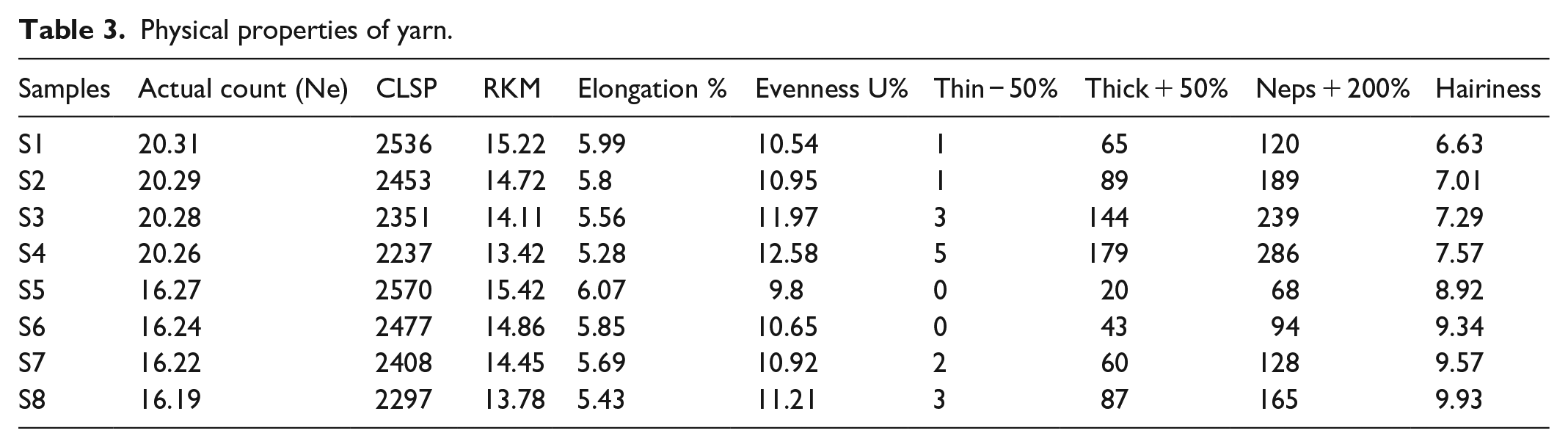
Table 3 presents the impact of yarn linear density, specifically yarn count, and the utilization of leno waste on the quality of properties in ring spun yarn, including yarn evenness, strength, hairiness, and imperfections.
Physical properties of yarn.
Effect of leno waste on mechanical properties and imperfections
Figure 3 illustrates the tensile properties of yarn produced from leno-recovered fibers and virgin cotton for socks. The figure demonstrates that as the yarn count becomes coarser, there is an increase in yarn strength and breaking elongation percentage. This reduction is attributed to factors such as diminished fiber-to-fiber friction and weaker fiber groups in finer yarns, where more fibers are packed in the same cross-section. 15 However, as the percentage of recovered fibers in the yarn increases, both strength and elongation decrease. This can be attributed to a higher concentration of short fibers in the core of the yarn, which reduces cohesion between fibers and increases slippage. The decreased fiber length leads to a decline in the strength and elongation of the yarn. These findings align with the research conducted by Jamshaid et al. 4 who reported that a decrease in the length of short fibers in recovered fiber results in reduced tenacity and elongation of the yarn. Conversely, an increase in fiber length of the recovered fiber leads to higher tenacity, elongation, and reduced irregularity in the yarn.

Effect of yarn count and blend ratio of virgin and leno waste fibers on tensile strength & imperfection.
The effect of yarn linear density and blending of leno waste with virgin cotton on imperfections are shown in Figure 3, which indicates that as the yarn gets finer, the imperfection increases which also directly affects the properties of the socks. The reason is that, as yarn fineness increases, imperfections rise due to factors like decreased fiber cross-section and increased fiber openness which increase the surface roughness of the socks. As the quantity of recovered fiber from leno waste rises, there is a corresponding increase in the presence of thin sections, thick portions, and neps. The reason for the increase is due to the short length and a smaller number of fibers per unit area which increased the higher imperfections. Béchir et al. 16 reported that as the ratio of recycled fibers in the yarn increased yarn unevenness and IPI values of blended yarns increased as well. Mwasiagi and Mirembel 17 reported that with the increase in yarn linear density yarn thin and thick places increase in the yarn.
Effect of virgin cotton and leno waste yarn on unevenness & hairiness
Figure 4 illustrates the impact of yarn hairiness and evenness, comparing yarns made from virgin cotton and a combination of waste fibers. As expected, the hairiness values increase with higher yarn linear density and an increased percentage of waste fibers. Conversely, the evenness of the yarn improves as the linear density decreases, but unevenness increases with a higher percentage of waste fibers. The increased yarn unevenness is attributed to the alignment of fibers along the core of the yarn, resulting in greater irregularity among the fibers as the fiber length decreases. Altaş and Kadoğlu 18 have reported that hairiness values of yarn increase with higher yarn linear density, while hairiness decreases as the fiber length of the constituent fiber increases. Additionally, Béchir et al. 16 found that as the ratio of recycled fibers in the yarn increases, both yarn unevenness and IPI (Imperfections Per Kilometer) values of blended yarns also increase. Similar results were reported by Sakthivel et al. 19 and Peters et al. 20

Effect of yarn count and blend ratio of virgin and leno waste fibers on evenness & hairiness.
Evaluation of knitted fabric properties
Surface morphology
The surface images of socks made from virgin cotton fibers and recycled fibers are depicted in Figure 5. Figure 5(a) displays the surface of socks composed entirely of 16/1 yarn composed of virgin cotton fibers, while 5b shows socks having 16/1 yarn with a 70:30 ratio of virgin cotton to recycled cotton fibers. While there is no significant difference in structure, the recycled socks exhibit greater surface roughness compared to the virgin cotton socks. This heightened roughness is attributed to the smaller length of waste fibers emerging from the yarn core and becoming visible on the surface, thereby increasing the overall surface roughness of the socks. In Figure 5(c) and (d), the fabric structure of socks with a 20/1 count is presented, featuring 100% virgin cotton in Figure 5(c) and a 70:30 ratio of virgin to recycled fibers in Figure 5(d). These results mirror the effects observed in the 16/1 cotton fabric. Consequently, it can be concluded that there is minimal disparity in the surface morphology of socks crafted from virgin cotton fibers compared to those incorporating recycled cotton fibers with a 70:30 ratio.

Microscopic images of socks development include: (a) socks made from 16/1 yarn with 100% virgin cotton fibers, (b) socks developed from 16/1 yarn with a fiber ratio of 70:30 for virgin cotton to leno waste cotton, (c) socks produced with 20/1 yarn featuring 100% virgin cotton fibers, and (d) socks developed from 20/1 yarn with a fiber ratio of 70:30 for virgin cotton to leno waste cotton.
Thermal resistance
The thermal resistance of a fabric refers to its ability to impede the transfer of heat from one side to the other. A higher thermal resistance value indicates that the fabric provides a warming sensation to the wearer. The thermal resistance values in Figure 6 reveal that decreasing yarn linear density has an inverse effect on the thermal resistance of the sock while increasing the percentage of leno waste leads to an increase in the thermal resistance of the knitted fabric. The primary reason for this is the yarn’s hairiness. As hairiness increases, the presence of static air also increases, which hinders the passage of heat in socks and ultimately increase the thermal resistance of the fabric. Celep et al. 21 have reported that fabrics made from recycled cotton fibers exhibit higher thermal resistance and lower air permeability, providing a warmer sensation upon initial contact.

Effect of yarn count and blend ratio of virgin and leno waste fibers on the thermal resistance of knitted socks.
Air permeability
Figure 7 demonstrates that all the knitted fabric samples exhibit higher air permeability. The data suggests that as the yarn count becomes finer, the air permeability of the fabric increases. On the other hand, an increase in the percentage of recovered fiber from waste leads to a decrease in the air permeability of the fabric which diminish the comfort properties of the socks. This can be attributed to the growing number of protruding fiber ends, which reduce the porosity of the fabric. These findings align with previous research conducted by Gun et al., 13 who reported that the air permeability of knitted single jersey fabric is lower for fabrics made from reclaimed fiber compared to those made from virgin cotton material.

Effect of yarn count and blend ratio of virgin and leno waste fibers on the air permeability of knitted socks.
Overall moisture management capability (OMMC)
The overall moisture management of all the knitted fabric samples exhibited favorable moisture management properties, as cotton, which has good moisture management properties, was used. When comparing the overall moisture management (OMMC) of 100% virgin cotton in Figure 8, it was observed that as the yarn count becomes finer, the OMMC decreases. The reason is that finer count yarns exhibit lower OMMC values, attributed to their higher unevenness compared to coarser yarns. The unevenness of finer yarns can result in reduced moisture management capacity, as reflected in OMMC values. Moreover, the higher number of fibers in the cross-section of finer count yarns can contribute to a lower moisture management capacity due to reduced space between fibers for moisture movement. 22 Additionally, as the percentage of waste increased to 30%, the OMMC values of the knitted fabric decreased further. The reason is that waste fibers, being shorter and coarser than virgin fibers, contribute to increased yarn unevenness, resulting in lower moisture management capacity. Furthermore, the higher surface roughness of waste fibers can further reduce moisture management capacity due to the limited available surface area for moisture transport. These findings are consistent with previous research conducted by Gun et al., 13 who reported that the overall moisture management (OMMC) of knitted single jersey fabric is lower for fabrics made from reclaimed fiber compared to those made from virgin cotton material.

Effect of yarn count and blend ratio of virgin and leno waste fibers on OMMC of knitted socks.
Socks pilling
Pilling refers to the formation of clusters of intertwined fibers on the surface of fabric due to friction and abrasion. The pilling rating values in Figure 9 indicate that as the percentage of leno waste in the fabric increases, the occurrence of pilling on the fabric surface also increases. On the other hand, the pilling of the socks is not significantly affected by yarn count. Pilling is closely related to the presence of protruding fiber ends on the fabric surface. With an increase in the percentage of leno-recovered fiber, which typically contains a higher proportion of short fibers, the likelihood of pilling also increases.

Effect of yarn count and blend ratio of virgin and leno waste fibers on the pilling rating of knitted socks.
Statistical analysis
Table 4 presents the results of a Full factorial ANOVA analysis for various properties of socks. The factors analyzed are the yarn count and the percentage of waste in the fabric. The analysis includes the sum of squares, F-value, and p-value for each property. For the property of thermal Resistance, both the count and waste percentage factors show statistically significant effects. The F-values of 39.24 (for the count) and 20.52 (for waste %) indicate a significant impact on thermal resistance. The p-values of 0.008 (for yarn count) and 0.017 (for waste %) further support the significance of these effects. Regarding air permeability, the yarn count factor shows a significant effect with an F-value of 12.31 and a p-value of 0.039. The waste percentage factor also demonstrates a highly significant impact, as indicated by the large F-value of 34.68 and a low p-value of 0.008.
Full factorial ANOVA of sock properties.

For the property of OMMC (Overall Moisture Management), the yarn count factor exhibits a significant effect with an F-value of 18.29 and a p-value of 0.023. The waste percentage factor shows a lower but still noticeable effect with an F-value of 5.86, although the p-value of 0.09 suggests that it may not be statistically significant at the conventional 0.05 significance level.
Conclusion
Successful development of knitted socks using leno waste has been achieved. With an increased percentage of leno waste, the yarn’s CLSP (count, length, strength, and proportion), RKM (abrasion resistance), and yarn elongation decrease, while imperfections, hairiness, and U% (unevenness) increase. This can be attributed to the higher presence of short fibers in the core of the yarn, resulting in reduced cohesion and increased slippage among the fibers. Consequently, the strength and elongation of the yarn are negatively affected. The irregularity among fibers and variations in the number of fibers ends per unit length contribute to yarn unevenness, higher imperfections, and increased hairiness. It can be concluded that socks with a higher percentage of leno waste exhibit greater thermal resistance, providing a warmer sensation when worn during winter. Conversely, as the yarn becomes finer, the thermal resistance decreases, making the socks more breathable for summer wear. Additionally, the air permeability and water vapor resistance of the socks increases with a finer yarn count, promoting better evaporation of sweat. However, an increase in leno waste percentage decreases air permeability. Overall moisture management of all samples is good, attributed to the use of cotton as the base material for the socks, which inherently possesses good moisture management properties. As the yarn becomes coarser, the moisture management of the socks improves. Furthermore, higher leno waste percentages result in improved pilling resistance, indicating good physical appearance and durability of the socks. The full factorial ANOVA analysis reveals that both the yarn count and the percentage of waste in the fabric significantly influence the thermal Resistance, air permeability, and OMMC properties of the socks ensuring they can be used for an extended period, providing both value for money and esthetic comfort to the wearer.
Footnotes
Availability of data and material
The data will be made available as per requirement.
Code availability
Not applicable.
Declaration of conflicting interests
The author(s) declared no potential conflicts of interest with respect to the research, authorship, and/or publication of this article.
Funding
The author(s) received no financial support for the research, authorship, and/or publication of this article.
Ethics approval
Not applicable.
Consent to participate
Not applicable.
