



Abstract
This research focuses on the integration between functional finishing and the performance properties of polyester fabric for comfortable clothes. The effects of nanofinishing (zinc oxide nanoparticles and nano-polyurethane nanocomposite) on the ultraviolet protection properties of polyester fabric, the whiteness index, and the Kawabata Evaluation System were studied. Under the optimum finishing conditions, excellent protection (150) was achieved at lower concentrations of the nanocomposite, and zinc oxide nanoparticles individually enhanced the whiteness index (73). The results of the Kawabata Evaluation System showed that the finishing processes improved mechanical and performance properties (tensile, shearing, bending, compression, surface roughness, thermal, and hand properties), indicating that all the finished fabrics offered enhanced functionality, thermal and comfort properties. Enhanced total hand value properties (3.7 for summer and 5.1 for winter) were realized by finishing, assuming the finished fabrics were applied to men’s shirts and women’s dresses for summer and winter apparel. Scanning electron microscopy and energy disperse X-ray spectroscopy analyses showed a uniform layer of zinc oxide nanoparticles and nano polyurethane on the fiber surface. Fourier transform infrared spectroscopy confirmed the structural changes in the finished fabric.
Keywords
Introduction
The impact of finishing polyester fabrics using nanostructured materials and their effect on the functionality, mechanical, and hand properties have not been widely explored. In recent years, owing to their effective and successful applications in the textile industry, nanomaterials have attracted growing interest among promising new revolutionary approaches compared to conventional. 1 In addition, the synthesis and applications of metals and metal oxide-based nanoparticles (NPs), such as silver (Ag), copper (Cu), gold (Au), zinc (Zn), iron oxide (Fe2O3), zirconium oxide (Zr2O), stannous oxide (SnO2), titanium dioxide (TiO2), and zinc oxide (ZnO), have received increased attention. 1 Considerable interest has been paid to ZnO NPs, which exhibit various characteristics, such as chemical stability, inexpensiveness, accessibility, superiority over other inorganic and organic ultraviolet (UV) protective materials, and nontoxicity.2,3 Furthermore, zinc ions, a natural product, are considered one of the most prevalent and nontoxic metals in the world. 4
ZnO NPs are innovative metal oxides with outstanding physicochemical characteristics. Owing to its good thermal conductivity, high electron mobility, strong scattering absorption coefficients, and broad bandgap, ZnO has been extensively used in many applications.5,6 Its significant efficacy in blocking radiation and its good chemical stability upon UV radiation (UVR) account for its excellent UV protection qualities. The reported UV protection mechanism of ZnO includes UV radiation absorbance and UV light refraction and scattering due to its high index of refraction, which inhibits UV radiation from passing through textile materials and reaching the skin. Moreover, due to their high surface-to-volume ratio, ZnO NPs provide significantly better UV protection than microsized ZnO. 7
Finishing textiles using nanomaterials does not provide sufficient fixation and durability. As a result, utilizing polymer nanocomposites offers effective NP deposition with good adhesion to textile fibers, which is a crucial demand. 8 Recently, various hybrid nanocomposites have been prepared, as they have various environmental and industrial applications. 9
Owing to its remarkable physical qualities, such as low-temperature flexibility, resistance to abrasion, controlled stiffness, and transparency, polyurethane (PU), a segmental copolymer with alternate soft and hard segments, has received the extensive application. However, PU has inadequate mechanical and thermal properties. Chemical alteration of the molecular structure and the introduction of organic or inorganic compounds, such as metal oxides, have improved PU characteristics for various applications. 10
Polymer nanocomposites of metal oxides and organic polymers have been widely studied for textile modification. They exhibit multifunctional properties, such as UV protection, self-cleaning, antiodor, and antibacterial. 3 Moreover, the obtained fabrics can be used for promising applications due to their sustainability despite losing fundamental fabric properties, such as esthetic values, wearability, comfortability, and flexibility. Notably, they can improve various performance and mechanical properties, such as fabric deformation, tensile strength, and stiffness.1,3,11
ZnO and PU nanocomposites can be prepared in different processes. The most recently used are in situ polymerization and the blending process. These processes introduce the prepared nanocomposite to fabrics as thin functional layers, which are used in conventional textile finishing techniques and in industrial and environmental applications.6,12
Different techniques can be used to apply nanocomposite materials to fabric surfaces. The most common technique is pad–dry–cure conventional finishing, in which NPs are deposited on the fabric surface and permeate the fiber and fabric interstices in this procedure. 2
Although many studies have considered the aforementioned functional properties, only a few have explored the capabilities of ZnO-mixed PU nanocomposites,6,10 which can be considered an innovative approach to polyester (PET) fabric functionalization in the current study.
Several studies have investigated the preparation and implementation of NPs for photocatalyst, hybrid solar, and functional applications on fabrics and other materials using sol-gel, hydrothermal, and chemical bath deposition techniques. These techniques have recently gained a raised concern owing to their time intensiveness, and most of them require NPs and nanocomposite deposition in two stages. Sonication is now a straightforward, cost effective, and environmentally acceptable method for synthesizing and applying various organic and inorganic NPs and nanocomposites to textiles.5,6
Notably, the use of proper finishing agents can improve the mechanical and performance properties of finished material. 1
Meanwhile, addressing the relationship between functionality and comfort properties is necessary. The current research investigates the effect of nanocomposite finishing of PET fabrics on the fundamental mechanical, hand, and comfort properties of the finished fabrics using the Kawabata Evaluation System (KES).
Clothing fabrics are examples of “human-interacting materials” used to cover the skin, with a significant connection between material characteristics and human requirements. Furthermore, clothing quality is connected to a fabric’s mechanical characteristics, which is the primary consideration for customers. Moreover, the designers of textile fabrics consider critical aspects that influence product behaviors. Therefore, most recent studies have focused on consumer attitudes, preferences, and daily needs and demands to determine the perfect functional clothing that protects humans from the surrounding environment and is comfortable at the same time. 13
Hence, different test methods were developed to evaluate these performance and tactile properties using either subjective or objective techniques. 13 Physiological and sensory hand attributes determine apparel comfortability. Therefore, fabric properties, such as thermal conductivity, water vapor resistance, hygroscopicity, and air permeability, could influence physiological comfort.14 –16
Furthermore, subjective assessment as a qualitative method examines the fabric/garment handling, in which an expert experiences the overall sensation by manipulating fingers or touching the fabric, stating good handle, average handle, or poor handle classification.14,17
KES is an objective and quantitative method that performs accurate measurements using instrumental devices provided by their software program for measuring and calculating the evaluated properties.14,17
It includes four individual devices that can obtain more than 16 parameters in the warp and weft directions, comprising practically all fabric mechanical properties measured under low-stress conditions: tensile strength, bending, shearing, compression, surface properties, hand parameters, sensorial comfort, and thermal properties.15,16
The KES devices can evaluate four tensile parameters: the linearity of the stress-strain curve (LT), fabric extensibility, which measures a fabric’s capability to stretch under a tensile force (EMT), and the tensile energy per unit area (WT) that accounts for the effects of both EMT and LT, and tensile resiliency (RT) that measures the recovery from tensile deformation.18,19
The material must be subjected to stretch or shear to be compatible with human body movement changes, as shear deformation is widespread throughout the wearing operation. In other words, it represents the hardness of distorting a fabric by bending. Shear rigidity (G) is connected to material bending characteristics. Combined with bending rigidity (B), it will be an excellent predictor of fabric’s ability to drape and is often required to obtain the desired apparel shape during clothing manufacturing.20,21
From the garment-manufacturing viewpoint, the bending rigidity variable is crucial, especially with sewing-lightweight fabrics. The greater the bending rigidity, the greater the fabric’s ability to withstand bending by an externally applied force, such as spreading and stitching. Furthermore, thickness and fabric density have a massive effect on this property.18,22
Another measurement is fabric compression, which is an essential factor to consider when evaluating textile mechanical properties, and is correlated to the fabric handle, including fabric softness, fullness, and surface smoothness. This characteristic can affect a fabric’s thermal properties.14,21
The fabric handle is directly related to the garment’s surface characteristics. The coefficient of friction (MIU), the measure of MIU variation (MMD), and the measure of geometric roughness (SMD) that describes the evenness and smoothness of the fabric surface, are the three parameters employed as indicators of fabric surface property.18,19
Apparel is widely known for managing the quantity of heat transfer between the human body and the environment. The heat transmission behavior of apparel is highly related to thermal comfort, which is an important aspect when designing garments. Because a textile comprises different fibers interlacing in a woven construction, thermal expansion transfer is not well recognized. The influence of fiber properties, yarn qualities, and fabric construction on heat resistance has been investigated in different studies. 23
The primary hand value (PHV) and total hand value (THV) are hand parameters evaluated by KES. They are affected by the raw material, yarn structure, fabric construction, and finishing procedure. Hand parameters are not a single physical feature to be determined. Therefore, one of the advantages of KES is the evaluation of these parameters using one device regarding the measured values of the mechanical properties evaluated.15,16
Consequently, the KES determined the three-hand parameters to analyze fabric applications in winter and summer clothing.15,16 The first primary hand parameter is Koshi, defined as a feeling related mainly to bending rigidity. It is a springy property that intensifies this feeling. When the fabrics have a compact structure, elastic yarn usually gives a high Koshi value. The second primary hand parameter is Numeri, defined as a combination of soft, supple, and smooth textures. For example, the fabric made of cashmere fiber has a high Numeri value. The third primary hand parameter is Fukurami, defined as the mixed feeling that arises from bulky, rich, and well-formed behavior linked to springy compression and fabric thickness properties.15,16,21
The use of ZnO NPs, nano-PU, and their polymer nanocomposites to finish PET fabric improves its functionality, and studies that have evaluated the low-stress mechanical, hand, and comfort properties of PET fabric remain limited. In summary, Table 1 compares previous and current studies, revealing the first point of innovation in this study.
A literature survey and comparison on PET fabric related to nanocomposite finishing and KES of mechanical, hand, and comfort properties.

Notably, only a few studies have explored the effect of nanocomposite finishing and its impact on the mechanical, hand, and comfort properties of PET fabric using KES, assuming product application in the apparel field.
The above-highlighted gap primarily motivated this study. This study aimed to investigate the effects of finishing PET fabric with ZnO NPs, nano-PU, and their hybrid nanocomposites on UV protection potential, as well as the impact on PET fabric morphology and surface using scanning electron microscopy (SEM) and energy disperse X-ray spectroscopy (EDX). In addition, Fourier transform infrared spectroscopy (FTIR) was used to characterize the functional groups of the PET fabric samples before and after finishing. The whiteness index (WI) values of PET fabric samples were measured before and after finishing.
The instrumental and computerized KES of the finished PET fabrics were used to evaluate the performance and low mechanical properties, hand parameters, thermal, and comfort properties. Therefore, the assessed properties are considered critical factors in predicting and classifying the functional fabrics obtained for the best applications and end-uses in the apparel field. Hence, this study claims to connect functionality with comfortability and applicability. Accordingly, the current study integrates the relationship between the functional finishing process as a starting strategy and the finished fabric comfortability and introduces suitable applications and end-uses.
Experimental work
Fabric
Bleached and an irregular satin weave 4 100% PET fabric was purchased from Misr Spinning and Weaving Company, El-Mahalla El-Kubra, Egypt. Fabric specifications are 70 ends/cm for warp, 32 picks/cm for weft, and 134 g/m2 fabric weight. The polyester fabric was subjected to chemical activation by alkaline hydrolysis before undergoing any finishing process, simulating the industrial situations. 26
Chemicals
ZnO nanopowder was purchased from Sigma-Aldrich; BAYPRET® NANO-PU Nano-dispersion self-crosslinking polyether polyurethane emulsion was kindly supplied from TANATEX Company, nonionic detergent Hostpal® CVL-EL was kindly provided from Clariant. Folic acid as a pharmaceutical grade was purchased from EL-Nile Company for Pharmaceuticals and Chemical Industries.
Preparation process of ZnO NPs and nano-PU dispersions
For the preparation of the finishing dispersion, different concentrations of ZnO nanopowder [0.5–2.5% w/v], BAYPRET® NANO-PU nano polyurethane [25–100 g/l], and Folic acid [5 mg% w/v] were added to distilled water are mechanically stirred at room temperature for 10 min and sonicated at 80°C for 15 min to obtain a homogeneous suspension.
Finishing processes and functionalization of PET fabric
The PET fabric samples were finished with the prepared dispersions of ZnO NPs, nano-PU, and ZnO/PU nanocomposite using the sonication technique for 15 min at 80°C. In the presence of Folic acid. Then the coated samples were squeezed two dips and two nips at a wet pick up 100%, dried at 100°C for 3 min, then cured at [110°C, 130°C, 150°C] for 2 min and rinsed with distilled water to remove the excess of nonattached NPs. Finished PET fabric samples are coded as follows. B refers to blank; M refers to samples finished with ZnO/PU nanocomposite; Z refers to samples finished with ZnO NPs, and PU refers to samples finished with nano-polyurethane.
Washing procedure
Before any testing and evaluation, the finished PET fabric samples were washed for 10 washing cycles according to the standard AATCC Test Method 61-1996 to remove unfixed NPs from the finished PET samples.
Evaluation of whiteness index
The whiteness index (WI) values of PET fabric samples were measured and calculated on an Ultra-Scan PRO D65 UV/VIS Spectrophotometer (CEM, Charlotte, NC, USA).
Ultraviolet protection ability
The UV protection properties of PET fabrics were evaluated according to the Australian New Zealand standard test method 135-2000 by measuring ultraviolet radiation transmission using UV-JASCO V-750 Spectrophotometer. The ultraviolet protection factor (UPF) values of the fabrics were calculated using Equation (equation (1) below) from the transmission spectral of the tested fabrics. They were measured three times within the range of 280–400 nm. The UPF rating means how efficiently a fabric prevents UV radiation from the sun, often referred to as solar UV radiation (UVR). The greater the UPF rating, the material blocks more solar UVR. Depending on the UPF value calculated, the protection category is classified as the following; (<15) non-ratable, (15–24) good, (25–39) very good, and (40–50, 50+) excellent protection against UVR. 29

Where Eλ is the relative erythema spectral effectiveness, Sλ is solar spectral irradiance in W m−2 nm−1 (Eλ and Sλ are obtained from the standard test method database); Τλ is the spectral transmittance of the sample obtained from UV spectrophotometric measuring, and Δλ the difference between measurable wavelength in nm. 30
Scanning Electron Microscopy (SEM) and Energy Disperse X-ray Spectroscopy (EDX)
SEM and EDX were utilized to examine the effect on PET fabric morphology and chemical components of finishing processes. 31 A JEOL-Model JSM T20 scanning electron microscopy operating at 19 kV was used to obtain photomicrographs of the finished and blank PET samples.
Fourier Transform Infrared Spectroscopy (FTIR)
FTIR was used to characterize and examine different functional groups in PET fabric samples. The FTIR was obtained using the transmission technique, with a frequency of 4 cm−1 and a spectral band of 400–4000 cm−1 nm.31 –33
Performance and comfort properties using Low-stress Kawabata Evaluation System
Low-stress mechanical properties of the unfinished and finished PET fabrics were measured using KES-FB-Auto (KATO TECH Co. LTD, Kyoto, Japan). The KES system comprises four automatic test instruments for conducting tensile, shearing, bending, compression, surface friction, and thermal properties, as shown in Table 2.13,34 In addition to evaluating primary hand value (PHV) and total hand value (THV), to predict the applications of PET fabrics in summer or autumn/winter apparel products. All samples have sizes of 20 × 20 cm, and measurements have taken place in both the warp and weft directions, excluding the compression properties measured only in the cross-sectional direction. 22
Low-mechanical, surface, and thermal properties measured by KES.
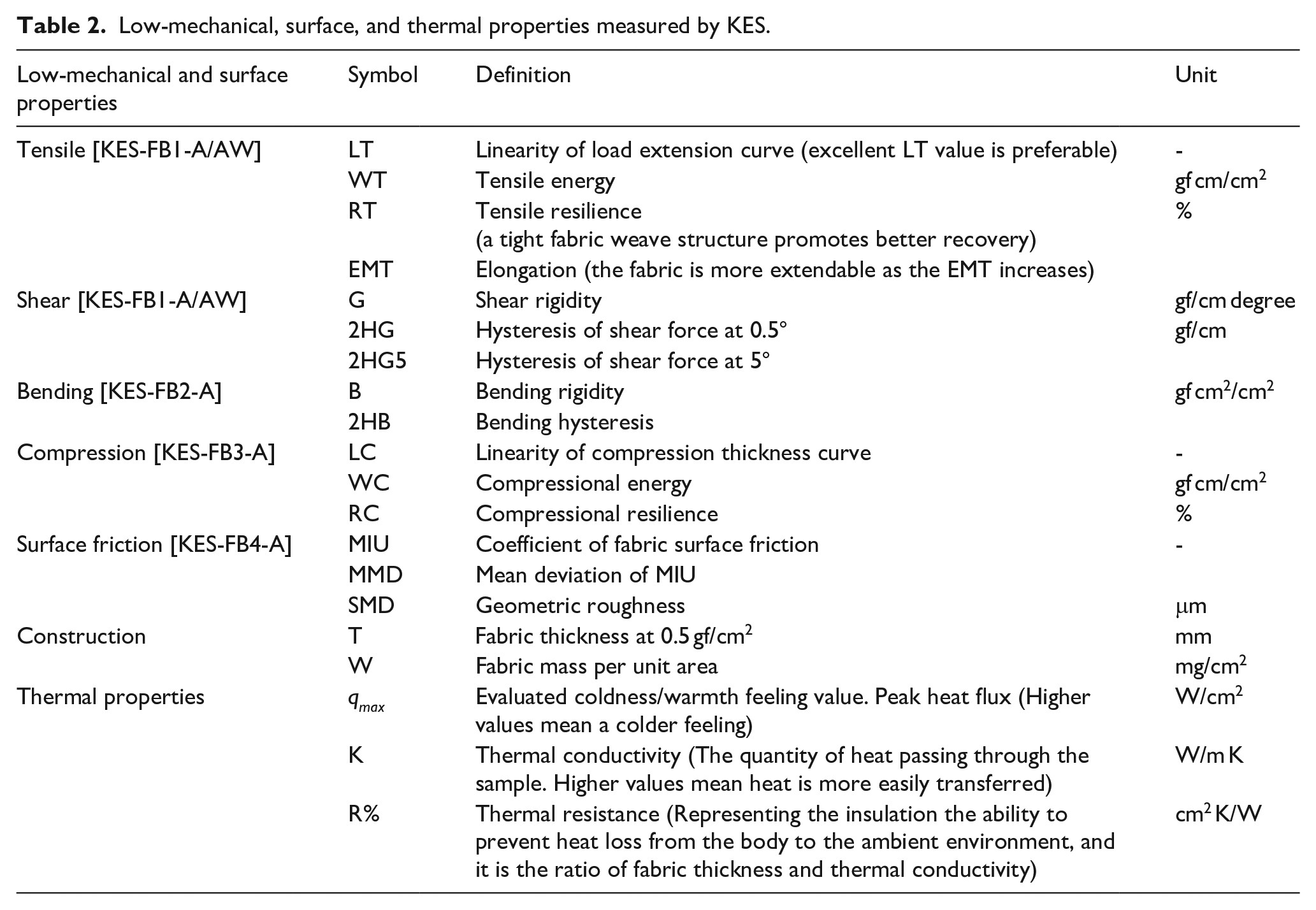
The same device, the KES-FB1-A/AW, evaluated tensile and shear properties. KES-FB2-A was used to measure bending characteristics. Moreover, the device used to measure compression properties is KES-FB3-A. Surface and frictional properties (fabric friction and surface roughness) are measured by KES-FB4-A. 15
The KES-F7 Thermo Labo was used to measure the thermal properties parameters. Coldness and warmth feeling (qmax) measured using JIS L 1927 Textiles-Measurement method of cool touch feeling property. Thermal conductivity (K) measured using GB/T 35263-2017 Textiles-Testing and evaluation for cool sensation at contact instant and thermal resistance (R) of the PET fabric samples. These parameters evaluate the fabric potency to provide a sense of coolness in the summertime and undergarments fabrics and a touch of warmth in the winter. This device measures such feeling by evaluating the “qmax” value, which means the maximum amount of heat transfer (peak heat flux) and “K” value in dry conditions, and the temperature differences were at 30°C and 20°C at standard temperature and humidity conditions (20°C and 65% relative humidity).
Results and discussion
Effect on UV protection properties
Table 3 shows the impact of different finishing conditions (concentrations and curing temperatures) on the ultraviolet protection factor (UPF) of PET fabric functionalized with ZnO NPs, nano-PU, and their nanocomposites. The results revealed that ZnO NP concentrations (0.5%, 1%, and 2%) and nano-PU concentrations (25, 50, and 75 g/l) enhanced the UPF of the PET fabric. Increasing both concentrations enhanced the UPF values up to 50+ (200, 190, and 150) respectively over the blank fabric (30) and raised the protection category to an excellent rating, which is necessary and highly recommended for apparel and different textile applications, regardless of the curing temperatures used.
Effect of ZnO NPs, nano-PU finishing conditions (concentrations and curing temperatures) on UPF of PET fabric.

Where STDEV is a standard deviation.
ZnO NPs provide excellent UV protection via absorption, reflection, and scattering mechanisms, where the part of the UV absorbed by ZnO leads to exciting electrons in valence bands,7,35 inducing its high refractive index, which prevents UV rays from reaching the skin through direct and diffuse transmission through textile materials. In addition, the UV protection properties of ZnO NPs stem from their high effectiveness in blocking radiation and their superior chemical stability during UV radiation exposure. 7
Moreover, 2.5% ZnO NPs and 100 g/l nano-PU decreased the UPF value without affecting the protection category, which still has excellent protection. These results may be due to the increase in aggregation of the NPs that functionalize the fabric surface, thereby negatively affecting the UPF values, which does not preserve the superior UV protection potency. The curing temperature of 110°C achieved the highest UPF values, whereas that of 130°C–150°C decreased the UPF values without affecting the protection category. 7
Consequently, under the optimum finishing conditions, the desired UPF value (50+, 150) and excellent protection category were realized, achieving sustainability by minimizing chemicals and saving energy. Hence, the optimum condition was ZnO/PU nanocomposite achieved with 0.5% ZnO NPs, 50 g/l nano-PU, and curing at 110°C.
Effect on the whiteness index
Here, the effects of the concentrations of ZnO NPs and nano-PU and curing temperatures on the whiteness properties values were analyzed. Table 4 shows that finishing the PET fabric with ZnO NPs enhanced WI values (71–76), reflecting improved whiteness properties. This probably occurred because the loaded ZnO NPs on the fabric surface had a broad absorption band at 385 nm and extended into the far UV, irrespective of the curing temperatures used in the finishing process (110°C, 130°C, and 150°C).36,37
Effect of ZnO NPs, nano-PU finishing conditions (concentrations and curing temperatures) on WI values of PET fabric.

STDEV, a function that calculates standard deviation for a data sample.
In addition, another reason may be that ZnO NPs as white pigments offer several additional advantages and can improve the bulk polymer’s mechanical and thermal properties.36,37
However, a higher curing temperature of 150°C and nano-PU concentration of 100 g/l decreased the WI values. These results showed that raising the curing temperature to elevated temperatures induced a degree of yellowness that decreased the WI value, which agrees with the results found in previous studies.38,39
Characterization of PET surfaces by SEM and EDX
SEM and EDX were used to analyze the textile fabrics’ surface morphology.31,32,40 Figure 1(a) to (d) shows the effect of finishing processes on the PET fabric surface. Several pores and itching were observed on the PET fabric surface, resulting from alkali pretreatment (Figure 1(a)). 26

SEM and EDX characterization of: (a) blank PET fabric, (b) PET fabric finished with nano-PU, (c) PET fabric finished with ZnO NPs, and (d) PET fabric finished with ZnO/PU nanocomposite.
Accordingly, alkali-activated PET fabric before the finishing operation led to surface roughness and provided sites available for functional finishing agents that could penetrate the fibers’ surface. 26
In contrast, finishing with nano-PU induced a smoother surface (Figure 1(b)), which covered the fabric surface with a thin transparent layer. 41
Figure 1(c) and (d) shows some aggregation on the PET fiber surface after incorporating ZnO NPs in the finishing bath formulation individually or with ZnO/PU nanocomposite. This may be attributed to the lower concentration used in the current study.11,42 Another explanation for these findings is that NPs are readily agglomerated due to their tiny size, elevated surface reactivity, and high specific surface area. These findings are in line agreement with previous research works.11,43
Figure 1(d) shows the surface morphology of the ZnO/PU nanocomposite, which showed a smoother and uniform layer with fewer aggregations. This result revealed the advantage of using the PU polymer in the dispersion and compatibility with ZnO NPs while preparing their nanocomposite.8,41
The EDX images showed the Zn content on the PET fiber surface finished with ZnO NPs and ZnO/PU nanocomposites (Figure 1(c) and (d)). According to the EDX results, the zinc content using ZnO NPs alone exceeded that of ZnO/PU nanocomposite, owing to the interaction of ZnO NPs with nano-PU. Most of the surface hydroxyl groups of ZnO NPs reacted with the amine or isocyanate functional groups of nano-PU. 6
Characterization of PET fabric by Fourier Transform Infrared Spectroscopy (FTIR)
Figure 2 shows the spectral FTIR of PET fabrics (alkali activated (blank), finished with nano-PU, ZnO NPs, and ZnO/PU nanocomposite). The C–O–C stretching vibration bands that appeared at ~1087 and ~1237 cm–1 were attributed to the ester groups of PET fabric.32,44

(a and b) FTIR spectra of blank, PU, Z, and M PET fabrics.
A peak at 2360 cm–1 also indicated the existence of carboxylic groups (–COOH), which can be attributed to the alkali activation of the PET fabric surface.26,32
Notably, a stretching vibration band at ~1720 cm–1 was associated with a carbonyl group (C = O bond). The stretching band of the –NH group appeared at ~3300 cm–1, which was attributed to the urethane bonds regarding PET fabric finished with nano-PU.10,44 The absorption of isocyanate of PU, characterized by peaks, appeared at 2190–2100 cm−1,44 which was observed for PET fabric finished with ZnO NPs only, and new peaks appeared around 450–510 cm−1 associated with stretching vibrations of ZnO. In addition, the FTIR spectra of ZnO–PU nanocomposite showed that the characteristic urethane bond N–H and C–O appeared at 3300 and 1720 cm−1. The peak at 2930–2850 cm−1 represented the asymmetric and symmetric stretching bands of the CH2 group.6,45
Effect of functional finishing on low-stress mechanical properties evaluated by KES
The essential aspects of producing functional fabrics include imparting the functionality desired for a particular application, acquiring consumer requirements benefits, and maintaining the performance and tactile properties. In this regard, an integrated approach to evaluating the performance of functional fabrics is undoubtedly essential. Some methods have been used to measure and evaluate the low-stress mechanical properties of functional fabrics. The present study used KES to measure and evaluate mechanical properties, such as tensile strength, shearing, bending, compression, and surface friction, under the previously mentioned testing conditions.
Effect on tensile strength
The most important performance properties of fabrics in apparel applications are strength and elongation. The inter-fiber friction effect, ease of crimp removal, and load extension qualities of yarn are essential factors in fabric tensile performance. The KES instrument for tensile strength includes four tensile parameters: the linearity of the load extension curve (LT), tensile energy (WT), tensile resilience (RT), and extensibility. The linearity of the stress-strain curve is represented by LT (EMT), which reflects the elasticity and extensibility of the fabric. A low LT value suggests that the fabric has an elastomeric character and a high comfort level in clothing (more comfortable); the finishing processes markedly impact a fabric’s tensile properties.18,27,34
Table 5 shows the lower mean value of LT of the blank and finished fabrics with ZnO NPs in both directions. Increasing stretchability and recoverability decreased LT regarding finishing with ZnO NPs, inducing a softer hand that enabled a more comfortable attitude while wearing. The more significant the extensibility is, the better the fabric’s tactile quality, which supports previous research.18,27,46
Effect of functional finishing on tensile strength properties evaluated by KES.

STDEV, a function that calculates standard deviation for a data sample.
Reverse results were observed considering finishing the PET fabric with nano-PU and ZnO/PU nanocomposites. LT values increased, causing the fabric to become slightly harsh, possibly due to the nanocomposite’s crosslinking and small particle size, which can easily be entrapped into the fiber matrix. 43
Table 5 shows the WT parameter values. The WT values of the fabrics finished with nano-PU and nanocomposite exceeded those of blank- and ZnO-finished fabrics. The high-value WT showed that the fabric was tighter or compact, reducing the hand value. The greater the WT values, the greater the fabric strength; however, it adversely influences hand feeling. 18
The nano-PU may strengthen the nanocomposite finishing and the interaction between the nano-PU and ZnO NPs. Moreover, hydrogen-bonding interactions between nano-PU and ZnO NPs enhanced the adhesion potential of the ZnO/PU nanocomposite. The hydroxyl groups (OH) on the ZnO NP surface are strongly linked to the electronegative component of urethane, urea, and ether. Furthermore, they can act as fillers, assisting with the load-sharing phenomenon observed in the PET finished fabric that improves tension distribution.6,35,43
Tensile resilience (RT) refers to the ability to recover from deformation and extensibility (EMT); a fabric with a higher RT value has better handling. Table 5 shows that the RT values of the PET fabrics finished with nano-PU and ZnO/PU nanocomposites (81.5% and 80.8%, respectively) exceeded those of the blank and ZnO NPs finished fabrics (⩽60%).27,44
The EMT value of the PET fabric finished with ZnO NPs, nano-PU, and nanocomposite in the warp direction (~2.8%) exceeded that of the blank fabric, indicating higher elongation and better comfort afforded by the fabric. The obtained results may be attributed to the nanosized ZnO–PU. Fewer chain interconnections between polymer chains result in a higher elongation at break. 44
Finally, PET fabrics finished with nano-PU and ZnO/PU nanocomposites achieved better tensile strength properties, maintained hand, and comfort properties at an acceptable level.
Effect on shear characteristics
Shear is an essential factor in determining how a fabric is handled and draped. Shear rigidity reflects (G) the fabric’s subjective handling (increasing shear rigidity improves the fabric’s perceived stiffness). Shear rigidity refers to the ability of a fabric to resist shear stress. The other parameters are shear stress at 0.5° (2HG) and 5° (2HG5).14,17,18
Table 6 shows that the finished fabric had lower G, 2HG, and 2HG5 values than the blank fabric in the warp and weft directions. It exhibited higher recoverability from stress due to higher surface friction properties than the blank fabric (stiffer, more compact, and had a lower hand value.17,25,39
Effect of functional finishing on shear characteristics evaluated by KES.

STDEV, a function that calculates standard deviation for a data sample.
The finishing processes decreased shear rigidity and fabric stiffness and enhanced the fabric handle and comfortability. The homogeneity and leveling distribution of ZnO NPs and nano-PU on the fabric surface and the lower degree of aggregation reduce surface roughness and enhance the fabric fullness; hence, better soft and smooth handle and more comfortable fabrics are realized. 47
In summary, the data of shear parameters evaluation indicated that functional finishing in this study enhanced the fabric fullness; as a result, it offered a better soft and smooth handle and more comfort.25,39
Effect on bending characteristics
Bending properties are determined using bending rigidity (B) (how easily it bends) and bending hysteresis (2HB) (the fabric’s capacity to recover) lower values of bending hysteresis enhance a fabric’s flexibility and hand properties.14,27,46
Table 7 shows that the B values differed in both directions: that in the warp direction exceeded that in the weft direction, and the fabric in the warp direction was less flexible and elastic than that in the weft direction because warp yarns are more twisted than weft threads to resist the stresses they face during the weaving process. 17
Effect of functional finishing on bending characteristics evaluated by KES.

STDEV, a function that calculates standard deviation for a data sample.
Additionally, Table 7 shows that finishing led to decreased 2HB values, inducing better bending resilience and suggesting more flexibility, elastic recovery, better hand, and more comfort properties. 17 Hence, finishing processes did not affect fabric elastic recovery and flexibility: the required drapability for apparel was not affected during wearing. 46
Moreover, the overall B and 2HB values decreased correspondingly after the finishing processes because of the elimination of excess NPs from the formulations during the laundering process after finishing, as high NP content on the fabric surface can increase bending properties. This result supports a previous study. 26
The deposition of ZnO NPs and nano-PU in low concentrations loaded on the fabric’s surface, which increased fabric weight and thickness, necessitated an enhancement in bending properties. 43
Generally, fabric finishing may cause fuzzy or entangled surface fibrils, which are pushed externally once the fabric is bent. Consequently, the crimping in the fabric raises elasticity, which allows the fibers to return to their original structure. 47
Finally, the bending properties of PET fabrics finished with ZnO NPs, nano-PU, and ZnO/PU nanocomposite were enhanced, which has afforded better hand and comfort properties.
Effect on compression characteristics
Fabric compression significantly affects fabric handling, including softness, fullness, and surface smoothness, along with the influence of fabric structural factors such as yarn crimp level and thickness, component fiber, and yarn surface quality.14,17
Kawabata et al., 13 proposed three parameters to explain the compression properties of fabrics. The linearity of the compression thickness curve (LC), compressional energy (WC), and compression resilience (RC) are the three parameters.13,15 These variables are associated with the fabric’s PHV (Fukurami).14,16,22
Table 8 shows the evaluation results of these parameters for PET fabrics before and after finishing processes, which showed a slight decrease in LC after finishing, ranging from 0.48 (finished with ZnO/PU nanocomposite) to 0.52 (finished with nano-PU). Nevertheless, samples finished with ZnO/PU nanocomposite exhibited a higher reduction of LC after finishing, indicating that the fabric samples were easier to compress after finishing. 22
Effect of functional finishing on the compression characteristics evaluated by KES.

STDEV, a function that calculates standard deviation for a data sample.
The WC values of the finished PET fabrics increased after applying all finishing formulations, ranging from 0.18 (PET fabric finished with ZnO/PU nanocomposite) to 0.19 (PET fabric finished with nano-PU), which is associated with an increase in fabric thickness after finishing processes. Hence, the fabric thickness was proven to be a crucial factor that influences the WC value.14,18
The formation of fuzzy surface fibrils throughout the padding, drying, and curing steps necessitated an enhancement in WC value after the finishing processes, inducing a denser finished PET fabric structure, which agrees with previous studies.16,47
RC parameter describes the fabric’s ability to recover quickly after compressional deformation, which improves when the RC is high. The obtained results for the RC value followed in this order: blank (57.07%) > ZnO NPs (55.05%) > ZnO/PU nanocomposite (52.54%) > finished with nano-PU (50.35%), and the standard deviation value was 2.94.16,17
The overall conclusion from the results above is that all finished PET fabrics showed better compression, hand, and comfortable properties.
Effect on surface characteristics
Surface properties are associated with the fabric handle, which can be considered the most objective assessment of fabric comfort. The surface property indicators include MIU, MMD, and SMD, which describe the fabric surface’s evenness.18,19
Table 9 summarizes the results of the evaluated parameters. The MIU and MMD values slightly increased after finishing the PET fabric, which was attributed to the surface becoming rougher after finishing with ZnO NPs and nano-PU loaded on the PET fabric surface.27,34,46
Effect of functional finishing on the surface characteristics evaluated by KES.

STDEV, a function that calculates standard deviation for a data sample.
Furthermore, a few aggregations of ZnO NPs existed on the fabric surface after the finishing processes, and the increased thickness caused a minimal effect on surface roughness.27,47,48
Therefore, the finishing process caused a slight increase in surface roughness for surface property evaluation without a significant effect on the hand and comfort properties of the finished PET fabrics.
Effect on thermal properties
The thermal comfort properties of fabrics are vital for apparel applications and are gaining more attention due to climate fluctuations or their use in skin contact applications. 15 The essential parameters for determining the thermal behavior of fabric are thickness and density. 49
These parameters are the coldness/warmth feeling value (qmax), thermal conductivity (K), which refers to heat being transferred from the skin to the fabric, and thermal resistance (R), the capacity to prevent heat loss from the body to the surrounding atmosphere, giving a warmer feeling.23,24,50
Table 10 shows the results of the thermal properties of the PET fabrics before and after the finishing processes. The results showed that finishing the PET fabric with nano-PU did not affect the qmax values. However, the results of ZnO NPs and ZnO/PU nanocomposite finishing showed increased qmax values, indicating that these finishing formulations enhanced coldness or warmth feeling. 7
Effect of functional finishing on thermal properties evaluated by KES.

STDEV, a function that calculates standard deviation for a data sample.
Moreover, the obtained results are reasonable, as incorporating ZnO NPs into the finishing formulations induced a higher moisture content. The fabric has a higher moisture content, allowing for a colder feeling within the same fabric construction.24,51 In general, the higher the qmax value, the bigger the heat transfer between the skin and fabric; that is, the materials feel.7,23
The thermal conductivity (K) and thermal resistance (R) values improved for the PET finished fabrics, enhancing the thermal comfort properties compared to the blank fabric, which can permit the heat to transfer quickly.7,49 This is due to the increase in PET fabric thickness after the finishing process. 52 The deposition of ZnO NPs raised the fabric thickness and decreased the air gap between the fabric and the skin in the finished fabrics, leading to increased K, which is supported by other studies.50,53
Furthermore, ZnO NPs can be incorporated into finishing formulations as innovative substances with unusual chemical behavior, such as good thermal conductivity and strong absorption coefficients, which necessitated their widespread apparel applications.5,50
Notably, improvements in the K and R parameters are significant features of fabrics used in underwear, exhibiting cotton-like properties. 15
In brief, finished PET fabrics exhibited the simultaneous advantages of improved coolness and a better capacity to prevent heat loss from the body to the surrounding atmosphere, giving a warmer feeling suitable for various applications.24,50
Effect on hand value and comfort properties
The measurement of fabric handle properties provides better knowledge of garment comfort. THV and PHV of clothing materials can be estimated qualitatively by grading them as good handle, average handle, or poor handle. Alternatively, they can be measured quantitatively by mechanical properties (traditional machines) or computerized KES. 14
The KES apparatus automatically integrates the evaluated fabric and surface properties to determine and calculate the fabric hand parameters. To evaluate fabric according to PHV, Japanese expressions are used. Koshi (stiffness) is a stiff sensation caused by the fabric’s springiness, influenced by the fabric’s bending qualities. Fukurami (fullness and softness) is a feeling of bulkiness and being well-draped. The bulk and compression properties of the fabric consequently have a significant impact on this aspect. Numeri (smoothness) shows the fabric’s smooth feel and is linked to fabric surface properties, weave structure, and yarn specifications.24,34
Table 11 summarizes the PHV and THV of the finished PET fabrics. The obtained data showed no significant variance between the finishing formulations in the PHV parameters. 15
Effect of functional finishing on PHV and THV of PET fabric for suitable apparel applications (men’s shirts, woman’s dresses).

The results showed that all the finished fabrics achieved lower values of Koshi (4–5.8) than the blank fabric (6.5). This enhancement can be regarded as an enhancement in the elasticity and bending properties of the finished fabrics, inducing more hand improvement and comfort. Koshi parameter correlates with bending, stiffness, shearing, and compression properties. Moreover, it is affected by fabric weight and thickness. This finding is because finishing processes did not affect fabric elastic recovery and flexibility; they did not induce the required drapability properties for apparel applications and comfort while wearing.22,46
The effect of finishing on this parameter can be attributed to the elimination of excess ZnO NPs during the laundering process after finishing. Hence, a high NPs content on the fabric surface can negatively affect bending properties. 26
The Numeri results of the finished fabrics increased compared to the blank fabric for all finishing formulations. This relates to the enhanced surface properties with better tensile, bending, and shear properties of the finished PET fabrics, which induces better hand properties and more comfortability.15,24
Table 11 also presents the Fukurami value, which correlates with the bending, compression, shear, and tensile characteristics. The results showed that the finishing processes enhanced the Fukurami values associated with better compression properties and higher fabric thickness of the finished PET fabrics, inducing better hand properties and more comfortability. 18
From the finishing viewpoint for the Fukurami parameter, it can be attributable to the fact that PU is a segmental copolymer within its soft segments, imparting flexibility, abrasion resistance, and controlled stiffness to the finished fabrics.6,10
After measuring the mechanical properties to determine THV with the KES hand evaluation KN-302-Summer (Category I), all the finished PET fabrics possessed outstanding quality (⩾3.5) in this order, finished with ZnO/PU nanocomposite > ZnO NPs > nano-PU (Table 11), which are suitable values for application in summertime apparel. These high-quality finished PET fabrics are associated with MIU, EM, WT, and LC values and agree with the ratings and findings reported in earlier studies.13,15,27,34
Concurrently, the THV evaluation of KN-203-Winter (Category II) results indicated that all finished PET fabrics achieved good quality (⩾4) in the following sequence: nano-PU > ZnO NPs > ZnO/PU nanocomposite, which are acceptable values related to shear properties and are suitable for winter–autumn garment applications, including men’s wear.13,15,34
These results discussed above are reasonable, as the finishing processes impart softer properties and better fabric elasticity, resulting in higher apparel comfort potency.18,27
In conclusion, the present study assumed the application of the finished PET fabrics in the men’s shirts, suits, and women’s dresses for midsummer and autumn-winter apparel. The finished PET fabrics with ZnO/PU nanocomposites exhibited the best PHV because they achieved the lowest value of Koshi (stiffness) and the highest values of Numeri (smoothness), Fukurami (fullness), and an acceptable rating of THV. 50
Conclusion
In the present study, KES investigated the effect of ZnO NPs, nano-PU, and ZnO/PU nanocomposite functionalization of PET fabric on the mechanical, surface, and thermal properties associated with hand and comfort evaluation. The UV protection properties of the finished fabrics were enhanced, affording excellent protection (150). Meanwhile, the WI values of the finished fabric were measured, and the results showed that using ZnO NPs individually enhanced them. The SEM and EDX images analyzed the morphology of PET fabric surfaces. The images indicated the chemical activation before finishing and the presence of etching due to the alkali-activation imparting apparent surface roughness. At the same time, a smoother surface was observed because of the finishing with the nano-PU layer. A uniform layer of ZnO NPs and ZnO/PU nanocomposite appeared and surrounded the finished PET fiber surface. The EDX images confirmed the Zn content presence on the finished PET fiber surface. The FTIR analysis confirmed the chemical structural changes of the PET finished fabrics.
The KES results showed that the finishing processes did not affect tensile parameters. Additionally, bending and shearing properties were improved due to better surface friction properties that enhance the fabric’s fullness and provide a softer and smoother handle. The finishing processes slightly decreased the evenness of the finished fabric surface and increased irregularities due to the loading of ZnO NPs. The results showed that different finishing processes enhanced thermal properties and comfort compared to the blank fabric. PHV and THV are evaluated for embracing PET fabrics’ applications. The optimum finishing formulation was achieved by finishing PET fabric with ZnO/PU nanocomposite, which imparted the adequate THV, recording the lowest Koshi, highest Numeri, and Fukurami values. The current study suggested the application of the finished PET fabrics in men’s shirts and women’s dresses for summer and autumn/winter apparel.
Footnotes
Declaration of conflicting interests
The author(s) declared no potential conflicts of interest with respect to the research, authorship, and/or publication of this article.
Funding
The author(s) received no financial support for the research, authorship, and/or publication of this article.
