




Abstract
Reducing pollution in various industries such as textile is very important. In this paper, two parallel methods were used to reduce pollution of the process and application of dye. The first approach was the selection of plant-based dyes (Madder with the botanical name of Rubia tinctorum and Reseda with botanical name of Reseda odorata) and the application of a tannin-based mordant (pomegranate peel with botanical name of Punica granatum). The second approach was extraction and dyeing in ultrasound media. The extraction efficiency of madder, Reseda, and pomegranate peel in water with the ultrasound-assisted method was 23%, 33%, and 29%, respectively. In this paper, the meta-mordanting method was used for mordanting procedure, and to compare the results, Cu (copper) was selected as the mineral mordant. Extracts were identified by FTIR method. Yarns’ changes in the process of mordanting and dyeing are investigated using two methods, FTIR and SEM. The effect of changing the concentration of mordant and dyes with the amount of K/S were evaluated and the K/S value of dyed samples illustrated that increasing the dye concentration of the dye increases the amount of K/S. The color fastness properties of all samples were investigated using the ISO standards.
Introduction
Humans have long used natural dyes to add color to fibers and natural dyes have been used to add color to the living environment. 1 Toxic chemical agents discharged into water bodies from industries have endangered the equilibrium of natural ecosystem. The genotoxic and mutagenic agents are more problematic because they can cause heritable disorders that may pass to future generations.2,3 Natural sources for dye production include fruits, roots, flowers, and other sources.4,5 The extraction method is an important factor in preparing natural dyes. 6 The use of ultrasonic energy is a new, important, and environment-friendly method for producing natural dyes. Methods of dyeing with natural materials, such as the use of ultrasonic methods in dyeing, have been updated over the centuries. To obtain the best environmental conditions, researchers have evaluated the use of ultrasonic dye extraction and dyeing of fibers.7,8
The preparation of natural dyes or mordants from natural sources is done by various methods. An optimal method has several characteristics including low price, repeatability, high efficiency, and being environmentally friendly.9,10 Today, environmental issues are of great interest to researchers and the public. One of the new methods, mentioned above, is the ultrasound microwave-assisted technique (UMA). 11 Solvent type and time are two determining factors in the extraction procedure that have a direct effect on the shade of green by using the extraction technique. 12 Extraction, using the UMA method, is often done without solvents or in the presence of safe solvents such as water or ethanol, and this procedure is very fast and accomplished in a short amount of time.13,14
Udrescu et al. 15 used the ultrasonic technique for improving different yarn and fiber performance. The kinetic of dyeing illustrated that the best results are obtained under 80ºC and 90% in a bath exhaustion value condition. The fastness and colorimetric properties studies showed that the best results achieved for dyed fibers were under ultrasonic conditions (80ºC). The effect of dyeing silk fabrics with Arjun Bark extract under an ultrasonic condition was studied. Dyeing conditions were 15–60 min at 60ºC and different media were evaluated under these conditions. The pre-mordanting method using 5% alum and 9% iron and post-mordanting method using 5% alum and 3% iron were employed for the mordanting procedure. The color fastness and colorimetric results showed that Arjuna Bark extract is a suitable option for dyeing silk fabrics. 16 Guesmi et al. 17 dyed wool fabrics with Opuntiaficus-indica (prickly pear cactus) extract to obtain an olive green dye and used chlorophyll as the mordant for gaining the green color. Dye and mordant extracts were prepared using the ultrasound technique and dyeing was performed with the help of ultrasound batch extraction. Dyeing conditions were MLR 40:1, pH 4.5, and the temperature was 40ºC. All dyed samples showed good fastness properties. Hosseinnezhad et al. 18 employed the ultrasonic method for extraction of madder, weld (dyes), and oak (mordant) as biomaterials. These natural extractions were used for wool yarns and all dyed samples illustrated good fastness properties. Naveed et al. 19 used microwave technique for extraction and dyeing of cotton fabrics by pomegranate rind and turmeric rhizome. The results show that the 3 min is the effective exposure time for improvement in dyeing behavior of cellulosic fabric. Good color strength was observed by dyeing fabric irradiated at 65°C for 40 min in dyeing bath having pH 6. It is observed that microwaves increased the color strength as well as color fastness properties. Mahmood et al. 20 investigated the dyeing behavior of cotton fabric using extract from Eucalyptus globulus and Curcuma longa. In this study, alum and ferrous sulfate were employed as mordanting agents. Mordant lessened the adverse effects of hard water, but not satisfactorily. Moreover, water hardness also adversely affected the extraction of natural dyes from Eucalyptus globulus and Curcuma longa; however, dye exhaustion was improved by mordant and the sequestering agent.
To convert dyeing into a green and environmentally amicable process, natural dyes and mordant were prepared by the ultrasonic method. Pomegranate peel, as a bio-mordant (using the meta-mordanting method), and madder (Rubia tinctorum, an evergreen perennial) and Reseda luteola (a biennial flowering plant) as natural dyes, were utilized for the green dyeing of the wool. The most important strength of the work is the use of natural mordnat for dyeing wool yarns, which are widely used in Iran for the production of handmade carpets. All procedures (extraction and dyeing) were done using the ultrasonic method. All extractions and applied yarns were investigated by an analytical method. Finally, ISO standards were employed for the investigation of fastness properties.
Experimental
Materials and methods
The 100% wool carpet yarn (215 tex/twofold) is a natural protein-based fiber, which has been used in Persian carpets or rugs for thousands of years. Madder (M) and Reseda (R) is the main sources of natural dyes obtained from vegetable for wool dyeing. Copper sulfate was purchased as a mineral mordant with 92% purity from Merck Company. For the analysis of chemical bonding between ingredients, attenuated total reflection-Fourier transform infrared (ATR-FTIR) spectra were collected on a spectrometer (Perkin Elmer, USA) equipped with a ZnSe crystal to help qualitative evaluation of changes in the main characteristic group absorption bands in the mordanting wool as well as dyed wool yarns. The FTIR and ATR spectra were decreased using a single reflection horizontal ATR accessory with a ZnSe crystal fixed at an incident angle of 45°. Heidolph Rotary Evaporator (Hei-VAPValue digital, Germany) was used to get the supersaturated solution extraction. Light fastness was conducted on a Hanau Xenotest 150S according to ISO 105-B02:2014(en). Wash and rub fastness properties of the dyed yarns were determined according to ISO 105-C10 2006(en) and ISO 105-X12 2016 standards.
Mordanting and dyeing processes
First, the wool samples were drained in the dyeing process for 20 min at 60ºC using a soap solution (2 g/L of soap) to enhance surface wettability. The concentration of the natural mordant (pomegranate peel) employed in dyeing are: 5%, 10%, and 20% and dye concentrations of 5%, 10%, and 20% were selected. The natural dye was added to the dye bath at room temperature (25–28ºC) and stirred for 15 min. Then, the wool yarns and mordant were added to it and the temperature of dyeing bath was reached 45ºC for 15 min and it was stirred at this temperature for 45 min. Finally, the dyed yarns were cooled and washed (Figure 1).

Schematic procedure of extraction and dyeing.
Results and discussion
Preparation of mordant and dye extract
The dyeing process was done in an aqueous medium and the UMA method can be utilized to reduce the time.21,22 For this reason, in this study, we employed the UMA method and water solvent for extraction and dyeing. The temperature control in the UMA method is done by adding ice in the extraction or dyeing bath at an appropriate temperature (Table 1). All extractions were identified by FTIR techniques. The results of the FTIR test confirm the presence of the functional group of chemical structures of the extracted compounds. Siddiqua et al. 23 investigated the dyeing behavior of cotton fabrics and extracted the optimum condition for dyeing. The functional group and structural changes was confirmed by analytical methods.
The FTIR spectra of natural dyes and bio-mordant.

Mordanting and dyeing
Most natural dyes have a low affinity to be used in the dyeing process. To refine this limitation, the mordanting flow is necessary for many dyeing cases. One of the important benefits in the mordanting processing is the improvement of the fastness and colorimetric properties of all samples.24,25 In this study, pomegranate peel extract was employed as a mordant for the green dyeing for dyeing wool yarns with madder and Reseda. The concentration of 10%, 20%, and 40% was used for the processes of mordanting and dyeing and both were performed in an aqueous medium with the help of ultrasound. Figure 2 shows a real image of dyed yarns.

Images of dyed yarns with (a) Madder (M) and (b) Reseda (R) in the presence of pomegranate (Po).
Identification of mordanted and/or dyed yarns
FTIR technique is a common method for identifying functional groups that can be used to change functional groups by mordanting or dyeing. 26 The amino acid groups as an important group in wool, has clear effects on FTIR spectra. Numerous articles have been published describing this group.27–29 The results of SEM investigation (Figure 3) showed that the washed wool yarns had an ordered and smooth surface. The application of mordant and dyes diminished the smoothness of the yarn surface. The smoothness of the mordaned yarns were decreased due to the formation of non-planar molecules on the surface of yarns.30–32 Periolatto et al. 33 investigated the SEM results of dyed wool fibers. From the SEM results, it can be seen that there is no marked damage on the fibers in the treated sample. However, the effect of the treatment can be seen even if limited to the surface of the treated wool fibers. In particular, these fibers dyed at 85°C compared to untreated ones show a roughness modification due to lifting and smoothing of the scales.

SEM images of dyed samples with Reseda (a) and Madder (b) and FTIR spectra (c) in concentration of 20% (dye and bio-mordant).
As mentioned before, the mordanting process is very effective in the dyeing affinity. In other words, the use of a mordant on K/S parameters was very effective and showed an increase (Figure 4). The tannins in the natural mordant increase the amount of K/S value by forming a chemical complex between the dye molecules and yarns.34–36 To prepare natural tannin, pomegranate peel was used and with the help of the ultrasound method, the tannin-containing extract was prepared and employed in the dyeing process. Three concentrations of 10%, 20%, and 40% were used in the mordanting’s process. The dyeing process was performed using four concentrations of 5%, 10%, 20%, and 40% using the two dyes madder and Reseda. Figure 4 shows the increase of both the concentration of the natural dyes and the amount of K/S value.
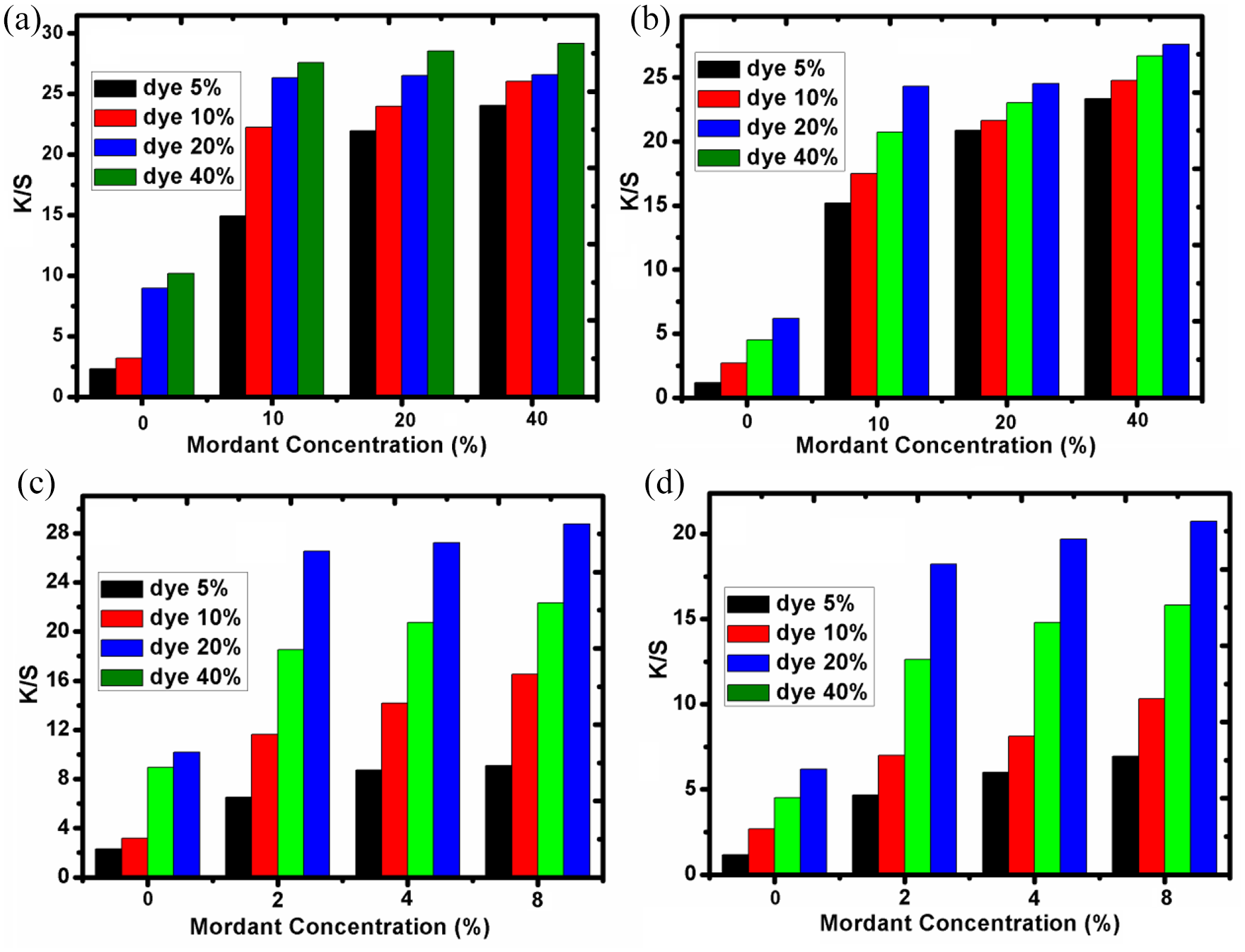
K/S of dyed samples with (a) R and Po, (b) M and Po, (c) R and Cu, and (d) M and Cu.
The use of different mordants causes the production of various hues on the fibers. Wool dyeing in the presence of different mordants is no exception to this rule.36,37 To achieve the green color and sustainable dyeing, it is necessary to use biomaterials as much as possible. The production of a functional hue on fibers is also important. To this end, copper mordant, as a conventional metal mordant, was utilized to compare and evaluate the colorimetric (Figure 5) and fastness properties. The reason for choosing copper was due to the similarity of the shade produced on the yarns after mordanting with pomegranate peel extract.

(a) a*b* and (b) scatter plot of dyed yarns.
Figure 5(a) illustrates a*b* value distribution of dyed yarns with bio-dyes. The presence of a*b* in dyed yarns with madder, in the first fourth of the hue area, indicated that all dyed samples had a red hue using both mineral and natural mordants. Similar conditions were obtained in dyeing with Reseda in terms of the hue position. Figure 5(b) illustrates C*L* (namely the color saturation and lightness) value distribution of dyed samples with madder and Reseda as bio-dyes. The results showed that by increasing the concentration of dye, the amount of L* decreased, which was due to the increase in the number of dyes on the yarn. The amount of L* at a concentration of 5%, 10%, 20%, and 40% of madder and 20% natural mordant were 50.08, 44.51, 37.22, and 31.36, respectively. This condition was also obtained for Reseda and mineral mordant. Another point derived in the results was that the hue of dyed yarns was very similar to the mineral and natural mordant and showed that natural mordant replaced the mineral mordant.
Cotton fabrics were dyed by natural dyes in the presence of curcumin as mordant using plasma modification to improve fabric dyeing. The a*b*L* of dyed samples were investigated by ISO techniques. The results showed that plasma-treated samples had more ΔΕ* than other samples. 38 The natural dye from leaves of fennel was prepared by Haddar et al. 39 and used for dyeing of cotton. Alum and ferrous sulfate were used as mordants using three different techniques. The a*b*L* of dyed samples were investigated by ISO techniques. The results showed that the type of mordant had a direct effect on the shade of all dyed samples.
Fastness and K/S properties, summarized in Tables 2 to 4, were evaluated using ISO standards. The dyed yarns without mordanting processing are shown in Tables 2 and 3. All data on dyed yarns where a metal mordant was used are provided in Table 4. The results illustrated that using a mordant increases the fastness properties. The washing fastness of dyed yarns was good and the staining value was 4–5. Light fastness (moderate value) of metal mordanted yarns is higher than that of natural mordant because the metal mordant creates a metallic complex that is stronger than tannin chemical bonding. The results of this study were similar to many papers reporting on this subject.18,21 The dyeing properties of safflower’s extraction on silk fabrics were investigated by Adeel et al. 40 Dyeing conditions are microwave bath, 3 min, and natural mordant as pre- and post-mordanting. Mordant application improved fastness properties. Hosseinnezhad et al. 41 employed the combination of bio-mordant (Yellow and Black myrobolan as tannin-rich mordants) in dyeing procedure to improve of dyeing properties. The highest K/S was obtained for yellow myrobalan: black myrobalan = 4:6 ratio. Ismal et al. 42 employed the green shell of almonds as a green dye for wool dyeing. The ultrasound and conventional techniques were used for wool dyeing and fastness and hue properties were compared. Rosemary, pomegranate, and thuja (cedar) were selected as bio-mordants. Dyeing results showed that the area of hue was different in the two dyeing methods. All dyed fibers had good fastness properties. In another study, Babul extract was employed as tannin-based mordant in wool dyeing with K/S about 4.14. 43 Employing of Gallut (tannin-rich) in pre- and post-mordanting technique resulted in K/S values of 16.09 and 14.66, respectively. 44
Fastness properties and K/S value of yarns dyed with Reseda.

DC: dye concentration (%); MC: mordant concentration (%).
Fastness properties and K/S value of yarns dyed with Madder.

Fastness properties of fabrics mordanted using Cu salt.

DC: dye concentration (%); MC: mordant concentration (%); R: Reseda; M: Madder.
Conclusion
Reducing environmental pollution is one of the most important challenges for many industries. The dyeing industry is one of the most polluting industries. Using natural compounds and replacing them with chemicals materials can reduce the toxicity and pollution of wastewaters in these industries. For this purpose, two natural dyes (Madder and Reseda) and a natural mordant (Pomegranate peel) for dyeing wool fibers were examined. Extraction process was performed by helping ultrasound conditions using water as solvent. Pomegranate peel extraction efficiency was 36%. According to the meta-mordanting procedure, wool yarns and mordant were added to bath of dyeing and the temperature of dyeing bath was reached 45ºC for 15 min and it was stirred at this temperature for 45 min. A FTIR technique was used to investigate the change of functional groups on wool and the presence of dye. The amino acid groups as an important group in wool, has clear effects on FTIR spectra. Pomegranate peel extract has its shade, and its use as a mordant produces new types of red and yellow shades on natural fibers. The washing fastness of dyed yarns was good and the staining value was 4–5.
Footnotes
Acknowledgements
The authors sincerely thank the Center of Excellence of “Institute for Color Science and Technology” for making this investigation possible.
Declaration of conflicting interests
The author(s) declared no potential conflicts of interest with respect to the research, authorship, and/or publication of this article.
Funding
The author(s) received no financial support for the research, authorship, and/or publication of this article.
