



Abstract
In this work, the quality of four plain single jersey weft-knitted fabrics (produced from the same flax yarn) having different structural characteristics (stitch density, weight, and thickness) before and after pilling, was examined. The quality of knitted fabrics was evaluated in terms of their compression (compressibility, thickness loss, and compressive resilience), comfort (air permeability and water retention), and strength (bursting strength and ball traverse elongation) properties. The obtained results revealed that the fabric with the lowest structural characteristic values has the highest compressibility, thickness loss, and air permeability, while the least compressive resilience, water retention, bursting strength, and ball traverse elongation, both before and after pilling. Pilling causes a decrease of compressibility, thickness loss, air permeability, water retention (for three lightweight fabrics), bursting strength, and ball traverse elongation but an increase in compressive resilience and water retention (for the most compact fabric). All studied knitted fabrics have excellent quality before pilling and excellent to good quality after pilling. A pilling leads to a decrease in the quality of all fabrics, especially of those with the least compact structure. Sample with moderate compactness possesses the best overall quality.
Introduction
Washing, dry cleaning, and/or wearing of the knitted fabrics can cause their pilling which represents a fabric surface defect. Likewise, pilling causes an unattractive appearance and an uncomfortable fabric handle due to the presence of pills on its surface.1–3 There are four stages of pilling formation: fuzz formation, entanglement, growth, and wear-off. 3 The pilling resistance of the knitted fabric depends on the fiber and yarn type, fabric structure, washing, and softening, while its evaluation depends on the type of test instrument and the number of pilling cycles.3–7
Compression is an important indirect indicator for knitted fabric comfort properties. It is closely related to the softness and can be judged through the change of fabric thickness under the influence of compression load.8,9 Fabrics’ compression is strongly related to yarn and fiber properties (yarn structure, yarn fineness and hairiness, yarn compressibility, and type of fiber), fabric geometry (weave type, fabric density), as well as surface irregularity.8–14 Besides compression, air permeability, and sorption properties are essential comfort properties, especially for summer clothing textiles. Air permeability determines the ability of air to flow through a given area of the fabric 14 and is strongly affected by fiber density, yarn type, yarn linear density, knitted fabric structural characteristics (loop length, fabric density, type of structure), porosity,15–19 as well as additional processes like finishing with different softeners.20,21 To ensure the durability of the knitted fabrics, they should be constructed in such a way to have satisfied strength properties (bursting strength) that will not significantly deteriorate during their lifetime. From the literature,15,22–26 it is evident that this strength property of the knitted fabrics remarkably depends on fiber type and blends, fabric structure, and washing process.
In the current investigation, the plain single jersey weft-knitted fabrics were chosen since this type of knitted fabric structure is the easiest for production, the most economically viable, and widely used for the manufacture of different types of garments. It is well known that garments made of such fabrics are light, stretchable, have good drapability, and possessed good sorption properties. Altogether make them suitable for manufacturing comfortable summer clothes, sportswear, medical clothing, etc. However, the quality of such fabrics also depends on their chemical composition. The plain single jersey knitted fabrics are usually made of cotton or synthetic fibers or their blends. Apart from the fact that flax fibers are more expensive than cotton, they are superior for obtaining fabrics with good strength (which is additionally improved in wet state 27 ), hygienic, thermal, electrostatic, antimicrobial, anti-allergenic, and UV protection characteristics.28–30 Moreover, thanks to their fine structure, flax fibers are capable of absorbing and desorbing moisture which are the most important contributors to cool handling and comfort, especially in a condition of high temperature and humidity. As a 100% renewable raw material, flax is sustainable, perfectly recyclable, and biodegradable fiber. It seems to be the right place to highlight the negative CO2 footprint; with a little help from the sun, flax plants on one hectare absorb more than 3.7 metric tons of carbon dioxide and convert it into oxygen. Besides all the above-mentioned advantages, flax fibers have certain drawbacks, such as low elasticity, 31 ease of creasing, and relatively poor abrasion resistance 27 which could be overcome by selecting the appropriate combination of knitted fabric structural parameters.
So far, the knitted fabric pilling resistance, compression, comfort, and strength behavior were analyzed independently of each other. Namely, the researchers have mainly investigated the influence of fiber and yarn type, knitted fabric structure, washing, and softening on the mentioned fabric properties. However, they neglected the overall fabric quality and its changes during everyday usage. Therefore, we decided to study the influence of pilling (as a fabric surface defect) on the quality of plain single jersey knitted fabrics through the determination of their compression, comfort, and strength properties, which has not been the focus of other researchers so far. In light of that, various experiments regarding fabrics’ compressibility, thickness loss, compressive resilience, air permeability, water retention, bursting strength, and elongation at maximum bursting force, both before and after pilling, were carried out. Based on the obtained results, the quality of tested knitted fabrics before and after pilling was evaluated. The finding of this paper would allow selecting the appropriate combination of knitted fabrics’ structural characteristics to provide the fabrics’ best quality during everyday usage.
Material and methods
Materials
In this investigation, the plain single jersey weft-knitted fabrics were used as experimental material. All studied fabrics were produced from flax spun yarn (27 × 2 tex) on the flat bed-knitting machine CMS 330.6 (Stoll, Germany) E12 gage having 16 yarn carries (eight yarn carries per each side), 599 needles per needle bed, and one carriage with three knitting systems. During the knitting process, the yarn tension, take-down tensions, and knitting speed (0.7 m s−1) were kept constant, while the cam setting was changed. The obtained knitted fabrics are characterized by different structural characteristics. Figure 1 depicts the single jersey plain structure with schematic (technical) and graphical notations, whereby Rb represents a stitch repeat in the width direction.

Single jersey weft-knitted fabric: (a) plain structure, (b) schematic, and (c) graphical notations.
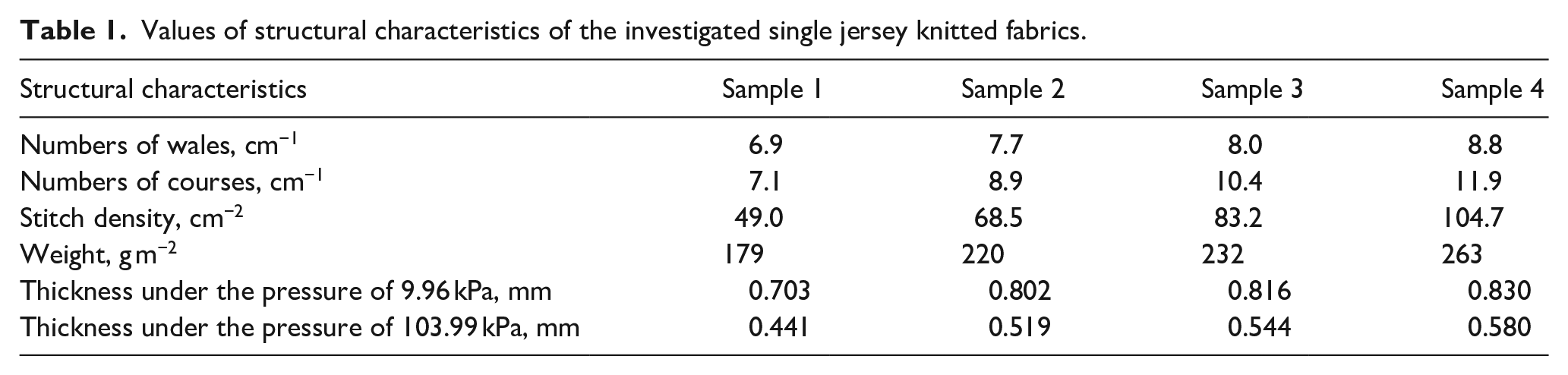
After the knitting, the fabrics were dry relaxed in such a way that they were laid on the flat surface (for several days) under standard atmospheric conditions. The fabrics’ surface appearance is given in Figure 2(a), while their structural characteristics, measured after dry relaxation, are listed in Table 1.

The surface appearance of single jersey knitted fabrics at 10× magnification: (a) before pilling and (b) after pilling (7000 rubs).
Values of structural characteristics of the investigated single jersey knitted fabrics.
Methods
Pilling measurements of the knitted fabrics
The knitted fabric propensity to pilling was determined based on the standard ISO 12945-2:2000 (Modified Martindale method) using SDL ATLAS M235 Martindale Abrasion and Pilling Tester. The fabric pilling was visually evaluated after different numbers of rubs (125, 500, 1000, 2000, 5000, and 7000), whereby grade 5 means that the pilling was not observed, while grade 1 means that the dense surface fuzzing and/or severe pilling occurred, and the pills of varying size and density covered the whole fabric surface. The presented results are the average values of three measurements per sample.
Determination of the structural characteristics of the knitted fabrics
The structural characteristics of the knitted fabrics were analyzed through the number of fabric wales and courses, stitch density, weight, and thickness. The number of fabric wales, courses, and fabric stitch density were determined according to standard EN 14971:2006. Fabric weight was determined according to the standard EN 12127:1997. Fabric thickness was measured at a pressure of 9.96 kPa using a thickness tester AMES, type 414-10, USA. The number of fabric wales and courses and stitch density were given as the average of 10 measurements, while the fabric weight and thickness were considered as the average of 5 measurements per sample.
Determination of the compression properties of the knitted fabrics
A thickness tester (AMES, type 414-10, USA) was used for the investigation of knitted fabrics’ compression properties (i.e. compressibility, thickness loss, and compressive resilience). The knitted fabric thickness was measured starting with the initial pressure of 9.96 kPa, which was further progressively increased to 17.62, 43.66, 59.01, 74.34, and 103.99 kPa. After attaining the maximum pressure, the test was reversed in the same way till the complete recovery of the sample. The reported results are the mean values of five measurements per sample.
Knitted fabric compressibility (C, %), thickness loss (TL, %), and compressive resilience (RC, %) were calculated according to the equations (1)–(3), respectively10,32:


where: T0c and Tmax (mm) are the thicknesses of the knitted fabric determined under the initial pressure of 9.96 kPa and under the maximum pressure of 103.99 kPa, Trec (mm) is the recovered thickness measured under the initial pressure of 9.96 kPa after removing the pressure of 103.99 kPa and the rest of 60 s, W’C and WC (Pa m) are the compression work recovery and compression work of knitted fabric, Pr and Pc (Pa) are the magnitudes of pressure under recovery conditions (i.e. under decompression of the sample) and the magnitude of pressure which causes compression of the sample, dTr and dTc are the changes of sample thickness under the decompression and compression phase.
Determination of the comfort of the knitted fabrics
The knitted fabrics’ air permeability (AP) was tested on the Air Permeability Tester (M021A) at a constant pressure of 100 kPa (20 cm2 test area) according to the standard EN ISO 9237:1995.
Water retention of knitted fabrics was determined according to the standard ASTM D 2402-01:2001, using the following equation:

where: mc (g) is the mass of knitted fabric after immersing in distilled water at room temperature for 1 h and centrifuging at 2000G for 5 min, and md (g) is the mass of the dry knitted fabric.
The presented results for air permeability represent an average of three measurements per sample, while those for water retention are the average of five measurements per sample.
Determination of the knitted fabrics’ strength properties
Determination of bursting strength and ball traverse elongation of knitted fabrics were realized using the device mounted in clamps of the dynamometer AVK, SZ type KG-2, Hungary. Bursting strength (BS, N) represents the maximal bursting force registered when the metal ball (having a radius of 9.5 mm) passes through the circular specimen (having a radius of 12.5 mm). Ball traverse elongation (BTE, mm), that is, the elongation at maximum bursting force, was also determined on the same device during the determination of bursting strength. The reported strength properties are the mean values of five measurements per sample.
Statistical analysis
The obtained results were statistically analyzed by using the t-test. The parameter t, for the independent sample, was determined using the equation (5), while for the dependent sample was calculated using the equation (6) 10 :


where:
Quality analysis
The quality of investigated knitted fabrics, before and after pilling, was assessed based on the results obtained for fabrics’ compression, comfort, and strength properties. For such estimation, the complex criterion of knitted fabrics’ quality (Qk) was established and calculated using the following equation 10 :

where: ni is a total number of investigated characteristics (in this investigation ni = 7), Qi is the dimensionless indicator of fabrics’ quality expressed through the value of investigated characteristic (QC – compressibility, QTL – thickness loss, QRC – compressive resilience, QAP – air permeability, QWR – water retention, QBS – bursting strength, and QBTE – ball traverse elongation).
The dimensionless indicator of fabrics’ quality (Qi) was calculated using the equation (8) 10 :

where: XD is die value, X is the average value of the measured characteristic. In the case of lack of die value, the minimal or maximal value of the tested characteristic, which means the best quality of the fabric, was used. The minimal value of thickness loss and the maximal value of remaining characteristics served as die value.
The following gradation of the fabric was applied: when Qk is in the interval 0.76–1.00, the fabric quality is excellent, when Qk is in the interval 0.51–0.75, the fabric quality is good, when Qk is in the interval 0.26–0.50, the fabric quality is satisfying and when Qk is in the interval 0.00–0.25, the fabric quality is rated as poor. 10
Results and discussion
Pilling of the knitted fabrics
The fabric pilling represents a generation of pills over its surface, whereby the pill formation is a dynamic process 33 since the pills are constantly formed (Figure 3(a)–(c)) and removed (Figure 3(d)).
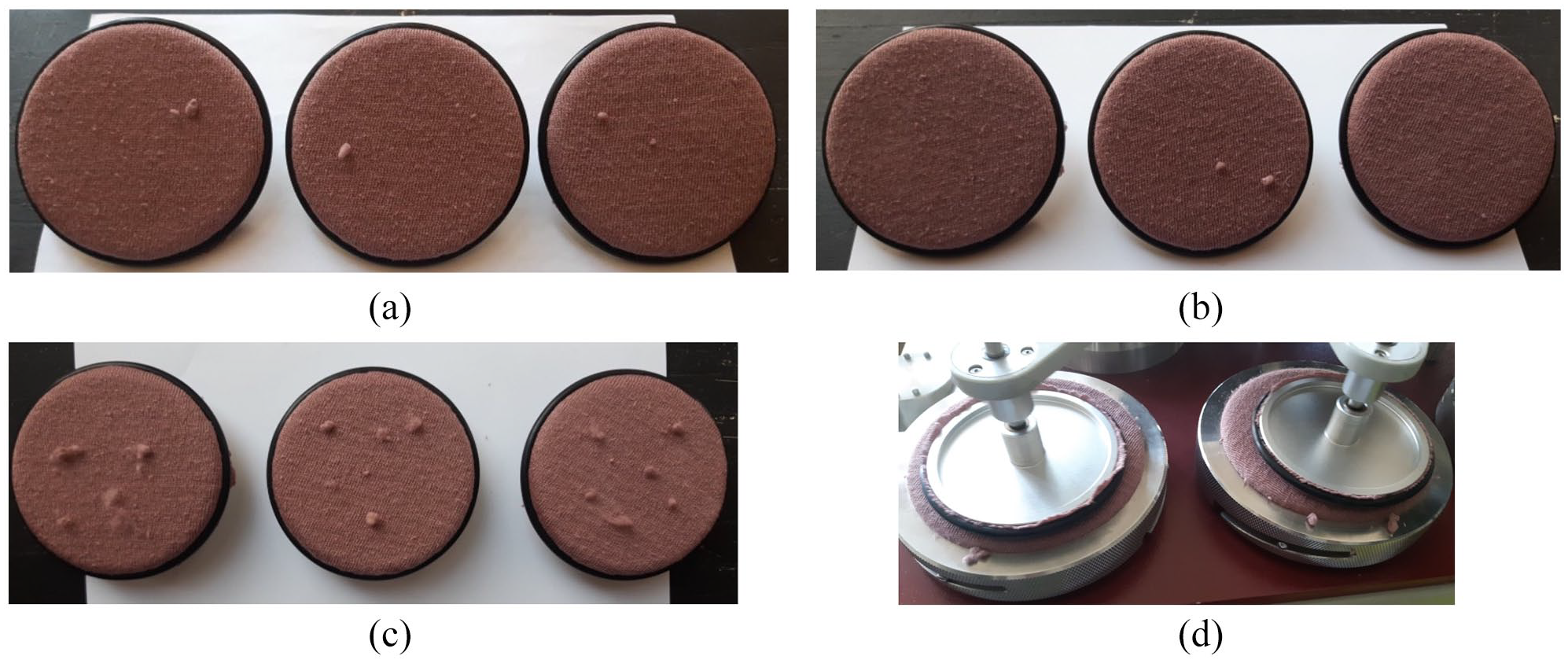
Appearance of Sample 3: after (a) 2000, (b) 5000, (c) 7000 rubs, and (d) removal of the pills during abrasion.
The pilling formation over the surface of the flax knitted fabrics having different structural characteristics was evaluated after a different number of rubs (125, 500, 1000, 2000, 5000, and 7000). The obtained results are presented in Table 2.
Grade of pilling of the investigated flax knitted fabrics.

For all investigated knitted fabrics, the increase in the number of rubs from 125 up to 7000 causes the decrease in the grade of pilling (Table 2), which is in agreement with the literature.4,34,35 Namely, the grade of pilling varied from 4 to 5 after 125 rubs (i.e. very slight surface fuzzing and/or partially formed pills were observed), while after 7000 rubs, the fabric pilling is evaluated with the grade 3 or 3–4 (moderate surface fuzzing and/or moderate pilling and partially slight to moderate pilling were observed). The decrease in piling grade with an increase in the number of rubs is a direct consequence of the changes that occurred on the knitted fabrics’ surfaces (such as fuzz formation, pills formation, or removal of the formed pills). Since investigated flax fabrics have different structural characteristics, especially weight and stitch density (Table 1) and very similar pilling grades (Table 2), it could be assumed that their structural characteristics did not significantly affect the pilling phenomenon. Haque and Elias 4 came to a similar conclusion in their research; they reported that knitted fabric weight does not affect their pilling behavior.
Compression properties of the knitted fabrics
For textile materials intended for clothing purposes, it is very important to possess softness. According to the literature, 8 the fabric that compresses easily under the influence of compression load is likely to be judged as soft, which gave us an idea to compare the compression properties (i.e. compressibility, thickness loss, and compressive resilience) of flax knitted fabrics before and after pilling, Figure 4.

Compression properties of investigated knitted fabrics before and after pilling (7000 rubs): (a) compressibility, (b) thickness loss, and (c) compressive resilience.
From the histogram presented in Figure 4, it is evident that Sample 1 has the highest compressibility (Figure 4(a)) and thickness loss (Figure 4(b)), while the lowest compressive resilience (Figure 4(c)), compared to other samples, both before and after pilling. Since the flax fabrics were knitted from the same yarn, it is clear that the fabrics’ structural characteristics determine their behavior during compression. Due to the lowest stitch density, fabric weight, and thickness (Table 1), Sample 1 showed the highest compressibility (19.1% higher than Sample 4), while Sample 4, having the highest values of structural characteristics has the lowest compressibility. More precisely, when the knitted fabric stitch density is lower, the spaces between the loops are higher (Figure 2, Sample 1a) enabling changing the yarn shape (it becomes flattened) and orientation under applied pressure altogether resulting in lower fabric thickness. This phenomenon is especially pronounced at the highest investigated pressure (103.99 kPa). In contrast, when the knitted fabric is characterized by a higher stitch density, the spaces between the loops are much lower and the yarns cannot be moved easily, nor flattened, that is, they remain rounder contributing to higher fabric thickness. The lowest spaces between the loops in Sample 4 (Figure 2, Sample 4(a)) prevent its compression even maximum pressure was applied. As a result, the difference between the thickness measured at the highest and the lowest pressure was the lowest for Sample 4, causing its smallest compressibility. The obtained results are in accordance with the results presented in the literature.11,36,37
After the removal of compressive load, the fabrics tend to return to their original form. In the case of Sample 4 (Figure 4(b)), the lowest decrease in its thickness registered when the highest pressure was applied means the fabric lowest thickness loss that is, best recovery after decompression. On the contrary, Sample 1 showed the highest thickness loss (25.2% higher than Sample 4), and therefore, the lowest recovery from deformation. A decrease in thickness loss with the increase in fabric weight is in line with the earlier findings.36,38
Besides compressibility and thickness loss, the fabric compressive resilience was also investigated (Figure 4(c)) since it represents the fabric’s ability to recover after compression. 36 This compression property is very important for flax knitted fabrics having in mind the flax fibers’ low elasticity. In the current study, Sample 4, characterized by the most compact structure, and the lowest spaces between the loops (Table 1, Figure 2, respectively), possesses the best recovery ability after compression, while Sample 1 having the least compact structure has the lowest recoverability (Figure 4(c)). Namely, during compression of the knitted fabrics, with an increase in their structural characteristic values, the tension between the loops increases too. After decompression, the loops tend to easier and faster return in their earlier (relaxed) state contributing to an increase in compressive resilience. Mukhopadyhay et al. 13 concluded that with the increase in pick density of woven fabrics, their recovery and resiliency increase too due to the increase in the number of cross-over points of warp and weft threads within the compression zone resulting in a greater mass of fabric.
To evaluate the differences in the knitted fabric compression properties, the statistical analysis by using a t-test (Table 3) was performed. The listed results show a statistically significant difference (level of significance of 0.001) between Sample 4 and Samples 1 and 2, independently on the investigated compression property and pilling. However, there is no statistically significant difference between the compression properties of Sample 1 and Sample 2, both before and after pilling. Based on the above discussed, it could be concluded that Samples 1 and 2 possessed almost the same softness.
Statistical results of the determination of knitted fabric compression properties using t-test.

C: Compressibility; TL: Thickness loss; RC: Compressive resilience; bp: before pilling; ap: after pilling; df: degree of freedom.
1, 2, 3, 4 – sample number.
0.05 level of significance. **0.01 level of significance. ***0.001 level of significance.
The investigated fabric compression properties might be changed due to the pilling formation during wearing and maintenance. Therefore, the effect of pilling (after 7000 rubs) on the knitted fabric compression properties was considered. After pilling, a decrease in the compressibility and thickness loss, as well as an increase in compressive resilience of the tested fabrics was registered (Figure 4(a)–(c)). It is evident from Figure 2(b) that surface fuzzing and pills of different sizes and densities are present on the sample surfaces after pilling. As a result, the fabrics’ structures became uneven/irregular and difficult to compress, that is, the pills aggravate fabrics’ compressibility. A statistically significant difference in the compressibility before and after pilling was observed for Samples 4 and 1 (Table 3). Among four fabrics, the most prominent and statistically significant decrease in the thickness loss after 7000 rubs was observed for Sample 4 (Figure 4(b), Table 3), while the compressive resilience of knitted fabrics slightly increased (Figure 4(c)). A decrease in the knitted fabrics’ thickness loss, as well as an increase in compressive resilience after pilling, could be ascribed by the presence of the pills on the samples’ surfaces that act as “springs” and allow the easier return of samples’ to their original position after removal of the load. Based on the results of the t-test, Sample 3 and Sample 4 show a statistically significant difference between the compressive resilience before and after pilling (Table 3).
Comfort properties of the knitted fabrics
The fabric air permeability and water retention were selected as important indicators of clothing comfort. These non-sensorial properties are meaningful, especially for fabrics intended for summer clothes, such as the studied flax fabrics. The results obtained for air permeability and water retention of all investigated knitted fabrics, before and after pilling, are presented in Figure 5.
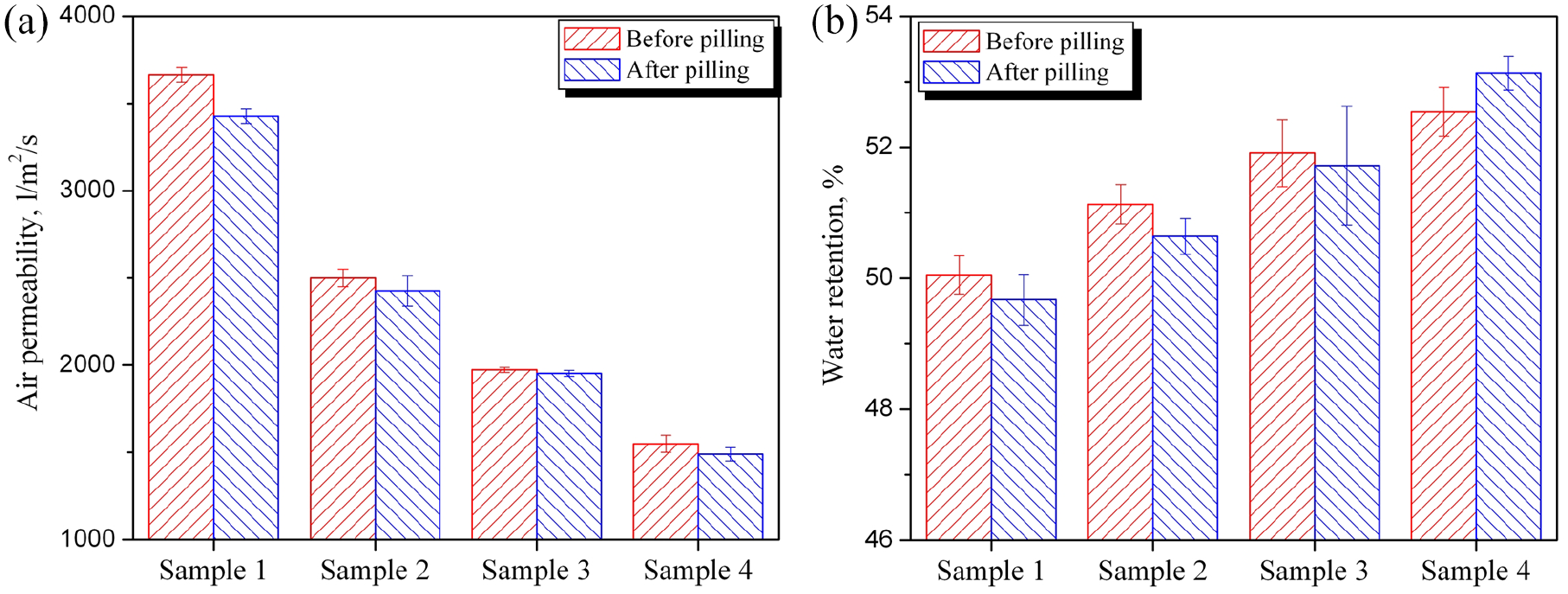
(a) Air permeability and (b) water retention of flax knitted fabrics before and after pilling (7000 rubs).
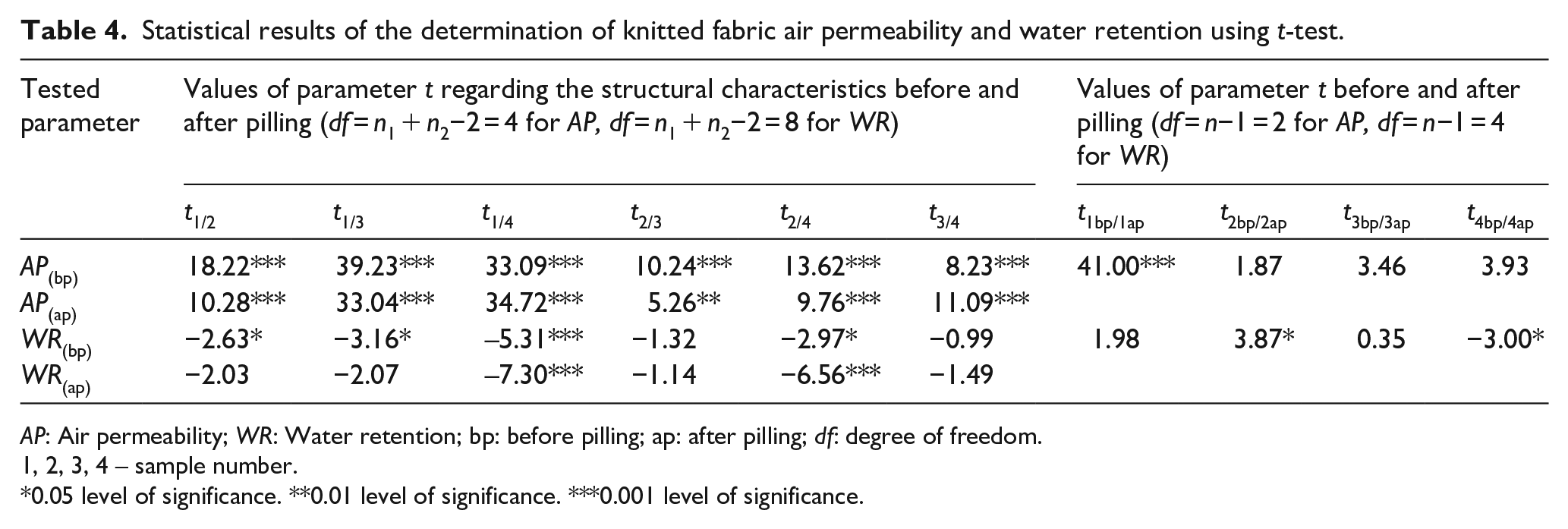
Observing in parallel the results for fabric structural characteristics and air permeability, it can be concluded that with increasing the fabrics’ compactness (i.e. with increasing the stitch density, fabric weight, and thickness, and consequently decreasing the space between the loops), the fabrics became less permeable and allow less air to flow through them. In other words, the higher the space between loops of the knitted fabric, the higher is the value of air permeability. For example, due to the least compact structure, Sample 1 has 2.36 and 2.30 times higher air permeability before and after pilling compared to Sample 4 with the most compact structure. The presented results followed the data reported by other authors.14,16,17,21 Contrary to the air permeability, Sample 1 shows the lowest, while Sample 4 shows the highest water retention value, both before and after pilling (Figure 5(b)). Good water retention (49.7%–52.5%) of investigated fabrics is owed to their chemical composition as well as the high amount of amorphous regions and a large number of hydroxyl groups that are responsible for retention of the high amount of water molecules. Apart from mentioned fiber structure, the fabric water retention also depends on the geometric characteristics of the fibers, as well as structural characteristics of the fabrics. 39 Bearing in mind that all fabrics were knitted from the same flax yarn, the differences in water retention between the samples could be attributed to their structural characteristics (stitch density, weight, and thickness). Namely, with the increase in fabrics’ stitch density, weight, and thickness, their ability to retain a larger quantity of water also increases. Therefore, the highest structural values of Sample 4 are responsible for its highest water retention value. Statistical analysis using t-test showed a statistically significant difference in water retention between Sample 1 and Sample 4 at the highest level of significance of 0.001 (Table 4). Furthermore, a statistically significant difference in air permeability between all investigated knitted fabrics, before as well as after pilling at the level of significance of 0.001 or 0.01, was observed. Based on the presented results, it could be assumed that the structural characteristics of the knitted fabrics have a greater influence on their air permeability than on water retention.
Statistical results of the determination of knitted fabric air permeability and water retention using t-test.
AP: Air permeability; WR: Water retention; bp: before pilling; ap: after pilling; df: degree of freedom.
1, 2, 3, 4 – sample number.
0.05 level of significance. **0.01 level of significance. ***0.001 level of significance.
Fabric pilling causes a decrease in air permeability of all samples (Figure 5(a)), which could be explained by the changes that occurred at the fabric surface during pilling. Namely, surface fuzzing and pill formation reduced the open spaces between the loops (Figure 2(b)) contributing to the formation of some kind of barrier for airflow. This is the most prominent in the case of Sample 1 since it has the highest open spaces between the loops which were masked by the fuzzed surface and formed pills. In the case of Samples 1–3, the water retention decreases after pilling, which is a consequence of the reduction of their weight and thickness during pilling. On the other hand, a possible explanation for an increase in water retention of Sample 4 after pilling is its most dense structure, which resulted in the difficult removal of formed pills from the fabric surface. Namely, the existence of pills of varying sizes and densities on the fabric surface contributed to retaining slightly more water after than before pilling. Results of the t-test show that pilling significantly affects the air permeability of Sample 1 and the water retention of Samples 2 and 4 (Table 4).
Strength properties of the knitted fabrics
Strength is a very important parameter for all textile materials since during dyeing, finishing, and using, they should have sufficient strength against different forces. 40 Knowledge about the bursting strength is very essential when selecting the appropriate knitted fabric for making garments. 22 The results of fabric bursting strength and ball traverse elongation, before and after pilling, are given in Figure 6.

(a) Bursting strength and (b) ball traverse elongation of flax knitted fabrics before and after pilling (7000 rubs).
Both tested strength properties gradually increase with an increase in fabric stitch density, weight, and thickness as well as with a decrease in the spaces between the loops (Table 1, Figures 2 and 6), independently on the pilling. For example, Sample 4 has 1.5 times higher bursting strength and 17.1% higher ball traverse elongation than Sample 1 before pilling. The lowest spaces between loops in Sample 4, due to the highest stitch density, prevent the passage of the ball through the sample, contributing to its highest bursting strength. 23 Results of the t-test showed statistically significant differences in bursting strength between the samples, except between Samples 2 and 3 (as a result of the negligible differences between their weights and the largest dispersion of the results), both before and after pilling (Table 5). Furthermore, a statistically significant difference in ball traverse elongation is observed between Sample 4 and Samples 1, 2, and 3 before and after pilling (Table 5).
Statistical results of the determination of knitted fabric strength properties using t-test.

BS: Bursting strength; BTE: Ball traverse elongation; bp: before pilling; ap: after pilling; df: degree of freedom.
1, 2, 3, 4 – sample number.
0.05 level of significance. **0.01 level of significance. ***0.001 level of significance.
Bursting strength and ball traverse elongation of investigated knitted fabrics decreased after pilling (Figure 6). The most prominent decrease in bursting strength (17.1%) was noticed for Sample 1, while in the case of the ball traverse elongation, the most prominent decrease (5.9%) after piling possessed Sample 3. A decrease in these strength properties after pilling could be explained by the fact that the fabric mass and thickness decrease. In parallel, the close contact between the fibers within the yarns was also disturbed enabling easier passage of the ball through the sample and therefore decreasing the bursting strength and ball traverse elongation. There is no statistically significant difference between the Sample 4 values of bursting strength before and after pilling. On the other hand, only in the case of Sample 3, a statistically significant influence of pilling on ball traverse elongation was observed, since the other samples had large dispersion of the results (Table 5).
Quality of the investigated knitted fabrics
To assess the quality of knitted fabrics, the complex criterion of their quality should be calculated based on the dimensionless indicator of quality, 10 which is presented through radar diagrams (Figure 7).

Dimensionless indicator of fabrics’ quality (Q) for: (a) Sample 1, (b) Sample 2, (c) Sample 3, and (d) Sample 4.
From Figure 7, it is evident that tested samples show different radar diagrams. However, significant differences (greater than 0.05) between dimensionless indicators of fabrics’ quality before and after pilling were not observed, except for bursting strength and air permeability for Sample 1 and thickness loss for Sample 4. The lowest difference between the dimensionless indicator of fabrics’ quality, before and after pilling, was registered for Sample 2.
Based on the results of dimensionless indicators, the complex criterion of fabrics’ quality (Qk) was calculated and presented in Figure 8.

Values of complex criterion (Qk) for gradation of investigated knitted fabrics’ quality.
All investigated knitted fabrics have excellent quality before pilling (Qk higher than 0.76). However, after pilling, the complex criterion values of Samples 1 and 3 are at the upper limit of good quality. The smallest decrease in the quality after pilling was noticed for Sample 4, while the highest decrease in the quality from the aspect of the analyzed compression, comfort, and strength properties was observed for Sample 1. Keeping in mind all investigated knitted fabrics and their properties before and after pilling, Sample 2, which possesses the best overall quality, distinguishes itself as the most suitable knitted textile material for the production of summer clothing.
Conclusion
In this work, the influence of pilling on compression (compressibility, thickness loss, and compressive resilience), comfort (air permeability and water retention), and strength (bursting strength and elongation at maximum bursting force) properties of four plain single jersey knitted fabrics (produced from the same flax yarn) having different structural characteristics (stitch density, weight, and thickness), were examined. Furthermore, based on the tested properties, the quality of fabrics, before and after pilling, was evaluated.
For all tested knitted fabrics obtained from the same folded flax yarn, the decrease in the grade of pilling with the increase in the number of rubs (from 125 up to 7000), was registered. Further investigations show that there are no significant differences in the grade of pilling between investigated samples at the same number of rubs.
The knitted fabric which has the highest stitch density, weight, and thickness, possesses the lowest compressibility, thickness loss, and air permeability, but the highest compressive resilience, water retention, bursting strength, and ball traverse elongation. The same trends were also observed after pilling. Decrease in compressibility, thickness loss, air permeability, water retention (for three lightweight fabrics), bursting strength, and ball traverse elongation but increase in compressive resilience and water retention (for the most compact fabric) after pilling, was registered. These differences in investigated compression, comfort, and strength properties are a direct consequence of the changes that occurred on the knitted fabrics’ surfaces (such as fuzz formation, pills formation, and removal of the formed pills).
All investigated knitted fabrics have excellent quality before and excellent to good quality after pilling. From the aspect of the analyzed fabrics’ quality, it was observed that pilling leads to a decrease in the quality of all fabrics, especially the sample with the lowest values of structural characteristics. Moreover, the smallest decrease in the quality was registered for the sample with the highest structural characteristic values, while the sample with moderate compactness shows the best overall quality.
The findings of this study could help the designers to select a suitable combination of knitted fabric structural characteristics in order to ensure suitable compression, comfort, and strength properties, that is, their excellent quality during exploitation. Taking into consideration the quality of all knitted fabrics evaluated from the aspect of their compression, comfort, and strength properties, before and after pilling, the sample (Sample 2) with the moderate compactness and the best overall quality is recommended as a most suitable for the production of summer clothing products.
Finally, there are two aspects of the significance of this research. On the one hand, based on the investigation of numerous properties that are significant for the everyday usage of knitted fabrics, a global picture of the quality of the tested material was created. On the other hand, the findings of this study could help the designers to select a suitable combination of knitted fabrics’ structural characteristics to ensure their excellent quality.
Footnotes
Declaration of conflicting interests
The author(s) declared no potential conflicts of interest with respect to the research, authorship, and/or publication of this article.
Funding
The author(s) disclosed receipt of the following financial support for the research, authorship, and/or publication of this article: This work was supported by the Ministry of Education, Science and Technological Development of the Republic of Serbia (Contract No. 451-03-68/2022-14/200287 and 451-03-68/2022-14/200135).
