



Abstract
This research study experimentally analyzed the effect of ring and rotor yarns which are 100% cotton spun yarn with 30s Ne count on the physical and comfort characteristics of single jersey, rib, and interlock knitted fabrics. The physical characteristics such as fabric Thickness, Tightness factor, Bursting strength, Abrasion resistance, and Pilling behavior were studied according to the ASTM Standard and statistically analyzed using Minitab software with ANOVA analysis. The Comfort characteristics were Thermal Insulation behavior (TIV), Water Vapor Permeability, and Air permeability; they were experimentally studied and reported. The results revealed that rotor spun yarn knitted fabrics demonstrated higher Thermal insulation behavior in the knitted structures when compared to ring spun yarn knitted fabrics. Ring spun yarn has better Abrasion resistance than rotor spun yarn, but the air permeability of the knitted fabric made from rotor spun yarn has better air permeability than ring spun yarn. The low stress mechanical properties are shear and compression behavior of ring and rotor spun yarn knitted fabrics were also critically analyzed. The results show that in a few cases the differences between regular fabric properties and the rotor and ring yarn fabric properties are quite significant, while marginal in other cases. However, the surface roughness values showed some interesting features of the knitted fabric structures.
Keywords
Introduction
Ring and rotor spun yarns are used to achieve special knitted fabric characteristics in knitting. The most evident properties of these yarns are high breaking strength, high elongation, and low hairiness, the statement given by Das et al. 1 Other yarn properties such as yarn unevenness and thin/thick places are comparable to conventional ring spun yarns. The structure of the rotor yarn offers many advantages in downstream processing by Candan and Önal. 2 The ring spinning process produces a new yarn structure which approaches the ideal staple fiber yarn construction even more closely. This has positive effects on raw material use, productivity, downstream processing, and on product appearance the finding is achieved on Candan et al. 3 In the rotor yarn spinning process, fibers from the spinning triangle are collected and integrated in the yarn. When rotor yarn characteristics are compared with ring yarn, the strength of rotor yarn improves by 15%–20% and elongation by approximately 20% and hairiness is lowered by as much as 50% the experimental work was obtained. 4 In rotor yarn, the fibers are uniformly oriented and joined into the yarn right after the end of the drafting arrangement. This is to ensure better tenacity, elongation, and hairiness properties. The better tenacity properties of rotor yarn provide opportunities to produce lower twist coefficients, resulting in an increase in yarn production rate and also better handling properties of the end product. 5 Rotor yarns also have better quality properties such as lower surface hairiness, higher air permeability and wicking behavior and different surface specifications, which help to improve further processing and increase their production. A revolutionary version of the ring spinning process called rotor spinning achieves remarkable improvement in yarn quality through better utilization of fiber properties. The statement is given by Mukherjee and Chindalia. 6 Rotor spinning is such a system where the yarn can be produced with higher speed and better quality, which gives benefit in the downstream processing. Consequently, fabric made from rotor yarn gives a better look. 7 The carded ring and rotor yarns of 20Tex were produced and plain knitted fabrics with three different loop lengths were made from them. The fabrics were analyzed and tested for abrasion, pilling, bursting strength, and thermal properties. It was reported that the knitted fabrics produced from rotor yarns showed better pilling performance compared to those produced from regular ring spun yarns. The experimental results were conducted by Ozdil et al. 8 Bursting strength of knitted fabrics produced from ring yarns were found to be higher than that of fabrics produced from regular yarns. 9 The performance assessment of rotor yarns in single jersey knit fabrics revealed their better wicking, water absorbency and air permeability properties when compared to ring spun yarn knitted fabrics. The findings were given by Spencer 10 and Manonmani et al. 11 The wicking behavior of rotor and ring spun yarns and their fabrics were studied and showed that the wicking height attained by rotor yarns was greater than that of ring yarns and the equilibrium wicking height gained is also more. 12 This may be attributed to the greater packing coefficient of rotor yarns. The same trend was noticed in fabrics produced from ring and rotor yarns. 13 The Effect of Air Permeability and Water Vapor Permeability of Clean Room Clothing on Physiological Responses and Wear Comfort. The condensed yarns in coarse, medium, and relatively fine counts with new raw materials are finding increasing applications in the production of premium shirting and suiting fabrics, knit fabrics for inner wear, T-shirts, sweaters, sportswear ladies stockings, lingerie, by Miraftab. 14 Knits are being used for outer and innerwear and also the number of applications of knitted goods continue to grow; they are now being included in all skin-contact end uses such as leg wear, footwear, lingerie, baby wear, sportswear, health care products, and more recently home furnishings. The most revolutionary achievement of rotor spun yarn knitting shows penetration into the formal wear segment given by Huang and Qian. 15 Yarns produced using various spinning technologies not only differ from one another in respect of their structure, but also in their bulk, mechanical, and surface properties. The low stress mechanical behavior of weft knitted fabrics was measured by both objective and subjective analysis by many researchers using Kawabata instruments for testing of comfort and fabric handle properties expressed by Alston. 16 The comparison of cotton knitted fabric properties made of rotor and conventional ring yarns before and after the production process was studied. It was reported that more uniform and high luster effect was brought out in the case of rotor spun yarn fabrics when compared to ring spun yarn fabrics. The findings were given by Akaydin and Can. 17 Thermal and water vapor permeability behavior of knitted fabrics mainly depends on fiber type, yarn packing density, knit structure, fabric thickness, and tightness factor of the fabrics. The novelty of the research aims to investigate the physical and comfort characteristics of knitted fabrics using ring and rotor spun yarns on various basic knit structures such as single jersey, rib, and interlock with various stitch lengths. Knitted fabrics are widely used due to their easy care properties and possess a high degree of clothing comfort. Liquid moisture transport and breathability of the fabric are two significant factors that affect the thermo-physiological comfort of a garment. The research has been significantly analyzed with ASTM Standard methods.
Experimental methods
Materials
The raw materials used for this research work were the cotton yarn of 30s Ne count. The count was selected from two spinning systems, namely, ring and rotor spinning. The cotton fiber property ratings for mean length 1.11–1.26 mm, fiber elongation, 5.9%–6.7%, fiber fineness, 175–200 μg, fiber maturity ratio 0.8%–1.0%, and fiber strength 26–28 g/tex The yarn is manufactured by Adama Spinning factory with the same yarn count which is 30s Ne, and the 100% cotton quality parameters of these yarns are given in Table 1. The yarn samples were tested for count, Lea strength, and CSP using an automatic wrap reel, Lea tester, and electronic balance as per the ASTM standards are ASTM D1907 -01for count and ASTM D1578-93 for yarn strength. The yarn unevenness and imperfection were tested using USTER tester III as per ASTM D1425-96 test methods at 400 m/min it has analyzed.
Ring and rotor yarn properties.

Knitted fabric production
Weft knitted fabrics were produced in knitting with two needles, it uses one continuous yarn that produces horizontal rows of loops that interlock. It frays, can ladder and loses its shape when worn frequently. These types of fabrics were produced in the Yirgalem Addis textile factory such as single jersey, (1 × 1) rib and (1 × 1) interlock fabrics were made from ring and rotor spun yarn, with stitch lengths of 2.7 mm, in all fabric structures using ORIZIO circular knitting machines. The GSM cutter, electric balance, and Centimeter scale were used gray fabric weight and measuring the stitch length of the fabrics. The following results have been tabulated in the Table 2.
Knitting machine specification.

Testing methods
The single jersey, 1 × 1 rib and interlock knitted fabrics were measured for their stitch length, aerial density in grams per square meter (GSM), and fabric thickness was tested in the Textile Technology Laboratory, at Ethiopian Technical University, with the help of Shirley Thickness gage and these knitted fabrics were tested as per AATCC 179 test procedures. The aerial densities of both ring and rotor spun yarn knitted fabrics were measured in grams per square meter by cutting a round sample of 100 sq.cm and weighing it in the electronic balance, and the results were obtained as per the ASTM standards. The dry relaxed knitted fabrics were tested for the properties of abrasion resistance, bursting strength, air permeability, water vapor permeability, thermal insulation, and compression behavior with respect to ASTM Standard. The testing of knitted fabrics was carried out in the standard atmosphere conditions of 65% ±2 RH and 25°C ± 2°C.
Measurement of air permeability
From the analysis it has been conducted that air permeability plays an essential role for applications such as comfort, thermal, and physical properties. It was found that the fabric GSM was closely related to the air-permeability. The air permeability decreased with the increase in mass per unit area. And the measurements were carried out by using 20 cm2 circular fabric with 100 Pa; the pressure difference for the results was expressed in cm3/s/cm2 by taking the average of 10 different measurements. The test was performed according to ISO 9237:1995 test method.
Measurement of bursting strength
The bursting strength of the single jersey, rib and interlock knitted fabrics were tested with the Bursting Strength tester, and the test was carried out at a textile laboratory for all developed samples. It have been measured the bursting strength in Kilograms per square centimeter. ASTM D 3786 in this test, fabric is clamped tight across a hydraulic or pneumatic diaphragm. The diaphragm is then expanded until the fabric bursts then the reading was noted in kg/cm2.
Measurement of abrasion resistance and fabric weight loss
Abrasion resistance is the ability of a fabric to resist surface wear caused by flat rubbing contact with another material. The abrasion resistance is measured in a number of cycles. It is the number of cycles required to form either a pin hole in the test specimen or the breaking of a set of threads to assess abrasion resistance. The abrasion resistance was determined by the Martindale abrasion tester in accordance with ASTM Standard ASTM D4966.

Measurement of water vapor permeability
Permeability is a broader term than porosity. The ability of liquid water, under pressure, to flow through porous materials is permeability and is described by the permeability coefficient. The normal SI unit for presence is the kilogram per second per square meter per Pascal. It is also known as water vapor transmission rate (WVTR) or moisture vapor transmission rate (MVTR) which is basically the mass of water vapor that is transmitted through a measured area of the fabric in a specific unit of time under specified conditions of temperature and humidity. This method is specified in European Standard EN ISO 12572:2001.

Measurement of thermal insulation (TIV)
The thermal insulation property of the fabric refers to the ability to resist the transmission of heat in all modes. It can also be defined as the effectiveness of a fabric in maintaining the normal temperature of the body under equilibrium conditions. The most important thermal property in most apparel is the insulation against heat flow, which is measured by thermal resistance. The magnitude of the heat flux at a point is inversely proportional to the thermal resistance of the material, that is, the higher the resistance, the lower the heat loss. The relation between sample thickness and thermal insulation is expressed in terms of thermal insulating values (TIV); it was determined by ASTM Standard D 1518 Method.
Low stress mechanical properties
Low-stress mechanical properties of knitted fabrics have established themselves as an objective measure of quality and performance. Fabrics are more extensible in the low-load region than in the higher-load region. The shear and compression behavior of the knitted fabrics such as single jersey, rib, and interlock structures were tested by using KES-FB1 and KES-FB3 tester, respectively.
ANOVA multivariable data analysis
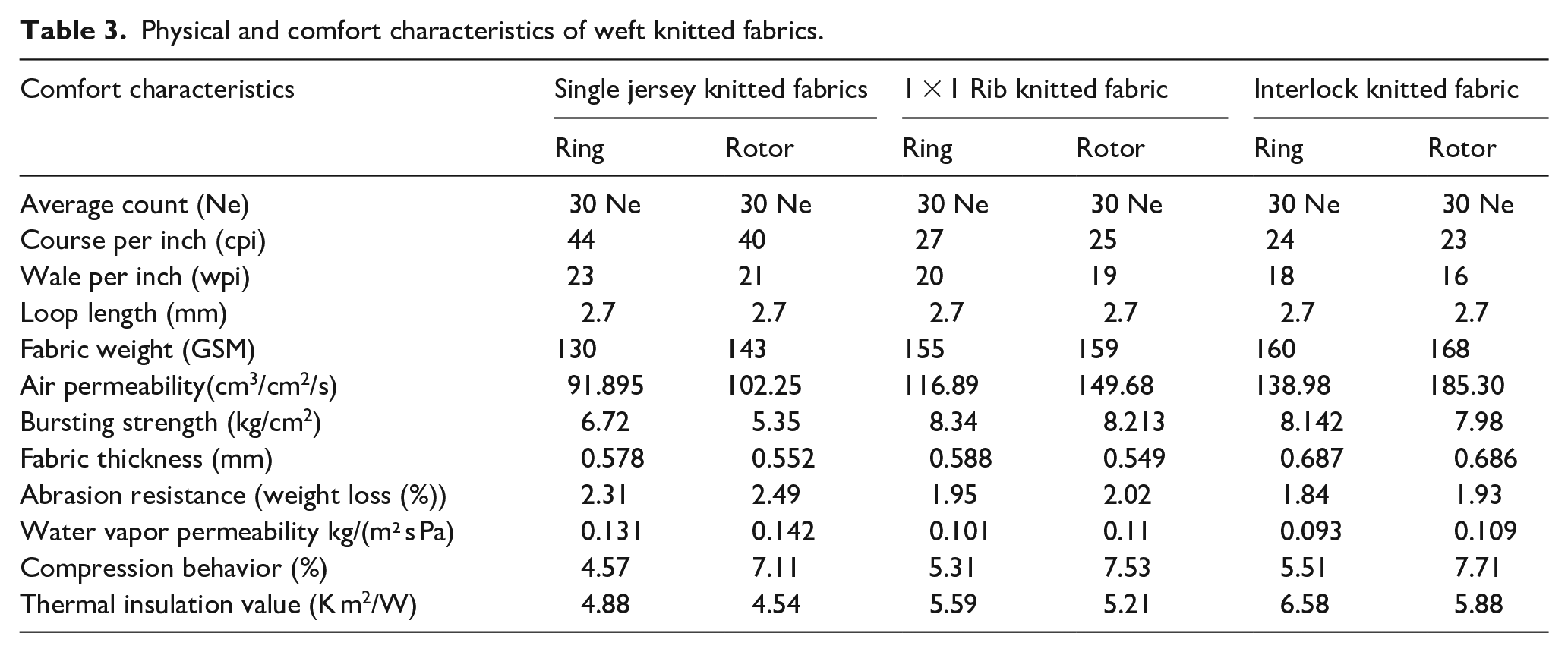
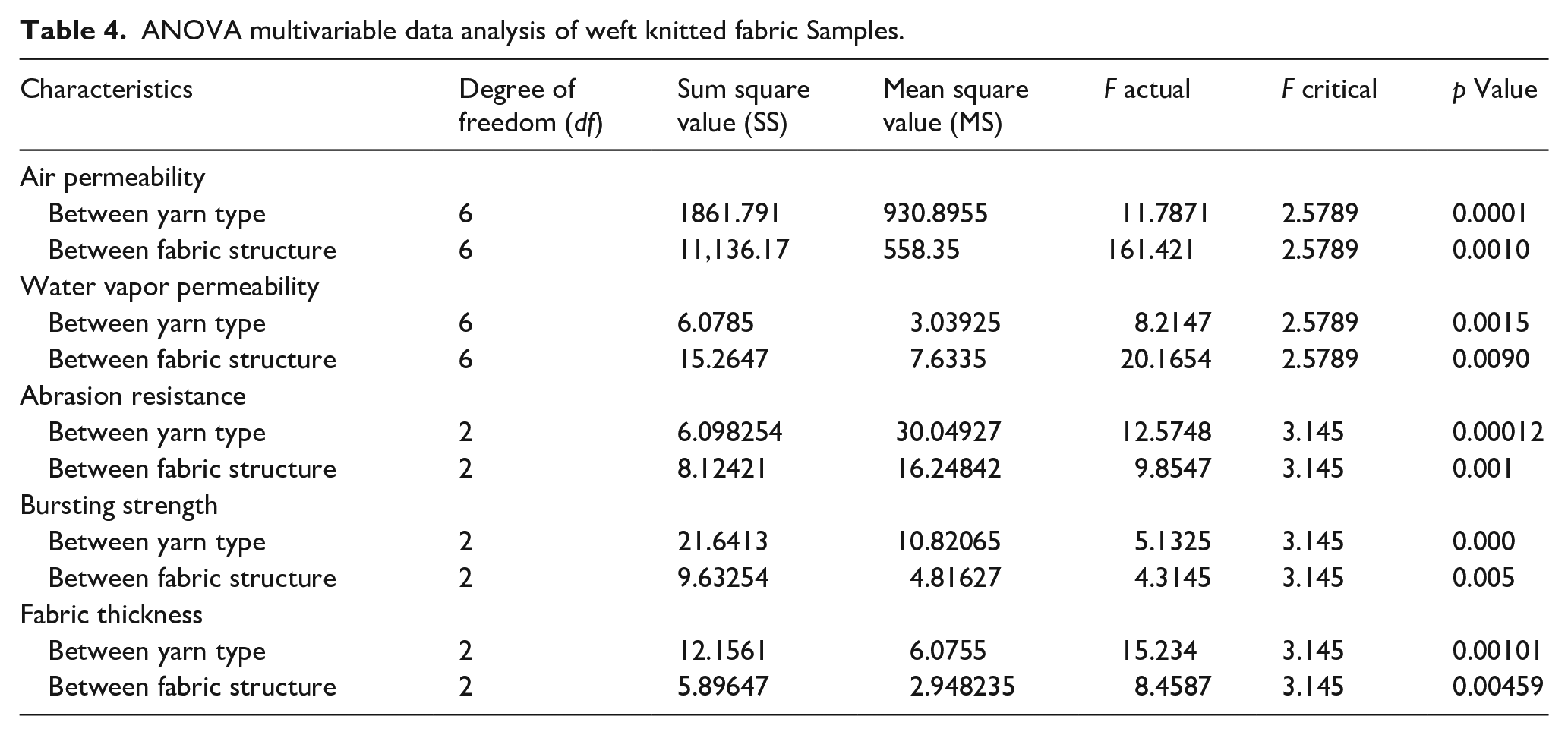
Results about the significant differences in various physical characteristics such as fabric thickness, abrasion loss, air permeability, water vapor permeability, thermal insulation behavior, and compression properties of various knitted fabrics in terms of knitted structures, stitch length and yarn types are tabulated in the Table 3 and analysis of variance in ANOVAs in Table 4.
Physical and comfort characteristics of weft knitted fabrics.
ANOVA multivariable data analysis of weft knitted fabric Samples.
Results and discussion
Effect of air permeability
The fabric transport property, which is most sensitive to the fabric structure, is air permeability, defined as the volume flow rate per unit area of a fabric when there is a specified differential pressure across the two faces of the fabric. From the Figure 1, it can be observed that air permeability of the single jersey knitted fabrics was higher than that of rib and interlock knitted fabrics, the ranges between 102.25, 149.68, and 185.30 cm3/cm2/s, which may be due to the lower tightness factor and fabric thickness. It was also found that the ring spun yarn single jersey knitted fabrics have lower air permeability is 91.895, 116.89, and138.98 cm3/cm2/s, then the rotor-spun yarn knitted fabrics, which is probably because of the better integration of the fibers and higher yarn packing density of the ring yarns. ANOVA multivariable analysis that F(2, 8)7.2415 > 3.2514 (Factual > Fcritical) at 95% confidence level showed significant differences in tightness factor and air permeability in the knitted fabrics, the fabric thickness seems to be an influencing factor for air permeability of the knitted fabrics. The single jersey knitted fabrics were found to have higher air permeability when compared to rib and interlock structures. The similar experimental findings were obtained by Bhattacharya and Ajmeeri. 18

Air permeability of weft knitted fabrics samples.
Effect of bursting strength
The bursting characteristics of single jersey rib and interlock knitted fabrics made from ring and rotor-spun yarns with constant stitch lengths of 2.7 mm were studied. Figure 2 exposed that the relationship between the bursting properties of single jersey rib and interlock knitted fabrics made from ring and rotor spun yarns has a loop length of 2.7 mm were evaluated. The bursting characteristics of single jersey knitted fabrics had lower values when compared to rib and interlock fabrics produced from rotor yarn is 5.35, 8.213, and 7.98 kg/cm2 because of their structure with lower tightness factor and fabric areal density, the significant differences were found in the bursting strength of the same knit structures produced from rotor yarn with the same loop length of ranges between is 5.35, 8.213, and 7.98 kg/cm2 this may be due to the higher fabric density and tightness factor in lower loop length knitted fabrics and also when the stitch length is shorter, the number of loops per square inch has been increased, and therefore resistance toward the bursting force is more in the case of lower stitch length fabrics. ANOVA multivariable analysis that F(2, 8)4.3145 > 5.1325 (Factual > Fcritical) at 95% confidence level showed significant differences in tightness factor and bursting strength of knitted fabrics, made from ring yarns demonstrated higher bursting strength due to higher yarn breaking strength as a result of good integration of fibers and uniform fiber arrangement leading to better fiber strength exploitation than the fabrics made from rotor yarn for the knitted structures. The similar tendency was obtained by Sharma et al. 19
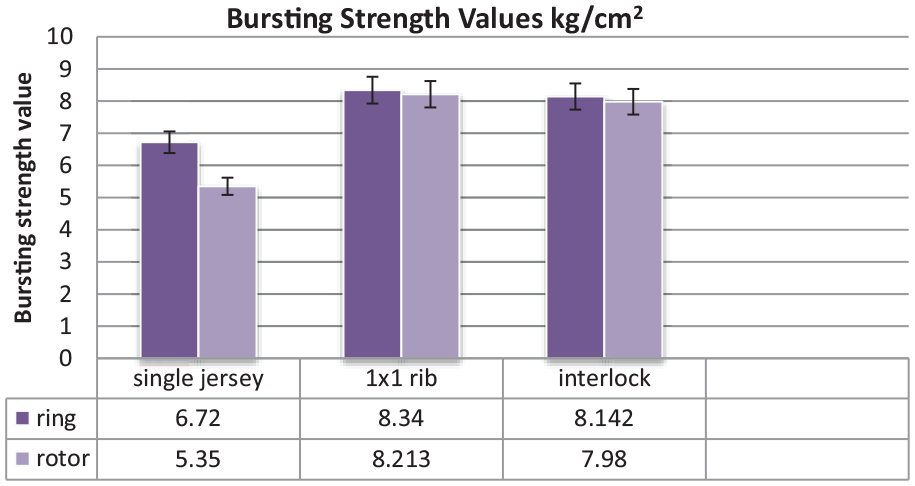
Bursting strength of weft knitted fabric samples.
Effect of fabric weight loss (%) and abrasion resistance
The weight loss (%) in abrasion of the single jersey rib and interlock knitted fabrics made from ring and rotor-spun yarns were analyzed. As shown in Figure 3, the abrasion loss (%) of the single jersey knitted fabrics was higher than that of rib and interlock knitted fabrics. The higher weight loss (%) in abrasion was noticed in the case of rotor spun yarn is 2.49%, 2.02%, and 1.93% when compared to ring spun yarns was also found that the abrasion weight loss (%) of the knitted fabrics increased when the stitch length decreased, its observed that 2.31%, 1.95%, and 1.84% because of the higher fabric density and fiber content in lower stitch length knitted fabrics. The ANOVA multivariable analysis shows that F(2, 8) 9.8547 > 3.145 (Factual > Fcritical) at 95% confidence level Knitted fabric made from ring spun length has better abrasion resistance than rotor spun yarn between fabric and yarn types. The higher weight loss value means the lower abrasion resistance. The similar results were obtained by Choi and Ashdown. 20

Abrasion resistance of weft knitted fabric samples.
Effect of water vapor permeability
The water vapor permeability behavior of various knitted structures such as single jersey, rib, and interlock fabrics made from ring and rotor spun yarns were examined. As seen from the Figure 4 it can be clearly indicated that the water vapor permeability of single jersey knitted fabrics was higher than the rib and interlock knitted structures, which may be due to the lower fabric thickness, fabric density and fabric cover factor when compared to rib and interlock knitted fabrics. The results revealed that the rotor spun yarn knitted fabric had a higher rate of water vapor permeability is 0.142, 0.11, and0.109 kg/(m² s Pa) than the ring spun yarn knitted fabrics. This may be due to better yarn packing density and lower hairiness and smooth structure of the yarns and the ring yarn water vapor permeability the in ranges between 0.131, 0.101, and 0.093 kg/(m² s Pa) The ANOVA multivariable analysis showed that F(2, 6)20.1654 > 2.5789 (Factual > Fcritical) at 95% confidence level, higher water vapor permeability was also found in the case of lower stitch density 2.7 mm in all kinds of knitted fabrics made from ring and rotor spun yarns. This may occur in yarn and fabric structures. The same experimental study was obtained by Bhattacharya and Ajmeeri 18 and Ibrahim. 21

Water vapor permeability of knitted fabric samples.
Analysis of thermal insulation values (TIV)
The thermal insulation characteristics of various knitted fabric structures such as single jersey, rib, and interlocks were analyzed and made from ring and rotor spun yarns. The thermal insulation values of the interlock knitted fabrics produced from ring yarn has the highest values of rotor yarn samples the ranges of ring yarn sample is 4.88, 5.59, and 6.58 K m2/W and the rotor yarn samples the range between 4.54, 5.21, and 5.88 K m2/W from the Figure 5 its observed that thermal insulation values is higher than the rib and single jersey knitted fabrics this may be due to higher fabric thickness, lower air permeability, and higher fabric cover factor. The thermal insulation value of the knitted fabrics was found to be dependent on their constant stitch length. By using the ANOVA statistical analysis, at 5% significance level, the thermal insulation values of the knitted fabrics were significantly different within stitch length (F = 89.96 in comparison with Fcrit = 6.94) at degree of freedom df = 8. The thermal insulation values of the yarn types such as ring and rotor spun yarn knitted fabrics of single jersey knitted fabrics were found to be significantly different between yarn types at 5% significance level (F = 7.21835 > Fcrit = 6.9442).Rotor spun yarn knitted fabrics demonstrated higher thermal insulation behavior in the knitted structures, which may be due to the higher packing density of rotor yarns than ring spun yarns. The fabric structures were single jersey, rib and interlock structures that also influenced the thermal insulation characteristics of the knitted fabrics and showed significant differences ((F = 7.21835 > Fcrit = 6.9442 at degree of freedom df = 8). This is due to the fabric properties such as air permeability, fabric cover factor, and fabric thickness. The similar finding was obtained by Beceren and Nergis). 22
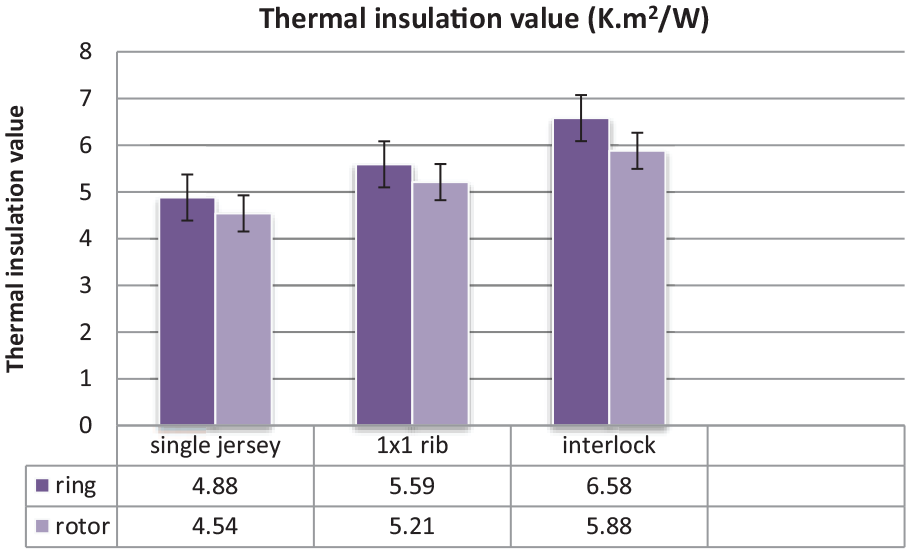
Thermal insulation values of weft knitted fabric samples.
Low stress mechanical properties (compression behavior)
The compressibility of a fabric mainly depends on the yarn packing density and yarn spacing in the fabric. Compressibility provides a feeling of bulkiness and spongy properties in the fabric. Compressibility has some correlation with the thickness of the fabric; the higher the thickness, the higher the compressibility. The low stress compression parameters such as LC, WC, RC, and T are related to the primary hand value (Fukurami or bulkiness) of the fabric. Physically, these properties are analogous to the tensile parameters such as LT, WC, and RC; RC gives the compression resilience, WC is the compression energy, and LC is the linearity of compression and fabric thickness, whereas T is the thickness of the fabric. The results of the compression properties are shown in Table 3. And in Figure 6 it can be observed that the compression resilience of rotor spun yarn knitted fabrics exhibited higher values than ring spun yarn knitted fabrics in single jersey, rib and interlock fabrics is 7.71%, 7.53%, and 7.11% this may be attributed to the better fiber integrity and yarn packing density of rotor spun yarns. However, the compression energy was found to be the lowest for ring spun yarn knitted fabrics in the ranges between 5.51%, 5.31%, and 4.57% when compared to rotor spun yarn knitted fabrics. The compression energy of all kinds of knitted fabrics was higher when fabric thickness, stitch density, and fabric areal density increased. It is interesting to note that no perceptible change in the linearity of the compression/thickness was obtained among the various fabrics considered in the study. This may be a result of the direct bearing of compression resilience on the fabric areal density. The similar experiment results were obtained by Muhammet and Yahya 23 and Manonmani et al. 11

Compression behaviors of weft knitted fabric samples.
Conclusions
The properties knitted fabrics, such as Air Permeability, Bursting strength, Weight loss (%) in Abrasion, Water Vapor Permeability, Thermal insulation, fabric Tightness factor, fabric Thickness, and Compression behaviors of ring and rotor spun yarn knitted fabrics were studied with various structures. Significant differences were reported in all knitted fabrics with constant stitch length of knitted structures. From the test, results revealed that Thermal Insulation; Water Vapor Permeability and Thermal insulation behavior of ring spun yarn knitted fabrics were found to have higher values than the rotor spun yarn knitted fabrics. This may be due to better fiber integrity and yarn packing density of rotor spun yarns. The ring spun yarn knitted fabrics were found to have higher Bursting strength, when compared to rotor spun yarn knitted fabrics for all knitted samples. The significant differences were reported in Air Permeability of all knitted fabrics with constant Stitch length and knitted structures. The Comfort characteristics of Thermal insulation, Water Vapor Permeability, and low stress mechanical properties of Compression behavior in single jersey rib and interlock knitted fabrics made from ring and rotor spun yarns were evaluated. From the test results, Thermal insulation, Water Vapor Permeability, and Compression behavior of ring spun yarn knitted fabrics were found to have higher values than the rotor spun yarn knitted fabrics. This may be due to better fiber integrity and yarn packing density of ring spun yarns. This research study of weft knitted structure has been recommended to the sportswear applications.
Footnotes
Declaration of conflicting interests
The author(s) declared no potential conflicts of interest with respect to the research, authorship, and/or publication of this article.
Funding
The author(s) received no financial support for the research, authorship, and/or publication of this article.
