



Abstract
The pursuit of sustainability has necessitated more renewable resources in construction materials. Plant-based natural fibres, which can be found globally, are abundant, low-cost and renewable. Moreover, plant-based fibres can improve the mechanical properties of construction materials as a low-cost, environmentally friendly renewable option. Accordingly, a thorough understanding of the characteristics and drawbacks of plant fibres, focussing on their use in cement-based composites, is needed to explore their potential in structural applications. Therefore, this study developed a conceptual framework to assess the factors affecting plant-based natural fibres and cement composites. The paper further demonstrates the application of the proposed framework to predict associated challenges and offers appropriate solutions. Finally, date palm fibres are suggested for future applications of the proposed conceptual framework.
This is a visual representation of the abstract.
Keywords
Introduction
The World Commission on Environment and Development defines sustainability as fulfilling the prerequisites of the existing generation without compromising the ability of future generations in meeting their own needs. 1 The rise in the world population and the correlated stress on the built environment are significant issues society must face. The construction industry demands have led to considerable waste generation and material and energy consumption for built infrastructure. According to Wescott, 2 the building construction industry is a massive consumer of land, energy and raw materials and a substantial contributor to environmental pollution, specifically greenhouse gas emissions. Therefore, the construction industry should embrace using renewable industry materials and by-products to enhance sustainability. 3
Natural fibres used for concrete reinforcement can be categorised as animal-, mineral- or plant-based. 1 Animal-based fibres include proteins such as wool, silk and hair. Similarly, fibres collected from minerals include wollastonite, palygorskite and asbestos. Common plant-based fibres are flax, cotton, jute, hemp, sisal, palm, bagasse, ramie and processed speciality fibres. Regarding fibre reinforcement and the enhancement of concrete properties, natural fibres can be used as adjuncts to their manufactured counterparts, as highlighted by Alawar et al. 4 and Dehghani et al. 5 Furthermore, the chemical and mechanical characteristics of plant-based natural fibres enable their use in various building industry applications.6–8 Several studies explored the use of plant-based natural fibres in the concrete industry, revealing improvements in the mechanical properties of concrete.9–11
Green composites were shown to be a viable alternative to synthetic composites in many applications. 12 Several studies explored the use of plant-based natural fibres in the concrete industry, finding that such fibres can enhance the mechanical properties of concrete.13–16 Indeed, polymers combined with cellulosic fibres was found to be an effective hybridisation strategy for enhancing cement hardness in non-structural fibre-reinforced composites (FRCs).16–18 This approach eliminates the need for harmful materials like asbestos and offers additional energy-saving advantages by removing autoclave requirements. 19
Thus, a thorough understanding of the characteristics and drawbacks of plant-based natural fibres and their use in cement-based composites is essential to explore their potential for structural applications. However, to date, no framework for plant-based fibre-reinforced concrete mixes exists, particularly regarding the production, characteristics, drawbacks and treatment of plant-based natural fibres and associated concrete-mix design strategies. The present work proposes a conceptual framework to help identify optimal processes for using different plant-based natural fibres and key issues concerning their incorporation into concrete materials. Herein, this study demonstrates the application of the proposed framework to predict the challenges associated with such materials and provide adequate solutions prior to production and application. Moreover, the future application of the proposed framework to date palm-based fibres for reinforcing cement composites is discussed. This work provides an in-depth analysis of the subject matter to enrich the knowledge of the discipline comprehensively.
Framework for using plant-based natural fibres in cement-based composites
This section presents a conceptual framework for using plant-based natural fibres in cement-based composites for construction applications. The selection of a particular framework is based on its effectiveness in collecting valuable data for the evaluation from different perspectives, bridging the information gap. The proposed framework comprehensively evaluates natural-fibre production and chemical, physical and mechanical characteristics. The drawbacks of plant-based natural fibres are also investigated, such as high water absorption and issues with compatibility and durability. This paper also discusses the application of specific treatments, such as compatibilisers, water repellents and hydrothermal methods to plant-based fibres in mitigating water absorption, improving the bond strength and maintaining the durability of reinforced cement composites. The proposed framework consists of five steps, as illustrated in Figure 1.

A proposed framework to guide the use of plant-based natural materials in cement-based composites.
Step 1: Select the plant-based natural fibre to be incorporated into cement composites based on its production cost and availability
The well-known economic advantages of plant-based natural fibres are due to lower raw material costs compared to those of their manufactured counterparts. The cost of raw materials affects the performance of specific sectors significantly. Cost-benefit plans are heavily contingent on raw material costs, which impact industrial capacity and development capabilities. Thus, the production and availability of plant-based natural fibres in various locations enables local building sectors to incorporate these materials into cement-based mixes produced in their respective region.
Cost reduction motivates the use of plant-based natural fibres in the FRC process as one of the least expensive options, especially in industrial applications. Onuaguluchi and Banthia 20 investigated the economic feasibility of replacing virgin hock-end steel fibres with the help of cost-benefit analysis in FRC formulation. As a result, the entire replacement of hocked-end fibres was found advantageous for FRC comprising 0.35% fibres if the cost of virgin fibres was greater than that of recycled fibres.
Nonetheless, the core advantage of using plant-based natural fibres is to mitigate the environmental effect. Previous studies examined the environmental sustainability of the recycled FRC process, which includes the life cycle assessment (LCA).21–23 For instance, Yin et al. 21 investigated the LCA of recycled FRC by comparing industrial virgin and domestic recycled polypropylene (PP). The authors witnessed that the carbon print, energy consumption, eutrophication and water print decreased with the industrial virgin PP compared to the domestic PP. Manufacturing recycled PP fibres from household waste is a complicated and energy-intensive procedure, requiring waste collection, cleaning, fibre production and reprocessing.
Step 2: Specify the chemical, physical and mechanical properties of the fibre
The chemical structure and mechanical properties of natural plant-based fibres enable them to be used in numerous applications in the construction sector.6–8 Natural plant-based fibres are composed of three main organic components – cellulose (glucose units), hemicelluloses (polysaccharides) and lignin (aromatic polymers and phenyl propane monomers) – as well as extractives and ash, as shown in Table 1. 24 Thus, such fibres are collectively known as lignocellulosic fibres. Table 1 indicates that the various fibre types have different underlying molecular structures, compositions, and, therefore, mechanical characteristics.
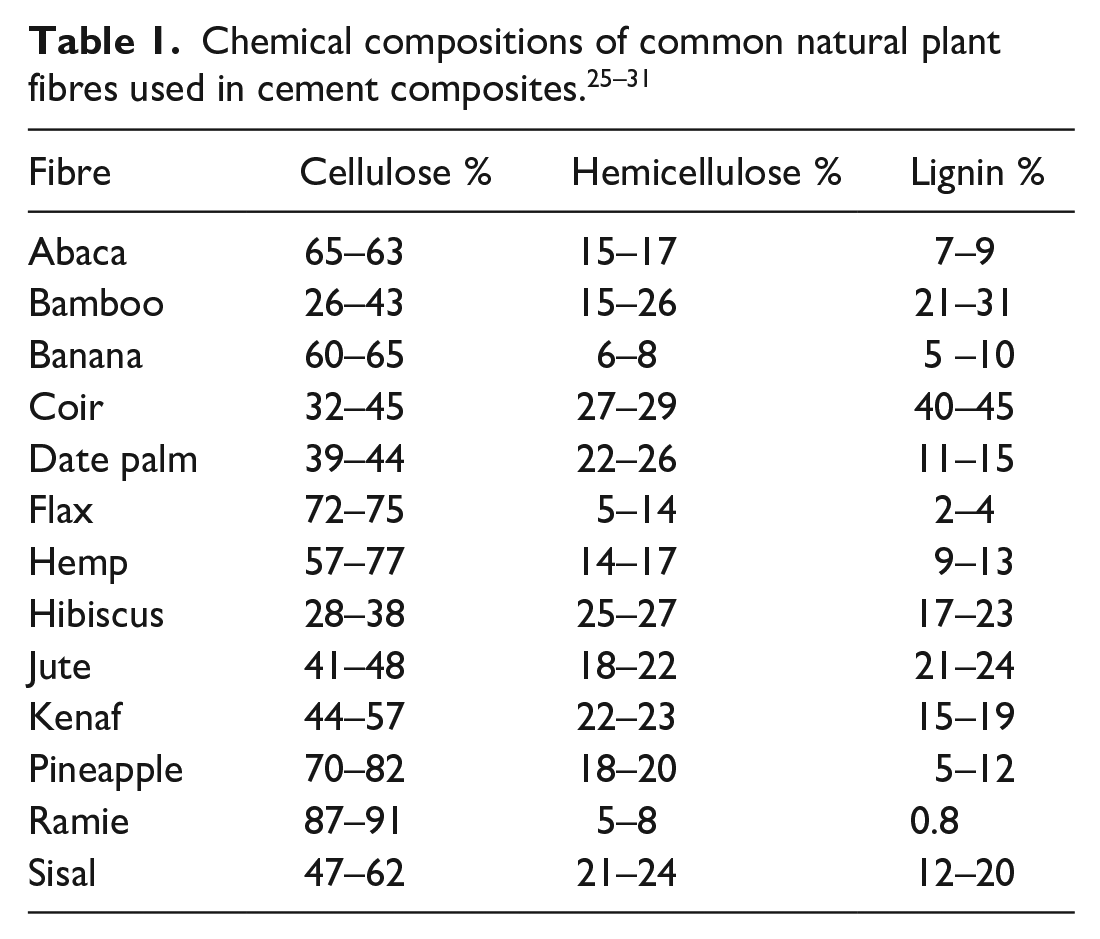
The chemical compositions of plant-based natural fibres have a significant effect on their mechanical characteristics. For instance, Komuraiah et al. 10 demonstrated that cellulose is the most reinforcing and robust organic compound, providing relatively high stiffness, strength and fibre stability. Thus, the amount of cellulose in natural plant fibres is positively associated with their mechanical properties, such as tensile strength, Young’s modulus and elongation at break. Although the hemicellulose content in plant-based natural fibres increased moisture, specific strength and Young’s modulus, the association between the hemicellulose and the microfibril angle, tensile strength, density and natural-fibre strain failure was negative. A strong positive correlation was also observed between lignin and moisture gain in plant-based natural fibres. Accordingly, lignin negatively impacted the specific strength, tensile strength, density and Young’s modulus. 18
Soil quality, seed density, plant-fibre position, crop type, harvesting time, field location, fertilisation and extraction and processing processes have strong relationships with the concentration of components. 32 Other factors that cause disruptions to the plant-fibre properties include drying methods, fibre cross-section and handling and processing damage. Fibre age has considerable effects on natural fibre–based properties, which include changes in the fibre’s centre and, thus, in the cross-section and fibre size. In addition, different mechanical attributes were present in the fibres, as shown in Table 2, which lists the mechanical properties of the most common natural plant fibres utilised in cement composites.
Mechanical properties of the most typical natural plant fibres utilised in cement composites.

Figure 2 summarises the factors affecting the physical and mechanical properties of plant-based natural fibres. A detailed description of the behaviour of plant-based natural fibres in cement-based composites is presented in the following section.

Factors affecting physical and mechanical properties of plant-based natural fibres.
As discussed above, numerous factors contribute to the physical and mechanical characteristics of plant-based natural fibres. Thus, the proposed framework recommends assessing the chemical compositions of various natural fibre and their physical and mechanical properties, including tensile strength, elongation at break, water absorption and Young’s modulus, before using in cement composites to enhance performance.
Step 3: Assess plant-based natural-fibre composite properties and performance
This framework focuses on the use of natural plant fibres in cement composites. Thus, a thorough understanding of the properties and performance of the plant-based natural fibres within cement composites is essential. In plant-based natural fibres, the cellulose chain making up the microfibres is composed of two integrated components: lignin, which is present in fibrils, and amorphous hemicellulose. 29
Fibres driven from plants are conceptualised through the reinforced matrix theory, presenting material of comparatively high tensile strength (cellulose) and hygroscopic material (hemicellulose) held in a thermoplastic matrix (lignin), as shown in Figure 3.
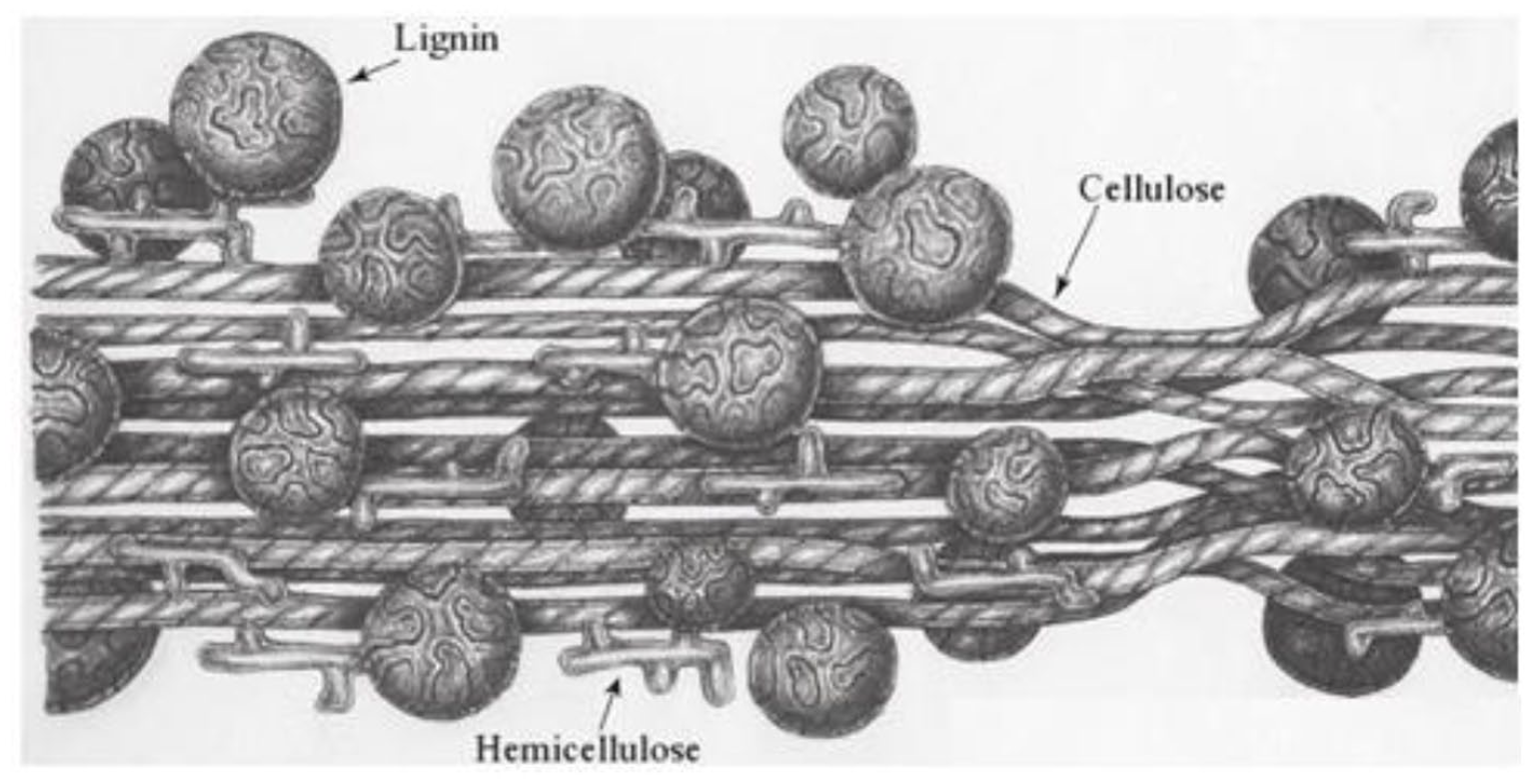
Conceptual rendering of reinforced matrix theory.
Plant-based natural fibres contain strongly polarised hydroxyl groups on their surfaces, which correlate with moisture gain. Therefore, the construction of well-integrated interfaces within a non-polar polymer matrix, such as the cement matrix, is challenging. The contraction of the fundamental plant-fibre structure is performed using the matrix, which reinforces concrete composites. In addition, cellulose may behave similarly to the rods used for reinforcing steel in the concrete matrix. Thus, a loose comparison is made between reinforced concrete and fundamental structures of plant-based fibres. In this analogy, cellulose represents the conventional steel reinforcing rods embedded in a concrete (lignin) matrix.
Additionally, hemicelluloses serve as a bridge between lignin and cellulose in plant-based fibres. 24 Thus, characteristics of fibre-reinforced composites rely on the fibre, interfacial bonding and matrix. 4 The strength of the fibre–matrix bond aids in exchanging composite stress, which significantly influences the ultimate mechanical attributes of the composite.
Adverse effects can occur when an alkaline pore solution is present on plant-based fibres, inducing alkalinity in the cement matrix, which further deteriorates such fibres. This obstacle leads to outcomes including porosity, internal strain, moisture absorption, chemical degradation and inferior mechanical characteristics.33,34 In addition, the composite components are less capable of eliminating the bond within the required timeframe. Extant studies have tested different methods to address the challenges of plant-based natural fibres. However, none provided methods to improve the mechanical characteristics of cement composites adequately. In the following section, the main drawbacks associated with incorporating plant-based natural fibres into cement composites are discussed comprehensively, and various treatment methods are proposed.
Step 4: Identify the main drawbacks of plant-based fibres and apply suitable treatment methods to overcome the issues
Although natural fibres derived from plants are widely available at low costs, their use in industrial construction applications may be limited, owing to several drawbacks. 35 The main disadvantages of using plant-based natural fibres in cement composites and treatment methods are discussed comprehensively in the following subsections. The core obstacles are reduced durability, incompatibility and high water absorption between the cement and fibre matrix.27,28 Composites with poor final properties result from such deficiencies related to these fibres.
High water absorption
The primary disadvantage associated with plant-based natural fibres is the increased absorption of water, which requires pretreatment for use in cement composites. Natural fibres derived from plants contain many hydroxyl groups, which increase moisture absorption capabilities.36,37 A cumulative impact was observed through the cell wall pores and open lumen to render the fibres susceptible to moisture absorption and, consequently, increase their dimensional instability. 38 Hydrogen bonds were eliminated by the absorption of water from the fibres to the matrix, and swelling appeared from moisture absorption, which elevated the thermal and mechanical degradation properties of natural composites.39–41 Nonetheless, a positive effect of the minor swelling of natural fibres was achieved in natural composites by increasing the pull-out force and frictional stress generated by the swollen fibres, which highlighted the mechanical interlinkage between the fibre and matrix. 42
Several studies focussed on controlling the water absorption of various plant-based natural fibres.43–46 Compatibilisers and water repellents are possible solutions to reduce moisture absorption and enhance the prevailing bond between the cement matrix and natural fibres. Hydrothermal treatment is another approach, which reduces the moisture intake of composites by increasing the crystallinity of cellulose throughout the hydrothermal treatment process. Furthermore, over-dried pulp fibre has been shown to induce high flexural strength and mitigate the toughness compared to air- or wet-cured specimens.47–53
Compatibility
The most severe drawbacks of using plant-based natural fibres in cement-based composites are the hydrophilic nature of the fibre and non-polar hydrophilic properties of the cement matrix. 28 Several mechanisms have been recommended to enhance the compatibility of natural fibres and interfacial bond strength. The fibre strength can change based on the surface treatment. The surfaces of natural plant fibre are affected by the fibre morphology, chemicals used in the treatment and processing conditions. Chemical reagents are primarily used for treating plant-based natural fibres, and several studies tested various chemical reagents to enhance the compatibility of the composites.5,54,55 The behaviour of the composite can be improved in terms of the reinforcement provided by the treated fibre. In contrast, abrasive chemicals and long exposure times may be detrimental to fibres derived from plants, reducing the tensile strength. 56
Some studies demonstrated that alkaline pretreatment with a low percentage of fibres enhances their adhesiveness in the cement matrix and improves the mechanical characteristics of the resulting composite.57–59 In addition, the alkaline treatment of fibres was shown to improve the cellulose’s tensile strength, elongation at break, surface roughness and surface exposure, which enhanced the mechanical properties of the composite matrix.60,61
Other research reported improvement in the bonding of the plant-derived natural fibres and cement matrix by heating. Heat treatments increase the fibre surface roughness by dehydrating its chemical components and enhancing fibre–matrix adhesion. 59 Castellano et al. 62 suggested using coupling agents consisting of organofunctional silanes to improve fibre–cement adhesion. Additionally, Savastano et al. 60 further reported the adhesive enhancement of sisal fibres and cement using the pulping technique, which could be achieved by either chemical (Kraft) or mechanical processes to enhance the adhesiveness cement matrix. According to Savastano et al., 63 mechanical pulping is less expensive than the chemical approach. Similarly, Basch and Lewin 38 highlighted that Kraft pulp-treated fibres had a stronger influence on the mechanical performance of the composite. Furthermore, Tonoli et al. 55 reported similar outcomes and stated that the fibre had improved adhesiveness with moderate refinement and sisal fibre pulp beating.
Durability
The degradation/deterioration and weathering characteristics of plant-based natural fibres should be thoroughly evaluated to assess the fibre composite durability. Numerous methods are commonly used to address the degradation of natural fibres from plants in cement composites, including packing or dry composite sealing to avoid the effects of water, particularly regarding alkalinity. Ramakrishna and Sundararajan 25 proposed substituting ordinary Portland cement with granulated blast-furnace slag to decrease the composite alkalinity. Similarly, Onuaguluchi and Banthia 20 recommended the partial substitution of cement with supplementary cementing materials through pozzolanic reactions to reduce the alkalinity present in cement-based mixtures. A sturdy process for carbonation can achieve a similar alkalinity reduction effect, as reported by Savastano et al. 63
Additional research showed that the hornification process by alternating drying and rewetting the fibres to mitigate water retention capability enhances the fibre–cement bond and increases fibre durability. Thus, the hornified fibre exhibited enhancements of the adhesion and frictional stress in the cement mortar matrix, which increased fibre durability. 64
As discussed above, the main drawbacks of using plant-based natural fibres in cement matrices include high water absorption, limited durability and incompatibility between the fibre and matrix. These shortcomings associated with natural fibres may result in poor final characteristics of such composites. However, the drawbacks of plant-based fibres may vary with their chemical compositions and physical and mechanical properties. Therefore, the specific disadvantages of plant-based fibres need to be identified to determine suitable treatment methods. A summary of the main drawbacks and their most common treatment methods from the reviewed literature is presented in Figure 4. Such treatment methods can be applied to the selected fibres (understudy) to save researchers time and effort.
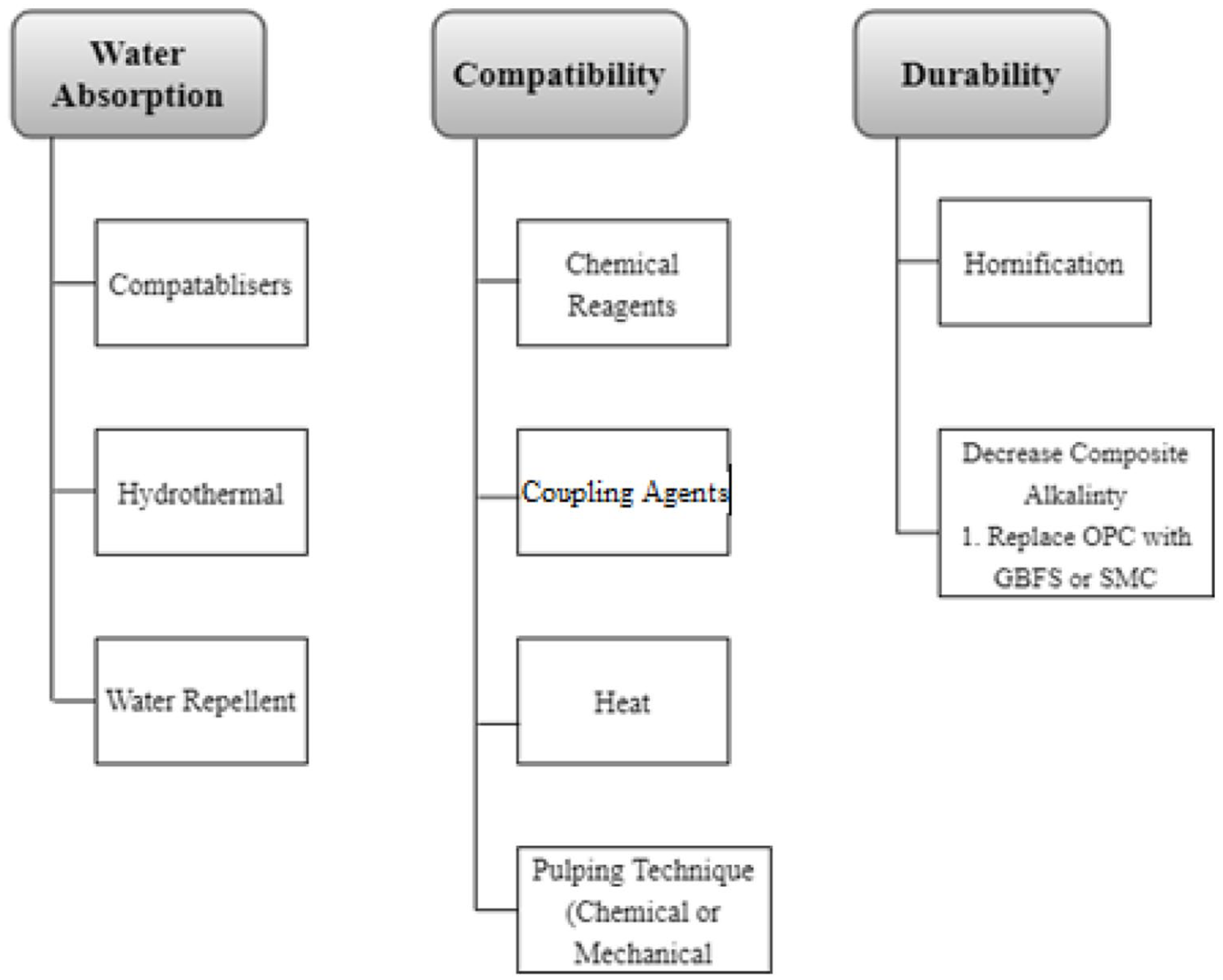
Most common drawbacks of and treatment methods for plant-based natural fibres.
Step 5: Test concrete properties to optimise treatment method
After selecting appropriate treatment methods from Step 4, the fibre concrete mixes are prepared, and the concrete properties are tested to optimise the treatment method. Cubes and beams can be constructed to evaluate the compressive and flexural strengths of the composites containing treated fibres by comparing the results to those of control samples containing untreated fibres. The most appropriate treatment method to obtain optimised composite characteristics can be identified according to the results from this step. The mechanical properties of the cement-based composites reinforced with treated plant-based fibre can be identified, and subsequently, suitable applications for building construction can be determined.
Potential implementation of date palm fibres in cement composites
The above-suggested framework was partially implemented in this study by using date palm fibres in cement-based composites. A comprehensive discussion was conducted based on the first two steps of the proposed framework, particularly involving the production of date palm fibres and their chemical, physical and mechanical characteristics. 65 The availability, cost and chemical, physical and mechanical characteristics of date palm fibres showed that they could serve as a feasible alternative to manufactured fibres in cement-based composites.
Step 1: Selection of date palm fibres based on availability and production cost
A large amount of data palm fibres were generated at a low cost, indicating good availability. Previous investigations found that date palm fibres were among the least expensive natural fibres, highlighting their potential usage in concrete composites.66,67
Step 2: Specification of the chemical, physical and mechanical properties of the fibre
In the author’s previous study, the chemical, physical and mechanical properties of date palm fibres were thoroughly explored. 65 As indicated in Table 1, in terms of the chemical composition, the cellulose quantity in date palm fibres is greater than that in lignin and hemicellulose, which is advantageous because cellulose is a constituent that provides sufficient fibre tensile strength. The average percentage of cellulose in date palm fibres (44%) is comparable to the other natural fibres commonly used in cement-based composites, such as bamboo (35%), hibiscus (33%), sisal (54%) and jute (44%), which results in adequate tensile strength and Young’s modulus. 65 Table 1 also indicates that the lignin content of date palm fibres is lower than that of other plant-based natural fibres commonly used in cement composites. Therefore, date palm fibres absorb less water when used in cement composites, yielding more desirable mechanical and weathering properties.
In addition, Table 2 indicates that date palm fibres have high elongation values at break, ranking behind coir and pineapple, compared to other plant-based natural fibres, which makes them suitable for various applications in the concrete industry. Moreover, Table 2 demonstrates that date palm fibres are among the least dense of these plant-based natural fibres. As a result, the production of lightweight composites is cost-competitive compared to using other natural and manufactured reinforcing fibres. Thus, the present work suggests using fibres obtained from date palms as reinforcements in the concrete industry.
However, as discussed in Step 2 of the proposed framework, the mechanical characteristics of the same types of fibre can differ based on size and source. Therefore, Table 3 summarises the mechanical properties of date palm fibres acquired at different sizes and from different sources, leading to varied behaviour in cement-based composites.
Date palm fibre mechanical characteristics.

Step 3: Evaluation of the date palm fibre composite properties and performance
Few studies have assessed the behaviour of date palm fibres in cement composites. For instance, Djoudi et al. 68 examined the use of construction composite comprising date palm fibres by studying the effects of the fibre length, curing type and volume fraction on the mechanical behaviour and durability of date palm. As a result, the bending resistance increased with the proportion and length of the date palm fibres. In addition, Benaniba et al. 69 determined the characteristics of date palm fibre composites experimentally in terms of thermal conductivity. The results showed that date palm fibre enhanced the thermo-mechanical properties of the composite material, improving the insulating capacity of the mortar considerably.
Step 4: Identification of the main drawbacks of date palm fibres and associated treatments
The water absorption capacity, compatibility and durability of date palm fibres were investigated to determine they are viable alternatives for the production of composites in the cement industry. A positive correlation was found between the lignin content in plant-based natural fibres and water absorption.
Different treatment methods to address plant-based natural fibres’ water absorption, compatibility and durability to improve their performance in cement composites are available, as shown in Figure 4. In this regard, the study recommends using these treatment methods to reduce the water absorption of date palm fibres and improve their compatibility and durability, yielding more desirable mechanical properties in the cement composites.
Step 5: Testing of concrete properties to optimise the treatment method
The strategies proposed in Steps 3 and 4 of the framework (see Figure 4) with the guidance of the literature review covered in the previous two sections can be implemented to optimise the composite characteristics. Accordingly, suitable applications for building construction can be determined. In future work, the compressive strength and indirect tensile strength will be determined from the cube and beam specimens, respectively, to determine the best treatment method for the treated date palm fibre composites. The 7-, 14- and 28-day compressive strengths of the concrete cubes will be measured. In addition, the tensile strength of the beam specimens will be determined by a flexural test. The flexural strength of all beams will be tested following the RILEM standard given in RILEM TC 162-TDF.70,71
Conclusions
Driven by the current focus on environmentally friendly materials and renewable resources, plant-based fibres have attracted considerable research attention as replacements for their manufactured counterparts. However, unlike manufactured fibres, lignocellulosic fibres have variable chemical and mechanical properties, which place a significant barrier to their use in building construction components because engineers are accustomed to the consistent and predictable characteristics of manufactured fibres.
Thus, a conceptual framework for using plant-based natural fibres in cement composites is proposed to evaluate the feasibility prior to composite construction and building installation. The framework guides researchers on evaluating plant-based fibre production and properties, effectively predicting the challenges faced and choosing the most efficient methods to address the shortcomings.
The proposed framework consists of five steps: (1) study the production and availability of plant-based fibres; (2) focus on their chemical, physical and mechanical characteristics; (3) identify the interaction between the selected fibre and proposed composite; (4) identify the fibre drawbacks and treatment methods; and (5) optimise the selected treatment method by testing concrete samples and identify suitable applications in the building industry based on test results. The study used the framework to evaluate the suitability of date palm fibres in cement-based composites by reporting on their production, properties, interaction within cement composites, associated drawbacks and treatment methods. The true potential of date palm fibres as a feasible alternative for composites in the cement industry was determined. The results demonstrated that date palm fibres could improve the mechanical properties of composites and reduce the weight of buildings at a relatively low cost. Moreover, future research can apply the proposed treatment methods and investigate the positive impact on composite properties.
Footnotes
Declaration of conflicting interests
The author declared no potential conflicts of interest with respect to the research, authorship, and/or publication of this article.
Funding
The author disclosed receipt of the following financial support for the research, authorship, and/or publication of this article: The work presented herein was funded by the Prince Sultan University, Riyadh, Kingdom of Saudi Arabia. This financial support is gratefully acknowledged.
