




Abstract
Fiber-reinforced flexible pipes are widely used to transport the fluid at locations requiring flexible connection in pipeline systems. It is important to predict the burst pressure to guarantee the reliability of the flexible pipes. Based on the composite shell theory and the transfer-matrix method, the burst pressure of flexible pipes with arbitrary generatrix under internal pressure is investigated. Firstly, a novel method is proposed to simplify the theoretical derivation of the transfer matrix by solving symbolic linear equations. The method is accurate and much faster than the manual derivation of the transfer matrix. The anisotropy dependency on the circumferential radius of the pipe is considered in the theoretical approach, along with the nonlinear stretch of the unidirectional fabric in the reinforced layer. Secondly, the burst pressure is predicted with the Tsai-Hill failure criterion and verified by burst tests of six different prototypes of the flexible pipe. It is found that the burst pressure is increased significantly with an optimal winding angle of the unidirectional fabric. The optimal result is determined by the geometric parameters of the pipe. The investigation method and results presented in this paper will guide the design and optimization of novel fiber-reinforced flexible pipes.
Keywords
Introduction
Fiber-reinforced flexible pipes are widely used to transport fluid at locations requiring flexible connection in pipeline systems. They protect the pipeline from damage caused by mechanical vibration and shock, proved extremely useful in aerospace engineering and marine engineering. Compared with cylindrical pipes, flexible pipes with arbitrary generatrix, such as spherical type and multiple arch type, have better performance on displacement compensation and vibration suppression. Fiber-reinforced flexible pipes are sandwich material compounded by reinforced layer and rubber layer, as shown in Figure 1(a). They are manufactured by the expansion and curing process, as shown in Figure 1(b). On the cylindrical core mold are laid from the inside to the outside the inner rubber layer, the reinforced layer and the outer rubber layer. Particularly, the reinforced layer is composed of multi-layer helically wound unidirectional fabric. The pipe is expanded to preset shape constrained by the outer mould. The unidirectional fabric is usually made of synthetic fiber, such as nylon, polyester, and aramid. Considering that the internal diameter of the flexible pipes could reach over 1 m, the high internal pressure induced by the transporting fluid is the key challenge faced by the flexible pipes. In order to guarantee the reliability of fiber-reinforced flexible pipes, the burst pressure should be investigated carefully.

(a) Rubber layer and reinforced layer of fiber-reinforced flexible pipes and (b) the expansion and curing process of fiber-reinforced flexible pipes with arbitrary generatrix. It should be noted that there is no gap between the threads in the same layer of the unidirectional fabric.
Recently, mechanical responses of composite flexible pipes under internal pressure have been investigated in depth. Van den Horn et al. 1 used the membrane theory to study the stress distribution and burst pressure of flexible pipes under internal pressure, but the shear stress was neglected. Bai et al. 2 investigated the stress distribution of cylindrical flexible pipes under internal pressure, and used the von Mises yield criterion to predict the burst pressure. Gao et al. 3 extended the work of Bai et al., 2 further considering the plasticity and improving the accuracy of burst pressure prediction. Xia et al. 4 presented an exact elastic solution for stresses and deformations of cylindrical flexible pipes under internal pressure based on the three-dimensional anisotropic elasticity. Neto et al. 5 established a full 3D finite model of the reinforced layer and used the von Mises failure criterion to predict the burst pressure. Zhou et al. 6 investigated the stress distribution of the reinforced layer under internal pressure based on the classical laminated composite theory, and concluded that the optimal winding angle of cylindrical flexible pipes is 55°. Some researchers investigated the mechanical properties of flexible pipes under loads combined pressure with axial tension 7 and bending. 8 Compared with the cylindrical pipe, the investigation on burst pressure of non-cylindrical pipe is insufficient. Zhang et al. 9 investigated stress distribution of spherical pipes under internal pressure based on the membrane theory, finding that the weakest position is on the middle of the pipe. Jaszak et al. 10 performed finite element analysis on spherical rubber pipe with Mooney-Rivlin hyperelastic model, concluding that the internal and external rubber layer have little influence on the stress distribution. Therefore, the rubber layer is negligible in the burst pressure prediction. However, the anisotropy of the reinforced layer is assumed to be uniform in the paper, which is not true in non-cylindrical pipes. To increase the strength of revolutionary shells, some researchers used variable angle tow (VAT) laminates with the idea of bend-free state under internal pressure.11,12 In VAT laminates, the fiber orientation is tailored spatially, resulting in varying stiffness properties. However, the theory is not suitable for fiber-reinforced flexible pipes. Since the elongation at break of synthetic fiber is obvious, the winding angle of the reinforced threads will change when the pipe is subject to high internal pressure. Therefore, the flexible pipe will lose bend-free state under high internal pressure.
Most research above mentioned is limited to the cylindrical flexible pipes. For flexible pipes with arbitrary generatrix, the theoretical model is needed to be improved to predict the burst pressure accurately. Firstly, non-cylindrical pipes are manufactured through the expansion and curing process. The winding angle of the unidirectional fabric depends on the circumferential radius of the pipe, while the winding angle is uniform in cylindrical pipe. So the nonlinear distribution of winding angle leads to inhomogeneous anisotropy of the reinforced layer in non-cylindrical pipes. Secondly, the stretch of the threads is obvious under high internal pressure. In steel reinforced flexible pipes, which have been studied thoroughly, the stretch of the steel is neglected usually. The winding angle will have a slight change caused by the stretch of the threads, along with the anisotropy of the reinforced layer in the flexible pipe subjected to high internal pressure. Thirdly, the transfer matrix of the pipe with arbitrary generatrix is much more complicated than the one of the isotropic pipe. Therefore, a simplified method to derive the transfer matrix is needed. The transfer-matrix method is a semi-analytical method to solve the governing differential equations of the flexible pipe. The most difficult step of the transfer-matrix method is the derivation of the transfer matrix, which transfers the state vector from one end of the pipe to the other end.
In this paper, the burst pressure of fiber-reinforced flexible pipes with arbitrary generatrix is investigated based on classical laminated composite shell theory and transfer-matrix method.13,14 The anisotropy dependency on the circumferential radius of the pipe is considered in the theoretical approach, along with the nonlinear stretch of the unidirectional fabric in the reinforced layer. A novel method is proposed to simplify the theoretical derivation of the transfer matrix by solving symbolic linear equations. The transfer-matrix equations are solved by the extended homogeneous capacity precise integration method.15,16 The theoretical prediction of burst pressure is obtained with the Tsai-Hill failure criterion. 17 Six different prototypes of the flexible pipe are tested for burst pressure to verify the agreement between the theoretical and the test results. The prototypes are composed of conical and spherical shells. To further improve the reliability of flexible pipes, influence on the burst pressure is investigated from the perspective of the strength of the unidirectional fabric. By changing the strength of the threads, the effects of the tensile strength, transverse strength, and shear strength of the threads on the burst pressure are discussed. The burst pressure of flexible pipes is increased significantly with optimal initial winding angle of reinforced threads.
Theory and test method
Model establishment
Figure 2 shows the sections of flexible pipes with arbitrary generatrix. A Cartesian coordinate system (x, y, z) and a curvilinear coordinate system

The sections of flexible pipes with arbitrary generatrix.
The theoretical analysis of this paper is based on Love-Kirchhoff assumption. 18 Linear strains at an arbitrary point of the pipe are defined as

where the reference surface strains and curvature and twist changes are given as

The reinforced layers of flexible pipes are composed of synthetic fibers. The elastic modulus and strength of the synthetic fibers are much greater than rubber materials. Therefore, only the reinforced layer is considered in the analysis of burst pressure, while the influence of the inner and outer rubber layers is neglected. The reinforced layer is composed of multiple layers of unidirectional fabric. The single-layer threads, which refer to the threads in the same layer of the fabric, could be regarded as an orthotropic material. 19 The stress-strain relations of the kth lamina in the reinforced layer are written as

where

where

where

where winding angle αk is the angle between direction 1 of the fiber and the direction
Although the initial winding angle of the unidirectional fabric on the cylindrical core mold is uniform, the winding angles of the expanded threads keep changing at different positions along the generatrix direction. For the expansion and curing process, the following two assumptions are proposed:
(1) The expansion and curing process is constrained by the outer mould. Therefore, the in-plane force in the reinforced layer and the stretch of the threads are negligible during the expansion and curing process.
(2) Both ends of flexible pipes do not rotate relatively to each other during the expansion and curing process.
Supposing the initial winding angle on the cylindrical core mold is α0, the geometric relationships established based on the above-mentioned assumptions are written as follows

where r0 represents the distance from the point at the end of flexible pipes to the axis of rotation. The winding angle distribution along the generatrix direction derived from equation (7) is

The stresses over the shell thickness are integrated to obtain the force and moment resultants, which are

where

where the stiffness coefficients Aij, Bij, Dij are given as

The equilibrium equations are written as
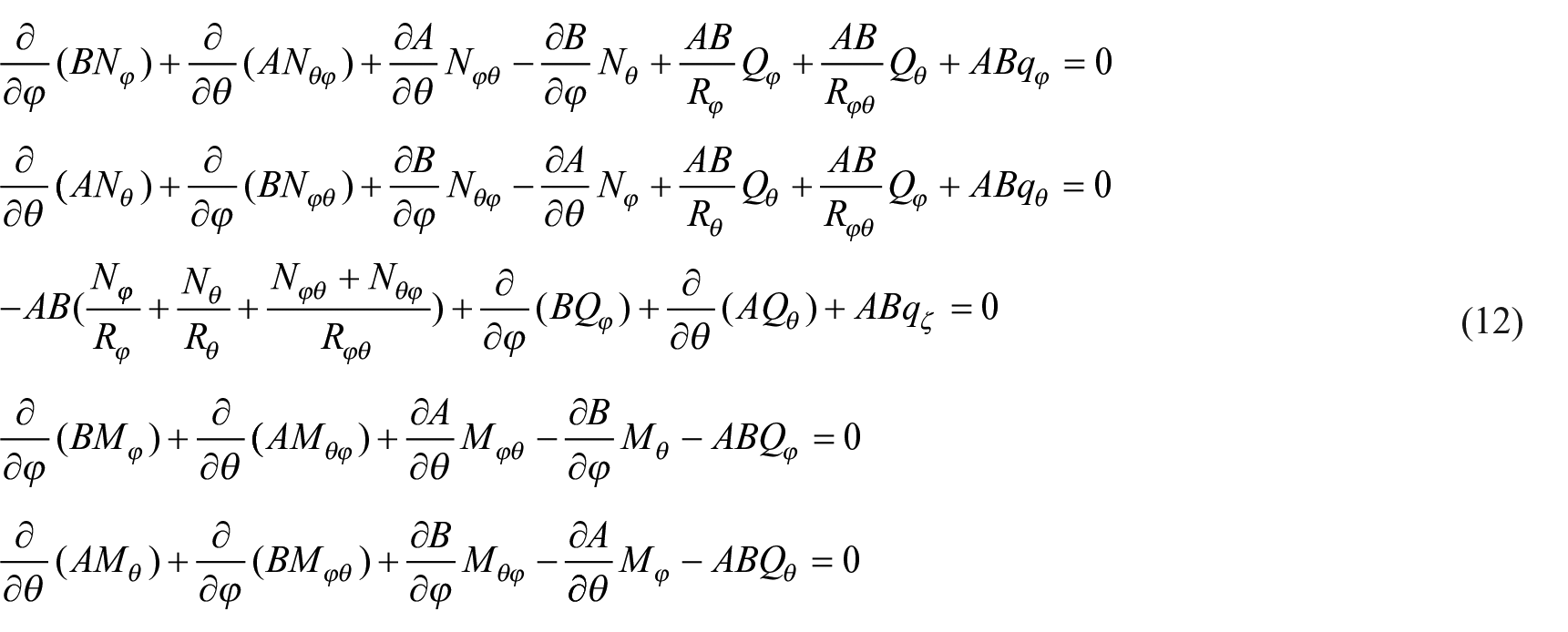
where the Lame parameters of thin revolutionary shells are

Simplified derivation of the transfer-matrix equations
The governing equations (2), (10), and (12) of reinforced layer under internal pressure are axisymmetric when calculating the burst pressure. They can be simplified as

Introduce the state vector

In order to use transfer-matrix method, equation (14) can be written as

where {
The key step of transfer-matrix method is obtaining the matrix

where
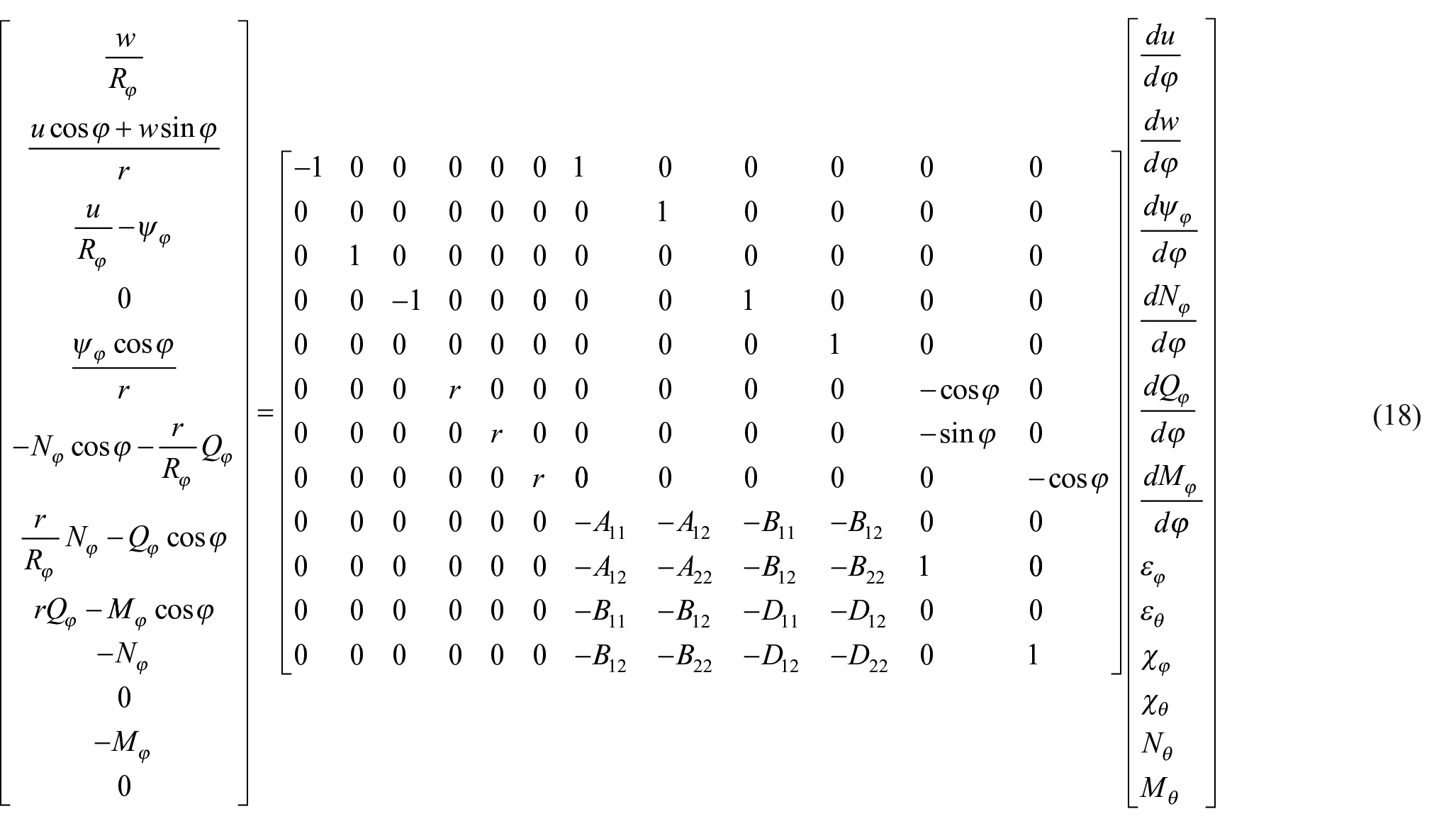
where
The solution of equation (18) will be expressed as a linear combination of

and

where the extended state vector

where
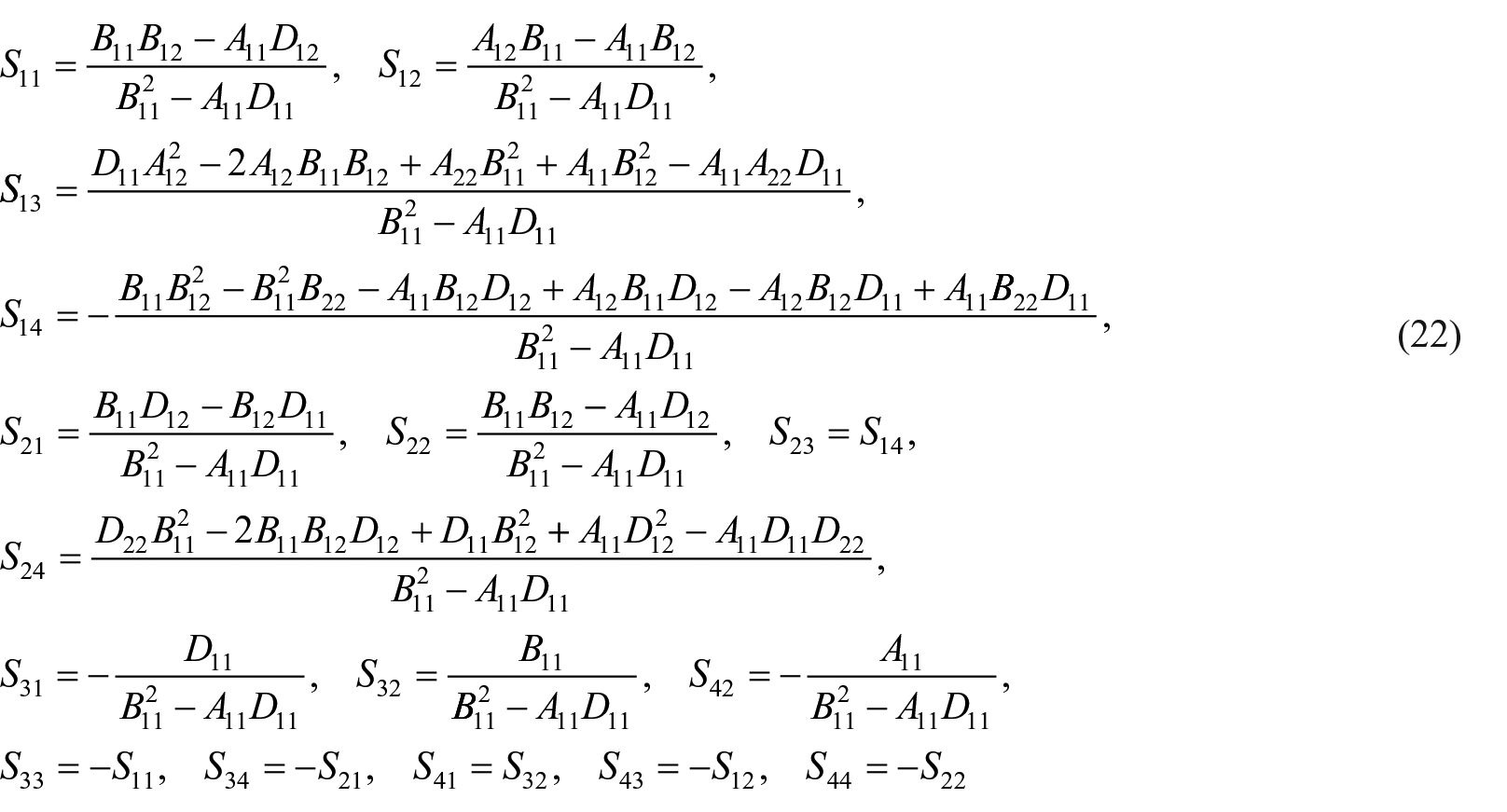
where the stiffness coefficients Aij, Bij, Dij are given as

The proposed software-aided derivation of the matrix

where
The stretch of the threads will cause a slight change of the winding angle in the pipe under high internal pressure, as shown in Figure 3. Considering the strains of the reinforced layer, the updated winding angle of the threads and the transformation matrix of the stiffness matrix are written as


The slight change of winding angle due to the stretch of the threads in the flexible pipe subject to high internal pressure.
The updated anisotropy of the reinforced layer is calculated with equations (4) to (6).
Prediction of burst pressure
The burst pressure of flexible pipes is calculated with Tsai-Hill failure criterion, which is written as

where X, Y, and S are tensile strength, transverse strength and shear strength of the unidirectional fabric, respectively. The directions of the tensile strength and transverse strength is the same as the fiber direction 1 and 2, respectively. Using equations (3) to (6), the stress distributions along fiber direction 1 and 2 are written as

The approach of burst pressure prediction of fiber-reinforced flexible pipes is shown in Figure 4. The increment of internal pressure is divided into many small steps. The winding angle of the threads and anisotropy of the reinforced layer will be updated in each step.
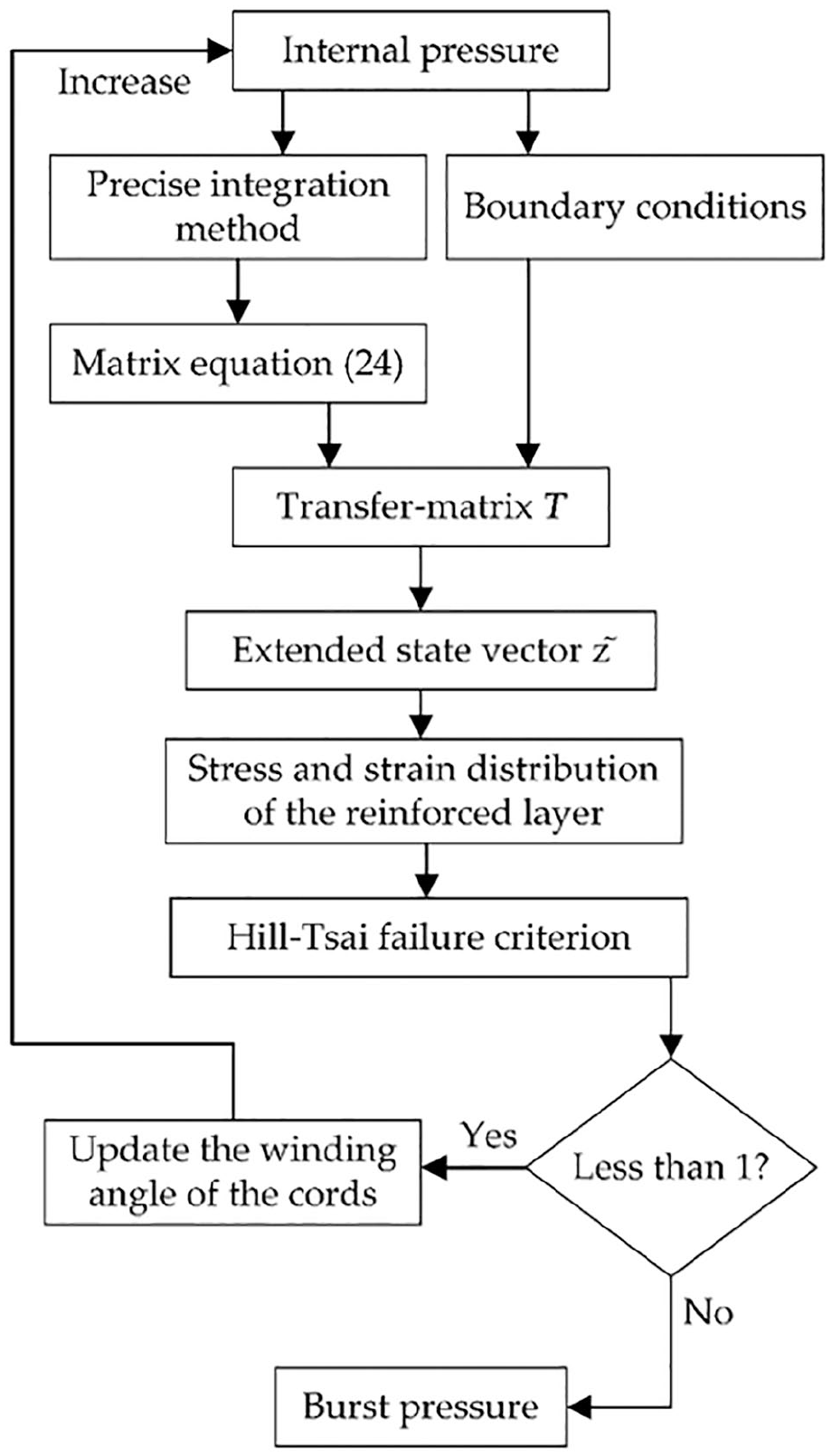
Approach of burst pressure prediction of fiber-reinforced flexible pipes.
The tests of burst pressure
To verify the accuracy of the theoretical prediction, the burst pressure tests are conducted on six different prototypes (DN40-DN125) of fiber-reinforced flexible pipes. The geometry of the prototypes is shown in Figure 5, and the photograph of the six prototypes is shown in Figure 6(a). The prototypes are composed of conical and spherical shells. L1 denotes the axial length of the prototypes, which is divided into two symmetrical subsections by the middle constraint ring. The generatrix of each subsection is composed of a straight line denoted by L2 and an arc tangent to the line. ξ represents the angle between the straight line and the rotation axis. Main structural parameters of the prototypes are shown in Table 1.

The geometry of the tested prototypes.

(a) Prototypes of DN40–DN125 reinforced flexible pipes, (b) the unidirectional fabric in the reinforced layer, (c) tensile test of the aramid thread, and (d) the damaged pipe (DN65) after the burst test.
Parameters of prototypes of the flexible pipes.

The typical properties of the unidirectional aramid fabric, which are used for the reinforced layer, are shown in Table 2. Unidirectional fabric is a type of non-woven fabric that has all thread going in the same direction. The aramid thread is composed of aramid yarns helically twisted together, as shown in Figure 6(b). In Table 2, the thread type 1*2 and 1*3 mean that each thread in the fabric is made from two and three yarns, respectively. The breaking strength and elongation at break of the aramid threads were obtained by third-party tensile tests under the requirement of Chinese national standard GB/T 30311-2013. 20 The tensile tests were performed with the MTS electromechanical test system, as shown in Figure 6(c) and Table 3. Both ends of the aramid thread were clamped. The upper end of the thread moved vertically and the lower end was fixed. The tensile force and displacement of the upper end were measured until the thread was broken. The average breaking strength and elongation at break were obtained by repeating the tensile ten times at least. The shear strength of the fabric was obtained from an article of Knoff. 21
Typical properties of the unidirectional aramid fabric.

List of test devices.
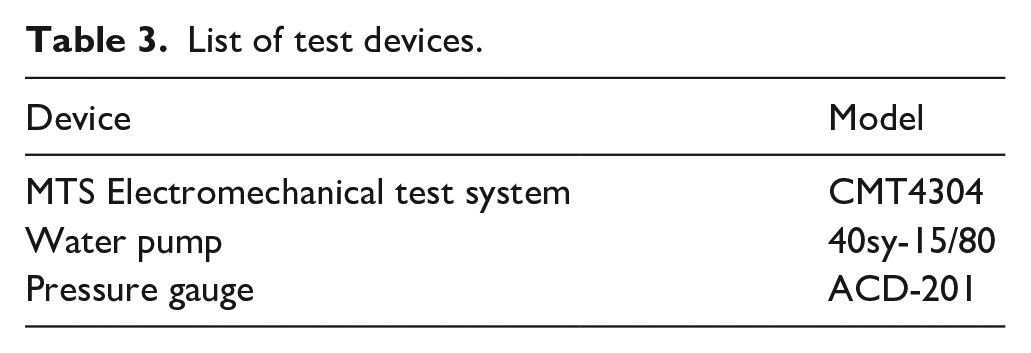
The photograph of the damaged pipe after the burst test is shown in Figure 6(d). The list of the test devices is shown in Table 3. In the burst test, the pipe was sealed and connected with a water pump and a pressure gauge, as shown in Table 3. The internal pressure of the pipe was rising from 0 MPa until the pipe was broken and the water leakage happened.
Results
The comparison between theoretical and test results of burst pressure is shown in Figure 7 and Table 4. The burst pressure decreases with larger inner diameter (I.D., which equals 2*r0). It should be noted that the burst pressure increases from DN50 pipe to DN65 pipe, since the aramid fabric in DN65–DN125 pipes has a larger breaking strength than the fabric in DN40–DN50 pipes. The average error of theoretical predictions is 4.1%, which can meet the needs of engineering application. When the I.D. becomes larger, the principal radius of curvature

Calculated and measured burst pressure versus inner diameter.
Theoretical and test results of burst pressure.

The geometry of the prototypes is shown in Figure 8. In Appendix A, the geometrical relations are derived to obtain the coordinates of an arbitrary point on the generatrix.

Geometry of the prototypes.
The boundary conditions of theoretical model are written as follows

where
Discussion
To improve the reliability of fiber-reinforced flexible pipes, influencing factors of the burst pressure are investigated from the perspective of the strength of reinforced threads and the initial winding angle of the threads in the discussion.
Define Tsai-Hill factor as

In order to analyze the influence of the threads strength on the burst pressure of flexible pipes, the tensile strength, transverse strength and shear strength of the aramid threads are increased by ten times individually, which are not realistic, to obtain the Tsai-Hill factor of tested prototypes, as shown in Figure 9. When the shear strength is increased by a factor of ten, the maximum value of Tsai-Hill factor is significantly reduced. When the tensile strength is increased by a factor of ten, the maximum value of Tsai-Hill factor is reduced, but the reduction is not obvious. When the transverse strength is increased by a factor of ten, the maximum value of Tsai-Hill factor hardly changes. Therefore, it can be inferred that the burst pressure is limited by the shear strength, while the tensile strength and transverse strength of the threads has no obvious effect on the burst pressure.
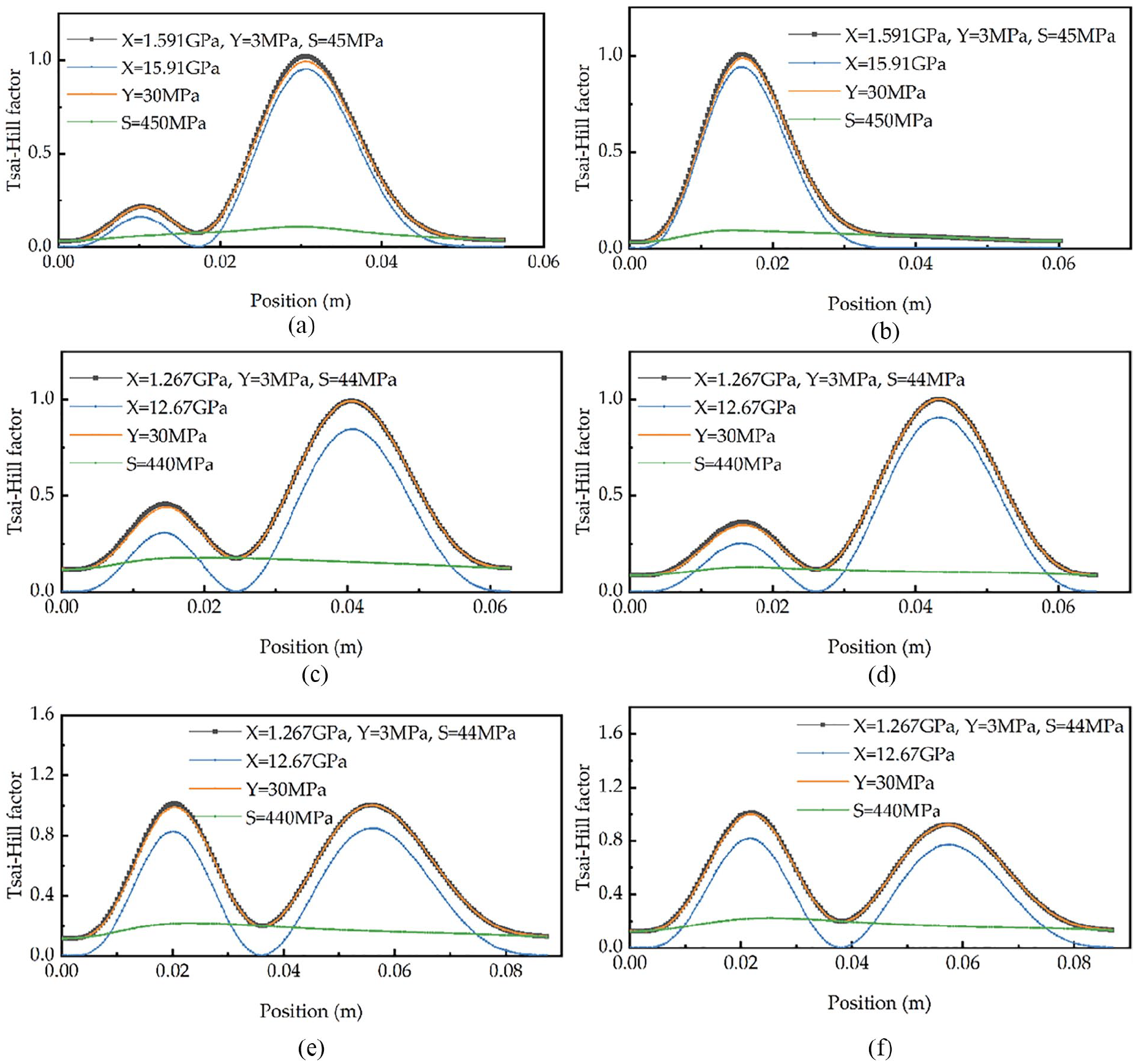
Tsai-Hill factor of flexible pipes with different strength values of aramid threads: (a) DN40, (b) DN50, (c) DN65, (d) DN80, (e) DN100, and (f) DN125.
The winding angle has significant influence on the distribution of the Tsai-Hill factor, as shown in Figure 10(a). Therefore, it could be inferred that the burst pressure will be improved with optimal winding angle of the pipe. Take the DN50 prototype as an example. By adjusting the initial winding angle of threads from 30° to 35°, the distribution of Tsai-Hill factor keeps changing. When the winding angle is adjusted from 30° to the optimal value of 32.5°, the burst pressure is increased to 14.3 MPa, as shown in Figure 10(b). The optimal burst pressure is 28.8% higher than the burst pressure of current DN50 prototype.

(a) Tsai-Hill factor of DN50 flexible pipes prototype with different winding angles and (b) calculated burst pressure vs winding angle of DN50 prototype.
The optimal winding angle of the prototypes depends on the geometrical parameters (ξ, L2), while the optimal winding angle of cylindrical flexible pipes is 55° according to literature [6]. The Relationship between burst pressure and winding angle with different ξ and L2 is shown in Figure 11(a) and (b), respectively. When the angle ξ is increased from 15° to 35°, the optimal winding angle is decreased from 41° to 26°. When the length L2 is increased from 5 to 25 mm, the optimal winding angle is decreased from 37.5° to 30.2°. The generatrix of the prototypes is more similar to arcs with shorter length L2, so the shear stress becomes smaller and the burst pressure is increased significantly.

(a) Calculated burst pressure vs. winding angle with different ξ and (b) calculated burst pressure versus winding angle with different L2.
The proposed methodology could be validated against cylindrical pipes. The optimal winding angle versus the angle ξ has been calculated with different length L2, as shown in Figure 12. When the angle ξ reaches zero, the pipe becomes cylindrical and the optimal angle is near 55°, which is not affected by different length L2. When the angle ξ is approaching zero, the generatrix of the pipe is becoming a straight line. Therefore, the optimal winding angle of the pipe is approaching 55° with decreased ξ, verifying the correctness of the proposed methodology.
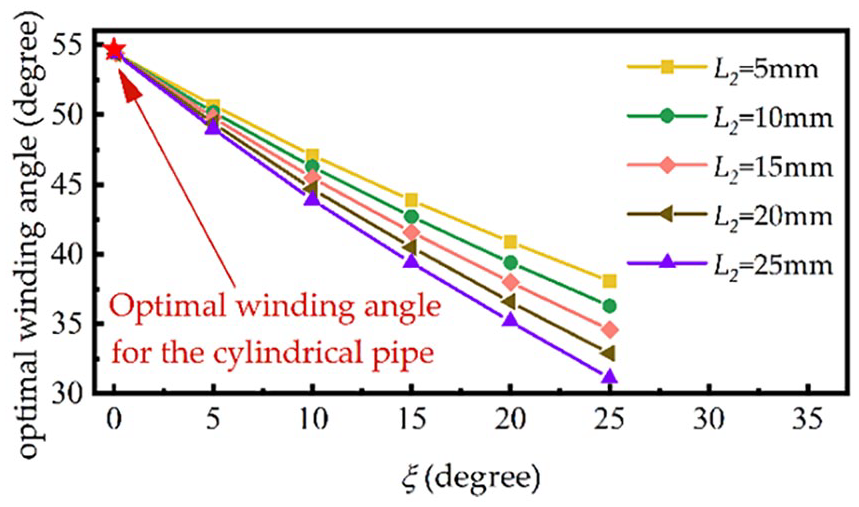
Optimal winding angle versus ξ with different L2.
Conclusion
The burst pressure of fiber-reinforced flexible pipes with arbitrary generatrix is investigated based on the composite shell theory and the transfer-matrix method. The derivation of the transfer matrix is simplified by solving symbolic linear equations. The accuracy of burst pressure prediction can meet the need of engineering application, if considering the nonlinear stretch of the threads and the inhomogeneous anisotropy of the reinforced layer of the flexible pipes. It is found that the burst pressure is increased significantly with optimal winding angle of the unidirectional fabric. The optimal result is determined by the geometric parameters of the pipe. The investigation method and results presented in this paper will provide guidance for the design and optimization of novel fiber-reinforced flexible pipes.
Footnotes
Appendix A
Based on geometric relations in Figure A1 (same as Figure 8), assuming the center coordinate of the arc is (a0, b0), yields
The solution of equation (A1) is
The coordinates of an arbitrary point are derived as follows
Appendix B
Declaration of conflicting interests
The author(s) declared no potential conflicts of interest with respect to the research, authorship, and/or publication of this article.
Funding
The author(s) received no financial support for the research, authorship, and/or publication of this article.
