




Abstract
The present study relates to manufacturing, characterization and optimization of bagasse fiber reinforced composites. For this purpose, response surface methodology was applied to simultaneously optimize the tensile strength, tensile modulus and tensile strain of bagasse fiber reinforced composites. Three levels of process variables, including concentration of sodium hydroxide for bagasse fiber treatment (4, 6, and 8%), content of bagasse fiber (10, 20, and 30 wt%), and length of bagasse fiber (1, 2, and 3 inch) were used to design the experiments according to the Box–Behnken design. Experimental results were analyzed by analysis of variance and fitted to second order polynomial models by using multiple regression analysis. The Derringer’s desirability function revealed that the values of process variables leading to optimized tensile strength, tensile modulus and tensile strain are 4%, 14.2 wt% and 1 inch for concentration of NaOH for bagasse fiber treatment, content of bagasse fiber and length of bagasse fiber, respectively. Validation experiments were carried out and high degree of correlation was found between the actual values and the predicted values of tensile properties of bagasse fiber reinforced composites.
Keywords
Introduction
Bagasse fiber is a by-product of sugarcane industry and it is available in abundance in Pakistan. 1 The primary means of disposing of this waste material is incineration to produce electricity. 2 This practice is one of the primary causes of air pollution in the areas where sugar mills are located.2–5 The other considerable source of bagasse fiber is the cottage industry which produces sugarcane juice. Large amounts of bagasse fiber waste produced by this sector have to be disposed of by the concerned municipal governments. In this context, the primary motivation of the present study is to explore the potential viability of using bagasse fiber in manufacturing of fiber reinforced epoxy composites. From relevant literature, it is evident that lingo-cellulosic fibers such as coir, banana, bagasse, etc. are increasingly being studied for use as the fiber phase in composites.6–8
The main reasons for this increasing interest of the research community in natural fiber reinforcements are certain characteristics of these materials such as bio-degradability, sustainably manageable resources and the fact that the final composite properties are appropriate for numerous applications. 9 In addition, given that fibers such as bagasse are essentially a waste material, the cost is lower compared to other commonly used composite reinforcement materials such as glass fiber. 10 However, there are other important considerations as well when selecting a fiber as reinforcement material in composite manufacturing. Mechanical properties in general and tensile properties of a composite in particular are among the main features to consider. This is because the tensile properties largely determine the end uses of a composite. Thus, it is a common practice to determine the tensile strength, strain and tensile modulus to ascertain the “fitness for use” of a composite for a given end use.11,12 The fiber reinforcement material used in a composite has a direct and significant impact on the overall mechanical properties of a composite. For instance, it is well-known that for fiber length below the critical length; the greater the length of a fiber the higher is the tensile strength of the composite. This is because longer fibers offer greater surface area which in turn results in stronger interaction between the fiber and the resin. 13 Another well-established fact is that increasing the proportion (by weight) of the reinforcement fiber results in increased tensile strength.6,14
Lingo-cellulosic fibers are usually extracted from their respective natural resources by manual, mechanical or chemical methods. 8 In the particular case of bagasse, fiber separation is done manually with the help of knives and scrappers. 14 The fibers thus obtained have lignin on the surface. In order to ensure strong adhesion between bagasse fibers and the resin, it is imperative to remove lignin from the fiber surface. 15 Removal of lignin is usually achieved by treating the extracted fibers with NaOH.16–18
Some other methods and chemicals can also be used to improve the bond strength between a resin and reinforcement fibers in a composite. Some of the researchers have used silane coupling agent to increase the bond strength between polylactic acid and basalt fibers.19,20 A similar approach has been reported to improve the bond strength between marine plant waste fiber i.e. Posidonia oceanica and polypropylene resin. 20
The inter-laminar strength of E glass polyester woven fabric was enhanced by using nano silica material. 21 The bond strength of polypropylene and kenaf fibers was improved by using polypropylene-grafted maleic anhydride PP-g-MA compatibilizer. 22 Techniques such as plasma treatment have been reported to increase the bond strength between carbon fiber and epoxy resin. 23 Thus, it is evident from a review of the available literature that various techniques can be used to improve the bond strength between the fiber phase and the matrix in a composite, particularly in the case of natural fiber reinforcements. These techniques are generally aimed at making the resulting composite materials suitable for non-structural as well as structural applications.
In view of the aforementioned background to the use of natural fiber reinforcements in composite manufacturing, particularly bagasse, it is evident that the main factors to be considered include the fiber weight percentage, fiber length and the effects of alkali treatment on the fibers. To the best of authors’ knowledge, a systematic evaluation of the effects of these factors is not reported in literature. Thus, the main objective of this research work is to investigate the influence of different parameters on the tensile properties of bagasse fiber composites and to optimize the tensile properties using the statistical tool of RSM.
The main aim of this research work is to develop a composite material from an agro-based waste i.e. bagasse fibers. If these studies are successful, these materials could be used to manufacture valuable composite products in the future. This research work will help to improve the economic condition of the farmers and will help to improve the rural economy.
Material and methods
Materials
For the present study, bagasse fiber was obtained from a local supplier of sugarcane juice. The bagasse waste that was obtained in bundle form was dried for 48 hours prior to extraction of fibers. The fibers were extracted from the bundles manually. For use as the matrix material, the epoxy resin LY 5052 and the hardener Aradur HY 5052 were obtained from Huntsman Pakistan.
Experimental design
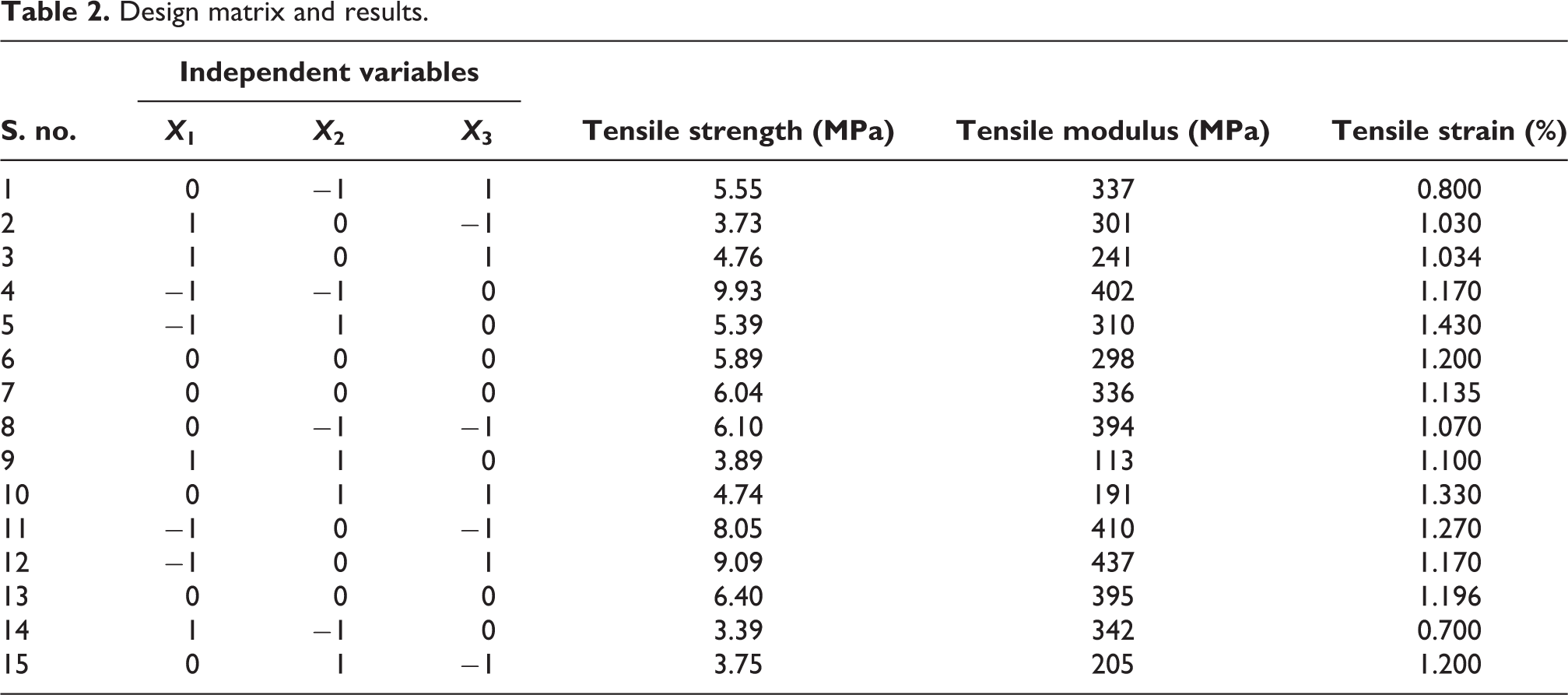
In this research work, the Box−Behnken Design (BBD) was used to obtain models for the optimization of tensile properties namely tensile strength (MPa), tensile modulus (MPa) and tensile strain (%) of bagasse fiber-reinforced composites with three independent variables at three levels. The independent variables employed were concentration of sodium hydroxide for bagasse fiber treatment (%, X1), content of bagasse fiber (wt %, X2), and length of bagasse fiber (in, X3). The BBD design consisted of 15 experiments with three center points. The level of independent variables and their coding are presented in Table 1. In assessing the effect of independent variables on tensile properties of manufactured bagasse fiber reinforced composites, the range of values for each variable was selected on the basis of the results obtained from screening experiments. 24 The BBD design matrix and results are presented in Table 2. The responses measured were tensile strength, tensile modulus and tensile strain. The statistical analyses were performed using Minitab 18. A second-order polynomial Equation, as a function of X, was fitted for each independent variable as follows:

Independent variables and levels (coded and uncoded) used for Box–Behnken design.

Design matrix and results.
In equation (1), Y0 is the estimated response; α0 represents the model intercept, αi, α i i and α i j represents the model regression coefficients; and Xi and Xj represents the ith (jth) independent variables i.e. concentration of NaOH for bagasse fiber treatment, content of bagasse fiber and length of bagasse fiber.
Alkali treatment
The bagasse fibers were soaked for 24 hours in sodium hydroxide (NaOH) solution according to the experimental plan shown in Table 2. Subsequently, the fibers were washed thoroughly with water and were air dried at ambient conditions for 24 hours.
Manufacturing of bagasse fiber reinforced composite
Hand lay-up technique was used to manufacture composites using bagasse fibers as reinforcement material. The procedure summarized below was adopted. A4 transparent plastic sheet was placed on a metal tool. Resin and hardener mixture was spread on the plastic sheet. The bagasse fibers were spread randomly on the resin layer. The remaining amount of resin was poured on top of the bagasse fibers. A second A4 transparent sheet was placed on top. A roller was rolled over the ensemble to ensure thorough penetration of the resin in the fibers. It was left to cure for 24 hours at ambient conditions. Curing at 100°C for 1 hour was carried out. The whole procedure is shown schematically in Figure 1.
24
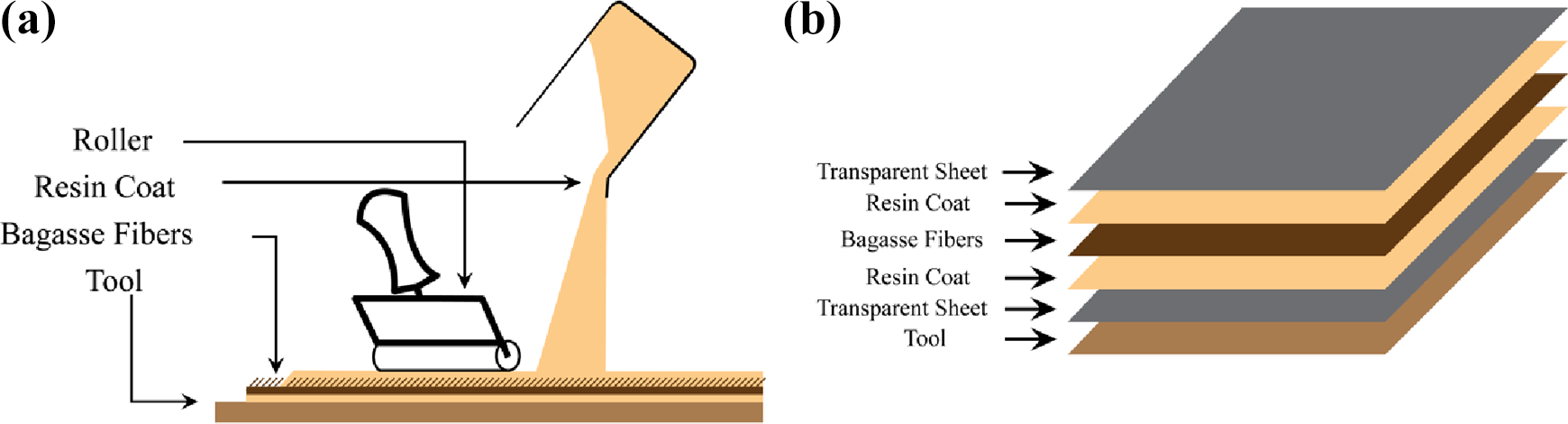
Schematic of (a) Bagasse fiber reinforced composite manufacturing process (b) Layering of bagasse fiber and matrix.
Characterization of the tensile properties of composites
The tensile tests of composites samples were carried out using Universal Tensile Testing machine Zwick/Roell Z005 with a load cell of 5 KN, according to ISO 527-4 1997 25 at a rate of extension of 2 mm/min. The sample size was 10 × 1 inch and the reported values are the averages of at least five samples per run.
Results and discussions
Statistical analysis
Effects of the concentration of NaOH for bagasse fiber treatment (X1), content of bagasse fiber in the composite (X2), and the length of bagasse fiber (X3) on tensile strength, tensile modulus and tensile strain were studied using the BBD design. The obtained models were reduced by using forward selection regression. Adequacy of the regression models was statistically evaluated by analysis of variance (ANOVA), coefficient of determination (R2), F-test, lack-of-fit and p-values for the model and the results are presented in Table 3. The ANOVA table in Table 3 shows the statistic such as degree of freedom (DF), sum of squares (SS), mean squares (MS), F and pvalues of the model terms. The details of the calculation methods were given in literature. 26
Analysis of variance (ANOVA) of the predictive models.

From Table 3 it can be seen, that the coefficient of determination (R2) are 0.9461, 0.9229 and 0.9051 for tensile strength (MPa), tensile modulus (MPa) and tensile strain (%), respectively; indicating that the predictive models are significant. The p-values of predictive models are <0.000, indicating that these models are significant at the 95% confidence level. The ANOVA gives F-values of 43.92, 29.94 and 23.83 for tensile strength (MPa), tensile modulus (MPa) and tensile strain (%), respectively; indicating that obtained models are significant and adequate to generate response surface plots (Figure 2). The lack-of-fit p-values of 0.173, 0.947 and 0.210 for tensile strength (MPa), tensile modulus (MPa) and tensile strain (%), respectively; reveal that they are not significant compared with the pure errors. The values of sum of square, degree of freedom and mean square shown in Table 3 are satisfying and confirm the high level of confidence of the predictive models.
Effect of independent variables on tensile properties
The resulting regression models specifying the relationship between the responses and the coded factors are shown in equations (2) to (4). The regression coefficients of developed models and their statistical significance (p < 0.05) are given in Table 4. In addition, the 3D surface plots and contour plots were constructed using developed models and are given in Figure 2(a) to (c).



The regression coefficients for tensile strength, tensile modulus and tensile strain.

Tensile strength
The predictive model for tensile strength is given in equation (2) and the regression coefficients of model and their statistical significance at p < 0.05 are shown in Table 4. The model shown in equation (2) implies that X1, X2,
The response surface plot and contour plot of tensile strength as a function of concentration of NaOH (X1) and content of bagasse fiber (X2) are shown in Figure 2(a). It can be seen from Figure 2(a) that tensile strength decreases with increasing concentration of NaOH (X1) and content of bagasse fiber (X2). It can also be seen that content of bagasse fiber does not have a linear effect. From 10 wt% to 20 wt% the change is moderate, while from 20 wt% to 30 wt% the change is sharp. This curvilinear effect is shown by the statistically significant quadratic term
Tensile modulus
The predictive model for tensile modulus is given in equation (3) and the regression coefficients of model and their statistical significance are presented in Table 4. The model implies that X1, X2,
The response surface plot and contour plot of tensile modulus between concentration of NaOH (X1) and content of bagasse fiber (X2) are shown in Figure 2(b). It is evident from Figure 2(b) that tensile modulus of bagasse reinforced composite drastically decreased as concentration of NaOH and content of bagasse fiber increased from 4 to 8% and 20 to 30% respectively. The distinct decrease in tensile modulus matches with the tensile strength and can probably be attributed to fiber damage caused by excessive delignification at higher concentration of sodium hydroxide solution.33,34 In addition, increase in the fiber content also resulted in the reduction of tensile strain thus resulting in decrease in the modulus. This was also perhaps because of lower wetting out of fibers by the resin.32,10
Tensile strain
The Predictive model for tensile strain is given in equation (4), and the regression coefficients of model and their statistical significance are presented in Table 4. The model implies that X1, X2 and X2X3 are significant variables affecting the tensile strain of bagasse fiber reinforced composites. The variable with the largest effect on tensile strain is the main effects of the content of bagasse fiber (X2) and concentration of NaOH (X1). This is followed by the interaction of content of bagasse fiber and length of bagasse fiber (X2X3).
The response surface plot and contour plot of tensile strain as a function of bagasse fiber loading (X2) and bagasse fiber length (X3) are shown in Figure 2(c). It is evident from Figure 2(c) that tensile strain of bagasse reinforced composite drastically increased as content of bagasse fiber and length of bagasse fiber increased from 10–30% and 1−3 inch respectively. This is because for the fiber content, the amount of fibers in the reinforcement had increased resulting in more elongation and higher strain. In case of fiber length, longer fibers will offer more surface area for the adhesion of matrix. This would provide more resistance resulting in higher strain.10,32

Surface response of statistically significant interaction: (a) X1X2 for tensile strength; (b) X1X2 for tensile modulus and (c) X2X3 for tensile strain.
Simultaneous optimization of tensile properties
The tensile properties of manufactured bagasse fiber-reinforced composites were simultaneously optimized by using Derringer’s desirability method. 35 In this study, optimum conditions for tensile properties were determined to obtain maximum tensile properties. The optimum tensile strength, tensile modulus and tensile strain of 9.3 MPa, 423.6 MPa and 1.26% were obtained at the concentration of NaOH (X1) of 4%, content of bagasse fiber (X2) of 14.2 wt% and length of bagasse fiber (X3) of 1 inch with a desirability value of 0.87. Figure 3 depicts the optimized conditions obtained for tensile properties of bagasse fiber-reinforced composites manufactured by hand lay-up method.

Desirability ramp for optimization of process variables for tensile properties of manufactured bagasse fiber-reinforced composites.
Experiments were conducted to validate the optimum conditions that were determined by statistical modeling as described in the aforementioned text. According to these optimal conditions, composite samples were prepared and the responses of interest i.e. tensile strength, tensile modulus and tensile strain were determined experimentally. The results thus obtained are presented in Table 5 along with the results obtained from statistical modeling. It was found that the actual values of tensile properties of bagasse reinforced composite were found to be closely co-related with the predicted values and fall within 95% confidence interval.
Comparison of predicted and actual tensile properties of bagasse reinforced composite.

Since micromechanics of fiber reinforced composites is one of the key determinants of the usefulness of a composite for specific applications, the characterization of failure mode of composites are under further investigation by the authors.
Conclusions
From the experimental results discussed in the previous section, the following conclusions can be made; Since it is necessary to treat bagasse fibers with alkali in order to remove the lignin from the fiber surface, the authors’ propose treatment with 4% NaOH for best results in terms of tensile properties. Under the given conditions the tensile properties were optimized using RSM technique. For the hand lay-up process, it is suggested that 14.2 wt% fiber content and 1inch fiber length will give the optimum results. Bagasse is a non-food agricultural waste, it has a good potential to be converted into a composite material. This research work will be further extended to manufacture products as well as hybrid composites, which can have a great positive impact on the rural economy.
Footnotes
Acknowledgment
The authors are thankful to NED University of Engineering & Technology for permitting to use laboratory facilities at Textile Engineering Department.
Declaration of conflicting interests
The author(s) declared no potential conflicts of interest with respect to the research, authorship, and/or publication of this article.
Funding
The author(s) received no financial support for the research, authorship, and/or publication of this article.
