




Abstract
The study analyzed the skin deformation of women’s limbs under yoga, and established a digital design model of weft-knitted seamless yoga pants based on skin deformation. Five representative yoga moves were selected. Eight female participants were selected to perform a standard standing posture and yoga postures. Three-dimensional scanning technology was used to measure the participants’ lower limbs, and skin data on different parts of the lower limbs were analyzed. The prototype of seamless pant was partitioned based on the skin deformation data, and it was establish a partition design model of weft knitted seamless yoga pant. By creating an fabric structure library and classifying it according to the tensile properties of the fabric structure, establishing the correspondence between the model partition and the fabric structure classification, which realized the digital design of the seamless yoga pants structure. The research results can provide a basis for the structure and style design of yoga pants, and realize the rationality and efficiency of clothing design.
Introduction
A high performance sports-wear can bring better sports experiences to assist the development of sports. The structure and design of the clothing need to meet the physiological characteristics of the human body. Bones, muscles, and skin are the basic compositions that determine the characteristics of the human body. 1 However, static measurement alone cannot meet the needs of clothing design, and sports posture is the main factor that affects the structure of the clothing.2,3 The skin deformation of the human body during activities is essential for ergonomic clothing structure design and designers to determine appropriate looseness to make the clothing fit comfortably. 4 Lee et al. 5 analyzed the effect of postures on the skin deformation of the lower body and drew the skin deformation map for reference of the outdoor pants functional design line. Luo et al. 6 studied the skin deformation of the lower extremities during cycling to design bicycle compression shorts. Kim and Hong 7 analyzed the skin deformation of knee to design tight sport-shorts. These researches above show that it is very important to understand the skin deformation and distribution caused by body movement for the development of high-performance garments.
Previous researchers mainly obtained skin deformations under specific actions through manual measurements. Early measurement methods include body surface marking method, gypsum method and unstretched wire method, etc.8,9 But they all belong to contact measurement, which requires manual recording and sorting of data, which takes a long time and is not conducive to collect data. Li et al. 10 analyzed the changes of the skin on the lower limbs of men in cycling by using the method of body surface marking. At present, non-contact measurement is more widely used, such as three-dimensional scanning method, which captures points on the surface of objects through the reflection of light. With the advantages of collecting data rapidly and extract it repeatedly, it has became a commo tool for anthropometry and clothing research.Shin and Chun 11 used a three-dimensional human body scanner to collect human body surface data and analyze the surface changes of the human body’s shoulders and back in the baseball hitting posture Wang and Wang 12 used a three-dimensional scanning system to obtain the skin deformation data of the lower limbs in the running posture. Seo et al. 13 estimated skin tension lines on part of the leg by using 3D scanning date.
In this study, the three-dimensional scanning method was used to obtain the skin deformation of the right limb of the human body in the yoga postures, and a skin deformation map of the lower limbs of women in their 20s was established. It is because that female in 20s are the main target consumers of yoga clothing. The prototype of weft-knit seamless pant was designed and partitioned according to the skin deformation map, and the relationship between the seamless fabric structure and the pants prototype partition was discussed to realize the digital design of seamless yoga pants. The research results can provide a reference for the design of the zoning structure of yoga pants, quickly realize the matching of clothing areas and organizational structures, improve the sports comfort and production efficiency of clothing, and provide a basis for the development and design of yoga pants.
Experimental
Yoga postures
In the yoga movement, the lower limbs movement takes the femoral and the knee joint as the two major fulcrums, and they have a certain range of activity. The axial movement of the joints will cause the stretching of the legs. By analyzing the joint movements and the stretching parts of the legs, the yoga movements are basically classified. In order to reduce the lack of data caused by the physical blockage of the laser, the selected movements are mainly standing, and the maneuverability and pull strength of yoga movements are comprehensively considered. In this paper, five yoga movements were selected for scanning, involving stretching of different parts of the legs. Among them, posture 1 and posture 2 stretch the front and back sides of the leg, and the main stretch parts of posture 3 and posture 4 are the inner and outer parts of the leg, posture 5 causes stretch to the knee. The above postures have a large range of motion and a strong sense of involvement in the legs (Figure 1).

Yoga postures.
Body scanning
In order to accurately measure the skin deformation between the human standing and the yoga postures, the body surface was divided on the right side of the lower limbs, 14 as shown in Figure 2. The intersection of the vertical and horizontal lines was used as the grid point. First the grid points were marked, and then pasted the 1 cm square mark points accurately on the grid points, 4 as shown in Figure 3.

Lower limb division.

Marking point pasting and distribution.
All experiments were conducted in the three-dimensional human body scanning room of Jiangnan University. The experimental equipment is the VITUS Smart XXL three-dimensional scanning system (Figure 4) of German Human solutions company. The system is based on the principle of optical measurement. Two cameras and a laser head on the four laser columns can be used scan the human body at the same time from the four directions of front, back, left and right, and record the three-dimensional human body image. Measure the distance of the line segment of the marked point by ScanWorX software (Figure 5).
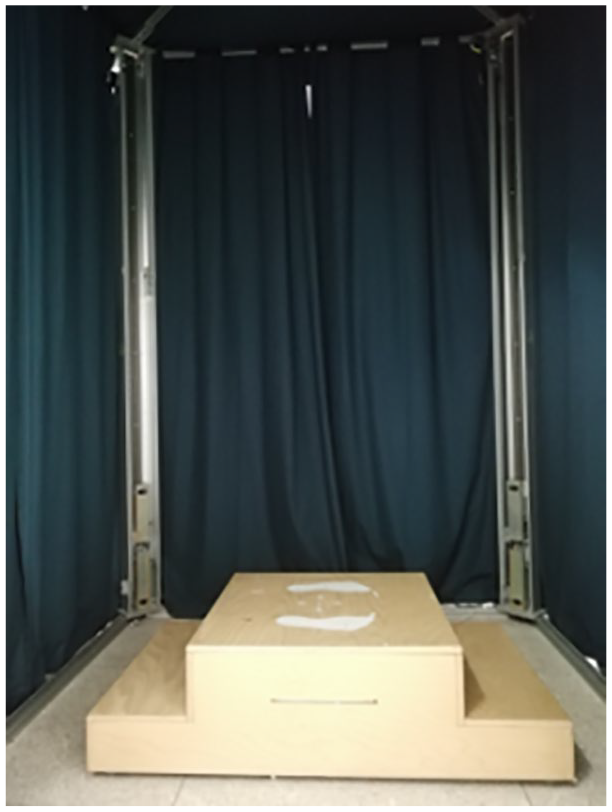
3D scanning system.
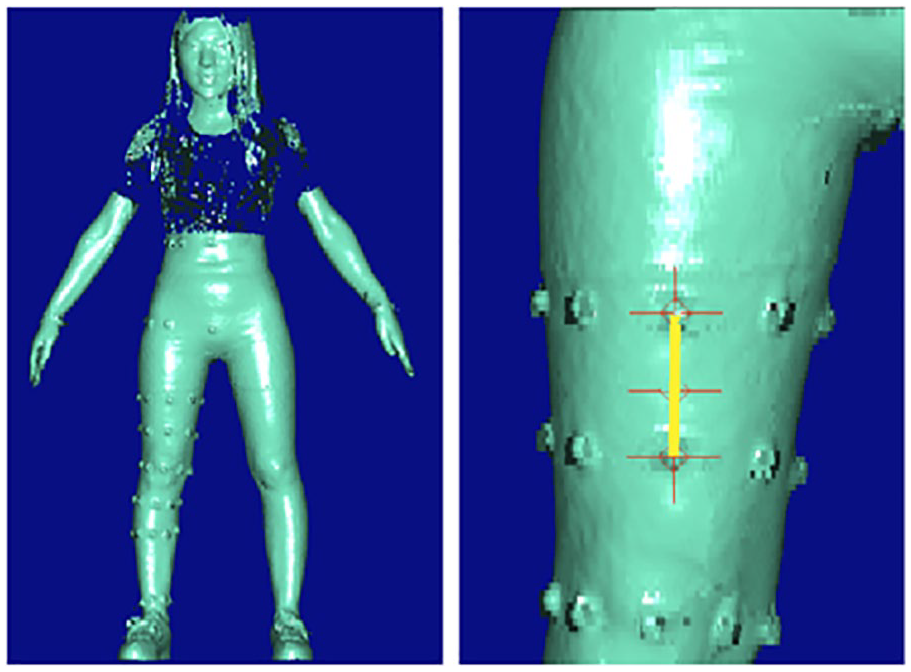
Body surface measurement diagram using ScanWorX system.
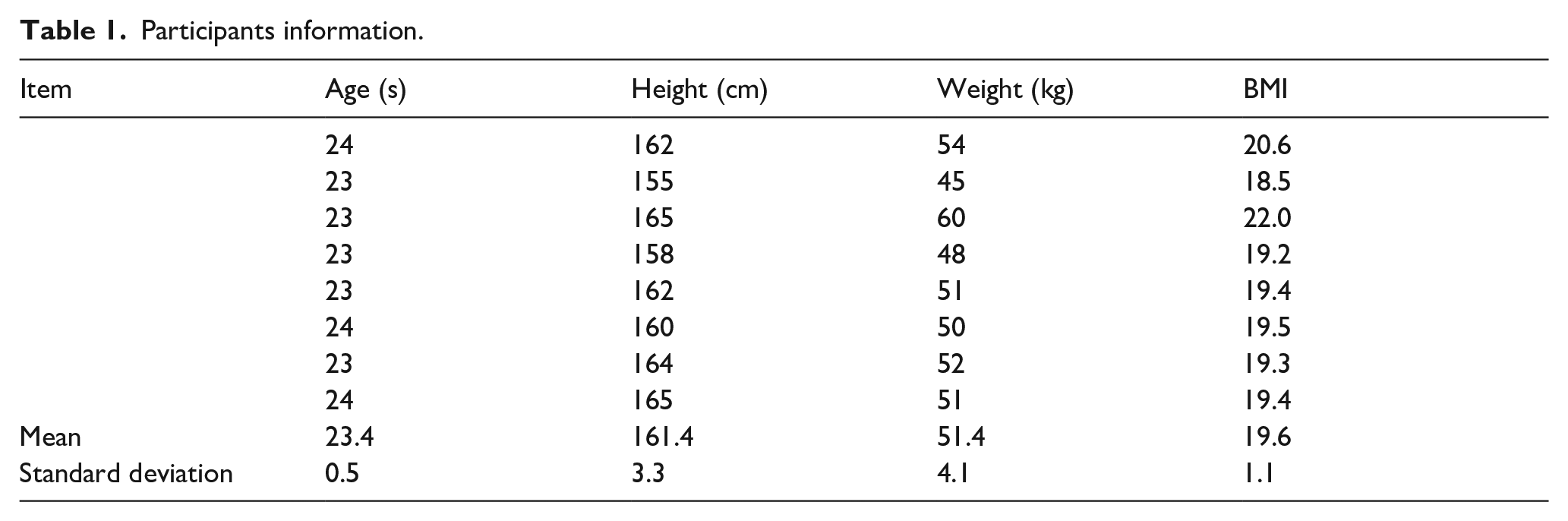
Eight female participants whose body data is within the normal weight range defined by the World Health Organization (BMI 18.5–22.5) were selected. The information is shown in Table 1. Since only the lower limb surface changes are measured, the participants wore tight short and the upper body was not required, standing at the measurement position of the human body. Participants maintained natural static standing and five yoga postures respectively, and the standard and consistency of postures were ensured by goniometer. Each posture was scanned three times to reduce errors.
Participants information.
Result analysis
Due to the differences among the individual participants, the values of static and dynamic changes cannot be directly compared. In this paper, formula 1 was used to calculate the length change of the line segment between mark points under the yoga postures, and the average value of the rate of change in the skin stretch of the participant’s body was analyzed. In order to analyze the measurement data more intuitively and accurately, first analyze the length change of the entire line in the vertical and horizontal directions to obtain the approximate situation of the skin surface deformation, and then analyze the change in the length of the grid line segment divided by the lower limbs to understand the lower limbs Skin deformation in local areas.

where, A refers to the length between the marked points under the yoga action, B refers to the length between the marked points in the static standing state.
Analysis of skin deformation rate of horizontal circumference
Figure 6 shows the change in the length of the horizontal line segment under different yoga postures. Waist circumference and hip circumference are always in a stretched state, and the rate of change in stretching is within ±6%. When the leg is reversed in posture 1, the rate of change in circumference is greater than other actions, and the rate of change in waist circumference reaches 5.58%. The line between the thigh circumference and the ankle is not change significantly in the first four postures. In action 5, the knee bending makes the knee circumference change rate reach 9.1%, the calf and thigh circumference change is similar, the change rate is between 2.4% and 3.8%.

Skin deformation rate of horizontal circumference in different yoga postures.
Analysis of skin deformation rate in vertical direction
Figure 7 shows the change in the length of the vertical line segment under different yoga postures. It can be seen from the figure that the stretching and contraction of the skin on the body surface under the yoga postures is significant and large difference, and the change range is between −12.14% and 14.26%. The vertical line A and the vertical line E serve as side sutures, the degree of change rate dispersion is low, and the difference in different postures is small. The vertical line C and the longitudinal line G are the anterior midline and the posterior midline, respectively. The anterior-posterior movement of the femoral joint and the knee flexion changes make the skin stretching and contraction change obvious, and the difference is large.

Skin deformation rate of vertical direction in different yoga postures.
Analysis of skin deformation in vertical and horizontal directions
The analysis of clothing structure design from the entire line segment is not convincing. In order to reflect the change of skin size in local areas, a more intuitive skin change grid chart is used for analysis (Figure 8). According to the size of the skin change rate value, the method of data grading is used to divide the value interval and differentiate it with different colors.

Skin deformation in local area.
It can be seen from the figure that the horizontal line segment is more moderate than the vertical change, and the value of the line segment change is ±10%. When the knee is bent in action 5, the horizontal line segment on the front of the knee circumference and the reverse side of the lower leg changes more obviously. The rate reached more than 20%. The length of the vertical line changes greatly and the difference is obvious. The waist, hip, and knee circumference have the largest changes, and the frontal stretch of the hip and knee circumference has the most obvious change. In the waist and hip region (horizontal line 1–horizontal line 2), the rate of change of the vertical line B and the vertical line C is basically at a negative value. At the thigh (horizontal line 2–horizontal line 4), the front line segment is basically in contraction or a small range of stretching, and the reverse line segment has a larger change range, in which the vertical line G and the vertical line H have the largest change, and the local line change range is greater than 50%. In the knee circumference area (horizontal line 4–horizontal line 6), the bending of the knee joint will cause a large stretch of the front line segment (vertical line B–vertical line D), with a maximum value of 64.51%, and the reverse line segment (vertical line F–vertical Line H) produces greater shrinkage. In the calf area (horizontal line 6–horizontal line 8), the change rate of the line segment is relatively small, basically fluctuating within ±10%.
Skin deformation of lower limb under yoga postures
Under different yoga postures, the skin deformation of each part is different, and the pressure value of the clothing is also different. In order to meet the pressure comfort requirements of the clothing during exercise, it is necessary to ensure that the pressure of the clothing is in the comfortable pressure range under the posture where the body surface skin deforms the most. The skin deformation of the entire line segment and local area of the lower limbs of the human body under five yoga postures was studied, and the maximum change value of the local line segment in different postures was selected. The results are shown in Figure 9. It can be seen from the figure that in the lateral deformation of each surface skin, the skin changes on the front of the lower limbs are at positive values, and the skin changes on the knee circumference and the thighs are more obvious. On the reverse side of the lower limbs, the changes in the muscle status of the lower leg make the skin stretch and contraction change larger. In the vertical deformation of the skin on each surface, the areas with large stretch changes include the lateral and reverse sides of the waist, the reverse hips, the medial and reverse thighs, and the front of the knee. Among them, the reverse of the hip circumference and the front of the knee have the most obvious tensile changes.
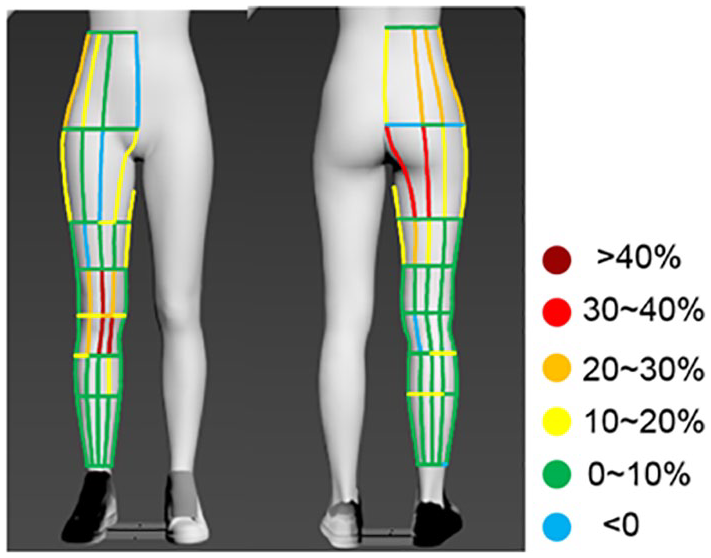
Skin deformation under yoga postures.
Partition design model for weft-knitted seamless yoga pants based on skin deformation
Yoga, as a stretch exercise, wearing comfortable and soft clothes can better meet the stretching of the human body during exercise, and ensure that the human body is not constrained. In traditional clothing, extra threads and fabrics at the seams may limit the stretching of the fabric and cause discomfort, while the size and density of seamless clothing can be adjusted according to different parts of the body, and there is less sewing, which has better elasticity and recovery than ordinary fabrics. It can meet the requirements of yoga sports on clothing, and improve the wearing comfort of clothing.
The process of making seamless clothing requires structural design and matching on the floor plan. Using the combination of two-dimensional and three-dimensional methods, according to the positions of the grid points in the 3D human skin deformation map and the vertical and horizontal line segments, the grid points of the prototype of the weft-knitted seamless body shaping pants are determined, and the grid points are connected through the line segments to make the three-dimensional human body and the two-dimensional clothing prototype grid points and dividing line segments correspond to each other. According to the grid points and the line segments between the grid points, the prototype of the weft-knitted seamless body shaping pants is divided into regions. Convert the horizontal and vertical skin deformation of Figure 9 into a seamless yoga pants partition design model (Figure 10).

Partition design model for weft-knitted seamless yoga pant.
Digital design of weft-knitted seamless yoga pants
Establishment of fabric structure library of weft-knitted seamless clothing
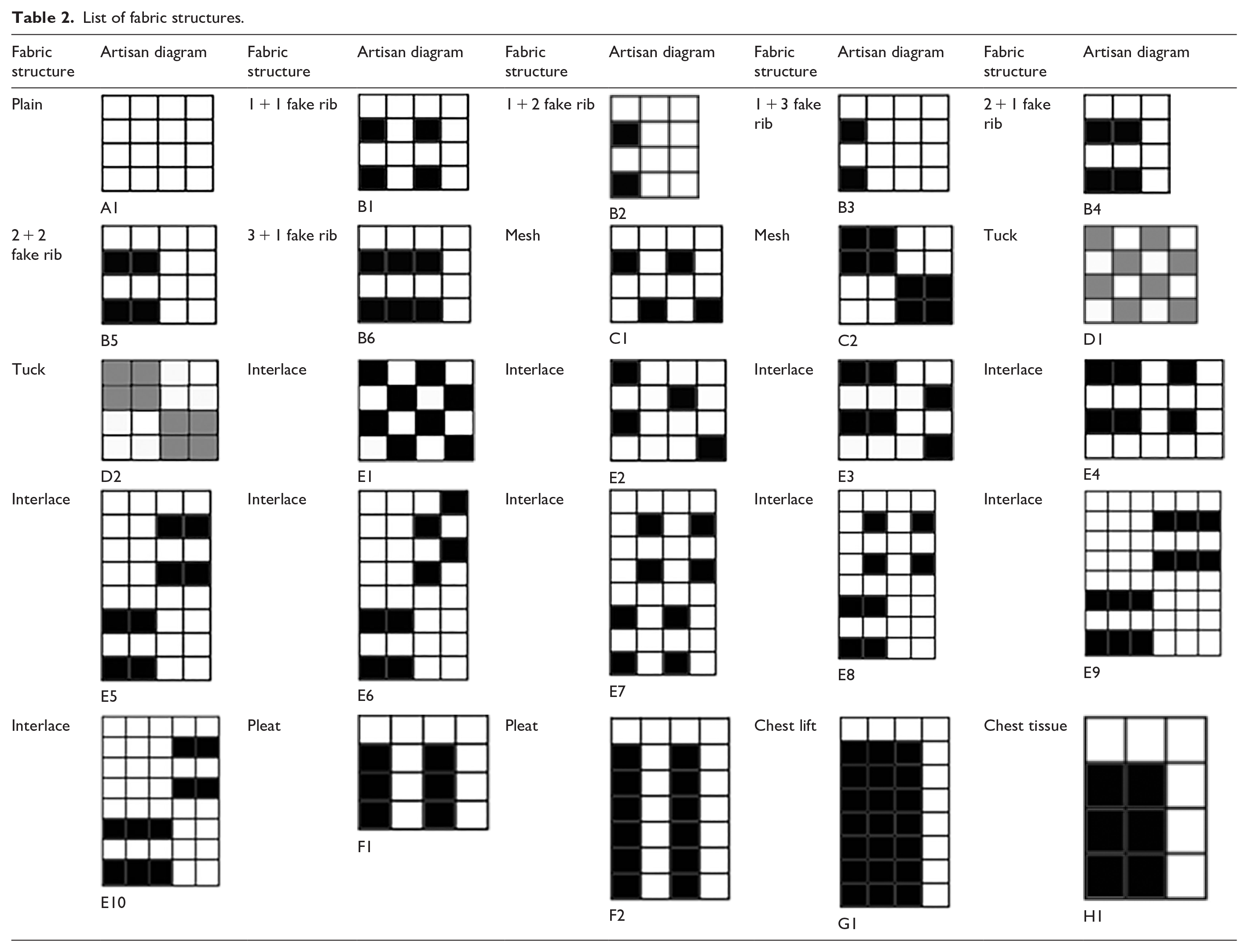
The diameter of the seamless circular machine is fixed, but the size of the human body is different. In actual production, refer to GB/T1335.2-2008 “Women’s Clothing Models” to clarify the size of each part of the human body, the combination of different fabric structures is used to achieve the change in the size of the details of the clothing. Commonly used fabric structures are plain, false rib, mesh and interlaced tissues. Table 2 shows the structural artisan diagrams of various fabric structures commonly (white squares represent circles, black squares represent non-woven, gray squares) represents tuck.
List of fabric structures.
Matching the partition design model for weft-knitted seamless yoga pants and fabric structure
The structure of the knitted fabric is the main factor that causes the difference in elasticity of different fabric structures. The basic structural unit is the loop. When the fabric is stretched, the loop transfers between each other. Table 2 shows the artisan diagrams of various fabric structures commonly. The floating on the back of the false rib structure is retracted due to prestress. The floating line is longer, the stretchability is better, while the plain stitch loops are smaller and connected to each other tightly, and the stretchability is poor. According to the ingenuity diagrams of the fabric structures, the tensile properties of the fabric structure of Table 2 are classified (Table 3).
Classification of fabric structures.

In the partition design model for weft-knitted seamless yoga pants, different zones have different requirements for the elasticity of the fabric. In order to make the stretching force of the fabrics in various zones tend to be consistent when the human body is moving, reduce the difference in clothing pressure, and improve the wearing comfort of the clothing. The tensile properties of the fabric structure of each zone form a gradient change, which corresponds to the skin deformation. For example, the area with large skin deformation is knitted with an easily stretchable fabric structure, and the area with less skin deformation is knitted with a fabric structure with relatively poor tensile properties. The fabric structure library was classified based on tensile properties. The same type of fabric structure can be used in different zones, the same, the same zone can be selected from different types of fabric structure (Figure 11). So as to establish the correspondence between the model zones and the fabric structure library to achieve matching of the zone and fabric structure rapidly.
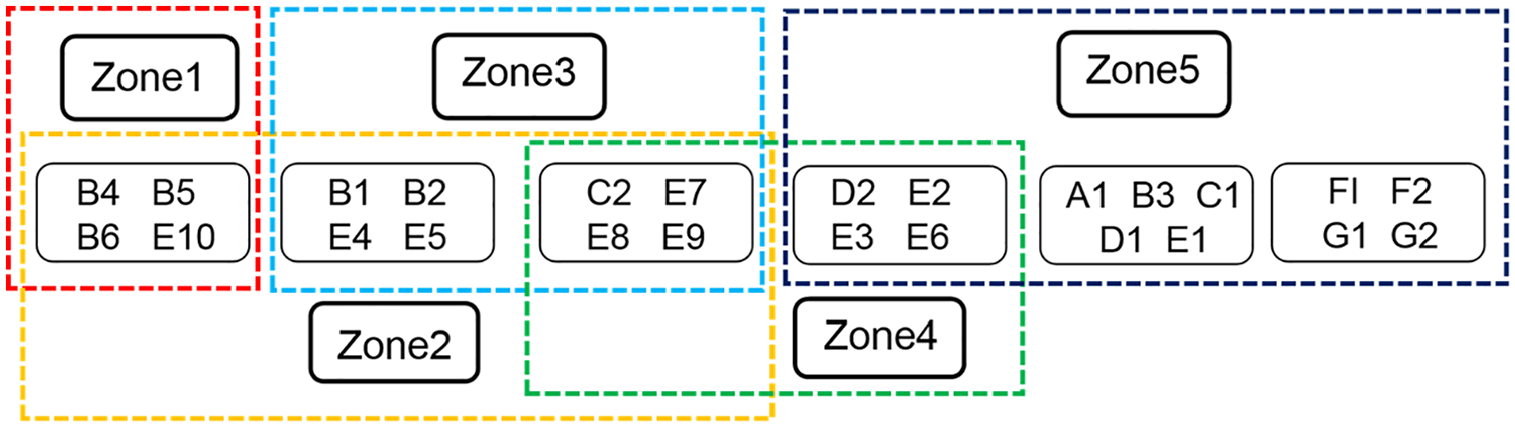
Correspondence between model area and fabric structure library.
Digital design of seamless yoga pants structure
Using the photon software of Santoni Seamless Underwear Circle Machine to realize the digital design of the structure of seamless yoga pants. First draw the fabric structure and save it as a pat diagram, establish an fabric structure database, and save it by category. Then create a new sdi file, import the clothing structure map designed based on partition design model for yoga pants. Fill different colors in the areas with different fabric structures, and then choose the structure for different color areas, the dis file is generated (Figure 12). So as to realize the digital design of seamless yoga pants structure.

Digital design of seamless yoga pants structure: (a) Sdi file, (b) fill the fabric structure, and (c) Dis file.
Conclusion
(1) It can be obtained from the skin deformation experiment performed on the lower limbs of the human body in yoga postures that the area with larger skin stretch is mainly concentrated between the waist line and the knee line. The parts with greater lateral skin stretch rate include the front of the thigh, the back of the lower leg, and the front of the knee. The vertical skin stretch is greater than that of the horizontal. Among them, the parts with obvious vertical skin stretch include the back of the waist, the buttocks, and the front of the knee. The research results can help to improve the rationality of the structure design of yoga pants and promote the development of high-performance yoga clothing.
(2) The skin deformation mapping was drawn based on the skin deformation of the lower limbs, and the prototype of the weft-knitted seamless pants was partitioned according to the skin deformation mapping. It was establish partition design model for the weft-knitted seamless yoga pants.
(3) By creating and classifying the fabric structure library, establishing the correspondence between the weft-knit seamless yoga pants partition design model and the organization library, which can quickly match the model area with the organization structure to realize the digital design of seamless yoga pants.
Footnotes
Declaration of conflicting interests
The author(s) declared no potential conflicts of interest with respect to the research, authorship, and/or publication of this article.
Funding
The author(s) received no financial support for the research, authorship, and/or publication of this article.
