



Abstract
Due to the effect of force and deformation of fancy stitches, the simulation of knitwear is facing a great challenges of the real-time. In this paper, the physical-geometric hybrid method is applied to reduce the amount of calculation during the simulation of knitwear. Discretized Newton’s Method is used to analyze the gap between dynamic knitwear-human body and the knitwear model, and then the knitwear model is further divided into different regions. A three-dimensional (3-D) mesh for knitwear is constructed by the application of adaptive remeshing. This makes it possible to refine the mesh at the parts that need the presentation of fabric surface details. Simultaneously, it can merge the adjacent patches at parts without the requirement of showing the details, and form a large 3-D patch. In the light of regional division, the 3-D knitwear model is divided into the tight layer, floating layer, and loose layer. In addition, the geometric loop model based on the cuboid particle system is employed to simulate the real force of loops and knitwear for tight layer and loose layer. Near-rigid deformation method is also applied into the floating layer to improve simulation efficiency. In conclusion, the corresponding processing method is performed with different computational models, which brings the dynamic simulation effect of knitwear with realistic and real-time.
Introduction
Dynamic simulation of knitwear is a research hotspot in the field of virtual reality, which has been widely used in animation, virtual display, knitwear CAD, etc. The development of computer hardware and increasing prosperity of network virtual reality directly increased urgent demands for real-time 3-D knitwear simulation. These 3-D knitwear simulations have been put forward in knitwear production, online games, and many other fields. Therefore, establishing a computational model with high calculation efficiency and an accurate simulation effect has become a vital issue in the dynamic simulation of 3-D knitwear. A geometry-based model is proposed to simulate knitwear, using empirical equations to characterize the geometric properties of the garment.
Researchers have established a series of geometrical models to simulate the structure of weft knitted fabrics. The geometric modeling methods of weft knitted fabric mainly include the following three models: the models based on Pierce loop model, the models based on piecewise function, and the models based on spline curves. Peirce 1 loop model is a typical model of loop simulation. It assumes that needle arcs and sinker arcs of the fabrics are represented by semicircles when the fabrics are entirely relaxed. The section of the yarn is circular and remains a constant radius in the model. In order to enhance the 3-D construction of the loop, the loop model based on a piecewise function is applied to the weft knitted fabric simulation. The loop is divided into eight sections according to different locations in Kurbak2,3 model, and each section corresponds to a function that describes the orientation of the yarn. Based on the Kurbak et al.4–6 model, different stitches are established, such as tuck, purl stitch, rib stitch, etc. Zhang et al. 7 proposed a 3-D loop modeling method based on Cardinal spline and recursive rotation frame method. To connect all the control points via a curved line to form a knitted loop shape, the Cardinal spline method is adopted due to its simplicity of calculation and adjustment in radians. The Cardinal spline can go through all of the control points, but only the four adjacent segmental lines deform when the control point moves. In our previous work, 8 the interpolation algorithm was used. This algorithm can generate new auxiliary points to solve the problem of the NURBS curves that cannot pass through all control points. To simulate the twist of folded yarns, the NURBS curves are regarded as the geometric center, which is rotated around with the cylinders. The three relative Euler angles of the cylinders are calculated by the spatial coordinates of adjacent points. Although this kind of method has high computational efficiency, it is not a simulation of the physical properties of real weft knitted fabrics, so that it can hardly show local details such as folds and empirical equations of the garment, which means it lacks the simulation effect of reality.
Physics-based computational model, a dynamic model, can be established according to the physical properties of fabric quality, elasticity, friction, etc. By simulating the dynamic deformation of garments, this kind of model can obtain realistic dynamic clothing simulation effects, among which the mass-spring model is the most widely used.9–11 In order to take into account the non-elastic properties of woven fabrics, Provot9,10 proposed a physics-based model to animate cloth objects derived from elastically deformable models. Due to the similarity of some physical properties between weft knitted fabrics and woven fabrics, such as drape and elasticity, the spring-particle model is widely applied in the 3-D simulation of knitwear.12,13
To simulate the correct physical behavior of weft knitted fabrics, Meißner and Eberhardt 14 and Eberhardt and Weber 15 adopted a particle system to calculate the dynamics of stretching, repelling, and bonding of the yarn in a weft knitted pattern. The actual length of the loops and the position of the bonding points on points mesh are stored. Assume that the spring force pulls adjacent particles toward or repels each other, and the coupled particle system is built. Yuksel et al. 16 proposed a modeling technique that builds yarn-level models of complex knitted stitches. A polygonal model is used to represent the large-scale surface of knitted fabric. By manipulating this mesh and assigning stitch types to its faces, various complicated knitting patterns can be simulated. The curve model representing the yarn is generated from the stitch mesh, then the final shape is computed by a yarn-level physical simulation. This simulation locally relaxes the yarn into a realistic shape while preserving the overall shape of the garment, thereby generating an effective yarn geometry for dynamic simulation. It can be efficiently created yarn-level models of knitted clothing deformation behaviors of weft knitted stitches by using their methods. However, the pure physical method needs a large amount of calculation; as a result, real-time simulation has certain difficulties.16–18
The physical-geometric hybrid model combines the respective advantages of the geometric model and the physical model. 19 The geometric method is used to generate the approximate drape state of the knitwear quickly, and then the final deformation result can be obtained by the physical deformation method. The physical method also can be used to obtain the overall deformation effect on the sparse mesh of the knitwear, and then the geometric method can be used to supply the deformation details of the cloth. 20 There is a defect of this type of hybrid model that some constraints of the two models will conflict with each other, making the cloth deformation effect unrealistic. Magnenat-Thalmann et al.21–23 have improved this method by analyzing the distance between the clothing model and the human body surface at rest. The geometric deformation method is used for the short distance clothing area, and the physical deformation method is adopted for the long-distance clothing area. However, the ease allowance between the surface of the clothing and the surface of the human body is dynamically variable. Pattern ease is another factor affecting garment size and comfort. Ease allowance is a measurable difference between the measurement of body and garment. It is generated by adding additional length and girth in design, grading, or modeling. Every garment should have a certain amount of ease for wearing, movement, and comfort. Upon garment style, other additional ease may be necessary. Ease allowance for wearing and movement is known as wearing ease, while the ease allowance for style is regarded as design ease. 24 The large simulation errors will generate in the division of clothing area if only according to the clothing-human relationship in a specific static state.
Meng et al.25–27 initially divided the human body model on the basis of skeletal structure, then subdivided it to get the ellipsoids with a different fitting degree according to the different requirements of the human body parts on the dressing accuracy. Therefore, the speed and effect of clothing simulation can be guaranteed. However, the generation of ellipsoids depends on human bones. While the abundant dynamic folds exist in loose areas of clothing and certain parts against the surface of the human body, it is difficult to simulate these phenomena by geometric methods, which means physical deformation methods are more suitable. The clothing area close to the body with more uniform deformation and fewer wrinkles is suitable for geometric methods to reduce computation. Therefore, the reasonable division of the clothing model area and the targeted application of deformation simulation methods will help improve the efficiency and effectiveness of dynamic clothing simulation.
In this paper, an improved cuboid particle system is introduced based on the spring-mass model to simulate the interaction of yarn tension between the patterns of weft knitted fabrics.8,28,29 By analyzing the dynamic ease allowance between the different regions of the knitwear and the human body model, and the complexity of the details of the dynamic deformation of the knitwear, a physical-geometric hybrid model is established. The knitwear model is divided into three independent grid areas, and three deformation calculation and collision processing methods are applied respectively. In this way, the calculation complexity of the dynamic knitwear simulation can be reduced effectively, and a satisfying simulation effect can be obtained. In order to meet the different needs of application backgrounds for simulation effects and efficiency, the proportion of the area of the three models in the overall area of the knitwear can be dynamically adjusted. To obtain the preliminary simulation results, the cuboid particle system is used, then the knitwear is divided into regions based on empirical data. Finally, the corresponding deformation algorithm is implemented in different regions. Figure 1 shows the overall framework of the hybrid model.

The framework of the hybrid model.
The loop model
The cuboid particle system
Fancy knitted weft stitch fabric is adopting into additional yarn, transfer or cancel the knitting process individual stages. Based on the basis stitches of weft knitted, fancy knitted weft stitch can be obtained by following methods: (1) change or cancel some stages of knitting process; (2) add additional yarn; (3) compose two or more stitches. 30 Considering the interaction of neighboring loops and the deformation behavior of fancy stitch, an improved physical model is introduced for weft knitted fabric. The model based on the mass-spring model is proposed to achieve volumetric representation of weft knitted fabric without sacrificing the simplicity and stability of the mass-spring method. To implement volumetric performance and complex fancy stitch, volumetric springs which connect red points and white points are employed to link the cuboid particle system in Figure 2. Each cube of the cuboid is modeled by stretching and shearing springs. The Loops are contained in the cubes. The white points on the first layer and the red points on the second layer are connected by springs. The deformation behavior of fancy weft knitted stitch is simulated by computing the coordinates of bonding points which campaign ensures neighboring particles, as shown in Figure 2.8,31 The length of the spring is determined by the course spacing, wale spacing, and thickness of loops. The course spacing can be expressed as the sum of h1 and h2, the wale spacing can be expressed as w, and t is the thickness of loops, as shown in Figures 2 and 3.

The realization of the cuboid particle system: (a) front view, (b) left view, and (b) rotated view.

The geometric model of plain knit.
The geometric loop model based on the cuboid particle system
The thread structure of the fabric is constructed by a stitch composed of bonding points. Each quadrilateral represents one type of loop whose structure is composed of the bonding points in a quadrilateral. According to Reference,
8
the coordinates of bonding points are computed by the interpolating of the neighboring particles. For example, BP1 =
Given the particles physical properties and associated with bonding points, the loop could be deformed with the displacement of the particles. Hence, the loop obtains real deformation behavior. This model is much more independent since it connects only at single points between the unit loop, and it is usually relatively easy to create complicated stitches by composing such a model. Figure 5 shows the geometric model of plain knit. The gray and black dots are bonding points and particles, and are denoted as BP s and pi,j,k, respectively. 8 pi+m,j+n,k corresponds to the white point and pi+m,j+n,k+1 corresponds to the red point in Figure 2, where m = 0, 1; n = 0, 1.
Division of knitwear areas
Each vertex of the knitwear model is calculated and divided into the region factor (RF) σ
i
. By analyzing the existing knitwear-human body dynamic data, the knitwear-human body dynamic ease allowance and the local detail complexity of the knitwear can be obtained.
32
The combined measurement values of knitwear-human body dynamic ease allowance and the complexity of local details of knitwear
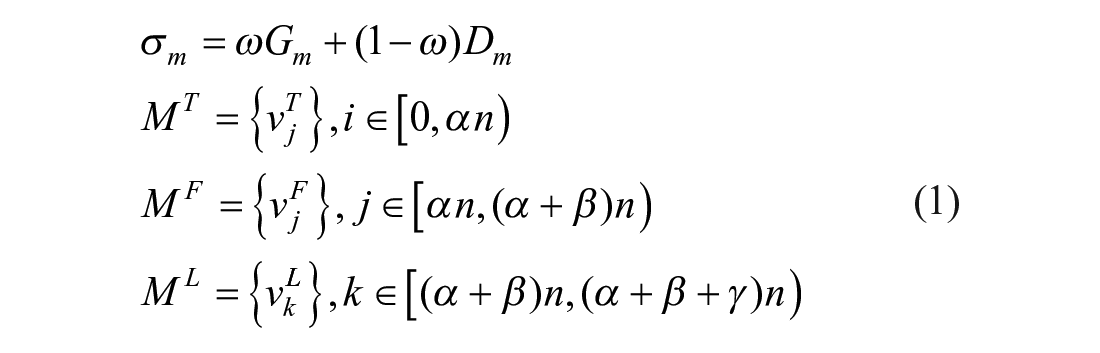
In addition, Gm and Dm are the dynamic gap value and detail complexity value of vertex vi, respectively, and
Geometric structure construction of knitwear based on ease allowance
Ease allowance displayed by knitwear in various parts of the human body can be obtained according to the values, which can refer to ergonomics and some statistical data. The values are used to decide the deviation of the apex of the knitwear surface from the apex of the human body surface, and obtain the characteristic rings at the characteristic position of the knitwear surface. Then, the characteristic rings and the surface at other positions can be used to obtain a new knitwear surface, as shown in Figure 4.

Distribution of ease allowances amount in characteristic rings of various parts: (a) characteristic rings and (b) cross-sections of characteristic rings.
The coordinates of the markers on the clothes are projected onto the corresponding body cross-section plane to obtain the ease between body and knitwear. 34 The cross-section curves can be fitted into the discrete points on the bust and the waist lines using the polynomial approximation by capturing the marker coordinates on the body. The marker points on the bust and waist cross-sections fit as follows:

where pi is the ith fitting coefficient, Xi is the coordinate of the ith marker point, and n is the degree of the fitting polynomials. Figure 5 illustrates the projection of the coordinates of the markers on the clothes at the waist line.

Projection of a clothes cross-section to the plane of the corresponding body cross-section.
The fitting curve of a torso cross-section in a dynamic position can be calculated by shifting the curve in equation (3)

The minimum distance between a clothes marker and the body cross-section is calculated by the Discretized Newton’s method. 35 It is known to all that this method can enhance the convergence of the iteration and reduce calculation time when inference occurs.
Establishment of adaptive remeshing of knitwear
The object of the adaptive remeshing is to reorganize the 3-D mesh of the cloth, so that it can refine the mesh in the parts that need to show the details of the fabric surface, and simultaneously merge the adjacent patches and form a large piece of 3-D patch for the other parts.
Specifically, the small 3-D patches are used to show details in areas with wrinkles, and the larger 3-D patches are applied in areas without smooth wrinkles.36,37
In order to achieve the target, it is necessary to find the shortest side that can express the required details. On this issue, a more popular way is to establish a 2-D force field to control the 3-D grid. In general, a tension field is exerted in 3-D space to represent the maximum tolerable side length between two points, then an adaptive re-division of the entire 3-D mesh is performed to adapt this tension field.
The tension field at each point i is represented by the matrix Ri, and Fij is used to define the action factor between the two points i and j, and is represented by equation (4), where ui represents the two-dimensional coordinate of point i.

For each edge, if the calculated action factor is greater than 1, it means that this edge cannot show the required details and needs to be processed. The algorithm iterates until all Fij calculated by all edges are less than or equal to 1. Three commonly used methods are employed to process the edges: edge splitting, turning, and merging, as shown in Figure 6.

Adaptive remeshing changes: (a) original grid, (b) grid split by edges, (c) edge-turned grid, and (d) merged grid of edges.
When the action factor of one edge is greater than 1, the edge will be split into two edges to enhance the ability to show details. The model information of the newly created vertex, including 2-D coordinates, current velocity, and tension field information, is obtained from the difference between the two original vertices. According to Narain’s et al. 38 algorithm, the 3-D coordinate position of the new vertex needs to be calculated from the quadratic error of the interaction between the surface curvature of the 3-D model and the adjacent patches. Edge merging is to delete one of the two vertices of the edge, and all edges in the iterative process will be merged. Only when the new edges generated are non-compliant, the edges will not be merged.
Dynamic simulation of the hybrid models
Because of the deficiency of folds details of the floating layer model and the relatively smooth overall deformation, the physical deformation methods will reduce the simulation efficiency, and cannot get obvious simulation effects. This work adopts the near-rigid deformation method, 39 which mainly realizes the model deformation under the premise that the triangle side length of the constraint model is as constant as possible. In this work, the deformation of the floating layer is calculated after the particle system used in the tight layer and loose layer. By using this method, the garment can be smoothed to avoid sharp point distortion.
Fold details performance of knitted fabrics is mainly considered in the dynamic simulation of loose layer knitwear. Tight layers show the deformation of fabrics by forces. The performance of wrinkle details and deformation of fabrics largely determine the overall simulation effect of knitwear. Therefore, the particle system based on section 2.1 of this work is used to express the complex dynamic details of the knitted fabric for the tight layers and loose layers model.
Solution of equations
The solution of the floating layer is mainly about the solution of the energy function. 40 The tight lay and loose layer are simulated by physical methods of the particle system proposed in this work, so Velocity-Verlet is used for calculation. Compared with the explicit Euler method and the complexity of the implicit Euler method, time integration of Velocity-Verlet integration not only improves efficiency but also exhibits certain stability. This is because it can avoid using the particle’s current position and velocity. Velocity-Verlet makes use of the particle’s current and previous frame position to obtain its position at the next frame. The position and velocity of particles are 31 :


where m represents the time of forces applied to particles, ∆m is the time step size, M is the mass of each particle,
Results and discussion
According to the previous work, the approaches proposed in this work have been tested in two aspects: one is the ability to produce the realistic virtual display of knitwear, and the other is the simulation speed for virtual animation scenarios. The simulator is performed on a system with Intel XEON Processor E3-123v3 LGA1150, 3.30 GHz, 16 GB RAM, and GTX 690 running on Windows 7 OS. The software platform used is Microsoft Visual Studio 2010 integrated development tools with OpenGL 3-D graphics library. We first constructs a three-layer clothing model based on the factors, and then conducts preliminary simulation deformation of clothing. Finally, the collision detection and response are performed to obtain the final clothing simulation effect.
Table 1 illustrates the simulation efficiency under the different stratification ratios. It is found that when the stratification proportion of tight layer, floating layer, and loose layer are 0.35, 0.30, and 0.35, respectively, the style of knitwear cannot just simulate the changes in the shape of the tight-fitting layer loops caused by the human body, but also show the unique drape and thickness effect, as shown in Figure 7.
The knitwear simulation efficiency under different layering ratios.


The simulation of knitwear by the proposed hybrid model.
Conclusion
This paper is aimed at the problem of excessive calculation when simulating the force of each loop in 3D knitwear, combining the structural characteristics of 3D knitwear. The RF method is used to divide the garment area. According to the dynamic gap and the complexity of the knitted garment, the garment is divided into the tight layer, floating layer, and loose layer. There is little fold detail information of the floating layer model; thus the near-rigid deformation method is adopted. This method mainly realizes the model deformation under the premise that the side length of the model triangle is as constant as possible. Because the tight layer and loose layer folds and local details are the most obvious, the cuboid particle system proposed in this work is used for physical simulation. The application of adaptive remeshing constructs a 3-D mesh of knitwear, which enables it to refine the mesh at the parts that need to show the details of the surface of the fabric. Meanwhile, it can merge adjacent faces at the parts that do not need to show details to form a large 3-D face, which can further reduce the scope of physical simulation and reduce the amount of calculation. The simulation effect and time show that the proposed method can genuinely show the dynamic effect of 3-D knitwear while the simulation time meets the real-time requirements.
Footnotes
Declaration of conflicting interests
The author(s) declared no potential conflicts of interest with respect to the research, authorship, and/or publication of this article.
Funding
The author(s) disclosed receipt of the following financial support for the research, authorship, and/or publication of this article: This work was supported by the National Natural Science Foundation of China (No. 61802285), the Scientific Research Project of Hubei Provincial Department of Education (No. D20201704), Hubei Province Technical Innovation Special Project (2019AAA005), the Chutian Scholar Program of Hubei Province, the Open Project Program of Key Laboratory of Eco-textiles, Ministry of Education, Jiangnan University (Nos. KLET1702 and KLET1704), the Open Project Program of Costume Art and Culture Research Center of Hubei Province (No. 2018HFG003), the Open Project Program of Fujian Key Laboratory of Novel Functional Textile Fibers and Materials, Minjiang University (No. FKLTFM1813), the Open Project Program of Engineering Research Center of Textile and Clothing (Minjiang University), Fujian Province University (No. MJFZ18103), and the Open Project Program of Engineering Research Center of Hubei Province for Clothing Information (No. 184084006).
