



Abstract
This study examines properties of the cotton/polyamide plain plated commercial socks (CO 81%/PA 19%) and pure polyamide fabric subjected to the multifunctional treatment by a sol-gel coating technique where tetraethyl-orthosilicate (TEOS) and zinc acetate dihydrate (ZAD) were used as precursors. Commercially available sock is produced on a single cylinder sock knitting machine which results in two surfaces (cotton and polyamide), with dissimilar characteristics thus leading to necessity of their separate studies. Experimental part examines surface structural clarification and compound identification using infrared spectroscopy. To assess the impact of modification such properties as air permeability must be tested and analysed. Pilot tests of antibacterial activity against Bacillus subtilis mscL 1141 and Staphylococcus aureus mscL 334 where carried out. Due to the modification consolidation treatment temperature below the destruction of material and the chemical compounds vibrational modes overlap, but in regions 1170–1650 cm−1 and 3200–3395 cm−1 show the presence of bounds corresponding to sol-gel coating presence on the surface.
Introduction
Sock products today must be provided with a range of comfort features such as sweat-absorption, breathability, quick drying, they must be eco and skin-friendly, comfortable, antibacterial and multi-applicable. Translation of these requirements into the technical features means that the sock design and fibres used should have the ability to wick out the moisture easily, the sock structure should be adapted to keep the foot ventilated and should be treated with the safe-by-design antimicrobial finishes, free of the skin irritating components. If different types of yarn are used in sock manufacturing, it should ensure comfort and performance. 1 Performing functional modifications in practical applications often address more complex issues. Treating textile fibres and yarns with hybrid organic-inorganic precursors can open possibilities to improve and complement functional and protective properties. 2 As shown in experiments and field research, after such treatments as hydrothermal processing and bleaching, as well as functionalization sock products tend to change their dimensional stability leading to changes in dimensional and comfort properties, that must be considered when designing a new product and its technology. 3
Thread pre-treatment before knitting/weaving is important as part of the anticipated integration of the wearable electronic components – sensors, electro conductive threads, capacitors into the modified textile products, such as socks, T-shirts, sweaters. 4 In most cases it is appropriate to insert a functional coating on the finished product during the final finishing process. Textile finishing can be carried out through chemical and mechanical methods on yarn or fabric including – treatments with acids and alkali, bleaching, calendaring, folding, heat setting and others. 5 During the process of knitting greases that are based on mineral and vegetable oil or synthetic ester type oils or waxes are applied to yarn. As a result, on the textile surface both compounds made to facilitate technological processes and functional coatings as well intermediates of chemical reactions can be located.
Research and technological processes require identification of surface changes by changing parameters and components, resistance to subsequent physical, chemical and/or mechanical treatments, while it is important to verify the existence of the coating in the finished product and changes in its performance during usage.
This study focuses on knitwear modification via sol-gel process integrated in final finishing. The commercial availability of organic and inorganic precursors for sol-gel method makes it a well-established technology, that can be used to obtain additional properties or to improve existing ones by using the sol-gel technique, which allows the fabrication of materials with different functional properties.6,7
The sol-gel technique has been commonly studied for coatings, where current antimicrobial agents (such as titanium dioxide, N-halamine, quaternary ammonium compounds (QACs), and metallic oxides) are incorporated into sol–gel nanoparticles and applied onto fabrics made of natural or synthetic fibres.
Because of the high wear resistance of sock products needed, cotton yarns must be accompanied by the abrasion resistant polyamide (PA) or polyester (PES) filaments accompanied with elastane threads or without them. This means that giving the product certain additional functionalities during the final finishing, the coating can be applied on a multi-fibre knitted fabric. So far, many studies have focused on the cotton woven and knitted fabrics modification by applying sol-gel technology,2,6–8 including those carried out by authors,9,10 but so far little attention has been paid to the modification of mixed fibre fabrics.
When modifying mixed fibre knits, control across the lifecycle of a product with nanoscale coating, rigorous testing and analysis is required to ensure that all end-use application specifications or regulatory compliance requirements are met, and product quality is maintained in use. To adapt the modifying technology to the product or to find alternative coatings for an existing technology, it is very important to develop a quality assurance program that gives the manufacturer, the retailer, and the consumer confidence that features, normally invisible to the senses, are actually inherent to the product. On the other hand, application of all applied technologies in the development stage, know-how and time-consuming methodologies, as well very expensive hardware, strictly limits the applied coating identification and control of its condition in manufacturing, supply chain and in use.
At the same time, the chemical composition and physical properties of functional coatings have a direct impact on their performance. It is essential to conduct comprehensive coating testing and analysis at all stages of its development, production and usage.
One of the current methods, Fourier transform infrared spectroscopy – attenuated total reflectance (FT-IR ATR) provides information related to the presence or absence of specific functional groups, as well as the chemical structure of polymer materials. Shifts in the frequency of absorption bands and changes in relative band intensities indicate changes in the chemical structure or changes in the environment around the sample, especially following induced modifications 11 for a wide variety of sample types such as threads, yarns, fabrics, fibres and polymers. Fourier transform infrared spectroscopy – Diffuse Reflectance (FT-IR DRIFT) is used for soft powder and powder mixture analysis, that in this case is not suitable for modified textile samples.
IR spectroscopy is an important and popular tool for structural clarification and compound identification in the sample and is even a common spectroscopic technique used for quantitative determination of compounds in mixtures. Peak intensity and corresponding wavenumber can show significant information about sample chemical structure through vibrational spectroscopy and can be applied to evaluate silane ring formation. Fourier transform infrared spectrometry can be used to determine the degree of hydrophilicity and hydrophobicity of silica network considering thin film porosity. 12 The nature of precursors, the molar ratios between the reactants, the nature of the solvent, the use of modifying agents, pH, the synthesis and permissible curing temperature, influence the coating microstructure and properties of the substrate, each one individually and in mutual interaction forms the outcome. It is easier to control the modification process of a single fibre substrate. But modern fabrics typically are comprised of multiple fibre types tangled in different patterns, as well dyes and additives used to achieve fabric functional properties. The large quantity of chemical bond information provided by FT-IR is one of its major challenges. At the same time each type of chemical bond has multiple modes of vibration producing numerous overlapping peaks that can make it difficult to make an unambiguous identification.
Another problem is that the penetration depth of FT-IR ATR has the same order of magnitude as the wavelength of IR light that ranges from several hundred nanometres to more than 1 µm. Thus, FT-IR ATR is not a very sensitive surface analysis method for nanomaterials that are in the tens of nanometres range 13 which is also observed in the analysis of textile surface functional coatings. 14 Spectral subtraction usually takes place when the isolation of a particular spectral feature in a polymer blend is desired. In this situation, the spectral subtraction method can be very useful for characterizing surface changes in result of its nano-scale modification, especially in recent times when FT-IR tools provides a relatively easy execution.
This study investigates possibilities to evaluate functional coating presence and intensity on the cotton/polyamide plain plated commercial socks subjected to the multifunctional treatment by a sol-gel coating technique via FT-IR ATR spectra and functional properties of modified sock samples.
Materials and methods
Materials and methods for modification and analysis
Modification was carried out on commercial cotton/polyamide single jersey plated knit socks
Sol synthesis and deposition of multifunctional coating
Sample pre-treatment
All samples were washed in distilled water according to EN ISO 6330:2012, for 46 min in 30°C, using detergent without brightening agents in defined concentration 5 mg/1 l water. After washing samples were dried in 60°C temperature until dry. Before modification samples were stored in climate chamber in following conditions (20°C ± 2°C relative humidity 65% ± 2%) according to ISO139: 2005.
Synthesis of sol solution
Sol solution was synthesized using TEOS as precursor and hydrofluoric acid HF (⩾40) catalyst. Nano sol was modified with 7.5 wt% zinc acetate dehydrate. Our previous studies testify that such sol composition provides antimicrobial activity and hydrophobicity to the modified cotton fabric, as well improves its wear resistance, while wearing comfort-proof properties such as air and vapour permeability remain sufficient for the first to the skin clothing layer.14,15 Sol synthesis consists of following processes: activization of molecular precursors, condensation and gelation.
Coating deposition
Dip-pad technique was used, and samples were dipped in sol solution for 10 min. Then samples were processed through textile calender rollers, to remove the excess solution and ensure even absorption of the coating. After these samples were exposed to heat treatment with following conditions – in 120°C for 5 min. At this stage, the applied coating is consolidated with the surface of the modified sample. After heat treatment samples are washed with the same conditions as in pre-treatment stage. Samples are dried in room conditions. Before all test samples were stored in climate chamber under normal climate conditions (20°C ± 2°C relative humidity 65% ± 2%) according to ISO139: 2005.
Sample designation is as follows:
Ks1 – unmodified reference samples (on the surface predominantly cotton yarns).
Ks2 – unmodified reference samples (on the surface predominantly polyamide threads).
Ms1 – modified samples (on the surface predominantly cotton yarns).
Ms2 – modified samples (on the surface predominantly polyamide threads).
Pa_reference – unmodified 100% polyamide fabric.
Pa_modif – modified 100% polyamide fabric.
Pa_modif_W – modified and washed after modification modified 100% polyamide fabric.
FT-IR ATR analysis
Bruker Tensor II with diamond prism was used, to obtain spectra for samples 10 scans taken for each specimen (FT-IR ATR). Whereas the ATR can provide highly reproducible results- the relative error does not exceed 3% at any point in the summary graphs. The following pre-processing of the spectra (baseline and background correction, spectrum alignment and normalization) was applied. FT-IR spectra were recorded in a range of 3800–400 cm−1 focusing on 1800–400 cm−1 and 2500–3700 cm−1 region, because it shows the typical changes in spectra. Freeware computer program SpectraGryph 1.2 – spectroscopy software was used to analyse and gather information of FT-IR spectra. This study focuses on changes in absorption intensities and their differences between groups of samples, because the complex composition of samples vibrational bands and peeks specific to the cotton cellulose and polyamide overlap with the deposited nanoscale coating chemical compounds vibrational bands and peeks. Analysis of difference spectrum during the scale up process from laboratory to the industrial production makes it possible to trace the existence of the coating both immediately after their modification and its changes in subsequent hydrothermal treatment processes and until the product reaches the end user with the manufacturer's guarantees.
Air and water vapour permeability assessment
Air permeability of fabric characterizes air flow that can pass through textile, this property also affects the textiles final application. Taking into account that nanoscale coatings can spread to a greater or lesser extent on textile pore walls, the permeability of textile decreases and is therefore a controllable characteristic. Air permeability was tested using “SDL Atlas Air Permeability” tester according to LVS EN ISO 9237:2001 standard. Used sample test area was 5 cm2 selected air pressure difference on both sides of material was 50 Pa and 100 Pa for polyamide samples. For each sample 10 measurements were made in different places. For water vapour permeability evaluation Permetest Skin Sensora (Czech Republic) tester was used according to EN ISO 11092:2014. Sample testing area was ø 80 mm. the temperature of the measuring head was maintained at room temperature for isothermal laboratory conditions (20–22°C and 45%–60% water humidity). This instrument measures heat loss of the measuring head due to evaporation of water with blank conditions and when measuring head is covered with sample. The results of the measurements can be expressed in terms of relative water vapour permeability (%) and water vapour resistance Rct (m2Pa/W).
Antibacterial assessment
Disk diffusion by Kirby-Bauer method (Susceptibility test method) is a technique used for testing rapidly growing organisms and pathogens using petri plates with nutrient agar. Pure polyamide samples with modification with sol solution with 7.5mas% ZAD were tested.
Samples were incubated for 24 h in 35 ± 2°C. Antibacterial activity against Bacillus subtilis mscL 1141 and Staphylococcus aureus mscL 334 were tested. Odorous substances produced by b.subtilis are isobutyric acids (with structural formula (CH3)2CHCOOH), isovaleric acids (C5H10O2), 2-Methylbutanoic acid (C5H10O2). It is widely accepted that synthetic fibres gather more moisture, between human microflorae and are less susceptible to bacterial destruction, but synthetic textiles such as polyamide (PA) can accumulate unpleasant odours more, that organic textiles like cotton. Tests were carried out in University of Latvia, Faculty of Biology, Institute of microbiology and Biotechnology.
Results and discussion
Fourier Transform Infrared Spectroscopy (FT-IR) and antimicrobial analysis of neat PA fabric
One hundred percent polyamide fabric was exposed to the modification to investigate the effects of the coating on the neat PA excluding the presence of cotton. Comparative FT-IR ATR analysis data of PA spectrum are collected in the Table 1, spectra of unmodified (Pa_reference), modified before (Pa_modif) and after laundry washes (Pa_modif_w) fabric samples can be seen in Figure 1.
Absorption peaks and descriptions of corresponding vibrations found in literature and tested samples.

Band is caused by stretching of the C = O group.
Band comes from NH2 deformation in primary amides and from a mixed vibration of N-H bending and C-N stretching in secondary amides. 18

FT-IR ATR spectra (400–2000 cm−1) of reference and modified polyamide.
A detailed study of the absorption nature of the 100% polyamide fabric shows that in some frequency bands the absorption intensity decreases substantially after modification, especially in the frequency ranges which correspond to the amide I – III bands in the frequency range 1179–1632, as well as amide V out of plane bends of NH and C=O with the peak frequencies at 578 and 685 cm−1 (Table 1) and continues to decrease after first hydrothermal treatment. The last trend is explained by the consolidation and degradation of the lose three-dimensional structures of the coated surface in the aquatic environment (Figure 1, bold and grey graphs).
Changes in absorption rate of the sharp strong band at 1538 cm−1 could be assigned to Zn-O, probably Zn acetate, as well as those of bands 1400–1456, 664, 517 and 432 are attributable to Zn-O vibration frequencies. 21 The sol in question contains preconditions for compound Si-O-Zn (Zn silane) formation, corresponding bands at 557 and about 900 cm−1 (Figure 1).
In the frequency range 404–500 and 750–1137 cm−1 the absorption of chemical groups of the coating dominates increasing the total absorption of the modified PA (Figure 1). The absorption intensity in this range continues to increase after hydrothermal treatment testifying to consolidation of deposited coating. Among other, in frequency range 820–1030 cm−1 SiF2 and SiF3 compounds can be identified, most likely with peaks at 905 and 934 cm−1. 22
Antibacterial activity
Water repellent properties and antibacterial activity are functions that can be given or increased via sol gel modification technology with applied modificator zinc acetate dehydrate. 15 Previously tests were caried out on cotton and this type of sol solutions showed good antibacterial activity against: st aurerus ATCC 25923, E. coli ATCC 25922, P. aeruginosa ATCC 10145. Antibacterial activity against modified pure PA samples were not tested.
As concluded from previous experiment chosen modification regime increases hydrophobic properties increasing water contact angle to 119°, ±2 for test period of 60 s. 14
Antibacterial tests against gram-positive bacteria b.subtilis of modified sample before (Figure 2(a)) and after hydrothermal treatment (Figure 2(b)) show. That zone of inhibition average diameter for both test samples was 15 mm. In both samples no growth is observed under both samples, the size of the inhibition zone does not change after hydrothermal treatment. This means that the developed technology and composition of sol solution is suitable for 100% cotton textiles as well for 100% PA textile modification, and in combination with cotton yarns will provide antibacterial activity.

Petry plate with agar: 100% PA sample modified with ZAD: (a) before hydrothermal treatment and (b) after hydrothermal treatment (after incubation for 24 h in 35 ± 2°C, and zone of inhibition. Antibacterial activity against Bacillus subtilis mscL 1141).
Comparative analysis of cotton/PA plain plated knitted socks spectrograms
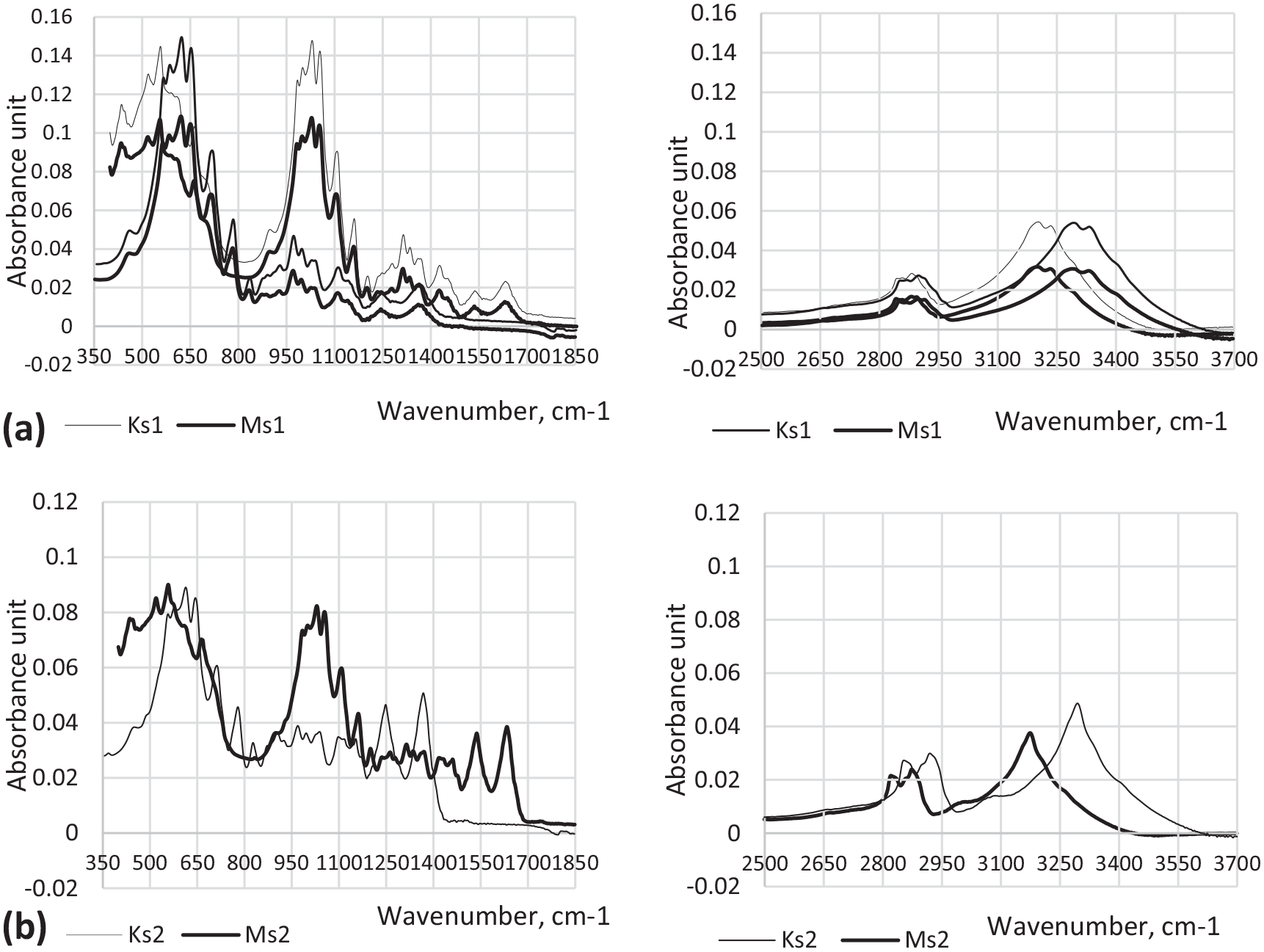
Sport and casual socks are now usually knitted on single – cylinder machines using two or more different yarn types producing plain plated knitted fabric. As a result, one of the surfaces in the experimental socks is dominated by cotton threads on the other – polyamide, which is also reflected in the spectra (Figure 3). The vibrational frequencies of all the fundamental bands along with their relative intensities of PA dominated surface and probable assignments are given in Table 1. The infrared spectral bands are compared with the Nylon 6 and cotton (70)/PA (30) corresponding bands.15–20,23
Comparative ATR
There are nine IR frequency regions that can be used in the study of the amide groups, namely amide A, B and amide I-VII (amide I -C=O stretch; amide II – in plane N-H bend coupled with C-N stretch; amide III – coupled N-H bend and C-N stretch as in amide II, but in an opposite phase; amide IV – in plane C=O bend; amide V -out of plane N-H bend; amide VI – out of plane C=O bend; amide VII -C-N torsional vibration). 24
Because the process takes place at temperatures that do not cause textile destruction, which in our experiment does not exceed 120°C, there is a great diversity of additional chemical compounds on the fabric fibres surfaces. It is very difficult to unambiguously identify the chemical compounds that have formed during the modification process on the surface of the fibres. The identification becomes more complicated as absorption/transmittance bands of chemical compounds of untreated knit and coated overlap fully or partially. Due to the coating (30–80 nm) produced in the sol-gel process, the absorbance of the chemical bonds is apparently weaker. The graphs of Figure 3(a) and (b) show absorption decrease on both knit sides in the broad absorption band 3400–3150 cm−1 which corresponds to molecular water hydrogen bonded to each other and to SiOH groups. 11 As seen from graphs of Figure 3, the absorbance of the modified cotton surface in this frequency range is significantly higher than that of PA surface. Amorphous microporous xerogel film covers fibres and lining fibres pores close to the surface which results in absorbance decrease, especially in the frequency ranges specific to the cellulose 898–1400 cm−1 and 350–670 cm−1 (Figure 3(a) and (b)).
Absorbance decrease shown by graph Ms2 in frequency ranges 3200–3395 cm−1 with the peaks at 3297 cm−1 and 1170–1650 cm−1 testify to the presence of sol-gel coating on PA fibres (Figure 3(b)).
Assessment of air and water vapour permeability
In result of hydrothermal treatment coating final consolidation process takes place, in which coating surface agglomerates and gradually merges with the modified surface, resulting in surface structural changes that could decrease knitwear and fabric air permeability. Air permeability test shows decrease for both set of samples (Table 2). Decrease for sock samples after sol gel treatment and before washing is 6.6% and after washing 12%, showing that the final stage of modification completes the formation of coating. Similar tendency is seen in polyamide samples where initial air permeability is about ten times less due to the fabric thickness and high areal density – air permeability decreases by 19% after modification and by 32% for hydrothermally treated samples. Since the fabric is incomparably denser than the socks knit, cuts are much more tangible, but in reality, a comparison in this respect was not foreseen, focusing on the mixed cotton/PA single jersey plated knits.
Air permeability of experimental samples.

The water vapour permeability (WVP) of textile is a critical property of clothing systems, as well as it can create a more or less-favoured living environment for undesirable micro-organisms. WVP resistance after coating deposition on sock samples and hydrothermal treatment increases by 7% from 6.1 m2Pa/W.to 6.5 m2Pa/W. Increase of WVP resistance is associated with the precipitation of the coating on walls of the top pores narrowing them down, but since the layer is very thin, the WVP resistance increase is considered to be relatively small. When analysing both test results together, it is inevitable that the functional coating reduces air permeability and increases WVP resistance by reducing pore sizes, but the good news is that the sol composition and technology applied allows to maintain both characteristics, which are important for wearer comfort, within acceptable limits.
Conclusions
In this study the surface characteristics (before and after) of cotton/polyamide knitwear and polyamide fabric modification with applied sol-gel technology are analysed and the conclusions are summarized below.
ATR FT-IR spectra allow to identify the presence of PA in both woven and knitted textiles, as well as the presence of a modifying coating and its structural changes in hydrothermal treatment and possibly wearing processes.
Modified 100% polyamide fabric provides antimicrobial activity against sweat-living gram-positive bacteria b.subtilis causing unpleasant odours, complementing the spectrum of antibacterial activity of modified cotton and cotton/PA textiles.
The surfaces of socks produced on a single cylinder sock knitting machine as plated single jersey fabric from two or more different types of yarns and modified by the sol gel process are different in functional properties. This makes it necessary to carry out separate studies of each side to control proper the modification effects.
Spectrograms obtained by FT-IR ATR of cotton/polyamide socks confirms that both surfaces are covered with deposited functional coating and allows identification not only of the existence of the coating, but also of chemical groups that provide the intended functional properties.
The functional surface coating in which cotton is dominated due to better link between the chemical groups of the cellulose with the chemical groups of the modifying coating is more powerful and, in the consolidation process the coating becomes more homogenic compared to the surface with PA predominance.
The modified cotton/PA socks maintain good air permeability and water vapour permeability resistance, as the results show decreases by only 12% for air permeability and increase by 7% for WVP resistance, after hydrothermal treatment compared to the reference samples.
Footnotes
Declaration of conflicting interests
The author(s) declared no potential conflicts of interest with respect to the research, authorship and/or publication of this article.
Funding
The author(s) received no financial support for the research, authorship and/or publication of this article.
