




Abstract
In this paper, the effect of coffee carbon and graphene far-infrared polyamide knitted fabrics on blood perfusion were studied based on the test method of human skin microcirculation (HSM), starting from the plating yarn feeding ratio and stitch of seamless knitted fabrics. Set the face yarn feeding ratios of coffee carbon polyamide (CCP) and graphene polyamide (GP) as 100:0, 75:25, 50:50, and 25:75. The stitches were 1 + 3 rib, 1 + 1 false rib, and plain plating. Both the plating yarn feeding ratio and stitch were designed as two experimental factors. According to the comprehensive experimental design method, 12 seamless knitted fabrics were prepared. The HSM was tested by BVI Projection Vein Finder. According to the orthogonal analysis method: Factor A, the plating yarn feeding ratio has the greatest effect on HSM, the second was factor B. When the plating yarn feeding ratio was 75:25, the stitch was 1 + 3 rib, the fabric has an excellent promoting effect on HSM. The purpose of this study was to explore the process parameters of far-infrared seamless knitted fabrics that have a better promotion effect on HSM, to apply the process to develop functional health care clothing to meet people’s market needs.
Keywords
Introduction
With the progress and development of science, health, low-carbon, environmental protection and sustainability have become the mainstay of people’s lives, and people are increasingly concerned about the perfect integration of technology and health. In the overall environment, health-care textiles have increasingly highlighted their advantages due to their strong health-care functions. People’s pursuit of a healthy life ensures that health-care textiles have broad development prospects. Health-care textiles refer to a type of textiles that have the functions of emitting far-infrared rays, generating magnetic fields, and antibacterial functions, which are beneficial to adjust and improve collective functions, without any toxic and side effects, and can achieve the purpose of health care. Among them, far-infrared textiles have become a new consumption hotspot in recent years. It combines high-tech, warmth, and health care functions, and has the functions of promoting HSM and enhancing metabolism.
Far infrared’s energy can be absorbed by the human body in the form of soft radiant heat, which can penetrate 1.5 inches under the skin 1 and can be converted into the energy inside the human body after being absorbed by the skin. In addition, it can also promote the human body to produce a thermal reaction, increase the temperature of the skin’s inner layer, and expand blood vessels, so as to achieve the function of medical treatment, prevention, and health care. 2 This energy can promote the movement of water molecules and resonate with cell frequency, thus promoting human blood circulation, enhancing cell regeneration ability, accelerating the body’s ability to excrete harmful substances. The main purpose of preparing far-infrared functional textiles was to increase their far-infrared emissivity. Chinese infrared medicine expert Yao Dingshan pointed out that far-infrared textiles have a wide range of applications. 3 For example, far-infrared shoulder pads can be adapted to diseases such as frozen shoulder, knee pads can be adapted to the various knee joint pain symptoms, and so on. Chinese research and development of far-infrared health care textiles were later than Japan, Europe, the United States, and other countries. Although the quality and efficiency of such products were constantly improving, the overall technical and market expansion capability were still far behind the international advanced level. Therefore, to improve the independent innovation ability and added value of our country’s far-infrared textiles, use the far-infrared fibers to develop textiles with health care functions has become a hot topic in the Chinese market.
As a new type of functional fiber, coffee carbon fiber and graphene fiber have significant advantages in emitting far-infrared, releasing negative ions, and antibacterial. Today, coffee has become the world’s leading beverage second only to water, with a global trade volume exceeding 10 billion yuan. Coffee contains rich phytochemical components, including caffeine, chlorogenic acid, HHQ, etc. 4 In 2014, 9.1 million tons of coffee fruits were produced worldwide, and 0.9 kg of waste coffee ground would be produced per kg of instant coffee. Therefore, the research of coffee carbon fiber and textiles 5 not only conforms to the theme of “low carbon, environmental protection, health, and sustainability,” and meets people’s demand for upgrading textile consumption, it can also utilize coffee grounds as resources and reduce environmental pressure. In Ma et al. 6 prepared activated carbon with waste coffee grounds and pomelo peel as raw materials by phosphoric acid activation method. Graphene is a new material composed of carbon atoms with a two-dimensional honeycomb structure. 7 It has excellent antistatic, far-infrared functions, etc., so it is widely used in the winter textile field, such as graphene thermal underwear, graphene gloves, etc. In Hu et al. 8 applied graphene nanomaterials to the finishing process of cotton fabrics. After testing, the far-infrared emissivity of the treated cotton fabric can reach 91.1%. Combining coffee carbon fiber and graphene fiber to develop seamless knitwear suitable for winter use with good far-infrared health care performance was a major innovation of this research. It aims to apply the research results to the development of functional clothing to satisfy people’s demands.
At present, the methods for testing far-infrared emission performance of textiles can be divided into emission performance tests, absorption performance tests, and human body tests. Among them, the human body test can be subdivided into skin blood flow rate measurement method, skin temperature measurement method, and practical statistical method. The skin is easy to obtain, and the skin blood flow rate responds more obviously to local heating, which makes the skin a good carrier for the study of HSM. 9 Therefore, using the skin blood flow rate measurement method in the human body test to characterize the promotion of the far-infrared fabric on the HSM has become a simple and quick way to understand the function. 10
In this study, using polyamide-based coffee carbon fiber and graphene fiber, a 4-level face yarn ratio, and a 3-level stitch were designed, and 12 seamless knitted fabric samples were woven according to the comprehensive experimental design method. And through orthogonal experiments to analyze the influence of various factors on the HSM, to obtain the fabric process parameters with better performance. Then combine superior process parameters with ergonomics apply to the health care textile industry, and it provides a certain reference value for the development of far-infrared health care seamless knitted products which are suitable for winter and good promotion of HSM and skin blood flow rate.
Experimental study
Materials
Taking into account the production cost, CCP and GP were used as raw materials for face yarn, and CCP/ordinary polyamide (OP) coated yarn were used as raw materials for lining yarn.
Methods
Appearance
Before testing the appearance of the yarns, put the yarns bobbin in the standard atmosphere (temperature 20°C ± 2°C, relative humidity 65% ± 2%) for 24 h to adjust the humidity; arranged the test yarns into taking out yarn to fix the bundle of yarns, and hooked the yarns with copper wires, so that the bundle of yarns penetrates the capillary tube, just cannot be pulled; use a scalpel to cut quickly along the cross-section of the capillary tube, and perform multiple samples. In the second cut, selected a cylinder with a flat section and glued it to the electron microscope stage with conductive glue. At the same time, picked out a single yarn with a better shape, spread it evenly, and glued it to the electron microscope stage with conductive glue. Then it is gold-plated and placed under the JSM-5610LV scanning electron microscope to observe the longitudinal and transverse cross-section of the fiber. The experimental method refers to the standard GB/T 36422-2018 “Man-made fiber—Test method for micromorphology and diameter—Scanning electron microscope method.”
Sample preparation
In order to explore the promotion of CCP and GP far-infrared polyamide knitted fabrics on HSM, this paper changed the levels of plating yarn feeding ratio and stitch. There is a technological characteristic combines with SM8-TOP2S single-sided electronic seamless circular knitting machine provided by SANTONI, Shanghai, China. Each single seamless knitting machine has eight road systems, each road has eight yarn mouths, both a piece of plating yarn and ground yarn are knitted into each yarn mouth simultaneously. Reasonably designed the plating yarn feeding ratio of CCP and GP: 8-way CCP + 0-way GP, 100:0; 6-way CCP + 2-way GP, 75:25; 4-way CCP + 4-way GP, 50:50; 2-way CCP + 6-way GP, 25:75. Combined with the application, the most common stitches:1 + 3 rib, 1 + 1 false rib, and plain plating were selected.
To analyze the promoting effect of fabrics on HSM from the aspects of two factors. Considering the rationality and comprehensiveness of the test, the comprehensive test designed method was selected to test the four levels of plating yarn feeding ratios and three levels of stitches, and then a total of 12 groups of samples were woven. The fabric sample specifications are shown in Table 1. 11
Sample specifications.

Experimental equipment for HSM test
In the experiment, the microcirculation blood flow imaging instrument provided by Shenzhen Shengqiang Technology Co., Ltd., also named as BVI Projection Vein Finder, which is used for testing skin microcirculation (blood flow perfusion volume), as shown in Figure 1.
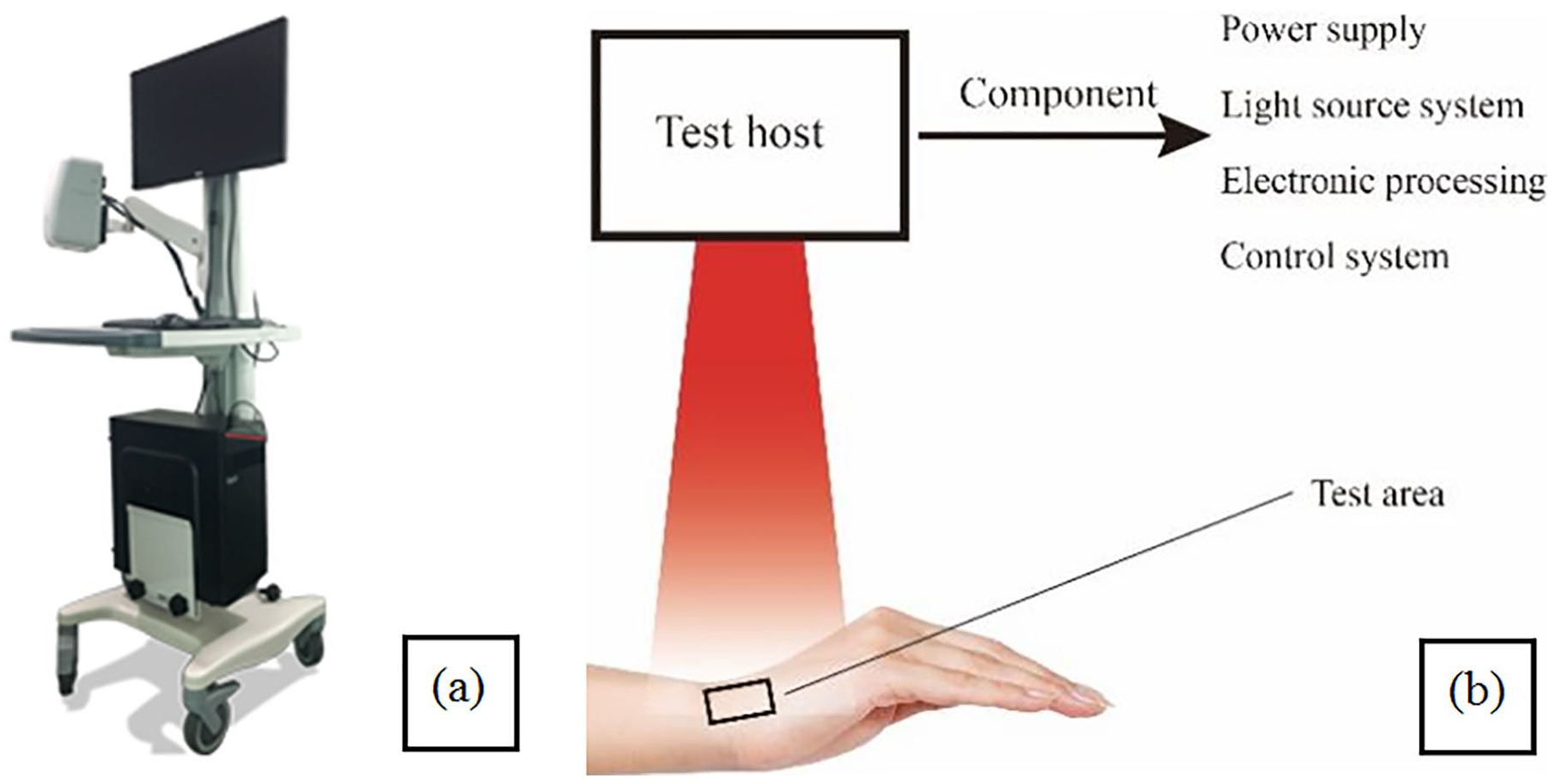
BVI projection vein finder of (a) instrument and (b) test principle.
The test principle is shown in Figure 1. The test area was 18 cm × 12 cm by applying the principle of laser speckle imaging. The host sent a laser to the surface of the object to be measured. The incident light was backscattered by the tissue surface, and the light path of the scattered light arriving at the imaging surface of the camera was different due to the uneven tissue surface. Different scattered light will produce random interference on the imaging surface, thus forming different light and dark speckle patterns. 12 After conversion by the microcirculation imaging system (MIS) in BVI Projection Vein Finder, it was displayed on the screen display to form the visible image of vein and blood vessel. The data obtained from the test cannot directly obtain the exact value of blood flow, but can directly reflect the change of blood flow perfusion volume of the tested tissue. 13
Subject conditions and test indicators
In the process of the experiment, the detection of skin temperature and blood perfusion was easily affected by the external environment and physiological factors. In order to avoid the interference of irrelevant factors, we should make preparations before testing: The fabric was placed in the standard atmospheric environment for testing to damp 24 h. To eliminate the interference of irrelevant factors, indoor lighting should be adopted. Marked the test points selected by the subjects in advance, and tried to keep the same test point for the same subject, so as to avoid the difference of test value caused by the change of test position. Before the beginning of the experiment, the subjects were first allowed to adapt to the laboratory environment, and then the subjects were required to put their right arm flat on the experimental platform covered with cloth and sit for 30 min. They were not allowed to exercise significantly, so as to minimize the microcirculation fluctuation caused by the exercise. In order to avoid psychological tension, the subjects can take appropriate and light action to maintain physiological and psychological peace.
Subject conditions: To avoid the influence of individual changes on the experimental results, 10 subjects were selected for the measurement of blood perfusion volume in this paper. To avoid gender and age differences, selected five males and five females, were required to have no cardiovascular disease or hypertension. 14 Foods richer in polyphenols can improve human glucose metabolism to a certain extent. To avoid the influence of this factor on the experimental results, the subjects are required not to eat excitatory food before the test. 15
Test index: Foreign scholars had found that due to the distribution of peripheral nerves in human limbs, they were more sensitive to environmental changes than other parts of the body. 16 Combined with the feasibility of the experiment, the selected test points should avoid visible veins, and the distance between the test points and elbow fossa should not be less than 2.5 cm, from the test points to wrist distal radioulnar joint should not be less than 2.5 cm too; the position of the test points should be determined according to knight’s anatomical map.
Determination of sample test plan
Sample specification: The shape of the sample is shown in Figure 2. The sizes of 12 samples were set according to the body shape and arm circumference of the subject, so as to ensure that the sample can wrap the right forearm of the subject without pressure. The size of the sample was (23–30 cm) × 10 cm. To reflect the influence of far-infrared polyamide fabrics on HSM promotion more accurately and truly, set perforated samples with a diameter of the middle hole of the perforated sample was 2 cm.

Perforated specimen.
Test methods and data processing: (1) Firstly, the subjects were asked to adjust the state according to the requirements of preparation before the test. (2) The test instrument was turned on, and the red laser beam was projected on the forearm. According to this, the vertical distance between the tester host and the subject’s right forearm was adjusted to make the “invalid” on the test page reach the “good” range. (3) Original value test: the subjects were tested, and the test process remained relatively static. At the marked points D1 and D2 which are shown in Figure 3, two rectangular frames of the same size were selected by using the frame selection function of the test software, and the blood perfusion volume of D1 and D2 points within 100s was measured. After the test, the phase with a relatively stable trend of blood perfusion value was selected, and the software automatically calculated this period. Then the blood perfusion value of the two test points without covering the fabric was measured. (4) Post coverage value test: the subjects were tested, and the test process remained relatively static. At the marked points D1 and D2, two rectangular frames of the same size were selected by using the frame selection function of the test software. The blood perfusion volume of D1 and D2 points within 100s was measured. After the end of the test, the phase of a relatively stable trend of blood perfusion value was selected, and the software automatically calculated this segment. Then the blood perfusion value of the two test points after covering the fabric was measured, and the subjects were required to sit for 10 min after each test.

Location map of test points.
Experimental test: the sample fabric was wrapped on the right forearm of the subject, covered for 20 min, without removing the fabric, the test was conducted directly in the skin area exposed by the perforation of the sample. The configuration of the test sample in the perforated group is shown in Figure 4, (a) is the original state of the uncovered sample, (b) is the blood flow imaging of the right forearm of the uncovered sample, (c) is the state of the covered sample, and (d) is the blood flow imaging of the right forearm of the covered sample.

Test state diagram of the experimental group: (a) uncovered specimen, (b) uncovered specimen blood flow imaging, (c) covered sample, and (d) covered sample blood flow imaging.
Calculation method of blood flow promotion multiple
The blood flow promotion ratio can reflect the ability of a fabric to promote skin microcirculation. 17 The calculation method of blood flow promotion multiple refers to the LDF detection method. 18 The original values and after coverage values were measured respectively, and the flow velocity ratio after covering (Fh/Fy) was used as the index to evaluate the blood flow promotion multiple. The specific calculation through equation (1) and equation (2),

ƒD1 and ƒD2 substitute for the blood flow perfusion volume at the D1 test point and the blood flow volume at the D2 test point. Equation (1) was used to calculate the blood flow velocity ratio.

Fh and Fy substitute for the flow velocity ratio after covering the sample and the original velocity ratio. Equation (2) was used to calculate the multiple of blood flow promotion after covering the sample.
Results and discussion
Appearance
Figure 5 shows the SEM images of CCP, GP, and OP fibers. Figure (a) to (f) are enlarged 4000 times, 1000 times, 4000 times, 1500 times, 2000 times, and 2500 times respectively. From the pictures (a) to (d), it can be seen that the surfaces of CCP and GP fibers are uneven and porous, unlike the OP shown in pictures (e) and (f) which have smooth appearances. The main reason was that CCP and GP fibers had added far-infrared nanoparticles during the spinning process which make the fibers appear porous. The existence of the porous structures can improve the moisture permeability and adsorption of the fibers, which can also increase the content of air so that the fabric has better thermal insulation. It makes the skin easy to heat up and speeds up blood flow. The transverse cross-sections of CCP, GP, and OP fibers all presented irregular polygons which increased the cohesion of polyamide fibers to a certain extent, thus making polyamide fibers have higher spinnability.

SEM images of (a) longitudinal CCP, (b) transverse CCP, (c) longitudinal GP, (d) transverse GP, (e) longitudinal OP, and (f) transverse OP.
Skin microcirculation
Test 10 subjects covered the blood flow promotion multiples of fabric, the results are shown in Table 2.
Blood flow promotion multiple of 10 subjects with fabrics covered.
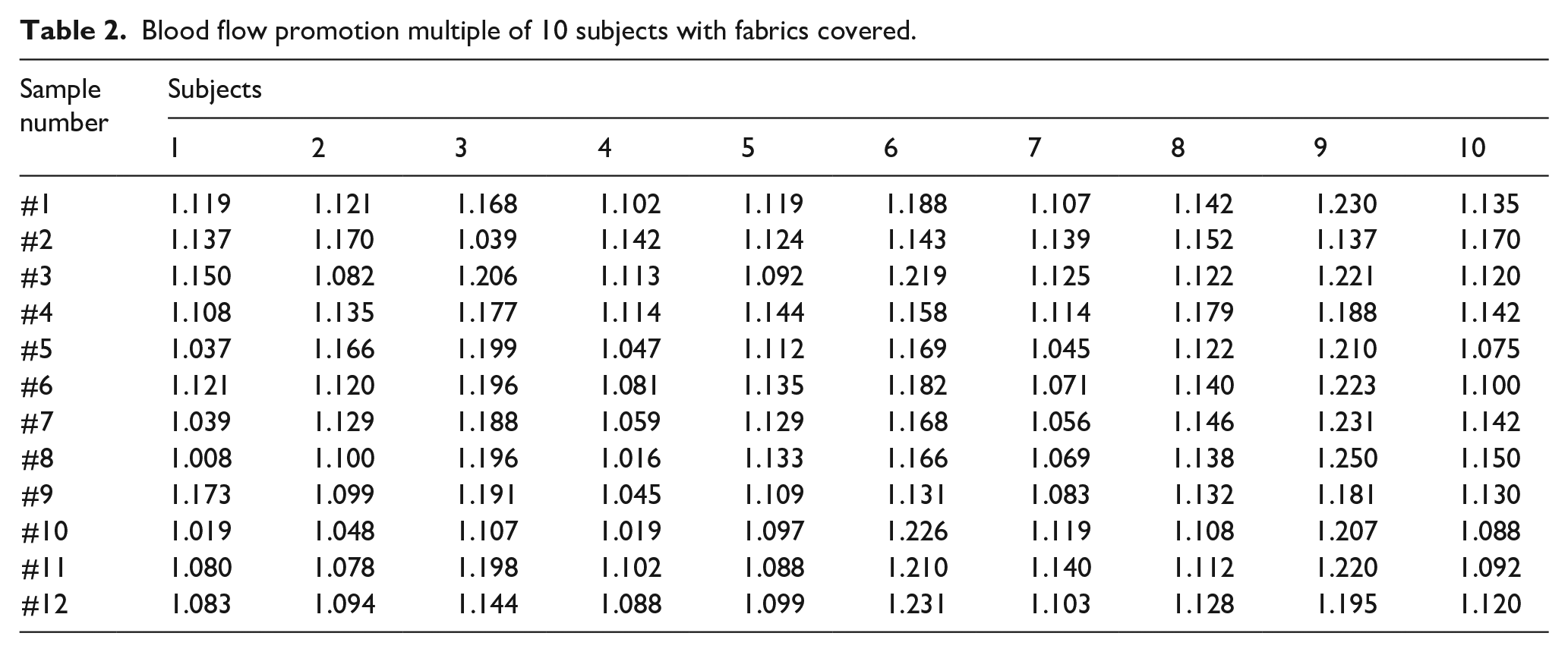
In order to analyze the influence of different far-infrared sample fabrics on the blood perfusion volume promotion multiple of these 10 subjects more intuitively, the trend chart of blood flow promotion multiple after covering different samples was made, as shown in Figure 6.
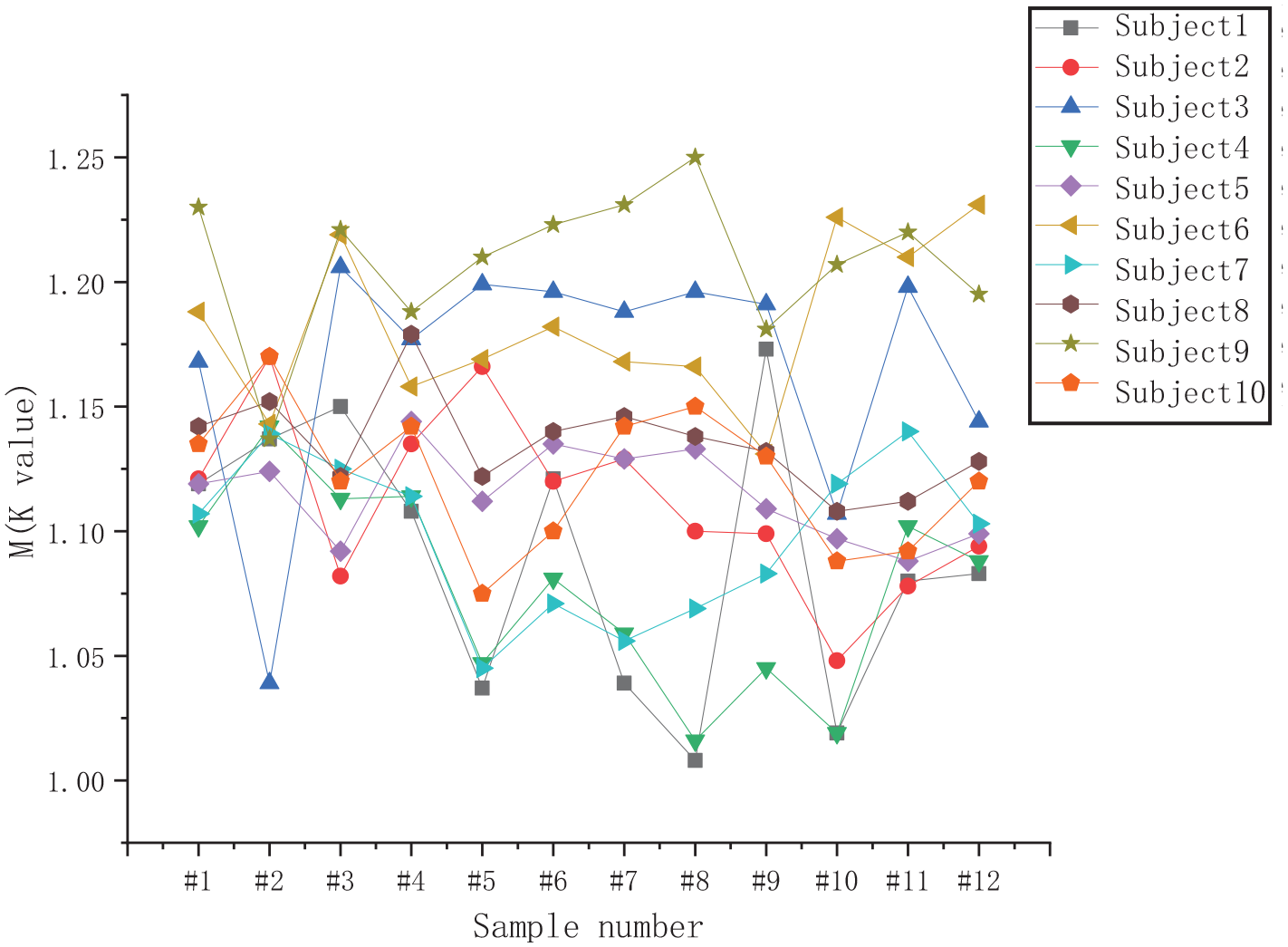
Effect of different far-infrared fabrics on blood flow promotion ratio.
According to the trend chart in Figure 6, it can be seen that the measurement results of these 10 subjects fluctuate appropriately within a certain range, and there were individual differences. On the whole, sample 5, sample 6, sample 7, sample 8, and sample 10 have low blood flow promotion multiples and were greatly affected by individual differences. Sample 2, sample 9, sample 11, and sample 12 have lower blood flow promotion multiples and were affected by individual differences. Sample 1, sample 3, and sample 4 have higher blood flow promotion multiples and were the least affected by individual differences. Among them, the blood flow promotion multiple of sample 1 was between 1.10 and 1.23, the blood flow promotion multiple of sample 3 was between 1.07 and 1.225, and the blood flow promotion multiple of sample 4 was between 1.10 and 1.16. To obtain analysis results more accurate, calculated the average value of the blood flow promotion multiples about each sample for all subjects, and the results are shown in Table 3.
Mean value of fabric blood flow promotion ratio.

The mean value of the fabric blood flow promotion ratio was analyzed by the orthogonal analysis method. The calculation results are shown in Table 4.
Orthogonal analysis table of fabric blood flow promotion multiple.

It can be seen from Table 4 that factor A, the face yarn ratio has a great influence on fabric promoting blood flow perfusion, and the weaving scheme with better fabric promoting blood perfusion effect was (A2, B1). To more intuitively understand the relationship between the level of each factor and the blood flow promotion multiple of the fabric, the changing trend of the fabric blood flow promotion multiple was drawn, as shown in Figure 7.

The trend of blood flow promotion ratio of fabric.
It can be seen from the results in the figure that: in factor A, the order of promoting multiple fabric blood flow was as follows: A1 > A2 > A3 > A4. That was, the higher proportion of CCP fiber content, the better effect of fabric blood flow promotion; factor B stitch, the fabric with flat needle yarn has stronger blood flow promotion effect.
Conclusion
In this experiment, CCP and GP yarns were selected as materials. According to the two important factors affecting the performance of seamless knitted fabrics, 12 samples were prepared based on the differences in face yarn ratio and stitch. The BVI Projection Vein Finder tested the influence of each sample on the HSM of 10 subjects. Finally, the orthogonal analysis method was used to judge the fabric process parameters of the samples with superior performance. According to the experimental results, it can be seen that factor A face yarn ratio has a greater impact on HSM, and the second was factor B stitch. When the face yarn ratio of CCP and GP was 75:25 with 1 + 3 rib stitch, the far-infrared knitted fabric has a better promotion effect on HSM. The results of this experiment were aimed at exploring the process parameters of far-infrared seamless knitted fabrics that have a better effect on promoting HSM, to provide a certain reference value of applying the process to the medical and health textile industry to develop a series of seamless knitted products with superior performance. Due to limited conditions, the samples involved in this experiment were not rich enough. In the follow-up research, the number of subjects should be increased, and clinical verification should be obtained so that the far-infrared seamless fabric can be safer and more efficient as an auxiliary treatment for related diseases.
Footnotes
Declaration of conflicting interests
The author(s) declared no potential conflicts of interest with respect to the research, authorship, and/or publication of this article.
Funding
The author(s) received no financial support for the research, authorship, and/or publication of this article.
