




Abstract
The fractal weave has a different appearance from the traditional weaves, and the fabric performances such as air and moisture comfort have not been studied. The relationship between the fabric structure and performance of the fractal weaves is not yet clear. In this paper, the corresponding fractal weaves were generated based on the fractal theory, and the corresponding fabrics were woven using raw silk as the warp yarn and cashmere/water-soluble vinylon as the weft yarn. The structural parameters, air permeability and moisture permeability were tested. The results show that fabric moisture permeability are not closely related with the three weave parameters of fractal dimension, average float length and weave coefficient. Its conduction mechanism is different from air permeability. The average floating length, fractal dimension, and its parameter combinations have a good fitting relationship with air permeability, and the polynomial fitting R2 can reach to 0.99938. The fitting formula 8 has guiding significance for the design of fabrics with certain air permeability requirements.
Introduction
Fractal theory has a wide applications in the field of textile engineering, such as natural fibers basically have super-dimensional twisted fractal structure; yarn structure, fabric pore structure, and appearance morphology also have fractal characteristics.1–3 The fractal pattern also has artistic value in textile pattern design. Fractal weaves are also designed based on fractal theory, which can be quickly generated using mathematical geometry methods and computer visualization techniques, and have a variety of styles. At present, the fractal structure was mainly designed based on the L system and the IFS theory.4–6 For example, based on the IFS theory, fractal twill weave with a unique texture effect was designed. 7 Ma 8 firstly used the multi-layer structure of fractal weaves to select different basic weaves at different levels, and generated a brand new fractal weave. The generated variable-dimensional fractal weave endowed the fractal weave with variable fractal dimensions, which effectively expanded the design space of fractal weaves. However, the above researches on fractal weaves were only for weave design and weave-ability exploration. Relevant research reports have not been retrieved on the fractal weave fabric performance such as durability, heat, and moisture comfort.
As an important parameter of fractal theory, fractal dimension has been widely used in the field of textile engineering such as the calculation of textile mechanical properties, permeability, and detection of fabric surface defects. Mahmood et al. 9 showed that in fiber-reinforced composite laminates, the distribution of fibers could be characterized by fractal dimension, and it could be used as parameters for the static and fatigue characteristics of fiber-reinforced composite materials. The fractal dimension could also be used to characterize the nanofibril structure and different carboxyl content of oxidized silk fibroin. 10 The fractal dimension was also used in the analysis of human thermal and wet comfort. For example, Shi et al. 11 showed that the coating method with the fractal dimension closest to the golden section number had the best thermal and moisture performance. Fractal theory can be used to explain that coated fabrics with the same structure had different thermal insulation and evaporation resistance under the same total silicone coating area. When the fractal dimension (D = 1.599) was close to the gold average (1.618), the best thermal and wet comfort could be obtained. 12 However, the above researches were mainly on the thermal and wet comfort with the surface coating, and the fractal characteristics of the fabric itself were not described.
Therefore, in this paper, to develop new silk fabrics with better air permeability and moisture permeability which is suitable for summer clothes, four basic structure with longer floating length were chosen, and based on fractal theory the corresponding fractal weaves were generated. To improve the elasticity and wrinkle resistance of silk fabrics, the fabrics were woven using raw silk as the warp yarn and cashmere/water-soluble vinylon as the weft yarn. After degumming and water treatment, silk and cashmere interwoven fabrics were developed. The appearance, weave parameters, air permeability and moisture permeability were tested. What’s more, it explored the influence of the weave parameters of the designed fractal weave on the moisture and air permeability, and try to establish a relationship model between the fractal dimension and the fabric permeability and moisture permeability.
Experimental
Weave design
In order to make the fabric have better air permeability and moisture permeability, Barley-corn weave, bird’s eye weave, perforated weave, and honeycomb weave were selected as the basic weaves. These four weaves all have regularly arranged long and short floats which can form holes and uneven surface in the fabrics. The holes can provide paths for air and moisture, and the uneven surface can form “point contact” with skin which can wick moisture away from the skin.
The weave charts are shown in Figure 1.

Basic weaves: (a) barley-corn weave, (b) bird’s eye weave, (c) perforated weave, and (d) honeycomb weave.
Drawing the fractal weave firstly needs to determine the basic weave of the first and second layers. The basic weave of the second layer was filled into the object weave points of the basic weave of the first layer (i.e. the organized points in the weave chart) to form a fractal weave. In order to prevent a large number of floating areas at the non-object weave point area, that is, at the latitude weave point, it is necessary to fill the latitude weave point area with filling weave. Figures 2–5 show the fractal formation process of the above four basic structures.

Fractal weave formation based on barley-corn weave: (a) first layer weave, (b) sub-layer weave, (c) filling weave, and (d) final fractal weave.

Fractal weave formation based on bird’s eye weave: (a) first layer weave, (b) sub-layer weave, (c) Filling weave, and (d) final fractal weave.

Fractal weave formation based on perforated weave: (a) first layer weave, (b) sub-layer weave, (c) Filling weave, and (d) final fractal weave.

Fractal weave formation based on honeycomb weave: (a) first layer weave, (b) sub-layer weave, (c) filling weave, and (d) final fractal weave.
Figure 2 shows the fractal weaves based on the barley-corn weave. The basic weave of the first layer was plain weave, the basic weave of the sub-layer was barley-corn weave, and the filling weave was two upper two lower right twill. Filling the barley-corn weave into the warp weave point of plain weave, and filling the filling weave into the weft weave point of plain weave, thus fractal weave based on barley-corn weave was obtained, and the number of warp (weft) weave cycles was 16. Figures 3 and 4 were fractal weaves based on bird’s eye weave and perforated weave. The basic weave and filling weave were the same as the barley-corn weave. The filling weave in Figure 5 is different from the above. The main consideration was that the honeycomb weave as the sub-layer basic weave was longer in the weft yarn float line, so, three upper one lower right twill with the longer warp yarn float line was used as the filling weave to avoid too long floating line of the final fractal weave, which would not conducive to the stability of weaving process and structure.
Fabric weave
Based on the above eight basic weaves and their corresponding fractal weaves, 150D/2 silk raw silk was selected as the warp yarn, and 80D 50/50 cashmere/water-soluble vinylon yarn was used as the weft yarn. A rapier sample loom (SL7900, Taiwan Shuoqi Industrial Co., Ltd. Company) was used to complete weave. The design warp and weft yarn density was 250/10 cm, but when weaving barley-corn weave and fractal barley-corn weave, when the weft yarn density was 250/10 cm, the weaving density was too large to be woven normally, so for the barley-corn weave and fractal barley-corn weave, the selection of suitable weft yarn density was 180 and 200/10 cm respectively.
Degumming and dissolving finishing
Raw silk degumming adopted alkaline protease degumming method. The process was as follows: firstly 1.5 owf% white base anti-staining agent (model FZ-2, Duoweikang) was added to the cold water, and then the water temperature raised to 50°C and kept it at a constant temperature. 0.85 owf% pancreas plus bleach T was added, and then the PH value of the water was adjusted to 8–9 using PH value adjuster FK831, finally 5 × 10⁻⁴ g/L alkaline protease was added. The fabric soaked in advance was put into the above solution at a bath ratio of 1:30. After constant temperature immersion for 45 min, the temperature was raised to 70° for 1 min to inactivate the enzyme, and then fabric was washed twice in clean water and dried.
During the degumming process, the water-soluble vinylon has been dissolved and no separate water-soluble treatment was required.
Calculation of similitude fractal dimension
Fractal whole S consists of S1, S2, . . .. . ., Sn which are not overlapping, and every part magnifies 1/ri can equal to S (0 < ri < 1,i = 1,2,. . .. . ., N), if ri = r, similitude fractal dimension can calculate as following,

If ri is incongruence, similitude fractal dimension can calculate as following,

For example, for the weave in Figure 1(a), Similar scaling factors was
Calculation of interlacing time and average floating length (Fj, Fw)
In a weave repeat unit, each warp yarn and weft yarn are interlacing, from floating to sinking, and then from sinking to floating, it called a interlacing. The interlacing time can calculate as following

Where,
For the irregular weave, the interlacing time for every warp or weft yarn is not equal. The average floating length can calculate as following,

The calculation of the weave coefficient C
The calculation formula of the weave coefficient proposed by HC Alemina was in the following:

Breathability and moisture permeability test
Use FX3300 LabAir Breathability Tester to test the breathability of fabrics. The test standard is GB/T5453-1997 “Determination of Breathability of Textile Fabrics.” The diameter of sample was 20 cm, and pressure was 100 Pa. After 2 min, the air permeability would be automatically displayed.
Using the YG601H computerized fabric moisture permeability meter, the moisture permeability test was in accordance with GB/T 12704.2-2009 “Testing method for moisture permeability of textile fabrics Part 2: Evaporation method.” The diameter of sample was 10 cm, and the distilled water in the cup was about 34 mL. The temperature of the moisture vapor permeability meter was set to 38°C, and the relative humidity was set to 90%. The taken out combination were weighed after 1 h and 2 h to calculate the moisture permeability.
Results and discussions
Fabric appearance
Figure 6 shows the appearance of fabric samples. Barley-corn weave was composed of hopsack weaves along a diagonal line, and a single row of opposite twill weave at another diagonal line. As shown in Figure 6(a), a granular pattern can be formed on the surface of the fabric, which is more complicated and gorgeous than other weaves. The fabric samples of bird’s eye weave and perforated weave have regular holes, as shown in Figure 6(b) and 6(c). Compared to perforated weave, the bird’s eye weave fabric sample felt more delicate. This was because the bird’s eye weave was filled with warp rib and weft rib weaves, and the floating areas of the fabric were more uniform, forming a special bird-eye-like appearance effect. On the contrary, four adjacent warp yarns (or weft yarns) are drawn and overlapped with each other, and a hole was formed in the middle in perforated weave, so the feel was rough. The sample of the honeycomb fabric is shown in Figure 6(d). It had obvious regularity, and had the appearance of irregularities like squares with higher four sides, and lower middle area. The three-dimensional sense is the strongest.

Appearance photo of fabric sample: (a) barley-corn weave, (b) bird’s eye weave, (c) perforated weave, (d) honeycomb weave, (e) fractal barley-corn weave, (f) fractal bird’s eye weave, (g) fractal perforated weave, and (h) fractal honeycomb weave.
Since the filling weaves in the fractal weaves were twills with a convergent texture, the texture of the samples of fractal weaves was more delicate than that of the basic weave, among which the fractal barley-corn weave (Figure 6(e)) and the fractal bird’s eye weave (Figure 6(f)) had obvious crepe effect. As shown in Figure 6(g), the fractal perforated fabric still had regular and obvious holes, while the fractal honeycomb weave (Figure 6(h)) had the original structure’s unevenness in the longitudinal direction. Compared with the original sample, the fractal weaves had a distinct creped appearance.
Warp (weft) count and mass
Table 1 shows the warp density, weft density, and unit mass before and after finishing of fabric samples. Comparing the data before and after silk degumming treatment, it was found that the warp and weft densities of the fabric sample were basically unchanged, and most of them had a slight increase. The degumming and water-soluble treatment reduce the mass per square meter of fabrics. It can be seen that the weight reduction of the No. 4 honeycomb weave fabric is the smallest, and the remaining fabrics were all above 24.50%. So the designed and woven parameters of eight samples were as consistent as possible, and the effect of air permeability and moisture permeability only consider the effect of weave parameters in the following.
Warp (weft) count and mass of fabric samples before and after finishing.

Table 2 shows the average warp and weft floating length, weave coefficient and fractal dimension of eight weaves. Warp and weft average floating length were the same for all weaves, so it just called floating length F in the following. Among the basic weaves, the largest average floating length was the honeycomb weave, and the smallest is the bird’s eye weave. The average floating length of the barley-corn and perforated weave were the same of 2.67; in the fractal weave, the value of float length is smaller than that of the basic weave. The smallest value is the barley-corn fractal weave and it was 1.65. The order of the average floating length was 4 > 1 = 3 > 7 > 6 > 2 > 8 > 5.
Weave parameters of fabric.
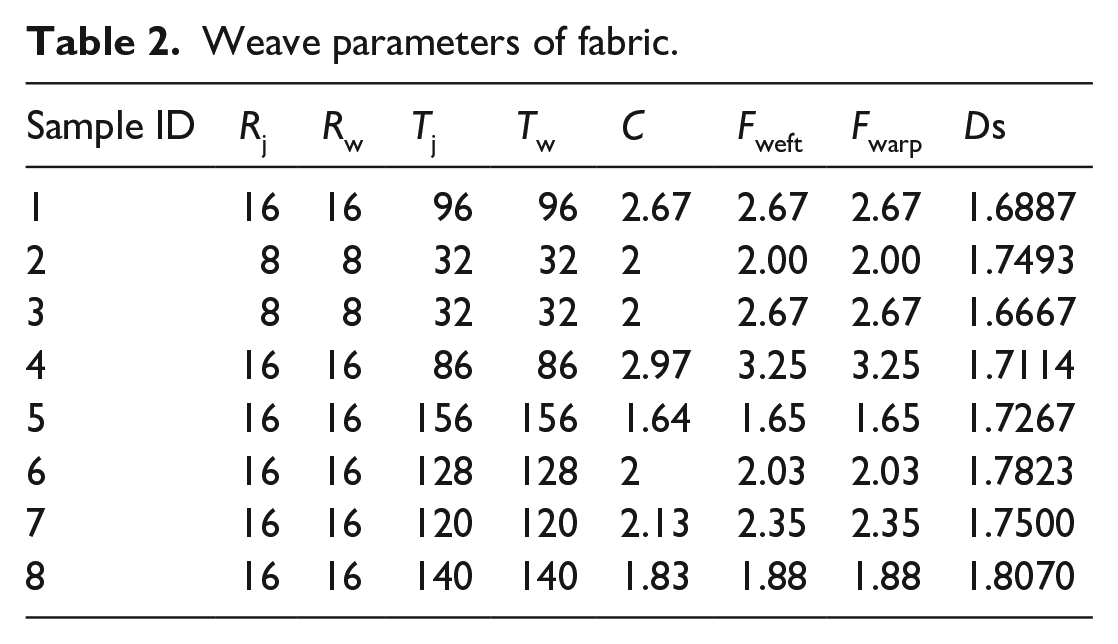
For weave coefficient C. The larger C, the looser the weave, and the tighter the converse. It can be seen from Table 2 the minimum C was the fractal barley-corn weave with the value of 1.64, indicating it was the tightest weave, and the maximum C of the honeycomb weave was 2.97, indicating it was the loosest weave. C values of fabrics 2, 3, and 6 were equal to 2, but their interweaving laws and floating length distribution were actually different. Therefore, C value can be used to describe the tightness of weaves with unequal warp and weft cycles, but the different distributions of the warp and weft float length cannot be well described.
For the fractal dimension, it can be seen from Table 2 the maximum fractal dimension of the honeycomb fractal weave was 1.8070, and the minimum fractal dimension of the barley-corn weave was 1.6887. According to the definition of fractal dimension, the fractal dimension reflects the proportion of warp weave points in the fabric structure to a certain extent, and the average float length reflects the warp weave points (or weft weave points) distribution. So F and Ds can complement each other, and can further reflect the weaveal characteristics of the fabric weave.
Air permeability
Figure 7 illustrates the air permeability of different weaves. It can be seen that the honeycomb weave had the best air permeability of 4771.76 mm/s, followed by barley-corn weave, perforated weave, and bird eye weave. In fractal weave, the air permeability performance data had a small gap, and all data were less than basic weaves. The air permeability was mainly related to the pore structure of the fabric, 13 including the cavity in the fiber, the slit hole of the fiber in the yarn and the slit hole between yarns. Under the premise that the raw materials used in the fabric and the design density were consistent, the air permeability of the fabric mainly depended on the degree of porosity of the fabric caused by fabric weaves.

Air permeability of different weaves.
Figures 8–10 show the effects of fractal dimension, average floating length and weave coefficient on air permeability. It can be seen from Figure 8 that as the fractal dimension increases, the air permeability increases first and then decreases. When the fractal dimension was 1.7114, the air permeability was the best. From Figure 9 it can be seen that as the average floating length increased, the air permeability increased approximately linearly. From the linear fitting results, the goodness of fit was R2 = 0.81787 (Prob > F = 0.00127) indicating that the linear fitting effect was good and the linear equation was significant.

Relationship between fractal dimension and air permeability.

Relationship between average floating length and air permeability.

Relationship between weave coefficient and air permeability.
It can also be seen from Figure 10 that as the weave coefficient increased, the air permeability also increased roughly linearly. From the linear fitting results, the goodness of fit was R2 = 0.72323 (Prob > F = 0.00461), indicating that the linear fitting effect was not bad, and the linear equation was significant. Comparing Figures 10 and 11, it can be seen that the linear correlation between air permeability and weave coefficient was less than the linear correlation with the average floating length.

Moisture permeability of different weaves.
From the above fitting results it can be seen that the single factor fitting of air permeability had not yet achieved a superior effect. Therefore, the above three weave parameters: weave coefficient C, average float length F and fractal dimension Ds were combined, and their fitting effects on air permeability were analyzed. Among them, the best fitting effect with weave coefficient participation was shown in Equation 6. The fitting effect was not good. Instead only the two parameters of average float length and fractal dimension fit better, as shown in equations (7) and (8). The R2 of the two fitting methods were greater than 0.9, and the fitting effect of equation (8) was 0.99938. Therefore, formula 8 can well predict the air permeability of fabrics, and can also be used to guide the design of the fabric structure with certain air permeability requirements.


Moisture permeability
Figure 11 shows the moisture permeability of different weaves. It can be seen the moisture permeability of barley-corn weave was the best, which was 229.93 g/m2, and for other weaves they were all below 190 g/m2. Figures 12–14 illustrated the relationship between fractal dimensions, average floating length and weave coefficient on moisture permeability respectively. It can be seen from Figures that there was no obvious regular relationship between the moisture permeability and the above three weave parameters respectively. The fitting results also showed that there was no good fitting relationship between the combination of the three weave parameters and the moisture permeability. The maximum R2 was 0.30086 and Prob > F = 0.17624.

Relationship between fractal dimension and moisture permeability.
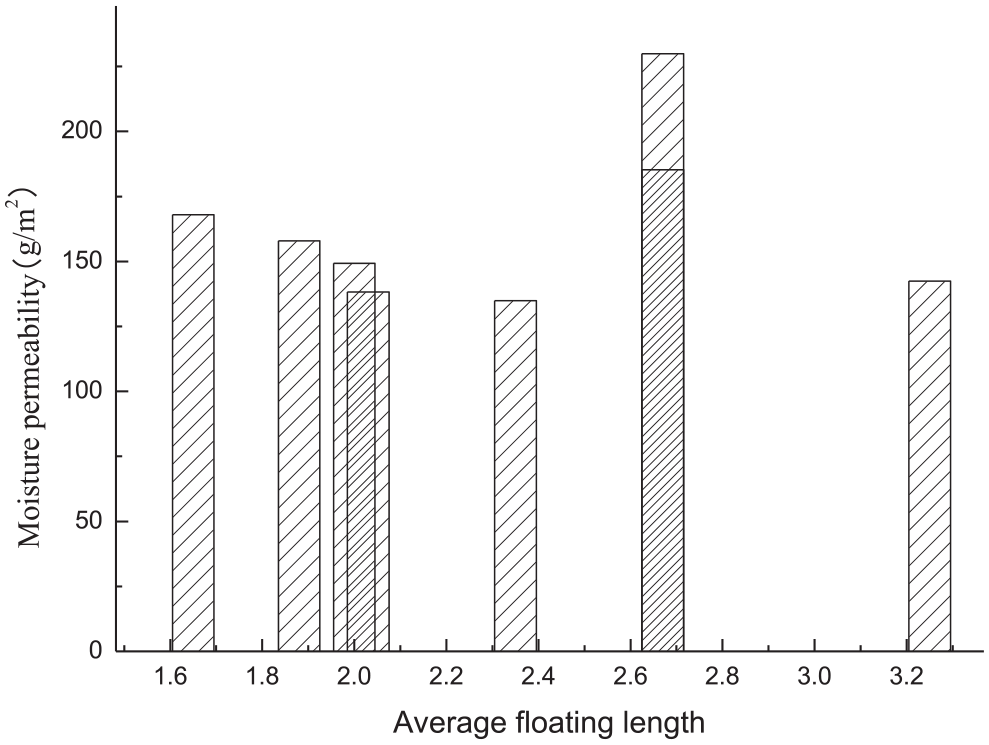
Relationship between average floating length and moisture permeability.

Relationship between weave coefficient and moisture permeability.
From the above analysis it was clear that there was a certain degree of difference between the transmission mechanism of moisture and air permeability. The air permeability of the fabric is mainly achieved through the holes in the fabric. Under the pressure difference between the two sides of the fabric, the air is transmitted from the surface of the fabric to the other side. The essential influencing factors are the pore size and structure. The moisture permeability of the fabric not only depends on the pore transmission, but it is mainly related to the moisture absorption capacity of the fabric material and the capillary effect inside the fabric. In addition, when the above-mentioned woven fabric structure is relatively tight, the pores of the fabric become smaller, and the influence of the size structure decreases. The liquid-vapor transmission means that it first absorbs moisture through the fiber itself, then condenses on the fiber surface and internal pores, and then transfers to the outer surface of the fabric through the wicking effect to evaporate. Therefore, the three weave parameters of fractal dimension, average floating length and weave coefficient were not closely related with moisture permeability.
Conclusions
Compared with the basic weave, the texture of fractal weave was more delicate, and all had obvious crepe effect.
The maximum weave coefficient of the honeycomb weave was 2.97, and the average float length was 3.25, indicating that the weave was the loosest, the average floating length was the longest, and the air permeability was also the largest, which was 4771.76 mm/s. The fractal barley-corn weave had the smallest weave coefficient of 1.64, and the average floating length was also the smallest of 1.65, indicating that the weave was the tightest and the permeability was also the smallest. The moisture permeability of barley-corn weave was the best, and there was no clear corresponding relationship with weave parameters.
The R2 of the average float length and fractal dimension and its parameter combination and permeability can reach 0.99938. Formula 8 had certain guiding significance for the design of fabric structure that requires breathability.
Footnotes
Declaration of conflicting interests
The author(s) declared no potential conflicts of interest with respect to the research, authorship, and/or publication of this article.
Funding
The author(s) disclosed receipt of the following financial support for the research, authorship, and/or publication of this article: This work was supported by Beijing Institute of Fashion and Technology under Young Backbone Teacher Growth Support Plan of [BIFTQG2012]; scientific research project of Beijing Institute of Fashion Technology [2020A-09]; Educational Reform Project of Beijing Institute of Fashion and Technology [JGQ1807]; College Student Innovation and Entrepreneurship Training Project 2020.
