




Abstract
Concrete Canvas (CC) is a 3D spacer fabric-reinforced cement-based composite, prepared through filling cement-based composite powder into fabric via the porous surface of 3D spacer fabric. When hardened by water, CC forms a water-proof, fire-resistant, and durable concrete layer with outstanding mechanical properties. So far, CC has been applied in inflatable tents, slope protection, structure reinforcement and repair, ditch lining, and other engineering projects, as well as furniture and artwork design. Existing studies on CC primarily focus on the modification and optimization of its component materials, and CC reinforcement using externally bonded FRP and aluminum flakes. CC has a broad application and an enormous application potential in emergency engineering, such as the protection of emergency tents and shelters, emergency repair and construction of airport pavement and positional projects; however, it is necessary to improve the compressive strength, flexural strength, wear resistance, anti-penetration performance, and base course bond performance of CC. To that end, research from the perspectives of modifying CC component materials, reinforcement of CC by externally bonded FRP, the improvement of the anchorage method, and the optimization of anchoring primers can be carried out.
Keywords
Introduction
Concrete Canvas (CC), also called Concrete Cloth, is a 3D spacer fabric-reinforced cement-based composite, created by filling cement-based composite powder into the porous surface of 3D spacer fabric and applying a layer of sealant on the lower surface of the fabric after compaction. For storage and transport, CC can be made into coils. CC can also be flexibly tailored and deformed to fit various working planes like canvas, and it can also be directly sprayed with water for hardening and molding. After molding, CC forms a water-proof, fire-resistant, and durable concrete layer with controllable curing time, adjustable thickness, and outstanding mechanical properties (Figure 1).1–4 See its mechanism in Figure 1.

Principle of making concrete canvas.
CC was invented in 2005 by British inventors Brewin and Crawford. At that time, there was a need for a type of semi-permanent tent which could be built at low cost, had fast molding, and was resistant to wind, rain, snow, and other loads. Finally, 3D spacer fabric-reinforced cement-based composite was adopted (Figure 2). Tents of this type adopt the same lining adopted by ordinary inflatable tents, and are covered on the outside by CC. These tents have all of the advantages of inflatable tents (i.e. low cost, easy storage and transport, convenient construction, high assembled building strength, fine protective performance, long service time, and good indoor environment), and can completely satisfy the demands for accommodation and infirmaries in emergency rescue, disaster relief, and other applicable scenarios. 5
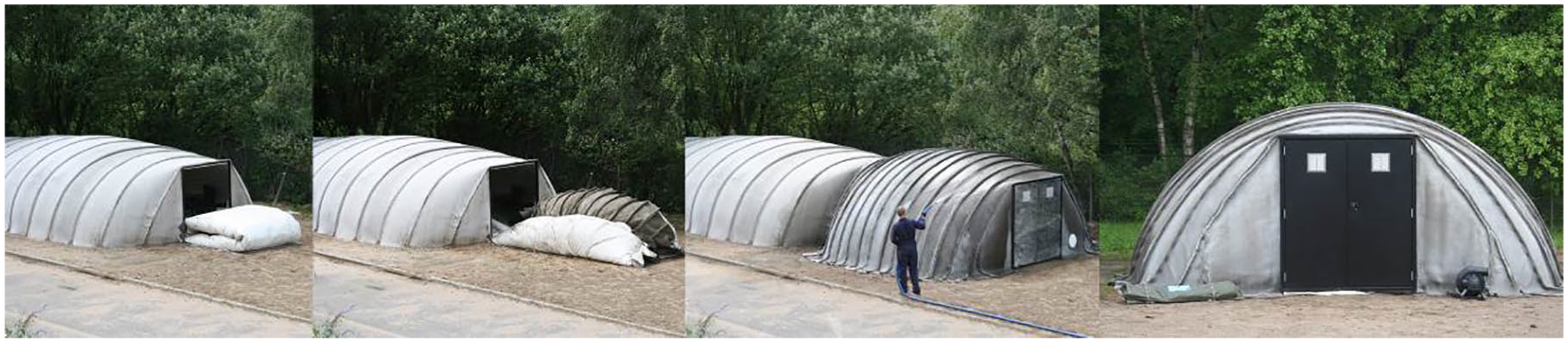
Concrete canvas tent.
CC is a composite material composed of cement matrix and 3D spacer fabric. According to the strength theory of composite materials, the performance of CC is determined by the properties of cement matrix, the strength of 3D spacer fabric itself and the interfacial adhesion between them. The main influence of cement matrix is cement characteristics, filling quality, and additives. In order to ensure the cement matrix is filled with uniform density, vibration can be added when filling cement matrix in 3D space fabric to ensure that the cement matrix is full of fiber layer. When the mass of concrete canvas does not increase after vibration, it can be considered that the cement matrix has been filled and compacted. As is shown in Figure 3, the 3D spacer fabric is a kind of sandwich structure, in which the surface layer of one fabric is mesh fabric, and the other is designed as non-mesh fabric. The spacer yarn connects the upper and lower surface layers.1–5

Schematic diagram of 3D spacer fabric.
The properties, volume fraction and geometric pattern of fabric have important influence on the properties of composites. The geometric characteristics of fabric have an important influence on the interface between the fabric and the matrix material. On the one hand, it can increase the interface performance, so that even if the fiber with low elastic modulus is used, the strain hardening behavior of the composite can be produced. On the other hand, it can sharply reduce the strengthening efficiency of high-performance bundled yarn. Knitted, woven and nonwoven methods can be used to form the desired fabric pattern. The strengthening mechanism is: when the matrix cracks, the fiber can transfer the stress at the crack, so that the stress borne by the matrix disperses to the fiber, so as to increase the strength of the composite. On the other hand, the fiber can enhance the toughness of the cement-based composite material, which is due to the deboning and pulling-out behavior of the fiber with the matrix after the matrix cracks, so as to increase the energy absorption of the composite material.5–9
CC is fabric-reinforced concrete with unique characteristics4–9: (1) Rapid strength formation: whether sprayed with or immersed in water, existing commercial CC can uniformly achieve an ultimate strength of at least 80% after 24 h; the hardening time of CC can be regulated through adjusting the concrete material ratio. The 10 day compressive strength, compressive modulus, flexural strength and flexural modulus of Concrete Canvas Company’s commercial products in UK can reach 40 MPa, 1.5 GPa, 3.4 MPa, and 0.18 GPa respectively. 5 By optimizing the cement-based composite and 3D spacer fabric, Bao prepared CC with 10-day compressive strength of 40 MPa, bending strength of 5 MPa and compressive modulus elasticity of 1.6 GPa. 4 (2) Simple and convenient construction: Having been made into coils, CC can be cut and tailored with a knife or other simple tools before being sprayed with water; by virtue of its easy deformation, CC can form irregular shapes form integral wholes with soil masses, concrete members, and other reinforced bodies by means of anchorage via epoxy resin. (3) Flexible and diverse specifications: The rolled CC renders it possible to make it into either big rolls, or small ones movable by one person. This design is especially significant for emergency repair and construction projects imposing strict requirements for machinery, manpower, and time, and for many other application scenarios. The thickness of CC can be modified through adjusting the thickness of the 3D spacer fabric. Currently, commercial CC has a thickness of 5–20 mm. (4) Good structural performance: 3D spacer fabric has a sound reinforcement constraint effect on concrete and can inhibit crack propagation, improve its integrity, and absorb the impact energy. (5) Water-proof, fire resistance, and corrosion resistance: Generally, the water-proof performance of CC substrate can be guaranteed through adopting a water-proof material; its corrosion resistance and UV irradiation resistance can be guaranteed through modifying and strengthening the 3D spacer fabric and substrate. The cement based composites have good flame retardancy, and the three-dimensional spacer fabrics can also have good flame retardancy by selecting appropriate fiber materials and modifying fibers. (6) Environment friendliness, durability, and economical efficiency: CC is characterized by low cement consumption and good environment friendliness, and when used as a substitute for shotcrete in slope protection and other scenarios, CC can effectively reduce the health hazards to construction workers. CC also has high wear resistance and durability; compared to ordinary concrete, CC can effectively reduce the reliance on large machinery and personnel, especially in field engineering. In regions with heavy traffic, using CC in construction can reduce the occupation of roads, thus effectively lowering construction cost.10–18
However, CC also has some shortcomings such as weak compressive strength, flexural tensile strength, shear strength and penetration resistance. Fiber reinforced composite (FRP) has the advantages of light weight, high strength, good corrosion resistance, large plastic deformation, strong design ability, and good fatigue resistance. It is widely used in the field of civil engineering to improve the bending and shear strength of concrete structures or components.19–21 Therefore, strengthening concrete canvas with FRP can effectively make up for the shortcomings of its weak strength and penetration resistance.
The above analysis on the characteristics of CC suggests that it has a broad potential application scope. In fact, since being invented in 2005, CC has been extensively applied in more and more scenarios, mainly covering CC tents, slope protection, structure reinforcement and repair, and ditch lining, as well as furniture and artwork design. In 2018, ASTM International released a guideline on the field preparation, layout, installation, and hydration standard of geosynthetic concrete composite mat (GCCM), which can be seen as a milestone in the promotion of CC in engineering applications. In 2019, ASTM released the specification for testing the flexural strength of GCCM using the three-point bending test, suggesting that CC application has been very thorough.22–24
Notwithstanding the extremely broad application prospects of CC, especially in emergency engineering, there is still a lack of studies on CC, and the studies that do exist are not up to date; in particular, with regard to the special demands of emergency engineering, targeted modifications should be introduced. For this reason, identifying the application and research status of CC and analyzing its application prospect and modification in terms of emergency engineering is necessary. This will be of vital significance for carrying out follow-up studies on CC, expanding its application scope, raising its research level, and, more importantly, improving construction efficiency and quality of emergency engineering.
Application status of CC
CC tents
As can be known from “Introduction,” CC was first invented to satisfy the demands for semi-permanent tents in emergency rescue and disaster relief. Since then, CC tents have been widely used. By adopting alkali-free glass fiber wire cloth as fire-proof coverage, it is possible to improve the fire-proof performance of CC; by adding modified polyester fiber and water-absorbent resin in the cement-based composite, its resistance to penetration, frost, impact, and corrosion can also be enhanced (Figure 4). See the interiors of a CC tent and the test on its protective performance in Figure 4. 25

Protective performance test and interior view of concrete canvas tent.
Slope protection
Currently, shotcrete is extensively used for slope protection. Compared to shotcrete, CC can avoid the generation of dust and lower the level of construction noise during slope protection, thus alleviating health hazards to construction workers and interference of the surrounding environment. In addition, CC has lower demands for machinery and skill level of construction workers, making construction more convenient. CC also helps to significantly reduce construction time and lower construction cost. The revetment constructed with CC is uniform in thickness, and a one-time construction can cover a slope, slope-top drainage ditch, and slope-toe drainage ditch, with high integrity. The reinforcement effect of CC can also improve slope stability during seismic action.26–28 Jongvivatsakul et al.29–31 from Chulalongkorn University in Thailand replaced the bentonite in a bentonite mat (GCL mat) with cement to enhance mat strength and stiffness, prepared GCCM, and experimentally studied its tensile strength, flexural strength, puncture resistance, and frictional behavior. They found that GCCM could be used for soil slope protection. Figure 5 shows an engineering example of using CC for slope protection.

Engineering example for slope protection.
Structure reinforcement and repair
At present, CC is commercially available for the protection of submarine pipelines and the reinforcement of mine walls (Figures 6 and 7). Studies have also been launched to explore the possibility of using CC for the reinforcement and repair of concrete members and retaining walls. Emad from American University in Cairo used CC for the repair of concrete beam members, performed three-point bending tests on beams, and recorded their deflection. Taking the flexural strength of beams as the evaluation index, Emad tested the flexural strength of beams before and after CC reinforcement, and the effects of three reinforcement methods (i.e. anchorage, epoxy resin bonding, and cement slurry bonding) between CC and concrete members. As can be seen from test results, CC can effectively improve the flexural strength of concrete beam members; epoxy resin bonding has the most significantly improves the flexural strength of beams. CC is completely applicable to the temporary and rapid repair of concrete members. 32

Underwater pipeline protection.

Reinforcement of mine wall.
Cao reinforced PVC tubes and concrete columns using CC, performed flattening tests, axial compression tests, and three-point bending tests on composite tubes, and carried out compressive performance tests on composite tube-confined concrete. According to test results after CC reinforcement, compared to PVC tubes, composite tubes saw their ring stiffness, ultimate compressive capacity, and ultimate flexural capacity improved by 261.85%, 82.79%, and 106.15%, respectively. The strength and ductility of CC-reinforced composite tube-confined concrete were also significantly enhanced.16–18
Niu combined CC and CFRP in order to reinforce concrete columns, aiming to solve the problems of inadequate crack resistance and failure to effectively prevent concrete corrosion by corrosive mediums when CFRP is used alone for reinforcement. Results showed that the reinforcement effect of CC greatly reduced the concentration of CFRP corner stress, expanded the specimen’s effective confinement zone, and gave better play to CFRP reinforcement on concrete. The ideal number of CC reinforcement layers would be two. 33
Ditch lining
By virtue of its rapid strength formation, simple and convenient construction, flexible and diverse specifications, and other advantages, CC is extremely suitable for use as ditch lining, especially in projects requiring fast construction and facing severe operating conditions. Presently, CC has been extensively used in ditch lining projects at abroad (Figure 8). 5 See some typical engineering examples in Figure 8.

Engineering example for ditch lining.
Furniture and artwork design
CC is safe, environment-friendly, and characterized by low concrete consumption, fast strength growth, high structural strength, and flexible and convenient use. Through combining these advantages with the idea of modular design, Dutch designer Erasmus Scherjon creatively integrated metal frameworks with CC to design outdoor double chairs in 2010. So far, many furniture designers and artists have applied CC in furniture and artwork design, effectively reducing production cost and creating diversified styles through full mixing with textile art. Figure 9 shows some examples of artwork and furniture based on CC design.34–37

Example for furniture and art design.
As can be seen from the above analysis, by virtue of its advantages, CC is being more and more widely applied; however, it also has disadvantages, such as low initial and post-hardening apparent density, high porosity, inadequate flexural strength, insufficient compressive strength in the thickness direction, and poor anti-penetration performance. Considering that these disadvantages have restricted the further promotion and application of CC, targeted material modifications and reinforcement are needed to improve existing CC.38–43
Research status of CC
Modification of component materials
In view of the low post-hardening apparent density and high porosity of commercial CC, Cao probed into the modification of cement, and tested Portland cement, magnesium potassium phosphate cement, and sulfate-aluminum cement. Considering the expansibility of anhydrite, Cao also compared the effects before after adding anhydrite, and adopted 100% polyester fiber fabric cloth. According to the results, the CC adopting sulfate-aluminum cement as matrix had the highest tensile strength. The compactness of the CC adopting 80% 725 sulfate-aluminum cement + 20% anhydrite as matrix could reach as high as 99.7%.16–18
Guo investigated the application of magnesium-phosphate cement as matrix in CC and achieved a relatively high strength; however, the samples were susceptible to halogenation, efflorescence, and excessively fast setting as well as controlling the raw material indices was difficult. 3 Bao comparatively studied the influence laws of five cements used as matrix (i.e. magnesium-phosphate cement, sulfate-aluminum cement, magnesium-chloride cement, high-alumina cement, and Portland cement) on the compressive strength of CC, and found that the CC adopting high-strength sulfate-aluminum cement + anhydrite as matrix had the highest compressive strength, and that its 10 d compressive strength could reach 40 Mpa. 4 Based on the above results, Han used semi-hydrated gypsum (in place of anhydrite) + high-strength sulfate-aluminum cement as matrix to prepare CC, found that the CC prepared in this manner had a 10 d compressive strength of above 40 Mpa, and achieved a shorter setting time, a higher fineness degree, and a greater strength improvement; however, specimens prepared according to this formula had a poorer strength repeatability. 2 Han et al.14,15 also investigated the influence of the geometric shape of 3D spacer fabric on the tensile properties of CC, and performed tensile tests on 3D spacer fabric-reinforced CC specimens based on five different geometric shapes. It was found that N15 3D spacer fabric-reinforced CC had the best tensile properties in terms of tensile strength, reinforcement efficiency factor, and crack propagation. Also, N15 3D spacer fabric-reinforced CC makes convenience for production and packaging.
Zhang et al. 13 explored the effect of high-alumina cement + gypsum for improving the properties of CC. High-alumina cement and an appropriate dosage of gypsum could achieve a CC strength that exceeded the strength of the CC adopting sulfate-aluminum cement as matrix. Compared to the high-alumina cement adopting calcium aluminate (CA) as the main mineral phase, the system of high-alumina cement + semi-hydrated gypsum adopting C12A7 as the main mineral phase could realize better strength development, formula designability, and dry shrinkage property, with an optimal gypsum dosage of 20%–30%.
External reinforcement of CC
Zhang 1 proposed to externally bond FRP on CC for reinforcement, compared the tensile, flexural, shear, and anti-penetration performance of CC before and after FRP, and found that CC saw substantial improvements in tensile, flexural, and shear strength after being reinforced by externally bonded FRP. To be specific, after reinforcement, CC tensile strength reached 8.74 MPa in the warp direction, and 8.76 MPa in the weft direction, that is, increases of six and nine times compared to pure CC, respectively; its flexural strength reached 50.86 MPa in the warp direction and 42.86 MPa in the weft direction, that is, increases of 20 times compared to pure CC in each case. According to ballistic impact test results, the confinement and deformation effects of 3D spacer fabric were the main factors influencing the absorption of impact energy, and CC anti-penetration performance could be significantly improved either through increasing the number of CC layers or through adopting FRP reinforcement.
Li et al. 11 came up with the idea of improving CC tensile strength with externally bonded aramid fiber reinforced polymer (AFRP), tested the tensile and shear strength of CC after AFRP reinforcement, and built a finite element model to compare CC strength before and after AFRP reinforcement and the stability of shotcrete revetment with different curing periods in rain and other severe environments. Results revealed that AFRP-reinforced CC could meet the protection requirements of slopes <10 m in height, and that AFRP-reinforced CC would be more suitable for slope protection projects requiring fast construction and facing rain or other severe environments. Li et al. 12 also explored the applicability of CC reinforced by carbon nano tube (CNT)-modified ultra-high molecular weight polyethylene (UHMWPE) unidirectional fabric to the design of retaining walls and found that reinforced CC was applicable to reinforced earth retaining walls 3–10 m in height, and a reasonable reinforcement spacing is 0.5–1 m.
Ahmad and Pasnur 44 from the Indian Institute of Technology reinforced CC using an Aluminum Mosquito Sheet (AMS), tested the flexural strength of reinforced CC based on three-point bending test, and found that the flexural strength of reinforced CC reached 23 MPa (i.e. a growth of nearly ten times compare to pure CC). Compared to other reinforcing materials (such as stainless steel and FRP), aluminum is cheaper and more flexible, and has higher corrosion resistance.
Theoretical and numerical simulation of CC
Based on the assumption that the confinement effect of 3D spacer fabric on dry shrinkage is produced by the joint action of all of its components, Zhang et al. 13 established a theoretical model for the influence of 3D spacer fabric on the dry shrinkage of CC, obtained a simplified expression for the maximum tensile stress produced in CC, and performed dry shrinkage tests on CC to verify the correctness of the theoretical model. Results indicated that the value predicted by the model fit well with the test value, and the inhibitory effect on the dry shrinkage of CC was primarily provided by the spacer yarn.
Fayyaz et al. 45 from Imam Hussein University (Iran) experimentally studied the protective performance of CC in resisting near-ground explosions, created a finite element model to analyze the stress, crack, and deflection development of CC tents under explosive loads, and found that CC of appropriate thickness effectively improved the protective performance of tents under explosive loads. However, the research conducted by the Netherlands armed forces reached a different conclusion. To test the applicability of CC tents at the front lines of combat, the Netherlands armed forces constructed a finite element model to investigate the bearing capacity of CC tents under loads such as wind, snow, and explosions and found that CC tents could resist a maximum wind speed of 60 m/s and a maximum snow load of 16 kN/m2, but could not withstand mortar or bullet attacks, or provide adequate protection for soldiers fighting at the front lines. 46 It can be concluded that CC can resist certain blast impact load, but its direct resistance to the penetration of heavy weapons is limited and needs to be strengthened. In addition, due to the limitations of current simulation technology, numerical simulation cannot completely restore the mechanical characteristics of CC under blast load. Therefore, in order to determine the protective characteristics of CC, field test is still a necessary means.
Jirawattanasomkul from Kasetsart University equated GCCM to concrete reinforced by externally bonded FRP; referring to the FRP-reinforced concrete bond-slip models proposed by Dai and Ueda. Jirawattanasomkul et al. put forward a GCCM flexural-tensile constitutive model, and revised the finite element model using flexural test data. The load-displacement curve predicted by the model fit well with test results; however, it should be noted that this model only applies to small-strain problems. In slope stability and deformation analysis, especially under tensile and impact loads, large-strain problems are usually inevitable. 29 To solve the large-strain problems of GCCM under tensile and puncture stress, Jirawattanasomkul came up with a 2D nonlinear finite element model, which can be used to predict the stress and strain of GCCM after initial cracking and yielding and provide a basis for engineering design and practice.31,47,48
Application prospect of CC in emergency engineering
Protection of emergency tents and shelters
In emergency operations, tents are needed for both personnel and equipment. When an emergency operation is expected to last for a while, CC, by virtue of its strength and durability, can guarantee long-term service and is extremely suitable for the protection of emergency tents and shelters. For emergency tents and shelters used at the front lines, the ability to withstand wind, rain, snow, and other natural loads is only a basic requirement, as they must also be designed with sound fire-proof performance and protective performance. However, according to the results of the test carried out by the Netherlands armed forces on tent and shelter protection using CC, commercial CC is not currently capable of fully satisfying emergency demands. Figure 10 shows the tests on tent and shelter protection with CC conducted by the British armed forces and Netherlands armed forces. In 2008, the British armed forces carried out a small-scale test on CC-based shelter protection at the front lines of Afghanistan, which demonstrated the satisfactory effect of CC; later they purchased another 5500 m2 CC for front-line shelter protection.38–42 In 2011, the Netherlands armed forces investigated the reinforcement and protection of tents and shelters using CC and found that CC tents could resist loads (such as wind and snow) and light weapons but could not withstand mortar or bullet attacks or provide adequate protection for soldiers fighting at the front lines; hence, CC was recommended for use only in accommodation, canteen, and infirmary scenarios. 46

Test for tent and shelter protection.
In brief, to use CC for front-line emergency engineering protection, it is still necessary to strengthen its anti-penetration performance, possibly through modifying the component materials (3D spacer fabric and cement-based composite) of CC, and through enhancing the protective performance of CC-reinforced works using externally bonded materials with a strong anti-penetration performance.
Emergency repair and construction of airport pavements
Airports serve as essential platforms and support for air combat, and are commonly the primary target of attack by both sides in a war. In this context, one of the keys to winning a war lies in the ability to provide emergency repair for an airport under attack, open another front based on combat intention, and ensure the successful takeoff of warplanes.49–52 Currently, the emergency repair of airports primarily relies on the combination of flying object refill, graded broken stones, roller compacted concrete, and other base courses with glass FRP pavement slabs and assembled aluminum pavement slabs.53–57 However, with the use of cluster bombs, the traditional combat mode based on air bombardment or “spotted attack” by heavy guided munitions has been fundamentally transformed, and the destruction of targets has been characterized by “large scope, serious damage, and long blockade.” In this case, existing emergency repair and construction materials can no longer fully cope with new repair needs, and novel emergency repair materials and construction methods are in urgent need.58–62 Considering that CC can be tailored at will into different shapes before hardening and that a coil of CC can provide a sufficiently long pavement distance, CC perfectly suits the emergency repair demands of airport and airdrome pavement. However, before using CC for the emergency repair and construction of airport pavements, two questions must be answered: (1) how can the compressive strength, flexural strength, and wear resistance of CC be improved; (2) how can the bond performance with the base course be enhanced. The first question can be answered through modifying CC component materials and externally bonding reinforcing materials. The solutions to the second question include the optimization of anchoring primer, and the improvement of anchorage method.
CC also presents a great potential for application in helidromes. When a helicopter takes off or lands in the field, the turbulence generated by its rotors will bring dust into the air, posing significant hazards to human health. Dust also speeds up wear and damage to vehicles, helicopters, and other equipment. Using CC for the construction of helidrome pavements not only accelerates construction pace and lowers construction cost, but also inhibits the generation of dust and guarantees the safe take-off and landing of helicopters. 63
Emergency repair and construction of positional projects
During wartime, as required by combat tasks, it is necessary to transfer some emergency equipment (such as radars and air defense missiles) between different locations. However, in many regions, there are no qualified roads available, which raises needs for rapid road construction. In addition, radar sites and ground-to-ground missiles also make demands on site treatments, such as flattening, compaction, and curing.64,65 Relying on a series of advantages, CC presents a broad application prospect in the rapid pavement of low-cost roads, fast hardening of battle fields, and quick construction of drainage ditches. The British armed forces and Japanese armed forces also tested the applicability of CC to site hardening and drainage ditch construction (Figure 11) and used CC for the emergency repair and construction of positional projects such as low-cost roads, radars, and ground-to-ground missiles. It was found that the problems encountered in this scenario were similar to those encountered in the emergency repair and construction of airports.

Examples for the construction of position engineering.
Conclusions and suggestions
(1) CC has a series of advantages, including rapid strength formation, simple and convenient construction, flexible and diverse specifications, good structural performance, water-proof, fire resistance, corrosion resistance, environment friendliness, durability, and economical efficiency. However, CC also has disadvantages, such as low post-hardening apparent density, high porosity, and inadequate anti-penetration performance.
(2) Current CC applications include covering inflatable tents, slope protection, structure reinforcement and repair (submarine pipelines, mine walls, and concrete beam-column members), ditch lining, and other engineering projects, as well as furniture and artwork design. CC is especially suitable for projects requiring fast construction and rapid strength formation and facing irregular working planes and severe working environments.
(3) Aiming at the disadvantages of CC, Existing studies in this field primarily concentrate on the modification and optimization of CC component materials (cement-based composite and 3D spacer fabric), CC reinforcement by externally bonded FRP and aluminum flakes, and the simulation analysis of CC characteristics through finite element modeling. However, these studies are still limited, and not thorough enough. The finite element model directly refers to the FRP-reinforced concrete bond-slip model.
(4) CC has broad application prospects and an enormous application potential in the protection of emergency tents and shelters, the emergency repair and construction of airport pavement, the emergency repair and construction of positional projects, and other emergency engineering projects. However, CC compressive strength, flexural strength, wear resistance, anti-penetration performance, and base course bond performance still needs to be improved. To achieve this goal, the following efforts can be made: modification of CC component materials, reinforcement of CC by externally bonded FRP, improvement of anchorage method, and optimization of anchoring primer.
(5) In order to promote the application of concrete canvas in engineering, it is necessary to carry out in-depth research from the aspects of tensile strength characteristics, durability, strengthening mechanism, and the construction of constitutive model between fabric performance, matrix performance and CC performance.
Footnotes
Declaration of conflicting interests
The author(s) declared no potential conflicts of interest with respect to the research, authorship, and/or publication of this article.
Funding
The author(s) disclosed receipt of the following financial support for the research, authorship, and/or publication of this article: This study was supported by the Natural Science Basic Research Program of Shaanxi (grant number 2020JQ-474); the Jiangsu Planned Projects for Postdoctoral Research Funds (grant number 2020Z321) and China Postdoctoral Science Foundation (grant number 2020M671485).
