



Abstract
This research paper reports a study on thermal and sound insulation samples developed from recycled cotton/polyester (recycled cotton/PET) for construction industry applications. The waste recycled cotton and polyester fiber is a potential source of raw material that can be considered for thermal and sound insulation applications, but its quantities are limited. While the quantities are limited, waste recycled cotton fiber was mixed with recycled/PET fiber in 50/50 proportions in the form of two-layer nonwoven mats with a chemical bonding method. The samples such as cotton (color and white), polyester (color and white), and cotton-polyester blend (color and white) were prepared. All the samples were tested for thermal insulation, sound absorption, moisture absorption, and fiber properties as per the ASTM standard. Also, behaviors of six recycled cotton/polyester nonwoven samples under high humidity conditions were evaluated. The sound absorption coefficients were measured according to ASTM E 1050 by an impedance tube method, the sound absorption coefficient over six frequencies 125, 250, 500, 1000, 2000, and 4000 Hz were calculated. The result revealed that nonwoven mats that are prepared from recycled/PET/cotton waste have confirmed more than 70% of the sound absorption coefficient and the recycled nonwoven mats provided the best insulation, sound absorption, moisture absorption, and fiber properties. The recycled waste cotton/ polyester nonwoven mats have adequate moisture resistance at high humidity conditions without affecting the insulation and sound-absorbing properties.
Keywords
Introduction
The concern over the environment-induced a large number of companies to start developing the manufacturing process using alternative materials for their products and seeking new markets. With the significant production of waste fibrous materials, different companies are looking for applications wherein waste materials may represent an added-value material1–5 Thermal insulation plays an important role in contributing to the energy-saving in the building by heat gains and losses through the building envelop. 6 A study reported the effective building insulation alone will save over one hundred times the impacts of the carbon footprint from material usage and disposal, irrespectively of the materials used by Schmidt et al. 7 Knitted waste can be converted into short fibers by the application of mechanical processes. Series of trials have been undertaken in the course of a research project aimed at more or less complete reuse of fibers from end-of-life textiles. First of all, knitted waste is crushed with a shredder. Thermal and sound insulation samples made from recycled textile waste materials from wool and polyester are shown and confirmed that they are good sources for building industry applications. 8 The use of recycled polyester nonwovens has many advantages compared to conventional sound absorbers, including reduced product cost, good handling, and environmental protection. The sound absorption coefficient of the recycled polyester nonwovens was determined by a two-microphone impedance measurement tube; the determination of the noise absorption coefficient is nothing more than the absorption energy rate of the material against the incidence energy. They have determined the relationship between the acoustic absorption values measured and the nonwoven parameters including fiber properties and web properties.9,10 Recycled materials exhibit good sound absorbing properties they are viable alternatives to conventional materials for practical applications. 11 A study was conducted on the sound absorbency of a knitted spacer fabric which can be applied to automotive interior parts and have the potential for greater sound absorbency than conventional plain knitted fabrics.12,13 Nonwovens produced from recycled natural fibers blended with synthetic fibers have been tested acoustically and nonwoven bio-composites materials from agricultural wastes such as rice straw and sawdust have resulted in high sound absorption coefficients. 14 Recently noise absorbent textile materials, especially nonwoven structures or recycled materials, have been widely used because of the low production costs and they’re being aesthetically appealing.15,16 Recycled polyester fiber is derived from the post-consumer waste of plastic bottles which are potential sources of raw material for reducing environmental pollution. 17 Biopolymer based composites have attracted the attention of researchers and industries due to their eco-friendliness and environmental sustainability, as well as their suitability for a number of applications. Bio-composites containing natural fibers and biopolymers would be the ideal choice in the development of biodegradable materials for different applications.18,19 A study has been reported on the development of insulation materials from recycling cotton fiber with comparable properties as that of conventional materials. In another recent study, Wyerman 20 highlighted the quantity issues of alternative recycled polyester materials available in the market to meet the demand for the building sector, although recycled cotton materials are very good insulators. The absorption of sound mainly results from the dissipation of acoustic energy due to the viscosity and heat conductivity of the medium. Differences in pore structure due to different fiber orientation, random arrangement of fibers produce samples with small pores, and a higher number of fiber to fiber contact points which ends in better sound absorption properties. In this study chemical bonded nonwovens were manufactured from reclaimed fiber and tested for the sound absorption performance. The sound absorption influencing factors such as thickness, density, air permeability, porosity, and thermal conductivity was measured according to the ASTM Standard and the purpose of construction industry applications.
Experimental methods
Materials and methods
The raw materials used in this research are “cut and sew” knitwear production waste materials. The waste materials were collected from knitwear garment industries then-segregated depending on their colors and prepared for recycling to process in waste recycling machines. These wastes are then fed into the re-used fabric opener machine to obtain reclaimed fibers. The recycled fiber is then converted into a web structure with different density by using a mechanical carding process in a carding machine to form an air-laid web, and the binder used here is polyvinyl acetate (PVA). The schematic representation of adhesive bonding is given in Figure 1.
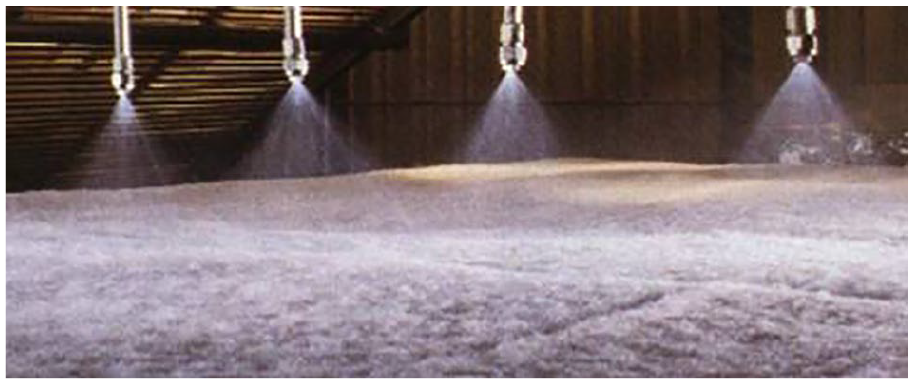
Schematic representation of adhesive bonding.
Bonding is done by means of spraying the binder into the textile structure by means of sprayer arranged above the moving web. The binder saturates on the surface layers and does not penetrate far in the structure which is normally quite thick. The spray adhesive bonding is an exact measure of the number of binders applied, uniform binder distribution, and a soft fabric handle. The adhesive add on percentage is taken care of to maintain at 20%. Precaution is taken to avoid the excessive or lesser flow of adhesive through the sprayer. By the calendar roller pressure, the fibrous layer is converted into nonwoven fabric. 21 The produced recycled cotton/polyester samples such as cotton (color and white), polyester (color and white), and cotton-polyester blend (color and white) were prepared. The preferred samples of proportions with 6 to 8 mm thick, 80 mm wide, and 200 mm long were developed to measure the sound absorption coefficient. Figure 2 shows prepared samples of color and white adhesive-bonded recycled nonwovens. The physical properties of nonwoven are fabric thickness, density, porosity, air permeability, thermal conductivity was tested according to the ASTM standard, and physical properties were tested to measure the influence of the sound absorption coefficient of recycled nonwovens.
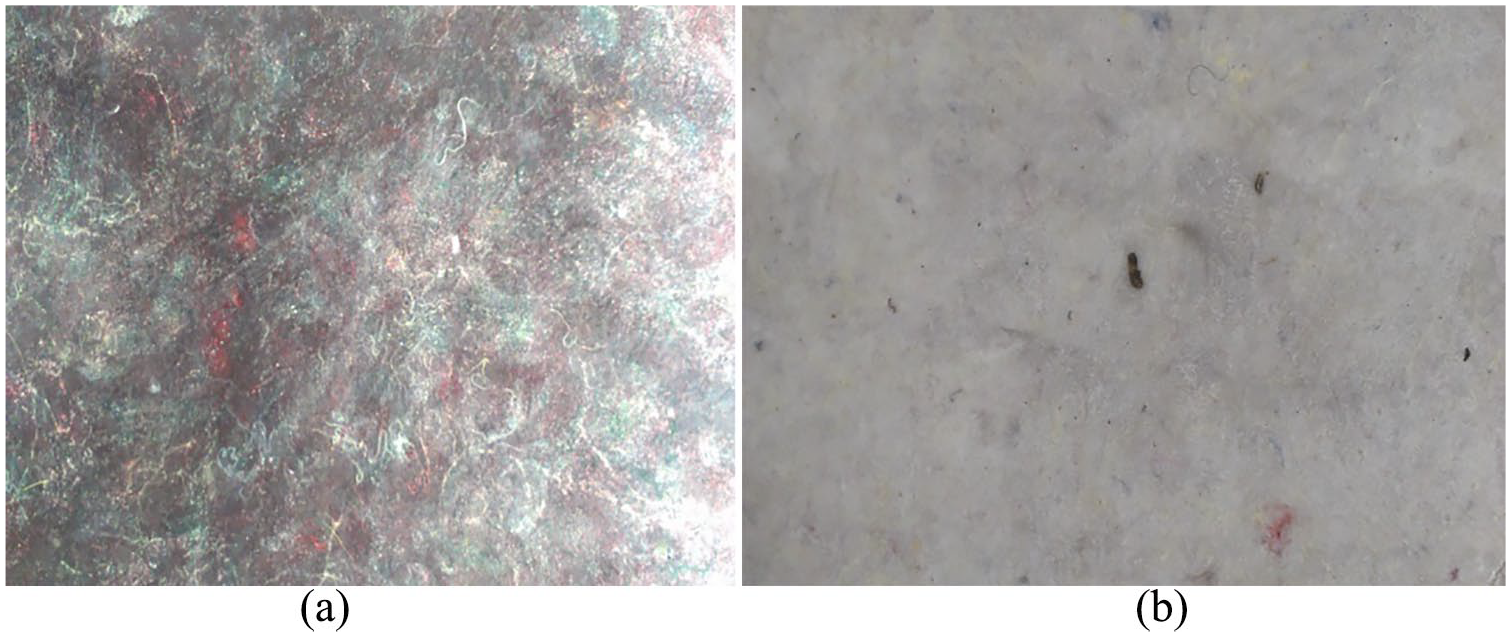
(a) Color and (b) white adhesive bonded nonwoven recycled cotton/polyester samples.
Thickness
The thickness tester is specialized equipment to determine the thickness of nonwoven fabrics. The mean value of all the readings of thickness was determined to the nearest 0.01 m is calculated and the result is the average thickness of the sample under test. The fabric thickness was determined in accordance with ASTM D5729 standard method.
Density
Shoshani 22 showed the increase of sound absorption value in the middle and higher the frequency as the density of the sample increased. The wide usage of porous sound absorbers for reducing noise and controlling reverberation time is studied by Yang et al. 23 The specimen with 12 cm diameter and 80 cm2 area were cut out randomly and weighed. Average of 20 observations taken for each sample and expressed in kg/m2.The density was calculated by using the following relationship.

where,
W = weight of sample per unit area, determined by standard method ASTM D 3776.
Kg/m2 = mass of a material in kilograms in one square area
Porosity
The porosity of a porous material is defined as the ratio of the volume of the voids in the material to its total volume. 24 Equation gives the definition for porosity

where
Va = Volume of air in the voids
Vm = Total volume of the sample of the acoustical material being tested. The porosity was found out with ASTM B809.
Air flow resistance
Air flow resistance is a fundamental property of porous materials; it gives information on their porous structure and, indirectly, on their acoustical properties. The measurement is standardized in ISO 9053, which describes the measurement equipment and the test procedure. This standard defines the air flow resistance, as:

where,
Δ p = air pressure difference in pascals
qv = volumetric airflow rate in m3/s
where R, is the air pressure difference, in Pascals, across the test specimen, is the volumetric air flow rate, in cubic metrics per second, passing through the test specimen.
Air permeability
The rate of airflow passing perpendicularly through a known area of fabric is adjusted to obtain a prescribed air pressure differential between the two fabric surfaces and its generally expressed in terms of cm3/s/cm2 calculated at operating conditions. From this rate of airflow, the air permeability of the fabric is determined in accordance with ASTM Test Method D 737. The need for measuring the acoustical property of fibrous media for predicting the airflow resistivity was studied by Yang et al. 25
Thermal conductivity
Thermal conductivity coefficient was measured using Lee’s disc method. 26


The thermal conductivity of samples was then calculated theoretically by using the Maxwell model as illustrated above where comparisons between theoretical and experimental results were accomplished. The thermal conductivity was determined in accordance with ASTM D 6343.
Scanning electron microscopy
Morphological analysis was performed as per the ASTM D 256 Standard using a JEOL SEM instrument, on cryogenically fractured surfaces of nonwoven samples. The developed non-woven’s fractured surfaces after tensile testing are examined using a scanning electron microscope (SEM) JEOLJSM-6480LV. Figure 3 shown in a, b SEM micrographs of a fractured surface of recycled non-woven’s tensile test.

(a) and (b) SEM micrographs of fractured surface of recycled nonwoven’s tensile test.
Measurement of sound absorption coefficient
The normal incident sound absorption coefficients (α) were measured according to ASTM E 1050-10 standard test method by using an impedance tube, which was kindly provided by Automotive Research and Testing Center (ARTC, Taiwan). The mechanisms of the impedance tube measurement setup are shown in Figure 4. When a sound wave is incident on a material, it can be absorbed, reflected, and transmitted by the material, and all three phenomena are possible depending upon the types of materials. Absorbing the incident sound wave is an effective way to control the noise. The frequency ranges used for the measurement was 50 to 4000 Hz. The frequency range was divided into three different classes, low (50–1000 Hz), medium (1000–2000 Hz), and high (2000–4000 Hz) ranges. Ten readings were taken randomly from each sample for evaluating sound-absorbing properties. The resisted but absorbed sound by the recycled fibrous nonwoven materials can be calculated by the following derivation by Koizumi et al. 27 and Teli et al. 28

where
SR = sound reduction
dBwos = sound level without sample and
dBws = the sound level with sample
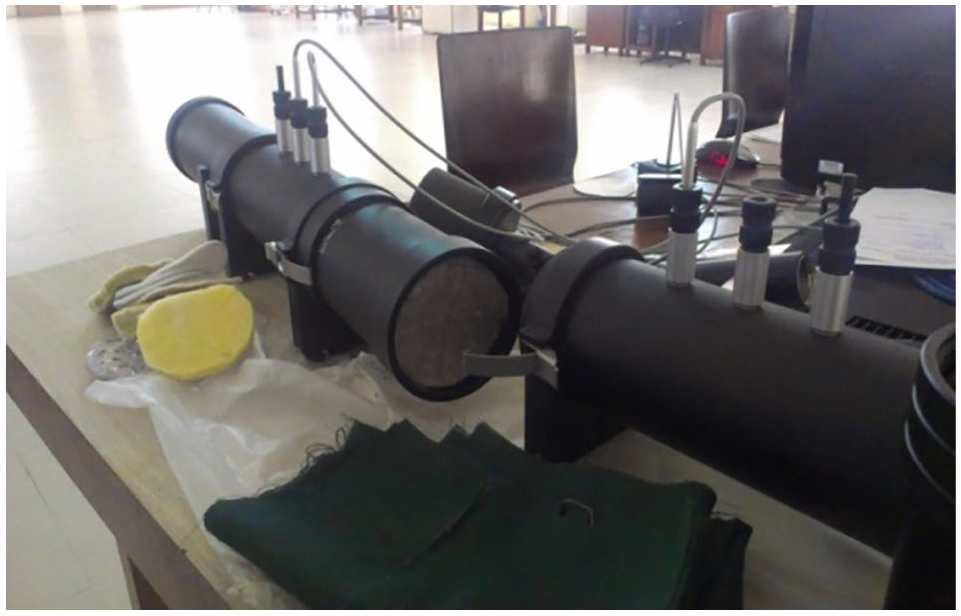
Impedance tube measurement set up.
Results and discussion
Sound absorption property
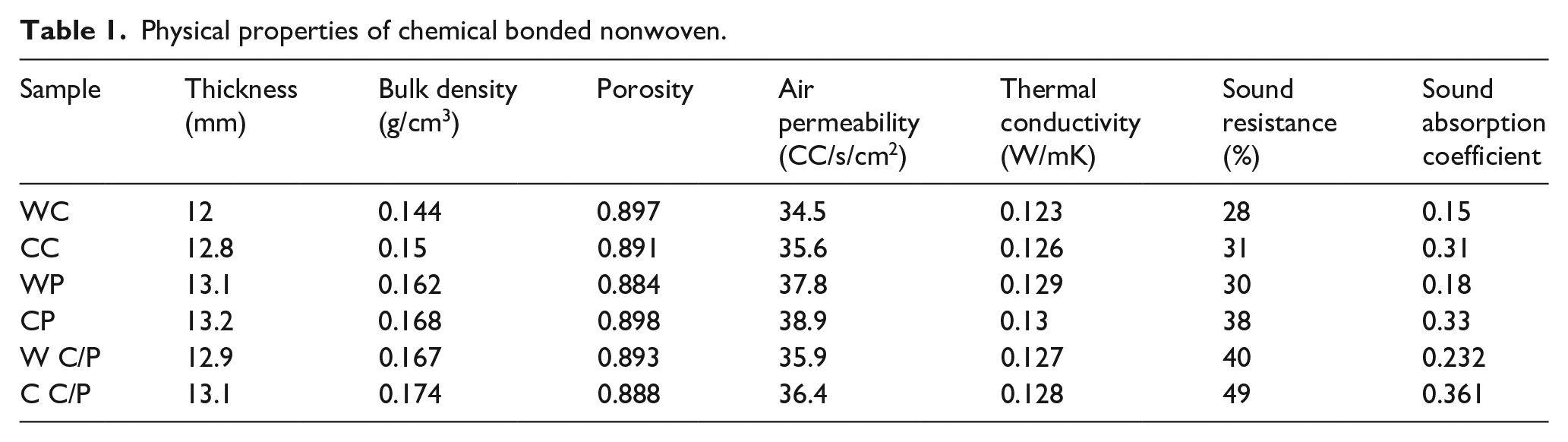
One of the objectives was to obtain superior sound absorption property in the samples in addition to the thermal insulation property. The physical properties of the recycled nonwoven samples are tabulated in Table 1. All developed recycled nonwoven samples showed better sound absorption properties in the overall frequency range (50–4000 Hz). Sound absorption coefficients (α˛) of the samples in various frequency ranges are shown in Figure 5. The sound absorption depends upon the thickness of the material amongst other factors.29,30 The reason can be attributed to the fact that the kinetic energy of the incident sound wave gets converted to a low level of heat energy when it passes through a thicker structure. The thicker structure absorbs sound waves by causing frictional loss between sound waves and fiber, thereby dampening the effects of the propagating sound wave. Another factor was the tortuosity component. Recycled cotton/polyester-based nonwoven samples can be observed that while frequency increases, the sound absorption coefficient (SAC) of all samples WC, CC, WP, CP, W C/P, and C C/P also increases. Similarly, while thickness increases the sound-absorbing performance also increases. At the highest frequency of 4000 Hz, the SAC values of WC, CC, WP, CP, W C/P, and C C/P are 0.4, 0.68, 0.4, 0.65, 0.55, and 0.72. The calculated average SAC values of WC, CC, WP, CP, W C/P, and C C/P which are 0.156, 0.312, 0.182, 0.331, 0.232, and 0.361 also reveal the same. Fibers interlocking in nonwovens are the frictional elements that provide resistance to acoustic wave motion. In order to design a recycled nonwoven web to have a high sound absorption coefficient, porosity should increase along with the propagation of the sound wave. 31 The recycled nonwoven porous structure possessed excellent performance for the absorption of high-frequency sound waves, especially above 4000 Hz.
Physical properties of chemical bonded nonwoven.
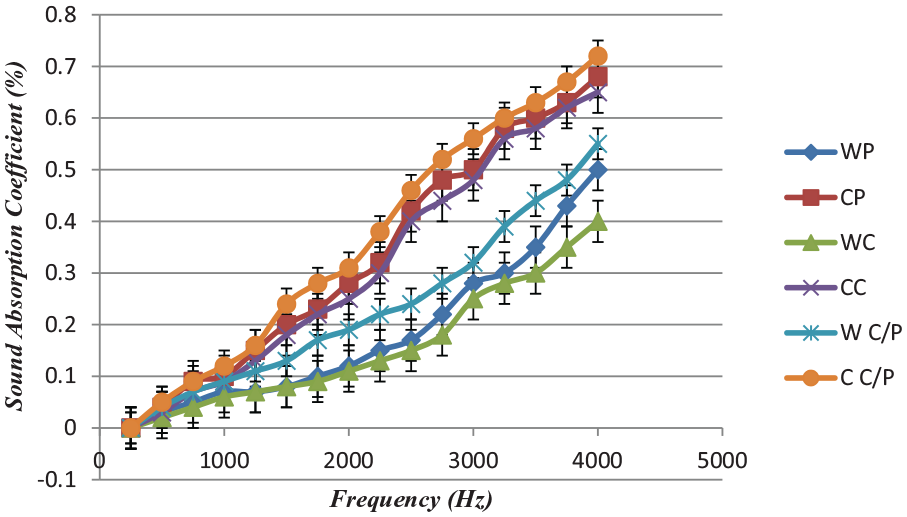
Variation of sound absorption coefficient with frequency.
SEM analysis
Figure 3 shows the SEM image of reclaimed nonwoven fabric from which the perimeters are measured with scalex plan wheel XLU. The recycled cotton/polyester fibers nonwoven samples are measured three times and the final average values were taken as a fiber perimeter. The surface area of the fibers was calculated by multiplying the perimeter and the total fiber length in the fabric. The surface area of the nonwoven fabrics is 25 × 4 mm2 was obtained as per the ASTM Standard ASTME 2809. The same finding was observed by Shoshani and Yakubov. 32 The fracture surface study of recycled nonwovens after the tensile test is shown in Figure 2(a) and (b). It is clear that the fibers are detached from the resin surface due to poor interfacial bonding. Pulled- out fibers are clearly visible for composites with 5 wt. % fiber content and 3 mm length. However, the composite with 15 wt. % fiber and 12 mm length shows good matrix/fiber adhesion. Only very small fiber pull-out which coated with matrix materials. The same results obtained by Carvalho et al. 33 and Santhanam et al. 34
Influence of thickness
In this study sound absorption in porous materials was concluded as low-frequency sound absorption has a direct relationship with thickness. This study shows a high increase of sound absorption at low frequencies, as the material gets thicker the sound absorption property decreases as shown in Figure 6. However, at higher frequencies thickness has an insignificant effect on sound absorption. The results revealed that the thicker the material better the sound absorption values on the middle value of the thickness of the sample. The color cotton/polyester nonwoven C C/P with a thickness of 13.1 mm results with an average SAC of 0.361 which is higher than CC WC, WP, CP, W C/P non-woven fabric. The thickness of recycled nonwoven is less than 3.5 mm little sound absorption is achieved, if the thickness is more 9.03 mm best sound absorption is achieved. The same finding was experimental by Asdurbali. 31
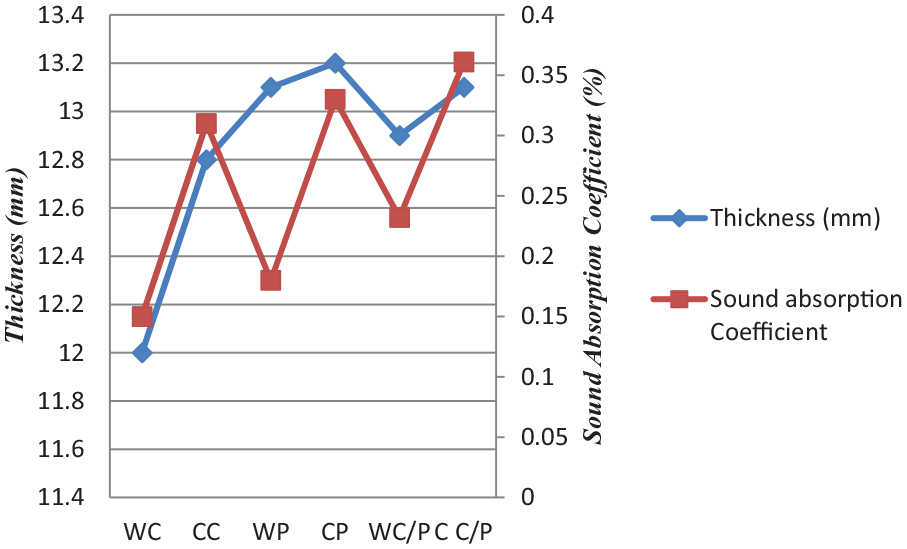
Influence of thickness on sound absorption coefficient.
Influence of density
Figure 7 show that the density increases the sound absorption coefficient of the sample increases. A study by Ramlee et al. 35 showed an increase in sound absorption values in the middle and higher frequency as the density of the samples was increased. The number of fibers increases per unit area when the apparent density is large. The energy losses increases as the surface friction increases, thus, the sound absorption coefficient increases. Less dense and more open structure absorbs the sound of low frequencies (500) Hz. Denser structure performs better for frequencies above than 2000 Hz. It reveals that the increase in density directly increases the SAC. Colored nonwoven which has a difference in density of 0.03 g/cm3 with the white nonwoven depicts 24% increases in SAC. Color and white polyester nonwoven having the difference in density of 0.08 g/cm3 with the Depicts 32% increase in mean SAC. Cotton polyester nonwoven having the difference of density 0.025 g/cm3 with increases in mean SAC of 0.361. The number of fibers increases per unit area when the apparent density is large.

Influence of density on sound absorption coefficient.
Influence of porosity
Figure 8 shows the influence of porosity on sound absorption of recycled cotton/polyester-based upon the color and white samples values is 137.74, 136.56, 142.56, 139.56, 140.56, and 138.97, the results exposed that when comparing the porosity and microspores the micro pores satisfy the diffusion sound waves. The SAC of the porous materials were highly dependent on the permeability of the materials. Less porosity and less air permeability of the samples permit the sound frequency lesser amount at low-frequency level, but at a higher frequency, the sound enters the fine pores and experience friction between the fibers and adhesiveness, thus performs with higher absorption of sound energy. The same finding was obtained by Koizumi et al. 27

Influence of porosity on sound absorption coefficient.
Influence of air flow resistance
Figure 9 shows the relationship between specific airflow resistance and sound absorption coefficient. It can be inferred that higher air flows give better sound absorption values. The sound absorption property was influenced by a high increase in airflow. With a high increase of airflow resistance and increasing in density of fabric the sound absorption property also highly affected. The airflow resistance of the color nonwoven is about 35.6 to 38.9 cc/s/cm2 with SAC of 0.31 to 0.36. It is clear that where the fabric density increased, the airflow resistance decreased due to increased resistance to airflow caused by the consolidation of the web, but also increases the short fiber content which will occupy the air voids. The color polyester sample has the highest air flow resistance value with the SAC of 0.33 which is greater than that of WC, CC, WP, CP, W C/P, and C C/P the same result was obtained by Koizumi et al. 27

Influence of air flow resistance on sound absorption coefficient.
Influence of thermal conductivity
The thermal insulation properties of the samples were measured in terms of the thermal conductivity. The thermal conduciveness of various samples is shown in Figure 10. The thermal conductivity better is the insulation property. Low values of the thermal conductivity imply higher resistance to conduction of the heat through the material. With the increase in temperature, the thermal conductivity increases for all samples. Two-layer mats with 50% recycled cotton fiber along with 50% recycled fiber provided one of the best insulation properties. These results showed that it is possible to develop samples that show similar thermal conductivity as that of 100% recycled cotton and polyester fiber. The thermal conductivity for the color polyester material is about 0.13 W/mK which has a SAC value of 0.33 which is higher than that of the WC, CC, WP, CP, W C/P, and C C/P. These samples were suitable for roof ceiling insulation applications in a building. The study has conducted by Küçük et al. 36

Influence of sound absorption on thermal conductivity.
Sound insulating performance of the recycled cotton/polyester nonwovens
The chemical bonded nonwovens while tested for the performance of sound insulation with 30 to 70 dB showed that the increase in the number of the layer increases the insulation of sound. The average insulation percentage values for the three-decibel values were shown in Figure 11. The nonwoven of recycled color and white cotton, color, and white polyester, and color and white cotton-polyester blend approximately results in 15%, 27%, and 35% decibel sound results with fabric to source distance of 25, 50, and 75 cm. The reclaimed fibers nonwoven of color and white cotton, color and white polyester, and color and white cotton, polyester blend showed approximately sound insulation of 17%, 33%, and 42% with fabric to source distance of 25, 50, and 75 cm. These results also reveal that as the sound insulation increases the distance between the fabric and the source also increases. 29

Sound resistance performance of recycled cotton/polyester nonwovens.
Conclusion
Six different recycled cotton/polyester nonwoven mats (WC, CC, WP, CP, W C/P, and C C/P) were produced and produced and tested for thermal insulation, acoustic absorption, behavior. Recycled Polyester/ cotton mats (CC and C C/P) showed the best thermal insulation and acoustic absorption. CP and W C/P nonwoven mats were absorbing more than 70% of the incident noise (50–4000 Hz). There were no significant changes in the thermal insulation and acoustic properties of the recycled nonwoven mats when evaluated under high humidity conditions. SEM figures showed that some of the scales present in the recycled cotton fiber of CC and C C/P nonwoven mats were degraded, whereas expected no changes in the morphology of recycled polyester fiber mat was noticed. These alternative materials will contribute to the cost-benefit as well as green building initiatives through the development of materials from natural and recycled resources.
Footnotes
Declaration of conflicting interests
The author(s) declared no potential conflicts of interest with respect to the research, authorship, and/or publication of this article.
Funding
The author(s) received no financial support for the research, authorship, and/or publication of this article.
