



Abstract
The influence of softening on tensile strength, elongation at break, moisture regain and microscopic morphology of Palm Sheath fiber extracted by chemical degumming using 80% sodium hydroxide; bleached by hydrogen peroxide and softened by silicone emulsion softener was studied. The softened and unsoftened fibers were characterized for their longitudinal view, tensile strength and elongation at break of single fiber by scanning electron microscope (SEM). The single fiber tensile strength and elongation at break were 19.6% and 10.22% respectively. The calculated value of moisture regain and moisture content of the softened fibers was 12.65% and 11.23% respectively. The tensile strength, elongation at break, moisture management of the softened palm sheath fiber was significantly higher. As a result of surface modification microscopic morphology, the treated fiber was also found different. The study result had drawn the significant influence of the surface modification on the forth mentioned properties of the extracted palm leaf sheath fiber.
Introduction
Currently, there is a growing interest in biodegradability of materials due to the promulgation of more restrictive regulations concerning the utilization of petroleum-based non-renewable resources and the recovery of wastes. On the other hand; in countries where the agricultural lead economy is practiced a huge amount of wastes is generated from the agricultural sector. Surprisingly while such an alternative agricultural biomasses are returning to nature unused there is a declining supply of raw material. Utilization of natural fiber, especially agricultural waste fiber needs further development as a long term strategy to develop the tremendous wealth of natural plant fiber that is currently underutilized. 1
Fibers from Plant sources are obtained from different plant parts such as stems, leaves, roots, fruits, and seeds. The Utilization of Natural fibers and its advantages as reinforcements in polymer composites are reported.2–5 The cellulosic plant fibers are extracted from different parts of plants, that is, baste fibers which is extracted from stems of jute, kenaf, ramie, hemp, flax and so on, seed fibers which is obtained from cotton, coir, and kapok, leaf fibers such as sisal, pineapple, and abaca, grass and reed fibers obtained from rice, corn, and wheat, and core fibers such as hemp, kenaf, and jute. There are also more cellulosic plant fibers from wood and roots sources. 6 Natural fibers including palm, kenaf, jute, hemp, flax, bamboo were used as matrix in composite to investigate the influence of natural fibers on mechanical properties of composite materials.7–9 The Extraction and characterization of palm fibers conducted by researchers10,11 to extract fibers from stems, fruits, trunk, and leaves by different extraction methods reported the performance and properties of the palm fibers were consistent with the properties of other baste fibers.
By other researches, 12 fibers with potential characteristics were extracted were extracted from pine apple leaves using chemical and/or enzymatic methods for the conception of the fiber materials for different applications. Date palm leaflet fibers extracted By chemical retting processes with 5% NaOH, 1%NaOH, by ultrasound and enzymatic extraction followed by treatment with 1% NaOH in water demonstrated higher cellulose content and crystalline, lowest MFA, and the highest ultimate tensile strengths.
To extract quality fibers from baste with the required quality for textile and composite; a careful selection of extraction methods has to devised. Palm fiber extraction is mainly by water retting involving water only, water and chemicals and/or biological treatment.13,14 The traditional water retting uses bacteria such as bacillus and clostridium and fungi such as Rhizomucor pusillus and Fusarium lateritium to attack the non-cellulosic substances to separate the fibers from the core.15,16 By chemical retting, it is possible to degrade and remove non-cellulose components from the baste and reuse the wastewater for continuous retting process to minimize the chemical cost as well as its environmental pollution.15,16 Effective chemical retting can provide positive mechanical properties with reducing flexural rigidity, linear density and diameter with softer handle by removing impurities with control over Retting duration, chemical concentration and retting temperature.15,16
Studies have shown that effective chemical treatment can improve the properties of palm fibers.17–20 A study conducted to modify palm fiber surface using different alkali treatments with a wide range from 0.5 to 5 % and acid treatment with 0.3 N, 0.9 N and 1.6 N for 1 h at 100°C 17 revealed a significant increase in tensile properties. As reported in, 18 the alkalization treatment kenaf fibers with 6% NaOH improved the tensile properties as compared to untreated fibers and using coupling agents’ that is, with MAPP or MAPE amplified the tensile strength.With this study, the morphology and tensile strength were considerably improved, whereas fibers treated with HCL were found to harm tensile strength and morphology. 19 investigated the effect of different fiber surface treatments and reported silane significantly improves the mechanical properties.
In this study, the influence of pretreatment of textiles on surface characteristics of chemical degummed palm leaf sheath fiber is investigated as an option for surface modification treatment.
Materials and methods
Materials
For the extraction of palm sheath fiber; gloves were used to prevent stinging from the plant while harvesting and collecting the palm sheathes, a sickle was used to cut palm tree stems and to debark the palm sheathes, vat for degumming and to immerse decorticated fiber, thermometer, Digital weighing balance pipette and chemicals (NaOH, H2O2 AND wetting agent).
Methods
Palm leaf sheath preparation
Palm leaf sheathes harvested from Kombocha-Ethiopia. The sheath stripped off the leaves and thorns carefully with the help of the sickle, without causing any damage to the stems. The leaf sheaths were dried in a shaded area out of direct sunlight for two days and soaked with water for two days to facilitate the removal of sheath husk.
Figure 1 shows the Procedures of palm leaf sheath preparation for extraction (a) Harvested leaf sheath (b) Soaked leaf sheath (c) decorticated fiber The Photos of Dried palm leaf sheath (Figure 1(a)) and the soaked sample of palm leaf sheath (Figure 1(b)) can be referred to see the leaf sheaths prepared for this study. Finally; the soaked sheaths were washed (with water Figure 1(c) is a photo showing washing of palm leaf sheaths) and chemical degumming continued.

A photo showing procedures of palm leaf sheath preparation for extraction, photographed by the author, 2018.
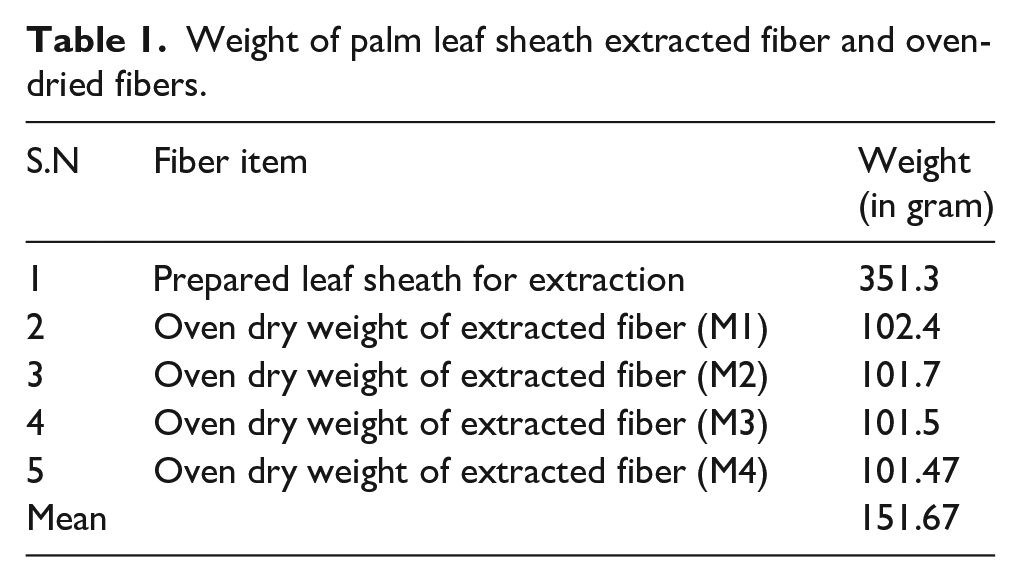
The extracted and washed fibers ( Figure 2 ) were dried in oven dry to almost dry constant weight (Mf) of the fiber and the amount of fiber extracted from palm leaf sheath was calculated as the ratio between the final weight of the fiber (Mf) and that of the palm tree leaf sheath before chemical degumming (Mi).

A photo of fiber extracted by degumming, photographed by the author, 2018.
From the above table 1 the Amount of fiber extracted from the palm leaf sheath was calculated as follows:

Weight of palm leaf sheath extracted fiber and oven-dried fibers.
Chemical degumming
The gum present in palm leaf sheath is composed of primary xylans (Hemicelluloses or Pectin) which are insoluble in water but easily soluble in alkaline solutions which means degumming is the process of removing pectins and impurities like ash from the palm. The Palm sheath was initially boiled in alkaline solution (NaOH) to dissolve the gummy substance inside the sheath then washed with water to remove the dissolved gummy substance. The procedure employed to degum the leaf sheath was; the first 20% sodium hydroxide is prepared and taken into a vat. 203.4 gm of raw decorticated palm fiber immersed into the alkaline solution. The fiber liquor ratio kept at 1:10 and with a 0.5% wetting agent. The mixture is incubated at 100°C for 2 h 30 min. Finally washed the fibers with warm water to remove the dissolved gummy substance and then dried.
In Figure 2 it is visible that the color of raw fiber extracted from palm leaf sheath by chemical degumming is reddish yellow and the fiber is still sticky even after washing due to the presence of residual gummy substances.
Bleaching process
The extracted fibers were sticky due to the presence of Residual gums or layers attached to the degummed fibers as they can be seen in Figure 2. Residual gums or layers attached to the degummed fibers were removed with the help of H2O2 (hydrogen peroxide). Also the H2O2 bleaching removes the naturally occurring coloring matter and disclosed the creamy white color of the fiber (see the photo of the bleached fiber in Figure 3). To bleach the fiber 15% of hydrogen peroxide and 0.5% of wetting agent taken in a vat, immersed 345 g fiber in it, liquor ratio was kept at 1:10, incubated at 100°C for 2 h and 30 min. Finally washed and dried.

A photo of bleached palm leaf sheath fiber, photographed by the author, 2018.
Softening treatment of palm leaf sheath fiber
Sample cluster of bleached fibers taken out and kept to characterize longitudinal, tensile and elongation of the bleached fiber. The other fibers treated with silicone emulsion softener followed by steaming and then dried.
Testing, tensile strength, elongation, and a cross-sectional view
Both softened and UN softened fibers were characterized under the same condition. The tensile test was carried out using 50 fibers to determine the strength and elongation at break under tensile stress at 25 mm distance clamping the fibers at a constant speed equal to 20 mm/min and with the force of 50 N. The test was conducted at an ambient temperature of 28°C and R.H. of 65%.
Table 2 outlines the recorded tensile and elongation at break of softened and unsoftened palm leaf sheath fibers. Using the recorded data the standard deviation of the unsoftened and softened palm leaf sheath fibers were calculated as follows
Tensile and elongation property of palm leaf sheath fiber before and after softening.



For elongation at break, the standard deviation is

The tensile strength data has a standard deviation of 0.97N whereas the elongation at break data has a standard deviation of 7.23%. The higher standard deviation in elongation at break tells us that the softening treatment given to the fiber helped much to improve the extensibility of the fiber. The standard deviation of tensile strength data is less as compared to that elongation at break data. This shows us the tensile strength is more consistent due to the closely packed data of the unsoftened and softened fibers. So the softening treatment more influence on elongation at break and lesser effect in tensile strength.
As can be understood from Table 2, The softened palm leaf sheath fibers have slightly increased tensile strength and increased elongation at break of almost twice that of unsoftened fiber. The specimen’s longitudinal view tested by Scanning Electron Microscope (SEM) to characterize the morphology of the untreated fibers and softener treated as presented below.
In Figure 4a the fibers formed Dimples which is due to micro void nucleation on or around sites where local plastic deformation is high. If the force of extension is applied microvoids grow, coalesce, and eventually rupture to produce dimples on the fractured surfaces. Due to this fact, the tensile strength and elongation at break of the UN softened palm sheath fiber is discussed as inferior. The Separation was occurred in the softened palm leaf sheath fiber (see Figure 4a.) Low-index and the well-defined plane crack was occurred in softened plan leaf sheath fiber (see Figure 4b). The factors which were susceptible to promote this crack where external factors such as humidity and temperature. It is understood that the rapture is Trans-granular cracking which followed a path through the grains. Suck kind of crack exhibits little or no plastic deformation compared to dimple rupture. This fact proves the softened fibers have more elongation at break than that of unsoftened palm leaf sheath fibers. Moisture regains (R%) and Moisture content (W%) of the softened palm leaf sheath fibers were also characterized. To calculate the R% and W% of the fibers first, the fibers were conditioned at room temperature for 24 h. After 24 h the conditioned fiber weight was measured and found as 13.52 g. Following that the weighed fibers were dried in an oven at a temperature of 100oC again and again until the fiber dry fully and no reduction in weight.

Longitudinal view of palm leaf sheath fiber under scanning electron microscope (a) unsoftened (b) softened the fiber.
From above table 3; R% and W% calculated as follows:


The dry weight of extracted palm leaf sheath fiber.

Discussion and conclusion
Discussion
In the present study extraction of Palm leaf sheath fiber by chemical degumming using NaOH was investigated. The alkaline solution helps to dissolve the naturally available gums from the leaf sheath the dissolved gum is washed off from the fibers by washing. Alkaline concentration, temperature, time, and presence of antioxidants are factors that affect chemical degumming. This particular extraction was carried out using NaOH and a wetting agent at 100oC for 2 h and 30 min. The Investigation found that Fiber extraction from palm sheath fiber by chemical degumming has a 28.87% fiber yield.
The longitudinal study of the fiber under a scanning electron microscope revealed that the softening of the bleached fiber changed the longitudinal view of palm leaf sheath fiber from rectangular to a cylindrical shape.
The mechanical properties: the tensile and elongation of palm leaf sheath fiber increase significantly if treated with softener. The softened leaf sheath fiber has a tensile strength of 8.31N and elongation of 19.6%.

Effect of softening on tensile strength and elongation of palm fiber.
The moisture regains (R%) and moisture content (W%) of the softened fiber is 12.65% and 11.23% respectively. The moisture regain and moisture content of the fiber is good but it needs to be enhanced more by further treatments.
Generally; bleaching revealed the creamy white color of the fiber and softening changed the longitudinal view and enhanced moisture regain and moisture content of the fibers. This implied that pretreatment textile influence mechanical, morphological and also chemical characteristics of palm leaf sheath fiber.
Conclusion
Palm leaf sheath fiber was effectively extracted by chemical degumming using 20% sodium hydroxide with 1:10 fiber to liquor ratio and 0.5% wetting agent at 100°C for 2 h 30 min. The naturally occurring reddish color and Residual gums or layers attached to the degummed fibers were removed by H2O2 (hydrogen peroxide) bleaching to whiten the fibers. Softening the fibers revealed a slight increment in tensile strength and a drastic increment of elongation at break. Softening also oriented the fibers along their longitude, increased strength and changed the cross-sectional view of the fiber from rectangular to circular. The moisture management of the fibers was also improved due to the softening treatment.
Generally; in this study softening revealed increased tensile strength, increased elongation, increased moisture management and morphological shape is also changed due to the softening effect.
Footnotes
Data Availability
The data used to support the findings of this study are included in the article. Data in figures and table formats are included within the article and also provided in separate MS-Word format. Additional data used to support the findings of this study will be available from the corresponding author upon request. Apart from the data collected from experiments previously reported data were used to support this study and are cited at relevant places within the text as references.1–21
Declaration of conflicting interests
The author(s) declared no potential conflicts of interest with respect to the research, authorship, and/or publication of this article.
Funding
The author(s) received no financial support for the research, authorship, and/or publication of this article.
