



Abstract
Due to respect for the environment and the search for more sustainable materials, scientists have started in recent decades to launch studies on bio-composite materials. It is well known that building materials are among the most commonly used materials and have an obvious negative impact on the environment. The development of environmentally friendly composites as insulating materials in buildings offers practical solutions to reduce energy consumption. Therefore, this work presents the use of a new bio-composite material composed of natural fibers, date palm fibers, cement, and sand. In addition, the study on the effect of adding date palm fibers on the thermo-mechanical characteristics of mortars assesses the thermal insulation properties as well as the water absorption and mechanical performance of this new bio-composite material to use it in the construction of buildings. The percentage by weight of date palm fiber in the test samples varied from 0% to 30% for a fiber size of length equal to 7 mm. The characteristics of these samples were determined experimentally in terms of resistance to bending and compression as well as thermal conductivity. The results show that while increasing the weight of date palm fiber, an obviously reduction in thermal conductivity, flexural, and compressive strength of the composite is observed. Hence, date palm fiber has a positive effect on the thermo-mechanical properties of the composite material. Therefore, it considerably improves the insulating capacity of the mortar.
Keywords
Introduction
Environmental protection becomes mandatory for researchers before implementing new technologies to avoid damaging the environment. Utilization of waste material and renewable resources as alternative building materials have become the popular way to overcome the environmental problem in most of the developing countries. 1 The increase in construction development in the field to days can be seen from the use of materials in improving the quality of the building, which is characterized by higher usage of new basic materials. The use of new base material results in depletion of the utilization of non-renewable resource and efforts to improve the quality of buildings such as utilizing environmentally friendly waste in improving the quality of material. Basically, the use of additional material in building construction has more strength and environmentally friendly. The use of the local materials in the building industry, regardless of their level of underutilization, has become a necessary component to the solution for the economic problems of developing countries.2,3 The building sector is a large consumer of materials and energy resources, highly polluting, and a generator of residues. Therefore, in the search of sustainable building construction, an attention turns to research the adequate use of industrial and agro-industrial materials, 4 which offer several advantages, such as availability, recyclability, low cost, no toxicity, no abrasion, biodegradability, and good thermo-mechanical performances. Therefore, the use of waste material and renewable resources as alternative building materials have become the popular way to overcome the environmental problem in most mandatory developing country and protecting the environment becomes mandatory for the researchers before implementing the new technology to ensure no environmentally damage.
Composite materials are widely used today in numerous applications in many engineering fields.5,6 Many factors affect the properties of composite materials reinforced by natural fibers, which include the geometry, the properties of the different phases (matrix and fibers), the distribution and orientation of fibers with in the medium, the contact between the fibers and matrix, 7 the shape and size of the fibers, the mix design, and the mixing and the processing methods. For the performance predictions of composites, many studies on the composites used only a few significant parameters such as fiber content, fiber length, and fiber type. 8 Organic fibers can be produced from a number of solid wastes such as bamboo, coconut, date palm, oil palm, sugarcane, and vegetable wastes. Some of these fibers are chemically more inert than either steel and glass fibers. In addition, they are cheaper and more importantly most of them can be natural. Several studies were carried out with natural materials and have shown that they are not only comparable with standard building materials but they also cause little concern in terms of health and safety during handling.9–11 The need to optimize buildings’ energy behavior has been imposed by climatic and economic motives. Indeed, it is well known that energy efficient buildings could reduce the consumed fossil fuels quantities and thereby reduce CO2 and SO2 emissions into the atmosphere. In addition, agricultural countries produce considerable amounts of waste. 12 The exploitation of this agro-waste in insulating materials production could help in agricultural processing industry diversification and provides a source of income to farmers. Moreover, by adopting local materials such as available lignocellulose materials, the impact of transportation decreases by up to 400% compared to building materials imported from overseas. 13 The date palm (Phoenix dactylifera) wood is abundant in North African and Gulf countries. Tunisia has more than 4 million date palms, which occupy nearly 41,000 hectares. 14 After the date fruit harvesting, important quantities of date palm rachis and leaflet wastes are accumulated every year. In this context, some published works have focused on new eco-friendly materials reinforced by natural fibers such as palm fibers, 15 corncob,16,17 rice straw, 18 and sisal fibers.12,19,20 The potential of this raw material is based on its sustainability, low cost, availability, low density, high quantity, and low environmental impacts.21–23 Many researchers dealt with the use of palm trees by-products in construction materials due to their high thermal insulation properties. AL-Oqla and Sapuan 24 studied the feasibility of date palm fibers (DPFs) for sustainable automotive industry. Also, Sun et al. 25 and Chikhi et al. 26 studied the effect of petiole and rachis of palm trees on thermal conductivity and compressive and flexural strengths of gypsum-based composite materials. The effect of the same fibers on thermal conductivity and compressive strength of mortar-based composite materials has been investigated by Benmansour et al. 27 In addition, Kriker et al. 28 have evaluated mechanical properties of reinforced concrete with Algerian DPFs. Djoudi and colleagues29,30 have studied the effect of the addition of Algerian DPF on thermal and mechanical properties of plaster concrete.
According to these above-mentioned studies, we have developed an energy efficient composite material that consists of a mortar reinforced with the DPFs. In this study, the bio-composite material is experimentally characterized in terms of thermal conductivity, as well as compressive and flexural strengths and water absorption.
Experimental methods
Materials
The composites used are formed from DPFs, sand, and cement. The cement used is Portland cement from Algeria. The sand used is from Bou Saada, Algeria; it is coarser, with a maximum diameter reaching 5 mm with a widely distributed particle size distribution. DPFs are used as inclusions. It was obtained from the oasis of Ouargla, Algeria. Due to their exposure to the natural environment, the DPFs have been contaminated by a large amount of sand and dust. The samples were washed with fresh water and manually disassembled into fiber bundles. Before its use, the DPF meshes were washed with high pressure water in order to remove the polluting particles. Then, these fibers were first dried in the sun for 2 days and then in an oven at T = 70°C until dried. Then, the fibers of diameter less than 0.7 mm were cut to the desired length. In this study, only one fiber sample size with a length equal to 7 mm (DPF7) is listed below and shown in Figure 1.

Date palm fiber of size with a length equal to 7 mm (DPF7).
Composite preparations
The composites considered as a motor were obtained by mixing prompt Portland cement (CPJ-CEM II/A 32.5) from LAFARGE factory in M’sila, south of Algeria, sand, and water for several concentrations 6%, 12%, 18%, 24%, and 30% of DPF weight. The composites were made by mixing fibers, cement, and sand in a mixer with angular rotation equal to 40 rpm for 5 min. Dry mixing is necessary to homogenize the mixture of the three constituents such as cement, DPF, and sand. For this, water was added gradually and the mixing continued for 5 min. Then, the mixture was rapidly poured inside rectangular molds characterized by these dimensions 40 × 40 × 160 mm3 to reduce water loss by evaporation in the ambient air. The mold was filled with material and left in the open air for almost 24 h. Next, the samples were submerged in water at 21 ± 2°C for 28 days according to standard EN 196-1. 31 The samples were dried in the open air for 48 h in the molds and 28 days after demolding. The proportions of the materials used in the mixtures are shown in Table 1. Figure 2 shows the samples of mixture date palm (MDP7: Sand + cement + DPF7) (MDP7) constituted by sand, cement, and DPF7.
Weight concentrations of the used materials.
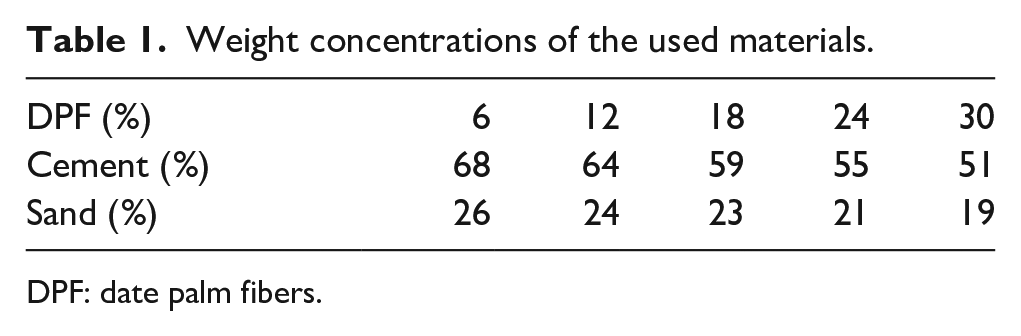
DPF: date palm fibers.

MDP7 samples for different concentrations of DPF weight.
Measurement methods
Morphology analysis
Microscopic examinations of images of typical sample of raw DPF (Figure 1) in a transversal direction of fibers were carried out using a JEOL JSM-6301F scanning electron microscope (SEM).
Water absorption of DPF
To study the water absorption process, the measurements were made in accordance with ASTM C642-97. 32 The samples of MDP7 shown in Figure 2 were previously dried at T = 60°C to reach a constant weight. Then, the water is absorbed by capillary effect. The percentage of water absorption in the materials was calculated by weight difference between the samples after immersion in water and the dry samples using equation (1) as follows

Thermo-mechanical characterization method
Mechanical strength and thermal conductivity are the most critical factors that have to be considered in the choice of buildings’ thermal insulation materials. Mechanical strength degree, especially compressive strength, depends on the use; whereas low density makes the material light and therefore reduces the construction charges.
Flexural strength test
The flexural strength was tested at 28 days on prismatic specimens characterized by the dimensions 40 × 40 × 160 mm3 in accordance with the standard EN 196-1.33,34 The mechanical properties obtained by testing five prismatic samples were performed on a three-point test configuration machine, and the maximum flexural strength of mortars was determined from the maximum load after the first visible crack using equation (2), the device of flexural strength is represented in Figure 3.

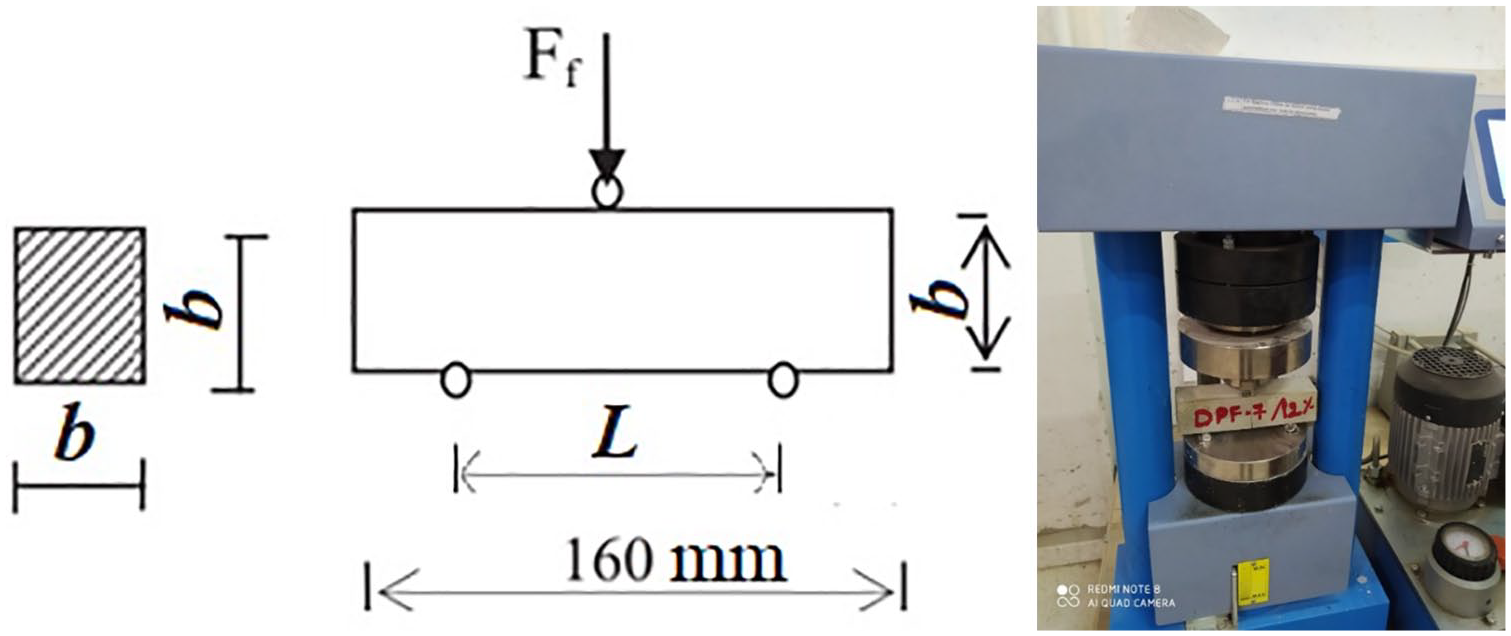
Flexural strength test (MPa) by three points bending of MDP7 samples.
Compressive strength test
The compressive strength was tested at 28 days in according with standard EN 196-133,34 on half-prism obtained after flexion rupture samples. The mechanical properties obtained from test were performed on five specimens. Then, the compressive strength of mortars was determined from the maximum load using equation (3). The device of compressive strength is shown in Figure 4.


Compressive tests of MDP7 samples.
Thermal conductivity of composites
Measuring the thermal conductivity of the test pieces under laboratory conditions is done by 50% RH and 20°C using the hot-wire method after drying of samples for 28 days. This transient method is the classic method for measuring the thermal conductivity of insulating materials. The method consists in placing a thermal shock probe sandwiched between two samples to be characterized. Evaluation of thermal conductivity and volume heat capacity is based on periodically sampled temperature records as a function of time. By mathematical processing of this signal integrated in the provided software, the thermal conductivity is identified.
Results and analysis
Surface morphology
SEM of a typical sample of raw DPF (Figure 1) shows that DPF is cylindrical in shape, as shown in Figure 5(a). Also, the SEM micrograph of a raw fiber shows that the surface containing a large number of uncompleted grown fibers (predictable to be residual lignin) and artificial contaminations (sand and dust). A cross section of a single DPF detects a large number of hollow single fibers collected and bonded by a primary layer, as shown in Figure 5(b). 35

SEM micrographs of a cross-sectional view of raw DPF display (a) its cylindrical shape and (b) the multi-cellular fiber.
Water absorption fiber content
The absorption mainly depends on the open porosity of the material. These pores are produced in large numbers during the introduction of vegetable fibers into the composite materials. It is an established fact that lingo-cellulosic materials are hydrophilic in nature, since their main constituents are cellulose, hemicellulose, lignin, and others factors contributing to their absorption of moisture from the atmosphere. 36 Figure 6 represents the water absorption of MDP7 composites. From the results, it was observed that adding fiber to the mortar results in a significant increase in water absorption. This is due to the fact that the DPF is a very hygroscopic material. This result was reported by Chikhi et al. 26 by studying the water effect on gypsum composites filled with DPF. They discovered that the water content of composites depends strongly on the DPF water absorption capacity. Relating to numerous authors, the absorption of natural fibers depends on the fibers’ size, content, and their chemical composition (cellulose).32,37 They discovered that the water content of composites is highly dependent on the water absorption capacity of DPF.

Water absorption as a function of fibers’ content.
Thermal conductivity as a function of concentration of DPF
Figure 7 shows the development of the thermal conductivity as a function of the fibers’ content. From these results, it is clear that the thermal conductivity decreases as the fibers’ content increases. Indeed, as soon as fibers’ content reach 24%, the thermal conductivity values drop from 0.8 W m−1 K−1 for the reference material (Mte) to 0.15 W m−1 K−1 for the MDP7 and corresponds to a reduction of 92%. This diminution is correlated to the insulating character of the DPF, which have a thermal conductivity of 0.083 W m−1 K−1 as AL-Oqla and Sapuan 24 and Khedari et al. 38 discovered. The evolution of thermal conductivity in Figure 7 confirms that beyond approximately 24% of DPFs loading, the decrease in the thermal conductivity of composite was relatively low. For this reason, it appears useful to limit the fibers’ content around this value. In fact, from the results obtained in this study, we can obviously assume that the addition of DPFs could considerably improve thermal insulation of composites with the reduction in the effective thermal conductivity.

Thermal conductivity as a function of concentration of MDP7.
Density as a function of the DPF concentration
To determine the relationship between the density and the fiber concentration, the measurements were made after the drying of the samples during 28 days. The temperature of the samples over the test measurement is approximately 20°C. The density values of the samples tested after 28 days for the MDP7 composites are shown in Table 2. It is important to remember that the effect of concentration of DPF has a higher impact on the thermal conductivity and density of composites; these results are in agreement with Lahouioui et al. 39 Moreover, the presence of water reduces the insulating capacity of the composites.
Density as a function of the DPF concentration.

DPF: date palm fibers; MDP7: Mixture date palm (MDP7: Sand + cement + DPF7).
Flexural strength properties
Figure 8 shows that the flexural strength decreases with the DPF content as the DPF mesh enhances the sample plasticity and delays the breaking of the composite material. For samples with DPF mesh content greater than 6%, a significant drop in the flexural strength has been observed. Indeed, addition of fibers supports the formation of pores within the samples. Therefore, their porosity increases and consequently the compactness and the cohesion of the composite material are significantly reduced. This performance was reported by Hamza et al. 14 Chikhi et al., 26 Brás et al., 40 and De Pellegrin et al. 41 considered plaster and mortar reinforced with natural fibers. According to Figure 8, a best improvement for MDP7 fibers was at a dosage of 6%. Although, this result is a misnomer when compared to the overall trend of results. The worst flexural strength was recorded for a dosage of 30% of DPF due to excess of fibers and a bad distribution of the fibers in the matrix. Whereas, the increase in the porosity of the material reduces the flexural strength.

Flexural strength as a function of the concentration of the fibers.
Similarly, due to the nature of flexural failure which is depended on the tensile strength of the materials at the extreme fibers, the increase in flexural strength between the concrete without fibers (0%—0 cm) and the MDP7 concrete mixtures less than 6% is also attributed to the tensile strength of the palm date fibers. These results obviously show that a greatest benefit can be achieved by adding relatively DPFs at minimal dosages less than 6%. This is a favorably sustainable outcome for strengthening of concrete structures to improve flexural strength.
Compressive strength test
Figure 9 shows the average values of the compressive strength of concrete as a function of the percentage of fibers with a length equal to 7 mm. The results show that the compressive strength decreases with the increase in the percentage of fibers. The maximum compressive strength of MDP7 concrete occurs at a dosage of 6% in the matrix and is lower than that of pure concrete (0%—0) with a reduction of 16%. Therefore, it is clear from the results that good compressive strength can be obtained if the dosage of palm fibers is less than 6%. In addition, it can be noted that the addition of fibers interrupts the mineral skeleton of the concrete, creates voids inside the matrix, and increases its porosity to give its minimal resistance. 42 These observations are in agreement with the results of previous research on different fiber concretes.43,44

Compressive strength as a function of the concentration of the fibers.
Correlation between compressive strength and water absorption
Figure 10 presents the experimental results of the compressive strength as a function of the water absorption for the fiber of a length equal to 7 mm. From these results, it is clear that the compressive strength decreases significantly with increasing water absorption. These results are comparable to the results reported by Benmansour et al. 27 In these conditions, a correlation between compressive strength and water absorption is proposed with good dispersion and a correlation coefficient R² equal to 0.91


Correlation between compressive strength and water absorption.
Conclusion
The results of an experimental investigation on the thermo-physical and mechanical properties of the mortar reinforced with DPFs are reported in this article. The goal is to study the possibility of using this material as a component of an insulating material to reduce the heat loss in buildings.
Our results based on quantitative and qualitative analysis are as follows:
DPFs composites show higher water absorption with fibers’ content, which can cause micro-cracks in side composite structures.
Experimental investigations have indicated that increasing the DPF content increases the insulating capacity of the mortar by reducing its thermal conductivity.
The mortars reinforced by DPFs increase the flexural strength at low percentage of fibers and the use of DPFs decreases the compressive strength of mortar.
Footnotes
Appendix
Declaration of conflicting interests
The author(s) declared no potential conflicts of interest with respect to the research, authorship, and/or publication of this article.
Funding
The author(s) received no financial support for the research, authorship, and/or publication of this article.
