




Abstract
The utilization of environmentally friendly composite materials for building insulation offers a practical solution to reducing energy consumption. This study explores the application of novel biocomposites, comprising cement, sand, treated (DPFT) and raw (DPF) date palm fibers and their influence on the thermal and mechanical properties of mortars. The samples were prepared with varying weight percentages of date palm fibers (0%− 20%), treated with NaOH, and possessing a fiber length of 7 mm. Water absorption, density, resistance to bending and compression, thermal conductivity and diffusivity were encompassed. The results indicate that incorporating treated fibers has a beneficial effect on the thermal and mechanical properties of the composite when compared to using raw fibers. Additionally, higher proportions of DPF lead to decreased thermal conductivity, diffusivity, and resistance to bending and compression, highlighting the positive impact of DPFT on the composite’s thermal and mechanical attributes. Notably, the treated fiber composite significantly enhances the insulation capacity of the mortar.
Keywords
Introduction
To address long-term environmental concerns and the depletion of non-renewable resources, researchers have proposed the development of high-performance bio-based materials to improve building quality. The necessity for stronger and more sustainable building materials has been emphasized by Benaniba et al., 1 Amanuel 2 and Zhang et al. 3 In developing countries, the utilization of local materials in construction has become essential to address economic issues, as reported by Sethuraman et al. 4 and by Chiker et al., 5 despite their underutilization. Producing insulation materials from agricultural waste has been suggested as a means to diversify the industry and provide a source of income for farmers. AL-Oqla and Sapuan 6 and Kaplan and Bayraktar 7 reported that adopting local materials can reduce transportation impact by up to 400% compared to importing building materials from faraway locations. The construction industry’s substantial use of materials and energy resources, along with its impact on pollution and waste, has led to an increased focus on sustainable building practices. To address this, Alawar et al. 8 propose the utilization of industrial and agro-industrial materials that offer advantages such as recyclability, affordability, non-toxicity, and good thermo-mechanical performance. In developing countries, researchers prioritize environmental protection by exploring the utilization of waste and renewable resources as alternative building materials before considering the adoption of new technologies. Benaniba et al., 9 Kessal et al., 10 Bellel and Bellel 11 and Wang et al. 12 have observed an increasing use of composite materials in various engineering applications. However, natural fiber reinforced composite materials are influenced by various factors, such as fiber distribution, orientation, contact between fibers and matrix, fiber size and shape, mix design, methods of mixing and processing, and properties of different phases (matrix and fibers), as noted by Ayadi et al. 13 In a study conducted by Bamaga 14 it was found that, the hydrophilic nature of lignocellulosic fiber composites had a negative impact on their mechanical properties as it decreased the bond strength between fibers and matrices. However, attempts have been made to improve the interfacial bonding and mechanical characteristics of these composites through chemical pretreatment of fibers, as demonstrated by Ben et al. Atitallah et al. 15 and Bayraktar et al. 16 For instance, Alfa fibers treated with a specific method were found to have improved mechanical properties and better resistance to water aging, as reported by Refaai et al. 17 Additionally, Meftah et al. 18 reported that an alkaline treatment enhanced the tensile strength of these composites. On the other hand, incorporating untreated lingo cellulosic raw materials into composites improves their thermal conductivity while decreasing their mechanical properties, as reported by Yahiaoui et al., 19 and Lamrani et al. 20
As there is a need for energy-efficient building materials and a desire to reduce the consumption of fossil fuels and associated emissions, environmentally friendly materials reinforced with natural fibers, such as palm fibers, corn cobs, rice straw, and sisal fibers, are being developed from agricultural waste products. In fact, Tunisia alone has over 4 million date palms occupying nearly 41,000 hectares, and the waste generated from the palm wood, petiole, and spine after date fruit harvests offer advantages such as availability, durability, low cost, low density, large quantity, and low environmental impact, as reported by Sağlam et al. 21 and Lilargem et al. 22 Several researchers, including Meftah, 18 and AL-Oqla, 23 have investigated the potential use of these materials in building materials, with a focus on their thermal conductivity, compressive strength, flexural strength, and mechanical properties.
In light of the promising findings from previous studies regarding the potential of chemically treated fibers in developing energy-efficient composite materials, the main objective of the current study is to experimentally characterize the thermal conductivity and diffusivity, resistance to compression and flexion, and water absorption properties of a novel bio-composite material. By incorporating cement, sand, and both treated (DPFT) and raw (DPF) date palm fibers, we aim to explore the impact of the treated fibers on the thermal and mechanical performance of the composite. This investigation seeks to contribute to the field of eco-friendly building materials, offering valuable insights into the suitability of date palm fiber-based bio-composites for building insulation and energy conservation.
Experimental methods
Materials
To create bio-composite samples, Kriker 24 used processed date palm fibers (DPFT) and raw fibers (DPF) with sand and Portland cement sourced from Algeria. However, the date palm fibers were contaminated with sand and dust due to environmental exposure. To clean the fibers, they were washed in fresh water, disassembled, and high-pressure cleaned to remove contaminants. After drying in the sun for 2 days and then in an oven at 70°C, fibers with a diameter less than 0.7 mm were cut to a length of 7 mm (DPF7) and treated chemically by immersion in a 1% solution of sodium hydroxide (NaOH) for an hour at 100°C, as shown in Figure 1.

Date palm fibers (DPF 7).
As per the findings of Phong et al., 25 the concentration of 1% NaOH was chosen due to the higher mechanical properties of bamboo fibers treated at this concentration, compared to other fibers treated with 2% and 3% NaOH. Thus, among the objectives of this chemical treatment, the main aim is to enhance the adhesion between the fibers and the matrix by removing the smooth lignin-rich surface. The sand used had a wide particle size distribution with a maximum diameter of 5 mm and a coarse texture, as shown in Figure 2.

Particle size distribution of sand.
Morphologie de surface
Figures 3 and 4 present the morphological structure of untreated and treated palm fibers. Figure 3(a) and (b) show a typical SEM image of raw DPF, which displays a cylindrical shape of the fibers. Meanwhile, Figure 4 illustrates the SEM micrograph of an untreated fiber, which exhibits a surface with many rough impurities (such as residual lignin) and artificial contaminants (such as sand and dust) as reported by Djoudi et al. 26 and Jiang et al. 27

SEM of a typical sample of raw DPF displays (a) its cylindrical shape and (b) the multi-cellular fiber (Benaniba et al. 1 ).

SEM of treated fiber with (1% NaOH).
In contrast, the SEM micrographs of treated palm fibers demonstrate an enhancement in surface morphology and fibrillation, as depicted in Figure 4. Nonetheless, the SEM images also reveal a significant distortion of the surface morphology following chemical treatment, which may be attributed to the acidic attack on the fiber surface according to Chikhi et al. 28
Composite preparations
In the studies conducted by Lyu et al. 29 and Akter et al., 30 composites of mortar were produced using treated date palm fibers (MDPFT) and untreated date palm fibers (MDPF). MDPF composites were fabricated by combining water, sand, and Portland cement (CPJ-CEM II/A 42.5) obtained from the LAFARGE factory in M’sila, Algeria, with varying concentrations of 4%, 8%, 12%, 16%, and 20% by weight of both treated DPFT and raw DPF. To ensure homogeneity, the fibers, sand, and cement were initially mixed dry, after which water was gradually added. The mixture was then blended for 6 min at 40 rpm using an equal angular rotation mixer. Afterward, the mixture was quickly poured into rectangular molds measuring 40 × 40 × 160 mm3 to reduce evaporation loss and allowed to air dry for 24 h. The samples were then air-dried for 48 h at 20°C in accordance with EN 196-1 after being molded for 28 days. Table 1 provides the proportions of the materials used in the mixtures.
Weight concentrations of the used materials.

Measurement methods
Scanning electron microscope (SEM)
Images of a representative sample of mortar specimens incorporating both treated and untreated date palm fibers, captured in a transverse direction, were obtained using a JEOL JSM-6301F scanning electron microscope (SEM).
Water absorption of the DPF
In order to investigate the process of water absorption, the methodology outlined in ASTM C642-97, and was followed by.29,31 The raw and treated MDP7 samples were dried at a constant temperature of T = 60°C prior to the experiment. The water absorption was initiated by capillary action and the percentage of water absorption was determined by measuring the weight difference between the dry samples and the samples of DPF7 (raw and treated) after immersion in water. Equation (1) was used to calculate the percentage of water absorption.

Where:
m(t): The sample weight at time t after saturation weighedin air,
ms: The dry weight.
Thermo mechanical characterization methods
When selecting insulation materials for buildings, it’s important to consider the mechanical strength, thermal conductivity, and diffusivity as the top priorities. The intended use of the building determines the required level of mechanical strength, where compressive strength is of utmost importance. Additionally, the material’s lightweight due to its low density helps in decreasing the overall construction loads.
Flexural strength test
After 28 days, prismatic specimens measuring 40 mm × 40 mm × 160 mm were used to assess the flexural strength of MDPFT and MDPF composites. The evaluation followed the guidelines of EN 196.32,33 The maximum flexural strength of the mortars was measured by determining the maximum load after the initial visible crack using equation (2). The mechanical properties of the composites were evaluated using a three-point composite testing machine, and five prism samples were tested.

Where:
Ff: The highest load expressed in Newtons (N),
L: The distance between the supports, which was set to L = 100 mm
b: The specimen’s width is equivalent to b = 40 mm.
Compressive strength test
The compressive strength of (MDPFT) and (MDPF) composites was gaged after 28 days by subjecting a half-prism to testing, in adherence with the EN 196-1 32 standard. This was obtained post the bending failure of the samples. The mechanical features were examined via five specimens, and equation (3) was utilized to derive the maximum load for calculating compressive strength.

Where:
Fc (N): Displays the highest load.
b (mm): Relates to the specimen’s width.
Thermal conductivity and thermal diffusivity of composites
The Hot Disk analyzer was used to determine the thermal conductivity and thermal diffusivity of (MDPFT) and (MDPF) composites at 50% RH and 20°C. This device can measure the thermal conductivity, temperature diffusivity, and heat capacity of a variety of materials, including solids, liquids, powders, and pastes, using the transient planar source method. The device can measure both homogeneous and heterogeneous materials, with a wide range of thermal conductivity from 0.005 to 1800 W.m−1.K−1. After the 28-day drying period of the samples, the thermal conductivity (λ) and Thermal diffusivity were determined by periodically exciting a block composed of the sample between two metal plates, with temperature measured on the front and back plates using thermocouples. The thermo-physical parameters of the samples were determined using the Levenberg-Marquardt method to minimize the quadratic difference between the theoretical heat transfer functions and the measured values. The Hot Disk analyzer has been well-described in the literature by Ibos et al., 34 and the measurement procedures were followed according to Braiek et al. 35
Result and discussions
Water absorption
Dagwa et al. 36 suggested that the absorption process is mainly influenced by the open porosity of the material. The addition of plant fibers to composite materials results in the creation of numerous pores. As mentioned by Benmansour et al. 37 lignocellulosic materials possess hydrophilic properties due to the presence of cellulose, hemicellulose, lignin, and other components, which facilitate moisture absorption from the surrounding atmosphere. The water absorption characteristics of untreated and treated MDPF composites are presented in Figure 5. The incorporation of fibers into the mortar enhances water absorption for both MDPF and MDPFT composites. Date palm fibers exhibit high hygroscopicity, leading to greater water absorption for MDPF composites compared to MDPFT composites. Lahouioui et al. 38 and Sethuraman et al. 4 reported that the concentration of fibers at [4%, 12%, 20%] was higher than [36%, 58%, 76%], respectively. The low adhesion between the untreated fibers and the matrix accelerates the diffusion rate of water molecules, resulting in a substantial increase in water absorption.

Water absorption of raw and treated MDP7.
Compressive strength test
The compressive strength values of biomaterials composed of 7 mm long date palm fibers, both raw and treated, are shown in Figure 6 as a function of fiber percentage. As the percentage of raw and treated fibers increases, the compressive strength of the composites decreases. The maximum compressive strength is obtained at a dosage of less than 8% in the matrix, which is lower than that of the pure material (0%–0%). The reduction in compressive strength is 26% for composites containing raw fibers and 9% for composites containing treated fibers. Thus, it can be concluded that the compressive strength of the palm fiber composites can be optimized by using a fiber dosage of less than 8%. The incorporation of fibers in the matrix creates voids and increases the porosity of the material, which reduces the resistance and mechanical properties of the material, as noted by Venkatesan and Bhaskar, 39 Sun et al. 40 It is worth noting that the compressive strength of composites reinforced with treated fibers was higher than that of composites reinforced with untreated fibers. This improvement can be attributed to the removal of wax, which leads to improved interfacial interactions between fibers and matrices. Our findings are consistent with those of previous studies on mortars reinforced with plant fibers, such as Taoukil et al.,. 41 Miraoui et al., 42 Oushabi et al. 43

The relationship between the compressive strength and the percentage of untreated and treated date palm fibers.
Flexural strength test
In Figure 7, the relationship between flexural strength and the concentration of untreated and treated date palm fibers (DPF and DPFT) is presented. The results show that with an increase in the concentration of treated and untreated fibers, the resistance to bending decreases, while the plasticity of the samples improves, and the failure of the composite material is delayed by the mesh of palm fibers. At a concentration of 20%, a considerable reduction in flexural strength was observed [32%, 42%] for treated and untreated DPF, respectively, for samples with a mesh content of treated and untreated DPF greater than 8%. This finding is consistent with previous research, including Brás et al., 44 Bahrami and Marandi 45 who reported that the addition of treated fibers results in the formation of pores in the samples, leading to an increase in their porosity and a decrease in the composite material’s compactness and cohesion. These observations were made in natural fiber-reinforced plaster and mortar. Our results indicate that the best improvement for treated and untreated MDPF fibers is achieved at a lower dosage of 8%, with treated fiber composites (MDPFT) having an advantage. However, it is important to note that this finding does not reflect the overall trend of the results because increasing the material’s porosity reduces its resistance to bending. Furthermore, the raw and treated date palm fibers’ tensile strength influences the nature of the flexural fracture, which affects the results. Our findings suggest that adding processed DPF at low dosages below 8% can provide favorable and durable reinforcement for concrete structures to enhance their flexural strength, as reported by Bahrami and Marandi, 45 Adamu et al. 46 and Wang et al. 47

The relationship between flexural strength and the concentration of untreated and treated date palm fibers.
Density as a function of DPF and DPFT concentration
Table 2 displays the density values of both untreated and treated MDPF composites, which were measured after drying the samples for 28 days at a temperature of approximately 20°C. The density measurements were taken based on the concentration of fibers in the composite.
Density as a function of the DPF and DPFT concentration.

The concentration of both treated and untreated DPF significantly affects the thermal conductivity and density of composites. As the fiber content increases, the density of the composites decreases. Figure 8 illustrates that at an 8% concentration, the density decreases by 24% for treated MDPF composites and 22% for untreated composites, with the treated DPF composite exhibiting a greater advantage. This observation aligns with results reported by Lahouioui et al. 38 Additionally, the presence of water has been found to reduce the insulation capabilities of composites.
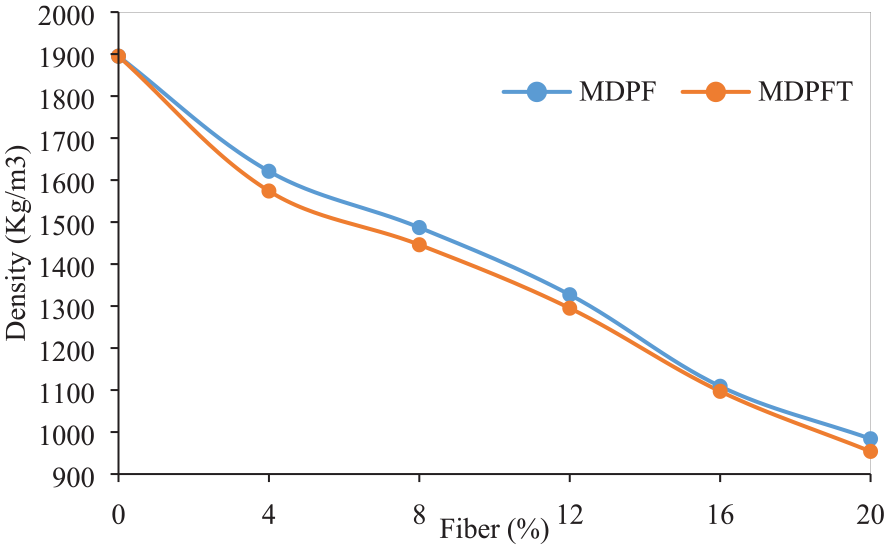
Density variation in relation to the concentration of raw and treated date palm fibers.
Thermal conductivity and diffusivity
Figures 9 and 10 demonstrate the variations of thermal conductivity and thermal diffusivity, respectively, in relation to the concentration of treated and untreated fibers. These results reveal that as the fiber content increases in MDPFT and MDPF composites, both thermal conductivity and thermal diffusivity decrease. At a concentration of 16%, the thermal conductivity reduces by 65% from 0.8 W m−1 K−1 in the reference material to 0.29 W m−1 K−1 for MDPF and 0.28 W m−1 K−1 for MDPFT, as shown in Figure 10. This decrease is expected due to the lower thermal conductivity of natural fibers compared to the reference material. Previous research, such as,41,48 also reported similar findings for composites reinforced with plant fibers.

Thermal Conductivity as a function of the percentage of raw and treated date palm fibers.

Thermal diffusivity as a function of the percentage of raw and treated date palm fibers.
Correlation between thermo physical properties
Correlation between density and compressive strength
According to Figure 11, there is a correlation between compressive strength and apparent density.

Evolution of Density ρ versus Compressive strength Rc.
The polynomial relationship between compressive strength and apparent density suggests that there is a complex interaction between the two properties. This relationship is not simply linear, but rather exhibits a higher-order polynomial curve. This means that changes in apparent density can have a significant impact on compressive strength, particularly at higher or lower densities.
The high correlation coefficients of 0.78 and 0.88 for mortars made with treated and untreated fibers, respectively, indicate a strong relationship between compressive strength and apparent density. This means that knowing the apparent density of a mortar can provide a good estimate of its compressive strength, with a small margin of error.
Overall, these findings suggest that measuring the apparent density of mortars can be an effective non-destructive method for estimating their compressive strength. 48 This can be particularly useful in situations where destructive testing is not feasible or desirable, such as in the case of historic or fragile structures where preserving the original material is a priority.
Correlation between conductivity K and compressive strength
A polynomial correlation between compressive strength and thermal conductivity in mortars can be observed, according to Figure 12. Correlation coefficients of 0.84 and 0.94 were obtained for mortars made with treated and untreated fibers, respectively. These results suggest that a good estimate of a mortar’s compressive strength can be obtained by knowing its thermal conductivity. The polynomial relationship between compressive strength and thermal conductivity indicates that a complex interaction exists between these two properties. It is not simply linear, but rather displays a higher-order polynomial curve. This means that changes in thermal conductivity, particularly at higher or lower conductivities, can have a significant impact on compressive strength. The strong relationship between compressive strength and thermal conductivity is indicated by the high correlation coefficients, implying that thermal conductivity can be used as an effective non-destructive method for estimating compressive strength.48 –50

Evolution of thermal conductivity λ versus Compressive strength Rc.
Scanning Electron Microscope (SEM) observation of the mortars
Figure 13 presents the microstructural analysis results of mortar samples based on treated date alm fibers (MDPFT) and mortar samples based on untreated date palm fibers (MDPF) using Scanning Electron Microscopy (SEM). For MDPFT samples, it is evident that the treated date palm fibers exhibit a rough surface, promoting a strong adhesion with the matrix. Conversely, for MDPF samples, a smooth fiber surface is observed, with a gap between the fiber and the matrix. These results convincingly explain the enhancement in flexural and compressive strength. The chemical treatment of date palm fibers with 1% NaOH significantly improves the matrix-fiber adhesion.

SEM Observation of Fiber-Reinforced Mortar Samples.
Conclusions
The present study focuses on experimentally investigating the thermal and mechanical properties of a novel insulating material designed to reduce the energy demands of buildings and associated greenhouse gas emissions. Our quantitative and qualitative analysis has yielded the following results:
Raw fiber composites exhibit very high-water absorption, causing micro cracks, particularly with high fiber content, whereas treated palm fiber composites are expected to be more durable than untreated palm fiber composites (DPF) in a humid environment.
The density of both composites is reduced with a high content of treated and untreated fibers, resulting in lighter materials.
Treated fiber composites exhibit higher mechanical strength values than untreated fiber composites, considering the fiber content.
The thermal conductivity values of composites made with treated and untreated fibers increase with increasing fiber content, compared to the reference composite (0% fiber content). Additionally, the thermal diffusivity values are reduced by approximately 60% for fiber percentages greater than 4%.
The results of this study indicate that the treatment of date palm fibers has a positive effect on mechanical compression, bending, density, conductivity, and thermal diffusivity.
Observation through SEM reveals a strong adhesion between the treated date palm fibers and the matrix, characterized by a rough surface.
Overall, these findings demonstrate the potential of treated palm fiber composites as an effective and sustainable alternative for insulation materials in building applications. The reduced water absorption and improved mechanical and thermal properties make them a promising candidate for reducing energy consumption and greenhouse gas emissions associated with building construction and maintenance.
Footnotes
Declaration of conflicting interests
The author(s) declared no potential conflicts of interest with respect to the research, authorship, and/or publication of this article.
Funding
The author(s) received no financial support for the research, authorship, and/or publication of this article.
