




Abstract
In this research, a new method was developed for extracting fibre directly from the ramie. High-speed water treatment was found to be beneficial for the removal of husks. The proposed fibre extraction process included retting, first high-speed water treatment, oxidative degumming and second high-speed water treatment. The retting time and hydrogen peroxide concentration suitable for the removal of husks were found to be 7 days and 8 g/L, respectively. There was very little residual husk in the extracted sample. Scanning electron microscopy showed that most of the gums were removed. The fineness and tenacity values of the ramie fibre that was extracted using the proposed method were close to the values of the ramie fibre extracted by using the traditional process. As compared with the traditional process, the chemical agent consumption, boil time and labour intensity of the new extraction method were less.
Introduction
Bast fibres, such as ramie, jute, hemp and flax, have become the focus of intense interest in recent years. 1 Ramie fibre is an important textile material having many excellent properties, such as high tensile strength, high moisture absorption, good thermal conductivity and outstanding antibacterial functions. 2 Ramie fibre can be used for clothing, technical textiles and fibre-reinforced composites. 3
Ramie fibre is extracted from ramie plants using the initial production process. The ramie is first stripped from the stem of the ramie plant. Then, the ramie is decorticated to remove the outside husk, and the decorticated ramie is manufactured. The decortication process used to be done by hand for several years. The decorticated ramie contains approximately 20%–30% non-cellulosic gummy components. 4 Before the spinning process, the decorticated ramie needs to be degummed to remove the gummy materials and disconnect the bound fibres. 5 The traditional alkaline degumming process of ramie not only has a large chemical consumption but produces serious environmental pollution problems.
The traditional ramie fibre production process is restricted by various factors, including the environmental contamination and high work intensity. 6 To reduce the chemical agent consumption and pollution, various techniques, such as oxidation degumming,7,8 bio-degumming (enzymatic and microbial)9,10 and physical methods, have been developed for extracting the ramie fibre. 11 In the oxidative degumming process, an oxidant is used to degrade the gum. As compared with the traditional chemical degumming, oxidative degumming decreases the chemical reagents and the pollution, whereas the residual gum rate and yield of the degummed ramie are increased. 12 In the oxidative degumming process, the cellulose was oxidised to oxidised cellulose; therefore, the fibre tenacity reduced. 13 Adding cellulose protective agents, such as anthraquinone, can improve the fibre tenacity. 8 Biological degumming can reduce the number of chemical reagents and pollution. 14 However, the cost of enzyme preparation is relatively high, and microbial degumming requires special fermentation equipment, which restricts the application of biological degumming. Physical methods, such as water jet treatment15,16 and explosion technology, 17 are beneficial for the removal of gum.
Previous studies have mostly focussed on the degumming procedure. In this research, a new method that combines high-speed water treatment, retting and oxidisation was developed for extracting fibre directly from the ramie without using the manual decorticate procedure. The effect of high-speed water treatment, retting days and the hydrogen peroxide concentration on the removal of husk and fibre properties were investigated. The properties of the extracted samples were characterised.
Experiment
Materials
The raw ramie was planted in Huanggang, Hubei Province. The ramie was stripped from the ramie plant by hand. The main chemicals used in this research were sodium hydroxide, hydrogen peroxide and sodium tripolyphosphate, which were purchased from Sinopharm Chemical Reagent Co. Ltd. in China.
New extraction process
The treatment process of the ramie involved the following process: raw material retting followed by high-speed water treatment. Then, oxidative degumming was performed, which was followed by high-speed water treatment and then drying.
The details of each procedure are given below.
Retting: The ramie was retted in the pool from 1 to 9 days.
Oxidative degumming: The ramie sample was treated in a peroxide solution (sodium hydroxide 2 g/L, hydrogen peroxide 0–8 g/L, anthraquinone 2 g/L) for 1 h at the temperature of 80°C. Then, 8-g/L sodium hydroxide was added to the peroxide solution. The ramie sample was treated in this peroxide solution for 2 h at the temperature of 100°C.
High-speed water treatment: The ramie sample was treated by a high-speed water jet for 3 min (see Figure 1). The speed of the water jet was approximately 5 m/s.

Setup for high-speed water treatment.
Traditional extraction method
Traditionally, the ramie is decorticated by hand to remove the outside husk. Then, the decorticated ramie is degummed using the following steps. After immersing the raw material in the acid solution, it undergoes first alkali boiling and second alkali boiling. Then, it is washed and dried. The conditions of alkali boiling are shown in Table 1.
Conditions for the alkali degumming process.

Physical and mechanical tests
The tensile properties of the fibres, such as the strength and tenacity, were measured using a YG006 testing machine (Ningbo Textile Instrument Factory, China). The gauge length and drawing speed were kept at 10 mm and 20 mm/min, respectively. The average values were obtained using results from 50 specimens. The fineness of the fibre was tested using the Chinese national standard of GB/5884-86.
Weight loss rate

Scanning electron microscopy
Scanning electron microscopy (SEM) micrographs of the ramie fibre surface topography of the untreated and treated fibres were taken using the scanning electron microscope (JEOL JSM-6510LV, Japan). It was operated at 10 kV. Before the SEM evaluation, the sample was coated with a thin layer of gold using a plasma sputtering apparatus.
Residual husk rate
Husks in ramie sample were picked by hand. The residual husk rate was calculated using the following equation

Residual gum rate
The residual gum rate of the ramie was measured using the Chinese standard GB5889-86 method for the quantitative analysis of ramie chemical components analysis.
Results and discussion
Effect of high-speed water treatment
The adhered impurities present in ramie may have hampered the yarn quality and be removed during degumming processing. In this research, high-speed water treatment was used to remove the husks in the ramie. The raw ramie skin was treated using different processes (see Table 2) to explore the effect of high-speed water treatment on husk removal. The weight loss rate was used to evaluate the removal effect of the husk and gum. The weight loss rates of different processes were calculated. The results are shown in Table 3.
Fibre extraction process with different high-speed water treatment times.

Effects of water treatment times on the weight loss rate.

As shown in Table 3, the weight loss rate of the ramie sample increased as the high-speed water treatment times increased. This means that the high-speed water treatment was beneficial for husk removal; therefore, it is better to treat twice with high-speed water. When the ramie sample was treated by high-speed water, the husks and gum were removed because of the impact force of the high-speed water. The improved fibre extraction process involved the following steps: retting, first high-speed water treatment, oxidative degumming and second high-speed water treatment.
Effect of retting days
The retting was performed as an environmental degumming method with low production costs. Raw ramie skin was retted in the pool for 1, 3, 5, 7 and 9 days, respectively. Then, all the retted samples were treated by the following process: first high-speed water treatment, oxidative degumming (hydrogen peroxide 8 g/L) and second high-speed water treatment. The degummed sample was dried and weighted. Then, the weight loss was calculated, and the fibre property was tested. The results are shown in Figures 2 and 3.

Effects of retting time on the weight loss rate.

Effect of retting time on fibre fineness.
From Figure 3, it is obvious that the weight loss rate increased with an increase in the retting time from 1 to 7 days. The weight loss rate remained almost stable when the retting time exceeded 7 days. The ramie sample was treated by high-speed water, and the gum was degraded by microbes. Therefore, the force between the fibre and the husks decreased, and the husks were removed easily by using high-speed water treatment. Along with the increase in the retting time, the gum in the ramie was degraded gradually by microbes in the pool; therefore, the intensity between the fibre and husks was low, and the husks were easy to remove.
The gum was gradually removed from the ramie fibre, and the fibre fineness increased with an increasing retting time from 1 to 7 days (see Figure 3). The fibre fineness remained almost stable when the retting time exceeded 7 days. Considering all factors, the most suitable retting time was 7 days.
Effects of hydrogen peroxide concentration
After retting and the first high-speed water treatment, parts of the gum and husks were removed from the ramie skin. The oxidative degumming process was used to remove the residual gums and husk. The ramie skin was treated using the following process: retting in the pool for 7 days, first high-speed water treatment, oxidative degumming and second high-speed water treatment. The ramie samples that were degummed with different hydrogen peroxide concentrations were dried and weighed. The weight losses were calculated, and the fibre properties were tested. The results are shown in Figures 4 and 5.
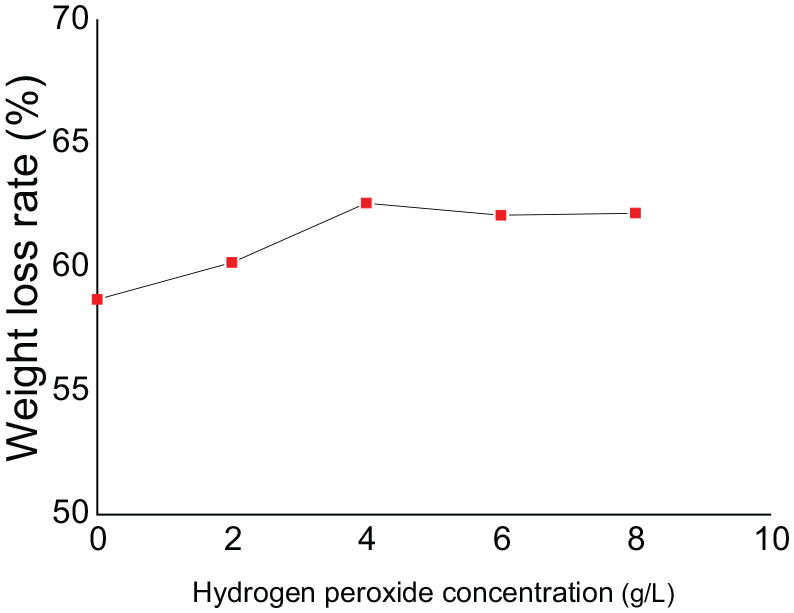
Effect of hydrogen peroxide concentration on weight loss.
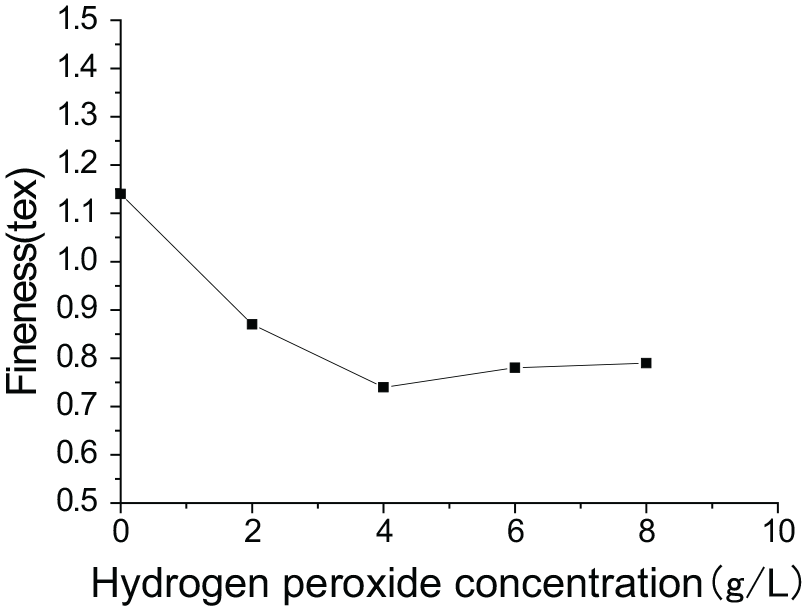
Effect of hydrogen peroxide concentration on fibre fineness.
Figure 4 shows that the weight loss rate increased with an increasing hydrogen peroxide concentration from 0 to 4 g/L. Subsequently, the weight loss rate remained almost stable when the hydrogen peroxide concentration exceeded 4 g/L. Hydrogen peroxide is an oxidation agent. The gum and husk were oxidised by the hydrogen peroxide and more easily dissolved in the degumming solutions. From Figure 5, we can see that the fibre fineness decreased as the hydrogen peroxide concentration increased. Similar results were obtained in a previously conducted study. 18 The fibre fineness reached its minimum value at 4-g/L concentration of hydrogen peroxide. Therefore, the suitable hydrogen peroxide concentration was 4 g/L.
The appearance of the ramie and degummed ramie samples was compared to reveal the removal of husks. Figure 6(a) shows that the raw ramie skin had a large amount of husks. Some husks started coming off the ramie fibre, and some fibres started separating after being retted in pools for 7 days (see Figure 6(b)). Most of the husks were removed from the ramie fibre (Figure 6(c)) because of the physical force of the high-speed water treatment, and more single fibres were separated. Figure 6(d) clearly shows that there were fewer husks in the ramie sample after the second high-speed water treatment. In summary, the husks were gradually removed from the ramie using the fibre extraction process.
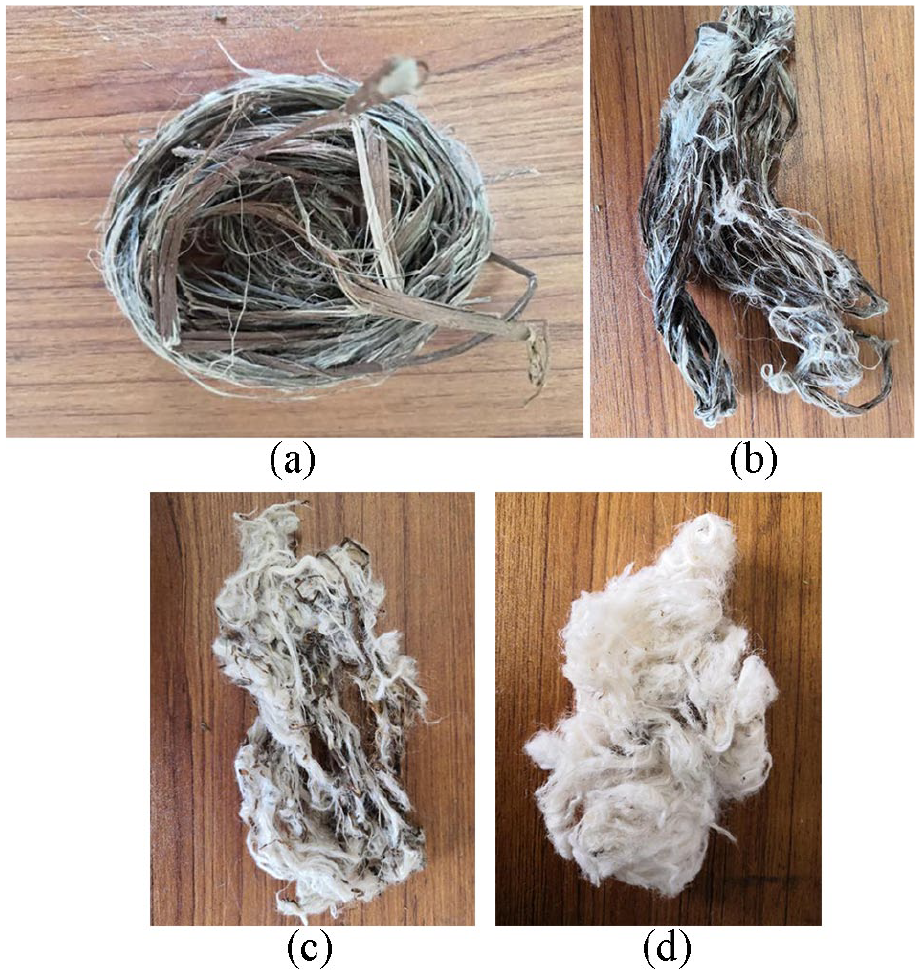
Appearance of the ramie sample: (a) raw ramie, (b) ramie sample after retting, (c) ramie sample after the first treatment with high-speed water and (d) ramie sample after the second treatment with high-speed water.
Surface morphology
The surface morphologies of the raw ramie and degummed fibres were compared using SEM. The SEM images showed that the surface of the raw ramie was rough and coarse because of the heavy gum (see Figure 7(a)); the degummed ramie fibre showed a smoother surface because the gummy materials had been removed (see Figure 7(b) and (c)).

SEM image of raw ramie and degummed ramie fibre: (a) raw ramie, (b) degummed ramie fibre and (c) traditional degummed ramie fibre.
Comparison between the proposed process and traditional process
The most efficient fibre extraction process involved retting for 7 days, which was followed by the first high-speed water treatment. Then, oxidative degumming was performed, which was followed by the second high-speed water treatment. The optimised oxidative degumming process involved treating the ramie sample in peroxide solution (sodium hydroxide 2 g/L, hydrogen peroxide 4 g/L and anthraquinone 2 g/L) for 1 h at the temperature of 80°C. Then, 8-g/L sodium hydroxide was added to the peroxide solution. The ramie sample was treated in this peroxide solution for 2 h at the temperature of 100°C. The fibre property, residual husks and gum rate of the ramie sample produced by the new process and traditional process are listed in Table 4. The fineness and tenacity of the ramie fibre obtained using the proposed method and the traditional process were quite similar. The residual husk rate was only 1.6%, and the residual husks in the sample were so small that they could be removed in the spinning process. The residual gum rate of the new processed sample was a little higher than that of the traditional ramie sample; however, the extracted sample was loose and white, and the single fibre was separated (see Figure 6(d)). Therefore, the extracted ramie fibre was suitable for the spinning process.
Properties of the ramie samples.

To produce 1 t of refined ramie fibre, the boil time, manual decortication time and the chemical agents of the new process and traditional process were calculated (see Table 5). In the traditional process, 510 kg of chemical agents was consumed and the boil time was 5.5 h; these values reduced to 450 kg and 3 h, respectively, for the proposed method. This implies that the chemical agents and energy will be saved; therefore, waste water pollution will decrease. Moreover, the outside husks are usually decorticated by hand from the raw ramie bark in the traditional process. According to the normal manual decorticate productivity, 1500 h was needed for one person to produce 1 t of refined ramie fibre. Therefore, this work could be completed only if 100 people worked continually from 7:00 a.m. to 10:00 p.m. without any break. The manual decortication process was reduced in the new process, thereby reducing the labour intensity.
Chemical consumption for the production of 1-t refined ramie fibre.

Conclusion
In this research, a new method was developed to extract fibre directly from the ramie. It had been found that high-speed water treatment was beneficial for the removal of husks. Suitable retting time and hydrogen peroxide concentration were also good for the fibre property and the removal of husks. The improved fibre extraction process involved retting for 7 days followed by the first high-speed water treatment. Then, oxidative degumming was performed followed by the second high-speed water treatment. In the optimised oxidative degumming process, the ramie sample was treated in the peroxide solution (sodium hydroxide 2 g/L, hydrogen peroxide 4 g/L and anthraquinone 2 g/L) for 1 h at the temperature of 80°C. Then, 8-g/L sodium hydroxide was added to the peroxide solution. The ramie sample was treated in this peroxide solution for 2 h at the temperature of 100°C. The husks were gradually removed from the ramie skin using the fibre extraction process. There were very few residual husks in the degummed sample. SEM shows that the gums were mostly removed. The fineness and tenacity values of the ramie fibre that was produced using the proposed method were close to the values obtained using the traditional process. As compared with the traditional ramie initial production process, the chemical agent consumption, boil time and labour intensity were less for the new extraction methods.
Footnotes
Declaration of conflicting interests
The author(s) declared no potential conflicts of interest with respect to the research, authorship and/or publication of this article.
Funding
The author(s) disclosed receipt of the following financial support for the research, authorship and/or publication of this article: This work was supported by the earmarked fund for the research project of Hubei Key Laboratory of Biomass Fibers and Eco-Dyeing & Finishing (STRZ2018006) and the research project of Hubei Education Department (Q20181707).
