Bisphenol-substituted spirocyclic phosphazene derivatives were synthesized in 85%–94% yields and analyzed for flame retardant application to cotton fabric using Limiting Oxygen Index, Fourier transform infrared thermogravimetric analysis, differential scanning calorimetry, microscale combustion calorimetry, thermogravimetric analysis, and scanning electron microscopy. The thermogravimetric analysis methods indicate a decomposition pathway consistent for phosphorus-nitrogen-containing compounds. Levoglucosan phosphorylation and carbonaceous char formation were observed. Limiting Oxygen Index testing of these compounds on cotton-based fabrics showed improved flame resistance compared to untreated fabrics.
Industrial, governmental, and academic research groups have sought for years to synthesize effective flame retardant (FR) compounds for application to cotton textile, and many reviews have been written on this subject.1–3 In recent years, legislative action in the European community has restricted the use of some FRs, causing the focus of research to shift toward nitrogen- and phosphorus-based compounds. Phosphorus-nitrogen-based FR compounds retard in the condensed phase of combustion through a mechanism of protective phosphorylation of the cellulosic polymer and the formation of protective char.4–6 Given the pressing need to find evermore effective FRs, this research group began investigating phosphazene derivatives which have high percentages of phosphorus and nitrogen in their molecular structures. There are many journal articles written and patents issued concerning polymeric phosphazene blends,7–13 but this research focused on monomeric spirocyclic phosphazene derivative forms that are covalently linked to cotton. Specifically, this research searched for easily synthesized, high-yielding phosphazene derivatives, which offer promise as FRs and are covalently linked to cotton fabrics, unlike the aforementioned blends which are extruded as polymers or coated onto fabric. In addition, this investigation explored the thermal decomposition of the FR using microscale combustion calorimetry (MCC), differential scanning calorimetry (DSC), thermogravimetric analysis (TGA) as well as Fourier transform infrared spectroscopy (FTIR) coupled to the TGA instrument (TGA-FTIR). Limiting Oxygen Index (LOI) analyses determined the minimum concentration of oxygen that would support combustion. Scanning electron microscopy (SEM) provided images of the textile fibers after application of the FR and burning.
Materials and methods
Phosphonitrilic chloride trimer 2 (Aldrich), 2,2′-biphenol 1 (Aldrich), anhydrous K2CO3 (Fisher Scientific), and acetone (Fisher Scientific) were used as received. All reactions were conducted under ultra-high purity (UHP) argon and monitored using silica gel IB2-F thin layer chromatography (Fisher Scientific). NMR spectra were recorded on a Varian 400-MHz instrument using CDCl3 as solvent. 1H and 13C NMR chemical shifts are given in ppm (δ) referenced to tetramethylsilane (TMS). 31P chemical shifts are given in ppm (δ) referenced to a coaxial NMR tube containing 85% aqueous H3PO4. Bleached and mercerized twill fabric, 258 g m−2 (Testfabrics, Inc., Style 423) was used as received, hereinafter referred to as cotton twill. Three separate concentrations of compounds 3 and 4 (1%, 2%, 4% w/w in chloroform) were prepared and three samples of cotton twill were immersed in each solution for 1 h, then cured in a vacuum oven at 160°C for 5 min.
Gas chromatography–mass spectrometry analysis
Gas chromatography–mass spectrometry (GC-MS) was carried out on a GC model 6890 with MS model 5973 (Agilent 145 Technologies) fitted with an DB5-MS (20 m × 0.18 mm id., 0.18-μm film) modular accelerated column heater (MACH) capillary column (Gerstel, Inc., Linthicum, MD). The MACH column heating was controlled by an integrated Gerstel Maestro software, beginning with a 1-min hold at 50°C, followed by a 12°C min−1 gradient to 300°C, with a 3.17-min hold at 300°C. A helium flow rate of 0.7 mL min−1 was maintained by a programmed pressure gradient in the ChemStation software (14.8 lbf in−2 (1-min hold) to 33.6 lbf in−2 at 14.8 lbf in−2 min−1, with a 3.17-min final hold). The oven and MS transfer temperatures were set at a constant 250°C. A QuickSwap was employed between the column and MS transfer, with a 3-lbf in−2 flow of helium. An autosampler performed the GC injections, using a 1-μL injection volume, into a splitless injector at 250°C. Data were collected and analyzed using the MSD ChemStation program (Rev.D.03.00.552; Agilent Technologies 1989-2006). Identification of peaks was by mass ion (573 and 459 amu, respectively) and chlorine isotope patterns.
The synthesis of 2,2,4,4-tetrachloro-6,6-[spiro(2,2′-dioxy-1′,1″-biphenyl)] cyclotriphosphazene (TSDBC 3) was performed using a modified procedure of Carriedo et al. as reported by Fontenot and colleagues.13–15 Proton, carbon, and phosphorous nuclear magnetic resonance spectroscopic values are in agreement with the literature. Yield = 94%. MS (GC) m/z 459 [M − e−]+.
The synthetic method, electrospray ionization mass spectroscopy, and nuclear magnetic resonance spectral characterization of 2,2-dichloro-4,4,6,6-bis[spiro(2,2′-dioxy-1′,1″-biphenyl)] cyclotriphosphazene (DBDBC 4) are identical to those previously published paper.15 The synthetic yields reported herein (85%) are slightly improved, compared to those previously reported (77%). MS (GC) m/z 573 [M − e−]+.
LOI
LOI was performed on treated fabrics according to ASTM D2863-00 protocol using a Dynisco Polymer Test LOI chamber. Treated fabrics cut to 6.4 × 12.7 cm (W × L) were conditioned for 48 h. The single, average value of four consecutive LOI measurements was reported.
TGA-FTIR
The TGA-FTIR analysis was conducted using a TA Instruments Q500 thermogravimetric analyzer and a Bruker Tensor-27 spectrometer. In this experiment, 5–8 mg of each sample was heated between 20°C and 550°C in the thermogravimetric analyzer at a rate of 10°C min−1 and under a nitrogen flow rate of 60 mL min−1. The resulted volatile decomposition products then traveled through a transfer line to reach the gas cell of the FTIR spectrometer. The TGA analysis investigated the thermal degradation of the samples from 20°C to 600°C; specifically, the gaseous products released during the main degradation ranging from 100°C to 500°C. Both transfer line and gas cell were maintained at 200°C. When the evolved gases reached the gas cell, they were analyzed by a liquid-nitrogen cooled MCT detector which is equipped with ZnSe window. The gas components were then recorded as the absorption peaks in the 4000- to 600-cm−1 region at a resolution of four wavenumbers. Data were collected every 5°C along the TGA heating profile, and there was a 30-s delay between the timed measurements for the FTIR. When the experiment was completed, the data were analyzed using an OPUS spectroscopy software which measures the intensity of the absorption band (representing the functional groups) as a function of temperature. For analytical purposes, OriginPro 2018b was used to retain the three-dimensional (3D) images (surface plots) of the FTIR spectra.
TGA
TGA was performed using a TA Instruments Q500 (Waters LLC) under a nitrogen atmosphere. Sample masses of 4.0–8.0 mg were heated from 25°C to 600°C at a rate of 10°C min−1. Three repetitive measurements were conducted, and their average thermal parameters were reported. Char yield and onset temperature was analyzed using Universal Analysis 2000 software.
DSC
The FR-treated fabrics were analyzed by DSC using a Q100 differential scanning calorimeter (TA Instruments). Approximately 4 mg of each sample was weighed in aluminum pans and analyzed from 45°C to 510°C with a temperature gradient of 10°C min−1 and a nitrogen flow rate of 50 mL min−1. Data were collected in triplicate for each sample and the resulting thermograms averaged, and the average curve plotted with OriginPro2018b.
MCC
The MCC analysis was performed using a Govmark MCC-2 microscale combustion calorimeter, following a slight modification to ASTM D 7309-13 as previously reported by Nam et al.16 Approximately 4-mg samples were weighed in an MCC ceramic cup, and the sample was heated to 550°C at a constant heating rate of 1.2°C s−1 in a stream of nitrogen flowing at 80 mL min−1. The pyrolysis products of the sample after thermal decomposition were mixed with a stream of oxygen with a flow rate of 20 mL min−1 and completely oxidized with a combustion temperature setting of 900°C.
SEM
SEM measurements were performed by the Shared Instrumentation Facility, Louisiana State University. The morphology of treated fabric samples was analyzed by SEM. The fabric samples before and after flammability tests were affixed to the SEM sample stage with double-sided carbon tape and platinum-coated with argon as a carrier gas. The metalized fabrics were scanned in a FEI Quanta 3D FEG FIB/SEM dual beam system under accelerated electrons with 5-kV operating voltage and 3.0-pA beam current to minimize damage to the cotton fibers.
Results and discussion
Synthesis of the spirocyclic phosphazenes
Figure 1 details the syntheses of TSDBC 3, and DBDBC 4. Similar compounds have shown anti-tumor17 and antimicrobial properties.18,19 Phosphazenes have also been covalently bonded with fluorophores such as dihydroxytetraphenylethylene for detection of explosive nitroaromatics including 2,4,6-trinitrotoluene (TNT) and picric acid.20 The synthesized compounds reported herein were examined solely as FRs only and not for these other properties.
Synthesis of TSDBC 3 and DBDBC 4.
Compounds TSDBC 3 and DBDBC 4 were synthesized in yields of 94% and 85%, respectively. Chromatography was not required, and multi-gram quantities were readily obtained by precipitation of the final product from the reaction solution. The high yields and simple work-up make these compounds ideal candidates for investigation as FRs. These two compounds were chosen because they each possess favorable structural characteristics that are beneficial in FRs. Specifically, each compound has a phosphorous–nitrogen core that (1) provides an acid source for phosphorylation of the decomposing cellulose polymer, thus preventing levoglucosan formation; (2) provides gaseous nitrogen during thermal decomposition for dilution of oxygen and as a char blowing agent. In addition, TSDBC 3 and DBDBC 4 possess a bisphenol ring system that (3) provides a carbon source for char formation. Neither TSDBC 3 nor DBDBC 4 was soluble in the most common laboratory organic solvents with the exception of chloroform and both were insoluble in water. When the textile fabrics were treated with each FR, they maintained a high degree of whiteness, although some stiffening of fabric hand was noted. Cotton twill treated with low concentrated solutions of TSDBC 3 and DBDBC 4 was analyzed for FR properties using LOI, TGA-FTIR, TGA, DSC, MCC, and SEM. The results are reported herein.
LOI
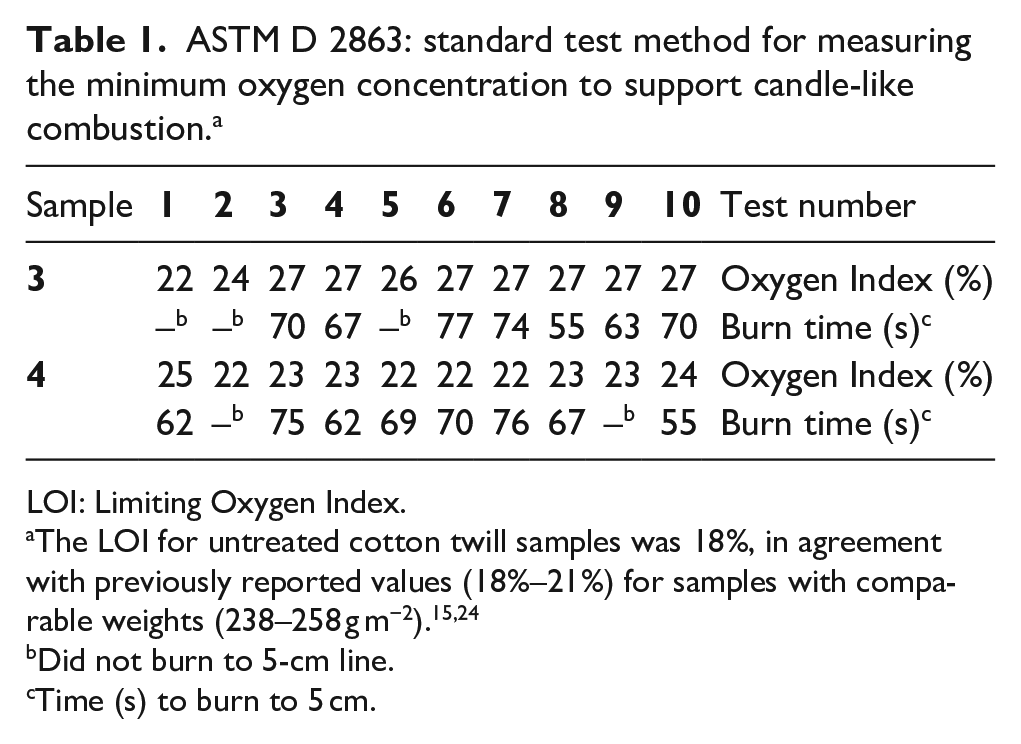
Ten cotton twill samples were prepared by treating each fabric with a 4% (w/w) solution of chloroform and either TSDBC 3 or DBDBC 4. Each treated sample exhibited FR properties in LOI testing that were superior to untreated cotton twill samples. The summary of LOI results is found in Table 1. TSDBC 3 has an LOI value of 27% (compared to 18%–21% for untreated cotton twill samples) in 7 of the 10 samples tested and is classified in the upper limit of slow burning materials.15,21–24 This was, however, below the LOI threshold of 29% for classification as self-extinguishing. Notably, similar compounds containing a core cyclotriphosphazene unit had an LOI of 31% at a weight add-on of 6%.15 The slightly higher LOI can likely be attributed, in this case, to the greater weight add-on during the treatment step. In addition, bridged cyclotriphosphazenes have comparable LOIs of 26.8%, 27.5%, or 29% with a 3% add-on.25–27 Other FR containing a core triazine with covalently linked phosphonate esters had an LOI of 32% but also had a considerable 19.7% add-on.28
ASTM D 2863: standard test method for measuring the minimum oxygen concentration to support candle-like combustion.a
The LOI for untreated cotton twill samples was 18%, in agreement with previously reported values (18%–21%) for samples with comparable weights (238–258 g m−2).15,24
Did not burn to 5-cm line.
Time (s) to burn to 5 cm.
The time required to burn to the 5-cm line ranged from 55 to 77 s. When samples from TSDBC 3 were subjected to 22%, 24%, and 26% oxygen, the treated twill fabric did not burn to the 5-cm line. DBDBC 4 has an LOI value of 22%–24% and is likewise slow burning according to the same classifications. The time required to burn to the 5-cm line ranged from 55 to 76 s. Two samples of DBDBC 4 did not burn to the 5-cm line when 22% oxygen was applied, and one sample did not burn to the 5-cm line when 23% oxygen was applied.
TGA-FTIR
The real-time gaseous products released in the pyrolysis of cotton twill fabrics treated with TSDBC 3 and DBDBC 4 were examined by TGA-FTIR. The resulting FTIR data were plotted as a 3D surface plot in which the evolution of gas products is shown as a function of both wavenumber and temperature. The TGA-FTIR spectral output from cotton twill fabrics treated with TSDBC 3 and DBDBC 4 under different temperatures is shown in Figure 2. For treated cotton fabrics, no pyrolysis product was detected below 270°C. Most absorption bands began to appear at 280°C to 290°C, which were assigned as follows: the gases released are mainly water vapor (~4000–3500 and 1800–1500 cm−1), hydroxyl OH (~3400–3100 cm−1), hydrocarbon CH (~3014–2600 cm−1), CO2 (~2360–2310 and 710 cm−1), CO (~2185–2100 cm−1), CO (~1850–1600 cm−1), C=C ring aromatic vibrations (1600–1497 cm−1), and a mix of P=N and P–O–C stretching (~1250–900 cm−1). When comparing the evolution profiles for cotton twill fabrics treated with TSDBC 3 and DBDBC 4, it is noticeable that the two FR compounds behave similarly. These similarities are the products of the decomposition of the cellulose polymer, the appearance of free radicals, oxidation, dehydration, decarboxylation, decarbonylation, and formation of tarry pyrolyzate-containing levoglucosan, which vaporizes and then decomposes at later time or higher temperature.29,30 These degradation products are similar to what has been observed previously for related cyclotriphosphazenes.13 Thus, the primary decomposition products are the release of aromatic, amino, and phosphorous functionalized compounds that provide a protective char barrier that inhibits the production of flammable gases.
TGA-FTIR of pyrolysis products from fabrics treated with (a and b) TSDBC 3 and (c and d) DBDBC 4.
TGA
Three concentrations of TSDBC 3 (1%, 2%, 4% w/w in chloroform) were prepared and three samples of cotton twill fabric were immersed in each solution for 1 h, then cured in a vacuum oven at 160°C for 5 min. Percent add-on after curing ranged from 1% to 5%. In all three concentrations, less than 5% weight loss in the form of water occurred prior to 200°C. However, between 200°C and 225°C, there was an observed weight percentage loss of 2% to 10%, directly proportional to the concentration of TSDBC 3. In addition, Figure 3 shows the onset of rapid weight loss corresponding to thermal decomposition (Tonset) occurred at a lower temperature in samples treated with a higher concentration solution of TSDBC 3 than in samples treated with a lower concentration (e.g. 280°C for 4%, 290°C for 2%, and 320°C for 1%). A similar trend was noted for the formation of protective char: 330°C for 4%, 340°C for 2%, and 360°C for 1%. Upon reaching 550°C, the samples treated with the highest concentration (4%) retained 17% of their original weight compared to retention of 10% and 7%, for the samples treated with 2% and 1% solutions of TSDBC 3, respectively.
Comparative TGA profiles from 50°C to 550°C of fabrics treated with TSDBC 3 at 1%, 2%, and 4% concentrations.
Three solutions of DBDBC 4 (1%, 2%, 4% w/w in chloroform) were prepared and three samples of cotton twill fabric were then immersed in the prepared solutions for 1 h and cured in a vacuum oven at 160°C for 5 min, similarly as reported for TSDBC 3. Percent add-on after curing ranged from 1% to 5%. A subsequent comparison of their fire-retardant properties using TGA was made as depicted in Figure 4. In all three concentrations, less than 10% weight loss occurred prior to reaching 200°C. Similar to TSDBC 3, the onset of rapid weight loss occurs earlier in higher-concentrated samples (280°C in 4%) than in lower-concentrated samples (290°C in 1% and 2%). In addition, in higher-concentrated samples, the formation of protective char occurred earlier (305°C in 4%) than in lower-concentrated samples (325°C in 1% and 310°C in 2%). Upon reaching 550°C, the samples with the higher-concentrated treatment (4%) maintain 25% of their original weight, compared to the lower-concentrated samples (1% and 2%) which have 13% and 18% of their starting weights, respectively.
Comparative TGA profiles from 50°C to 550°C of fabrics treated with DBDBC 4 at 1%, 2%, and 4% concentrations.
A comparison using TGA was made between untreated cotton twill and cotton twill treated with 4% solutions of phosphazene 2, TSDBC 3, and DBDBC 4 and is shown in Figure 5. The purpose of this comparison was to determine the extent to which phosphazene 2 was an effective FR on its own and to determine the extent to which the bisphenol substitution of phosphazene provided improved flame retardance. As expected, untreated cotton twill exhibited no flame retardance and underwent a rapid weight loss percentage of >80% between 340°C and 390°C (Tonset = 354°C). At 600°C, the untreated material was completely consumed. After treatment of cotton twill with a 4% solution of phosphazene 2 as described above, the Tonset occurred at 320°C, ~34°C below the untreated fabric; from 550°C to 600°C, only 8%–9% of the mass of the treated fabric remained. When the cotton twill was treated with 4% solutions of TSDBC 3 and DBDBC 4, the onset of rapid weight loss percentage decreased to 294°C and 288°C, respectively. Higher percentages of char remained as previously mentioned.
TGA profiles from 50°C to 600°C of untreated cotton twill (Twill-423), and fabrics treated with (4%) phosphazene 2, TSDBC 3, and DBDBC 4.
Phosphazene 2, TSDBC 3, and DBDBC 4 improve the flame retardance of cotton twill as is evident in Figure 5. However, phosphazene 2 alone does not impart superior flame retardance compared to a synthesized combination of phosphazene 2 and bisphenol 1. A phosphorus–nitrogen synergism in the decomposition process is the most probable explanation for the improvement seen with phosphazene 2, but it is the synthetic incorporation of bisphenol 1 with phosphazene 2 which provides even greater flame retardance through the formation of protective char in conjunction with the synergistic P–N effects. It is not surprising then that DBDBC 4, the tetra-phenol product, forms significantly more char compared to the bi-phenol TSDBC 3 in an oxygen atmosphere. Remaining char amounts were similar when the analyses were in a nitrogen atmosphere.
DSC
The DSC curves for twill fabrics treated with 4% solutions of TSDBC 3 and DBDBC 4, and the untreated cotton twill are shown in Figure 6. Comparative TGA, derivative thermogravimetry (DTG), and DSC curves for the cotton twill fabrics treated with TSDBC 3 and DBDBC 4 are shown in Figure 7. A small endotherm was observed at 184°C prior to any decomposition for TSDBC 3–treated cotton twill, which was attributed to the melting point of small deposits of TSDBC 3 on the cotton surface. This was confirmed by the melting point determined with the aid of an Accumelt™ melting point apparatus that gave a melting point of 188°C; no mass loss was observed in the TGA curve at this temperature. In addition, a sharp exotherm was noted at 253°C and a peak thermal decomposition temperature was noted at 322°C before a small, broad endotherm. The exotherm at 253°C is the result of thermal crystallization or polymerization of the FR and crosslinking with the cotton fibers as no mass loss occurred during this region; the endotherm denoted at 292°C was accompanied by the majority mass loss in the TGA profile. DBDBC 4 exhibited a sharp endotherm at 294°C associated with decomposition/mass loss in the TGA curve, followed by a small exotherm at 302°C, which is attributed to curing/crosslinking of residual compounds with the cotton structure. These attributes were absent in the control twill, which exhibited a single broad endotherm at a decomposition temperature of 362°C.
DSC curves from 100°C to 450°C for fabrics treated with TSDBC 3, DBDBC 4, and the control cotton twill (Twill-423).
Comparative TGA, DTG, and DSC curves from 125°C to 450°C for fabrics treated with TSDBC 3 and DBDBC 4.
MCC
MCC analysis is a small-scale flammability testing technique that is based on the principle of oxygen consumption.31,32 MCC testing provides key flammability parameters such as heat release capacity (HRC), heat release rate (HRR), peak heat release rate (pHRR), total heat release (THR), and the temperature at maximum heat release (Tmax). The average HRR curves for the cotton twill and TSDBC 3 and DBDBC 4 treated fabrics are shown in Figure 8, while the corresponding combustion data are shown in Table 2. Each curve is averaged over the range from 100°C to 500°C, while the combustion data are presented as the average of three measurements with the standard deviation expressed as the uncertainty. Of note, both FR-treated compounds had significant char formation of ~25%, and the incorporation of TSDBC 3 or DBDBC 4 significantly reduced the temperature at which the maximal heat release occurred. Comparing char amounts in MCC versus TGA, it must be pointed out that in MCC both samples are heated in a nitrogen atmosphere, while in TGA both samples are heated in an oxygen atmosphere. It is interesting to note that both the pHRR and the THR were the lowest for cotton twill treated with TSDBC 3 containing a single bisphenol moiety, and in fact the cotton twill treated with DBDBC 4, containing two bisphenol moieties, resulted in an increase in the pHRR compared to cotton twill. However, the DBDBC 4–treated fabric showed an increase in the HRC compared to a nearly 50% decrease in the case of TSDBC 3 compared to cotton twill. In general, lower combustion values indicate a better performing FR treatment. The fact that monosubstituted outperforms the disubstituted indicates the unreacted halogens may play a significant role in the FR treatment with TSDBC 3 and DBDBC 4.
HRR curves for cotton twill (Twill-423), and fabric treated with 4% (w/w in CHCl3) TSDBC 3 and DBDBC 4. The curves are the average from the three experiments.
Char (%) was measured based on the mass difference of the residual compound after heating/combustion at 550°C and subsequent cooling of the (unsealed) MCC cup.
SEM
Surface images of cotton twill fabrics that were treated with TSDBC 3 and DBDBC 4 and burned are shown in Figure 9. The top two images (Figure 9(a) and (b)) show the fabric after application and thermal curing of the FRs onto the fabrics at 5000×. The monosubstituted TSDBC 3 in image (a) appears evenly dispersed along the exterior of the fabric fibers, while the disubstituted DBDBC 4 in image (b) appears less evenly dispersed with some agglomeration present. After burning, Figure 9(c) shows the cotton fiber treated with TSDBC 3 to be intact, with no apparent shrinkage or cracking. The FR appears to have polymerized during the burning process in agreement with results from DSC analysis. Figure 9(d) shows the twill fabric treated with DBDBC 4 after burning where the cotton fibers have shrunk considerably and the FR appears to have formed small globules on the fiber surface. Figures 9(e)–(f) are magnifications of Figures 9(c) and (d), respectively, enhanced from 5000× to 20,000× to show the surface details. In Figure 9(e), short, wisp-like filaments of polymerized FR TSDBC 3 on the surface of the fiber indicate a blowing effect from the FR during thermal decomposition. Globular formation is clearly apparent in the DBDBC 4 treated and burned fabric (Figure 9(f)).
Top, treated cotton fabrics coated with (a) TSDBC 3 and (b) DBDBC 4 (5000×); middle, burned fabrics (c) TSDBC 3 and (d) DBDBC 4 (5000×); bottom, burned fabrics (e) TSDBC 3 and (f) DBDBC 4 (20,000×).
Conclusion
Two bisphenol-substituted cyclotriphosphazene monomers were easily synthesized in high yields and tested for FR properties using TGA and LOI standardized methods. TSDBC 3 has a LOI of 27% and is classified in the high end of slow burning materials, while DBDBC 4 has a LOI of 22%–24% and is classified as slow burning. Standardized TGA analyses indicate a beneficial effect from the phosphorus- and nitrogen-containing compounds which impart improved flame retardance with increasing concentration as compared to untreated cotton twill. Bisphenol-substitution effectively increased char formation in TGA testing, though unreacted halogens were a possible reason why fabric treated with TSDBC 3 outperformed fabric treated with DBDBC 4 in LOI testing. These results and SEM imaging have shown that low-level concentrations of monomeric forms of derivatized phosphazenes can be effective FRs in cotton textile applications.
Footnotes
Acknowledgements
The authors wish to thank Jade Smith for treating fabrics with flame retardants and providing TGA-FTIR analyses and Dongmei Cao at the LSU Shared Instrument Facility for collecting the SEM data. Additionally, the authors would like to thank the National Program Staff, the Mid-South Area Director, and the Center Director of the Agricultural Research Service of the U.S. Department of Agriculture for providing the necessary support for the study presented here. The Southern Regional Research Center is a federal research facility of the U.S. Department of Agriculture in New Orleans, LA. The names of the companies and/or their products are mentioned solely for the purpose of providing information and do not in any way imply their recommendation or endorsement by the USDA over others.
Declaration of conflicting interests
The author(s) declared no potential conflicts of interest with respect to the research, authorship, and/or publication of this article.
Funding
The authors disclosed receipt of the following financial support for the research, authorship, and/or publication of this article: This research was funded through the United States Department of Agriculture (ARS Research Project Number 6435-41430-005-00D).
ORCID iDs
Michael W Easson
Jacobs Harris Jordan
References
1.
SalmeiaKAGaanSMalucelliG. Recent advances for flame retardancy of textiles based on phosphorus chemistry. Polymers2016; 8(9): 319.
2.
HorrocksARKandolaBKDaviesPJ, et al. Developments in flame retardant textiles: a review. Polym Degrad Stabil2005; 88(1): 3–12.
3.
WeilED. Fire-protective and flame-retardant coatings: a state-of-the-art review. J Fire Sci2011; 29(3): 259–296.
4.
HendrixJEDrakeGLJrBarkerRH. Pyrolysis and combustion of cellulose. III. Mechanistic basis for the synergism involving organic phosphates and nitrogenous bases. J Appl Polym Sci1972: 257–274.
5.
PandyaHBBhagwatMM. Mechanistic aspects of phosphorus-nitrogen synergism in cotton flame retardancy. Text Res J1981; 51: 5–8.
6.
KubotaS. Flame retardant finishing. In: JCSalamone (ed.) Polymeric materials encyclopedia, vol 4. New York: CRC Press, 1996, pp. 2389–2396.
7.
AllcockHR. New approaches to hybrid polymers that contain phosphazene rings. J Inorgan Organometal Polym Mater2007; 17(2): 349–359.
8.
XuLWuXLiL, et al. Synthesis of a novel polyphosphazene/triazine bi-group flame retardant in situ doping nano zinc oxide and its application in poly (lactic acid) resin. Polym Adv Technol2019; 30(6): 1375–1385.
9.
SinghKPMishraAKumarN, et al. Nadimide substituted fluorinated polyphosphazenes: synthesis and characterizations. Polym Bullet2019; 76(5): 2277–2294.
10.
Metinoğlu ÖrümSSüzen DemircioğluY. One-pot synthesis and characterization of crosslinked polyphosphazene dopamine microspheres for controlled drug delivery applications. J Macromol Sci, Part A: Pure Appl Chem2019; 56(9): 854–859.
11.
SuKCHJowJZhuJL, et al. Substituted phosphazene compounds and their use as flame resistance additives for organic polymers. WO2009055993A1 Patent, 2007.
FontenotKRNguyenMMAl-Abdul-WahidMS, et al. The thermal degradation pathway studies of a phosphazene derivative on cotton fabric. Polym Degrad Stabil2015; 120: 32–41.
14.
CarriedoGAFernández-CatuxoLGarcía AlonsoFJ, et al. Preparation of a new type of phosphazene high polymers containing 2,2′-dioxybiphenyl groups. Macromolecules1996; 29(16): 5320–5325.
15.
FontenotKREassonMWSmithJ, et al. Application of a phosphazene derivative as a flame retardant for cotton fabric using conventional method and supercritical CO2. AATCC J Res2014; 1(6): 16–26.
16.
NamSCondonBXiaZ, et al. Intumescent flame-retardant cotton produced by tannic acid and sodium hydroxide. J Anal Appl Pyrolysis2017; 126: 239–246.
17.
GörgülüAOKoranKÖzenF, et al. Synthesis, structural characterization and anti-carcinogenic activity of new cyclotriphosphazenes containing dioxybiphenyl and chalcone groups. J Mol Struct2015; 1087: 1–10.
18.
IbişoǧluHBeşliSYukselF, et al. Investigation of nucleophilic substitution pathway for the reactions of 1,4-benzodioxan-6-amine with chlorocyclophosphazenes. Inorganica Chimica Acta2014; 409(Part B): 216–226.
19.
IlterEEAsmafilizNKiliZ, et al. Phosphorus-nitrogen compounds: Part 19. Syntheses, structural and electrochemical investigations, biological activities, and DNA interactions of new spirocyclic monoferrocenylcyclotriphosphazenes. Polyhedron2010; 29(15): 2933–2944.
20.
HuXMCheQZhouD, et al. One-step preparation of fluorescent inorganic-organic hybrid material used for explosive sensing. Polym Chem2011; 2(5): 1124–1128.
21.
FenimoreCP. Candle-type test for flammability of polymers. In: LewinMAtlasSMPearceEM (eds) Flame-retardant polymeric materials, vol. 1. New York: Plenum Press, 1975, pp. 371–397.
22.
HorrocksARTuneMPriceD. The burning behavior of textiles and its assessment by oxygen-index methods. Text Prog1989; 18: 1–205.
23.
NelsonMI. A dynamical systems model of the limiting oxygen index test: II. Retardancy due to char formation and addition of inert fillers. Combust Theory Model2001; 5: 59–83.
24.
ChangSCondonBGravesE, et al. Flame retardant properties of triazine phosphonates derivative with cotton fabric. Fiber Polym2011; 12(3): 334–339.
25.
ZhaoBLiangWJWangJS, et al. Synthesis of a novel bridged-cyclotriphosphazene flame retardant and its application in epoxy resin. Polym Degrad Stabil2016; 133: 162–173.
26.
LiangWJZhaoBZhangCY, et al. Enhanced flame retardancy of DGEBA epoxy resin with a novel bisphenol-A bridged cyclotriphosphazene. Polym Degrad Stabil2017; 144: 292–303.
27.
LiangWJZhaoBZhaoPH, et al. Bisphenol-S bridged penta(anilino)cyclotriphosphazene and its application in epoxy resins: synthesis, thermal degradation, and flame retardancy. Polym Degrad Stabil2017; 135: 140–151.
28.
ZhangFGaoWJiaY, et al. A concise water-solvent synthesis of highly effective, durable, and eco-friendly flame-retardant coating on cotton fabrics. Carbohydr Polym2018; 199: 256–265.
29.
WangSLiuQLuoZ, et al. Mechanism study on cellulose pyrolysis using thermogravimetric analysis coupled with infrared spectroscopy. Front Energ Power Eng China2007; 1(4): 413–419.
30.
ShenDKGuS. The mechanism for thermal decomposition of cellulose and its main products. Bioresour Tech2009; 100(24): 6496–6504.
31.
SchartelBPawlowskiKHLyonRE. Pyrolysis combustion flow calorimeter: a tool to assess flame retarded PC/ABS materials?Thermochim Acta2007; 462(1): 1–14.
32.
ChengX-WGuanJ-PTangR-C, et al. Phytic acid as a bio-based phosphorus flame retardant for poly(lactic acid) nonwoven fabric. J Clean Prod2016; 124: 114–119.