



Abstract
In order to study the influence of rainstorm on parachute dropping, the smoothed particle hydrodynamics/arbitrary Lagrangian–Eulerian coupling method is proposed. Finite elements are used to describe the continuous material such as fabric and air flow field, and the smoothed particle hydrodynamics particles are used to describe the discrete raindrops. The coupling between different fluid and structure is realized by penalty function. In order to distinguish the most influential factor of rainstorm environment on parachute, the effects of raindrop field and wind field in rainstorm are studied, respectively. It could be found that the raindrop fields with different droplet sizes have little effect on the parachute’s shape, opening shock, and performance according to the comparative analysis, while the vertical wind field has a great influence on parachute’s deceleration performance. The wind field, not the raindrop field, is the most important factor affecting the parachute’s deceleration performance. The method and conclusions in this article could provide some references for parachute design.
Introduction
Parachute has an irreplaceable position in the field of aerospace life-saving due to its light weight and high efficiency of aerodynamic deceleration. However, the use of parachute is often affected by complex environmental factors. Especially in the severe rainstorm environment, the opening shock and deceleration performance will be seriously affected. Therefore, the parachute dropping is usually carried out under good weather conditions. In some special cases, such as delivering goods or personnel in disaster relief or wartime, the air dropping will sometimes have to face severe weather. However, there are few related study works. In fact, there are numerous airdropping failures caused by external environmental factors, which has gradually attracted the attention of many scholars.
At present, the investigations of parachute working processes are mainly divided into experimental method and numerical method. The former requires a great deal of manpower, material, and financial resources. In addition, the data collection is more difficult, especially in the bad weather, while the latter has gradually become an important method in parachute research field due to the lower cost and repeatability. The typical examples are as follows: Tutt et al.1,2 used arbitrary Lagrangian–Eulerian (ALE) method to simulate the parachute opening process, which is the most widely used method in engineering application, and Karagiozis et al. 3 used large eddy simulation (LES) to calculate the working process of disk-gap-band parachute at supersonic speed. The other numerical models such as immersed boundary (IB) 4 and stabilized space time fluid structure interaction (SSTFSI)5,6 are also used to simulate the parachute working process. However, the researches about parachute dropping in severe weather are less. Yue et al.7,8 took the parachute used by Shenzhou spacecraft as the research object, and the discrete phase model (DPM) was used to study the raindrops’ trajectory and distribution.
The above works based on grid model lay a foundation for the follow-up studies of parachute working processes. Those models can better describe the continuous medium such as air, but it is difficult to describe the discrete matter such as rain, hail, and snow. The two-phase flow model based on DPM does not consider the fluid structure interaction, and it is impossible to evaluate the effect of rainstorm on parachute working process. Therefore, a smoothed particle hydrodynamics/arbitrary Lagrangian–Eulerian (SPH/ALE) coupling model is proposed in this article. The ALE method is used to calculate the parachute working process, and the SPH particles are used to describe the raindrops. In this article, the air domain, raindrops, and parachute system are based on Lagrangian description; therefore, the coupling forces between air/raindrop and fabric can be transformed into contact forces calculated by penalty function. Subsequently, the C9-type parachute is taken as the research object, and the influence of severe weather on parachute working process is studied in this article.
Model development
Raindrop field model
At present, the volume of fluid (VOF) model which describes droplet impacting is mainly based on Euler description. It could obtain the spreading change and impact force combined with FSI calculation. This model is usually used to study micro-physical problems such as single droplet impacting. However, this model can hardly be used for study of macro-physical problem due to the huge amount of calculation. It can be found that the two factors contributing most to the impact force are droplet size and velocity from the related research works.9,10 Therefore, the spreading phenomenon is neglected in this article. Here, the raindrop field is described by SPH particles. The governing equations are as follows


where


The




where
The above governing equations are solved by central difference scheme in time domain.
Wind field and parachute system model
In this article, the finite element method is used to discretize both the air domain and parachute system. The velocity of the external wind field acts on the boundary of the air domain as the velocity boundary all the time (Figure 1). In order to realize the motion of air domain, three non-collinear nodes


Schematic diagram of grid motion.
When the local coordinate defined based on equation (10) moves with the structure, the transformation matrix

The grid moving velocity

where
Then grid of air domain will be reconstructed by solving Laplace differential equation after moving the air domain, and the information of air domain is updated by using Monotone Upwind Schemes for Conservation Laws (MUSCL) discrete scheme. 11
Coupling model
The main purpose of this work is to evaluate the influence of rainstorm on the parachute’s opening shock, and the interaction between air and raindrops is ignored. The coupling calculation between different fluids and fabric is the key of this model. Here, the coupling calculation is realized by using penalty function. The nodes of structural elements are taken as the master nodes, and the nodes of raindrop and air domain are the slave nodes. The nearest master node nm from each slave node ns will be searched at each time step and determines whether penetration occurs. In case of penetration, the coupling forces

Schematic diagram of penalty function principle.
Analysis of influence of raindrop field on parachute’s performance
In order to evaluate the influence of the raindrop field on parachute’s performance, the working process is calculated based on infinite mass situation (the grids of air domain and lines collection point are fixed, which is similar to the parachute working in wind tunnel experiment). The model of raindrop field is established according to Chen et al.’s
12
observation. On 7 July 2009, Chen used the Parsivel laser precipitation particle spectrometer to collect the data of the rainstorm (Pukou, Nanjing, China). In his work, the relationship between the raindrop size distribution and the intensity of rainstorm was obtained (Table 1). Chen divided the raindrops into four categories (0.25 mm < D ⩽ 1 mm, 1 mm < D ⩽ 2 mm, 2 mm < D ⩽ 3 mm, and D > 3 mm). The ratios
Rain spectrum characteristics.

It could be found that the raindrops (1 mm < D ⩽ 2 mm) are not dominant in quantity, but they have the largest contribution to the rain intensity. Therefore, the raindrops with diameter of 2 mm are taken as the research object. As a contrast, the influences of raindrops with diameter of 3 and 4 mm on parachute’s performance at the same particle number are also studied. The particle spacing is 0.214 m and is calculated according to the particle concentration shown in Table 1. The raindrop field is established by 55470 SPH particles (Figure 3). The adjacent particles will not interact with each other due to the smoothing length used in Kernel weight function being far less than 0.214 m.
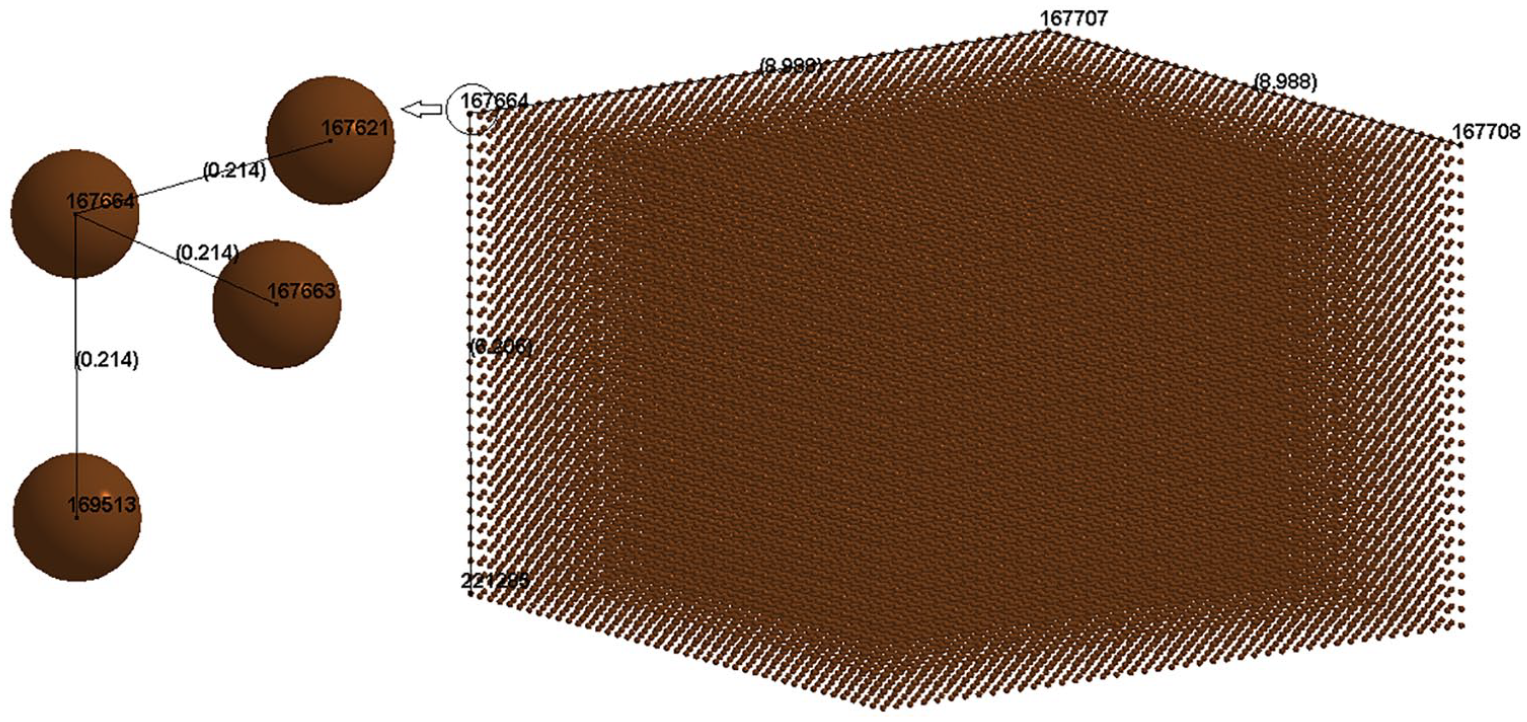
Raindrop field model with diameter of 2 mm.
The C9-type parachute with 28 pieces of canopies has been equipped by the US army for many years. Many works take this classic parachute as the research object. The structural and material parameters can be found in Table 2. In this article, the canopy and air field are discretized by 20,228 triangular elements and 147,392 hexahedral elements. The C9 parachute in fully inflated state (Figure 4(a)) is obtained according to the method described in the literature. 13 The models of raindrop field, air domain, and parachute system can be interpenetrated with each other to achieve the final assembly model because the three are described by Lagrangian method (Figure 4(b)).
Parameters of model.


The model in infinite mass situation calculation: (a) fully inflated state and (b) assembly model.
The C9-type parachute’s steady descending velocity is 6–7 m/s. Therefore, the velocity boundary at inlet is 6 m/s, and the ambient pressure is 1 atm. The relative velocity is adopted for the falling velocity of raindrop field. The relative velocities of different raindrops are different due to different sizes and drag force. The relative falling velocity is defined according to the observation results of the literature 14 (Table 3).
Falling velocity and relative velocity of different models.

Figure 5 shows the change of stress contour of the above four models. It can be found that the canopy bears large stress at the initial stage (0.012 s) due to the inertial force. The stress concentration area begins to move to the canopy top (0.0147 s), and then to the canopy bottom (0.5 s). When the flow field tends to be stable, the stress mainly concentrates at the bulge of canopy (1.5 s). Meanwhile, it can be found that the different raindrops impacting have little effect on canopy’s stress change. In other words, the raindrops will not affect the strength of parachute system.

Stress contour of different models: (a) Model A, (b) Model B, (c) Model C, and (d) Model D.
Figure 6 is the comparison of opening shock. It can be found that the opening shocks of four models are almost the same. The size and falling velocity of raindrop increase, and the opening shock of parachute decreases slightly. Figure 7 shows the distance change of two nodes at the canopy bottom (as shown in Figure 4(a)). The four models have almost the same change, and the difference is almost negligible. In a word, the impacting of raindrop field has little influence on parachute performance.

Comparison of opening shock.

Distance change of two nodes at the canopy bottom.
Analysis of influence of wind field on parachute’s performance
The raindrop field is not considered when the influence of wind field is studied in this article. The calculation in infinite mass situation cannot evaluate the influence of wind field. Therefore, the calculation in finite mass situation (the position of parachute system changes obviously in the local coordinate, which is similar to the airdropping) is carried out. The C9-type parachute is still used as the research object, but the parachute model in folded state is used (Figure 8). The different wind field models are shown in Table 4.

The model in finite mass situation calculation.
Parameters of different wind field models.

Figures 9 and 10 show comparison of opening shock and velocity of payload, respectively. The downwind field will increase the opening shock of Model E, and its maximum peak value is 1.28 times of Model F (upwind field). The steady descending velocity of Model E (8.8 m/s) is about 5.5 m/s faster than that of Model F (3.3 m/s). This shows that the downwind field will increase the probability of parachute failure, while the upwind field is the opposite. Models G and H have little difference in changes of opening shock and steady descending velocity. Model G (6.4 m/s) is slightly faster than Model H (5.6 m/s), both of which are close to the design value.

Comparison of opening shock.

Comparison of payload’s velocity.
Conclusion
In this article, an SPH/ALE coupling method is proposed to study the influence of rainstorm on parachute working process. The working processes of C9 parachute in infinite mass situation are calculated. It is found that the raindrops impacting have little influence on parachute strength, opening shock, and shape change according to comparison. Then the influence of wind field on parachute performance in finite mass situation is studied. The downwind field will seriously affect the parachute’s deceleration effect, while the upwind field is the opposite. In conclusion, the wind field, not the raindrop field, has the greatest influence on parachute’s performance.
Footnotes
Declaration of conflicting interests
The author(s) declared no potential conflicts of interest with respect to the research, authorship, and/or publication of this article.
Funding
The author(s) disclosed receipt of the following financial support for the research, authorship, and/or publication of this article: This work was supported by the Natural Science Foundation of Jiangxi Province of China (No. 20181BAB211004).
