



Abstract
In this study, antimicrobial and electromagnetic shielding properties of metal composite single jersey fabrics were investigated. For this purpose, stainless steel wire, copper wire, and metalized silver polyamide filament were commingled with textured polyester. The composite yarns were knitted to single jersey fabrics. Electromagnetic shielding effectiveness of samples was measured according to free space test method between 0.8 and 5.2 GHz frequency range. In addition, antibacterial and antifungal activity tests were performed for the overall technical characterization of composite fabrics. The effects of metal type, filament form on electromagnetic shielding effectiveness, and antimicrobial properties were examined. All composite fabrics showed electromagnetic shielding properties at different levels up to 35 dB in vertical direction. Fabrics including metalized multifilament yarn exhibit higher electromagnetic shielding effectiveness in both vertical and horizontal directions. In addition, antibacterial activity level of metalized silver polyamide and copper composite fabrics reached up to 99% against Klebsiella pneumoniae and Staphylococcus aureus. Furthermore, Aspergillus niger could not grow on these composite fabrics.
Keywords
Introduction
Electrical and electronic devices are used almost in all areas of daily life. While operating, various devices, such as modems, computers, mobile phones, radio, microwave ovens, and alternating current (AC) motors, emit electromagnetic waves. Due to its extensive radiations, both people and the devices are often exposed to electromagnetic waves emitted at various polarizations.
Electromagnetic waves at different frequencies may cause some adverse effects such as electrical malfunctions, ignite flammable or other hazardous atmospheres, and even it may have a direct effect on human tissue. There are increasing scientific evidences linked to negative effects of human health caused by exposure to electromagnetic waves. In some studies, it is stated that the electromagnetic radiation is closely related to serious health problems such as leukemia, brain tumors, Alzheimer’s disease, allergies, stress, sleep problems, and depression.1,2 The electromagnetic spectrum contains an array of electromagnetic waves, increasing in frequency, from extremely low frequency to high frequency waves such as X-rays and gamma rays. The spectrum of electromagnetic waves and their applications are shown in Figure 1. 3

Electromagnetic spectrum and EM wave applications and effects.
Electromagnetic shielding is the basic method to prevent electromagnetic radiation in any direction. Shield is a barrier that is used to prevent the radiation of electromagnetic waves from entering the environment from any point. Textile materials produced from conventional textile fibers are nearly transparent to the electromagnetic field. However, metal composite textile materials can be used to provide electromagnetic shielding.4–7 Recently, the textile-based shielding materials are widely used in the electromagnetic shielding application instead of traditional metal sheets and other shielding materials due to their desirable shielding ability, light weight, flexible structure, cost effectiveness, breathable, and wearable features.1,6–9
The conductivity and electromagnetic shielding effectiveness (EMSE) of textile materials can be improved by surface treatments, lamination of conducting layers, conductive coating, metallization, adding or incorporating conductive filler, fibers, and yarns into the fabric.10,11 Metal blending and fabric surface modification are the two major methods in the literature. It is difficult to use 100% metal wire/fiber in fabric production due to its high stiffness and these type of fabrics are uncomfortable for end-use. Therefore, hybrid yarns produced from metal wires with synthetic or natural fibers/yarns can be preferable.8,12
In previous studies, various methods were used for the production of metal composite yarn such as blending in staple form,6,13 hollow spindle,9,10,14 metal coating, 15 plying/twisting with metal wire,16–18 core spun,1,19–24 and siro core spinning. 8
There are many studies about knitted fabrics produced from different types of metal composite yarns. In these studies, effects of metal component type, metal wire diameter, knitted structure, wale/course densities, number of fabric layers, and measurement direction on EMSE were investigated. Perumalraj and Dasaradan examined the effects of the changes in diameter of the copper wire in composite yarn and the density of plain, rib, and interlock fabrics. They stated that the interlock fabric showed better EMSE values than other structures and the EMSE increased with increasing wale density, course density, tightness factor, and decreasing the diameter of copper wire. 5 Rajendrakumar and Thilagavathi investigated the EMSE and antibacterial activity of single jersey knitted fabrics produced from silver-coated copper wire/cotton core spun yarn. Authors noted that the produced fabrics showed 40 dB and above EMSE at the low frequency. Due to the effect of silver coating, antibacterial reduction level reached 60%–63% against Escherichia coli. However, the amount of silver ions was not enough to provide antibacterial activity against Staphylococcus aureus. 1 Çeken et al. investigated EMSE of fabrics with different knitting types. They used copper and stainless steel wire as conductive content in wrapped and core composite yarns. It was determined that the copper provided better EMSE than stainless steel due to the higher conductivity of copper wire and the increase in the conductive wire ratio increased the EMSE. They found that EMSE of lacoste type knitted sample showed better EMSE. In another study, they determined that the EMSE in vertical direction is higher than in horizontal direction.20,25 Bedeloğlu studied the electrical and EMSE properties of metal composite fabrics knitted by stainless steel composite yarn. Author determined that the rib fabrics showed better EMSE than plain fabrics. Therefore, increasing the amount of stainless steel wire significantly increased the conductivity and thinner metal wire provided higher EMSE than thicker one. 18 Örtlek et al. investigated the EMSE of plain, double, and pique knit fabrics in vertical and horizontal directions. They determined that the pique knit fabric showed better EMSE. They noted that the EMSE of knitted fabrics depends both on the amount and the orientation of the conductive component in relation to the direction of the electromagnetic field. 8 Tezel et al. investigated the EMSE of single jersey knitted fabrics produced from stainless steel/cotton and copper wires/cotton yarns. They noted that if the polarization of electric field is perpendicular to the metal wire direction, fabrics do not exhibit EMSE ability. Therefore, the single jersey knitted fabrics showed EMSE ability in the same direction as that ofthe conductive metal wires. 26 Majumdar et al. studied the development and performance optimization of antibacterial materials made from polyester–silver nanocomposite fibers. In that study, single jersey fabrics were produced using different blending ratios of polyester–silver nanocomposite fibers with different yarn counts and machine gauge. They determined that the bacterial reduction increased with the increasing percentage of nanocomposite fibers and yarn count and antibacterial activity of produced fabrics reached upto 90 % against S. aureus. 13 Yu et al. investigated the electromagnetic shielding and antibacterial properties of warp knitted fabrics produced from the yarn including antibacterial nylon and stainless steel wire. In the study, EMSE of samples were measured at 30 kHz–3 GHz frequency range. For single-layer fabrics, EMSE does not increase by increasing the metal content alone.. So, they used lamination technique for producing two- and three-layered fabrics with varying layer angles. They determined that the multi-layer fabrics with layer angels of 0°/90°/0° have EMSE mostly above 20 dB between 100 kHz and 3 GHz frequency. Also these fabrics could provide antibacterial protection due to antibacterial nylon in composite structure. 14 Kumar et al. investigated the electrical resistance and electromagnetic shielding efficiency of plain knitted fabrics for developing the comfortable and protective garments. In the study, cotton- and nano-silver-coated conductive yarns were knitted together. Electromagnetic shielding measurements were carried out in horizontal and vertical directions between 400 and 1100 MHz frequencies. They stated that EMSE of all produced fabrics were at excellent levels between 500 and 800 MHz (above 90%) and at 1000 MHz (above 70%) for both polarizations. 15 Mofarah et al. produced full Milano and 1 × 1 rib knitted fabric from the copper wire core/cotton core spun yarns. They examined the EMSE ability of these fabrics. According to their results, EMSE of samples reached upto 40 dB and full Milano fabric showed better EMSE than 1 × 1 rib sample. They were found that the heavier and thicker fabrics with larger stitch density provided the higher EMSE and two-layer samples have higher EMSE ability. 23 Özkan and Duru Baykal investigated the antifungal activity of fabrics knitted using metal composite yarn. Metalized silver polyamide (PA) and polyester yarns were fed into same intermingling jet for producing metal composite yarn. Antifungal activity test was applied to knitted fabric according to AATCC30 test procedure against Aspergillus niger. Authors identified that the application provided antifungal activity to knitted fabric. 27 The air intermingling technique is used for combining purposes (commingling) of filament yarn. 28 As a novelty, this technique was used to combine metal wire with filaments yarns in recent studies. The produced metal commingled yarns were used in various textile structures such as tufted carpet,29,30 woven fabrics 31 , and so on, for gaining electromagnetic shielding properties.
In this study, metal wire/polyester and metalized silver PA filament commingled composite yarns were produced. As mentioned in the literature review, EMSE and antimicrobial properties of woven fabrics, and carpet structures that were produced from this type of yarn were investigated in different research works.30,31 However, there are limited studies about antimicrobial ability of the knitted fabrics produced from metal–commingled yarns. 27 The related research about the EMSE properties of single jersey fabrics produced from metal composite–commingled yarn was not found in the literature. There are various studies in the literature about EMSE and antibacterial activity properties of knitted fabrics produced with different metal composite yarns (core spun, wrapped, ply, twisted, etc.). A few studies have attempted to evaluate these two features together.1,5 The purpose of this study is to determine the EMSE and antimicrobial ability of single jersey knitted fabrics produced from the metal composite–commingled yarn. This study can contribute to the literature about the usage area of metal composite yarns produced with air intermingling technique and the EMSE and antimicrobial properties of single jersey fabrics produced from these yarns.
Materials and methods
In this research, textured polyester filament, metalized silver PA filament, copper, and stainless steel wire were used for production of metal composite yarns. Properties of the materials used in the study are given in Table 1.
Properties of the yarns.

These components were preferred to provide both EMSE and antimicrobial properties together. In previous studies, stainless steel and copper wires are widely used components in the structure of electromagnetic protective textiles.23–26 It was also known that the metallized silver PA and copper wire have antimicrobial features.27,29
Production of composite yarn and knitted fabric
Intermingling technique was used for production of metal hybrid yarn. Compared with other techniques, the air intermingling method is faster, easier to implement, and cost effective. Textured polyester and metal filaments were fed together into the intermingling jet. Preliminary productions have shown that the components have commingled successfully at 5 bar pressure and 150 m/min speed. All productions were carried out at this speed and pressure levels. The intermingling process diagram is shown in Figure 2.
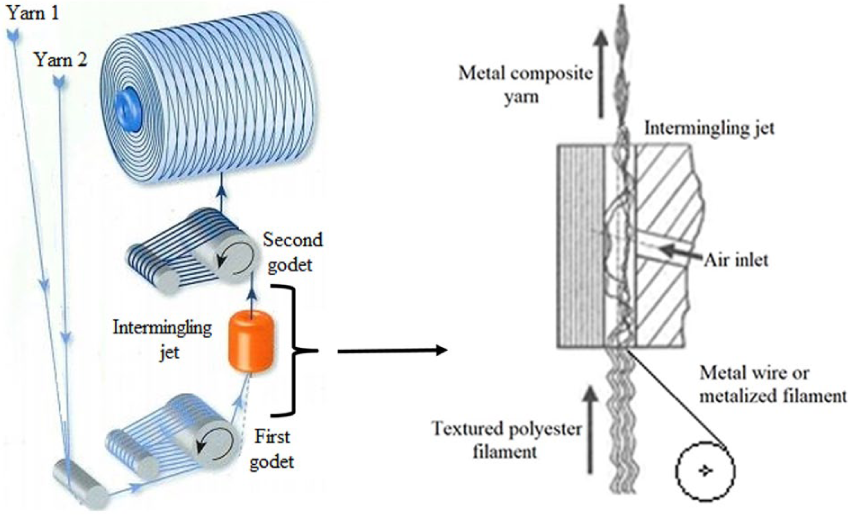
The intermingling process diagram.
The production of metal composite yarn was carried out successfully by the commingling technique. Microscope images of produced composite yarns were taken at 10× magnification ratio by digital camera microscope (Figure 3).

Microscope images of the metal composite yarns.
In previous studies, it was noted that the complex knitting structures such as rib and interlock can provide better EMSE than plain knitted structure.19,32 Jagatheesan et al. reported that there are frequent yarn breakages during the production of interlock-type complex structure as compared with the plain knitted structure. In addition, the stiffness and stability of the plain fabrics are lesser than rib structures. 33 Thus, single jersey knitted fabrics was only made in this study for investigation. The composite yarns were knitted to single jersey fabrics by laboratory type circular knitting machine under the same process parameters. Specifications of knitting machine are given in Table 2.
Specifications of knitting machine.

Microscope images of samples taken at 20× magnification ratio by digital camera microscope are shown in Figure 4.

Images of the metal composite knitted fabrics.
In Figure 4, it can be seen that the metalized silver PA filament was more spread on the surface of fabric than copper and stainless steel wire. Copper wire was more broken than stainless steel wire in commingling and knitting processes. Broken wires on the different areas of fabric surface can be seen in Figure 4.
Antimicrobial activity tests
Fabrics having electromagnetic shielding ability can be used in various areas. To protect sensitive medical devices, both antimicrobial ability and EMSE are important, especially, when they are used in an environment that includes resources that may cause infections, such as hospitals, microbiological laboratories, and so on. 1 Therefore, antibacterial and antifungal properties of fabrics were also examined.
Antibacterial activity test
Antibacterial and antifungal activity tests were applied to fabrics including metalized silver PA, copper wire, and control sample. AATCC 100 test method was preferred for determining antibacterial activity against S. aureus and Klebsiella pneumonia. This method provides a quantitative assessment of the antibacterial activity. Circular swatches of knitted fabrics with 4.8 ± 0.1-cm diameter were prepared for 0- and 24-h inoculation steps of test procedure. Inoculation was carried out by bacteria culture with concentration of 1.5–2 × 10⁵ CFU/mL. Inoculated samples were incubated for 18–24 h at 37°C. Incubated knitted fabric swatches were added to the 100 ± 1 mL of neutralizing solutions and shaken for 1 min. Serial dilutions were done with sterile deionized water and suspensions of the last dilutions were poured on agar plates and incubated for 24 h at 37°C. After incubation, the number of colonies were counted visually and the antibacterial activity was calculated using equation (1)

where R is the percentage reduction ratio, A is the number of bacteria recovered from the inoculated test specimen swatches in the jar incubated over the desired contact period, and B is the number of bacteria recovered from the inoculated test specimen swatches in the jar immediately after inoculation (at “0” contact time).
Antifungal activity test
Antifungal activity tests were applied according to “AATCC 30 -2004 Test III” test standard against A. niger. Purpose of this method is to determine the susceptibility of textile materials to mildew and rot and to evaluate the efficacy of fungicides on textile materials. Knitted fabric samples were cut into disks of 3.8 ± 0.5-cm diameters from both treated and untreated samples. Fabric disks are placed onto agar plates and are inoculated with spores of A. niger at 28°C for 7 days. The results were assessed visually whether there is fungal growth on the sample or not.
EMSE tests
EMSE measurements were carried out according to free space test method. This method can be applied to flexible materials due to the high degree of freedom in the geometry of the installation. 13 Commonly used devices in daily life such as AM/FM radio, mobile phone, wireless modems emit electromagnetic waves at a frequency range of 0.8–5.2 GHz. Therefore, EMSE measurements were performed in this frequency range. The samples were positioned between the transmitter and receiver antennas as shown in Figure 5. Two horn type antennas were used in measurements and placed on the same axis.

Electromagnetic shielding test diagram.
EMSE can be described as the logarithmic form of the ratio between the intensity of field or power in a place with shielding material (Et, Ht, Pt) and without shielding material (E0, P0, T0) in the same measurements. EMSE is calculated by equation 2 6

The measurements were carried out by rotating clockwise 90° in the horizontal (Figure 6(a)) and vertical (Figure 6(b)) directions for determining the effect of wave polarization.

Placements of sample at: (a) horizontal and (b) vertical directions.
Obtained EMSE data were analyzed statistically. In the first step, Kolmogorov–Smirnov test was used to determine the normality of data. The significance value was very close to critical value (significance = 0.048) and so the distribution of data was accepted as normal. This result indicated that parametric tests could be used for data such as analysis of variance (ANOVA). After that, Levene’s test statistics were used to assess the equality of variances for the detection of a suitable multiple comparison test (post hoc). The results showed that the variances were equal (significance = 0.150). In addition, correlation analyze was conducted to exhibit the relation between frequency and EMSE. Detailed results are given in “Results and discussion” section.
Results and discussion
Antibacterial activity test results
Textured polyester knitted fabrics were tested as control samples. The fabrics containing only polyester yarn did not show antibacterial and antifungal activity as expected. It is known that stainless steel (AISI 316L) has no antimicrobial properties.34,35 In addition, copper and silver are used in various applications due to its antibacterial and antifungal properties. The copper and silver ions cause the structural and morphological changes in the bacterial cells and damage cell membrane with direct contact.36,37 Similarly, antifungal activity of silver and copper are reported in previous studies.37,38 These structural effects caused by copper and silver ions lead to bacteria cell death. Therefore, antibacterial and antifungal activity tests were only applied to metalized silver PA and the copper composite fabrics.
According to the test results, metalized silver PA and copper composite knitted fabrics have very high antibacterial activity against S. aureus and Klebsiella pneumoniae bacteria. Petri dish photos of metalized silver PA composite, copper composite, and textured polyester fabrics for K. pneumoniae after 24 h contact time are given in Figure 7.
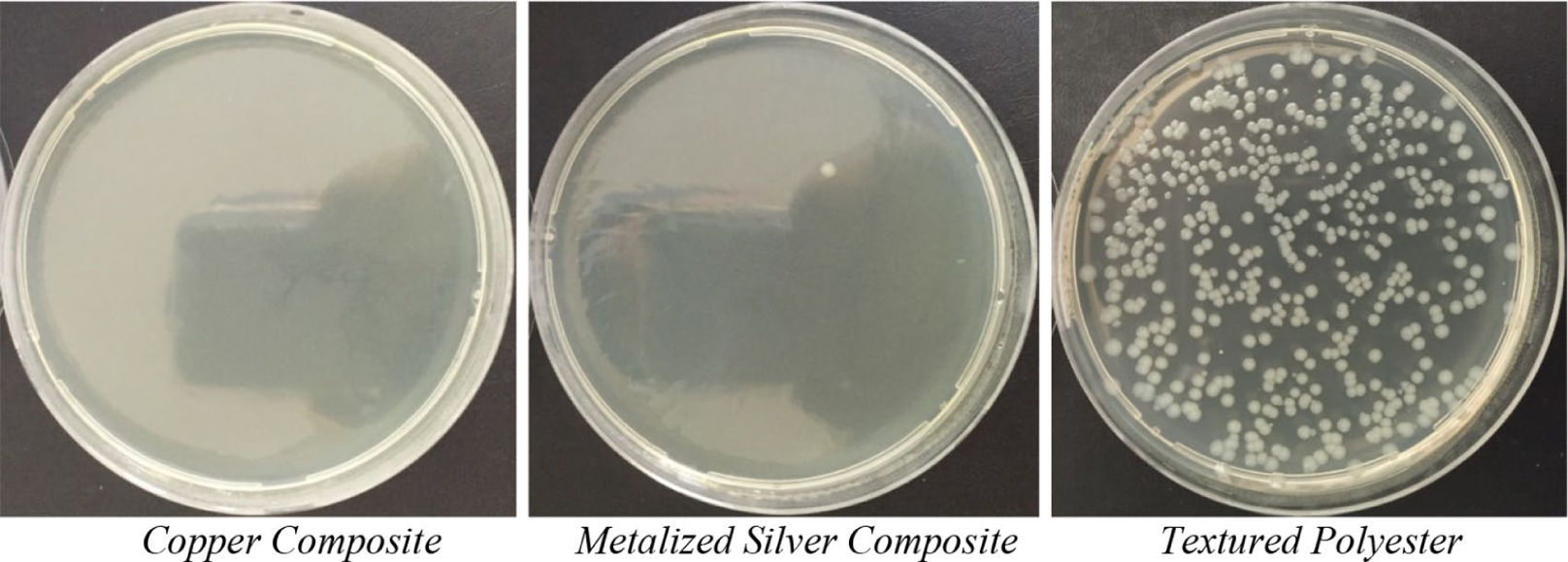
Photos of petri dishes after 24 h contact time for K. pneumoniae.
Petri dish photos of metalized silver PA composite, copper composite, and textured polyester knitted fabrics for S. aureus after 24 h contact time are given in Figure 8.

Photos of petri dishes after 24 h contact time for S. aureus.
As can be seen Figures 7 and 8, there is no colony of K. pneumoniae and S. aureus at the end of 24 h for metalized silver PA and copper composite knitted fabrics. In a previous study, polyester–silver nanocomposite fibers, used in the structure of single jersey fabric, provided antibacterial activity of above 90%. 13 In another study, single jersey fabrics including silver-coated copper wire/cotton core spun yarn showed antibacterial activity around 60% level. 1 In this study, the metallized silver PA and copper wire commingled yarns gained the strong antibacterial properties (above 99%) to the single jersey knitted fabrics. The metal component does not follow a straight path in the yarn structure produced using air commingling technique. As a result of the nature of commingling technique, metal component comes out in some areas along the yarn structure. This structural property increased the contact surface between metal component and bacteria. This structural difference can be effective to obtain strong antibacterial activity.
Antifungal activity test results
In the test, textile samples including antifungal component were placed onto agar plates and inoculated with spores of A. niger at 28°C for 7 days. Fungal growth on sample was evaluated visually. Petri dish photo of textured polyester fabric is shown in Figure 9.

Petri dish photo of polyester knitted fabric.
Fungal growth on textured polyester sample can be clearly seen as shown in Figure 9. Polyester fabric did not show antifungal activity as expected. Growth of A. niger mold was not observed on metalized silver PA and copper composite knitted fabrics. Petri dish photos are given in Figure 10.
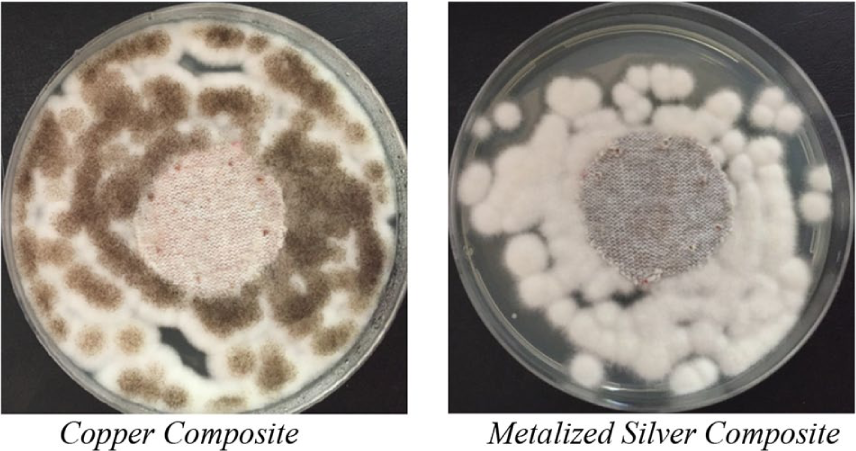
Petri dish photos of copper and metalized silver PA knitted fabrics.
Antibacterial and antifungal activity results were consistent with the study in the literature. Özkan et al. used the copper wire and metalized silver PA filament in carpet backing fabrics in different amounts. In previous study, the samples including copper wire and metalized silver PA in their all warps showed antibacterial and antifungal activity similar to results of this study. 29 The results of antibacterial and antifungal activity tests showed that the produced metalized silver PA and copper composite knitted fabrics can be used safely as antimicrobial textiles in public places such as schools, hospitals, and so on, against pathogenic microorganisms.
EMSE test results
EMSE of composite knitted fabrics was tested separately at vertical and horizontal directions of between 0.8 and 5.2 GHz frequency range. Textured polyester knitted fabric was transparent for electromagnetic waves as expected. The vertical direction EMSE (dB) values of copper, metalized silver PA, and stainless steel composite fabrics are given in Figure 11.

Vertical direction EMSE values of knitted fabrics.
All samples including metal/metalized composite yarn have electromagnetic shielding properties at different levels. In previous studies, it was determined that the single jersey fabrics including copper wire showed EMSE values between 15 and 40 dB despite the differences in yarn production methods.1,26 EMSE of copper composite fabrics produced in this study reached up to 28 dB. These fabrics could not exhibit protective performance as good as in previous research. The breakage of copper wire during the commingling process was the possible cause of the decrease in EMSE. Generally, the single jersey fabrics including stainless steel wire showed EMSE values between 20 and 50 dB.8,25,26 The protective performance of steel composite fabric was close to EMSE values noted in the previous studies. According to the study of Özkan and Telli, 31 the breakage of metal wire during the commingling process can be reduced by feeding the wire into air jet between two filament yarns. With this approach, EMSE performance of knitted fabrics can be increased.
In Figure 11, it seems that SE values of stainless steel and metalized silver PA samples generally decrease with increasing frequency. EMSE of stainless steel and metalized silver PA composite fabrics show a similar tendency. Correlation analsis was applied to determine the relationship between frequency and EMSE. Correlation results were given in Table 3.
Results of correlation analysis.

EMSE: electromagnetic shielding effectiveness.
Correlation coefficient is a measure of the linear correlation between two variables. It has a value between +1 and −1, where 1 is total positive linear correlation, 0 is no linear correlation, and −1 is total negative linear correlation. In Table 3, there is a significant negative correlation between frequency and EMSE for stainless steel and metalized silver PA composite fabrics. According to the value of correlation coefficient, this relationship can be interpreted as moderate (0.40–0.59) and strong (0.60–0.79). 39 The wavelength of incident wave decreases with increasing frequency. Thus, shorter waves can penetrate the pores of fabrics. 40 The reverse correlation in the copper composite sample was caused by breakage of the wire during the commingling process. Therefore, the copper composite sample could not provide effective shielding up to 2.16 GHz frequency.
ANOVA and multiple comparison tests were used to compare EMSE of different metal types. EMSE was taken as dependent variable. ANOVA showed that the difference among the groups was statistically significant (significance < 0.05). But, it does not provide information about which group is different from the other. So, Tukey, which is one of the multiple comparison test was applied to determine the differences between the groups. Tukey test result is given in Table 4.
Tukey test results.

According to Table 4, the difference among the EMSE of knitted fabrics including different types of composite yarn was statistically significant. In addition, EMSE of these fabrics can be listed as follows: metalized silver PA > stainless steel > copper. Çeken et al. stated that the knitted fabric including copper wire provided better shielding than fabric containing stainless steel due to higher conductivity of copper. 20 However, in this experimental study, the copper wire was more broken than stainless steel wire during the commingling and knitting processes (Figure 4). This could be the reason for lower EMSE value of copper composite fabric than the other samples. Metalized silver PA composite fabrics exhibit highest EMSE especially at low frequencies. EMSE values of metalized silver PA composite fabric exceeded 30 dB at peak point. EMSE of copper and stainless steel composite fabrics reached a maximum of 28 dB. EMSE at these levels can be classified as very good and excellent, respectively, for general use of textile materials. 41
All composite fabrics showed better EMSE values in vertical direction than in horizontal direction. This result is consistent with previous studies. According to previous studies, the weft knitted fabrics provided better electromagnetic protection in their course (vertical) direction due to polarization effect.8,25,35,42,43 Because, the conductive yarns can only be incorporated in knitting direction, shielding is provided only in that direction for electromagnetic field. 44 Horizontal direction EMSE (dB) of composite fabrics can be seen in Figure 12.

Horizontal direction EMSE values of composite fabrics.
The metal composite fabrics showed EMSE between 0 and 17.5 dB in horizontal direction due to polarization effect (Figure 12). According to the previous studies, conductive yarns being parallel to the incident field can shield more amounts of electromagnetic waves. 33 EMSE is provided by the contact of conductive filaments between loops for horizontal direction. Metalized silver PA composite fabric generally exhibits higher EMSE at horizontal direction similar to the EMSE results at vertical direction. This difference can be explained by the placement of the conductive multifilament in composite yarn structure as shown in Figure 3(c). In comparison with monofilament wires, multifilament conductive filament has larger surface area. Widespread distribution of conductive multifilament on the fabric surface can be clearly seen from Figure 4. This distribution increases the contact possibility of conductive filaments among the loops throughout the horizontal direction. Jagatheesan et al. 33 reported that the increase in the connectivity among the loops including conductive component increases the EMSE of knitted fabrics. As a result, conductive content in multifilament form provided better shielding in horziontal direction. Liang et al. 6 specified that conductive yarns should be used both in horizontal and vertical directions to provide shielding against electromagnetic waves from different directions. Sancak et al. 24 studied the EMSE and surface resistivity of knitted fabrics. In their study, fabrics having lower surface resistivity showed better EMSE performance. In another study, the surface resistivity of the single jersey knitted fabric containing con-ductive multifilament filament yarn was found to be lower than fabrics containing metal wire in both direction. 45 When the results of research works were evaluated together, it can be said that the form of conductive filament and placement in structure are important factors for multiaxial shielding and the level of EMSE.
Conclusion
In this research, effect of metal component type (copper, stainless steel, and metalized silver), conductive filament form (monofilament or multifilament) on EMSE, antibacterial and antifungal activity properties of metal composite on single jersey fabrics were investigated. Important findings are summarized below.
All samples including metal/metalized composite yarn have electromagnetic shielding properties at different levels. A statistically significant negative correlation between EMSE and frequency was determined. However, this correlation was to be classified as weak according to correlation coefficient.
EMSE values in vertical direction were higher than the horizontal direction. This situation was caused by the continuity of conductive filament in vertical direction due to the weft knitting technique. Therefore, shielding was provided only in that direction of electromagnetic field.
The difference among the EMSE of knitted fabrics including different types of composite yarn was statistically significant and EMSE sorting of composite fabrics was as follows: metalized silver PA > stainless steel > copper. Actually, copper has better conductivity than stainless steel; however, copper wire was more broken than stainless steel wire during the commingling and knitting processes. This was the possible cause for the lower EMSE of copper composite sample.
Metalized silver PA composite fabrics showed the best EMSE in horizontal direction because multifilament conductive yarn uniformly distributed in composite yarn structure. This distribution contributed to the conductivity and EMSE in vertical and horizontal directions.
The air intermingling technique is used for combining purposes (commingling) for filament yarns. Thus, metalized silver PA multifilament was most suitable component in the study for commingling. As a result, metalized silver PA multifilament provided better EMSE especially in vertical direction. Metalized silver PA composite fabric was found to be most suitable type for electromagnetic wave attenuation for both vertical and horizontal measurements.
According to antibacterial and antifungal activity test results, textured polyester and stainless steel composite knitted fabrics have no antibacterial and antifungal activity against S. aureus and K. pneumoniae bacteria and A. niger fungi as expected.
Metalized silver PA and copper composite fabrics exhibited very strong antibacterial activity (99% level) and fungal growth was not observed on these fabrics.
Finally, air intermingling technique can be used for combining the metal wires with filament yarns and single jersey fabrics can be produced from these yarns. It can be said that the produced metalized silver PA and copper wire composite knitted fabrics are suitable for using as anti-microbial textiles for protection in public places such as schools, hospitals, and so on, against pathogenic microorganisms and electromagnetic radiation.
Footnotes
Author’s note
Some results of the study were presented as oral presentation for “17th AUTEX World Textile Conference” in Greece.
Declaration of conflicting interests
The author(s) declared no potential conflicts of interest with respect to the research, authorship, and/or publication of this article.
Funding
The author(s) received no financial support for the research, authorship, and/or publication of this article.
