




Abstract
Today we can’t imagine our life without electricity and technology, transport and television. In the information age, computers, the Internet, cell phones, and smartphones are helpers for everyday needs. However, our environment and comfortable living in it can be detrimental to our health. It is hard to realize the fact that such a global technical breakthrough has hit human health. Exposure to electromagnetic radiation could lead to changes in the structure of nerve cells and blood formulas, deformation of the circulatory system, pathology of the endocrine system, decreased immunity, and so on. Nowadays the development of innovative textiles with electromagnetic radiation shielding is a relevant topic that promotes the creation of a flexible protective screen for the human being and various electronic devices. Textiles themselves do not protect against electromagnetic radiation; however, the textiles can be successfully converted into protective material after changing the raw material composition, creating a new production process, or adapting technologies that can make them electrically conductive. Basic methods of textile producing such as weaving, knitting, non-weaving, or their combination can be used to make electromagnetic shielding fabric. In this study, the knitting on 8-gauge flat-bed machine has been chosen as main technology. The metal wire (stainless steel: 0.12 mm) is used separately or together with 10 × 2 tex cotton yarn. Two sets of samples with different interloopings are produced which differ by steel percentages and positioning in the structures. Electromagnetic shielding effectiveness of textile samples (dB) was measured according to ASTM 4935-10 on frequency range 30 MHz–1.5 GHz. It is concluded that the positioning of the metal components in the knitted structure is the main factor determining the shielding ability. The half Milano rib knitted structure demonstrates the highest shielding efficiency.
Introduction
Protection against electromagnetic radiation (EMR) is one of the main tasks that must be solved with the advent of electrical and electronic devices worldwide. Among the various proposed solutions, textile products and textile composite materials are most widely used due to their versatility. 1 Textile materials for electromagnetic shielding are widely used in the manufacturing of high-tech and new-generation interactive structures. In addition, they have advantages due to their flexibility and comfort, 2 protection against radio frequency interference, coordination of thermal expansion, and, at the same time, has low weight. 3
Textile materials that are used for protection against EMR require screening performance depending on the scope of their use: 4 professional protection or general use (see Table 1). The first class includes medical equipment, quarantine material, professional security uniform for electronic manufacturer, electronic kit, or other newest applications. The second class includes casual wear, office uniform, maternity dress, apron, consumptive electronic products, and communication-related products or others.
Electromagnetic effectiveness range of textile. 4

SE: shielding effectiveness.
Textiles do not protect against EMR themselves, however, it can be successfully converted into protective material after changing the raw material composition, creating a new production process, or adapting technologies that can make them electrically conductive. The most common methods for creating textile materials for protection against EMR are as follows: covering textiles with conductive materials and to use conductive fillers.
Generally, the textile-finishing techniques by in situ polyaniline polymerization and nickel electroless plating in the weft-knitted fabric demonstrate the capability of fabricating high-performance EMR shielding fabric that can be adapted in applications such as conference room shielding, electronic EMR shielding, or foldable shielding screens. 5 Novel conductive fabrics were developed by polymerizing aniline onto the polyamide (PA)-knitted fabrics. 6 Conductive fabric structures were obtained by the formation of polyaniline bound onto the PA fibers. In another research, 7 graphene-coated knitted and woven fabric are produced. It is observed that knitted fabric performs better in terms of the main properties (surface resistivity, add-on percentage, air permeability, pore size, water vapor permeability than that of the woven fabric).
However, surface treatment is often time-consuming, labor-consuming, and quite expensive as well. Consequently, conductive fillers in the form of conductive polymers, metal fibers, metal wires, metal-coated filaments, or complex filaments are increasingly used to protect against EMR. The analysis of scientific papers on the problem of textile screen development has shown that knitted fabrics are highly competitive due to their high volume and the positioning possibility of the conductive elements in different layers of the fabric structure. So, knitted fabrics made of combined conductive threads and yarn exhibit good shielding of EMR,8,9 which increases with the increasing stitch density of the rib 1 × 1 and plain jersey fabrics. 10
It should be noted that for the textile screens production two basic knitting methods are used: the warp 11 and weft 12 knitting. It is noteworthy that the warp knitting allows the creation of the newest elastic materials with protective properties in which conductive components (bamboo charcoal/stainless steel (SS) wrap yarns 13 or multi-functional hybrid yarn) 14 are used as a weft filling yarns. The elastomeric threads are used as longitudinal filling yarns to provide high elasticity of fabric. The resulting elastic warp-knitted fabrics are applied as health care maternity belts in the future, which have good water vapor transmission, far-infrared radiation, and electromagnetic shielding properties. These fabrics have ability of improving health care, electromagnetic shielding, comfort, dry, and air permeability, which reduces discomfort and increases service life to wearers.
For the shielding materials manufacture, three basic weft interlooping such as plain, 15 rib, 16 and interlock 17 are usually used. Some of the development is devoted to the creation of knitted screen materials by introducing metal wires in the form of weft threads into the knitted structure.3,18,19 Test results show that such weft-knitted structures have 10–40 dB shielding effectiveness (SE) under the frequency of 500 MHz. 19 On the contrary, such materials lose flexibility in the direction of wire filling, which reduces the consumption properties of the materials and limits their use scope.
Some researchers8,9,20,21 pay attention to the manufacturing process of conductive composite yarns with SS or copper wires and knitted materials based on them. The metals had different performances in different frequency ranges. In the range of 1–3 GHz, SS had a better electromagnetic SE than copper and silver. There was no significant difference among the metal types in terms of the absorbed and reflected power ratio values between 4 and 5 GHz ranges. 16 Others22–25 prefer the core–sheath bicomponent fibers and yarns. In composite fibers, one component is dispersed within the other. Bicomponent fibers occur when two different components are present in different constructions. Usually metal/cotton conductive composite yarns are produced by the core–spun technique on the ring spinning machine, involving SS-, copper-, and silver-coated copper wires with 0.05–0.12 mm thicknesses and 100 tex as well as 50 tex conventional (cotton) yarns.
It was observed that the knitted fabrics produced with high yarn count showed greater electromagnetic SE because there was less isolation. The effect of the metal wire type was highly significant between 15 and 600 MHz. 17 An increase in copper wire diameter shows a general decrease in electromagnetic SE. With the increase in diameter, the bending of copper thread becomes more difficult, resulting in openness in the knitted fabric structure, thereby providing less SE.17,24
It was stated13,14 that when conductive metal wires were formed in a laminated fabrics, they displayed the best EMR shielding behavior, especially for high-frequency electromagnetic waves. Yu et al concluded 13 that EMR shielding efficiency of two-layer fabrics depends on lamination angles due to the metal wire forming a grid structure in the lamination fabrics. Özkan and Telli studied the effects of number of layers on the absorption and reflection properties in electromagnetic shielding and concluded 26 that the effect of the number of layers was not statistically significant on the absorbed and reflected power in the range of 0.8–2.6 GHz. There was a significant difference above the frequency of 2.6 GHz for the absorbed power ratio.
The main goal of this research is the creation of new knitted materials for shielding against EMR. The SS wire is a conductive element of future materials that has been used separately and together with conventional (cotton) yarn.
Materials and methods
Manufacturing of knitted fabric
To study the effect of interlooping, the conductive components content, and the type of loop structure elements on the properties of knitted materials, two sets of knitted fabrics were produced on 8-gauge flat knitting machines, using 0.12-mm diameter SS wire and 30 × 2 tex cotton yarn.
During the production of the first series samples, the steel wire and cotton yarn are fed separately and feeders change after every two courses. As a result, two courses of rib 1 × 1 are formed from cotton yarn and two from a steel wire according to the interlooping repeat. Photos and yarn path representation of the first set of knitted samples are presented in Figure 1. Photos represent both sides of fabric except the 1 × 1 rib structure with the same appearance. The control samples of rib 1 × 1 are knitted from only of cotton yarn (#1.1) and only of metal threads (#1.2). To determine the effect of the shape and size of the conductive components on the shielding properties of knitted fabric, the SS wire is introduced into the knitted structure in the form of loops (#1.2, #1.3, and #1.4) and tucks (#1.5 and #1.6). The loops from the SS wire are formed at all needles (#1.2, #1.3, and #1.5), or according to the repeat (#1.4 and #1.6).
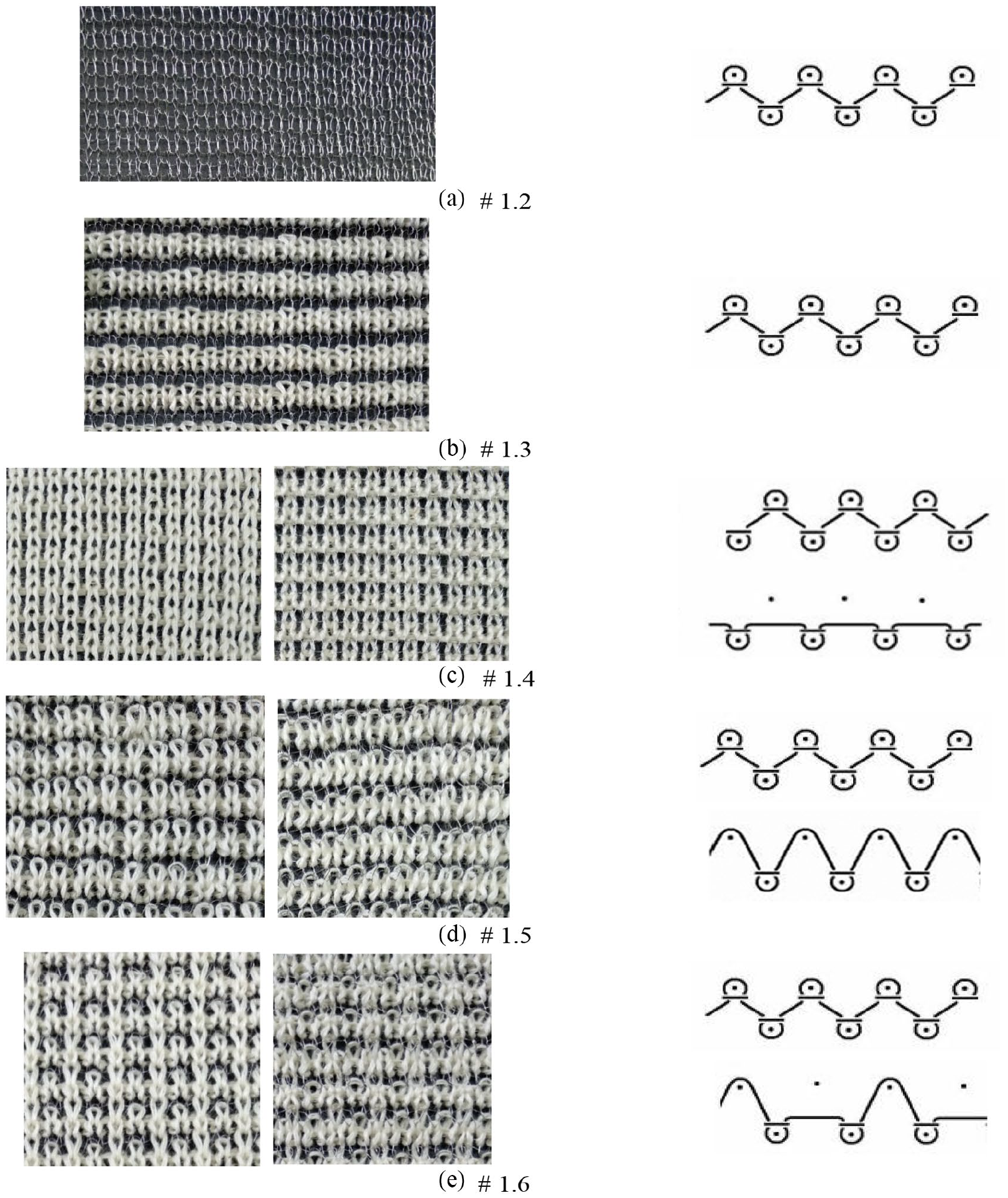
Photos and yarn path representation of the first set of hybrid knitted samples.
For the second set of sample production, the SS wire is fed to the knitting area along with the cotton yarn. To provide the different positions of the conductive element in the structure, four types of interlooping are chosen: rib 1 × 1 (Figure 2(a)), half cardigan (Figure 2(b)), cardigan (Figure 2(c)), and half Milano rib (Figure 2(d)). All fabrics are made with two variants: only from cotton yarn (#2.1, #2.2, #2.3, and #2.4) and with SS wire (#2.1S, #2.2S, #2.3S, and #2.4S)

Photos and yarn path representation of the second set of hybrid knitted samples: (a) rib 1 × 1, (b) half cardigan, (c) cardigan, and (d) half Milano rib.
Measurement methods
Standard test methods,27–30 as well as specially developed methods, are used for the investigation of the properties of knitted materials for EMR shielding: electromagnetic shielding of textile samples electromagnetic interference (EMI) SE (dB) was measured in frequency range of 30 MHz–1.5 GHz. 31 This is one of the standardized methods for evaluation of planar materials including quite wide frequency range to be able to check SE at frequency close to working frequency of given emitter, for example, mobile phones with working frequency of 800 and 1900 MHz. Testing device consists of vector analyzer Rohde & Schwarz ZNC3 (frequency range from 9 kHz to 3 GHz). Total SE (dB) with the use of test fixture EM-2107A (ElectroMetrics) 32 was measured. The measuring system was calibrated before each test.
Shielding efficiency is determined by comparing the difference in attenuation of the reference sample with the test sample taking into account input and output losses. The measurement procedure consists of two steps: in the first step, the reference sample is placed in a test adapter to compensate for the communication capacity. The sample has the shape of a 33-mm circle inside the 133/76-mm ring. In the second stage, the actual test sample is used as shown in Figure 3.

Installation setup for measuring the EMR shielding efficiency of textile.
SE in dB is the ratio of the field before and after attenuation of electric and magnetic field and depending on the type of receiver can be expressed as

where Р1 or Е1 is the power or voltage that is obtained with the material; and Р0 or Е0 is the power or voltage that is obtained without the material.
Results and discussion
Structural parameters
At the first stage of the study, the main characteristics of the knitted fabric structure were determined: raw material composition, thickness, and basis weight, as well as stitch density (number of courses and wales per 100 mm). Ten parallel measurements of each index were made for each variant of knitted fabric, the average results of which are shown in Table 2.
Structural parameters of metallized knitted fabric.

GSM: gram per square meter; SS: stainless steel.
Obviously, the obtained cloths differ in both the conductive element content and the basis weight. Increasing the wire content leads to a decrease in the gram per square meter (GSM) for the first set of samples (Figure 4). The weight of the full cotton knitted fabric (#1.1) is almost 2.5 times higher than the corresponding fabric from the steel wire (#1.2) due to the bending of wire resulting in openness in the knitted fabric structure.

Dependence of GSM on steel wire content (w) for the first set of samples.
The results obtained for the second set of fabrics show that conductive element content is 29% when knitting a steel wire together with cotton regardless of the interlooping. The steel wire in the knit structure has a significant impact on the shape and configuration of the loop due to the rigidity of the wire and its flexural resistance. The loops skeletons are more stretched longwise and there is a certain distance between wales that is well demonstrated at the corresponding photos (Figure 2). Consequently, knitted fabric with steel wire has a lower stitch density both vertically and horizontally compared to the knitted fabric from cotton yarn only. It should be noted that the basis weight (GSM) of the rib 1 × 1 fabric with SS wire is 15% higher than cotton fabric. Meanwhile, half cardigan, cardigan, and half Milano rib fabrics from cotton only and from cotton with conductive elements have almost identical values.
Shielding effectiveness
The results of EMR SE studies of knitted materials produced by separate feeding cotton yarn and SS wire (the first set of samples) are presented in Figure 5.

Shielding effectiveness of hybrid knitted fabric of first set.
The study’s results have shown that all knitted fabrics have EMR shielding properties, especially at low frequencies of up to 0.3 GHz. The shielding efficiency is on average higher than 10 dB and depends on the arrangement of the conductive components in the structure. It should be noted that the shielding efficiency of all the studied samples is 5 dB and practically does not depend on the interlooping repeat in the frequency range from 0.7 to 1.5 GHz.
Attention is drawn to the fact that 100% cotton knitted material (#1.1) also exhibits the EMR shielding ability in the frequency range up to 0.2 GHz: efficiency is 15–10 dB in the range up to 0.1 GHz, followed by a gradual reduction to 5 dB at 0.2 GHz. It is supposed, that this ability is mainly related to volume of the knitted structure which could provide a mechanism for multiple reflections.
According to the literature,15,17,20,33 integrating the SS wire into the structure leads to an increase in their EMR shielding ability by the mechanism of reflection. The results of the experiment show that there is no dependence of shielding efficiency on the percentage of SS wire content. In the studied frequency range, both samples—#1.5 (30 wt%) and #1.6 (51 wt%)—show identical properties (Figure 5). Meanwhile, sample #4 (7% metal component) has the best EMR shielding properties among the knitted fabrics of the first set, exceedingly even the properties of 100% SS wire fabric.
Therefore, the main factor that determines the shielding ability is the positioning of the metal components in the knitted structure. Thus, the loops from SS wire in sample #1.4 (Figure 1(c)), which is made by combined interlooping, are located in two layers: one layer is made by rib 1 × 1 loops and the other by plain loops. Such arrangement of the structural elements leads to their mutual overlay, which in turn leads to an increase in the EMR shielding efficiency.
To increase the shielding efficiency of knitted fabric, we used two layers of each fabric with a 0°/0° and 0°/90° orientation. The layers aren’t connected in any way to imitate multilayered clothing. Figure 6 shows the mean value of SE of single-layer samples compared with double-layered sandwiches. It is evident, that two layers (0° orientation) provide higher SE by about 3–5 dB compared to single-layer. The double-layered samples with 90° orientation to each other have highest SE. In this case, SE is higher by about 10–15 dB compared to single-layer sample.
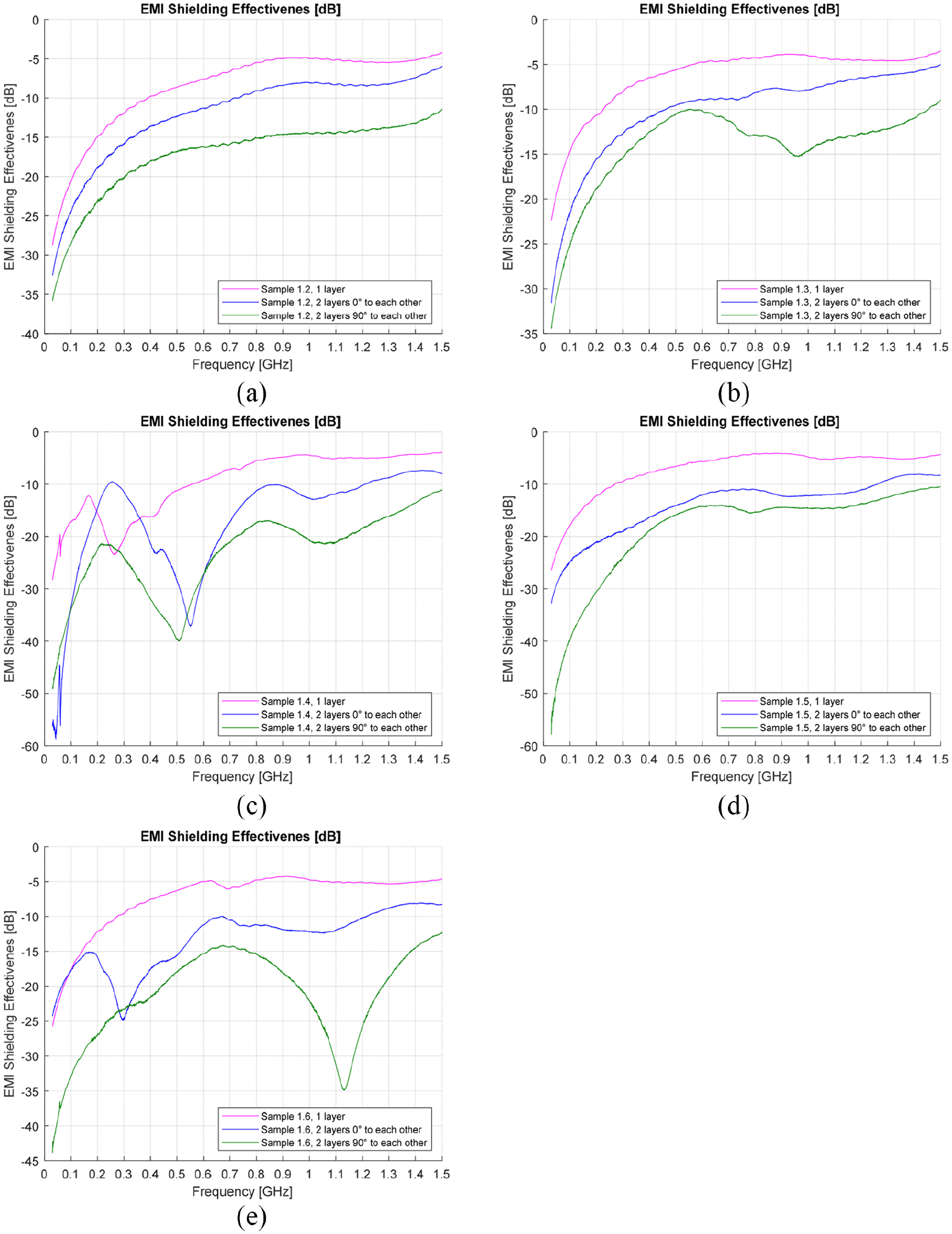
EMI SE (dB) comparison of single-layer and double-layered sandwich for first set of samples: (a) #1.2, (b) #1.3, (c) #1.4, (d) #1.5, and (e) #1.6.
For the second set of knitted fabrics, the cotton samples were measured for one time. Only samples with steel (#2.1S, #2.2S, #2.3S, and #2.4S) were measured on two different places. Same knitted fabrics were also measured using two layers of the sample in two different orientations: (a) 0° and (b) 90° to each other. Figure 7 shows electromagnetic SE of those samples. It can be concluded that cotton substrate has similar SE, very close to 0 dB at frequencies higher than 600 MHz.

EMI SE (dB) for second set of samples: (a) #2.1, (b) #2.2, (c) #2.3, and (d) #2.4.
Samples containing steel wire have SE around 8–10 dB for frequency 1.5 GHz, whereas sample #2.4S has the highest SE from all samples. In a case of layered samples, the higher SE have samples with 90° orientation of layers to each other compared to samples with 0° orientation of layers. Here, the SE ranges from 10 to 20 dB at frequency 1.5 GHz, the highest SE was reached by sample #2.4S—two layers with 90° orientation (SE = −20 dB at frequency 1.5 GHz).
Conclusion
The produced hybrid knitted fabrics have the ability to EMR shielding. The shielding efficiency at low frequencies (up to 0.3 GHz) is higher than 10 dB and depends on the arrangement of SS filaments in the knitted structure. It was found, that double-layered sandwiches (with 0° orientation of layers) provide higher SE by about 3–5 dB compared to the single layer. The double-layered sandwiches with 90° orientation to each other have the highest SE. In this case, SE is higher by about 10–15 dB compared to the single-layer knitted structure.
From the results it is evident that the main factor that determines the shielding ability is the positioning of the metal components in the knitted structure. The half Milano rib knitted structure demonstrates the highest shielding efficiency due to the arrangement of the structural elements.
Footnotes
Declaration of conflicting interests
The author(s) declared no potential conflicts of interest with respect to the research, authorship, and/or publication of this article.
Funding
The authors disclosed receipt of the following financial support for the research, authorship, and/or publication of this article: The research is carrying out under the joint Ukraine – Czech Republic R&D Project “Development and investigation of nanomodified textiles for human-being and electronic equipment’s protection” (2019-2020).
