



Abstract
As a lot of time is spent in the car, the comfort of not only the car seat but also the car seat cover itself has become of increasing importance. With increasing use of ventilated seats, the control of the physical and mechanical properties of leather in response to punching has become of prime importance in the design of car seats. This study evaluated the changes in the physical and mechanical properties of leather due to punching and proposes optimum punching intervals for car seats. Sixteen types of leather, punched at three spatial intervals (2, 3, and 5 mm), were evaluated in terms of their apparent density, softness, coefficient of friction, warm-cool feeling, and mechanical properties. Leather punching affected its physical and mechanical properties. However, there were differences in punching intervals that significantly affected each property, including the mechanical properties. Depending on the performance required when developing a product, a suitable punching interval must be selected. Therefore, punching at 5 mm intervals is preferred for obtaining physical and mechanical properties similar to those of untreated leathers, and punching at 3 mm intervals is recommended for achieving more softness. On the contrary, punching at 2 mm intervals increases air permeability but decreases dimensional stability.
Introduction
Leather is a durable and flexible material made from animal raw hides (mostly cow leather). Leather seat covers are preferred to seat covers made from other materials, despite their lower temperature, humidity, static support characteristics, vibration reduction performance, and noise absorption performance, compared with fabric-made seat covers. This is because leather seat covers are excellent in terms of their interior and exterior harmony, enable good and comfortable seating, and are considered luxurious.1,2 Punching is used to design details in fashion and non-fashion products, and to provide ventilation for sneakers, shoes, and car seats.
The human body emits moisture in the form of sensible perspiration, that is, sweating, and insensible perspiration, that is, water passing through the skin by diffusion; the latter is not consciously felt by humans. 3 Thus, if proper temperature and humidity are not ensured at the contact area between the body and the seat surface, the occupant will feel severely uncomfortable. To prevent this and to improve the comfort feeling, punched-leather seats with ventilation devices are used. Seat ventilation is the most widely used auxiliary cooling system. It is a functional seat which suppresses the occurrence of moisture and perspiration using an electric fan to blow wind over the backrest and seat cushion.4,5 Punching details of various designs are used to pass the wind through the leather seats.
In general, when the driver sits on the seat, a body pressure equivalent to ~75% of the weight is concentrated in the butt. 6 The load applied over a long period of time will affect the physical properties of punched leather. For this reason, punched-leather seats are required to have different physical and mechanical properties from punch-free leather seats, and it is necessary to study the effect of leather punching.
Owing to the increasing demand on the climate comfort of car seats, Velivelli et al. 7 studied an optimal seat cooling distribution for thermal comfort, while Lee and Lee 8 investigated the application of low-cost climate control seats using heating, ventilation, and air-conditioning system. Thus, research has been performed to determine factors that define seat comfort, which would facilitate further development of car set cooling and heating devices, and improve the comfort of car seat materials. Heinzel et al. 9 evaluated and classified leather, textile structures, and artificial leather in complete seat constructions with respect to their ability to transfer moisture and heat. Cui et al. 10 studied water and oil repellency treatment of polyester/flax car seat cover fabrics, and Matsuoka and Kanai 11 evaluated the sitting comfort of leather car seats, whose grain leather patterns were different. Additional studies have been conducted to improve the physical properties of leathers and to develop environment-friendly leather methods.12–15
Most of the existing research concentrates on the development of leather cutting machines16,17; few studies have examined the effects of material changes on the physical and mechanical properties in leather punching. Because punched-leather ventilated seats can increase comfort, demand for this type of materials is expected to continue to increase.
When purchasing products, consumers receive various information, including the construction characteristics relative to sensory perception. Moreover, because the consumer prefers a product displaying the desired tactile perception and sensibility, the characteristics of the material directly or indirectly affect the preference. A car seat cover uses about 54–63 m2 of material for general passenger cars, thus having an impact on the car appearance and in turn on the customer purchasing desire. Punching and punching intervals will change the physical and mechanical properties of the leather, affecting comfort and sensitivity. To identify consumer demands and to provide differentiated products, it is necessary to comprehensively analyze the changes in physical and mechanical properties due to punching.
The study evaluated changes in the physical and mechanical properties of leathers induced by punching, investigated the effect of the punching interval on these properties, based on this; and suggested the optimal punching interval for automobile leather seat covers, which can increase consumer satisfaction.
Methods
Leather
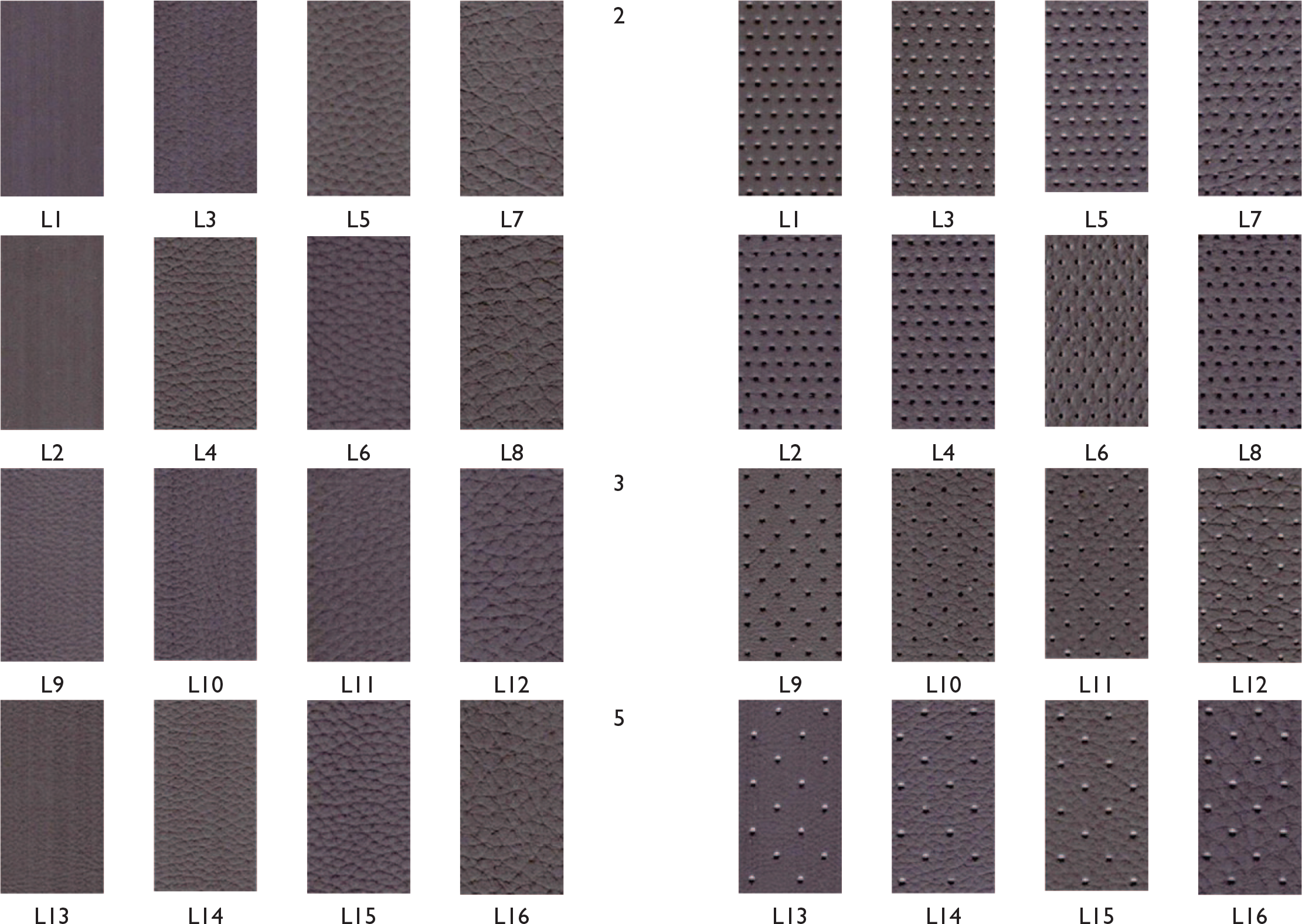
To derive punching levels and design factors of leathers for car seat covers, in-depth interviews with three experts (each with more than 10 years of experience in leather manufacturing and related companies) were conducted. Punching was diamond-shaped, its sides were 2, 3, and 5 mm (DKP-1500, Dae-kwang Engineering Co, Korea), and the punching characteristics are listed in Table 1. Embossing sizes were none, 1, 2, and 3 mm (Rotopia, Yurim Machinery Mfg Co., Korea). These leather factors are widely used in the market. The thickness and softness of the leathers were limited to those having suitable physical properties for car seat covers. The area used for the experiment was limited to the butt area, and the leathers were grain leathers. The characteristics of leathers are listed in Tables 2 and 3.
Characteristics of punching.

Characteristics of leathers.

Photographs of untreated and punched leathers.

Physical and mechanical properties tests
Thickness
Leather thickness was measured in accordance with ISO 2589. 18 The measured leather was placed on a thickness gauge with the silver surface facing upward, and the scale was read after 5 ± 1 s with a slow load application. Three samples (10 cm × 10 cm) of 16 untreated and 16 punched leathers were measured, and averages were obtained.
Weight
The weights of five samples (10 cm × 10 cm) were measured to obtain an average value under the standard conditions of 23.0°C and relative humidity (RH) 50.0%. 19 Five samples were measured and the average value was obtained.
Gloss
Leather gloss was measured at 60° using a gloss meter (Elcometer, E406L, UK) according to ASTM D523. 20
Apparent density
The leather apparent density was measured according to ISO 2420. 21 The leather volume was calculated from the thickness and diameter of a circular test piece made of a round cylinder cut at right angles, and the weight of the leather was divided by the volume. Three samples (diameter, 10 cm) were measured, and the average value was obtained.
Softness
The leather softness was measured according to ISO 17235, 22 by using a digital leather softness tester (ST 300, MSA Engineering Systems Ltd., UK). A load pin was lowered onto a firmly fixed leather surface, and the leather distension by the load pin (i.e. softness) was measured and reported in millimeters. Three samples (20 cm × 20 cm) were measured, and the average value was obtained.
Coefficient of friction
The leather surface roughness was measured by moving the presser with the pressure applied to the leather surface using a friction tester (H5KT-0076, Hounsfield Test Equipment Ltd., England). Three samples (20 cm × 20 cm) were measured, and the average value was obtained.
Warm-cool feeling
KES-F7 (Thermo Labo II, Kato Tech Co., Ltd, Japan), a transient thermal conductivity measurement device, was used to measure the maximum transient thermal flow (Q-max) of leather for a very short time. The Q-max value indicates the warmth and coolness that the skin feels instantly as soon as the leather first touches it. Three samples (10 cm × 10 cm) were measured, and the average value was obtained.
Air permeability
The air permeability test was conducted according to ASTM D 737, using a FX 3300 III air permeability tester (TEXTEST AG, Switzerland). 23 The measurements were performed at a constant pressure drop of 125 Pa and the specimen area was 5.07 cm2.
Mechanical properties
Mechanical properties, using a KES-FB system, have been measured mainly for clothing materials. In the absence of any suitable method to measure the mechanical properties of non-clothing leathers, a KES-FB system (Kawabata Evaluation System, Kato Tech. Co. Ltd., Japan) was used. The backbone of the measured leather was cut in the warp direction and tested. Tensile, bending, shear, and compressive properties were evaluated under standard conditions (RH 65%, 20°C, 20 cm × 20 cm). Surface properties could not be measured for leather punching.
Analysis
Data could not be assumed to have the normal distribution; thus, non-parametric tests, such as the Mann–Whitney U test, the Kruskal–Wallis test, and the Tukey HSD (honestly significant difference) test, were performed using SPSS 18.0.
Results
Physical properties
The Mann–Whitney U test was conducted to verify the difference in the physical properties of punching. The associated results are shown in Table 4. Significant differences were found in the weight, apparent density, softness, Q-max, and air permeability of the leather by punching. Regarding the properties showing significant differences by punching, the Kruskal–Wallis and the Tukey HSD tests were performed to verify the difference in these properties according to the punching interval (Figure 1).
Differences between physical properties of untreated leathers and punched leathers.

SD: standard deviation.
p < .01, ***p < .001.

Physical properties of leathers, for different punching intervals: (a) Weight, (b) apparent density, (c) softness, (d) Q-max, and (e) air permeability.
Weight reduction owing to punching was observed, and a significant change in weight was observed for 3 mm punching. This shows that weight change is associated with the punching interval, that is, the number of punches per unit area (Table 1).
The results for the leather apparent density were similar to those for the leather weight. The apparent densities of the punched leathers were lower than for the untreated leathers. The apparent density is the ratio of the weight to the volume (m3) of air-containing leather. As the volume that included air increased following punching, the apparent density changed. A significant change in the apparent density was observed for 3 mm punching, which affected the weights of the leathers.
The softness of the punched leathers was higher than that of the untreated leathers. The leathers punched at the 5 mm interval showed softness similar to that of the untreated leathers. On the contrary, the softness was higher for the leathers punched at 3 and 2 mm intervals. The changes in the leather construction due to the holes affect the physical properties of the leather. 24 These results indicate that fibers such as collagen and elastin can be damaged by punching, and the coating on the leather surface is partially removed by punching, thereby increasing the degrees of freedom in fibers and coatings fixed to each other.
There was no statistically significant decrease in the friction coefficients of the leathers associated with punching. Just as punching is not felt at the waist and back, it seems that punching of leather do not have much effect on the leather surface properties when using wide contactors.
The Q-max of the punched leather decreased, that is, the warmth has increased. This was concluded because the untreated leather had a cool feeling owing to surface coating, called “finishing” including oiling, brushing, buffing, coating, polishing, embossing, glazing, and tumbling. 25 In addition, the formation of the air layer owing to punching seems to have increased the warm feeling by providing an additional thermal insulation. 26 A significant Q-max change was observed for the leathers punched at 3 mm, which affected the apparent density of the punched leathers.
The air permeability for the punched leathers was higher than that for the untreated leathers. Punching had a significant effect on air permeability. Air did not easily permeate the untreated leathers, but punching increased the air permeability of the leathers. Air permeability also depends on the structural properties of leather, such as porosity. 27 There was a difference in the air permeability of the leathers associated with the punching interval. The air permeability was the highest for 2 mm punching and the lowest for 5 mm punching. The natural leather has fiber bundles loosely and randomly interwoven with each other throughout the leather matrix and it is known that the natural leathers have nano-, micro-, and macropores in the range of 0.3 to 150 nm. 28 This structure, unlike PU leather, has intrinsic pore connectivity and excellent vapor permeability. However, in the case of leather for car seats, the effect of this structure may be insufficient due to the relatively high leather thickness. Therefore, these considerations suggest that punching the leather can improve the passenger comfort, and the number of punches per unit area of leather affects its air permeability.
Mechanical properties
The Mann–Whitney U test was conducted to verify the difference in mechanical properties of punching (Table 5). As a result, all mechanical properties except WC showed significant differences due to punching, which indicated that punching has a significant effect on the mechanical properties. The Kruskal–Wallis and the Tukey HSD tests were performed to verify the difference in these properties according to the punching interval (Table 6).
Differences between the mechanical properties of the untreated and punched leathers.

EM: extension; WT: tensile energy; RT: tensile resilience; B: bending rigidity; 2HB: hysteresis of bending moment; G: shear stiffness; 2HG: hysteresis of shear force; WC: energy in compressing fabric; RC: compression resilience; UL: Untreated leather, PL: Punched leather; SD: standard deviation.
p < .05, **p < .01, ***p < .001.
Mechanical properties of leathers, for different punching intervals.

EM: extension; WT: tensile energy; RT: tensile resilience; B: bending rigidity; 2HB: hysteresis of bending moment; G: shear stiffness; 2HG: hysteresis of shear force; WC: energy in compressing fabric; RC: compression resilience.
Tukey HSD test results a > b > c.
p < .05, ***p < .001.
The extension (EM) for the punched leathers was higher than that for the untreated leathers. EM differed significantly according to the punching interval. The leathers that were punched at 5 mm had a similar extension as the untreated leathers, and the leathers that were punched at 2 mm were the most easy to elongate. The tensile energy (WT) of the punched leathers showed a similar tendency to that of EM. The tensile resilience (RT) of the punched leathers decreased. RT reflects dimensional stability; thus, these results show that dimensional stability decreased. RT differed significantly according to the punching interval. The RT values for the leathers punched at 5 mm were similar to those for the untreated leathers, while they were lower for the leathers punched at 2 mm. These suggest that punching increased the leathers’ elongation, but decreased the recovery by the tensile force. As mentioned earlier, these results likely reflect structural changes, such as the changes in fibers and leather surface induced by punching.
The bending rigidity (B) of the punched leathers was lower than that of the untreated leathers. Punching improved the curved surface forming ability. However, there was no statistically significant difference between the bending properties associated with the different punching intervals. The results for the bending properties were different from those for softness, which was attributed to the differences between the used experimental methods. Softness without directionality was evaluated by swelling, 22 whereas the bending property was measured in the warp or the weft direction. 29 In other words, when measuring without directionality, the force was applied in all directions to increase flexibility.
The shear stiffness (G) and hysteresis of the shear force at 0.5° (2 HG) of the leathers differed significantly depending on punching. Therefore, the punched leathers were flexible and more easily recovered from shearing. Unlike the results for the bending properties, the shear properties differed according to the punching interval. The leathers punched at 2 mm were more flexible than the untreated leathers. The leathers that were punched at 2 mm exhibited better recovery after shear deformation. The difference between the results for the bending and shear properties is considered to be owing to the punching interval and the shear angle (φ). As shown previously, leather punching affected the physical properties; punching at 5 mm had the least effect on the leathers’ physical properties. In the shear property measurements, the force was applied in the oblique direction, that is, in the direction of the diamond side, owing to the shear angle (φ) and the constant load; therefore, the punching interval was small, making deformation easy. On the contrary, in the bending property measurements, the applied force acted in the warp or the weft direction, that is, along the height or the width direction of the diamond; consequently, the punching interval was larger, making deformation difficult.
Only compression resilience (RC) was strongly associated with punching, and the punched leathers exhibited better compression elasticity than the untreated leathers. This indicates that the porosity owing to punching imparted elasticity.
These results indicate that punching affects the mechanical properties, which causes a change in the tactile perception. It can be seen that punching affects the texture of leather and directly or indirectly affects sensitivity and customer preference. To produce differentiated leather products, research on subjective appearance and sensitivity as well as performance change due to punching is required.
Conclusion
The effects of punching on the physical and mechanical properties of leather were evaluated.
After punching, the leathers became lighter, the apparent density reduced, and the softness, warmth, and air permeability increased. In addition, punched leathers stretched well and had good compression recovery; however, dimensional stability degraded owing to the tensile force. Leathers punched at 5 mm intervals had similar physical and mechanical properties to untreated leathers. Statistically significant changes in weight, apparent density, and flexibility were observed for leathers punched at 3 mm intervals. For leathers punched at 2 mm intervals, significant changes in air permeability, tensile, and shear properties were observed. Therefore, punching at 5 mm is preferred for physical and mechanical properties similar to those of the untreated leather, and punching at 3 mm is recommended for increasing the leather softness. On the contrary, punching at 2 mm increases air permeability but decreases the leather dimensional stability.
The accuracy of this study may be low because it used a KES-FB system that is typically used for measuring the mechanical properties of textiles for clothing and it did not control leather variables other than punching. Additional experimentations involving the control of leather variables are required to accurately measure the mechanical properties of materials in future non-clothing applications. Thus, further research on punching in realistic scenarios of car seat usage under long-term loading and the evaluation of physical properties for durability are likely to effectively present a product capable of enhancing consumer satisfaction.
Footnotes
Declaration of conflicting interests
The author(s) declared no potential conflicts of interest with respect to the research, authorship, and/or publication of this article.
Funding
The author(s) received no financial support for the research, authorship, and/or publication of this article.
