




Abstract
The pore structure is one of the major factors affecting the mechanical properties of waste fiber recycled concrete. In this article, the pore structure and strength performance of waste fiber recycled concrete are experimentally studied. The design variables are water–cement ratio, recycled aggregate replacement rate, waste fiber length, and volume fraction of waste fibers. The pore structure characteristic parameters of waste fiber recycled concrete are investigated using mercury intrusion porosimetry test and fractal theory. The complex distribution of pore structure in space is quantitatively described by fractal dimension, and the pore structure is comprehensively evaluated. The results show that the water–cement ratio has the largest influence on the pore structure, and the fiber length has the least influence. The optimum volume fraction of waste fibers is 0.12%. There is an obvious linear relationship between the pore volume fractal dimension and strength. With the increase in the fractal dimensions, the compressive and splitting tensile strengths increase. Macroscopic mechanical properties of waste fiber recycled concrete can be predicted by the pore structure.
Introduction
Concrete is one of the most widely used building materials in the world. However, the concrete production consumes a lot of natural resources.1,2 The application of recycled concrete is one of the most effective measures to develop green concrete and to realize the coordinated development of architecture, resources, and environment. 3 Recycled concrete usually refers to recycled coarse aggregate concrete, and the recycled coarse aggregates determine the properties of recycled concrete. Xiao et al. 4 proposed that the source of the original concrete had a greater impact on the recycled concrete than the age, and the strength performance of the recycled concrete came from different sources will be lower than that of the single source. Therefore, the separate recovery of different-strength abandoned concrete can effectively improve the strength of recycled coarse aggregates and expand the application scope of recycled concrete. On this foundation, many researchers have carried out experimental research on the performance of recycled concrete. Scholars suggested that the properties of recycled aggregates were inferior to those of natural coarse aggregates, so the mechanical properties of recycled concrete were lower than those of ordinary concrete.5–7
The mechanical properties of recycled concrete can be effectively improved by adding various kinds of fibers. Fibers can improve the compactness of recycled concrete and play a connecting role when cracks are generated. 8 Carneiro et al. 9 pointed out that the addition of steel fibers and recycled aggregates increased the mechanical strength and modified the fracture process of the reference concrete. According to Prasad and Kumar, 10 recycled aggregate concrete had increased the split tensile strength by 13.03% and 10.57% in M20 and M40 grade concrete, with the addition of glass fibers. Polypropylene fibers also can improve mechanical properties of the concrete.11–13 Therefore, this article proposes adding waste carpet polypropylene fibers to recycled concrete to improve its mechanical properties.14,15 As a type of green concrete which can be reused for waste fibers and construction waste, waste fiber recycled concrete not only promotes the application of concrete waste but also is crucial to protect the ecological environment.
The pore structure can be utilized to predict the performance of recycled concrete in various ways, including the mechanical properties. 16 The pore structure of concrete is mainly described by the pore characteristic parameters, which reflect the degree of compaction and connectivity of the pores. The pore characteristic parameters are the major indexes to understand and analyze the pore structure of new materials. Zhang 17 indicated that there was an inverse correlation between the pore volume and the levels of stress to which the concrete can be afforded. However, the pore structure of concrete is complicated and disordered, and the traditional parameters cannot describe its complexity.
With the development of the pore research and fractal theory, the researchers found that the pore structure of some porous materials have an obvious fractal characteristics. Thus, fractal dimension can be used to describe the microporous structure of these materials and related physical properties. 18 Fractal theory is an eminent branch of nonlinear science proposed by Mandelbrot, 19 which describes the irregular phenomena and behaviors in nature. The fractal theory quantitatively represents the complexity of material as the fractal dimension. The concrete exhibits a series of fractal characteristics both in the nature of material and in the course of its work.20–23
The main contribution of this article is to investigate the pore structure and its effect on macro-mechanical properties for the waste fiber recycled concrete. The procedure is detailed in the following steps: (1) waste fiber recycled concrete with different design variables was prepared. (2) Then, mercury intrusion porosimetry (MIP) and strength tests were adopted to analyze the pore structure, and compressive and splitting tensile strengths. (3) Consequently, the fractal theory was used to describe the pore complex distribution quantitatively and developed the relationship between pore volume fractal dimension and the macro-strength. The studies provide a theoretical basis for the research of waste fiber recycled concrete.
Materials and methods
Materials
The properties of the cement and fine aggregates are listed in Table 1. There were two kinds of coarse aggregates: natural gravel and recycled aggregate. The recycled coarse aggregates were sourced from crushing abandoned concrete beams, whose characteristic compressive strengths after 28 days were 40 MPa. The abandoned concrete beams aging in 2 years came from the laboratory of Shenyang Jianzhu University. The particle sizes of the recycled and natural coarse aggregates were 5–25 mm. The properties are given in Table 2, and the shapes of recycled coarse aggregates are shown in Figure 1. Waste fibers were collected from the waste carpets (made in China) through artificial splitting, finally cutting into a certain length. The density of waste fibers was tested by liquid displacement technique, according to JC/T 287-2010 (Chinese standard). Other mechanical properties of waste fibers were tested in accordance with GB/T 14337 (Chinese standard). Figure 2 shows the shape of the waste fibers, and the physical properties are given in Table 3.
Material properties.

Basic material indicators of coarse aggregates.


Recycled coarse aggregates.
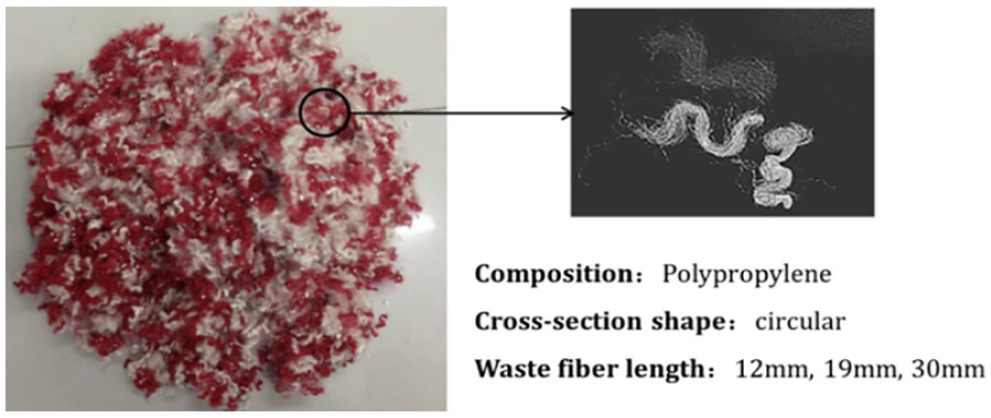
Waste fibers.
Physical properties of waste fibers.

Specimens
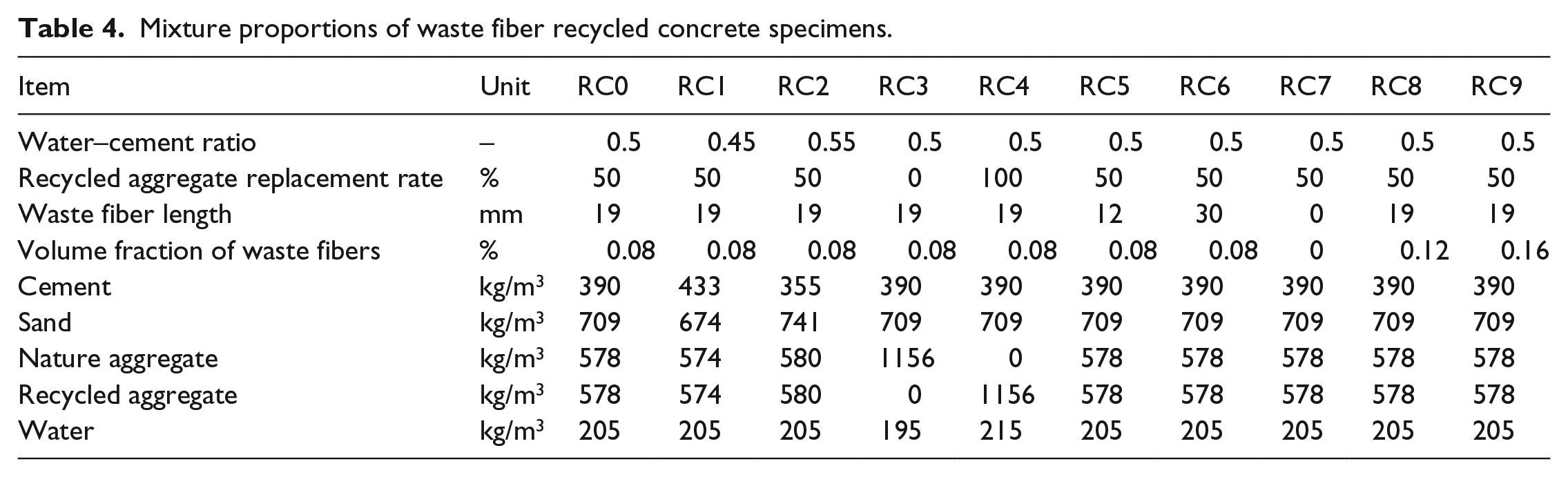
There were four variables: water–cement ratio (RC0, RC1, RC2), replacement rate of recycled aggregates (RC3, RC0, RC4), waste fiber length (RC5, RC0, RC6), and volume fraction (RC7, RC0, RC8, RC9). Concrete mixtures of waste fiber recycled concrete specimens are given in Table 4. Due to the larger water absorption rate of the recycled coarse aggregates (see Table 2), the water in this test was divided into two parts: free water and additional water. When the replacement rates of recycled aggregates were 50% and 100%, additional water consumptions were 10 and 20 kg/m3, respectively. 14
Mixture proportions of waste fiber recycled concrete specimens.
Methods
In preparation of waste fiber recycled concrete, first, coarse aggregates and waste fibers were mixed for 2 min in a forced concrete mixer; then, the cement and water were added and stirred at low speed for 2–3 min. This preparation method made the waste fibers uniformly dispersible. All specimens were cast in steel molds and compacted using a vibrating table. After casting, the specimens were covered with a plastic sheet, cured in air for a period of 24 h, and then the steel molds removed. All the specimens were cured in the curing room, with relative humidity no less than 95% and temperature 20°C ± 2°C. Three specimens of each variation were made, and the mixture used in each set should be sampled from the same plate.
The MIP test in accordance with ISO 15901-1 and was performed by the 9500-type automatic mercury pressure instrument, which was produced by Micromeritics Instrument Corp. Three samples for the MIP test with the length were approximately 5 mm. The size of the three specimens should be kept as uniform as possible, so as to reduce the deviation. This test adopts the low-pressure pore measuring method, maximum pressure value of 228 MPa, and the measured pore size ranged from 5 to 360,000 nm. The instrument is illustrated in Figure 3(a).

Test instruments: (a) mercury pressure instrument, (b) compressive strength, and (c) splitting tensile strength.
The compressive and splitting tensile strengths were performed with a “HYE-2000 Electric-Liquid Pressure Experimental” and in accordance with GB50081-2002 (Chinese standard). Three 150 mm ×150 mm ×150 mm cubes of each variation were used for the determining of the strength, respectively at 28 days. After curing, the water on the surface of the specimen was wiped dry and the strength test was performed. In compressive strength test, the specimen was placed on the bearing plate and the center of the specimen should be aligned with the center of the platen, as showed in Figure 3(b). With continuous and uniform loading mode, the loading speed should be controlled at 0.5 MPa per second. In the splitting tensile strength test, the split steel pad and three plate cushions needed to install on the testing machine first and the strip should be vertical with the top surface of the specimen (see Figure 3(c)). With continuous and uniform loading mode, the speed of loading should be controlled at 0.05 MPa per second.
Results and discussion
Pore structure characteristic parameters
The pore structure of waste fiber recycled concrete can be affected by water–cement ratio, recycled aggregate replacement ratio, and the addition of waste fibers. According to the results of MIP tests, the mercury increment of the specimens is presented in Figure 4. The error value of three specimens of the MIP test is controlled within 25% and the reliability is 95%. The influence of water–cement ratio on pore distribution is large, and fiber length has little effect. This is due to the existence of sufficient water in the recycled concrete with large water–cement ratio. The hydration degree of cement particles with large water–cement ratio is high.

The mercury increment of the specimens: (a) water–cement ratio, (b) recycled aggregate replacement rate, (c) waste fiber length, and (d) volume fraction of waste fibers.
The pore structure characteristic parameters of waste fiber recycled concrete can be calculated by MIP test (see Figure 5). The average values of three specimens are used as the pore structure characteristic parameters, and the standard deviations of three samples are listed in Figure 5, respectively. From Figures 4 and 5(a) and (b), when the water–cement ratio, recycled aggregate replacement rate, fiber length, and fiber content are different, the pore distribution is significantly different. With the decrease in water–cement ratio and recycled aggregate content, and the increase in the fiber length and the volume parameter, the total incoming mercury decreased, while the total surface area of pores increased. Compared with RC1, RC2 increased by 52.8% on the pore surface area, and increased by 2.99 times in the specific surface area. Compared with RC3, RC4 increased by 50.5% on the pore surface area, and increased by 2.46 times in the specific surface area. In the pore surface area, RC6 compared to RC5 increased by 8.5%; in the specific surface area, the RC6 is 1.69 times larger than RC5. The increase in the pore surface area of RC8 compared with that of RC9 was 22.8%, and the increase in the surface area reached 1.91 times. It can be seen that the water–cement ratio has a greater influence on the pore structure, and the fiber length has little effect. The optimum amount is 0.12%.

Characteristic parameters of pore structure: (a) total pore area, (b) specific surface area, (c) average pore diameter, and (d) total pore volume.
The average pore size is the average value of all pores, which has a great significance for the study of homogeneous materials. As can be seen in Figure 5(c), the average pore diameter of waste fiber recycled concrete is not regular, so it is not significant for the study of heterogeneous materials such as waste fiber recycled concrete. Figure 5(d) shows the total volume of pores in waste fiber recycled concrete. With the increase in the water–cement and replacement rate of recycle coarse aggregates, the total pore volume increases. The total pore volume is also affected by the addition of fibers. When the fiber volume parameter is 0.12%, the total pore volume is the smallest. The addition of the fibers has two sides. On one hand, the pore structure can be refined. On the other hand, a large proportion of long fibers can form a hollow drum in the concrete matrix. Therefore, the length and amount of fibers are within a reasonable range, which is beneficial to the pore structure.
The pore structure model adopts the Menger fractal model (in Figure 6) in fractal theory. The construction method is as follows: 19 (1) take a cube with a side length of R as the initial element, divide the initial element into m parts per side, and the small cube side length formed is the fixed value R/m. (2) Eliminate n in m3 small cubes, in which the rejected parts are taken as the porous structure, while the uncovered parts are the solid phase of cement-based materials. (3) Repeat the second step in accordance with the same rule, the minimum cube length is R/mk and the number of remaining cube is (m3 – n)k after the k iterations.

Menger fractal model.
The total pore volume is

The porosity is

By formula (1), (2) can be deduced

Take logarithm on both sides of the formula

According to the date of MIP test and equation (4), the pore volume fractal dimensions are obtained. They are listed in Table 5.
Pore volume fractal dimension.

From the perspective of topology and fractal theory, fractal dimension D is a parameter that represents the complexity of material pore distribution in space. The fractal dimension of the regular geometric is 2. However, the pore volume fractal dimension of waste fiber recycled concrete is between 2 and 3. This result indicates that the distribution of the pores in waste fiber recycled concrete is irregular and complexly disordered, and the fractal theory can be used to describe the pore complex distribution quantitatively.
From fractal theory and the Menger fractal model, the larger the fractal dimension of the pore, the more complicated the spatial geometry of the pore is, namely, the more complicated the spatial distribution of the material, the stronger the space filling capacity is. According to the relationship between fractal dimension and characteristic parameters of the pore volume (see Figure 5 and Table 5), with the increase in the pore volume fractal dimension, mean pore and the average pore size decreased, and pore specific surface area increased. The pore structure was refined and optimized for certain. The pore volume fractal dimension can be regarded as a comprehensive parameter of the pore structure, which makes up for the shortcomings of the MIP test that it cannot directly determine the pore shape and space distribution.
The relationship between compressive strength and pore structure
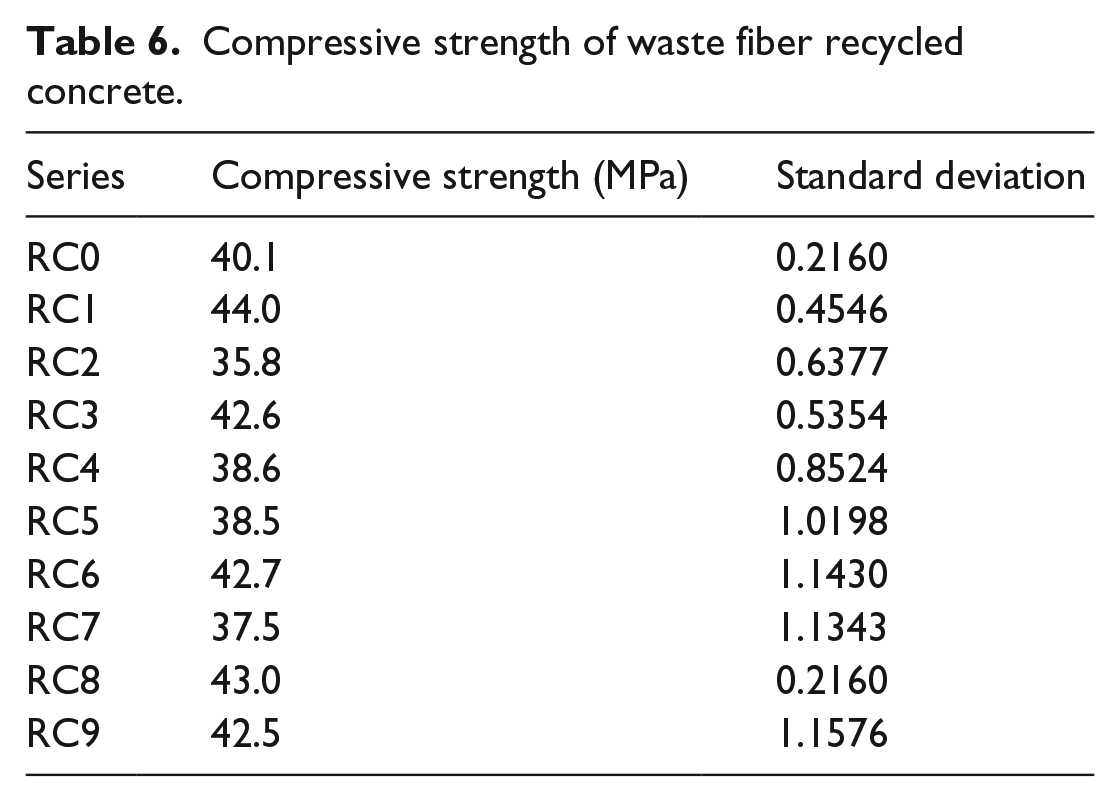
The aperture distribution is a factor that affects the compressive strength of concrete. 22 The average values of three specimens are used as compressive strength values. Table 6 lists the compressive strength of waste fiber recycled concrete and the standard deviations of three specimens. When the total volume and total porosity are the same, the strength of cement hydration products may vary greatly, and the main reason for this phenomenon is that the hydration products have different aperture distribution. The pore volume fractal dimension of waste fiber recycled concrete is linearly fitted with the compressive strength. The relationship between compressive and pore volume fractal dimension is presented in Figure 7.
Compressive strength of waste fiber recycled concrete.
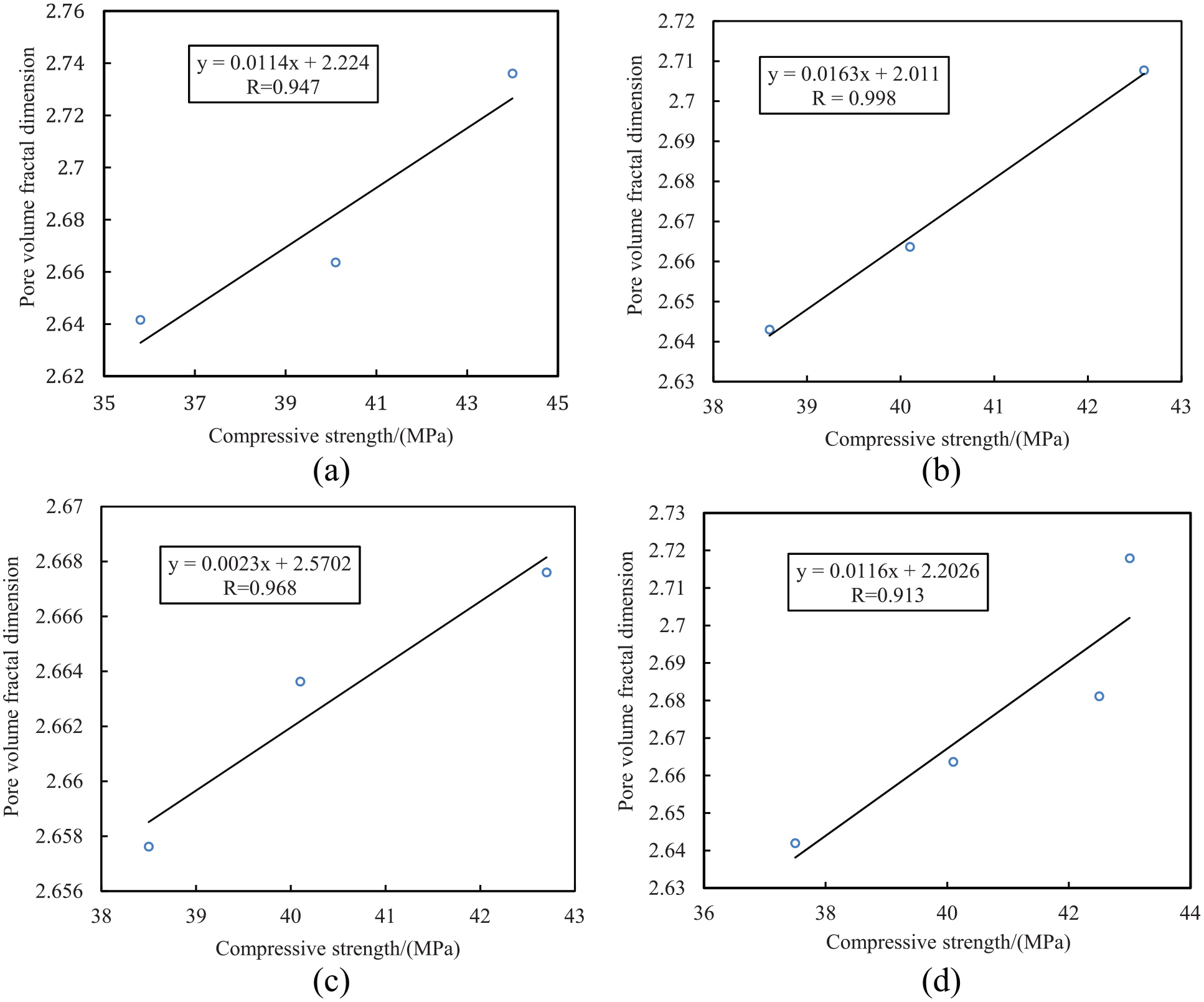
Relationship between compressive strength and pore fractal dimension: (a) water–cement ratio, (b) recycled aggregate replacement rate, (c) waste fiber length, and (d) volume fraction of waste fiber.
From Figure 7, it can be observed that the compressive strength of recycled fiber concrete is linearly related to the pore volume fractal dimension under different design variables, and the correlation coefficient R is more than 0.9. The compressive strength increases with the increases in the pore volume fractal dimension. The pore structure can significantly affect its compressive strength, so the fractal dimension can be used to evaluate the compressive strength of waste fiber recycled concrete.
As can be seen from Figure 7(a), the compressive strength decreases as the water–cement ratio increases. Mainly due to the cement hydration of concrete, the original volume of water turns into the pores. The large water–cement ratio leads to more water requirement for cement hydration, so the pore volume increases, the compactness of concrete decreases, the compressive strength decreases, and the pore volume fractal dimension decreases.
In Figure 7(b), the compressive strength decreases with the increase in the recycled aggregate content. In the process of preparing and producing recycled aggregates, cracks and initial damage lead to the porosity of the recycled aggregates to be higher than that of the ordinary aggregates. Therefore, when the waste fibers are regenerated, the stress concentration tends to occur. With the increase in the recycled aggregate content, the number of harmful pores increased and the pore volume fractal dimension becomes smaller.
There is a positive correlation between the pore volume fractal dimension and the compressive strength in the case of incorporation of waste fibers (see Figure 7(c) and (d)). Long fibers can make the structure compact and improve the compressive strength by increasing the complexity of pore structure. The compressive strength of waste fiber recycled concrete increased with the increase in fiber content, and the maximum increase was 14.7%. The incorporation of waste fibers can reduce the crack of cement matrix and improve the compressive strength of recycled concrete. When the fiber content is 0.16%, the compressive strength and pore volume fractal dimension decreased, indicating that the waste fibers are not the more the better, and beyond a certain range, the waste fibers are easy to hold together form a weak zone, resulting in a decrease in the compressive strength and pore volume fractal dimension.
Relationship between splitting tensile strength and pore structure
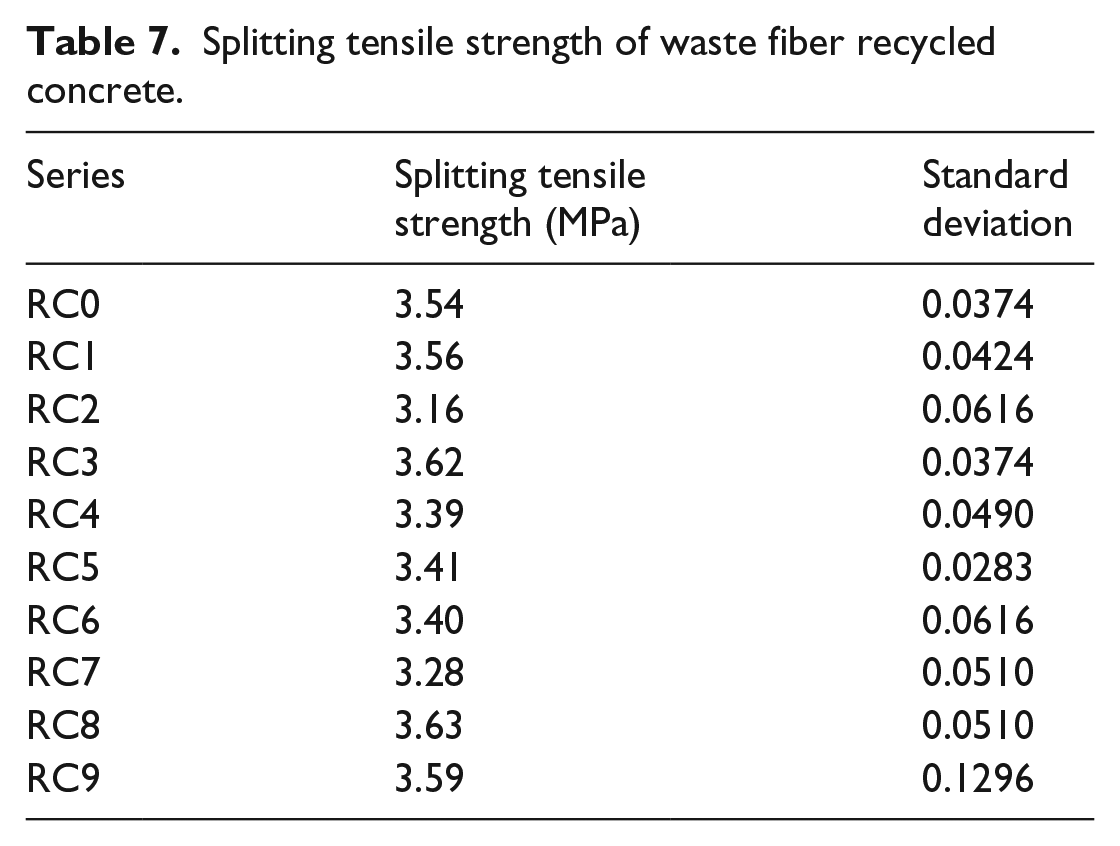
The incorporation of an appropriate amount of waste fibers in the recycled concrete can effectively improve the splitting tensile strength (see Table 7). The average values of three specimens are used as splitting strength values, and the standard deviations of three specimens are listed in Table 7. The splitting tensile strength decreases with the increase in the water–cement ratio. With the increase in the amount of recycled aggregates, the splitting tensile strength decreases. This is consistent with the recycled concrete. 2 With the increase in the length of the waste fibers, the splitting tensile strength of the sample increases obviously, and when the length of the waste fibers continues to increase beyond the certain range, the splitting tensile strength of the sample will slow down or even decline. With the increase in the amount of waste fibers, the splitting tensile strength increases, and when the amount of waste fibers reaches 0.16%, the splitting tensile strength of specimens decreases.
Splitting tensile strength of waste fiber recycled concrete.
The relation between pore volume fractal dimension and splitting tensile strength of recycled fiber recycled concrete is shown in Figure 8. With the increase in the pore volume fractal dimension, the splitting tensile strength increases.

Relationship between the splitting tensile strength and pore fractal dimension.
The water–cement ratio increased from 0.45 to 0.5, the splitting tensile strength decreased by 0.02 MPa, and the splitting tensile strength decreased by 0.38 MPa when water–cement ratio increased to 0.55. The relationship between splitting tensile strength and water–cement ratio of waste fiber recycled concrete is consistent with that of ordinary concrete, that is, the splitting tensile strength decreases with the increase in the water–cement ratio. This is due to the total pore volume decreases as the water–cement ratio decreases, and the recycled concrete becomes compact when the splitting tensile strength increases.
Recycled aggregate replacement rate increases from 0% to 50%, and the splitting tensile strength decreases by 0.12 MPa. The amount of recycled aggregates increases to 100%, and the splitting tensile strength of specimens decreases by 0.17 MPa. There is an initial crack in the regenerated coarse aggregates, and some of the cemented mortar is hardened, resulting in stress concentration, leading to a decrease in splitting tensile strength. With the increase in the recycled aggregate replacement rate, the number of harmful pores increased, the pore volume fractal dimension became smaller.
When the length of waste fibers increased from 12 to 19 mm, the splitting tensile strength of specimens increased by 0.15 MPa, but when the length of fibers was increased to 30 mm, the splitting tensile strength decreased by 0.16 MPa. The correlation between fractal dimension and splitting tensile strength of different fiber length is poor. This is mainly due to the long fibers in the mixing process have obvious tangled phenomenon.
Conclusion
The concept of fractal dimension in fractal theory can be applied to the study of pore structure of concrete. The pore volume fractal dimension is a comprehensive parameter of spatial distribution. It makes up for the shortage of the MIP test that it cannot determine the pore space distribution and shape directly, and provides a powerful tool for more comprehensive evaluation of the pore structure by MIP test.
The pore structure of waste fiber recycled concrete has distinct fractal features, which conform to the Menger fractal model. The calculation results show that pore volume fractal dimension of waste fiber recycled concrete is between 2 and 3. The water–cement ratio has the largest influence on the pore structure, and the fiber length has the little effect. The optimum fiber volume fraction is 0.12%.
The addition of recycled coarse aggregate is unfavorable to the mechanical properties of recycled fiber concrete, but the waste fiber can improve its compressive and splitting tensile strengths. This shows that waste fiber and recycled coarse aggregate as a type of concrete material are feasible; this type of concrete material can be a good solution to environmental problems, and creates greater economic and social benefits.
There is a certain relationship between the pore volume fractal dimension and the macroscopic mechanical properties of waste fiber recycled concrete, which can partly reflect the strength. When the compressive and splitting tensile strengths are large, the specimen is denser and the harmful pores are few, and the fractal dimension of pore volume is large.
Footnotes
Declaration of conflicting interests
The author(s) declared no potential conflicts of interest with respect to the research, authorship, and/or publication of this article.
Funding
The author(s) disclosed receipt of the following financial support for the research, authorship, and/or publication of this article: This work was funded by the Nation Natural Science Foundation of China (grant no. 51678374). The financial support was gratefully acknowledged.